Argument
Beginning with pure optical and sound situations, the book develops recollection and dream, the crystal-image, sheets of past and peaks of present, powers of the false, irrational cuts, cinemas of body and brain, and autonomous audiovisual structures. It reverses the relation between movement and time: forks, gaps, coexisting pasts, and incompossible presents organize the image directly, while movement becomes subordinate to time. Modern cinema thereby becomes a practice in which thought encounters its own powerlessness and renews belief in the world.
Core question
When perception no longer extends naturally into effective action, how can cinema present time directly? How does time released from movement transform memory, truth, the body, thought, and audiovisual relations?
Argument structure
Chapters 1–2 address broken sensory-motor links and cinematic signs. Chapters 3–6 distinguish recollection, dreams, crystals, sheets of past, peaks of present, and powers of the false. Chapters 7–10 turn to thought, bodies, brains, and audiovisual relations. Opsigns and sonsigns provide conditions for the question of direct time; they are not themselves identical to the direct time-image.
Chapter arguments and film examples
Concept index
01 · Beyond the movement-image
The break begins when seeing no longer leads naturally to an action adequate to the situation. Bodies still move, but action no longer closes the world.
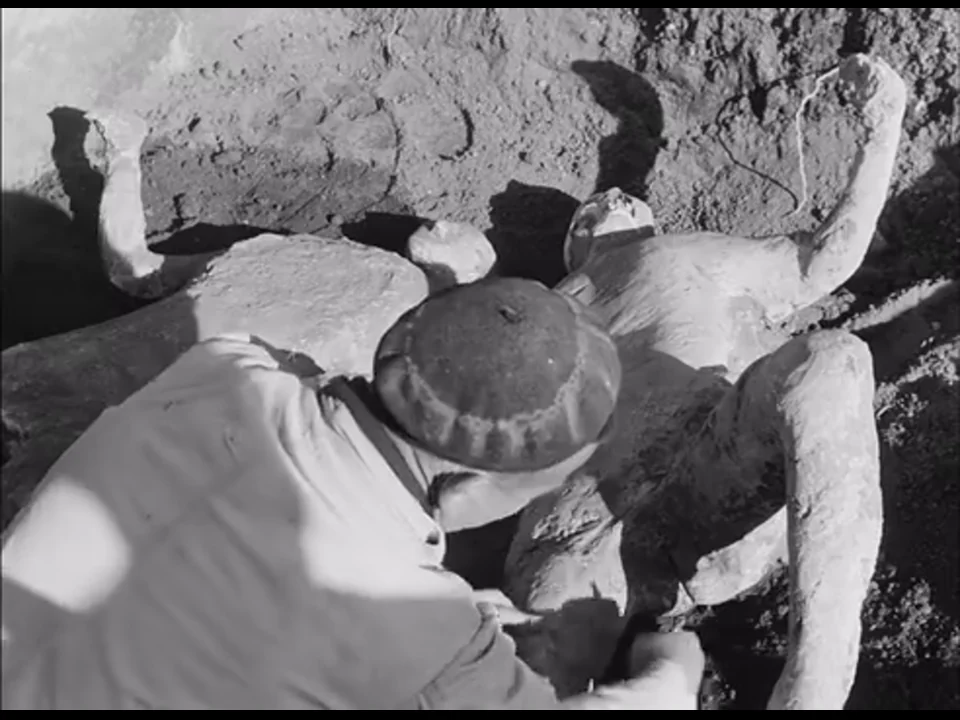
Journey to ItalyGermany Year ZeroLate SpringL’AvventuraPlaster returns an instant of death to the presentFinal wandering and the sight too much to bearChapter 1 analysis →Sensory-motor schema
The sensory-motor schema is not the definition of the movement-image but one specific body-world organization within it. A body receives movement from its milieu, selects perceptions according to its needs, retains what it cannot immediately discharge as affection, and answers the milieu through action. Its crisis does not mean that characters cease moving; the link from perception and affection to an action capable of changing the situation comes loose.
Pure optical / sound situation
A visual or auditory situation acquires a duration autonomous from cues for action or narration. Unable to translate what is seen or heard immediately into an effective response, the figure becomes a seer, listener, or witness. This is a threshold of the time-image, not direct time by itself.
The seer
The agent loses mastery over the situation and sees what habitual action concealed. The seer is a body struck by something too strong, too beautiful, terrible, or intolerable.
Everyday life, empty spaces and still life
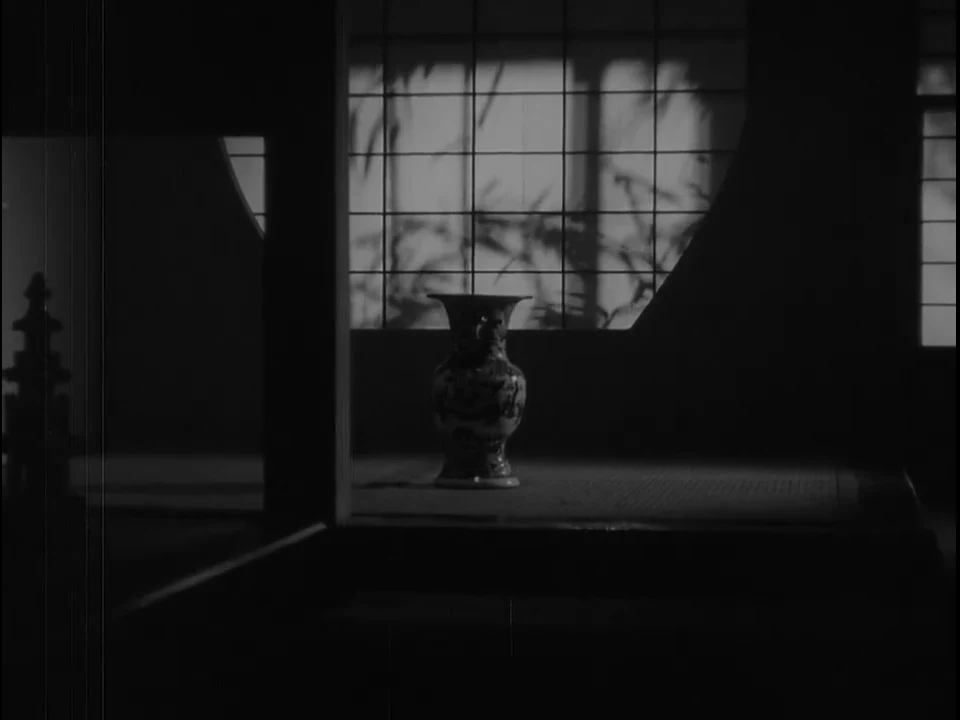
When everyday acts lose their dramatic climax, rooms, objects and intervals acquire duration. Empty spaces work through the absence of possible content; still life works through the presence and composition of objects. The vase between Noriko's changing expressions in Late Spring presents time as the form within which change occurs. Emptiness and still life are distinct constructions.
Any-space-whatever
A space stripped of stable coordinates, total continuity, and practical use: ruins, empty lots, fractured streets, waiting rooms, or virtual spaces built from light, colour, and fragments. Relations can be recomposed within it.
Clichés and the intolerable
Clichés let perception recognize familiar uses and meanings while screening out what exceeds them. Rossellini's figures confront factories, volcanic landscapes and remains that their habitual responses cannot absorb. The intolerable can inhabit everyday life: it interrupts ready-made recognition rather than merely producing a powerful stimulus.
Tactisigns: hands connecting space
Bresson separates hands, objects and bodily fragments from a total view, then connects them through contact and transfer. In Pickpocket, hands do more than display skill: the sequence of contacts between wallet, pocket, rail and body relates scattered positions. Touch organizes space.
Chapter source: Cinema 2, Minnesota 1989, chapter 1, pp. 1–24
Bicycle Thieves 1948
A defined search progressively loses its power to master the city, repair the family, or sustain the father’s identity.
1. Task established — The stolen bicycle compresses work, income, and family survival into a search-route.
The city can initially be read as clues, locations, and executable acts.
2. City disperses the route — Markets, crowds, rain, and chance encounters swallow each clue; father and son arrive after the event.
Rome no longer supports an action-chain adequate to the situation.
3. Seeing replaces solution — The boy sees his father’s failed theft and release into the crowd; they merge with the street flow.
Failed action becomes a sight to be endured, and the child becomes a seer.
Paisà 1946
Six encounters refuse to complete the event’s causal chain, leaving characters after the fact and before explanation.
1. Encounter already underway — Each episode enters an already formed wartime situation: landing, occupation, flight, ruins, or resistance.
Characters never master the situation from its beginning; they respond from limited linguistic and bodily positions.
2. Communication leaves a gap — Mistranslation, darkness, noise, and unequal identities prevent good intentions from reliably reaching the other.
Wartime reality repeatedly severs the line between perception and action.
3. Ending resists closure — Death or dispersal abruptly ends an episode, and the next does not explain its consequences.
The event retains an inexhaustible before and after, making spectators bear an unfinished relation.
Tokyo Story 1953
Ozu lets rooms, smokestacks, and corridors outlast family action, making the everyday bear time directly.
1. Transit fails to form a community — Trains and buses complete the parents’ movement, while the children’s rescheduling breaks the visit into brief hosting duties.
Effective movement does not generate adequate family action.
2. Empty views take the interval — After characters leave, the fixed low camera remains with rooms, corridors, smokestacks, and sea.
Place changes from plot passage into an optical sign with duration of its own.
3. Change remains in an unchanging form — After the mother’s death, house, sea, and ordinary gestures continue; grief is not exhausted by climax.
Time appears as irreversible minute change within the persistence of life.
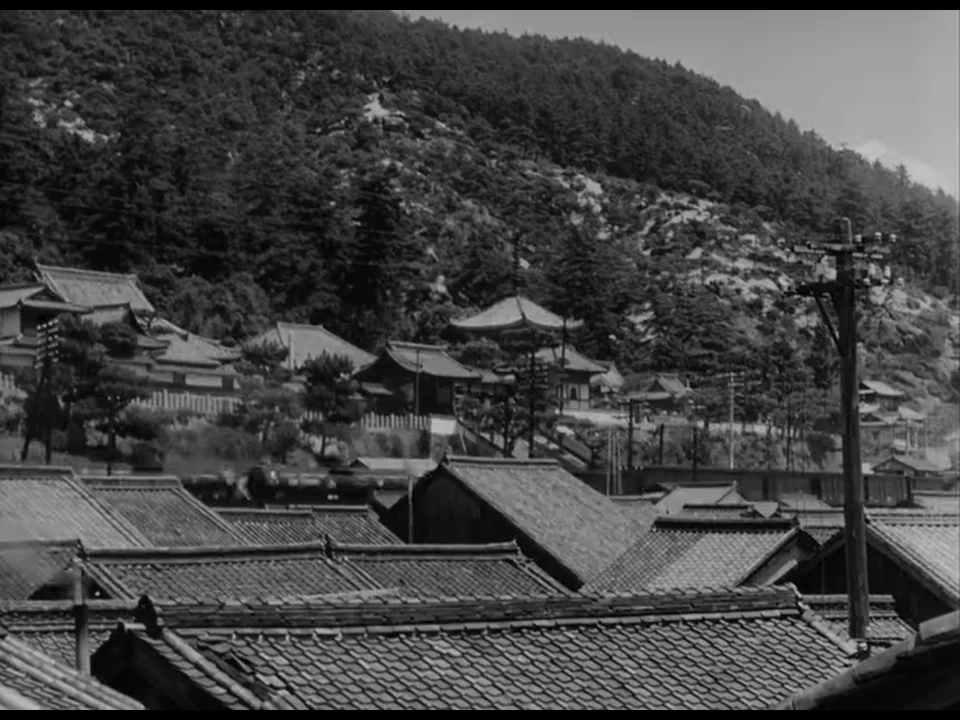 Watch sequence · 00:03:01 ↗
Transit completes movement while urban and everyday space first acquire duration of their own. 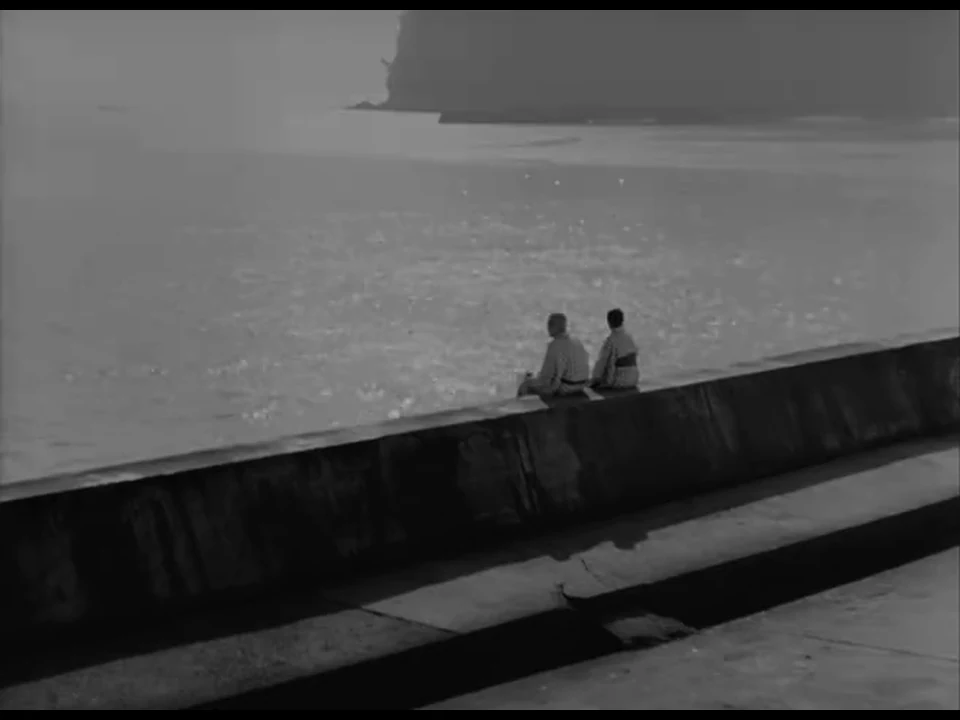 Watch sequence · 00:53:28 ↗
The visit pauses; sea, turned backs, and waiting place the couple inside pure duration. 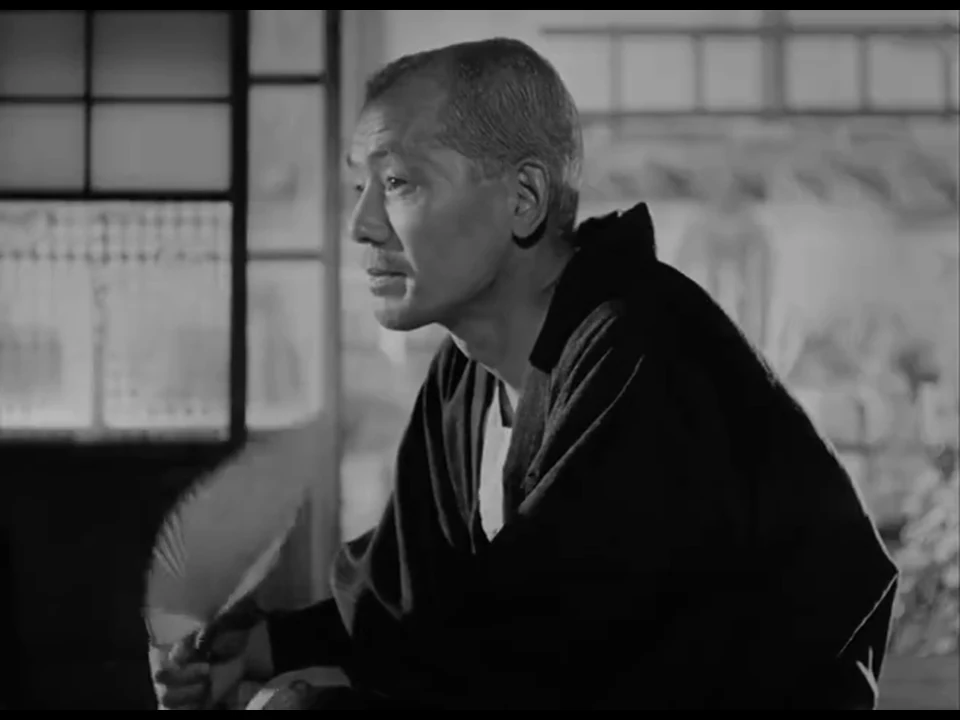 Watch sequence · 02:14:58 ↗
After the mother’s death, house and minor gesture continue; time is not closed by tragic plot. Céline and Julie Go Boating 1974
Wandering, sweets, and replay let spectators enter fiction and alter it, making fantasy an action that produces real relations.
1. Everyday routes loosen — Dropped objects, pursuit, disguise, and chance meetings turn Parisian action into playful wandering.
Goals cease to govern perception; bodies acquire improvisational connectivity.
2. Sweets open the repeated scene — After the sweet is ingested, the house story replays in fragments, and the women alternate as spectators and doubles.
The sweet becomes a bodily threshold between actual everyday life and virtual drama.
3. Spectators rewrite fiction — The women enter the house together, interrupt the scripted death, and rescue the child.
Fabulation no longer repeats the story; it produces a new real relation.
Pickpocket 1959
Hands, pockets, and crowds split whole bodies and continuous space, turning criminal action into a relation of touch, shame, and contact.
1. Hands act before persons — Close-ups at the racecourse and station isolate fingers, wallets, pockets, and routes of transfer, often cutting out faces and whole bodies.
Action no longer belongs to a whole agent; it is composed from tactile fragments.
2. Space is recomposed by contact — A trio relays stolen objects through stairs, carriages, and crowded passages while editing withholds an overview joining their bodies.
Space loses stable coordinates, retaining only the potential connection of one hand reaching another.
3. Touch changes the nature of action — Prison bars separate Michel and Jeanne as their hands and faces finally approach through the barrier.
The tactile circuit of skilled theft becomes contact without possession, and agency yields to an affective relation.
Still Life 2006 · Later comparison
The search continues, but the Three Gorges demolition landscape changes faster than action, turning the city from route into an unmasterable visual stratum.
1. An address lands on a vanished place — Han Sanming searches for his former wife at an old address whose neighbourhood is already submerged or under demolition.
The address no longer connects action to goal; urban coordinates fail from within.
2. Labour only passes through ruins — Demolition crews, boats, temporary dormitories, and migrating crowds continually alter scale and passage around the characters.
Space no longer contains a stable action-chain; it becomes an any-space-whatever in which relations can be recomposed at any moment.
3. The anomalous remains unexplained — A UFO passes, a building launches, and a tightrope walker crosses between blocks, each appearing as calmly as the documentary environment.
Reality is not unified by a stylistic boundary; seeing must bear the space's own rupture and recomposition.
Goodbye, Dragon Inn 2003 · Later comparison
Screen, leaks, footsteps, and empty seats outlast the act of viewing, making the closing cinema both actual ruin and virtual film memory.
1. Screen and audience do not close together — Dragon Inn sustains dense action on the large screen while spectators remain sparse, move slowly, and miss one another in the auditorium.
Screen action cannot organize the actual cinema; two temporal regimes coexist in one space.
2. Ambient sound takes the cinema — Leaks, footsteps, seats, toilet echoes, and extended silence cross corridors and empty halls, often without visible sources.
Sound no longer serves character action; the building acquires audible duration of its own.
3. Closure leaves a virtual cinema — After the audience leaves but before the staff finish closing the cinema, the camera preserves the empty screen and long corridors; the old actors' recognition also yields no shared future.
The actual cinema disappears while film memory continues to act as its virtual face.
Once Upon a Time in Anatolia 2011 · Later comparison
The search for a corpse repeatedly reaches the wrong place, releasing night, talk, wind, and fatigue from clue-function and turning investigators into viewers who endure steppe and death.
1. Headlights repeatedly illuminate nothing — The convoy stops at similar slopes and fountains as the suspect repeatedly says 'not here'; headlights isolate only fragments of grass, tree, and face.
The route accumulates no mastery; space changes from mapped coordinate to inexhaustible optical fragment.
2. Waiting releases irrelevant detail — Wind crosses the steppe and an apple rolls into a stream; car talk turns to illness, family, and death, while the mayor's daughter serving tea brings everyone to a pause.
Audio-visual details unable to advance the case acquire autonomous duration, briefly turning investigators into seers.
3. Finding the body does not complete truth — Exhumation, transport, and autopsy restore procedure, yet the doctor withholds a detail that could alter responsibility when recording cause of death.
Technical action completes while the event's ethical relation remains unexhausted; seeing retains more than closure.
Late Spring 1949
The vase and the post-wedding house do not explain Noriko's decision; they make a familial change appear within a form of time that does not move with the plot.
1. Expression still belongs to conversation — At the Kyoto inn, Noriko lies beside her father and looks toward him as he appears to fall asleep, still wearing a smile.
Marriage and separation can still be read as psychological responses generated by the conversation.
2. Still life interrupts response — The film cuts from Noriko's face to the vase in the room, holds, then returns to her now tearful face; the vase has taken no part in the dialogue.
A change has occurred, yet the fixed object refuses to serve as cause or symbolic explanation; the interval itself acquires duration.
3. The house preserves irreversible change — After the wedding, the father returns home alone and peels an apple; the long strip of peel hangs as he stops and lowers his head.
The everyday form continues after the family relation has irreversibly changed; time is not summarized by a climax but becomes visible in persistence.
Europe ’51 1952
The more Irene converts private grief into executable aid, the more factory, poverty, and institution reveal a relational scale beyond individual goodwill, turning her from agent into seer.
1. Aid takes over from mourning — After her son's death, Irene leaves the social world of her wealthy household, visits poor districts, gives money, seeks medicine, and takes a worker's shift.
Grief is first extended into a series of helpful acts that still have objects, aims, and results.
2. The factory overwhelms the scale of action — On a shop floor whose pounding fills the soundtrack, machines stamp repeatedly and rows of workers follow one rhythm; Irene walks through, stops, and looks, her body reduced in scale.
One substituted shift cannot exhaust the industrial relation before her; sight and noise cease to be task-cues and become a situation without an immediate response.
3. The institution renames seeing — After she cares for a dying woman, helps a fugitive leave, and urges him to surrender, family, doctors, and court commit her; at the end she looks through a high window as visitors gaze up from outside.
The institution closes down her aid, but the relation of looking reverses: the diagnosed woman becomes the one who sees society's limit.
Stromboli 1950
Island custom, tuna slaughter, and volcano progressively close Karin's routes of escape until landscape ceases to be an environment for action and becomes an audio-visual force her body can only endure.
1. The milieu resists domestication — Karin enters a fishing village enclosed by stone houses, narrow lanes, and an unfamiliar language, attempting to improve the home and persuade her husband to leave.
Domestic work and persuasion remain purposeful acts, yet they cannot reorganize the island into a milieu she can inhabit.
2. The slaughter becomes too strong a sight — The tuna slaughter unfolds through shouting, churning water, ropes, and the impact of fish; Karin watches from the boat and recoils in fear.
Labour no longer offers an action-chain she can join; its visual and sonic intensity overwhelms the body.
3. Climbing ceases to be escape — After the eruption she tries to leave across the volcano, but sulphurous smoke, black rock, wind, and exhaustion force her to the ground; at dawn she looks upward and calls to God.
At its limit the route loses purposiveness, and the fugitive becomes a seer struck by the world's beauty and terror.
L’Avventura 1960
After Anna disappears, the search never restores places to a map of clues; rocky island, town, and architecture instead preserve a void the characters' relations cannot fill.
1. The island disperses clues — On Lisca Bianca the group calls for Anna among fissures, cliff edges, and sea; wind and surf swallow any reply as similar formations recur in the frame.
Search continues, but cannot organize space into a continuous route toward the missing woman.
2. Search is displaced by a relation — Claudia and Sandro pursue reports through towns, hotels, churches, and empty squares, while attention gradually shifts toward their own desire and unease.
Anna is not solved but changes from an objective of action into an absent pressure the new affair cannot close.
3. The ending preserves two directions — Outside the hotel Claudia finds Sandro after his night with another woman; he sits and weeps, and after hesitating she places a hand on his head as wall and distant mountain divide the image.
The gesture is neither a verdict of forgiveness nor an act of rupture; the figures can only remain within an irreducible relational interval.
Umberto D. 1952
The maid's kitchen labour is held long enough to lose its purely task-bound function: objects, sounds, and the bodily sensation of pregnancy acquire time within its intervals.
1. Small tasks unfold in real duration — At dawn the maid enters the kitchen alone, lights the stove, adds water, grinds coffee, and pushes the door shut with her foot; the scene does not compress these acts into narrative transition.
The work remains executable but no longer exists only for its result; gesture and waiting begin to be seen.
2. An irrelevant detail interrupts the task — She notices ants on the wall, washes them away, then continues amid small kitchen sounds and blank pauses.
Perception does not advance the main plot; because action does not exhaust it, the everyday milieu acquires pure optical and sonic density.
3. A bodily fact is first sensed — The maid pauses and touches her pregnant belly, looks ahead briefly, then returns to the kitchen work.
Pregnancy is not announced by dramatic dialogue; it becomes a bodily sight she must endure when action pauses.
L’Eclisse 1962
From the dawn breakup to the missed rendezvous, people withdraw from spaces action should connect, leaving objects, urban noise, and light to take over the time abandoned by relation.
1. The breakup exhausts dialogue — Vittoria and Riccardo spend dawn in a flat moving objects, crossing rooms, and falling silent; fan, furniture, and street remain after their words are exhausted.
The decision to separate produces no decisive act; the void in the relation passes into objects and pauses.
2. Market noise leaves personal intention — At the stock exchange, gestures, shouted prices, telephones, and crowd movement accumulate at speed; as soon as silence for a death ends, the noise erupts again.
Sound no longer explains one character's action but becomes an autonomous milieu governing collective rhythm.
3. The location waits for absentees — The rendezvous arrives and neither Vittoria nor Piero appears; the film revisits the corner, water barrel, construction site, bus stop, and streetlamp as daylight fades.
Space no longer leads to an encounter; dead time is composed directly from objects, sounds, and light.
Early Summer 1951
A marriage decision advances through scattered talk and minor gesture, while false continuity, empty rooms, and barley fields repeatedly remove a single centre of action and sink familial change into everyday time.
1. Decision occurs beside casual talk — Her family keeps proposing a match, but in an everyday conversation with a neighbour's mother Noriko suddenly says she will marry the widowed Kenkichi.
A major decision receives no separate climax but actualizes from a side path in the network of household conversation.
2. False continuity replaces domestic space — The camera withdraws while holding the figure's position, then advances into a similar corridor that now belongs to another household.
Continuous movement no longer guarantees one place; space detaches from actionable coordinates and recomposes itself.
3. Season takes over the family outcome — After Noriko leaves, empty rooms, railway, and ripe barley fields continue; in the country her parents watch a distant wedding procession and speak quietly.
The household's reorganization is not closed by a wedding scene; persisting places and season preserve the change.
An Autumn Afternoon 1962
Repeated office, bar, and house reduce the decision to marry off a daughter from dramatic event to everyday variation; only after it is complete does the father see irreversible time in the empty home.
1. Repeated spaces accumulate pressure — Shūhei Hirayama repeatedly discusses his daughter's marriage at office, school reunion, bar, and home; routine continues and no single conversation determines the result.
Action-causality disperses across similar everyday series, whose slight repetitions gradually form irreversible pressure.
2. Another household becomes a foresight — He visits his impoverished former teacher and sees him running a noodle shop with the unmarried daughter who stayed to care for him; their gestures and cramped space bring him to a pause.
The everyday scene issues no command, yet makes Shūhei see a possible future for his own household.
3. Completed action leaves empty time — After his daughter appears in bridal dress, the wedding is passed over quickly; Shūhei drinks at a bar, returns home alone late at night, sits in the empty house, and weeps.
Only after the marriage task is complete does a time of separation appear that action cannot cancel; the organizer becomes a viewer.
Jeanne Dielman, 23 quai du Commerce, 1080 Bruxelles 1975
Jeanne Dielman raises domestic labour from background action to a bodily-temporal institution; minute disorder is a break in how ritual persists, not a psychological symbol.
1. Ritual times the body — Boiling potatoes, bathing, wiping the table, taking payment, and switching off lights are shown in full; the fixed camera lets the spectator measure each start, duration, and finish.
The everyday is not material filling an editing gap but a way the body bears time; Cinema 2, ch. 8, p. 202 is the primary coordinate.
2. Disorder first changes the object — Overcooked potatoes, misplaced shoes, and brief deviations in light and change appear without the shot explaining their cause.
The time-image acquires pressure through minute differences in objects: action can still finish, yet it no longer restores the identity of the former order.
3. The body interrupts the institution — After the final client, repeated washing, dressing, and sitting no longer reconnect the body to domestic time.
Read beside Ozu's still lifes: Akerman makes duration show its crack, while Ozu lets it show a quiet order; both release time from the dramatic event.
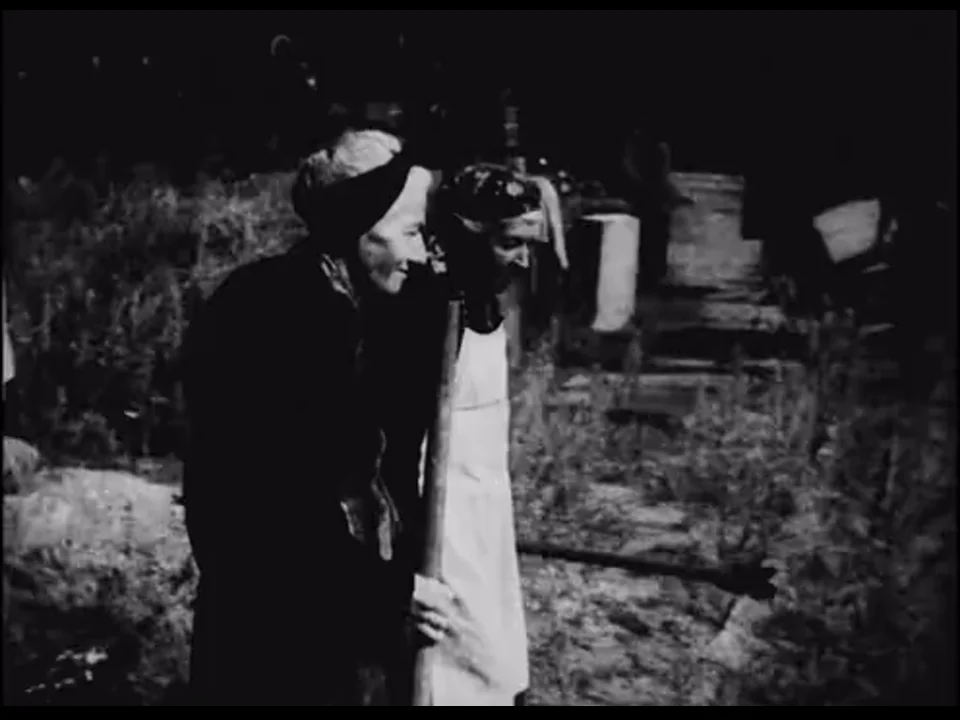 Watch this sequence · 00:02:35 ↗
Germany Year Zero · The cemetery emerges from rubble
The ruin must remove the space's single practical use while retaining local human actions; only their coexistence makes it more than a war backdrop.
Image: The camera first pans across damaged buildings and the city skyline, then cuts into an overgrown cemetery. People dig and carry materials among graves, markers, and rubble; a pale board crosses the foreground.
Sound: The opening orchestral music continues over the city views and the first images of labour in the cemetery.
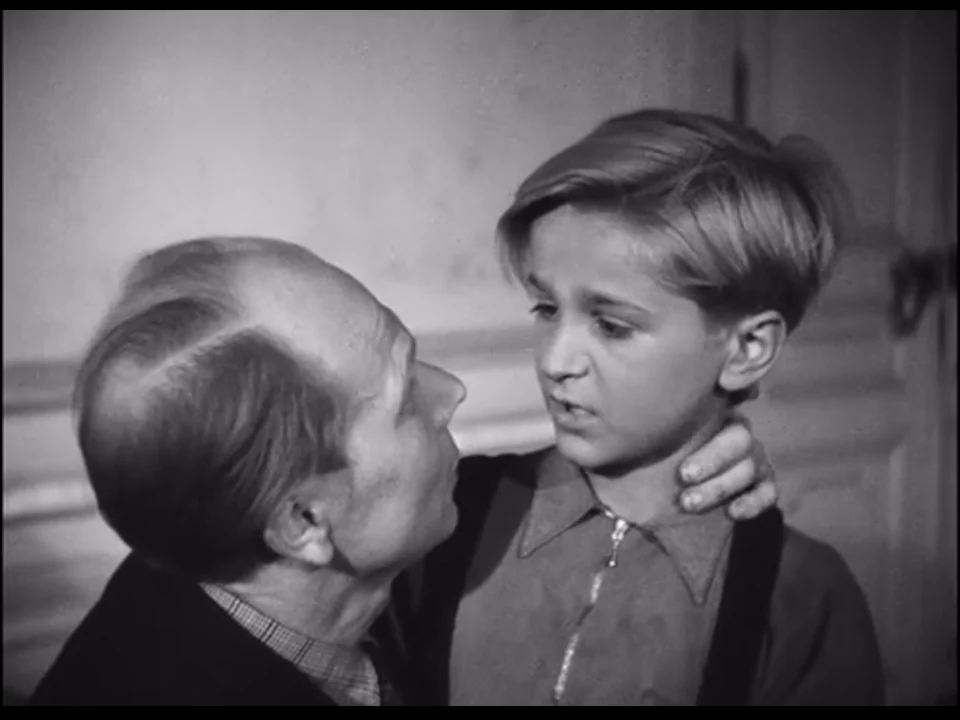 Watch this sequence · 00:24:40 ↗
Germany Year Zero · The teacher hands Hitler's record to the child
The record is then played in the ruined Chancellery, showing political speech converted into a portable, reproducible, and saleable object.
Image: The teacher keeps Edmund in front of him, repeatedly grips his shoulder and neck, and speaks at close range. Edmund remains nearly still while the teacher's hand and face dominate the frame.
Sound: The teacher asks why Edmund is out of school and why the family lacks food, then gives him a Hitler speech record and player to sell, telling him to claim the record as his own if questioned.
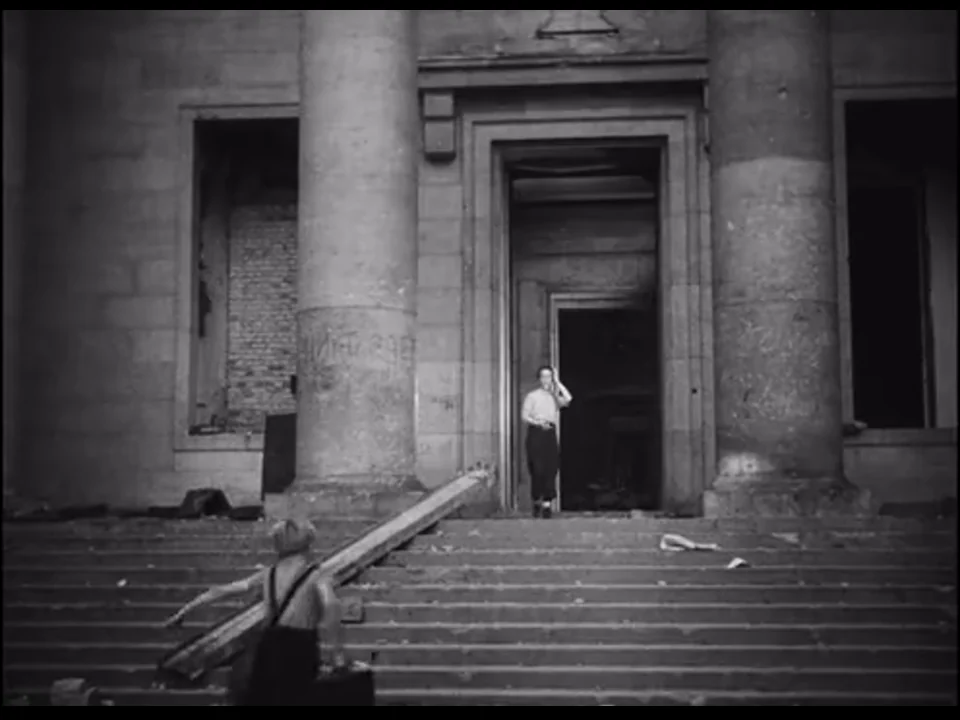 Watch this sequence · 00:27:50 ↗
Germany Year Zero · A historical voice crosses the ruined Chancellery
If the speech merely explains the place, sound and image remain illustrative; sound gains autonomous temporal pressure when recorded authority conflicts with architectural destruction.
Image: Edmund carries a case of records through the ruins while soldiers, visitors, and children move among broken walls. The facade, monumental steps, and empty doorways repeatedly reduce the figures to small bodies within the frame.
Sound: A portable gramophone plays a German political speech with an amplified, archival timbre; brief location conversation is also audible.
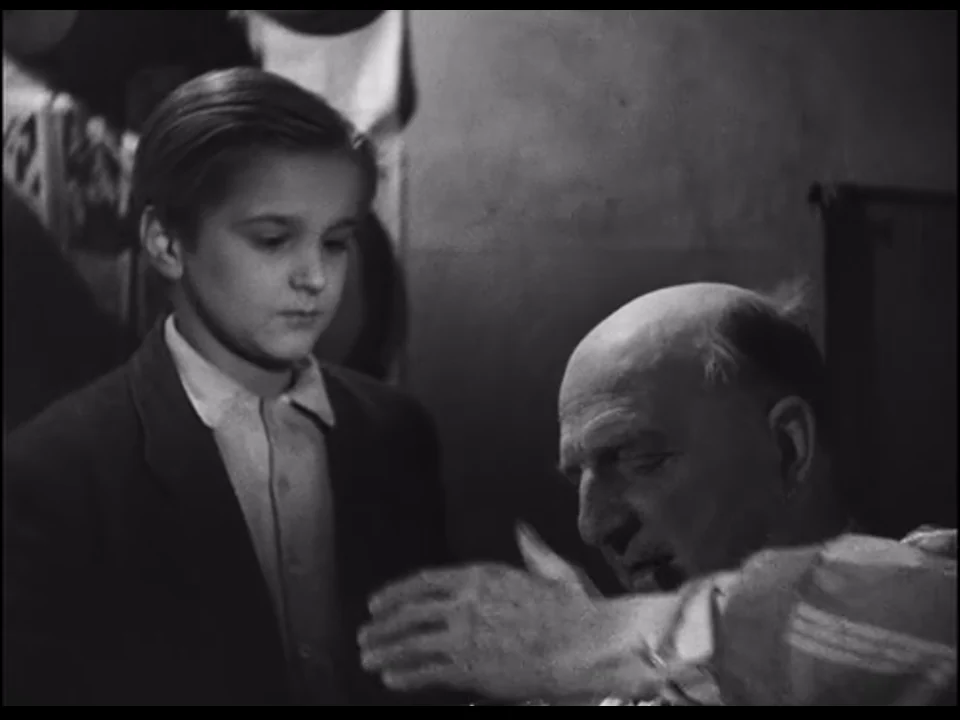 Watch this sequence · 00:52:15 ↗
Germany Year Zero · The glass turns speech into irreversible action
Rupture does not mean an absence of action; the criterion is that the more exactly the act is completed, the less its situation can be mastered or repaired by the agent.
Image: Edmund moves between table and bed, places powder in a drink, and the father later drinks from the glass. As the father drinks, Edmund stands beside the bed with his gaze fixed on the glass and his father.
Sound: Low German conversation is heard in the room, along with small sounds of glassware and tableware; music supplies no triumphant closure to the act.
 Watch this sequence · 01:03:18 ↗
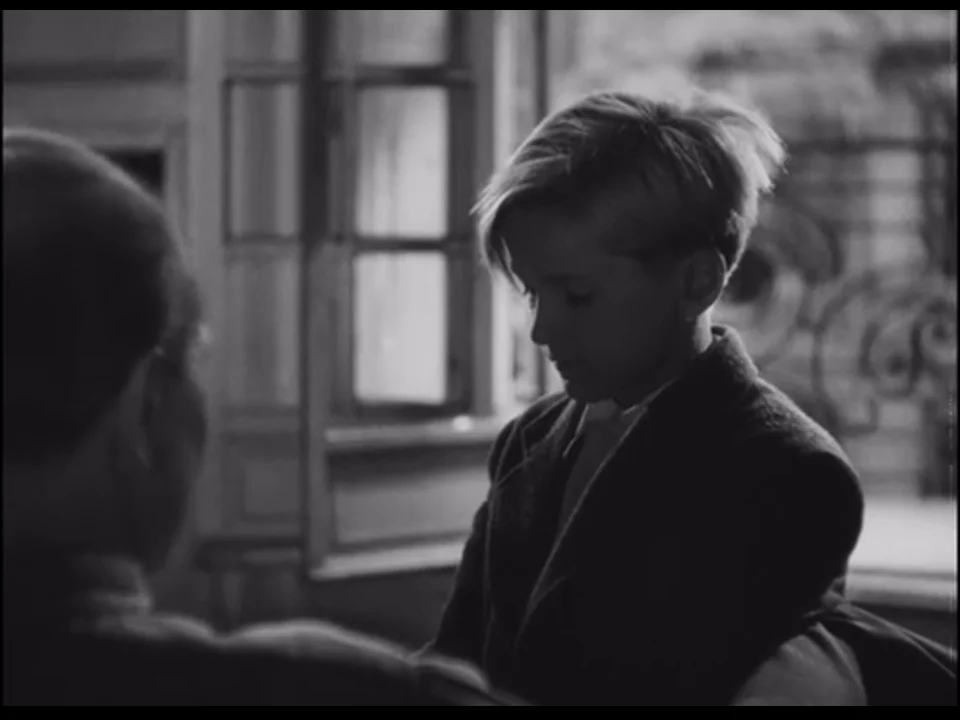
Germany Year Zero · The explanation for the act is withdrawn
If rebuke supplied a new task, the action-chain would continue; rupture holds when speech withdraws the old rule without establishing another.
Image: Neatly dressed in a dark jacket, Edmund stands before the teacher, first lowering his head and then retreating under the teacher's agitated gestures and speech. The teacher drives him toward the open balcony doors; Edmund curls beside the bright exit and then leaves.
Sound: The German argument sharply intensifies as the teacher rebukes him continuously; Edmund's voice is quieter and brief.
 Watch this sequence · 01:12:18 ↗
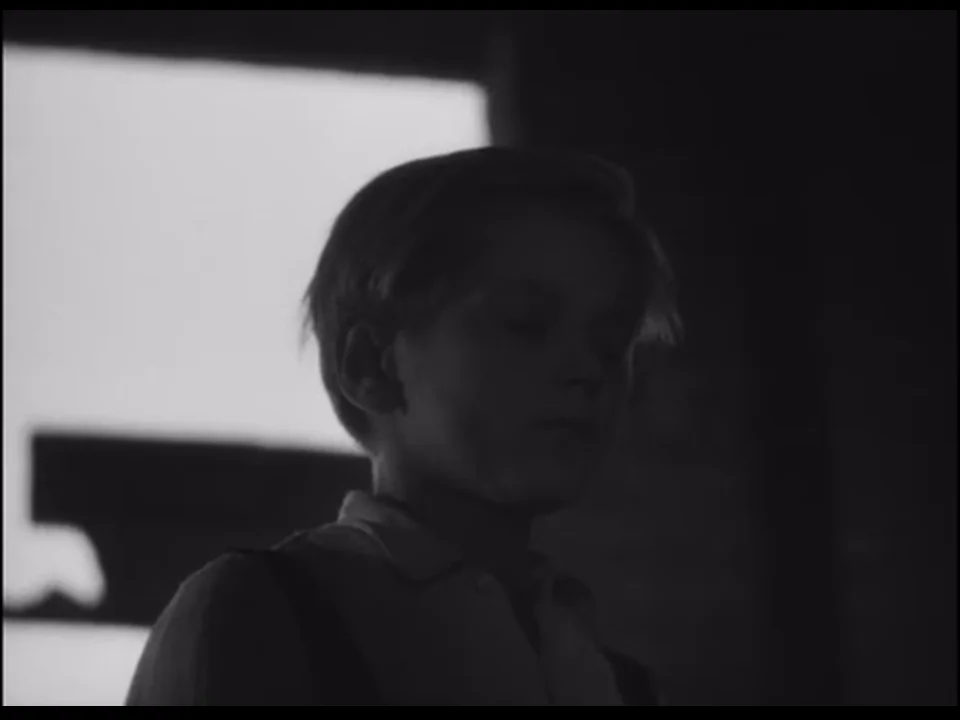
Germany Year Zero · Final wandering and the sight too much to bear
Wandering must let space and sound endure beyond route-finding and turn the child's motor helplessness into intensified seeing; the finale satisfies both conditions.
Image: Edmund crosses streets and broken walls alone, pauses outside a church, and enters a building without intact walls. He watches children playing, vehicles, and the street below, repeatedly touches debris and architectural fragments; after climbing upward, he falls from the building, and a woman in the street approaches his body.
Sound: The long passage is formed mainly by sustained orchestral music, traffic, distant children's voices, and urban ambience; Edmund speaks almost no dialogue.
 Watch this sequence · 00:30:25 ↗
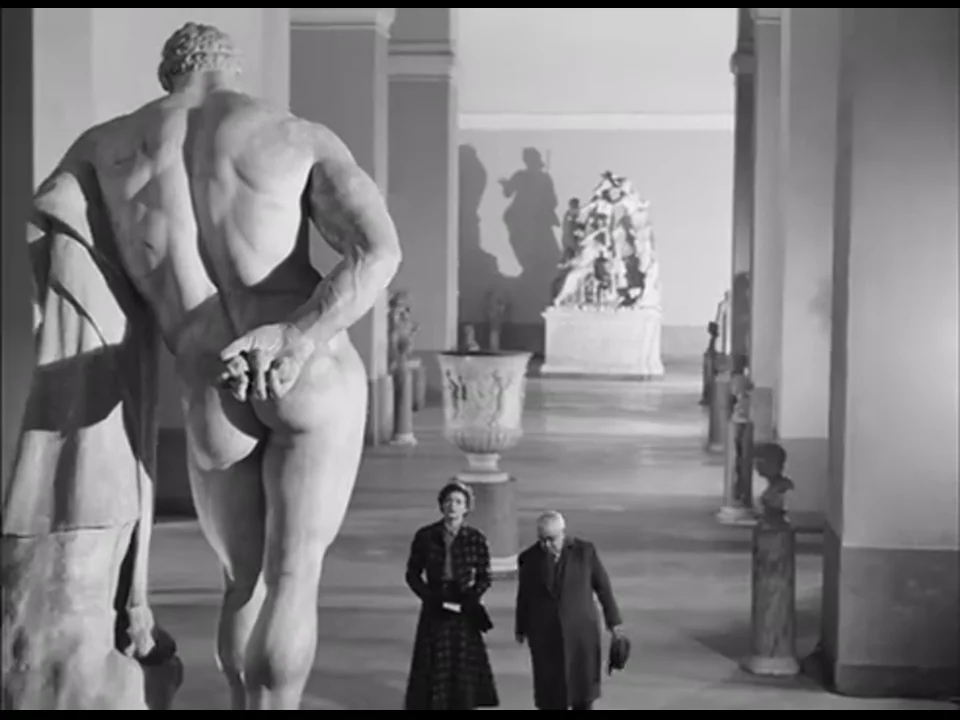
Journey to Italy · Monumental bodies reduce the tourist to a seer
Statue and viewer must form a repeated alternation, and Katherine's response must fail to extend naturally into action that changes the situation.
Image: Katherine follows a guide through the galleries as dancers, a satyr, the drunken faun, imperial heads, and monumental nudes successively occupy the image. Close views of statues alternate with close views of Katherine's face; she stops, looks up, and looks back without touching the objects.
Sound: The guide continuously names works, excavation sites, and biographical anecdotes in English; his voice repeatedly carries over close views of the statues. Footsteps and gallery reverberation remain beneath the commentary, with no score closing Katherine's responses into a single emotion.
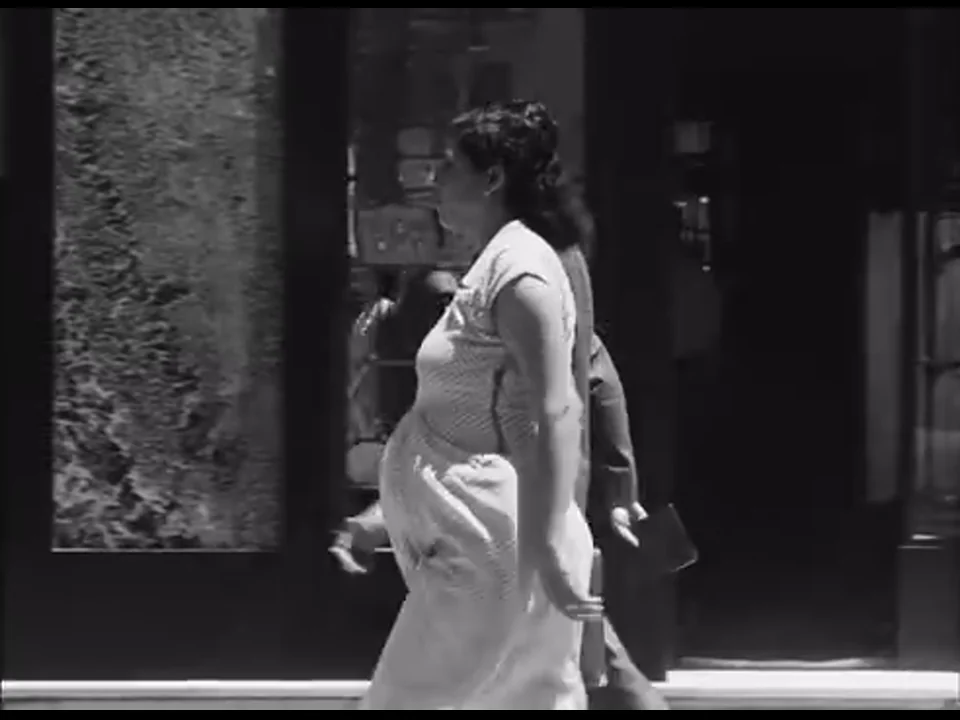
 Watch this sequence · 00:41:40 ↗
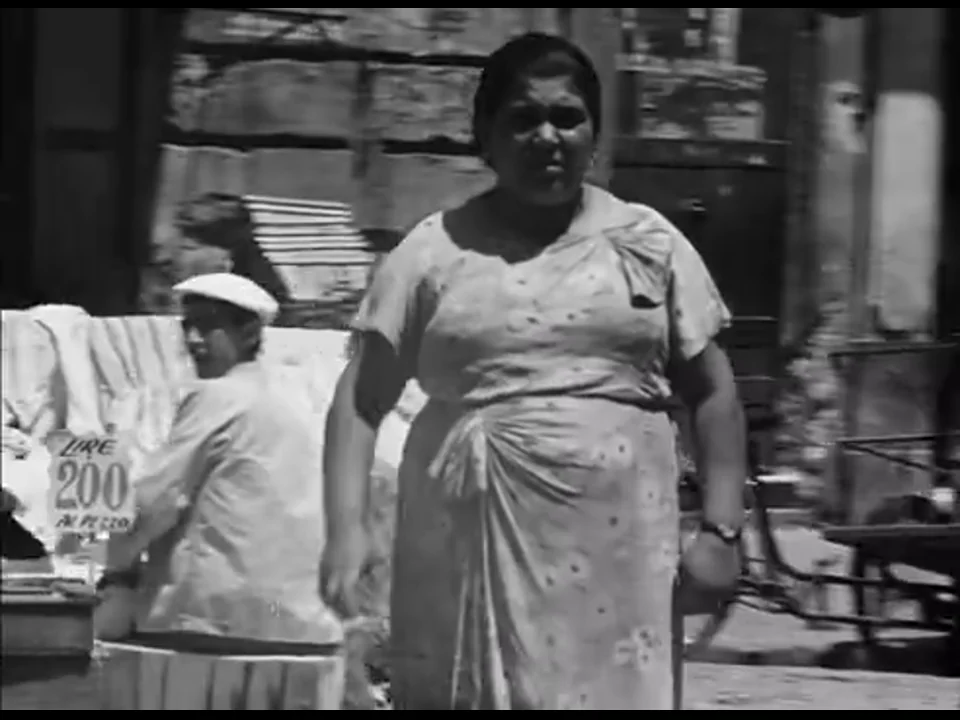
Journey to Italy · Pregnant bodies recur beyond the windshield
Multiple independent street views, Katherine's reaction shots, and the unchanged route must all be checked; the concept cannot be inferred from one passer-by.
Image: Katherine drives alone; frontal close-ups of her at the wheel alternate with moving views of pedestrians along the street. Several visibly pregnant women appear in succession, and the film repeatedly cuts back to Katherine's eyes and face.
Sound: Engine and street noise continue while Katherine voices her anger toward Alex in English; the speech does not instruct her to stop or change course.
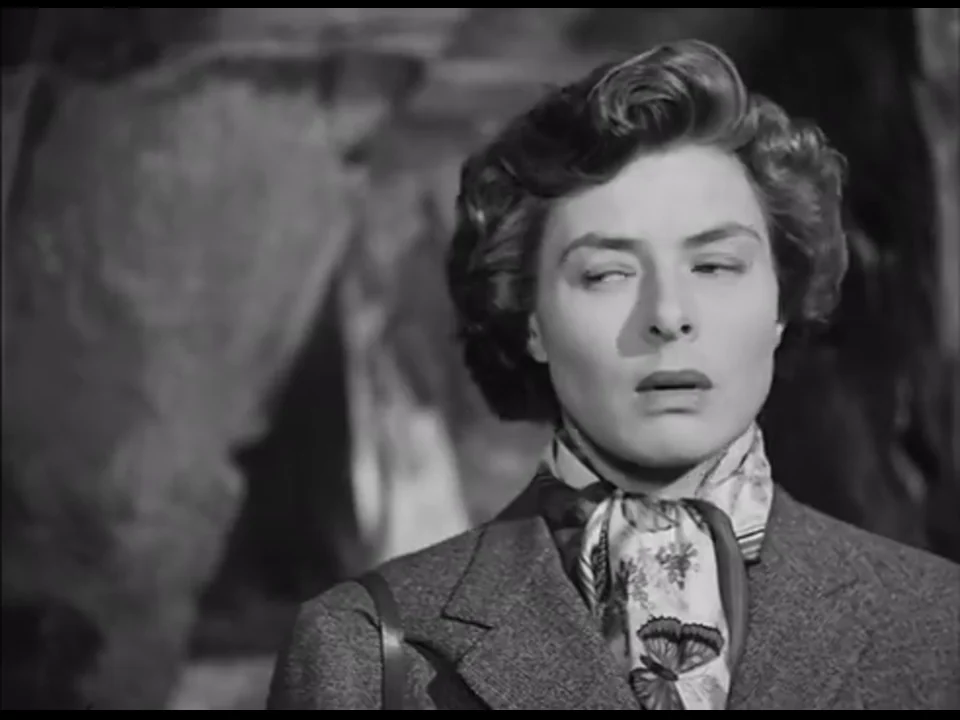 Watch this sequence · 00:43:20 ↗
Journey to Italy · Echo detaches the Sibyl's chamber from the tour
The echo must audibly return, while the prophecy of love must fail to become an answer Katherine can execute within the scene.
Image: A guide leads Katherine into a high, narrowing trapezoidal passage; their bodies diminish in depth while stone walls dominate the frame. The film cuts among the empty passage, the guide, and Katherine's face; she repeatedly stops instead of following closely.
Sound: The guide asks her to listen to the echo and calls out; the call returns from the stone chamber. The guide explains that lovers once came to ask the course of their love; Katherine then speaks Homer's verse, while footsteps, commentary, and echo remain distinct.
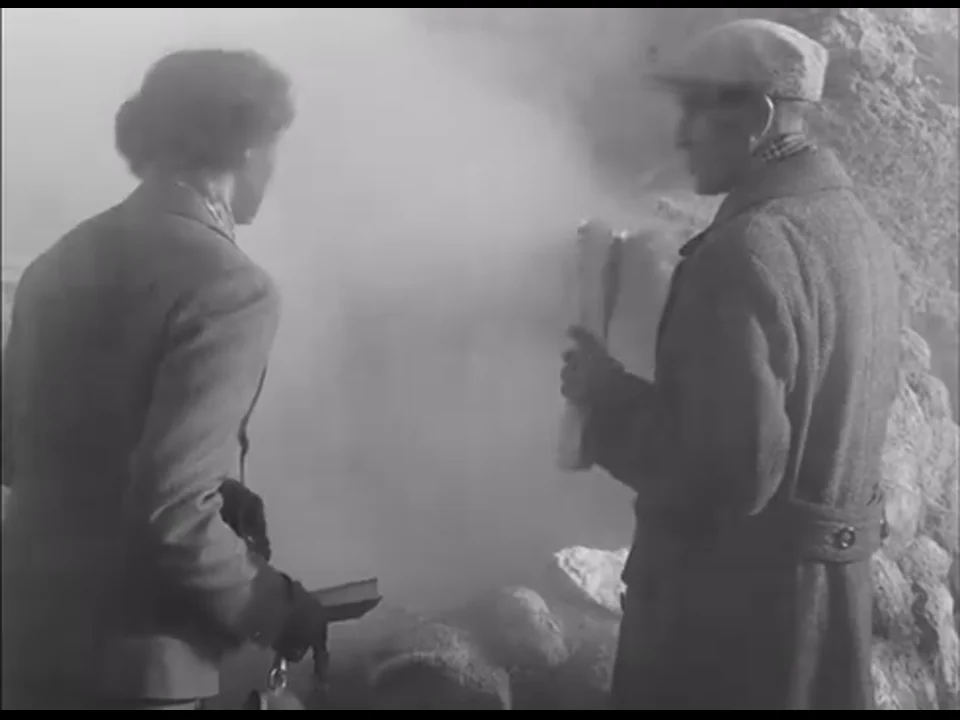 Watch this sequence · 00:52:00 ↗
Journey to Italy · Steam repeatedly erases ground and body
Steam must repeatedly conceal and reveal the figures within the same scene, while commentary fails to eliminate this rupture in visibility.
Image: Katherine follows a guide into the crater and bends toward fissures; the guide crouches, lights a flame, and approaches a vent. Steam repeatedly thickens, first hiding the ground and then reducing guide and Katherine to outlines before thinning again.
Sound: The guide explains the last eruption, the thin crust, boiling material, and a claimed ionisation effect in English; venting and wind continue through the commentary.
 Watch this sequence · 01:07:32 ↗
Journey to Italy · Expectant mothers are counted into a street series
The spoken count must be compared with the solitary drive at 00:40:22–00:41:57 for the repetition to acquire structural meaning.
Image: Katherine drives with Natalia beside her; their close views alternate with pregnant women, children, a laden donkey, and pedestrians along the street. The same type of body appears more than once, and every street view returns to looking and conversation inside the car.
Sound: Natalia remarks on the many expectant mothers in Naples and counts the pregnant women in view, then asks whether Alex likes children. Katherine answers that she does not know what Alex is thinking, while engine and street noise remain continuous.
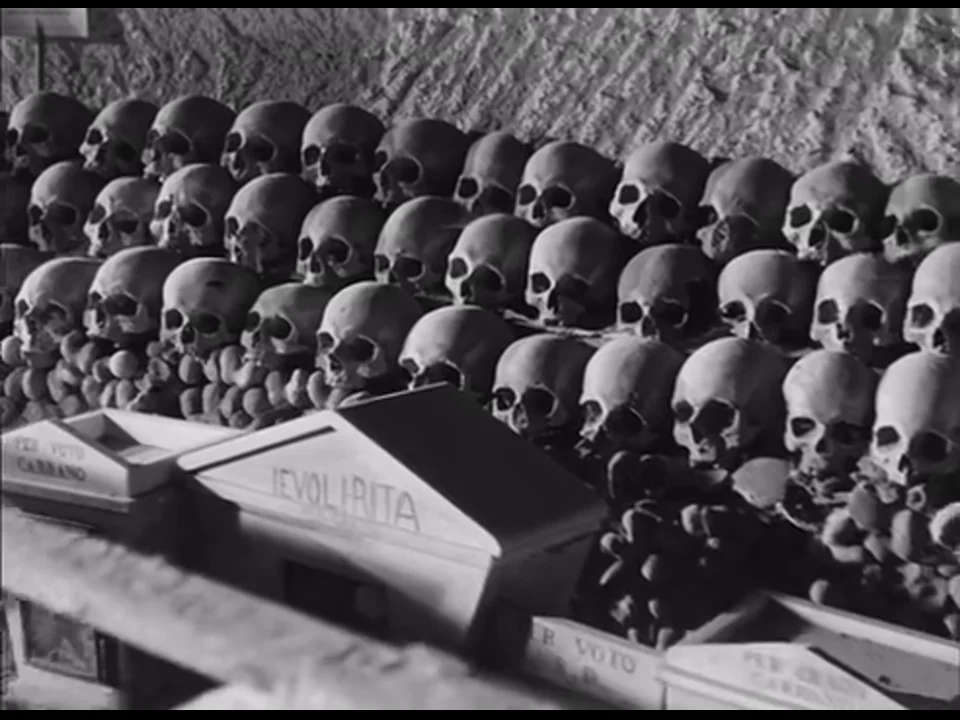 Watch this sequence · 01:09:40 ↗
Journey to Italy · Anonymous skulls receive war dead and an unborn child
The distinction between visible remains and Natalia's private speech must be preserved; they connect through space and audio-visual relations rather than becoming the same thing.
Image: Katherine and Natalia enter a dark cavern where skulls, long bones, devotional boxes, flowers, and candles line the walls. The film cuts among rows of remains, the two women's bodies, and the altar deep inside; Katherine repeatedly stops to look.
Sound: Footsteps, low prayer, and cavern reverberation reduce the volume of ordinary conversation. Natalia says that her brother died in Greece during the war and that she comes here to pray for him; she then voices her wish for a child.
 Watch this sequence · 01:15:10 ↗
Journey to Italy · Plaster returns an instant of death to the present
Technical reconstruction's success and sensory-motor response's failure must both remain visible; neither the bodies nor the couple alone is sufficient.
Image: Workers use trowels, brushes, and hands to remove volcanic material; pale plaster gradually exposes a head, teeth, arms, and legs against dark soil. Two adjacent bodies are identified as a man and a woman; the film alternates among the remains and Alex's and Katherine's responses.
Sound: The on-site commentary explains how plaster fills the cavity left after a body disintegrates and successively identifies legs, arms, skull, and teeth. Tools continue scraping soil; after the observers suggest the two may have been husband and wife, Katherine says she cannot bear it and asks to leave.
 Watch this sequence · 01:24:50 ↗
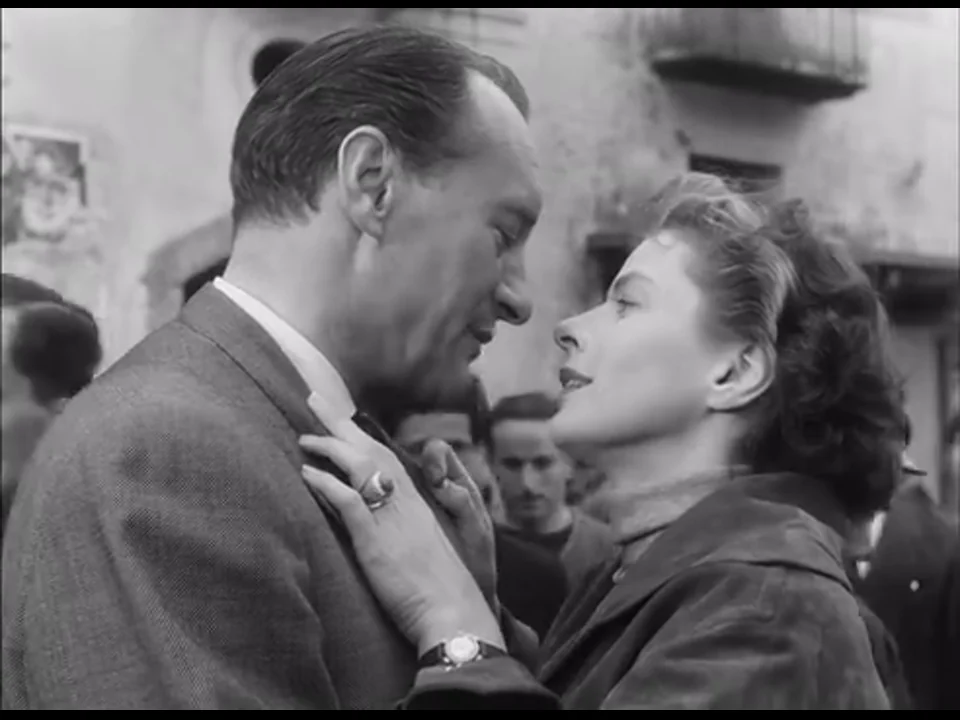
Journey to Italy · The crowd takes Katherine away, then presses the couple together
The crowd must visibly cause stoppage, separation, and renewed contact; the final embrace alone cannot establish a restored action-schema.
Image: A religious procession stops the car; after the couple get out, ranks, band, sacred image, and spectators keep crossing the frame around them. The moving crowd carries Katherine away from Alex; he passes through the crowd, finds her, and they grasp and embrace one another.
Sound: Band music, bells, prayer, cheering, and repeated cries of 'miracle' fill the street. Katherine calls Alex's name from within the crowd; after they reunite she says she does not want to lose him, while their voices remain surrounded by the collective sound field.
 Watch this sequence · 01:00:00 ↗
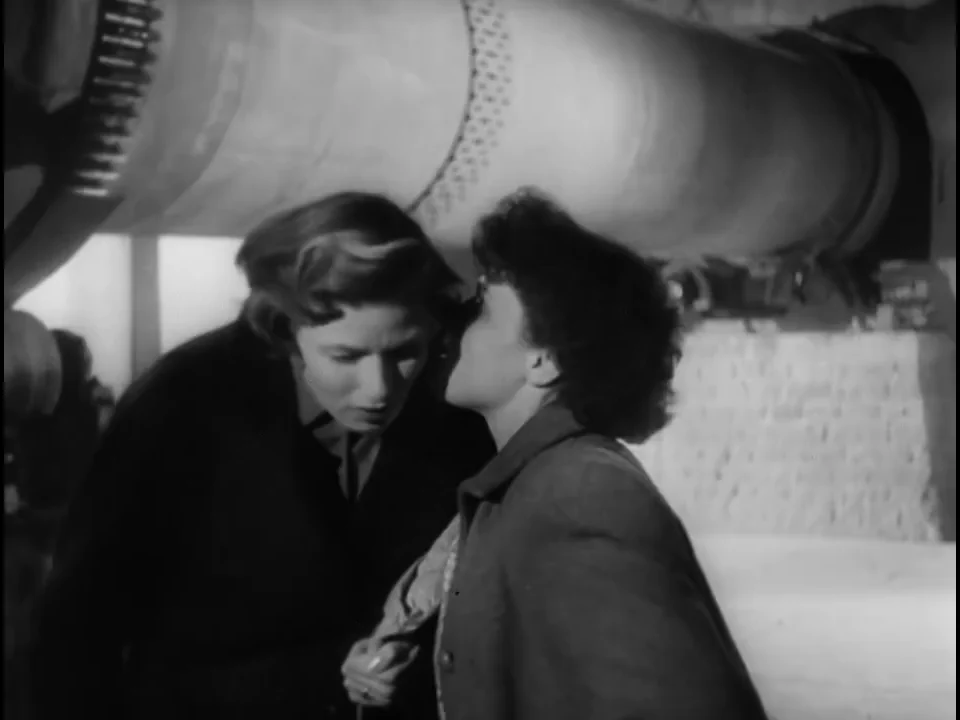
Europe ’51 · Local adjustments still work, yet use no longer exhausts what is seen
The criterion is not the mere presence of machines, a pause to look, or shock at the factory. Two evidentiary scales must be separated. Within the window, visual scale and mechanical noise persist after the communicative adjustment succeeds; across the film, local acts such as taking a shift, seeking help, and caring do not exhaust what Irene sees. Only when Marrati's account of practical recognition and Deleuze's audio-visual circuits explain this gap does the judgement of the seer hold.
Image: An enormous cylindrical machine spans the upper frame; pipes, supports, and its body divide the background into dense industrial layers. Irene and the worker stand in a narrow passage beneath the machine; Irene turns sideways and leans toward the other woman, who faces her.
Sound: Continuous mechanical noise and the women's dialogue occur together; their bodies remain close while they speak.
 Watch this sequence · 01:28:42 ↗
Late Spring · The vase does not explain Noriko's tears; the cuts give change a temporal form
The atlas reviews the passage in four steps: locate both vase shots, compare the facial shots, check the snoring and music, and trace the transition from the second vase to the rock garden. The first two directly test the face–vase–face relation discussed by Deleuze; the latter two examine Parks's extension to the longer sequence. Any fixed symbolic answer requires separate support from shot relations and cannot be inferred from the unestablished premise that Noriko sees the vase or from mistaking the vase shot for her point-of-view shot.
Image: In the shot immediately preceding the stored interval, Noriko lies down smiling. The stored bounds begin with the first vase shot, return to Noriko as tears gather in her eyes, cut to the same vase a second time, and end at the instant of cutting into the Ryōan-ji rock garden. Viewed with the adjacent shot, the order is Noriko's face–vase–Noriko's face–vase–rock garden. On this carrier, the first vase shot lasts about 6.089 seconds and the second about 10.260 seconds. During the second, the vase remains nearly motionless while bamboo shadows continue moving on the shoji.
Sound: On p. 297, Parks uses continuing snoring to establish temporal contiguity across the shots; on p. 298, he reports that a musical theme enters about four seconds into the second vase shot and bridges to the rock-garden scene. This is Parks's written account of his material; treating it as an audible fact of this carrier still requires a separate check of its soundtrack.
02 · Recapitulation of images and signs
Chapter 2 moves from Peirce’s classification to signs generated by images themselves. Opsigns and sonsigns mark pure optical and sound situations detached from sensory-motor continuation. This break does not establish a direct time-image, which requires movement to become subordinate to time.
Chapter referenceChapter 2 analysis →2004 Chinese edition · chapter pp. 38–67
Images, language and signaletic material
Light, movement, rhythm, intensity and spatial relations are already at work before cinema enters language. Treating shots as words and montage as syntax misses how those relations produce sense. Deleuze begins with non-linguistic image material and then asks how speech enters it. Cinematic thought need not first become linguistic structure.
Differentiation of images and genesis of signs
Perception, affection and action are differentiations of the movement-image in relation to a centre of indetermination, not arbitrary themes assigned to shots. Signs concern an image's composition and genesis. Peirce supplies a starting point, while Deleuze traces transformations between images. Thirdness in a mental-image concerns relation, not a third person in the frame.
Movement-image
The movement-image is a regime in which movement differentiates into perception, affection, impulse, action, reflection, and mental relation to organize the image directly, while time appears indirectly through movement and montage. The relation-image is a decisive realization within the mental-image's problem-field, not an additional source-level rank parallel to it, and films need not pass through one fixed action-chain.
Aberrant movement and disrupted continuity
Once movement loses a stable centre, measure or commensurable continuity, temporal relations need no longer be measured by its succession. Aberrant movement already exists in early cinema; the modern transformation makes it an organizing principle. Continued bodily movement and the capacity of action to organize a world are different questions.
Indirect and direct time
Montage can present a temporal whole through relations of movement: an indirect image of time. A direct time-image reverses subordination, making coexisting pasts, incompatible presents or irreducible gaps organize movement. Both long takes and short montage can participate; shot length alone does not decide the relation.
Chapter source: Cinema 2, Minnesota 1989, chapter 2, pp. 25–43
Nostalghia 1983
Exilic past keeps entering the Italian present, while the candle take turns a task into a duration of belief that cannot be abbreviated.
1. Place undoes the travel goal — Church, mist, baths, and ruins do not become objects of knowledge; Andrei repeatedly stops at the edge of looking.
The traveller changes from collector of sights into one compelled to see by place.
2. Two places enter each other — Russian home, family, and vapour enter Italian ruins and waterlogged rooms.
The past is not explanatory flashback but a virtual milieu acting within the present.
3. Task becomes temporal pressure — Andrei crosses the empty pool three times with a candle; failure, return, and renewed passage remain in shot-duration.
Completion does not cancel duration; bodily persistence makes belief appear as time itself.
The Great Dictator 1940
The Great Dictator tests the reflection-image at three evidentiary strengths. The globe ballet may let local action refer through a third term to a global political situation; double misrecognition may invert the action positions of victim and ruler; the final address is directly named by Cinema 1 as a figure of discourse, without showing that democratic institutions have thereby been transformed.
1. The globe poses an attraction candidate — From 00:54:08 to 00:56:16, Hynkel tosses and embraces an inflatable globe until its burst ends the dance.
Chapter 11, pp. 182–183 gives only the general criterion: whether a third term makes action refer indirectly to a global situation. Deleuze does not name the globe ballet scene by scene, so a withdrawal test remains mandatory.
2. Double misrecognition poses an inversion candidate — From 01:50:07 to 01:54:27, a drenched Hynkel is arrested as the fugitive while the uniformed barber is welcomed by officers and enters the parade convoy.
Chapter 10, pp. 171–172 directly names the one-face/two-situations mechanism, and chapter 11, pp. 183–187 gives the inversion criterion; the primary text does not classify these two misrecognition chains scene by scene.
3. The final discourse receives direct primary support — From 01:59:09 to 02:03:08, the image moves from podium totality to the barber's sustained frontal close-up, then cuts to Hannah after the address.
Chapter 10, pp. 172–173 directly uses the final intelligible address for the figure of discourse, and Cinema 2, chapter 2, p. 33 retrospectively names its genetic status. This supports the discourse-image without claiming that speech has transformed institutions.
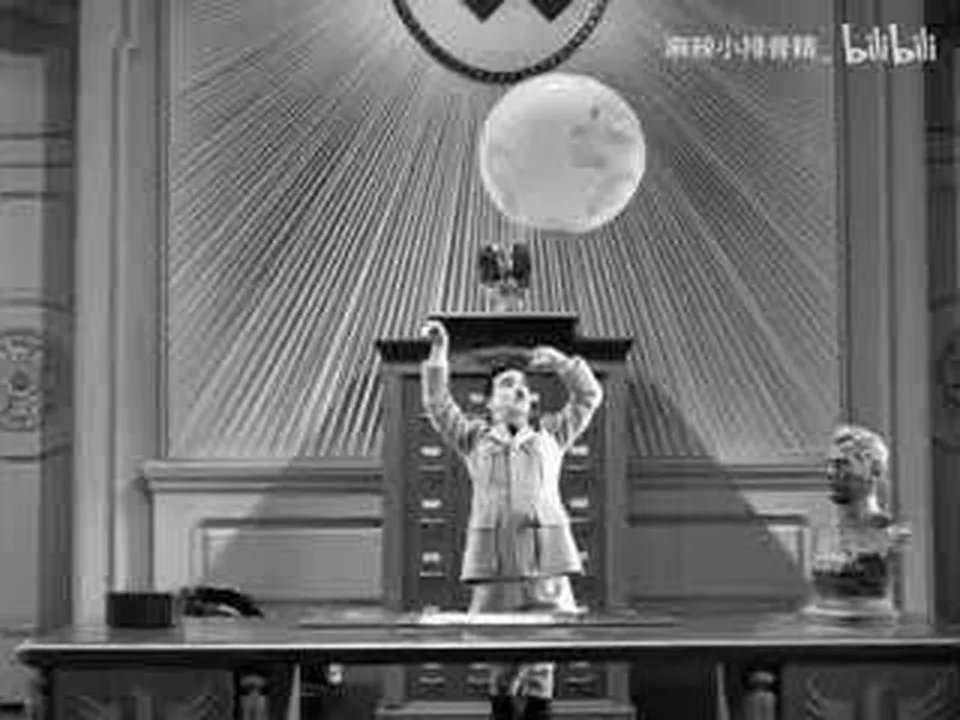 Watch sequence · 00:55:40 ↗
A third term refers weightless dance indirectly to world rule. This is an attraction candidate, not a scene-level primary classification. 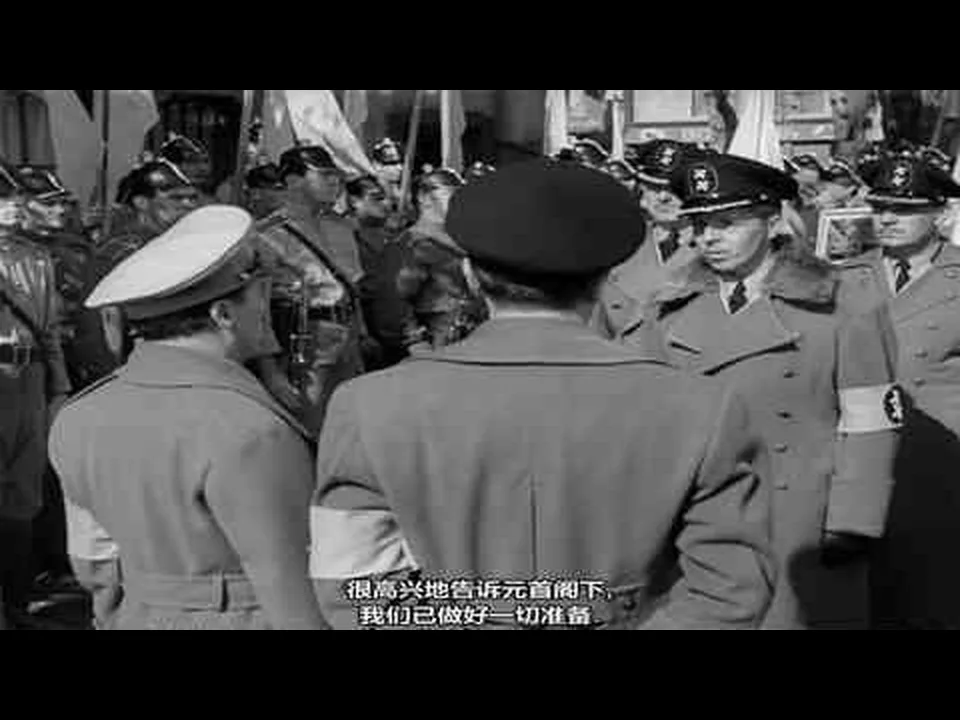 Watch sequence · 01:53:12 ↗
The welcome must be read with the other chain in which a drenched Hynkel is arrested before inversion of action positions can be proposed. 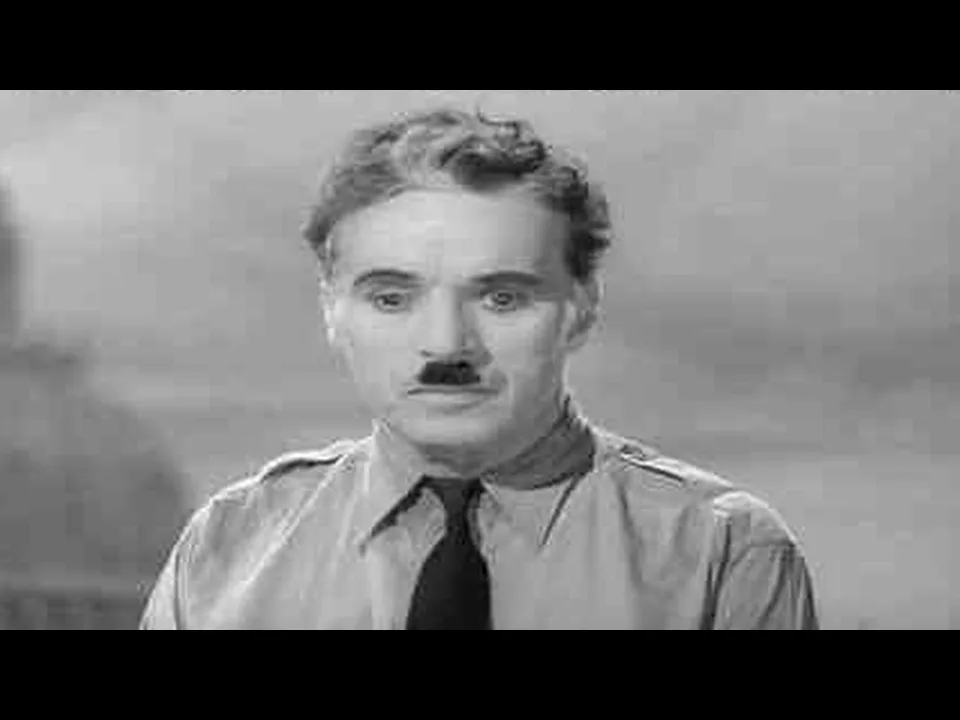 Watch sequence · 01:59:21 ↗
The sustained frontal close-up gives the spectator the problem of who can speak, to whom, and whether discourse can become action. Gertrud 1964
Gertrud detaches choice from calculable consequences: posture and silence make relation a visible problem before belief occurs in a present without guarantees.
1. Social space becomes a diagram of attitudes — Tables, sofas, and doorframes place Gertrud with husband, poet, and musician in one room while their gazes and bodies turn away from one another.
Action-information recedes and bodily attitude gains its own duration; Cinema 2, ch. 7, pp. 176 and 181–82 provide the primary locator.
2. Choice refuses exchange — Gertrud insists on an 'absolute love' and refuses to exchange feeling for marital security, career advantage, or social recognition.
Her choice is not a more efficient action but a failure of the evaluative standard of action itself; the body–thought relation becomes visible.
3. Stillness leaves belief — After the farewell, room, piano, and solitary posture provide no reconciliatory result, only a sustained attitude and a space one can return to.
Read beside Ordet's miracle, Gertrud shows belief without miracle: the world is not repaired, yet the figure persists through an attitude in this world.
Watch this sequence · 01:59:21 ↗The Great Dictator · The final address: discourse becomes a problem rather than declaring action victorious
Cinema 1, chapter 10, pp. 172–173 directly opposes the final intelligible language to the tyrant's gibberish and terror and names a figure of discourse; Cinema 2, chapter 2, p. 33 retrospectively makes the discursive figure the reflection-image's genetic sign. This supports the figure of discourse without proving that the address completes democratic institutional transformation; any claim of accomplished political victory must be withdrawn.
Image: The barber stands before several microphones under Hynkel's identity; the camera moves from podium and military setting to a sustained frontal close-up. The close-up progressively reduces the ceremonial background so that face, gaze, and duration of address become the main image-event; after the speech the film cuts to Hannah. The 01:59:21 anchor comes from Bilibili's native preview. The atlas cropped a non-film banner at the top without removing face, uniform, or filmic background information.
Sound: The barber shifts to sustained intelligible English address, audibly contrasting with Hynkel's earlier pseudo-German, noise, and threatening delivery. The atlas does not reproduce the speech at length.
03 · From recollection to dreams: third commentary on Bergson
Flashback and dream enter the time problem only after they leave the action circuit. Memory that repairs causality still serves action.
Chapter referenceChapter 3 analysis →2004 Chinese edition · chapter pp. 68–105
Habitual recognition
Habitual recognition connects an object to a practised action: recognizing a tool leads to using it, a road to continuing along it. Perception extracts enough features for the action and moves to another object. This economy makes the interruption and return of attentive recognition intelligible.
Attentive recognition
Attentive recognition suspends outward action and returns to the same object, assembling widening circuits of features and memory. Failed recognition matters: the object remains, but habitual use cannot explain it adequately. The factory in Europa ’51 enters another mode of seeing; a mental vision need not replay a past event.
The pure past and the actualization of recollection
The preservation of the past differs from a recollection currently appearing as an image. The pure past is virtual; a recollection-image results from its actualization in a particular search. Recollection does not merely retrieve a complete inner photograph. It enters a region of the past and brings relevant content into an image.
Recollection-images and flashbacks
A flashback changes presentation order but may restore a missing cause to a complete action-chain. A recollection-image therefore does not automatically give direct time. All About Eve returns present recognition to ambition and rivalry: the issue is how the return changes the present, not merely how much information it supplies.
Bifurcating time
Mankiewicz makes recollection expose different directions an event could take. A letter can unsettle several marriages, with each retrospective account changing the grasp of the present. Bifurcation concerns how events occur within relations, beyond the chronological order of flashbacks; multiple plotlines alone do not establish peaks of present.
Dream-images and expanding circuits
Dreams move between actualized images through transformation, dissolves and linkage. Circuits may expand indefinitely while still presenting time indirectly through substitutions. Dream content, strangeness and circuit structure are distinct issues. Hence the move from dream to the crystal's smallest circuit remains necessary.
Implied dreams and world movement
Musicals transfer movement from practical displacement into dance: streets, sets and colours seem to move for the figure. The world takes over a capacity initially assigned to the body. Singin' in the Rain turns a street into rhythmic space, while architecture and objects in Playtime choreograph the field of action.
Chapter source: Cinema 2, Minnesota 1989, chapter 3, pp. 44–67
PlayTime 1967
Glass reflections, dispersed actions, and sounds detached from their sources repeatedly cancel a single centre of comedy, requiring the modern milieu to be watched and heard like a polyphonic map.
1. Glass repeatedly displaces the target — Hulot pursues the man he is meant to meet through an airport-like office block, where glass partitions, identical cubicles, reflections, and distant figures generate wrong entrances and recognitions.
The space remains highly ordered yet cannot support a stable perception-action route.
2. Sound moves attention off-centre — On the Royal Garden's opening night, chair cushions pop, a glass door shatters, neon wiring fails, and gags occur simultaneously in different parts of the long shot.
Sound no longer accompanies a central action; it acts as a pointer requiring the viewer to search the frame for relations.
3. Breakdown recomposes public space — A handle carried by the doorman continues to function as an intact glass door, collapsed décor is remade into an enclosure by guests, and morning traffic circles the roundabout like a fairground ride.
Breakdown does not merely destroy order; it produces new connections among objects, sounds, and bodies.
All About Eve 1950
All About Eve splits one backstage present into competing sheets of past: each recollection gives the same entrance, friendship, and betrayal a new weight of reality.
1. The award-night present recalls the past — The film begins with Eve already on the award platform, then sends the spectator into different characters' recollections through camera and voice-over.
The present is not the endpoint of recollection but the interface through which several sheets enter; coordinate: Cinema 2, ch. 3, pp. 50–51.
2. The same event changes weight — Karen, Margo, and Eve recount the backstage encounter; the same courtesy, pause, and phone call acquire different motives in each telling.
Recollection is not a storehouse of facts; it reconnects a sheet of past to each figure's present desire and responsibility.
3. The future copies the past — At the end a new girl arrives and repeats Eve's entrance into Margo's home; success under the spotlight returns as a repeatable cycle.
Unlike ordinary flashback, the sheet of past determines a future act in return. Read beside Last Year at Marienbad, the film shows how choice becomes a repeatable social mechanism.
A Letter to Three Wives 1949
A letter from an absent woman places three households in one present while their pasts fork in different directions; voice arrives before the body, and action proceeds only through conjecture.
1. An absent voice establishes one present — As the three wives leave the island, the same letter arrives and Addie Ross's voice-over announces that she has taken one of their husbands.
An unlocatable voice places three households side by side; Cinema 2, ch. 3, pp. 50 and 52–53 provide the primary coordinates.
2. Three recollections fork — Each wife's recollection enters marital crisis through everyday detail: the same letter corresponds to three class positions, marital rhythms, and unspoken wishes.
The fork does not merely delay truth until the end; it lets three presents remain valid, forcing the spectator to move among incompatible versions.
3. The voice never appears — Until the end Addie remains primarily a voice and an account relayed by others; marital decisions are rearranged in her absence.
This is not merely a mystery waiting for an identity reveal but a limit test of the action-schema by a source-less voice; read it beside India Song's autonomous voice series.
Watch this sequence · 01:00:00 ↗Europe ’51 · Local adjustments still work, yet use no longer exhausts what is seen
The criterion is not the mere presence of machines, a pause to look, or shock at the factory. Two evidentiary scales must be separated. Within the window, visual scale and mechanical noise persist after the communicative adjustment succeeds; across the film, local acts such as taking a shift, seeking help, and caring do not exhaust what Irene sees. Only when Marrati's account of practical recognition and Deleuze's audio-visual circuits explain this gap does the judgement of the seer hold.
Image: An enormous cylindrical machine spans the upper frame; pipes, supports, and its body divide the background into dense industrial layers. Irene and the worker stand in a narrow passage beneath the machine; Irene turns sideways and leans toward the other woman, who faces her.
Sound: Continuous mechanical noise and the women's dialogue occur together; their bodies remain close while they speak.
04 · The crystals of time
The crystal is not a mirror prop. It is the smallest circuit in which actual and virtual rewrite one another while remaining distinct.
Chapter 4 analysis →Actual / virtual
The actual is a formed and locatable state. The virtual consists of fully determined and fully real differential relations, singularities, memories, and tendencies. It is not a possible future or a blurred copy of the actual. The virtual is actualized through differenciation: actualization creates a solution rather than making a pre-existing model resemble reality, and the formed actual continues to carry the virtual problem to which it responds.
Crystal-image
A crystal-image forms when an actual image and its own virtual image coalesce in the smallest internal circuit. The two faces pursue, feed back into, and exchange with one another. They preserve their difference in kind, yet the stable assignment of one face permanently to the actual and the other permanently to the virtual becomes undecidable. This objective indiscernibility makes visible the present's continual split into an actual present and a coexisting virtual past.
Indiscernibility and the splitting of time
Actual and virtual remain different in nature while their positions cannot be assigned stably. The crystal makes visible a present that passes while preserving itself as past. Indiscernibility therefore exceeds a character's uncertainty about dreams: the mirror hall matters through the exchange of facets, not merely optical confusion.
Limpid and opaque
As one face of the crystal becomes a clear actual image, the other recedes into opaque virtuality; then the two exchange. Their relation produces visibility. Limpid and opaque concern an exchange of positions, not exposure levels. In The Lady from Shanghai, a reflection can acquire the clarity of a target while a body recedes from identification. The direction of recognition changes again, keeping the circuit active.
Seed and environment
A seed triggers crystallization within an as-yet amorphous environment, while that environment must itself possess a virtual crystalline structure. Seed and milieu reciprocally individuate one another, making the crystal a world in formation.
Film within film, money and production time
When a film includes its own making, production time, finance and the filmed world can reflect one another. Passion connects tableaux, labour and an unfinished shoot. The crystalline problem concerns the exchange between a work and the conditions of its making; showing a camera alone does not establish it.
The perfect crystal: Ophuls
Ophuls folds movement back into an enclosed circuit. The circus present in Lola Montès summons fragments of a life and returns them to a spectacle that can be watched and sold. Perfection names the circuit's enclosure, not higher artistic value: the complete apparatus confines the life.
The cracked crystal: Renoir
Renoir makes performance, social ritual and feeling permeate one another, leaving fissures through which escape might occur. Theatre, hunting and emotional misrecognition in The Rules of the Game expose class order as a shared performance. A crack poses the possibility of escape without guaranteeing it.
The crystal in formation: Fellini
Fellini lets memory, dreams, rehearsals and present filming participate in a work's formation. In 8½, the past does not merely explain a director's blockage; returns themselves become the material of the emerging film. The crystal grows through connections between the work and the predicament of making it.
The decaying crystal: Visconti
Visconti brings sumptuous environments, ageing bodies and historical change into one world. Ritual persists while the conditions sustaining it have disappeared. Beauty and illness in Death in Venice, and the ball amid political change in The Leopard, expose irreversible decay from within the crystal.
Gallop and refrain: the sonic crystal
The gallop presses the present onward while the refrain returns and preserves a past. Film music can intertwine them without reducing the distinction to fast and slow tunes. Fellini and Nino Rota make music participate in the circulation and return of a life's fragments, connecting sound to temporal construction.
Chapter source: Cinema 2, Minnesota 1989, chapter 4, pp. 68–97
Nostalghia 1983
Exilic past keeps entering the Italian present, while the candle take turns a task into a duration of belief that cannot be abbreviated.
1. Place undoes the travel goal — Church, mist, baths, and ruins do not become objects of knowledge; Andrei repeatedly stops at the edge of looking.
The traveller changes from collector of sights into one compelled to see by place.
2. Two places enter each other — Russian home, family, and vapour enter Italian ruins and waterlogged rooms.
The past is not explanatory flashback but a virtual milieu acting within the present.
3. Task becomes temporal pressure — Andrei crosses the empty pool three times with a candle; failure, return, and renewed passage remain in shot-duration.
Completion does not cancel duration; bodily persistence makes belief appear as time itself.
In the Mood for Love 2000 · Later comparison
Repeated routes and rehearsed dialogue let an unrealized relation remain active within actual life, making memory not hindsight but the virtual face of the present.
1. Everyday routes begin to repeat — Narrow corridors, stairs, and noodle stall return under the same music as passing, collecting food, and waiting differ slightly each time.
Repetition does more than condense time; it gives the unspoken relation increasing actual pressure.
2. Rehearsal changes the present relation — Chow and Su act out how their spouses began the affair and how confrontation might occur, with scenes only later revealing themselves as rehearsal.
The virtual scene is not a false detour; it changes what the two can actually say and do.
3. The secret becomes material residue — Years later, Chow whispers the secret into a hole at Angkor Wat and seals it with mud; he leaves while the camera remains.
The unrealized relation leaves personal action and persists as a virtual past in an actual site.
Goodbye, Dragon Inn 2003 · Later comparison
Screen, leaks, footsteps, and empty seats outlast the act of viewing, making the closing cinema both actual ruin and virtual film memory.
1. Screen and audience do not close together — Dragon Inn sustains dense action on the large screen while spectators remain sparse, move slowly, and miss one another in the auditorium.
Screen action cannot organize the actual cinema; two temporal regimes coexist in one space.
2. Ambient sound takes the cinema — Leaks, footsteps, seats, toilet echoes, and extended silence cross corridors and empty halls, often without visible sources.
Sound no longer serves character action; the building acquires audible duration of its own.
3. Closure leaves a virtual cinema — After the audience leaves but before the staff finish closing the cinema, the camera preserves the empty screen and long corridors; the old actors' recognition also yields no shared future.
The actual cinema disappears while film memory continues to act as its virtual face.
The Lady from Shanghai 1947
Deception first makes identities exchange within narration; the funhouse and mirror maze then turn that unreliable relation into a visible circuit of copies until gunfire cracks the crystal.
1. Each figure supplies a version — Once Michael boards Bannister's yacht, Elsa, Grisby, and Bannister each advance accounts of love, faked death, murder, and legal escape.
Action proceeds through narratives that keep changing hands, drawing any stable tribunal of fact into the deceptive relation.
2. The funhouse spatializes versions — Michael crosses funhouse sets that rotate, tilt, and distort bodily scale; shadows, false passages, and grotesque surfaces block a straight escape.
Narrative unreliability becomes spatial unreliability as bodies and doubles lose stable coordinates.
3. Shattered mirrors terminate exchange — The hall of mirrors multiplies Elsa, Bannister, and their guns into rows of images; they fire at reflections, cracks spread, and only after mirrors fall do wounded bodies re-emerge.
Actual body and mirror-image become briefly indiscernible; gunfire does not expose one illusion but destroys the circuit sustaining their exchange.
8½ 1963
Guido's unfinished film is not a single work surrounded by reality, memory, and fantasy; it is the seed through which they actualize one another and continually expand.
1. Escape first becomes fantasy — Unable to open the doors in stalled traffic, Guido is engulfed by smoke; he suddenly floats into the sky, then is hauled back by a rope held below.
The actual impasse produces no solution but immediately exchanges places with a wish-image.
2. The unfinished work crystallizes life — Spa cure, production meetings, the vast launch-pad set, childhood memories, harem fantasy, and screen tests invade one another, while acquaintances perform versions of themselves on screen.
The film project ceases to be an object outside life; it crystallizes people, memories, and performances into its own milieu.
3. Failure becomes an open dance — After the besieged press conference and an imagined gunshot, all the figures reappear around the set at night and join hands in a circle; the adult Guido takes Luisa's hand and joins the dance, while the white-clad child Guido is finally left playing his flute.
Neither completion nor cancellation closes the work; actual figures and virtual versions re-enter a crystal still in formation.
Death in Venice 1971
Aschenbach's gaze upon beauty shares one surface of preservation with Venice's plague, cosmetics, and bodily decay, so aesthetic revelation can arrive only as already too late.
1. Looking organizes the resort world — Aschenbach arrives in Venice by boat and repeatedly seeks and watches Tadzio in the hotel dining room and on the beach; colonnades, deckchairs, and crowds frame his look.
Travel recedes as distant looking becomes his principal relation to the world.
2. The concealed plague enters the surface — Disinfectant, notices, departing guests, and staff denying rumours appear in the streets; after learning of the plague, Aschenbach remains and follows Tadzio's family.
Knowledge produces no adequate act of departure; the resort's polished surface and the decaying city become visible together.
3. Preservation reveals decomposition — He darkens his hair, whitens his face, and reddens his lips, then watches Tadzio on the sunlit beach; sweat sends dye down his face as he collapses and dies.
Cosmetics meant to preserve youth instead expose bodily decomposition; the crystal decays from within even as it preserves the ideal.
Lola Montès 1955
The circus present turns Lola's past into virtual images that can be exhibited repeatedly; each flashback in turn changes the meaning of the body onstage, forming a perfect crystal of reciprocal actual-virtual exchange.
1. The present is staged as a closed ring — The ringmaster presents 'the life of Lola Montès' in a circular circus; spectators surround the central platform as lights, rails, and questions fix Lola's body as an exhibit.
The actual present is no neutral narrative point but an apparatus that produces, prices, and encloses the past.
2. The past rewrites the performance — Questions and circus acts summon episodes with Liszt, Ludwig I, and others; movements, colours, and gestures from the flashbacks return to become the next performance.
The circus actualizes a virtual past, while that past shapes the actual performance; the two sides exchange along one circuit.
3. Every exit returns to exhibition — At the end Lola sits behind bars and extends her hand as spectators queue and pay to kiss it; the camera recedes while the line keeps lengthening.
A life is preserved as an endlessly repeatable present; the crystal's perfection is also the enclosure from which the figure cannot escape.
The Rules of the Game 1939
The estate mirrors theatre and life, masters and servants into a crystal; hunt and mistaken killing expose its fissure, leaving role-order to be barely restored by an account supplied after the fact.
1. Roles rehearse one another — At the country-house gathering, hosts, guests, and servants pursue mirrored affairs and deceptions; automata, masquerade, and stage entertainment turn social roles into overt performance.
Life and theatre lose any stable ontological order, each supplying an actual version of the other.
2. The hunt scores a fissure — Across the hunt, servants beat the brush, rabbits and birds flee, shots repeat, and animals fall in rapid alternation; estate ritual reveals itself as organized violence.
A real fissure appears within the performed order that elegant roles cannot fully absorb.
3. A mistaken killing is renamed — During the night chase, André leaves wearing Octave's coat and is shot by Schumacher as the intended target; Robert immediately announces the death to the guests as an accident.
An exchange of roles produces an actual death; the retrospective account can cover the crack but cannot restore an intact crystal.
Mirror 1974
The same face, house, and material elements keep changing places between childhood and present, making memory not an inserted return to the past but a crystal that turns reality from within.
1. Matter first connects times — Wind presses across the childhood field, doors and windows stir, and mother and children stand watching a barn burn; fire, water, smoke, and wooden walls persist beyond their actions.
The past first appears as a material milieu still at work, not as a private recollection explained by the adult.
2. One face exchanges generational positions — The same actor is both Maria, the mother in childhood, and Natalia, the former wife in the present; mirrors, doorways, and turns join the identities through similar gestures.
Resemblance no longer confirms one person but makes actual present and virtual past exchange which side is clear.
3. Ages coexist in one field — At the end the aged mother walks through the field beside the narrator's childhood children, while the younger mother occupies another temporal position in the same countryside.
Temporal sheets no longer obey the recollective order of one present; figures, ages, and place compose a turning crystal.
Stalker 1979
The Zone turns every shortest route into a risk and every goal into hesitation; its opaque milieu continually acts back upon the entrants' desires, leaving the seed unable to complete crystallization.
1. Crossing changes the visible world — The three leave a sepia industrial town on a rail trolley through prolonged metallic impacts; on entering the Zone the image turns to colour and fills with water, grass, rusted metal, and ruins.
Place is not merely a container for the destination; crossing changes the rules of perception and gives the milieu agency.
2. Detour replaces the shortest route — Stalker repeatedly throws cloth-tied nuts to test the path and forbids a straight crossing; the group detours around vehicles, shallows, and grass, then crawls through the tunnel called the Meat Grinder.
Spatial coordinates cannot prescribe action in advance; bodies must submit step by step to changes in relations they cannot yet see.
3. Arrival cancels the goal-act — At the Room's threshold all three stop: the Writer refuses to enter, the Professor produces then dismantles a bomb, and Stalker collapses beside the water; back in town, his daughter gazes at the glasses on the table as they slide one by one and the distant vibration of a train enters the soundtrack.
The stated goal is not actualized and the milieu never becomes a transparent whole; potential passes into a small event the expedition cannot explain.
Long Day’s Journey into Night 2018 · Later comparison
Bi Gan first turns memory into a set of narratives that cannot be closed, then presses those versions into one present through a continuous 3D journey; the long take matters not because it is long, but because it lets past, dream, and present rewrite one another.
1. Memory first creates a gap — In the first half, voice-over, photographs, songs, clocks, and recurring names call back Wan Qiwen without restoring her as an object the protagonist can finally investigate; Kaili becomes a memory-terrain made of lost things, debts, and unfulfilled promises.
The past is no longer background explaining the present; it is a virtual layer that continually changes how the present can be seen, spoken, and searched.
2. The transition makes the dream spatial — After the transition into the 3D long take, the figure moves through a billiard hall, stairs, rooftops, a bridge, streets, and a karaoke room; space stays continuous while relations and temporal positions drift, with the young position, the resemblance between Kaizhen and Wan Qiwen, and the present Luo Hongwu rewriting one another.
Continuous space does not guarantee one reality; it becomes a passage through the crystal, where each turn can send the actual face into another sheet of the past.
3. Return leaves an unfinished present — The long take returns to a field of singing, fireworks, and farewell without sealing the dream as false or memory as true; the protagonist receives an approach that still echoes, not compensation for what was lost.
The time-image is not an escape from reality; it makes reality bear a relation that cannot be solved. The dream is measured by its capacity to change the present.
Mulholland Drive 2001 · Later comparison
Lynch does not first give us a dream and then solve it with reality. Audition, Club Silencio, and blue box successively alter the evidentiary force of bodies, voices, names, and objects, making two lives actual and virtual to one another.
1. Performance first produces reality — When Betty reaches Hollywood, the innocent newcomer, amnesiac Rita, star's apartment, and audition opportunity resemble the clichés of a wish-world. Yet the audition abruptly shifts from broad rehearsal to proximity, whispers, and threat, rewriting the relations in the room through performance itself.
Performance no longer copies a pre-existing character; the image produces an intensity of reality that in turn determines who the figure can be.
2. Sound revokes the body's monopoly on evidence — Club Silencio repeats that there is no band and everything is recorded. During Rebekah Del Rio's Llorando, spectators still synthesize voice and body as one live event, until she collapses and is carried away while the song continues.
Visible body and recording are both actual materials. The collapse first breaks the attribution of source, then lets virtual layers of unseen event, memory, and performed identity enter the current situation and alter what counts as credible.
3. The blue box redistributes two lives — After the blue box opens, Betty/Diane, Rita/Camilla, successful audition/failed actor, love/hired murder, and blue key change places; objects and encounters from the first half acquire new debts and causes in the second.
The second half does not cancel the first as false. Each side keeps rewriting the other, turning truth from adjudication of one version into the tracing of transformations between versions.
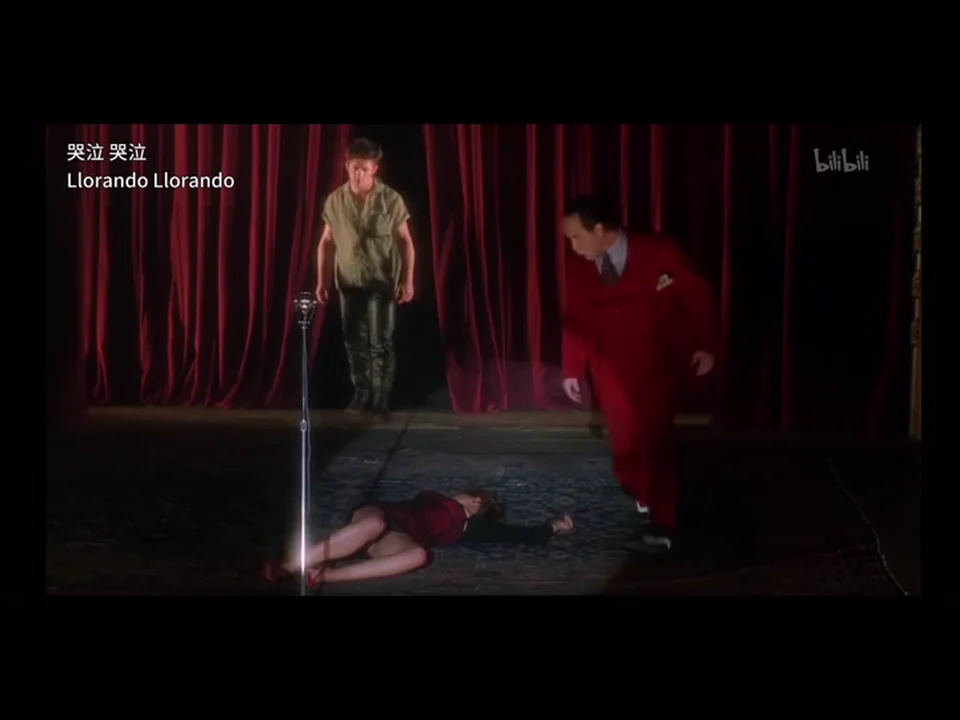 Watch sequence · 00:07:07 ↗
The body's collapse does not stop the voice: visible source and actual playback separate in the same instant. Black Swan 2010 · Later comparison
The mirror first trains the body; then reflection, role, and wound acquire the power to shape it in return. The Black Swan is not a second personality hidden inside Nina but an assemblage of rehearsal discipline, competitive gazes, mirrors, and stage that produces her.
1. Mirror corrects the body — The studio encloses Nina within mirrored walls, instruction, and repeated movement; each posture receives immediate reflected feedback.
Reflection initially serves sensory-motor training, reducing the body to a correctable and comparable unit of performance.
2. Reflection starts prescribing the original — Mirrored movement hesitates or slips, while Lily's face, Black Swan makeup, and Nina's bodily surface pass into one another; scratches and feathers intervene in seeing and acting.
The two visible materials no longer form original and copy. The virtual here is not another fictional personality inside Nina's mind but a differential structure composed of role memory, movement patterns, others' gazes, and bodily habits; it acts on actual movement and is altered again by each rehearsal.
3. Perfection drives capacity to rupture — In the finale, choreography, light, applause, and winged transformation reach maximum coherence while the bleeding body loses the possibility of continuing after 'I was perfect.'
As the role acquires full actuality it exhausts the performer; becoming is not psychological reconciliation but one event in which capacity increases and life contracts.
Synecdoche, New York 2008 · Later comparison
The warehouse stage is not a reduced model of reality. It copies its observer, enlarges itself, and rehearses reality's next version until life and performance become one productive machine without an outside.
1. Stage-seed expands into milieu — Caden begins by copying a room and gradually builds streets, apartments, workplaces, and another warehouse inside the warehouse.
The local model ceases to depend on the external city and keeps crystallizing a new milieu capable of enclosing its inhabitants.
2. The double rehearses the original — Sammy observes Caden for years, plays him, and enters his relationships; actors later replace actors, and life decisions enter rehearsal.
The copy does not merely reflect existing reality; it changes the original's next possible act, making actual and virtual versions condition one another.
3. Instruction takes the final body — After figures and spectators disperse, Caden follows an earpiece through blocking, cleaning, and farewell in the empty city, finally receiving the instruction to die.
Invisible speech becomes editing and action program; brain, stage, and city close into a screen that continues to operate.
05 · Peaks of present and sheets of past: fourth commentary on Bergson
The past coexists in sheets; the present forks into mutually incompossible peaks. Non-linearity changes which presents can coexist and how they relate, rather than merely scrambling order.
Chapter 5 analysis →Sheets of the past
Sheets of the past are not former presents stacked in chronological order but virtual regions in which the pure past exists at different degrees of contraction; the whole past coexists virtually with every present. Recollection does not retrieve a ready-made copy from storage. Starting from a present problem, it leaps into a region, searches along a sheet, and actualizes a recollection-image; the search may also change sheets, misrecognize, or fail.
Peaks of the present
Peaks of the present make several mutually incompossible presents persist as present and thereby deactualize the single continuous and decidable 'real present.' This is not a set of viewpoints upon an already settled event. The image sustains mutually exclusive present worlds without an external master version that can reduce the others to errors.
Depth of field and searching the past
Depth of field keeps bodies and events at different distances in relation. Citizen Kane arranges childhood, family, power and investigation across spatial depths that can participate in entering and searching the past. The organization of figures, camera and narration matters; deep focus alone is not a sheet of past.
World-memory and Resnais's temporal topology
Memory can exceed an individual's psychological possession and concern regions preserved by war, cities and history. Hiroshima mon amour connects wounds from two places through intimacy; Muriel lets colonial violence intrude into everyday life. Resnais organizes passages and transformations between sheets, making space a map of mnemonic relations.
Undecidable alternatives and incompossible presents
When several versions persist without entering one past-to-present sequence, choosing no longer means identifying the correct memory. Repeated gestures, spaces and accounts in Last Year at Marienbad sustain conflicting presents. The issue becomes the construction of temporal relations rather than a final missing clue.
Chronosign
Chronosign is the superordinate classification used when temporal relations directly organize the connection of images rather than merely measuring or resulting from action. Chapter 5 distinguishes two branches that are distinct and non-interchangeable: sheets of past make the virtual past coexisting with the present into regions of recollection-search, while peaks of present sustain incompossible presents and deactualize the single present. Both are signs of direct time, but they answer different problems.
Chapter source: Cinema 2, Minnesota 1989, chapter 5, pp. 98–125
Providence 1977
Bodily noise, weather, war, and fictional figures translate into one another, organizing the world as repeatedly redistributed cerebral sheets.
1. Body and world exchange sound — Coughs, intestinal noises, thunder, gunshots, and explosions continue one another through editing.
Viscera and historical outside cease to be separate levels; sound forms a brain-world membrane.
2. Relations are repeatedly reassigned — A figure changes age, place, desire, and kinship as spaces recur under narration.
Continuity no longer guarantees identity; sheets of past are reassigned at every shift.
3. Daylight crosses nocturnal fiction — The morning birthday gathering rearranges prior figures while retaining affective and bodily traces of the night stories.
Reality does not judge fiction; it composes a transverse sheet across versions.
Groundhog Day 1993 · Later comparison
The loop first turns memory into control of the milieu, then redirects repetition toward practice, care, and relations without guarantee.
1. Repetition trains prediction — Alarm, radio, weather, and street corner restart daily; Phil predicts people and accidents with growing precision.
The loop initially strengthens the sensory-motor schema rather than automatically producing direct time.
2. Knowledge becomes manipulation — Theft, seduction script, and cataloguing Rita’s preferences turn memory into action programs for desired outcomes.
Differences of the past are compressed into a more efficient present.
3. Action leaves return behind — Piano practice, care for the dying man, and help for strangers no longer guarantee escape.
Repetition changes from a technology of control into sustained production of capacities and relations.
Hiroshima mon amour 1959
Hiroshima and Nevers are not two stories explained in sequence; bodies, archives, and mutually negating voices make two pasts rewrite one another in a shared present.
1. Sound and image first conflict — Embracing bodies are covered in ash-like particles while hospitals, wounds, and museum images appear; she says she saw, and he replies that she saw nothing.
Testimony does not settle the images; visible material and speech remain irreducible from the outset.
2. One body summons another city — The Japanese man's sleeping posture, hand, and skin trigger the German lover's corpse, the shaving, the cellar, and Nevers streets.
Recollection no longer supplies present causality; one sheet of coexisting past invades the current body.
3. Cities become names — Night wandering and café dialogue end with the two addressing one another as 'Hiroshima' and 'Nevers.'
The private encounter becomes two unpossessable world-memories that the present relation can bear but not resolve.
Last Year at Marienbad 1961
Repetition does not recover one determinate encounter; it gives 'already happened,' 'never happened,' and 'happening now' presents of their own.
1. Architecture speaks before the event — A voice repeatedly describes corridors, mirrors, ceilings, and silent guests as the camera glides through symmetrical space.
Place no longer locates a past event; it becomes a machine that continually produces déjà vu.
2. The encounter forks into versions — When the same conversation returns in garden, bedroom, and bar, dress, posture, refusal, and consent keep changing.
The differences cannot be assigned to one missing true timeline; versions coexist as incompossible presents.
3. Departure cannot close the circuit — Shooting, the hotel game, and the final departure appear as fact, hypothesis, or replay, with no level appointed as judge.
Actual and virtual continue to exchange positions; the ending only extends the crystalline circuit.
24 City 2008 · Later comparison
Demolition, oral testimony, and performed witness rewrite one another's truth-status, making a factory past a memory produced by many and owned by none.
1. The site erases itself — Workshops, machines, moving crews, and demolition dust at Factory 420 are juxtaposed with images of the new development.
As testimony occurs, its material referent is disappearing; place cannot preserve the past intact.
2. Actors enter the testimonial series — Workers and performers including Joan Chen, Lü Liping, and Zhao Tao recount migration, love, and work in the same frontal interview form.
Professional identity cannot serve as final judge of authenticity; performance and witness must be tested through concrete detail rather than labels.
3. Memory circulates across materials — Old photographs, popular songs, dialects, silent faces, and new housing answer one another across decades.
The power of the false does not cancel history; it lets incompatible materials produce the city's sheets of past together.
In the Mood for Love 2000 · Later comparison
Repeated routes and rehearsed dialogue let an unrealized relation remain active within actual life, making memory not hindsight but the virtual face of the present.
1. Everyday routes begin to repeat — Narrow corridors, stairs, and noodle stall return under the same music as passing, collecting food, and waiting differ slightly each time.
Repetition does more than condense time; it gives the unspoken relation increasing actual pressure.
2. Rehearsal changes the present relation — Chow and Su act out how their spouses began the affair and how confrontation might occur, with scenes only later revealing themselves as rehearsal.
The virtual scene is not a false detour; it changes what the two can actually say and do.
3. The secret becomes material residue — Years later, Chow whispers the secret into a hole at Angkor Wat and seals it with mud; he leaves while the camera remains.
The unrealized relation leaves personal action and persists as a virtual past in an actual site.
Kaili Blues 2015 · Later comparison
The Dangmai long take does not arrange past, present, and future in sequence; it lets different ages, wishes, and objects provisionally exchange positions within one duration.
1. The journey carries several pasts — Chen Sheng enters Dangmai carrying the search for Weiwei, the old doctor's request, memory of a former lover, and a photograph, cassette, and shirt to deliver to the doctor's former lover.
The action-goal is already occupied by several pasts; the journey cannot unfold through search causality alone.
2. The long take lets times exchange — Motorbike, walking, ferry, and song pass the camera among figures; the young Weiwei and a woman hairdresser who resembles Chen Sheng's late wife seem to occupy others' past or future positions.
Unbroken space does not guarantee one present; it lets several temporal layers actualize at once.
3. Objects leave temporal anchors — Watches, pinwheel, train motif, and reversed clock return around the long take without restoring a single timeline.
Sheets of past and peaks of present touch through objects, leaving time perceptible but not totalizable.
Russian Ark 2002 · Later comparison
The single take does not compress history into one continuous present; it makes the Hermitage a memory-machine for selecting, losing, and changing among coexisting pasts.
1. Thresholds keep changing epochs — An unseen narrator and the Marquis cross successive doors as Peter the Great, Catherine, siege memory, and contemporary visitors appear in adjacent rooms.
Spatial continuity does not equal chronological continuity; each room selects a coexisting sheet of past.
2. Companions carry different histories — The Marquis recognizes art and court ritual while the narrator knows revolution, war, and the museum's future; their voices dispute what they see.
The past is not a unified national memory; positions from different eras select one another within the present.
3. The ball flows into a sea of time — After the grand ball, the crowd pours down the staircase, and the final view beyond the window makes the Hermitage seem afloat on a sea.
The ark preserves not one history but pasts that could not be lived together, allowing them to coexist and travel.
Citizen Kane 1941
A reporter searches a whole life through one word, but testimony, deep-focus space, and the final unseen sled distribute Kane across several coexisting sheets of past.
1. A last word starts the search — Kane says 'Rosebud' before dying and drops a snow globe; the reporter then consults Thatcher's unpublished memoir and interviews Bernstein, Leland, Susan, and the butler Raymond.
A word is installed as a solvable clue, as if the past could be recalled sheet by sheet through testimony.
2. One life divides among different sheets — Each testimony enters a different age, space, and affective position; the deep-focus guardianship scene holds the indoor contract together with the child playing in snow outside.
The past does not queue along one causal line but coexists in planes that cannot totalize one another.
3. The answer leaves the investigator behind — The reporter concludes that no single possession can explain a man; workers then throw the childhood sled marked 'Rosebud' into the furnace, unseen by the investigators.
The disclosure does not synthesize the sheets into a truth; it shows the image preserving a past neither character nor inquiry can actualize.
Je t’aime, je t’aime 1968
The time machine is meant to reproduce one minute but throws Claude into a past that contracts, repeats, and misjoins; the more precisely memory returns, the less its former present can be repossessed.
1. The experiment specifies a former present — Scientists place Claude, after his suicide attempt, inside a sealed capsule and plan to return him precisely to one minute on a beach with Catrine a year earlier.
The past is first treated as a locatable and measurable former present that technology can actualize again.
2. One minute splits into unequal fragments — After the apparatus fails, the beach pose and the same words recur, then abruptly cut to bedroom, office, bathroom, and other moments in the relationship.
Time no longer follows calendar order; the same detail opens onto sheets of past at different degrees of contraction.
3. Return cannot revise — Catrine's death and Claude's self-destructive impulse approach through different fragments, but repetition carries him away before he can remain in any return and act otherwise.
The past remains fully operative while refusing to become a revisable present; the experiment exposes a circuit of time rather than control over time travel.
The Rules of the Game 1939
The estate mirrors theatre and life, masters and servants into a crystal; hunt and mistaken killing expose its fissure, leaving role-order to be barely restored by an account supplied after the fact.
1. Roles rehearse one another — At the country-house gathering, hosts, guests, and servants pursue mirrored affairs and deceptions; automata, masquerade, and stage entertainment turn social roles into overt performance.
Life and theatre lose any stable ontological order, each supplying an actual version of the other.
2. The hunt scores a fissure — Across the hunt, servants beat the brush, rabbits and birds flee, shots repeat, and animals fall in rapid alternation; estate ritual reveals itself as organized violence.
A real fissure appears within the performed order that elegant roles cannot fully absorb.
3. A mistaken killing is renamed — During the night chase, André leaves wearing Octave's coat and is shot by Schumacher as the intended target; Robert immediately announces the death to the guests as an accident.
An exchange of roles produces an actual death; the retrospective account can cover the crack but cannot restore an intact crystal.
All About Eve 1950
All About Eve splits one backstage present into competing sheets of past: each recollection gives the same entrance, friendship, and betrayal a new weight of reality.
1. The award-night present recalls the past — The film begins with Eve already on the award platform, then sends the spectator into different characters' recollections through camera and voice-over.
The present is not the endpoint of recollection but the interface through which several sheets enter; coordinate: Cinema 2, ch. 3, pp. 50–51.
2. The same event changes weight — Karen, Margo, and Eve recount the backstage encounter; the same courtesy, pause, and phone call acquire different motives in each telling.
Recollection is not a storehouse of facts; it reconnects a sheet of past to each figure's present desire and responsibility.
3. The future copies the past — At the end a new girl arrives and repeats Eve's entrance into Margo's home; success under the spotlight returns as a repeatable cycle.
Unlike ordinary flashback, the sheet of past determines a future act in return. Read beside Last Year at Marienbad, the film shows how choice becomes a repeatable social mechanism.
L’Immortelle 1963
L'Immortelle makes the same night appear as mutually exclusive peaks of the present; roads, rooms, and the woman's name do not lead narration to an adjudicable version.
1. The road produces difference first — The man repeatedly drives through Istanbul; night roads, coast, and buildings seem the same yet bring him to a different encounter each time.
Spatial continuity is interrupted by minute differences, so the present is no longer one moment; Cinema 2, ch. 5, p. 106 places the film within the problem of peaks.
2. The name becomes an indiscernible point — The woman's name, room, and photograph mutate in conversation; the spectator cannot settle whether she is missing, remembered, or narratively induced.
The film does not hide one stable identity; difference of identity organizes seeing, with each version changing the credibility of the previous one.
3. The ending restores no tribunal — The man returns to the same road and meets death; the loop seems closed, yet no shot gathers every version into a cause.
Read beside Last Year at Marienbad: L'Immortelle refuses one present through peaks, while the latter places sheets and peaks together; both make the spectator carry judgement.
Muriel 1963
Muriel keeps the wartime past fractured across short shots, rooms, and repeated speech; the present cannot assemble them into one completed memory and must continue under their pressure.
1. Everyday surfaces cover the wartime sheet — Apartment arrangement, furniture movement, and walks by the sea form a present of continuous action, while Algerian fragments intrude as abrupt short shots.
The past is not explanatory background but a coexisting sheet that can alter the present's rhythm; Cinema 2, ch. 5, pp. 116, 118, 120, and 122–123 are film-level primary coordinates, while the present shot mechanism is this site's analysis.
2. Repetition mutates rather than completes — The same wartime word, photograph, and bodily attitude recur in different rooms, each time with one less piece of confirmable causality.
Repetition presses the sheet back onto the present without becoming a complete flashback; the spectator must read how absence organizes responsibility.
3. Fragments become ethical pressure — Bernard's silence, Hélène's arrangements, and Alphonse's return never reduce Muriel to a solvable case.
Read beside Hiroshima mon amour, private and wartime pasts remain incommensurable; the audio-visual gap becomes a lectosign rather than an information deficit.
Long Day’s Journey into Night 2018 · Later comparison
Bi Gan first turns memory into a set of narratives that cannot be closed, then presses those versions into one present through a continuous 3D journey; the long take matters not because it is long, but because it lets past, dream, and present rewrite one another.
1. Memory first creates a gap — In the first half, voice-over, photographs, songs, clocks, and recurring names call back Wan Qiwen without restoring her as an object the protagonist can finally investigate; Kaili becomes a memory-terrain made of lost things, debts, and unfulfilled promises.
The past is no longer background explaining the present; it is a virtual layer that continually changes how the present can be seen, spoken, and searched.
2. The transition makes the dream spatial — After the transition into the 3D long take, the figure moves through a billiard hall, stairs, rooftops, a bridge, streets, and a karaoke room; space stays continuous while relations and temporal positions drift, with the young position, the resemblance between Kaizhen and Wan Qiwen, and the present Luo Hongwu rewriting one another.
Continuous space does not guarantee one reality; it becomes a passage through the crystal, where each turn can send the actual face into another sheet of the past.
3. Return leaves an unfinished present — The long take returns to a field of singing, fireworks, and farewell without sealing the dream as false or memory as true; the protagonist receives an approach that still echoes, not compensation for what was lost.
The time-image is not an escape from reality; it makes reality bear a relation that cannot be solved. The dream is measured by its capacity to change the present.
06 · The powers of the false
The powers of the false appear when the person or position that judges truth also enters a metamorphic series. Truth and falsity keep being produced inside narration.
Chapter 6 analysis →Organic and crystalline description
Organic description presupposes an independently existing world that views can complement. Crystalline description creates, erases and modifies its object through presentation; later descriptions change the standing of earlier ones. Marienbad repeatedly redescribes spaces and encounters without recovering one complete scene awaiting confirmation.
Truthful and falsifying narration
Truthful narration can contain lies while preserving a common standard for identifying the real world. Falsifying narration affects that standard, transforming identities, events and temporal relations together. A twist that restores one explanation may remain truthful narration; the question is how judgment itself enters transformation.
Powers of the false
Narration abandons a recoverable model of truth and lets characters, testimonies, memories, and worlds mutate through a series of falsifiers. The false gains creative power by freeing itself from a model of truth.
The series of forgers
Forgers include those who make, authenticate, circulate and believe a version. The series progressively removes the external position of authority: artists, experts, markets and narrator in F for Fake all participate in producing authenticity. The film turns from an individual's fraud to the operation of judgment, including its own narration.
Life, becoming and evaluation
Abandoning one truthful model does not make every version equivalent. Through Nietzsche, Deleuze distinguishes forces that fix and exhaust life from those that transform relations and create possibilities. Evaluation asks what an image or narration can do: reproduce domination or make other connections possible.
Fabulation
Characters and filmmakers jointly remake reality through narration, performance, and re-enactment. Story no longer serves a prior truth; it creates a speaking position for a collective still in formation.
Chapter source: Cinema 2, Minnesota 1989, chapter 6, pp. 126–155
Close-Up 1990 · Later comparison
Trial, documentary recording, and reenactment make participants perform themselves; truth-testing shifts toward what relations and lives a lie can produce.
1. A chance object interrupts inquiry — As the reporter accompanies police to the Ahankhah home to arrest Sabzian, an aerosol can rolls down the street and the camera leaves people and testimony.
‘Finding truth’ no longer monopolizes the image; chance reality retains force of its own.
2. Participants perform themselves — Direct address in court intersects with reenactment of the first visit; Sabzian is defendant, actor, and author.
True and false identities lose a single tribunal and enter a productive series.
3. Technical gap keeps the ending open — Sound repeatedly fails during Sabzian’s motorcycle meeting with Makhmalbaf.
Reconciliation is arranged and accidental; incomplete sound refuses to certify a final real.
 Watch sequence · 00:54:30 ↗
The courtroom image presents Sabzian at once as defendant, performer, and self-narrator.  Watch sequence · 01:04:30 ↗
Reenactment asks the actual participant to play himself again, joining fact and performance in one body.  Watch sequence · 01:34:00 ↗
The meeting carries impersonation into a real relation; failing sound refuses to seal reconciliation as final proof. This Is Not a Film 2011 · Later comparison
Law blocks filmmaking action, yet speech, tape, and domestic devices give the absent film visible form.
1. The ban becomes space — The director is confined to his apartment; doors, windows, phone, and news sound press the political outside into the interior.
Law is not merely explained; it is filmed as a boundary on body and space.
2. Speech actualizes the unmade film — Tape outlines a set on the carpet as Panahi demonstrates screenplay, blocking, and shots through voice and gesture.
The speech-act gives the virtual film a temporary actual structure.
3. Devices open the political outside — Phone and camera first film one another; Panahi then switches to the video camera and follows an art student who is covering a shift and collecting rubbish floor by floor down the lift toward the street fires.
Private confinement connects to collective repression, and a new position of enunciation forms through filming.
Faces 1968
Laughter, drunkenness, pauses, and collapse make bodies continually change attitude, placing character truth not behind dialogue but in the time of gestural modulation.
1. Laughter conceals and exposes relations — Handheld close-ups stay with laughing faces, interruptions, embraces, and sudden silences, making faces modulate within one conversation.
Dialogue cannot stabilize character; attitude bears the fact that relations are changing.
2. Performance slides into endurance — Flirtation, dance, and exaggerated joking gradually become extended fatigue, humiliation, and bodily loss of control.
The body no longer performs social action; it becomes the surface on which time and pressure fall.
3. Morning offers no reconciliation — Rescue after the suicide attempt, sitting on the stairs, and fragmentary talk leave the couple in a new attitude not yet named.
The event is not recovered by psychological explanation; bodily change itself becomes the open ending.
F for Fake 1973
Editing lets forger, expert, market, and director take turns holding authority, until even the position that exposes deception enters the series of falsifiers.
1. The director signs a temporal contract — With magic tricks, editing table, and direct address, Welles promises that the next hour will be true.
Truth is not an external standard; it is established as a speech act the filmmaker can manipulate.
2. Authority keeps changing hands — Elmyr's paintings, Irving's biography, expert certificates, museums, and the art market authenticate and undo one another.
Original and fake can no longer be separated by a final tribunal; the judge becomes another figure in the series.
3. Exposure keeps producing truth-effects — Welles admits that the Oja-Picasso story is invented, yet it has already organized looking, desire, and authorship.
The false no longer merely conceals fact; it shows how narration produces truths that circulate.
Moi, un noir 1958
Assumed names, postsynchronized voices, and urban labour do not conceal true identity; they let filmed subjects invent speaking selves beyond assigned positions.
1. Aliases open virtual identities — Young Nigerien migrants in Abidjan introduce themselves through movie-star names such as Edward G. Robinson and Eddie Constantine.
The alias does not copy a star; it opens a subject-position not yet actualized within material poverty.
2. Voice reclaims the image — After filming, participants add first-person commentary to images of their labour, desire, failures, and neighbourhood.
The recorded body ceases to be an object of study; voice acts back on what the image can mean.
3. Fantasy enters shared reality — Boxing, dance, heroic fantasy, and casual dock labour alternate as personal narration circulates among friends' responses.
Fabulation makes fictional identity a real resource for collective enunciation rather than a dream of escape.
24 City 2008 · Later comparison
Demolition, oral testimony, and performed witness rewrite one another's truth-status, making a factory past a memory produced by many and owned by none.
1. The site erases itself — Workshops, machines, moving crews, and demolition dust at Factory 420 are juxtaposed with images of the new development.
As testimony occurs, its material referent is disappearing; place cannot preserve the past intact.
2. Actors enter the testimonial series — Workers and performers including Joan Chen, Lü Liping, and Zhao Tao recount migration, love, and work in the same frontal interview form.
Professional identity cannot serve as final judge of authenticity; performance and witness must be tested through concrete detail rather than labels.
3. Memory circulates across materials — Old photographs, popular songs, dialects, silent faces, and new housing answer one another across decades.
The power of the false does not cancel history; it lets incompatible materials produce the city's sheets of past together.
The Lady from Shanghai 1947
Deception first makes identities exchange within narration; the funhouse and mirror maze then turn that unreliable relation into a visible circuit of copies until gunfire cracks the crystal.
1. Each figure supplies a version — Once Michael boards Bannister's yacht, Elsa, Grisby, and Bannister each advance accounts of love, faked death, murder, and legal escape.
Action proceeds through narratives that keep changing hands, drawing any stable tribunal of fact into the deceptive relation.
2. The funhouse spatializes versions — Michael crosses funhouse sets that rotate, tilt, and distort bodily scale; shadows, false passages, and grotesque surfaces block a straight escape.
Narrative unreliability becomes spatial unreliability as bodies and doubles lose stable coordinates.
3. Shattered mirrors terminate exchange — The hall of mirrors multiplies Elsa, Bannister, and their guns into rows of images; they fire at reflections, cracks spread, and only after mirrors fall do wounded bodies re-emerge.
Actual body and mirror-image become briefly indiscernible; gunfire does not expose one illusion but destroys the circuit sustaining their exchange.
L’Immortelle 1963
L'Immortelle makes the same night appear as mutually exclusive peaks of the present; roads, rooms, and the woman's name do not lead narration to an adjudicable version.
1. The road produces difference first — The man repeatedly drives through Istanbul; night roads, coast, and buildings seem the same yet bring him to a different encounter each time.
Spatial continuity is interrupted by minute differences, so the present is no longer one moment; Cinema 2, ch. 5, p. 106 places the film within the problem of peaks.
2. The name becomes an indiscernible point — The woman's name, room, and photograph mutate in conversation; the spectator cannot settle whether she is missing, remembered, or narratively induced.
The film does not hide one stable identity; difference of identity organizes seeing, with each version changing the credibility of the previous one.
3. The ending restores no tribunal — The man returns to the same road and meets death; the loop seems closed, yet no shot gathers every version into a cause.
Read beside Last Year at Marienbad: L'Immortelle refuses one present through peaks, while the latter places sheets and peaks together; both make the spectator carry judgement.
Mulholland Drive 2001 · Later comparison
Lynch does not first give us a dream and then solve it with reality. Audition, Club Silencio, and blue box successively alter the evidentiary force of bodies, voices, names, and objects, making two lives actual and virtual to one another.
1. Performance first produces reality — When Betty reaches Hollywood, the innocent newcomer, amnesiac Rita, star's apartment, and audition opportunity resemble the clichés of a wish-world. Yet the audition abruptly shifts from broad rehearsal to proximity, whispers, and threat, rewriting the relations in the room through performance itself.
Performance no longer copies a pre-existing character; the image produces an intensity of reality that in turn determines who the figure can be.
2. Sound revokes the body's monopoly on evidence — Club Silencio repeats that there is no band and everything is recorded. During Rebekah Del Rio's Llorando, spectators still synthesize voice and body as one live event, until she collapses and is carried away while the song continues.
Visible body and recording are both actual materials. The collapse first breaks the attribution of source, then lets virtual layers of unseen event, memory, and performed identity enter the current situation and alter what counts as credible.
3. The blue box redistributes two lives — After the blue box opens, Betty/Diane, Rita/Camilla, successful audition/failed actor, love/hired murder, and blue key change places; objects and encounters from the first half acquire new debts and causes in the second.
The second half does not cancel the first as false. Each side keeps rewriting the other, turning truth from adjudication of one version into the tracing of transformations between versions.
Watch sequence · 00:07:07 ↗The body's collapse does not stop the voice: visible source and actual playback separate in the same instant.  Watch this sequence · 00:10:00 ↗
Pour la suite du monde · Preparing to revive the beluga hunt
Subsequent images show deliberation becoming roles, equipment, and shared labour.
Image: Three island men confer above the river; one handles a wooden post or tool. The hunt concerns the beluga, locally called marsouin blanc.
Sound: French location dialogue discusses preparations still to be made; the official player supplies English subtitles.
 Watch this sequence · 00:15:00 ↗
Pour la suite du monde · Low-tide knowledge is spoken back into use
Later judgements of tide, placement of posts, and collective labour take up this knowledge.
Image: Older islanders converse face-to-face beside a building in winter.
Sound: The dialogue specifies that the work must take place at low tide.
 Watch this sequence · 00:20:00 ↗
Pour la suite du monde · Announcing the project to the island
The sequel shows recruits, delegated roles, financing, and collective construction.
Image: A man explains the project to two others outside a wooden building.
Sound: The exchange frames the task as informing residents and drawing them into a collective intention.
 Watch this sequence · 00:25:00 ↗
Pour la suite du monde · Financing the revived hunt
The calculation belongs to the film’s larger collective reconstruction and leads toward purchase and construction.
Image: A seated man speaks during an indoor meeting; the frame concentrates on his profile and expression.
Sound: The discussion calculates a purchase in units priced at 500 dollars.
 Watch this sequence · 00:30:00 ↗
Pour la suite du monde · On the river, the hunt becomes an origin story
The attribution records the islanders’ narrative position; Indigenous history requires separate independent evidence.
Image: Men cluster on a working boat while the river continues moving behind them.
Sound: Conversation invokes earlier times and attributes the practice’s invention to Indigenous inhabitants before the settlers.
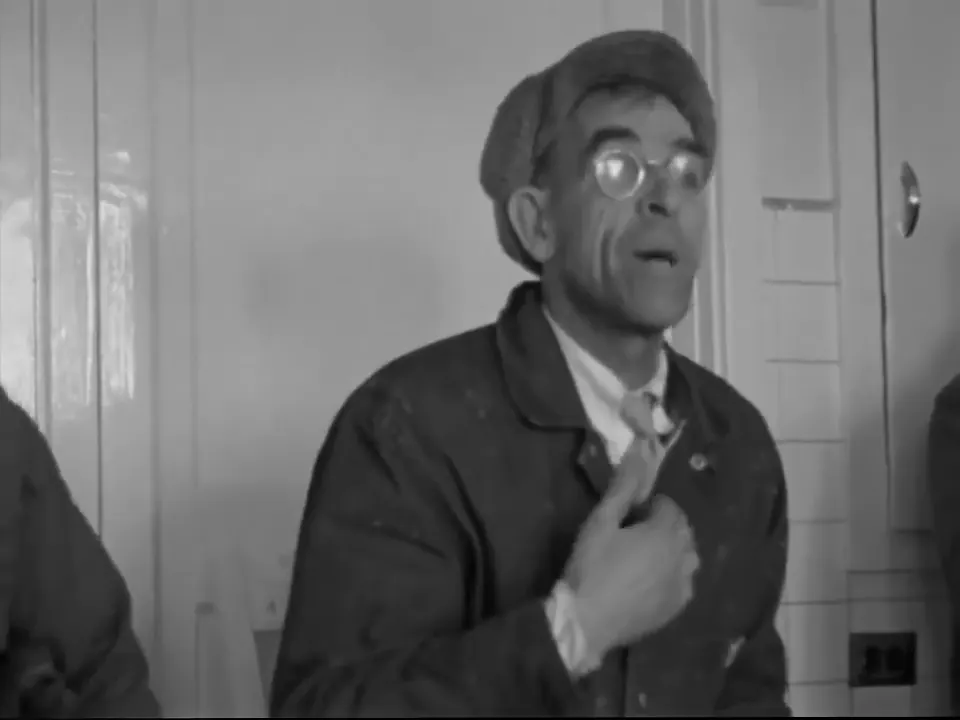 Watch this sequence · 00:35:00 ↗
Pour la suite du monde · How to outwit the whale
Later collective construction and hunting give the utterance practical force.
Image: An older man speaks indoors and gestures toward his chest while others listen.
Sound: He explains that the hunters must be more cunning than the whale.
 Watch this sequence · 00:43:56 ↗
Pour la suite du monde · Setting posts in the tide
The labour itself is action; its temporal relation comes from the full genesis from oral account to construction.
Image: Several islanders stand knee-deep in the tide among rows of set posts, steadying and adjusting an upright post; the sequence turns to the water, post rows, and close views of hands.
Sound: The dialogue discusses spacing posts about one pace (roughly three feet) apart, how water entering the boat impedes the work, and earlier labour in the water wearing leather boots.
 Watch this sequence · 01:10:00 ↗
Pour la suite du monde · Workshop debate over the origin of the posts
The scene establishes the speakers’ conjecture and memory; historical fact requires Indigenous sources and archival verification.
Image: Two men converse beside a furnace fire in a workshop.
Sound: The exchange asks where Indigenous people obtained the idea for the posts.
 Watch this sequence · 01:30:00 ↗
Pour la suite du monde · Gathering around the captured beluga
This segment first establishes a shared result; the later explicit delegation establishes plural speaking authority.
Image: Islanders gather around the captured beluga as it is prepared for transport; the sequence cuts to a speaker beside a vehicle and to the assembled group again.
Sound: The dialogue expresses joy after the capture and mentions God; no formal prayer is identifiable in this window.
 Watch this sequence · 01:40:00 ↗
Pour la suite du monde · Delegating a spokesman at the aquarium
Delegation is spoken by group members and changes who can speak in what capacity.
Image: Three men converse in an outdoor area of the aquarium; one occupies the position between the other two.
Sound: The exchange explicitly delegates one participant to speak for the group.
07 · Thought and cinema
Shock does not automatically produce thought. Thought begins in the unfillable interval between shock and image, sound, or body.
Chapter 7 analysis →The spiritual automaton
Cinema's automatic movement places thought within a process it does not initiate autonomously. Early theory hoped image-shock would awaken thought of a whole; Deleuze also asks how this automaticity can be captured. The spiritual automaton names a relation between moving images and thought, not a robot onscreen.
Shock, internal monologue and the whole
Eisenstein treats conflict between shots as a movement forcing thought beyond individual images. Image-to-concept, thought-to-image and the bond between humans and world form connected problems. The fragmentation of the Odessa Steps seeks more than intensity: it organizes suffering into a judgment concerning a historical whole.
The powerlessness of thought
Artaud turns cinematic thought toward an internal fissure: thought cannot naturally gather the images it encounters or guarantee its own capacity to think. Cinema moves from producing assured judgment toward making this powerlessness perceptible. The rupture must occur in image relations, beyond a character declaring confusion.
Belief in this world
After the bond with the world fails, belief is no longer the result of complete knowledge. It becomes a capacity to relate anew to bodies, love and this world. Europa ’51's protagonist cannot translate what she sees into a normal social role yet continues responding to suffering. Belief concerns living here, not a guarantee from another world.
Choice as a mode of existence
Choice concerns more than selecting an outcome from a menu: it involves becoming someone able to choose. Dreyer, Bresson and Rohmer place ethical problems within attitudes, encounters and duration. Its significance appears in a way of existing, not in the number of plot alternatives.
Theorem and problem
A theorem-like construction develops relations from conditions; a problematic one exposes the conditions themselves to an encounter from outside. The visitor in Teorema transforms each family member's life without gathering the changes into one psychological explanation. The problem sustains several directions of becoming.
Irrational cut / interstice
Deducible continuity among shots, sounds, and images gives way to an irreducible interval between series. Thought is forced to happen within it. A cut can separate shots or divide sound from visible events within one image. Instead of restoring continuity by supplying missing information, it keeps image series apart and forms relations through that distance. Passion's tableaux, labour and sounds must be read together in this way.
The outside and relinking
The modern whole no longer guarantees the eventual integration of shots. The interstice becomes a relation to the outside. Godard relinks words, images, labour and art across cuts, producing connections through differences. The outside is not another location to film, but what prevents established relations from closing on themselves.
Chapter source: Cinema 2, Minnesota 1989, chapter 7, pp. 156–188
Pierrot le fou 1965
Colour blocks, advertising speech, songs, and explosion repeatedly cut the road movie's continuous route, forcing the image to be read between shots rather than inside the story.
1. Clichés saturate the everyday — Party guests recite advertising copy while magazines, comics, and primary-colour planes enter Ferdinand and Marianne's escape.
Language and image first appear as ready-made fragments the characters cannot unify into a credible world.
2. The journey is joined by intervals — Cars, coast, diary, song, and direct address jump across one another, while sound often crosses or refuses visual causality.
The 'and' of editing replaces the natural passage from one action to the next.
3. Self-destruction cannot restore the whole — Ferdinand paints his face blue and wraps himself in dynamite; his cry of regret is cut by the blast, followed only by sea and verse.
The endpoint of action does not close the story; the irrational cut leaves thought in the audio-visual remainder.
Teorema 1968
The visitor's arrival and departure supply no solution; they push each social role in a family to a point where it can no longer perform itself.
1. One visitor triggers different relations — The visitor approaches maid, son, mother, daughter, and father in turn, with repetition preserving the difference of each bodily relation.
The family is not explained by one seduction; it is split into five problems not yet formed.
2. Departure disables roles — After the visitor leaves, the maid levitates, the son paints, the mother seeks strangers, the daughter becomes rigid, and the father gives away his factory.
No act restores family order; each drives an existing identity toward impossibility.
3. The problem remains in the desert — The father walks naked through station and wasteland, and his final prolonged cry receives neither answer nor explanation.
The film does not prove a proposition by conclusion; it lets the unthinkable persist as body and empty space.
Passion 1982
Unfinished restagings of paintings, factory conflict, and broken speech refuse to form one story, making thought arise in intervals among bodies and sites.
1. Restaging stalls in light — The studio repeatedly stages tableaux after Rembrandt, Goya, and Delacroix, while the director insists the light is wrong and the story cannot be found.
Image production ceases to obey the goal of a finished work; bodily attitude becomes an autonomous problem.
2. Factory speech refuses subplot status — Isabelle's stammer, pauses, machine noise, and labour dispute cross studio and hotel without being absorbed by the director's art story.
Body and sound establish their own line of thought; labour cannot be reduced to background for the paintings.
3. Sites connect only through 'and' — Studio, factory, hotel, and road are repeatedly juxtaposed; when figures depart, film, love, and strike all remain unresolved.
The irrational cut replaces hierarchy, forcing thought between heterogeneous series.
Europe ’51 1952
The more Irene converts private grief into executable aid, the more factory, poverty, and institution reveal a relational scale beyond individual goodwill, turning her from agent into seer.
1. Aid takes over from mourning — After her son's death, Irene leaves the social world of her wealthy household, visits poor districts, gives money, seeks medicine, and takes a worker's shift.
Grief is first extended into a series of helpful acts that still have objects, aims, and results.
2. The factory overwhelms the scale of action — On a shop floor whose pounding fills the soundtrack, machines stamp repeatedly and rows of workers follow one rhythm; Irene walks through, stops, and looks, her body reduced in scale.
One substituted shift cannot exhaust the industrial relation before her; sight and noise cease to be task-cues and become a situation without an immediate response.
3. The institution renames seeing — After she cares for a dying woman, helps a fugitive leave, and urges him to surrender, family, doctors, and court commit her; at the end she looks through a high window as visitors gaze up from outside.
The institution closes down her aid, but the relation of looking reverses: the diagnosed woman becomes the one who sees society's limit.
Gertrud 1964
Gertrud detaches choice from calculable consequences: posture and silence make relation a visible problem before belief occurs in a present without guarantees.
1. Social space becomes a diagram of attitudes — Tables, sofas, and doorframes place Gertrud with husband, poet, and musician in one room while their gazes and bodies turn away from one another.
Action-information recedes and bodily attitude gains its own duration; Cinema 2, ch. 7, pp. 176 and 181–82 provide the primary locator.
2. Choice refuses exchange — Gertrud insists on an 'absolute love' and refuses to exchange feeling for marital security, career advantage, or social recognition.
Her choice is not a more efficient action but a failure of the evaluative standard of action itself; the body–thought relation becomes visible.
3. Stillness leaves belief — After the farewell, room, piano, and solitary posture provide no reconciliatory result, only a sustained attitude and a space one can return to.
Read beside Ordet's miracle, Gertrud shows belief without miracle: the world is not repaired, yet the figure persists through an attitude in this world.
08 · Cinema, body and brain, thought
The two routes described in this chapter let the body bear time through attitudes and the brain organize it through topological relations. Both generate thought from action’s failure.
Chapter 8 analysis →Bodily attitudes and time
Fatigue, waiting, intoxication and hesitation retain a before and after in the body. Shifting attitudes in A Woman Under the Influence unsettle stable explanations of family relations. The body exceeds its role as plot instrument: its duration and rhythm confront thought with relations not yet reduced to psychological motives.
Gestus
A gesture can expose distance, power and dependency between people. Gestus arises from the organization of attitudes rather than an actor's isolated flourish. Laughter, silence, gathering and dispersal in Faces change who can remain in a room and who is excluded, bringing social relations into bodily form.
Everyday life and ceremony
One pole of bodily cinema is repeated work and habit; another is dance, ceremony and performance. Both can give the body a time exceeding practical tasks. Minute rhythmic deviations in Jeanne Dielman and games and reenactments in Céline and Julie Go Boating let repetition produce new relations.
Brain cinema and topology
Brain cinema treats inside and outside, memory, linkage and rupture as problems of spatial organization. The technical environments and temporal leaps of 2001, and the narrated world of Providence, give form to thought's connections. The brain here is not an organ photographed, but a construction of how images connect and disconnect.
Bodily and cerebral poles of experimental cinema
Experiment can work on bodily speed, fatigue and sensation, or on black and white screens, flicker, cuts and connections. One pole exposes viewing to intensity; another makes its organization perceptible. These are different operations through which images provoke thought, not mutually exclusive genres.
The missing people and minority cinema
Modern political cinema no longer presupposes a unified people waiting for representation. Colonialism, class and language divide the collective, and private life directly bears political pressure. Rocha, Rouch and Perrault turn speech, myth and performance into problems of collective formation: a people is created through these relations.
Speech act and a people to come
The storytelling speech-act crosses private affairs and politics, produces collective utterances, and prefigures the people who are missing. Perrault's islanders move from announcing a plan to sharing work and delegating a voice. Rouch's participants change their visible identities through roles and stories. Individual speech and collective formation transform one another; no speaker naturally represents everyone.
Chapter source: Cinema 2, Minnesota 1989, chapter 8, pp. 189–224
Céline and Julie Go Boating 1974
Wandering, sweets, and replay let spectators enter fiction and alter it, making fantasy an action that produces real relations.
1. Everyday routes loosen — Dropped objects, pursuit, disguise, and chance meetings turn Parisian action into playful wandering.
Goals cease to govern perception; bodies acquire improvisational connectivity.
2. Sweets open the repeated scene — After the sweet is ingested, the house story replays in fragments, and the women alternate as spectators and doubles.
The sweet becomes a bodily threshold between actual everyday life and virtual drama.
3. Spectators rewrite fiction — The women enter the house together, interrupt the scripted death, and rescue the child.
Fabulation no longer repeats the story; it produces a new real relation.
This Is Not a Film 2011 · Later comparison
Law blocks filmmaking action, yet speech, tape, and domestic devices give the absent film visible form.
1. The ban becomes space — The director is confined to his apartment; doors, windows, phone, and news sound press the political outside into the interior.
Law is not merely explained; it is filmed as a boundary on body and space.
2. Speech actualizes the unmade film — Tape outlines a set on the carpet as Panahi demonstrates screenplay, blocking, and shots through voice and gesture.
The speech-act gives the virtual film a temporary actual structure.
3. Devices open the political outside — Phone and camera first film one another; Panahi then switches to the video camera and follows an art student who is covering a shift and collecting rubbish floor by floor down the lift toward the street fires.
Private confinement connects to collective repression, and a new position of enunciation forms through filming.
Providence 1977
Bodily noise, weather, war, and fictional figures translate into one another, organizing the world as repeatedly redistributed cerebral sheets.
1. Body and world exchange sound — Coughs, intestinal noises, thunder, gunshots, and explosions continue one another through editing.
Viscera and historical outside cease to be separate levels; sound forms a brain-world membrane.
2. Relations are repeatedly reassigned — A figure changes age, place, desire, and kinship as spaces recur under narration.
Continuity no longer guarantees identity; sheets of past are reassigned at every shift.
3. Daylight crosses nocturnal fiction — The morning birthday gathering rearranges prior figures while retaining affective and bodily traces of the night stories.
Reality does not judge fiction; it composes a transverse sheet across versions.
2001: A Space Odyssey 1968
Tool, computer, and star gate progressively carry human action beyond its own scale until brain-like space no longer obeys an executable route.
1. A tool compresses history — An ape recognizes a bone as a weapon; when it rises into the air, a match cut lands on an orbiting spacecraft.
A vast technical history folds into one continuity of movement, while the logic of the tool becomes the governing circuit of the human world.
2. Calculation captures perception — Through lenses, lip-reading, life data, and airlock control, HAL sees, interprets, and disposes of the astronauts at once.
The perception-action chain leaves the human body, turning the spacecraft into a closed cerebral circuit.
3. Route becomes the unthinkable — The star gate's colour, alien terrains, and white room cancel stable orientation; Bowman sees himself age successively within one space.
Action-space becomes a time-space thought cannot master in advance, forcing the spiritual automaton to confront its limit.
Pierrot le fou 1965
Colour blocks, advertising speech, songs, and explosion repeatedly cut the road movie's continuous route, forcing the image to be read between shots rather than inside the story.
1. Clichés saturate the everyday — Party guests recite advertising copy while magazines, comics, and primary-colour planes enter Ferdinand and Marianne's escape.
Language and image first appear as ready-made fragments the characters cannot unify into a credible world.
2. The journey is joined by intervals — Cars, coast, diary, song, and direct address jump across one another, while sound often crosses or refuses visual causality.
The 'and' of editing replaces the natural passage from one action to the next.
3. Self-destruction cannot restore the whole — Ferdinand paints his face blue and wraps himself in dynamite; his cry of regret is cut by the blast, followed only by sea and verse.
The endpoint of action does not close the story; the irrational cut leaves thought in the audio-visual remainder.
Passion 1982
Unfinished restagings of paintings, factory conflict, and broken speech refuse to form one story, making thought arise in intervals among bodies and sites.
1. Restaging stalls in light — The studio repeatedly stages tableaux after Rembrandt, Goya, and Delacroix, while the director insists the light is wrong and the story cannot be found.
Image production ceases to obey the goal of a finished work; bodily attitude becomes an autonomous problem.
2. Factory speech refuses subplot status — Isabelle's stammer, pauses, machine noise, and labour dispute cross studio and hotel without being absorbed by the director's art story.
Body and sound establish their own line of thought; labour cannot be reduced to background for the paintings.
3. Sites connect only through 'and' — Studio, factory, hotel, and road are repeatedly juxtaposed; when figures depart, film, love, and strike all remain unresolved.
The irrational cut replaces hierarchy, forcing thought between heterogeneous series.
Faces 1968
Laughter, drunkenness, pauses, and collapse make bodies continually change attitude, placing character truth not behind dialogue but in the time of gestural modulation.
1. Laughter conceals and exposes relations — Handheld close-ups stay with laughing faces, interruptions, embraces, and sudden silences, making faces modulate within one conversation.
Dialogue cannot stabilize character; attitude bears the fact that relations are changing.
2. Performance slides into endurance — Flirtation, dance, and exaggerated joking gradually become extended fatigue, humiliation, and bodily loss of control.
The body no longer performs social action; it becomes the surface on which time and pressure fall.
3. Morning offers no reconciliation — Rescue after the suicide attempt, sitting on the stairs, and fragmentary talk leave the couple in a new attitude not yet named.
The event is not recovered by psychological explanation; bodily change itself becomes the open ending.
A Woman Under the Influence 1974
The harder family commands try to restore Mabel as wife and mother, the more her body reveals times and intensities those roles cannot contain.
1. Everyday ritual loses measure — As Mabel greets her husband, hosts his workers, serves spaghetti, and gathers the children, her gestures, volume, and pauses exceed situational norms.
Domestic tasks continue, but the sensory-motor schema can no longer stabilize the body as a social role.
2. Commands produce disorder — Nick repeatedly orders her to sit, stop, and speak normally, summoning relatives and friends to watch and correct her.
Speech fails to manage the body and instead turns the household into an apparatus of escalating exposure.
3. Return is not restoration — The homecoming party rapidly breaks down; the couple clears the crowd, settles the children, and tidies the room, but can only provisionally recompose life together.
The ending preserves a fragile capacity after gestural change, not proof of restored normality.
Moi, un noir 1958
Assumed names, postsynchronized voices, and urban labour do not conceal true identity; they let filmed subjects invent speaking selves beyond assigned positions.
1. Aliases open virtual identities — Young Nigerien migrants in Abidjan introduce themselves through movie-star names such as Edward G. Robinson and Eddie Constantine.
The alias does not copy a star; it opens a subject-position not yet actualized within material poverty.
2. Voice reclaims the image — After filming, participants add first-person commentary to images of their labour, desire, failures, and neighbourhood.
The recorded body ceases to be an object of study; voice acts back on what the image can mean.
3. Fantasy enters shared reality — Boxing, dance, heroic fantasy, and casual dock labour alternate as personal narration circulates among friends' responses.
Fabulation makes fictional identity a real resource for collective enunciation rather than a dream of escape.
Black God, White Devil 1964
Drought, trance, song, and changing leaders prevent a people from being represented by one myth; it remains unfinished through flight and narration.
1. The land first closes action — Cracked sertão, dead cattle, debt, and the landowner's whip compress Manuel's labour into killing and flight.
Action does not improve the milieu; it drives the body from one apparatus of domination to another.
2. Myths contest the body — Sebastião's rites and Corisco's cangaceiro performance use song, dance, blades, guns, and trance to demand absolute allegiance.
A people is not completed in its leaders; bodily attitudes expose how myth produces and exhausts collectivity.
3. Running gives the conclusion to the future — After the leaders die, Manuel and Rosa keep running across open land while song declares that the sertão will become sea.
The image does not show a people already present; the speech act preserves transformation as a relation still to come.
Jeanne Dielman, 23 quai du Commerce, 1080 Bruxelles 1975
Jeanne Dielman raises domestic labour from background action to a bodily-temporal institution; minute disorder is a break in how ritual persists, not a psychological symbol.
1. Ritual times the body — Boiling potatoes, bathing, wiping the table, taking payment, and switching off lights are shown in full; the fixed camera lets the spectator measure each start, duration, and finish.
The everyday is not material filling an editing gap but a way the body bears time; Cinema 2, ch. 8, p. 202 is the primary coordinate.
2. Disorder first changes the object — Overcooked potatoes, misplaced shoes, and brief deviations in light and change appear without the shot explaining their cause.
The time-image acquires pressure through minute differences in objects: action can still finish, yet it no longer restores the identity of the former order.
3. The body interrupts the institution — After the final client, repeated washing, dressing, and sitting no longer reconnect the body to domestic time.
Read beside Ozu's still lifes: Akerman makes duration show its crack, while Ozu lets it show a quiet order; both release time from the dramatic event.
Black Swan 2010 · Later comparison
The mirror first trains the body; then reflection, role, and wound acquire the power to shape it in return. The Black Swan is not a second personality hidden inside Nina but an assemblage of rehearsal discipline, competitive gazes, mirrors, and stage that produces her.
1. Mirror corrects the body — The studio encloses Nina within mirrored walls, instruction, and repeated movement; each posture receives immediate reflected feedback.
Reflection initially serves sensory-motor training, reducing the body to a correctable and comparable unit of performance.
2. Reflection starts prescribing the original — Mirrored movement hesitates or slips, while Lily's face, Black Swan makeup, and Nina's bodily surface pass into one another; scratches and feathers intervene in seeing and acting.
The two visible materials no longer form original and copy. The virtual here is not another fictional personality inside Nina's mind but a differential structure composed of role memory, movement patterns, others' gazes, and bodily habits; it acts on actual movement and is altered again by each rehearsal.
3. Perfection drives capacity to rupture — In the finale, choreography, light, applause, and winged transformation reach maximum coherence while the bleeding body loses the possibility of continuing after 'I was perfect.'
As the role acquires full actuality it exhausts the performer; becoming is not psychological reconciliation but one event in which capacity increases and life contracts.
Synecdoche, New York 2008 · Later comparison
The warehouse stage is not a reduced model of reality. It copies its observer, enlarges itself, and rehearses reality's next version until life and performance become one productive machine without an outside.
1. Stage-seed expands into milieu — Caden begins by copying a room and gradually builds streets, apartments, workplaces, and another warehouse inside the warehouse.
The local model ceases to depend on the external city and keeps crystallizing a new milieu capable of enclosing its inhabitants.
2. The double rehearses the original — Sammy observes Caden for years, plays him, and enters his relationships; actors later replace actors, and life decisions enter rehearsal.
The copy does not merely reflect existing reality; it changes the original's next possible act, making actual and virtual versions condition one another.
3. Instruction takes the final body — After figures and spectators disperse, Caden follows an earpiece through blocking, cleaning, and farewell in the empty city, finally receiving the instruction to die.
Invisible speech becomes editing and action program; brain, stage, and city close into a screen that continues to operate.
Watch this sequence · 00:10:00 ↗Pour la suite du monde · Preparing to revive the beluga hunt
Subsequent images show deliberation becoming roles, equipment, and shared labour.
Image: Three island men confer above the river; one handles a wooden post or tool. The hunt concerns the beluga, locally called marsouin blanc.
Sound: French location dialogue discusses preparations still to be made; the official player supplies English subtitles.
Watch this sequence · 00:15:00 ↗Pour la suite du monde · Low-tide knowledge is spoken back into use
Later judgements of tide, placement of posts, and collective labour take up this knowledge.
Image: Older islanders converse face-to-face beside a building in winter.
Sound: The dialogue specifies that the work must take place at low tide.
Watch this sequence · 00:20:00 ↗Pour la suite du monde · Announcing the project to the island
The sequel shows recruits, delegated roles, financing, and collective construction.
Image: A man explains the project to two others outside a wooden building.
Sound: The exchange frames the task as informing residents and drawing them into a collective intention.
Watch this sequence · 00:25:00 ↗Pour la suite du monde · Financing the revived hunt
The calculation belongs to the film’s larger collective reconstruction and leads toward purchase and construction.
Image: A seated man speaks during an indoor meeting; the frame concentrates on his profile and expression.
Sound: The discussion calculates a purchase in units priced at 500 dollars.
Watch this sequence · 00:30:00 ↗Pour la suite du monde · On the river, the hunt becomes an origin story
The attribution records the islanders’ narrative position; Indigenous history requires separate independent evidence.
Image: Men cluster on a working boat while the river continues moving behind them.
Sound: Conversation invokes earlier times and attributes the practice’s invention to Indigenous inhabitants before the settlers.
Watch this sequence · 00:35:00 ↗Pour la suite du monde · How to outwit the whale
Later collective construction and hunting give the utterance practical force.
Image: An older man speaks indoors and gestures toward his chest while others listen.
Sound: He explains that the hunters must be more cunning than the whale.
Watch this sequence · 00:43:56 ↗Pour la suite du monde · Setting posts in the tide
The labour itself is action; its temporal relation comes from the full genesis from oral account to construction.
Image: Several islanders stand knee-deep in the tide among rows of set posts, steadying and adjusting an upright post; the sequence turns to the water, post rows, and close views of hands.
Sound: The dialogue discusses spacing posts about one pace (roughly three feet) apart, how water entering the boat impedes the work, and earlier labour in the water wearing leather boots.
Watch this sequence · 01:10:00 ↗Pour la suite du monde · Workshop debate over the origin of the posts
The scene establishes the speakers’ conjecture and memory; historical fact requires Indigenous sources and archival verification.
Image: Two men converse beside a furnace fire in a workshop.
Sound: The exchange asks where Indigenous people obtained the idea for the posts.
Watch this sequence · 01:30:00 ↗Pour la suite du monde · Gathering around the captured beluga
This segment first establishes a shared result; the later explicit delegation establishes plural speaking authority.
Image: Islanders gather around the captured beluga as it is prepared for transport; the sequence cuts to a speaker beside a vehicle and to the assembled group again.
Sound: The dialogue expresses joy after the capture and mentions God; no formal prayer is identifiable in this window.
Watch this sequence · 01:40:00 ↗Pour la suite du monde · Delegating a spokesman at the aquarium
Delegation is spoken by group members and changes who can speak in what capacity.
Image: Three men converse in an outdoor area of the aquarium; one occupies the position between the other two.
Sound: The exchange explicitly delegates one participant to speak for the group.
09 · The components of the image
In Deleuze’s analysis, a modern audio-visual relation appears when sound gains its own temporal series and remains incommensurable with the image.
Chronicle of Anna Magdalena BachIndia SongPassionHitler: A Film from GermanyThe radio does not restore coordinatesChapter 9 analysis →The seen and the read in silent cinema
Silent cinema is not a world without speech. Intertitles make language readable while bodies and situations organize it visually. With sound cinema, speech becomes audible interaction and the image acquires a new readability. The transition is more than adding a soundtrack to an unchanged image.
Interactive speech acts
Conversation changes relations through interruption, response, mishearing and withholding. Speech initially acts within the visual situation, making social connections perceptible. The letter and retrospective conversations in A Letter to Three Wives repeatedly reposition marital relations through voice.
The sound continuum
Speech, noise and music can mix and transform within a continuous sound field while remaining differentiated. Three recording tracks do not exhaust the relations. Doors, glass and public spaces in Playtime produce sounds whose displacement from visible positions changes how architecture is understood.
Two aspects of the out-of-field
One aspect of the out-of-field points to adjacent space: a source outside the frame could be shown. Another relates visible space to a whole or duration exceeding local parts. Sound can sustain either relation. Modern audiovisual disjunction goes further by giving sound an autonomous series, beyond an unseen source awaiting disclosure.
Reflexive speech and voice-off
Voice can exceed conversation within a scene, recalling, judging or renarrating images. Reflexive speech changes its relation to the visible world as a whole. It differs from modern fabulative speech, which can create a space of narration rather than simply comment from outside on an already given story.
Autonomous sound and image: two framings
Duras lets voices narrate desire and a past while bodies, empty rooms and landscapes maintain another duration. Sound and image each have their own organization rather than illustrating one another sentence by sentence. They remain related, but through distance, cuts and relinking rather than the recovery of one unified scene.
The stratigraphic image
Landscapes carry labour, struggle and deaths not directly shown. Viewing reads relations between surfaces and buried histories, while speech can return those histories from another position. Too Early, Too Late and From the Cloud to the Resistance juxtapose landscape duration and speech, giving geographical space historical thickness.
How music organizes time
Music can sustain a whole's unity or keep audiovisual difference open. What matters is how it connects durations, returns a past or changes bodily time. Chronicle of Anna Magdalena Bach keeps the acts and duration of performance visible: music becomes a cinematic event rather than emotional commentary.
Chapter source: Cinema 2, Minnesota 1989, chapter 9, pp. 225–261
2001: A Space Odyssey 1968
Tool, computer, and star gate progressively carry human action beyond its own scale until brain-like space no longer obeys an executable route.
1. A tool compresses history — An ape recognizes a bone as a weapon; when it rises into the air, a match cut lands on an orbiting spacecraft.
A vast technical history folds into one continuity of movement, while the logic of the tool becomes the governing circuit of the human world.
2. Calculation captures perception — Through lenses, lip-reading, life data, and airlock control, HAL sees, interprets, and disposes of the astronauts at once.
The perception-action chain leaves the human body, turning the spacecraft into a closed cerebral circuit.
3. Route becomes the unthinkable — The star gate's colour, alien terrains, and white room cancel stable orientation; Bowman sees himself age successively within one space.
Action-space becomes a time-space thought cannot master in advance, forcing the spiritual automaton to confront its limit.
India Song 1975
Bodies in empty rooms and absent voices each preserve a film of their own, exchanging the pressure of an absent event only across the interval.
1. Bodies refuse to perform the voices — Slow walking, leaning, and dancing in the ballroom do not lip-sync with off-screen memories, names, and social conversation.
Voice ceases to be an attribute of the body, and visual attitude no longer explains the speaker.
2. The unseen occupies the sound field — The beggar woman's song, embassy memories, and the vice-consul's cries cross mirrors, empty halls, and heat without receiving matching event-images.
Absence is not an informational blank but an autonomous temporal layer preserved by sound.
3. Two images reach their limits — Mirrors, corridors, empty halls, and still attitudes drain visible action while voices repeatedly approach a catastrophe that is never reconstructed.
The irrational audio-visual cut makes the spectator read the distance rather than pair the two tracks again.
Pierrot le fou 1965
Colour blocks, advertising speech, songs, and explosion repeatedly cut the road movie's continuous route, forcing the image to be read between shots rather than inside the story.
1. Clichés saturate the everyday — Party guests recite advertising copy while magazines, comics, and primary-colour planes enter Ferdinand and Marianne's escape.
Language and image first appear as ready-made fragments the characters cannot unify into a credible world.
2. The journey is joined by intervals — Cars, coast, diary, song, and direct address jump across one another, while sound often crosses or refuses visual causality.
The 'and' of editing replaces the natural passage from one action to the next.
3. Self-destruction cannot restore the whole — Ferdinand paints his face blue and wraps himself in dynamite; his cry of regret is cut by the blast, followed only by sea and verse.
The endpoint of action does not close the story; the irrational cut leaves thought in the audio-visual remainder.
L’Eclisse 1962
From the dawn breakup to the missed rendezvous, people withdraw from spaces action should connect, leaving objects, urban noise, and light to take over the time abandoned by relation.
1. The breakup exhausts dialogue — Vittoria and Riccardo spend dawn in a flat moving objects, crossing rooms, and falling silent; fan, furniture, and street remain after their words are exhausted.
The decision to separate produces no decisive act; the void in the relation passes into objects and pauses.
2. Market noise leaves personal intention — At the stock exchange, gestures, shouted prices, telephones, and crowd movement accumulate at speed; as soon as silence for a death ends, the noise erupts again.
Sound no longer explains one character's action but becomes an autonomous milieu governing collective rhythm.
3. The location waits for absentees — The rendezvous arrives and neither Vittoria nor Piero appears; the film revisits the corner, water barrel, construction site, bus stop, and streetlamp as daylight fades.
Space no longer leads to an encounter; dead time is composed directly from objects, sounds, and light.
PlayTime 1967
Glass reflections, dispersed actions, and sounds detached from their sources repeatedly cancel a single centre of comedy, requiring the modern milieu to be watched and heard like a polyphonic map.
1. Glass repeatedly displaces the target — Hulot pursues the man he is meant to meet through an airport-like office block, where glass partitions, identical cubicles, reflections, and distant figures generate wrong entrances and recognitions.
The space remains highly ordered yet cannot support a stable perception-action route.
2. Sound moves attention off-centre — On the Royal Garden's opening night, chair cushions pop, a glass door shatters, neon wiring fails, and gags occur simultaneously in different parts of the long shot.
Sound no longer accompanies a central action; it acts as a pointer requiring the viewer to search the frame for relations.
3. Breakdown recomposes public space — A handle carried by the doorman continues to function as an intact glass door, collapsed décor is remade into an enclosure by guests, and morning traffic circles the roundabout like a fairground ride.
Breakdown does not merely destroy order; it produces new connections among objects, sounds, and bodies.
Alphaville 1965
Control no longer resides in one body but distributes across voice, dictionary, and interrogation; poetry introduces a relation the system cannot compute.
1. Power loses a central body — Alpha 60's voice issues from lights, speakers, and rooms, and the city continually answers it.
The commander becomes an information milieu, shifting power from central rule to distributed control.
2. Dictionary produces conduct — New dictionary editions delete words such as love, conscience, and poetry, while residents give standardized answers.
Linguistic subtraction narrows what can be felt and done, formatting bodies as information.
3. Poetry becomes system noise — Natacha learns poetry and says “I love you,” while voice and movement begin to deviate from the program.
An unencodable relation arises inside the network, opening a crack in electronic-automaton control.
A Letter to Three Wives 1949
A letter from an absent woman places three households in one present while their pasts fork in different directions; voice arrives before the body, and action proceeds only through conjecture.
1. An absent voice establishes one present — As the three wives leave the island, the same letter arrives and Addie Ross's voice-over announces that she has taken one of their husbands.
An unlocatable voice places three households side by side; Cinema 2, ch. 3, pp. 50 and 52–53 provide the primary coordinates.
2. Three recollections fork — Each wife's recollection enters marital crisis through everyday detail: the same letter corresponds to three class positions, marital rhythms, and unspoken wishes.
The fork does not merely delay truth until the end; it lets three presents remain valid, forcing the spectator to move among incompatible versions.
3. The voice never appears — Until the end Addie remains primarily a voice and an account relayed by others; marital decisions are rearranged in her absence.
This is not merely a mystery waiting for an identity reveal but a limit test of the action-schema by a source-less voice; read it beside India Song's autonomous voice series.
Muriel 1963
Muriel keeps the wartime past fractured across short shots, rooms, and repeated speech; the present cannot assemble them into one completed memory and must continue under their pressure.
1. Everyday surfaces cover the wartime sheet — Apartment arrangement, furniture movement, and walks by the sea form a present of continuous action, while Algerian fragments intrude as abrupt short shots.
The past is not explanatory background but a coexisting sheet that can alter the present's rhythm; Cinema 2, ch. 5, pp. 116, 118, 120, and 122–123 are film-level primary coordinates, while the present shot mechanism is this site's analysis.
2. Repetition mutates rather than completes — The same wartime word, photograph, and bodily attitude recur in different rooms, each time with one less piece of confirmable causality.
Repetition presses the sheet back onto the present without becoming a complete flashback; the spectator must read how absence organizes responsibility.
3. Fragments become ethical pressure — Bernard's silence, Hélène's arrangements, and Alphonse's return never reduce Muriel to a solvable case.
Read beside Hiroshima mon amour, private and wartime pasts remain incommensurable; the audio-visual gap becomes a lectosign rather than an information deficit.
The Ganges Woman 1974
The Ganges Woman pushes sound and visible space to their limits: sound preserves an atemporal relational history, image preserves empty places and attitudes, and they touch only at the irrational cut.
1. Sound detaches from bodies — Women's voices recur offscreen while the camera stays with corridors, beaches, and empty rooms, offering no lip movement or psychological reaction.
This is the autonomous audio-visual series discussed directly in Cinema 2, ch. 9, pp. 251, 257, 260–61, not ordinary explanatory offscreen sound.
2. Places preserve absence — The camera lingers on ballroom, shore, and veranda; after figures leave, the spaces retain their light, echo, and orientation.
The visual series does not wait for sound to complete a plot; the persistence of absence forces a stratigraphic relation.
3. The cut has its own duration — Sound suddenly turns toward another memory while the image does not change; the following encounter can connect only through difference, not causality.
Read beside India Song, the two voices and absent event show how the lectosign requires the spectator to relink heterogeneous strata.
The Lorry 1977
The Lorry makes the reader's voice bear the body while an empty cab and road bear visual movement; the journey is generated by two series that do not explain one another.
1. Reading replaces performance — Duras and Depardieu read the lorry story at a table; voice retains breath, hesitation, and stress, while the image does not turn them into the story's characters.
Cinema 2, ch. 9, pp. 257–58 treats this separation as a key sound–body case: sound acquires a body that no longer performs the action.
2. The lorry becomes ghostly movement — The empty cab, road, fields, and coast recur; the lorry seems propelled by narration, with no figure controlling its direction on screen.
Visual movement leaves the sensory-motor centre; the route gradually becomes oceanic perception rather than task progress.
3. The sea opens reading — The lorry moves toward the coast while reading continues an unrealized story; terrestrial road and sonic memory arrive together at a sea without endpoint.
Read beside Agatha and the Limitless Readings: the film does not ask whether the story is true, but how visual space and sonic memory each unfold time.
Mulholland Drive 2001 · Later comparison
Lynch does not first give us a dream and then solve it with reality. Audition, Club Silencio, and blue box successively alter the evidentiary force of bodies, voices, names, and objects, making two lives actual and virtual to one another.
1. Performance first produces reality — When Betty reaches Hollywood, the innocent newcomer, amnesiac Rita, star's apartment, and audition opportunity resemble the clichés of a wish-world. Yet the audition abruptly shifts from broad rehearsal to proximity, whispers, and threat, rewriting the relations in the room through performance itself.
Performance no longer copies a pre-existing character; the image produces an intensity of reality that in turn determines who the figure can be.
2. Sound revokes the body's monopoly on evidence — Club Silencio repeats that there is no band and everything is recorded. During Rebekah Del Rio's Llorando, spectators still synthesize voice and body as one live event, until she collapses and is carried away while the song continues.
Visible body and recording are both actual materials. The collapse first breaks the attribution of source, then lets virtual layers of unseen event, memory, and performed identity enter the current situation and alter what counts as credible.
3. The blue box redistributes two lives — After the blue box opens, Betty/Diane, Rita/Camilla, successful audition/failed actor, love/hired murder, and blue key change places; objects and encounters from the first half acquire new debts and causes in the second.
The second half does not cancel the first as false. Each side keeps rewriting the other, turning truth from adjudication of one version into the tracing of transformations between versions.
Watch sequence · 00:07:07 ↗The body's collapse does not stop the voice: visible source and actual playback separate in the same instant.  Watch this sequence · 01:08:47 ↗
Tropical Malady · The radio does not restore coordinates
The call must fail within the segment to restore position, command, or response, while forest sound continues to occupy the auditory field.
Image: Most of the frame remains dark; the soldier's face, hand, and nearby vines appear only intermittently. He stops, raises a handheld radio to his mouth, and then remains listening in place.
Sound: He calls headquarters twice; no reply from headquarters is heard within the segment. Forest insects continue to surround the brief human call.
10 · Conclusions
The conclusion keeps cinematic semiotics expandable. New images must redraw the relations among language, information, and what lies outside the image.
PassionMurielHitler: A Film from GermanyTropical MaladyThe monkey addresses the soldierGiving over body and memoryChapter 10 analysis →Automata, information and control
Electronic images can reorganize data and the positions of senders and receivers, but new technology does not guarantee new thought. The issue concerns the source and address of information: who speaks, who receives and what relations are organized. Alphaville's command language and 2001's computational system provide a comparison of image and control.
Relations between the signs
Opsigns and sonsigns open the problem of interrupted sensory-motor extension; memory and dream signs expand circuits; crystalline signs concern the minimal actual–virtual exchange. Chronosigns organize temporal order, series or becoming, while noosigns and lectosigns concern thought and readability. These are distinguishable, intersecting relations, not mandatory stages of advancement.
Noosign
The noosign marks a crisis in the relation between image and thought. Classical cinema's promise that an organic whole and shock would automatically reach thought fails; the image instead confronts thought with the Outside, the unthought, and its own powerlessness, reopening the problem of belief in the world.
Lectosign
The time-image tends toward an image that must be read: picture, sound, text, data, and invisible relations form strata. Viewing becomes an ongoing work of comparison, recomposition, and concept formation.
Cinema theory and concept creation
Cinema constructs problems through images and sounds; philosophy creates concepts for those constructions. Theory distinguishes relations previously conflated, making a film's invention thinkable, comparable and open to further development. Concepts must therefore return to works: a cut, an attitude or an autonomous sound can change the problem of the classification.
Chapter source: Cinema 2, Minnesota 1989, chapter 10, pp. 262–280
2001: A Space Odyssey 1968
Tool, computer, and star gate progressively carry human action beyond its own scale until brain-like space no longer obeys an executable route.
1. A tool compresses history — An ape recognizes a bone as a weapon; when it rises into the air, a match cut lands on an orbiting spacecraft.
A vast technical history folds into one continuity of movement, while the logic of the tool becomes the governing circuit of the human world.
2. Calculation captures perception — Through lenses, lip-reading, life data, and airlock control, HAL sees, interprets, and disposes of the astronauts at once.
The perception-action chain leaves the human body, turning the spacecraft into a closed cerebral circuit.
3. Route becomes the unthinkable — The star gate's colour, alien terrains, and white room cancel stable orientation; Bowman sees himself age successively within one space.
Action-space becomes a time-space thought cannot master in advance, forcing the spiritual automaton to confront its limit.
Alphaville 1965
Control no longer resides in one body but distributes across voice, dictionary, and interrogation; poetry introduces a relation the system cannot compute.
1. Power loses a central body — Alpha 60's voice issues from lights, speakers, and rooms, and the city continually answers it.
The commander becomes an information milieu, shifting power from central rule to distributed control.
2. Dictionary produces conduct — New dictionary editions delete words such as love, conscience, and poetry, while residents give standardized answers.
Linguistic subtraction narrows what can be felt and done, formatting bodies as information.
3. Poetry becomes system noise — Natacha learns poetry and says “I love you,” while voice and movement begin to deviate from the program.
An unencodable relation arises inside the network, opening a crack in electronic-automaton control.
The Ganges Woman 1974
The Ganges Woman pushes sound and visible space to their limits: sound preserves an atemporal relational history, image preserves empty places and attitudes, and they touch only at the irrational cut.
1. Sound detaches from bodies — Women's voices recur offscreen while the camera stays with corridors, beaches, and empty rooms, offering no lip movement or psychological reaction.
This is the autonomous audio-visual series discussed directly in Cinema 2, ch. 9, pp. 251, 257, 260–61, not ordinary explanatory offscreen sound.
2. Places preserve absence — The camera lingers on ballroom, shore, and veranda; after figures leave, the spaces retain their light, echo, and orientation.
The visual series does not wait for sound to complete a plot; the persistence of absence forces a stratigraphic relation.
3. The cut has its own duration — Sound suddenly turns toward another memory while the image does not change; the following encounter can connect only through difference, not causality.
Read beside India Song, the two voices and absent event show how the lectosign requires the spectator to relink heterogeneous strata.
The Lorry 1977
The Lorry makes the reader's voice bear the body while an empty cab and road bear visual movement; the journey is generated by two series that do not explain one another.
1. Reading replaces performance — Duras and Depardieu read the lorry story at a table; voice retains breath, hesitation, and stress, while the image does not turn them into the story's characters.
Cinema 2, ch. 9, pp. 257–58 treats this separation as a key sound–body case: sound acquires a body that no longer performs the action.
2. The lorry becomes ghostly movement — The empty cab, road, fields, and coast recur; the lorry seems propelled by narration, with no figure controlling its direction on screen.
Visual movement leaves the sensory-motor centre; the route gradually becomes oceanic perception rather than task progress.
3. The sea opens reading — The lorry moves toward the coast while reading continues an unrealized story; terrestrial road and sonic memory arrive together at a sea without endpoint.
Read beside Agatha and the Limitless Readings: the film does not ask whether the story is true, but how visual space and sonic memory each unfold time.
 Watch this sequence · 01:29:20 ↗
Tropical Malady · The monkey addresses the soldier
The speech must alter the identities and future options of both sides of the hunt rather than merely report the tiger's location.
Image: The soldier looks up after hearing a call; the film cuts to a monkey on a branch and back to the soldier. Thai subtitles appear across the shot/reverse-shot, and editing attributes the speech to the monkey's shot.
Sound: A voice calls 'soldier' and then describes the tiger as a shadow, pursuer, and companion to its prey. The speech offers two paths: kill the tiger to release it from the ghost world, or let the tiger devour the soldier so that he enters the tiger's world.
 Watch this sequence · 01:48:40 ↗
Tropical Malady · Giving over body and memory
Voice, painting, and gaze must jointly make predation more than one-way; if the ending merely confirmed victor and victim, this reciprocal relation would not hold.
Image: The film alternates between the soldier's frontal close-up and an image of a tiger extending a long tongue toward a kneeling human figure; the soldier keeps staring. At the segment's end, the film leaves the face for the dark canopy.
Sound: A voice addresses the 'monster' and gives over spirit, flesh, and memories. The speech says that every drop of blood sings 'our song' and ends by asking, 'Do you hear it?' Forest sound continues.
Related concepts, chapters, and films
Original editions, translations, and access
L’Image-temps. Cinéma 2
French · Les Éditions de Minuit · 1985
ISBN 9782707310477Original edition details- Cinema 2: The Time-ImageUniversity of Minnesota Press · 1989 · Trans. Hugh Tomlinson; Robert Galeta
- 《时间—影像:电影2》湖南美术出版社 · 2004 · Trans. 谢强;蔡若明;马月
- 《電影 II:時間-影像》遠流出版 · 2003 · Trans. 黃建宏