Andrei Tarkovsky / 安德烈·塔可夫斯基 · 1983
Nostalghia
Nostalghia
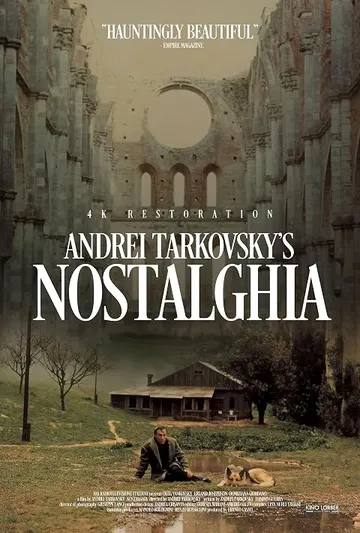
Misty Italy, a waterlogged house, and a Russian home embedded in ruins let exile’s past enter the present. Andrei crosses the empty pool three times with a candle; each bodily failure increases the shot’s temporal pressure, turning belief into persistence without guarantee.
Film details
- Original title
- Nostalghia
- Director
- Andrei Tarkovsky / 安德烈·塔可夫斯基
- Year
- 1983
- Region
- Italy / Soviet Union
Film analysis: how shots organize concepts
Exilic past keeps entering the Italian present, while the candle take turns a task into a duration of belief that cannot be abbreviated.
- 01Place undoes the travel goal
Church, mist, baths, and ruins do not become objects of knowledge; Andrei repeatedly stops at the edge of looking.
The traveller changes from collector of sights into one compelled to see by place. - 02Two places enter each other
Russian home, family, and vapour enter Italian ruins and waterlogged rooms.
The past is not explanatory flashback but a virtual milieu acting within the present. - 03Task becomes temporal pressure
Andrei crosses the empty pool three times with a candle; failure, return, and renewed passage remain in shot-duration.
Completion does not cancel duration; bodily persistence makes belief appear as time itself.
Close-reading questions
- 01As the misted Russian home, Italian spa, and abandoned buildings alternate in different tones and textures, how does nostalgia become a time in which two places exert pressure at once rather than an explanatory memory?
- 02As Andrei makes three attempts to carry a candle across the drained pool, how do long take, footsteps, breath, and extinction turn a minimal act into a duration that cannot be shortened?
- 03At the end, as a Russian house is enclosed by the ruins of an Italian abbey while Andrei and a dog sit under falling snow, how do an actual place and a virtual homeland coexist within one image?
Analysis and scene sources
Shots and scenes
Primary texts, scholarship, and locators
Theory coordinate: Atlas analysis; theoretical basis: Cinema 2, Minnesota 1989, ch. 2, pp. 42–43; ch. 4, pp. 78–79; ch. 7, pp. 169–177
- 01Cinema 2: The Time-Image
Authoritative source for the standard translation, translators, ISBN, and publication date.
Open the atlas source record →
Viewing gateways and editions
No direct viewing link is listed; film search gateways are available above.