Cinema 1: The Movement-Image
Xie Qiang · Ma Yue · Hunan Fine Arts Publishing House · 2016-03
Edition ID978-7-5356-7166-0
The two books do not simply divide classical and modern cinema into a before and an after. Cinema 1 studies how perception, affection, and action connect through the sensory-motor schema; Cinema 2 begins from the crisis of that link and asks how time comes to organize movement, memory, editing, sound, and image.
Xie Qiang · Ma Yue · Hunan Fine Arts Publishing House · 2016-03
Xie Qiang · Cai Ruoming · Ma Yue · Hunan Fine Arts Publishing House · 2004-08
01–02 rupture and new signs · 03–06 memory, crystal, truth · 07–10 thought, body, sound, information
How does action fail? How do actual and virtual exchange? How does a cut force thought?
Headings reproduce the 2016 edition: the contents use 情感—影像 / 动作—影像 and chapter eight uses 情愫; atlas prose uses 情动—影像 / 行动—影像.
2016 ZH-CN · PUBLISHED: 关于运动的论述(一评柏格森)
print 3–19Cinema 1 contents2016 ZH-CN · PUBLISHED: 画框与镜头,取景与分镜
print 20–46Cinema 1 contents2016 ZH-CN · PUBLISHED: 剪辑
print 47–89Cinema 1 contents2016 ZH-CN · PUBLISHED: 运动—影像及其三种变型(二评柏格森)
print 90–114Cinema 1 contents2016 ZH-CN · PUBLISHED: 知觉—影像
print 115–139Cinema 1 contents2016 ZH-CN · PUBLISHED: 情感—影像:面孔与特写镜头
print 140–163Cinema 1 contents2016 ZH-CN · PUBLISHED: 情感—影像:质、权力、任意空间
print 164–196Cinema 1 contents2016 ZH-CN · PUBLISHED: 从情愫到动作:冲动—影像
print 197–224Cinema 1 contents2016 ZH-CN · PUBLISHED: 动作—影像:大形式
print 225–253Cinema 1 contents2016 ZH-CN · PUBLISHED: 动作—影像:小形式
Open chapter research bridge print 254–280Cinema 1 contents2016 ZH-CN · PUBLISHED: 外形或形式的转换
Open chapter research bridge print 281–307Cinema 1 contents2016 ZH-CN · PUBLISHED: 动作—影像的危机
Open chapter research bridge print 308–336Cinema 1 contentsThe small form A–S–A′ does not mean a small subject. A gesture, face, uniform, or misrecognition comes first; the spectator infers a situation not yet given in full, and that disclosure redirects the next act. In The Great Dictator, one face joins the persecuted barber to the dictator's incommensurable social position, so minute differences repeatedly rewrite the world in which action occurs.
Begin with the identity reversal: the drenched Hynkel is arrested as the fugitive while the uniformed barber is welcomed. The crossed misrecognitions test how face, uniform, and ceremony disclose situation after the act. Then examine the final address: chapter 10 directly opposes intelligible speech to the tyrant's gibberish and terror, turning the social problem implicit in the doubled role into an image-object.
Plot misidentification alone is not a reflection-image; a third term must make action and situation relate indirectly. The final discourse is directly grounded in the primary text, but making the problem speak does not mean that the film has completed a democratic institutional transformation.
Primary problem locatorone face, two incommensurable situations
Chapter 11 asks how an intervening figure changes the scale and direction of action-forms. Attraction uses a plastic substitute to miniaturize or rehearse another situation; inversion exchanges the functional positions of strong or weak action and large or small situation; discourse makes the implicit problem itself an object. Only Cinema 2, chapter 2 retrospectively gathers these figures under the reflection-image.
The globe ballet poses attraction as a candidate: weightless local dance refers through the globe as a third term to the ellipsed situation of world rule, while the sphere's bursting countertests that relation. The identity exchange poses inversion as a candidate: the evidence is not one uniform still but the crossing of Hynkel's arrest with the barber's ceremonial welcome.
A globe that functions merely as metaphor or gag does not establish attraction, and exchanged identities do not by themselves establish inversion. Each claim must show a third term transforming the functional relation of action and situation, while retaining a condition under which the atlas's scene-level classification must be withdrawn.
Primary problem locatorattraction and inversion compose; discourse generates
The mental-image is not a shot of a character thinking; it occurs when the image organizes relations, symbolic acts, and intellectual feelings as objects of thought. The relation-image specifies Hitchcock's cinematic realization of Thirdness. Chapter 12 also diagnoses the crisis of the action-image, but crisis is a genetic condition for Cinema 2—not a licence to call every pause, incapacity, or gaze direct time.
Three Rear Window records form a progression and countertest. The opening makes cast, racing photographs, and damaged camera explain a fixed position of looking. The wedding ring compresses marriage, disappearance, murder hypothesis, and spectatorial knowledge into one concrete object. The flashbulb confrontation then asks whether relation still governs once the observer becomes observed and attacked, or whether the image has contracted into a stimulus–defence–failure action-chain.
Jeff's immobility does not mean that sensory-motor linkage has vanished: Lisa, Stella, the telephoto lens, and the telephone continue to delegate action. Nor is the red flash afterimage sufficient evidence of Thirdness. The relational reading holds only when observer, object, and the inference connecting them become image-objects together.
Primary problem locatorrelations, symbolic acts, intellectual feelings
Montage still presents time indirectly through relations of movement; any-space-whatever loosens metric space from the orientation of action; chapter 12 diagnoses a failing link between perception and effective action. All three prepare the problems of Cinema 2, but none means that direct time has already appeared.
Open the C1→C2 turning-point mapMain headings reproduce the 2004 edition; atlas guide labels are shown separately.
2004 ZH-CN · PUBLISHED: 超越运动—影像
Why does the sensory-motor schema falter in postwar cinema?
opsign / optical sign(opsign) · sonsign / sound sign(sonsign) · The seer(seer) · Any-space-whatever(any-space-whatever)
Ozurepresentative cases · Late Spring / Early Summer / An Autumn Afternoon · Rossellinirepresentative cases · Germany Year Zero / Europe ’51 / Journey to Italy · De Sicarepresentative cases · Bicycle Thieves / Umberto D. · Antonionirepresentative cases · L’Avventura / L’Eclisse / The Passenger
Begin with characters who see in place of action. Trace how pure optical and sound situations alter the character-world relation.
The break begins when seeing no longer leads naturally to an action adequate to the situation. Bodies still move, but action no longer closes the world.
Record what is seen, heard, done, and changed. The Pompeii operation in Journey to Italy and the final wandering in Germany Year Zero place technical movement beside personal impotence.
If action still solves the situation, read the passage as movement-image first. The time-image deserves further testing when leftover sound and image hold the figure in seeing.
Key termpure optical and sound situations
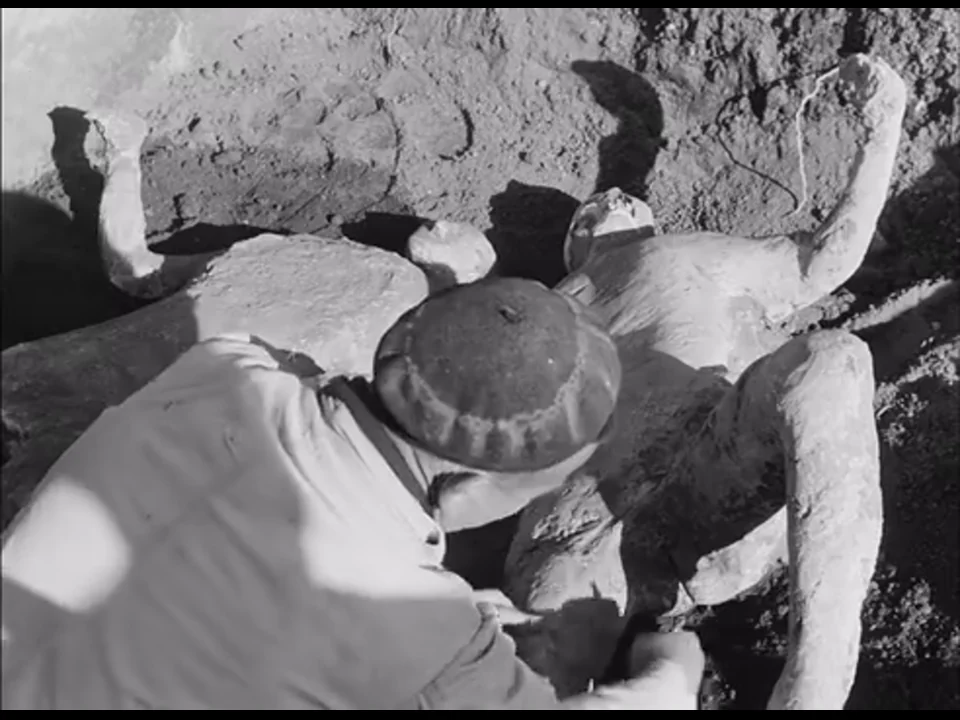 01:15:10
The technical operation successfully restores bodily contours while depriving the watching couple of their capacity to keep bearing the sight. Bilibili timecode 01:15:10.
Workers use trowels, brushes, and hands to remove volcanic material; pale plaster gradually exposes a head, teeth, arms, and legs against dark soil.
Two adjacent bodies are identified as a man and a woman; the film alternates among the remains and Alex's and Katherine's responses.
The on-site commentary explains how plaster fills the cavity left after a body disintegrates and successively identifies legs, arms, skull, and teeth.
Tools continue scraping soil; after the observers suggest the two may have been husband and wife, Katherine says she cannot bear it and asks to leave.
SITE ANALYSISTechnical reconstruction's success and sensory-motor response's failure must both remain visible; neither the bodies nor the couple alone is sufficient.
Bilibili at 01:15:10 Open original still ↗Frame-checked against the single-part Bilibili repost stream BV1h5MVzfEdW: the page API reports 5,141 seconds, while the retrieved qn16 media runs 5,140.78 seconds at 492×360. Player v2 supplies no usable subtitle track; English dialogue sense was aligned by scene content with an English SDH subtitle file from the Criterion Blu-ray. Every timecode follows the Bilibili carrier.Complete single-part film on Bilibili; the page, anonymous Player API, media bytes, and full 5,140.78-second duration were verified. Submission label: repost.
Bilibili · Steppenwolffff · public repost page · verified 2026-08-13Locator Cinema 2, ch. 1; atlas scene dossiers: Pompeii casts and final wandering; 2004 ZH-CN print pp. 1–37 (PDF viewer pagination follows the edition offset). · 2004 Chinese edition, print pp. 1–37; PDF viewer pp. 12–48 · Open the Cinema 2 edition record
2004 ZH-CN · PUBLISHED: 影像和符号的概述
How do Peirce’s categories lead cinematic signs toward an open taxonomy?
2004 Chinese edition · chapter pp. 38–67
zeroness See also: pure optical and sound situation · opsign / optical sign(opsign) · sonsign / sound sign(sonsign) · time-image
Hitchcockrepresentative cases · Rear Window / North by Northwest / Vertigo / The Birds · Italian neorealismrepresentative cases · Bicycle Thieves / Germany Year Zero / Journey to Italy · French New Waverepresentative cases · Pierrot le fou / Passion
This is the hinge between the two Cinema volumes: it revisits the closure of the movement-image and shows why new signs must appear.
2004 ZH-CN · PUBLISHED: 从回忆到梦幻(三评柏格森)
Why can flashback and dream remain within the sensory-motor regime?
2004 Chinese edition · chapter pp. 68–105
recollection-image · dream-image See also: onirosign / dream sign · virtual circuit See also: Actual / virtual · pure memory See also: pure past / past-in-itself
Mankiewiczrepresentative cases · All About Eve / A Letter to Three Wives · Carnérepresentative cases · Le Jour se lève · Minnellirepresentative cases · An American in Paris · Buñuelrepresentative cases · The Discreet Charm of the Bourgeoisie
Test whether action and psychological causality reattach recollection to the present.
2004 ZH-CN · PUBLISHED: 时间的晶体
How do the actual present and virtual past form the smallest circuit?
Actual / virtual(actual / virtual) · Crystal-image(crystal-image) · indiscernibility / indiscernible(indiscernibility) · Seed and environment(seed / environment)
Ophulsrepresentative cases · Lola Montès · Renoirrepresentative cases · The Rules of the Game · Fellinirepresentative cases · 8½ · Viscontirepresentative cases · Death in Venice
Read the crystal as dynamic exchange. Deleuze distinguishes perfect, cracked, forming, and decaying crystals.
2004 ZH-CN · PUBLISHED: 现在尖点与过去时面(四评柏格森)
How does direct time split into coexisting pasts and incompossible presents?
Sheets of the past(sheets of past) · Peaks of the present(peaks of present) · Chronosign(chronosign) · incompossible presents(incompossible) See also: peaks / points of the present
Wellesrepresentative cases · Citizen Kane / The Lady from Shanghai / F for Fake · Resnaisrepresentative cases · Last Year at Marienbad / Hiroshima mon amour / Je t’aime, je t’aime / Muriel · Robbe-Grilletrepresentative cases · L’Immortelle / The Man Who Lies
Compare the sheets of past in Citizen Kane with the multiple presents of Last Year at Marienbad: two forms of non-linearity produce distinct temporal structures.
2004 ZH-CN · PUBLISHED: 虚假的强力
How does time place the model of truth in crisis and give the false creative power?
Falsifying narration(falsifying narration) · series See also: genesign / genetic sign · metamorphosis See also: becoming · will to power See also: Powers of the false
Wellesrepresentative cases · Citizen Kane / The Lady from Shanghai / F for Fake · Robbe-Grilletrepresentative cases · L’Immortelle / The Man Who Lies · Godardrepresentative cases · Pierrot le fou / Passion · F for Fakerepresentative cases · F for Fake
04 · The tribunal enters the chain of falsifiers 06 · Speech organizes action and prefigures a people to come
Test whether the final tribunal enters the series of falsifiers; this determines the creative power of the false.
2004 ZH-CN · PUBLISHED: 思维与电影
How does cinema reveal thought’s powerlessness and force thinking to occur?
shock See also: noosign · spiritual automaton See also: noosign · the whole · interstice
Eisensteinrepresentative cases · Battleship Potemkin · Artaud · Godardrepresentative cases · Pierrot le fou / Passion · Straub–Huilletrepresentative cases · Chronicle of Anna Magdalena Bach / Too Early, Too Late
The chapter moves from classical faith that totality and shock automatically produce thought to modern cinema’s need to begin from the impossibility of thinking.
2004 ZH-CN · PUBLISHED: 电影,躯体与大脑,思维
How do bodily attitudes and brain-like spaces carry time and thought?
body of attitude See also: Body / brain · gestus See also: Body / brain · cinema of the brain See also: Body / brain · belief in this world(belief in the world)
Cassavetesrepresentative cases · Faces / A Woman Under the Influence · Godardrepresentative cases · Pierrot le fou / Passion · Garrel · Kubrickrepresentative cases · 2001: A Space Odyssey / The Shining · Resnaisrepresentative cases · Last Year at Marienbad / Hiroshima mon amour / Je t’aime, je t’aime / Muriel
02 · Actual and virtual exchange within one image 03 · The past coexists in sheets; the present forks into peaks 06 · Speech organizes action and prefigures a people to come
Read body and brain together: one begins from fatigue, waiting, and ceremony; the other from topological connections and informational landscapes.
2004 ZH-CN · PUBLISHED: 影像的构成元素
After the coming of sound, how does sound become genuinely autonomous?
audio-visual image See also: audio-visual disjunction / disjunction of sound and image · free indirect discourse · readable image See also: Lectosign · Lectosign(lectosign)
Straub–Huilletrepresentative cases · Chronicle of Anna Magdalena Bach / Too Early, Too Late · Durasrepresentative cases · India Song / Nathalie Granger / The Lorry · Godardrepresentative cases · Pierrot le fou / Passion · Syberbergrepresentative cases · Hitler: A Film from Germany
01 · When action loses its sequel, seeing gains time 05 · Sound and image reach their limits and become readable
Study how sound and image form distinct series and meet at an incommensurable boundary.
2004 ZH-CN · PUBLISHED: 结论
How should cinema re-draw the borders among semiotics, language, and information?
non-linguistic semiotics · information · the outside See also: interstice · belief See also: belief in this world
Godardrepresentative cases · Pierrot le fou / Passion · Resnaisrepresentative cases · Last Year at Marienbad / Hiroshima mon amour / Je t’aime, je t’aime / Muriel · modern cinema
01 · When action loses its sequel, seeing gains time 05 · Sound and image reach their limits and become readable
Return to the whole project: open taxonomy reserves generative space for images and signs yet to emerge.