 01:15:10
Memory and temporal strata · SHOT EVIDENCE
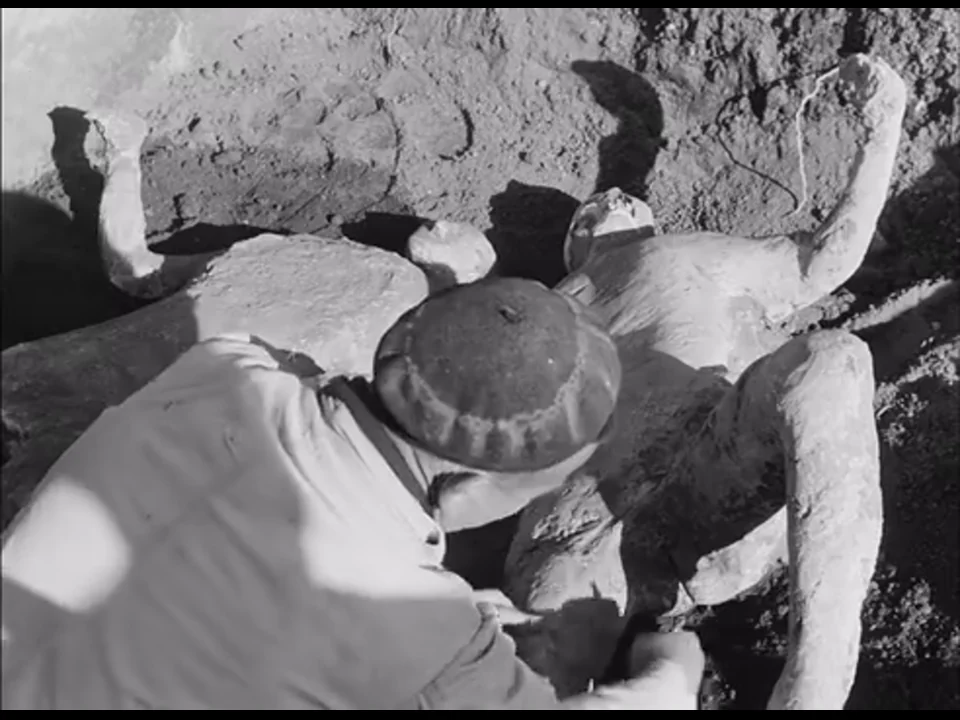
Plaster returns an instant of death to the present
Why does a successfully reconstructed past fail to increase the couple's capacity to handle the present and instead force Katherine to leave?
Film and viewing version
Journey to Italy · Viaggio in Italia · Roberto Rossellini / 罗伯托·罗西里尼 · 1954
Frame-checked against the single-part Bilibili repost stream BV1h5MVzfEdW: the page API reports 5,141 seconds, while the retrieved qn16 media runs 5,140.78 seconds at 492×360. Player v2 supplies no usable subtitle track; English dialogue sense was aligned by scene content with an English SDH subtitle file from the Criterion Blu-ray. Every timecode follows the Bilibili carrier.
Version boundary: The timecodes on this page apply only to the named viewing carrier. Restorations, differing leaders, or platform transcodes may shift them.
Passage and still timecodes
01:13:22 to 01:15:28
Passage bounds checked on the named carrier
The passage bounds and Bilibili still at 01:15:10 were checked separately on their named carriers. They remain distinct coordinates and do not establish identical timecodes for other versions.
Visible facts
- 01
Workers use trowels, brushes, and hands to remove volcanic material; pale plaster gradually exposes a head, teeth, arms, and legs against dark soil.
- 02
Two adjacent bodies are identified as a man and a woman; the film alternates among the remains and Alex's and Katherine's responses.
Audible facts
- 01
The on-site commentary explains how plaster fills the cavity left after a body disintegrates and successively identifies legs, arms, skull, and teeth.
- 02
Tools continue scraping soil; after the observers suggest the two may have been husband and wife, Katherine says she cannot bear it and asks to leave.
Action relation
The archaeological procedure completes its task precisely, yet successful operation does not relieve the sight; Katherine's only available action is to leave.
Temporal relation
Death appears not as historical explanation but gains a present surface through the cavity a body left and the newly poured plaster.
Conceptual reading
Technical reconstruction's success and sensory-motor response's failure must both remain visible; neither the bodies nor the couple alone is sufficient.
Concepts used in the judgement
- The seervoyant · SCENE SUPPORT
She is struck by the ancient couple's bodies; leaving results from incapacity to bear the sight rather than solving it.
→ - Pure optical / sound situationopsigne / sonsigne · SCENE SUPPORT
The gradually exposed bodies and scraping sounds exceed archaeological explanation and form direct audio-visual pressure.
→ - Sensory-motor schemaschème sensori-moteur · SCENE SUPPORT
Technical action succeeds while personal action fails; this difference fixes the schema's rupture within the scene.
→
Primary and scholarly coordinates
- 01Cinema 2: The Time-Image
Minnesota 1989 translation: ch. 1, p. 2 (listed as The Lonely Woman [Viaggio in Italia]).
Brief primary-text mention: on this page Deleuze includes Katherine among female tourists struck by unfolding images and visual clichés; the fuller argument for the turn from agent to seer comes from the surrounding chapter. This site analyzes each scene window, audio-visual fact, and criterion shot by shot.
Terminological coordinates
- seervoyant
Action cannot absorb what is seen, so looking itself acquires structural force.
→ - pure optical and sound situationsituation optique et sonore pure
The reconstruction procedure does not reconnect the sight to adequate action.
→ - opsign / optical signopsigne
The two bodies emerging from dark soil form opsigns exceeding informational explanation.
→ - sensory-motor schemaschème sensori-moteur
Seeing causes departure without producing action adequate to transform the marital situation.
→
Chapter relations
Viewing and still sources
Direct scene · Complete single-part film on Bilibili; the page, anonymous Player API, media bytes, and full 5,140.78-second duration were verified. Submission label: repost.