Concept definition
A visual or auditory situation acquires a duration autonomous from cues for action or narration. Unable to translate what is seen or heard immediately into an effective response, the figure becomes a seer, listener, or witness. This is a threshold of the time-image, not direct time by itself.
What the concept explains
An opsign or sonsign forms when a visual or auditory situation ceases to serve merely as information for the next action and acquires a duration that response cannot exhaust. Either may hold independently; chapter 9's audio-visual disjunction and lectosign require another relational test.
Sensory-Motor Rupture: How a Character Becomes a SeerThe Irrational Cut: How the Interstice Becomes a LectosignDiagrams and film passages
When do seeing and hearing exceed their use in action?
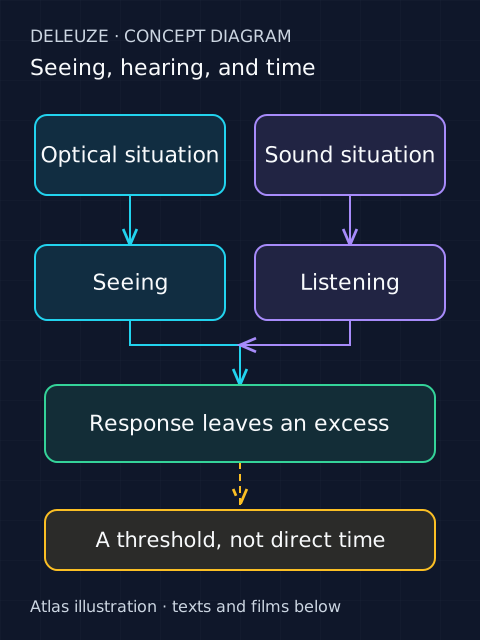
Threshold relation: opsigns and sonsigns open the problem of direct time; they do not equal direct time itself.
Open full-size diagramObserve image and sound separately
What scale, space, and bodily distance does the image establish? Does sound come from something visible, from offscreen, through amplification, or from a source that cannot yet be identified? Record each separately before comparing how they persist.
Compare response with what is experienced
The factory passage in Europa ’51 still contains communication and responses. The question is how machine scale, noise, and pressure on bodies exceed the completion of a task or exchange. The discussion of opsigns and sonsigns concerns this loosening of the connection.
This is a threshold to the question of time
Pure optical and sound situations give seeing and hearing relative autonomy. A direct time-image requires a further account of how time organizes images: the preservation of the past, the splitting of the present, or the reconstruction of succession. The diagram preserves that distinction.
Diagram references
Germany Year Zero
Germania anno zero (1948)
Supported by the scene
A historical voice crosses the ruined Chancellery
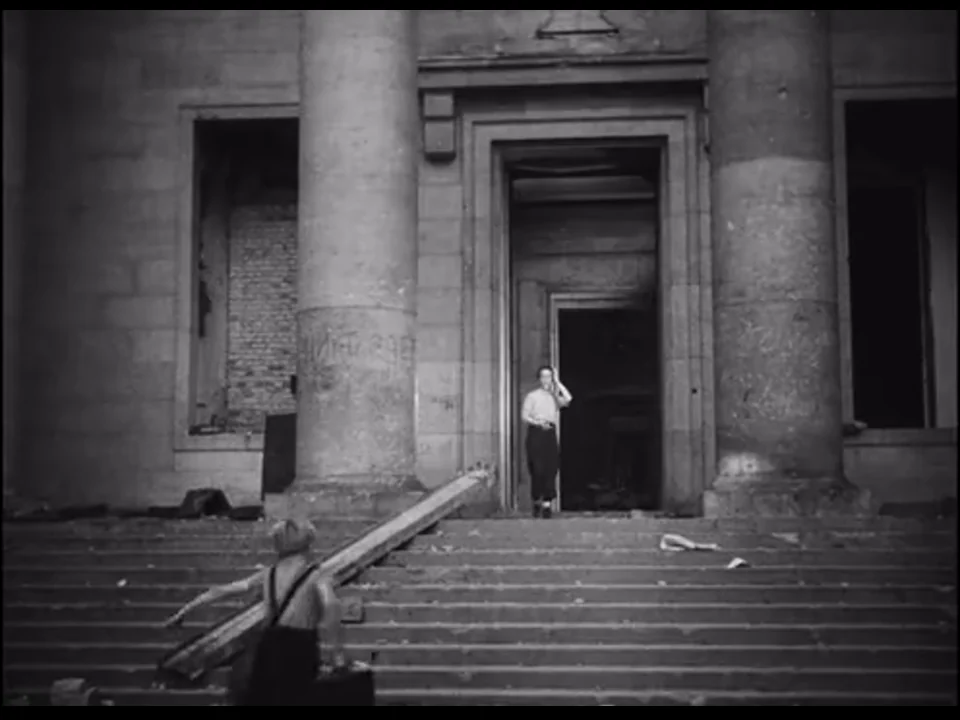
A recorded political voice meets the ruined Chancellery; the source of the voice and visible history are separated. Bilibili timecode 00:27:50.
Open full-size still- Displayed still
- 00:27:50
- Discussion passage
- 00:27:41 - 00:28:24
Frame-checked against the single-part Bilibili repost stream BV1hP4y1k78i: the page API reports 4,388 seconds and the retrieved qn16 media runs 4,387.37 seconds. Bilibili supplies no subtitle track; audible facts record only clearly discernible German speech, music, and ambient sound in the image sequence.
Complete single-part Bilibili film; the page and anonymous Player API were verified as playable. Bilibili submission label: repost.
Still checked: 2026-08-13 · Carrier access checked: 2026-08-13
Image
Edmund carries a case of records through the ruins while soldiers, visitors, and children move among broken walls.
The facade, monumental steps, and empty doorways repeatedly reduce the figures to small bodies within the frame.
Sound
A portable gramophone plays a German political speech with an amplified, archival timbre; brief location conversation is also audible.
Relation to the concept
Test whether the recording exceeds locational explanation and forms an autonomous auditory layer beside the ruin.
Sources and further reading
- Cinema 2: The Time-Image
Minnesota 1989 translation: Preface, p. xi; ch. 1, p. 2. 2004 Simplified Chinese edition: ch. 1, p. 3. · Brief primary-text mention: Deleuze uses the child in Germany Year Zero to connect motor helplessness with a greater capacity to see and hear. Preface p. x and the chapter's following passages are adjacent conceptual context, not direct pages on the film; the scene windows, facts, and criteria are this atlas's shot analysis.
- Bilibili · La-Jeunesse- · public repost page
00:27:50 · A recorded political voice meets the ruined Chancellery; the source of the voice and visible history are separated. Bilibili timecode 00:27:50.
Germany Year Zero
Germania anno zero (1948)
Supported by the scene
Final wandering and the sight too much to bear
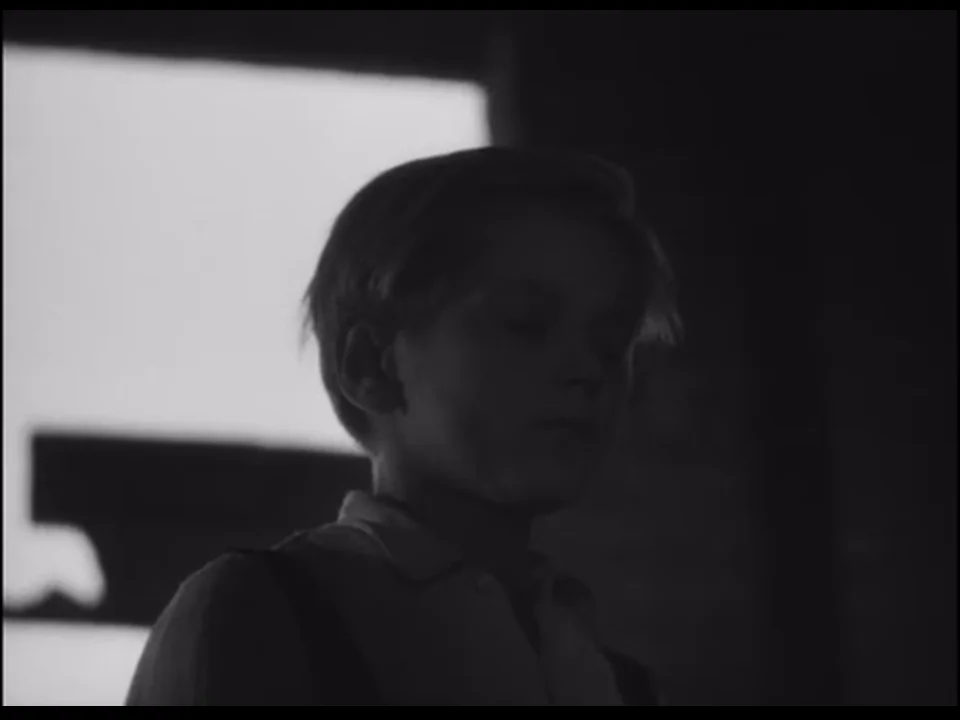
The long wandering turns streets, church, ruined buildings, traffic, and children's play from usable action-space into a city layer that must be watched. Bilibili timecode 01:12:18.
Open full-size still- Displayed still
- 01:12:18
- Discussion passage
- 01:05:01 - 01:12:44
Frame-checked against the single-part Bilibili repost stream BV1hP4y1k78i: the page API reports 4,388 seconds and the retrieved qn16 media runs 4,387.37 seconds. Bilibili supplies no subtitle track; audible facts record only clearly discernible German speech, music, and ambient sound in the image sequence.
Complete single-part Bilibili film; the page and anonymous Player API were verified as playable. Bilibili submission label: repost.
Still checked: 2026-08-13 · Carrier access checked: 2026-08-13
Image
Edmund crosses streets and broken walls alone, pauses outside a church, and enters a building without intact walls.
He watches children playing, vehicles, and the street below, repeatedly touches debris and architectural fragments; after climbing upward, he falls from the building, and a woman in the street approaches his body.
Sound
The long passage is formed mainly by sustained orchestral music, traffic, distant children's voices, and urban ambience; Edmund speaks almost no dialogue.
Relation to the concept
Urban sound and ruined images cease to be action cues and become durations that must be endured.
Sources and further reading
- Cinema 2: The Time-Image
Minnesota 1989 translation: Preface, p. xi; ch. 1, p. 2. 2004 Simplified Chinese edition: ch. 1, p. 3. · Brief primary-text mention: Deleuze uses the child in Germany Year Zero to connect motor helplessness with a greater capacity to see and hear. Preface p. x and the chapter's following passages are adjacent conceptual context, not direct pages on the film; the scene windows, facts, and criteria are this atlas's shot analysis.
- Bilibili · La-Jeunesse- · public repost page
01:12:18 · The long wandering turns streets, church, ruined buildings, traffic, and children's play from usable action-space into a city layer that must be watched. Bilibili timecode 01:12:18.
Journey to Italy
Viaggio in Italia (1954)
Supported by the scene
Monumental bodies reduce the tourist to a seer
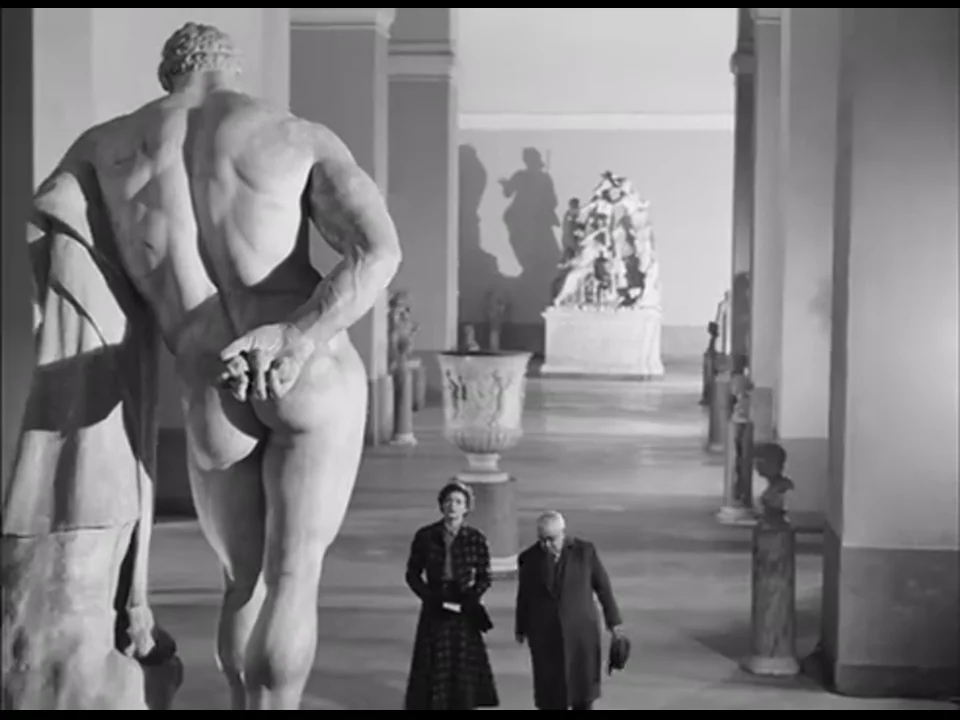
Ancient bodies overtake the tourist itinerary through scale, weight, and serial cutting. Bilibili timecode 00:30:25.
Open full-size still- Displayed still
- 00:30:25
- Discussion passage
- 00:27:27 - 00:31:09
Frame-checked against the single-part Bilibili repost stream BV1h5MVzfEdW: the page API reports 5,141 seconds, while the retrieved qn16 media runs 5,140.78 seconds at 492×360. Player v2 supplies no usable subtitle track; English dialogue sense was aligned by scene content with an English SDH subtitle file from the Criterion Blu-ray. Every timecode follows the Bilibili carrier.
Complete single-part film on Bilibili; the page, anonymous Player API, media bytes, and full 5,140.78-second duration were verified. Submission label: repost.
Still checked: 2026-08-13 · Carrier access checked: 2026-08-13
Image
Katherine follows a guide through the galleries as dancers, a satyr, the drunken faun, imperial heads, and monumental nudes successively occupy the image.
Close views of statues alternate with close views of Katherine's face; she stops, looks up, and looks back without touching the objects.
Sound
The guide continuously names works, excavation sites, and biographical anecdotes in English; his voice repeatedly carries over close views of the statues.
Footsteps and gallery reverberation remain beneath the commentary, with no score closing Katherine's responses into a single emotion.
Relation to the concept
The statues' scale, surface, and gaze exceed the practical use of the commentary.
Sources and further reading
- Cinema 2: The Time-Image
Minnesota 1989 translation: ch. 1, p. 2 (listed as The Lonely Woman [Viaggio in Italia]). · Brief primary-text mention: on this page Deleuze includes Katherine among female tourists struck by unfolding images and visual clichés; the fuller argument for the turn from agent to seer comes from the surrounding chapter. This site analyzes each scene window, audio-visual fact, and criterion shot by shot.
- Bilibili · Steppenwolffff · public repost page
00:30:25 · Ancient bodies overtake the tourist itinerary through scale, weight, and serial cutting. Bilibili timecode 00:30:25.
Journey to Italy
Viaggio in Italia (1954)
Supported by the scene
Pregnant bodies recur beyond the windshield
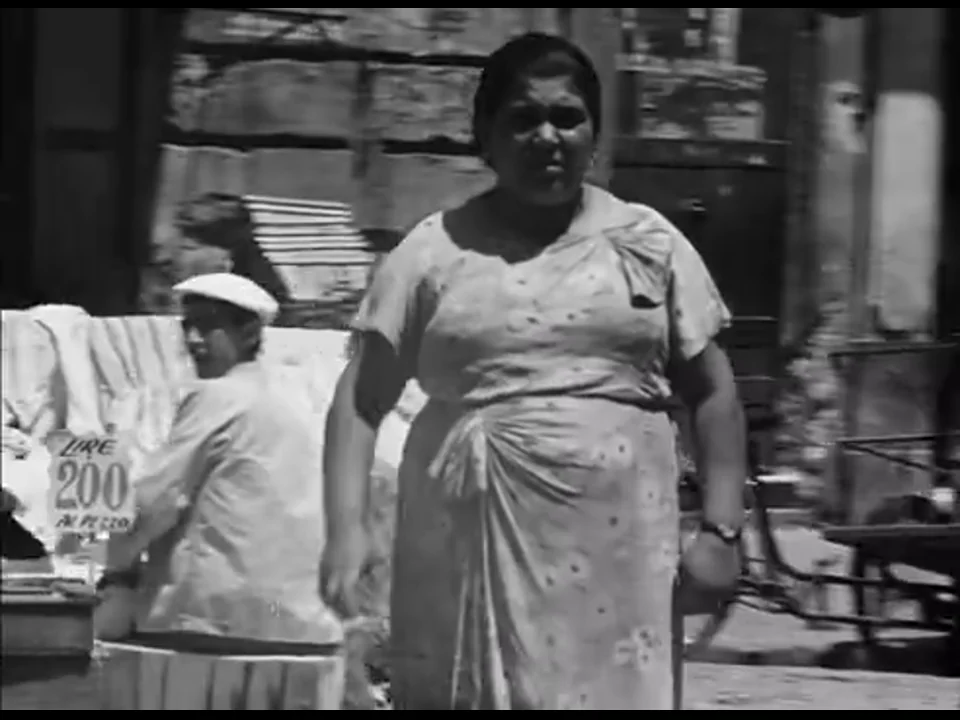
The car continues forward while pregnant bodies repeatedly interrupt Katherine's monologue on her marriage. Bilibili timecode 00:41:40.
Open full-size still- Displayed still
- 00:41:40
- Discussion passage
- 00:40:22 - 00:41:57
Frame-checked against the single-part Bilibili repost stream BV1h5MVzfEdW: the page API reports 5,141 seconds, while the retrieved qn16 media runs 5,140.78 seconds at 492×360. Player v2 supplies no usable subtitle track; English dialogue sense was aligned by scene content with an English SDH subtitle file from the Criterion Blu-ray. Every timecode follows the Bilibili carrier.
Complete single-part film on Bilibili; the page, anonymous Player API, media bytes, and full 5,140.78-second duration were verified. Submission label: repost.
Still checked: 2026-08-13 · Carrier access checked: 2026-08-13
Image
Katherine drives alone; frontal close-ups of her at the wheel alternate with moving views of pedestrians along the street.
Several visibly pregnant women appear in succession, and the film repeatedly cuts back to Katherine's eyes and face.
Sound
Engine and street noise continue while Katherine voices her anger toward Alex in English; the speech does not instruct her to stop or change course.
Relation to the concept
The moving street ceases to be navigational background and becomes an optical series driving cannot absorb.
Sources and further reading
- Cinema 2: The Time-Image
Minnesota 1989 translation: ch. 1, p. 2 (listed as The Lonely Woman [Viaggio in Italia]). · Brief primary-text mention: on this page Deleuze includes Katherine among female tourists struck by unfolding images and visual clichés; the fuller argument for the turn from agent to seer comes from the surrounding chapter. This site analyzes each scene window, audio-visual fact, and criterion shot by shot.
- Bilibili · Steppenwolffff · public repost page
00:41:40 · The car continues forward while pregnant bodies repeatedly interrupt Katherine's monologue on her marriage. Bilibili timecode 00:41:40.
Journey to Italy
Viaggio in Italia (1954)
Supported by the scene
Echo detaches the Sibyl's chamber from the tour
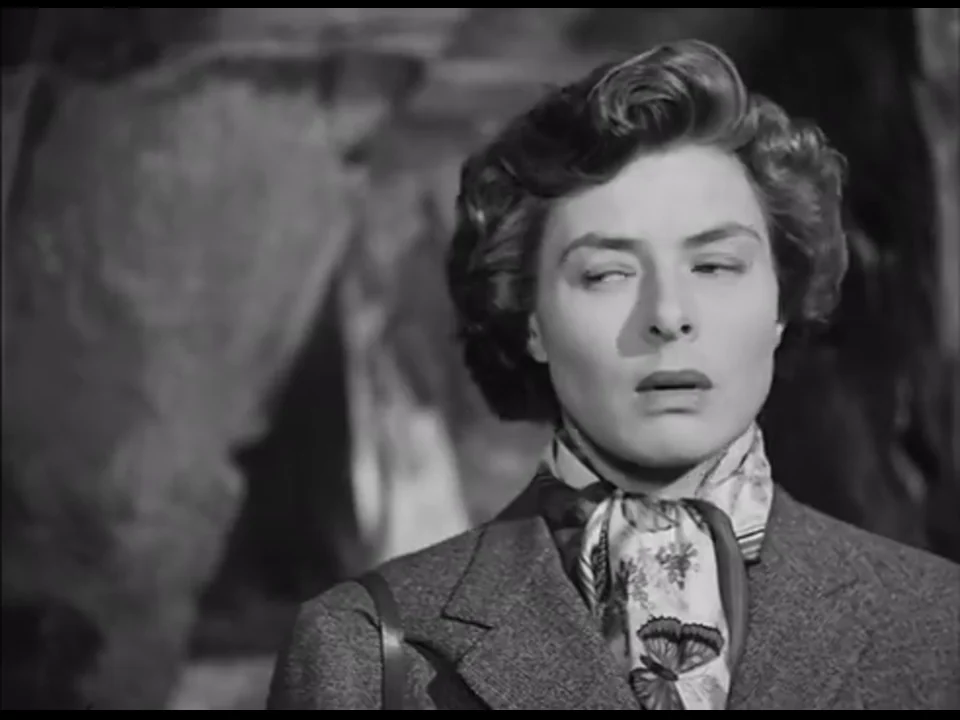
The cave places the guide's voice, echo, prophetic legend, and Katherine's marital question within one acoustic field. Bilibili timecode 00:43:20.
Open full-size still- Displayed still
- 00:43:20
- Discussion passage
- 00:42:00 - 00:45:08
Frame-checked against the single-part Bilibili repost stream BV1h5MVzfEdW: the page API reports 5,141 seconds, while the retrieved qn16 media runs 5,140.78 seconds at 492×360. Player v2 supplies no usable subtitle track; English dialogue sense was aligned by scene content with an English SDH subtitle file from the Criterion Blu-ray. Every timecode follows the Bilibili carrier.
Complete single-part film on Bilibili; the page, anonymous Player API, media bytes, and full 5,140.78-second duration were verified. Submission label: repost.
Still checked: 2026-08-13 · Carrier access checked: 2026-08-13
Image
A guide leads Katherine into a high, narrowing trapezoidal passage; their bodies diminish in depth while stone walls dominate the frame.
The film cuts among the empty passage, the guide, and Katherine's face; she repeatedly stops instead of following closely.
Sound
The guide asks her to listen to the echo and calls out; the call returns from the stone chamber.
The guide explains that lovers once came to ask the course of their love; Katherine then speaks Homer's verse, while footsteps, commentary, and echo remain distinct.
Relation to the concept
Empty passage and echo acquire optical and auditory density beyond the tour's function.
Sources and further reading
- Cinema 2: The Time-Image
Minnesota 1989 translation: ch. 1, p. 2 (listed as The Lonely Woman [Viaggio in Italia]). · Brief primary-text mention: on this page Deleuze includes Katherine among female tourists struck by unfolding images and visual clichés; the fuller argument for the turn from agent to seer comes from the surrounding chapter. This site analyzes each scene window, audio-visual fact, and criterion shot by shot.
- Bilibili · Steppenwolffff · public repost page
00:43:20 · The cave places the guide's voice, echo, prophetic legend, and Katherine's marital question within one acoustic field. Bilibili timecode 00:43:20.
Journey to Italy
Viaggio in Italia (1954)
Supported by the scene
Steam repeatedly erases ground and body
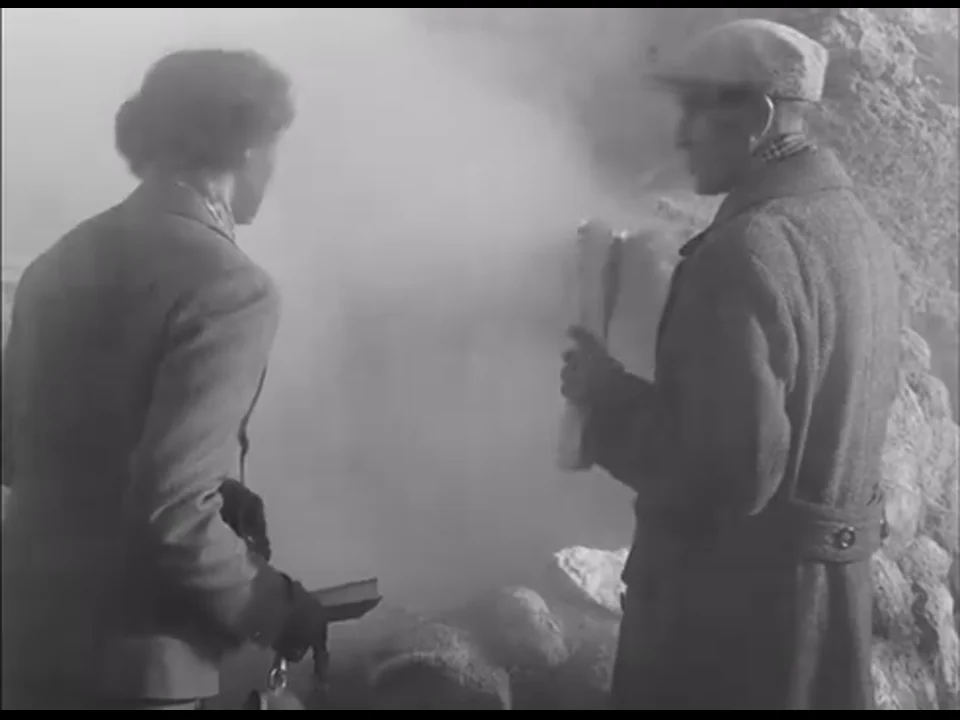
The explanation continues while steam repeatedly withdraws the visibility of ground and figures. Bilibili timecode 00:52:00.
Open full-size still- Displayed still
- 00:52:00
- Discussion passage
- 00:49:27 - 00:52:38
Frame-checked against the single-part Bilibili repost stream BV1h5MVzfEdW: the page API reports 5,141 seconds, while the retrieved qn16 media runs 5,140.78 seconds at 492×360. Player v2 supplies no usable subtitle track; English dialogue sense was aligned by scene content with an English SDH subtitle file from the Criterion Blu-ray. Every timecode follows the Bilibili carrier.
Complete single-part film on Bilibili; the page, anonymous Player API, media bytes, and full 5,140.78-second duration were verified. Submission label: repost.
Still checked: 2026-08-13 · Carrier access checked: 2026-08-13
Image
Katherine follows a guide into the crater and bends toward fissures; the guide crouches, lights a flame, and approaches a vent.
Steam repeatedly thickens, first hiding the ground and then reducing guide and Katherine to outlines before thinning again.
Sound
The guide explains the last eruption, the thin crust, boiling material, and a claimed ionisation effect in English; venting and wind continue through the commentary.
Relation to the concept
Venting sound and obscured image form an audio-visual situation that cannot be returned to the tour's action.
Sources and further reading
- Cinema 2: The Time-Image
Minnesota 1989 translation: ch. 1, p. 2 (listed as The Lonely Woman [Viaggio in Italia]). · Brief primary-text mention: on this page Deleuze includes Katherine among female tourists struck by unfolding images and visual clichés; the fuller argument for the turn from agent to seer comes from the surrounding chapter. This site analyzes each scene window, audio-visual fact, and criterion shot by shot.
- Bilibili · Steppenwolffff · public repost page
00:52:00 · The explanation continues while steam repeatedly withdraws the visibility of ground and figures. Bilibili timecode 00:52:00.
Journey to Italy
Viaggio in Italia (1954)
Supported by the scene
Expectant mothers are counted into a street series
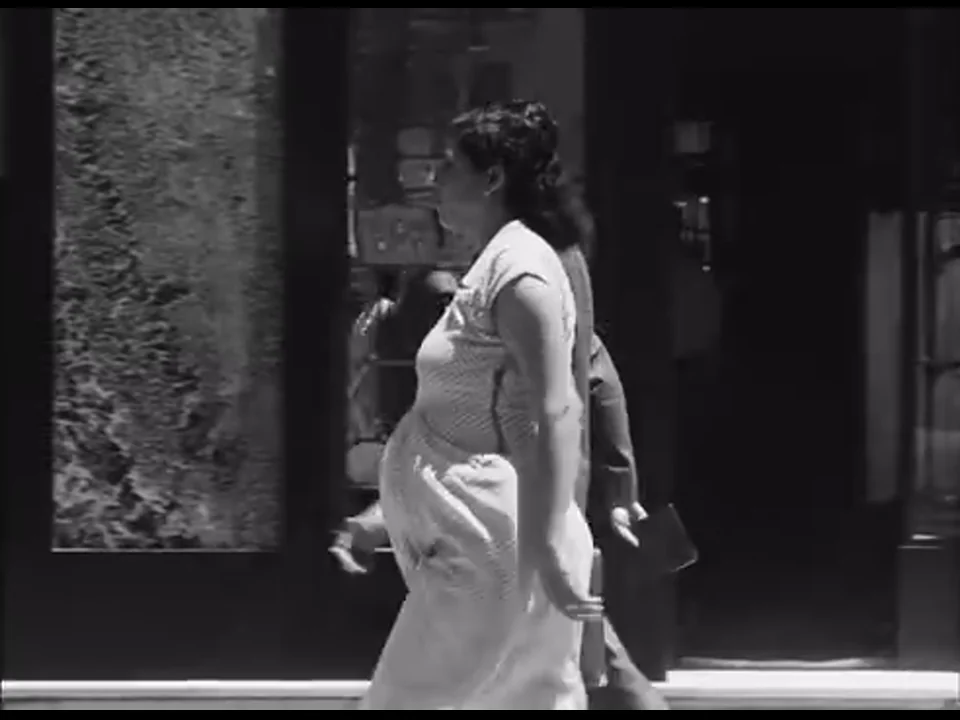
The pregnant figures Katherine earlier saw alone are now counted into an audible series by Natalia beside her. Bilibili timecode 01:07:32.
Open full-size still- Displayed still
- 01:07:32
- Discussion passage
- 01:07:10 - 01:08:26
Frame-checked against the single-part Bilibili repost stream BV1h5MVzfEdW: the page API reports 5,141 seconds, while the retrieved qn16 media runs 5,140.78 seconds at 492×360. Player v2 supplies no usable subtitle track; English dialogue sense was aligned by scene content with an English SDH subtitle file from the Criterion Blu-ray. Every timecode follows the Bilibili carrier.
Complete single-part film on Bilibili; the page, anonymous Player API, media bytes, and full 5,140.78-second duration were verified. Submission label: repost.
Still checked: 2026-08-13 · Carrier access checked: 2026-08-13
Image
Katherine drives with Natalia beside her; their close views alternate with pregnant women, children, a laden donkey, and pedestrians along the street.
The same type of body appears more than once, and every street view returns to looking and conversation inside the car.
Sound
Natalia remarks on the many expectant mothers in Naples and counts the pregnant women in view, then asks whether Alex likes children.
Katherine answers that she does not know what Alex is thinking, while engine and street noise remain continuous.
Relation to the concept
The street series and spoken count intensify one another without being exhausted by the task of driving.
Sources and further reading
- Cinema 2: The Time-Image
Minnesota 1989 translation: ch. 1, p. 2 (listed as The Lonely Woman [Viaggio in Italia]). · Brief primary-text mention: on this page Deleuze includes Katherine among female tourists struck by unfolding images and visual clichés; the fuller argument for the turn from agent to seer comes from the surrounding chapter. This site analyzes each scene window, audio-visual fact, and criterion shot by shot.
- Bilibili · Steppenwolffff · public repost page
01:07:32 · The pregnant figures Katherine earlier saw alone are now counted into an audible series by Natalia beside her. Bilibili timecode 01:07:32.
Journey to Italy
Viaggio in Italia (1954)
Supported by the scene
Anonymous skulls receive war dead and an unborn child
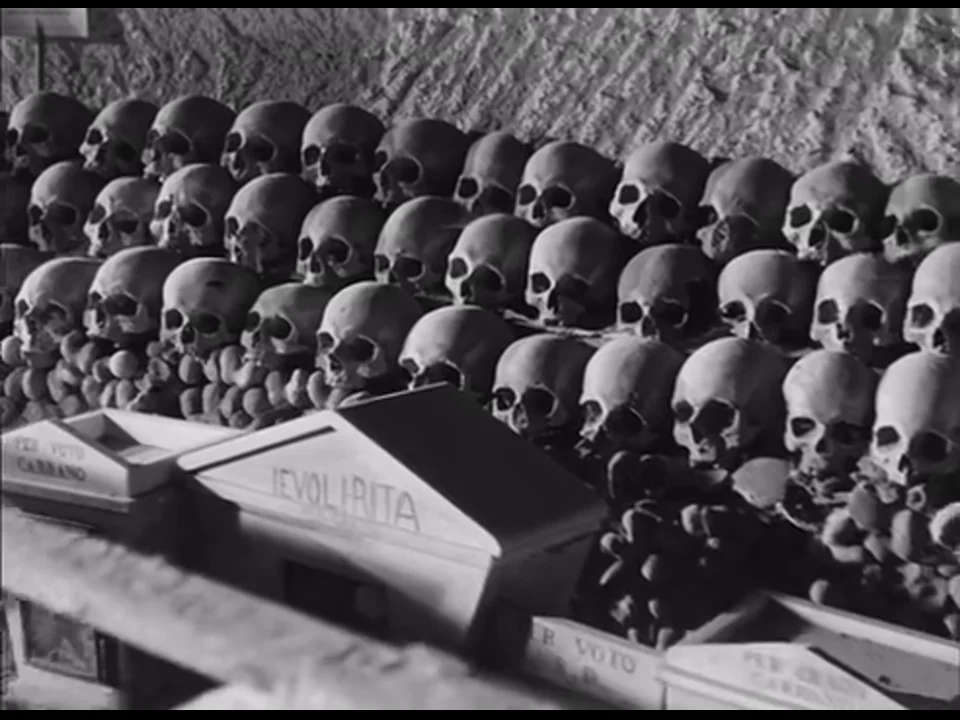
Anonymous remains, personal names, wartime memory, and a prayer for a child enter the same underground space. Bilibili timecode 01:09:40.
Open full-size still- Displayed still
- 01:09:40
- Discussion passage
- 01:08:34 - 01:11:24
Frame-checked against the single-part Bilibili repost stream BV1h5MVzfEdW: the page API reports 5,141 seconds, while the retrieved qn16 media runs 5,140.78 seconds at 492×360. Player v2 supplies no usable subtitle track; English dialogue sense was aligned by scene content with an English SDH subtitle file from the Criterion Blu-ray. Every timecode follows the Bilibili carrier.
Complete single-part film on Bilibili; the page, anonymous Player API, media bytes, and full 5,140.78-second duration were verified. Submission label: repost.
Still checked: 2026-08-13 · Carrier access checked: 2026-08-13
Image
Katherine and Natalia enter a dark cavern where skulls, long bones, devotional boxes, flowers, and candles line the walls.
The film cuts among rows of remains, the two women's bodies, and the altar deep inside; Katherine repeatedly stops to look.
Sound
Footsteps, low prayer, and cavern reverberation reduce the volume of ordinary conversation.
Natalia says that her brother died in Greece during the war and that she comes here to pray for him; she then voices her wish for a child.
Relation to the concept
Rows of remains, low prayer, and reverberation retain distinct densities while interrupting ordinary action together.
Sources and further reading
- Cinema 2: The Time-Image
Minnesota 1989 translation: ch. 1, p. 2 (listed as The Lonely Woman [Viaggio in Italia]). · Brief primary-text mention: on this page Deleuze includes Katherine among female tourists struck by unfolding images and visual clichés; the fuller argument for the turn from agent to seer comes from the surrounding chapter. This site analyzes each scene window, audio-visual fact, and criterion shot by shot.
- Bilibili · Steppenwolffff · public repost page
01:09:40 · Anonymous remains, personal names, wartime memory, and a prayer for a child enter the same underground space. Bilibili timecode 01:09:40.
Journey to Italy
Viaggio in Italia (1954)
Supported by the scene
Plaster returns an instant of death to the present
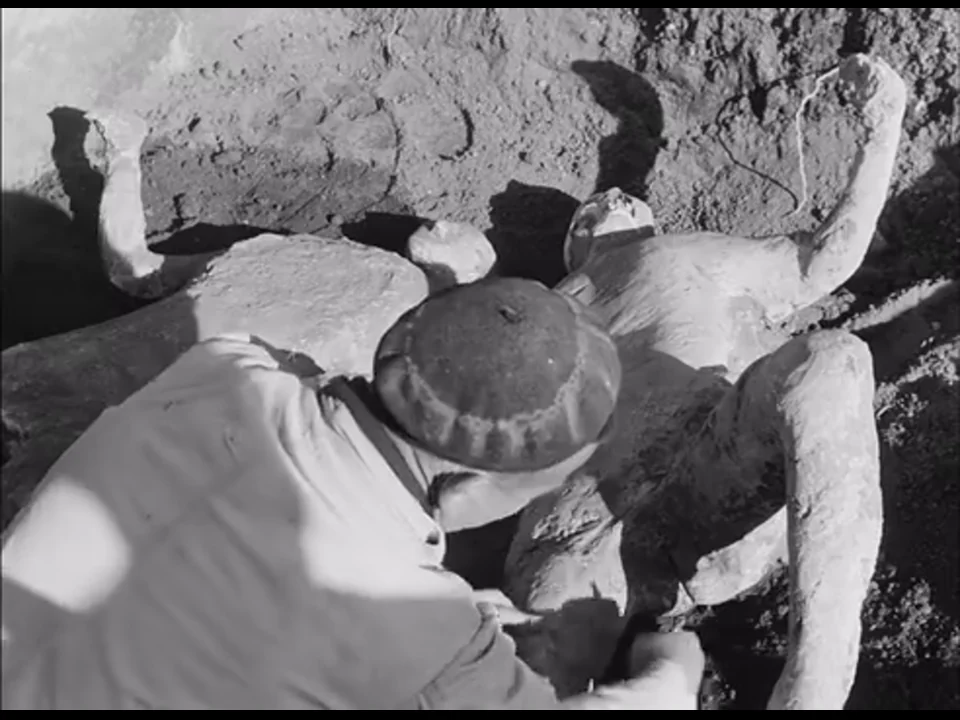
The technical operation successfully restores bodily contours while depriving the watching couple of their capacity to keep bearing the sight. Bilibili timecode 01:15:10.
Open full-size still- Displayed still
- 01:15:10
- Discussion passage
- 01:13:22 - 01:15:28
Frame-checked against the single-part Bilibili repost stream BV1h5MVzfEdW: the page API reports 5,141 seconds, while the retrieved qn16 media runs 5,140.78 seconds at 492×360. Player v2 supplies no usable subtitle track; English dialogue sense was aligned by scene content with an English SDH subtitle file from the Criterion Blu-ray. Every timecode follows the Bilibili carrier.
Complete single-part film on Bilibili; the page, anonymous Player API, media bytes, and full 5,140.78-second duration were verified. Submission label: repost.
Still checked: 2026-08-13 · Carrier access checked: 2026-08-13
Image
Workers use trowels, brushes, and hands to remove volcanic material; pale plaster gradually exposes a head, teeth, arms, and legs against dark soil.
Two adjacent bodies are identified as a man and a woman; the film alternates among the remains and Alex's and Katherine's responses.
Sound
The on-site commentary explains how plaster fills the cavity left after a body disintegrates and successively identifies legs, arms, skull, and teeth.
Tools continue scraping soil; after the observers suggest the two may have been husband and wife, Katherine says she cannot bear it and asks to leave.
Relation to the concept
The gradually exposed bodies and scraping sounds exceed archaeological explanation and form direct audio-visual pressure.
Sources and further reading
- Cinema 2: The Time-Image
Minnesota 1989 translation: ch. 1, p. 2 (listed as The Lonely Woman [Viaggio in Italia]). · Brief primary-text mention: on this page Deleuze includes Katherine among female tourists struck by unfolding images and visual clichés; the fuller argument for the turn from agent to seer comes from the surrounding chapter. This site analyzes each scene window, audio-visual fact, and criterion shot by shot.
- Bilibili · Steppenwolffff · public repost page
01:15:10 · The technical operation successfully restores bodily contours while depriving the watching couple of their capacity to keep bearing the sight. Bilibili timecode 01:15:10.
Journey to Italy
Viaggio in Italia (1954)
Supported by the scene
The crowd takes Katherine away, then presses the couple together
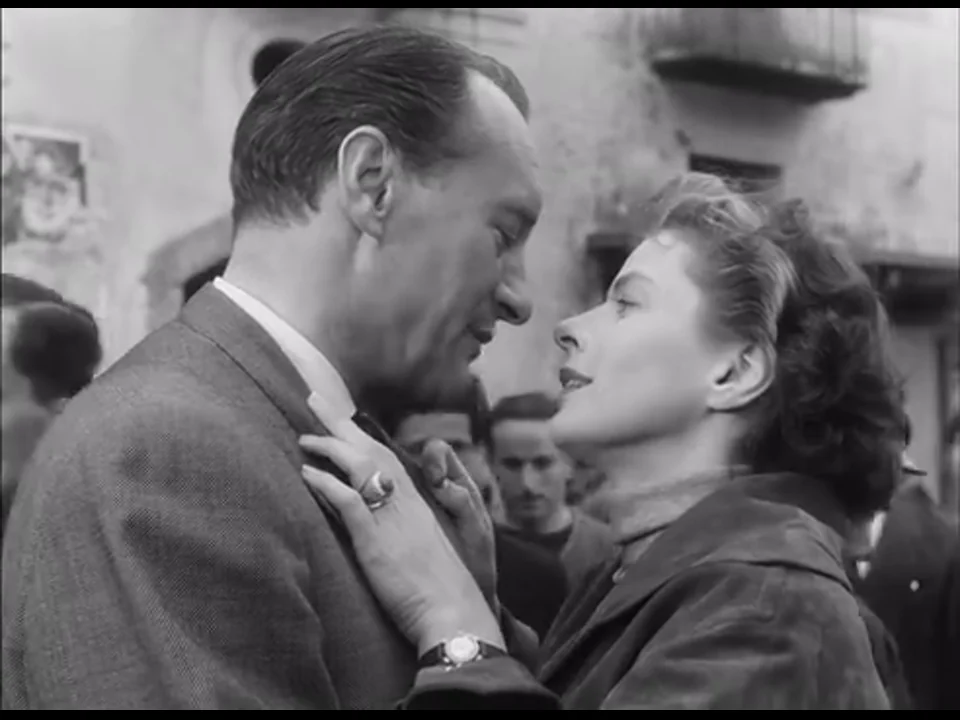
Reconciliation is not the couple's next planned step; it emerges after the procession interrupts, separates, and makes them call out. Bilibili timecode 01:24:50.
Open full-size still- Displayed still
- 01:24:50
- Discussion passage
- 01:21:18 - 01:25:28
Frame-checked against the single-part Bilibili repost stream BV1h5MVzfEdW: the page API reports 5,141 seconds, while the retrieved qn16 media runs 5,140.78 seconds at 492×360. Player v2 supplies no usable subtitle track; English dialogue sense was aligned by scene content with an English SDH subtitle file from the Criterion Blu-ray. Every timecode follows the Bilibili carrier.
Complete single-part film on Bilibili; the page, anonymous Player API, media bytes, and full 5,140.78-second duration were verified. Submission label: repost.
Still checked: 2026-08-13 · Carrier access checked: 2026-08-13
Image
A religious procession stops the car; after the couple get out, ranks, band, sacred image, and spectators keep crossing the frame around them.
The moving crowd carries Katherine away from Alex; he passes through the crowd, finds her, and they grasp and embrace one another.
Sound
Band music, bells, prayer, cheering, and repeated cries of 'miracle' fill the street.
Katherine calls Alex's name from within the crowd; after they reunite she says she does not want to lose him, while their voices remain surrounded by the collective sound field.
Relation to the concept
The procession's audio-visual density first overwhelms private dialogue, then opens a place for calling and reunion.
Sources and further reading
- Cinema 2: The Time-Image
Minnesota 1989 translation: ch. 1, p. 2 (listed as The Lonely Woman [Viaggio in Italia]). · Brief primary-text mention: on this page Deleuze includes Katherine among female tourists struck by unfolding images and visual clichés; the fuller argument for the turn from agent to seer comes from the surrounding chapter. This site analyzes each scene window, audio-visual fact, and criterion shot by shot.
- Bilibili · Steppenwolffff · public repost page
01:24:50 · Reconciliation is not the couple's next planned step; it emerges after the procession interrupts, separates, and makes them call out. Bilibili timecode 01:24:50.
Late Spring
晩春 (1949)
Supported by the scene
The vase does not explain Noriko's tears; the cuts give change a temporal form
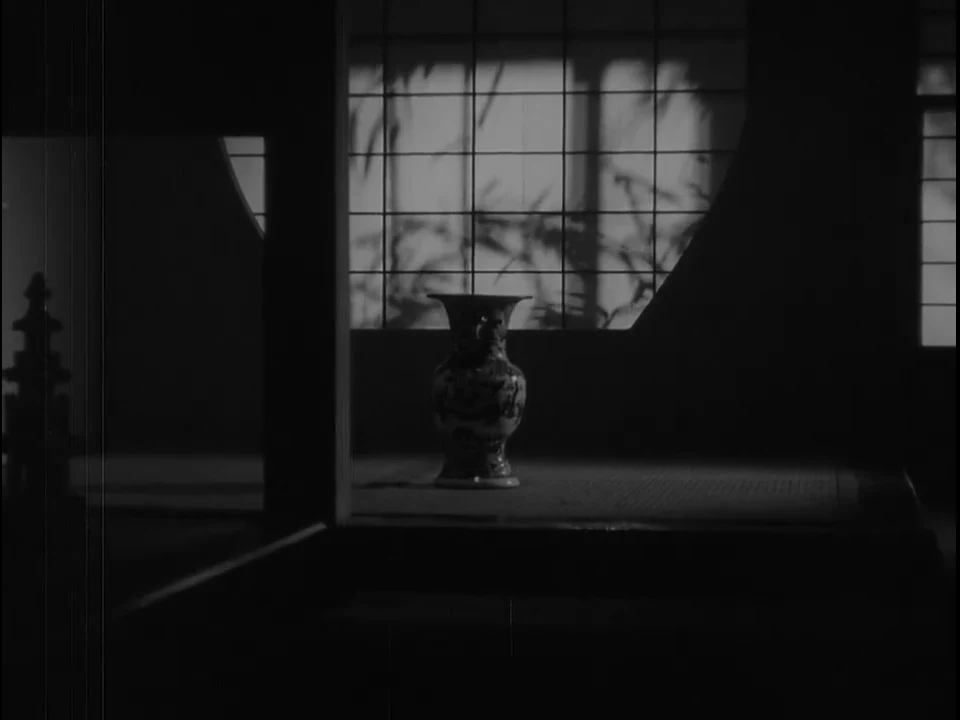
During the second vase shot, the vase remains nearly motionless while bamboo shadows continue moving across the shoji. The still records composition only. The 27.277-second interval from 01:28:20.380 to 01:28:47.657 begins with the first cut to the vase, passes through Noriko's face and the second vase shot, and ends at the cut into the rock garden; the preceding smiling face lies outside these stored bounds. Bilibili timecode 01:28:42.
Open full-size still- Displayed still
- 01:28:42
- Discussion passage
- 01:28:20.380 - 01:28:47.657
Within a continuous 01:28:15–01:28:55 window on the complete single-part Bilibili carrier BV1dN4y1B7tF, the atlas used cut detection and then frame-by-frame review to verify four cut points: first vase at 01:28:20.380, back to Noriko at 01:28:26.469, second vase at 01:28:37.397, and cut to the Ryōan-ji rock garden at 01:28:47.657. These coordinates bind only this 01:47:59 carrier; other restorations, releases, and leader lengths require fresh location.
Watch continuously from 01:28:15 to 01:28:50. First record visible differences between Noriko's two facial shots, then time both vase shots, and separately note snoring, music, and the cut to the rock garden. Do not begin by asking what the vase symbolizes. The coordinate binds only BV1dN4y1B7tF. Public reachability and the uploader's authorization to redistribute the feature are separate questions.
Still checked: 2026-09-03 · Carrier access checked: 2026-09-03
Image
In the shot immediately preceding the stored interval, Noriko lies down smiling. The stored bounds begin with the first vase shot, return to Noriko as tears gather in her eyes, cut to the same vase a second time, and end at the instant of cutting into the Ryōan-ji rock garden. Viewed with the adjacent shot, the order is Noriko's face–vase–Noriko's face–vase–rock garden.
On this carrier, the first vase shot lasts about 6.089 seconds and the second about 10.260 seconds. During the second, the vase remains nearly motionless while bamboo shadows continue moving on the shoji.
Sound
On p. 297, Parks uses continuing snoring to establish temporal contiguity across the shots; on p. 298, he reports that a musical theme enters about four seconds into the second vase shot and bridges to the rock-garden scene. This is Parks's written account of his material; treating it as an audible fact of this carrier still requires a separate check of its soundtrack.
Relation to the concept
The vase shots do not translate into cues for action. Verified shot duration and moving bamboo shadows support the pure optical situation. The snoring and music reported by Parks still require verification against this carrier's soundtrack and cannot independently establish a sonsign here.
Sources and further reading
- Cinema 2: The Time-Image
Minnesota 1989 translation, ch. 1, pp. 16–17 · Deleuze distinguishes still life from empty space and uses the vase to explain change occurring in an unchanging form. The primary text gives no seconds for this Bilibili carrier; the atlas separately verifies the four cuts.
- The Riddle of the Vase: Ozu Yasujirō’s Late Spring (1949)
Japanese Cinema: Texts and Contexts (2007), pp. 78–89; point-of-view debate on p. 86 · Nornes surveys conflicting interpretations and notes that Bordwell and Thompson correct Richie's and Schrader's loose descriptions of point of view. His emphasis on p. 86, however, is that this formal correction still does not explain why the vase is ‘oddly powerful.’ Rejecting the shortcut from ‘she sees the vase’ to a fixed emotional symbol is the atlas's methodological boundary, not Nornes's single conclusion.
- Change, Horizon, and Event in Ozu’s Late Spring (1949)
Film-Philosophy 20.2–3 (2016), pp. 292–298, DOI 10.3366/film.2016.0016 · Parks places Deleuze's temporal reading alongside shot legibility, sound continuity, and shot length. He reports four seconds for the first vase shot and nine for the second, whereas this carrier yields 6.089 and 10.260 seconds. Because the article does not identify its transfer or timing method here, the discrepancy is recorded without attributing it conclusively to an edition difference.
- Bilibili · bili_29513417942 · complete single-part Late Spring · user repost
01:28:42 · During the second vase shot, the vase remains nearly motionless while bamboo shadows continue moving across the shoji. The still records composition only. The 27.277-second interval from 01:28:20.380 to 01:28:47.657 begins with the first cut to the vase, passes through Noriko's face and the second vase shot, and ends at the cut into the rock garden; the preceding smiling face lies outside these stored bounds. Bilibili timecode 01:28:42.
Tropical Malady
สัตว์ประหลาด! (2004)
Concept relation awaiting verification
The radio does not restore coordinates
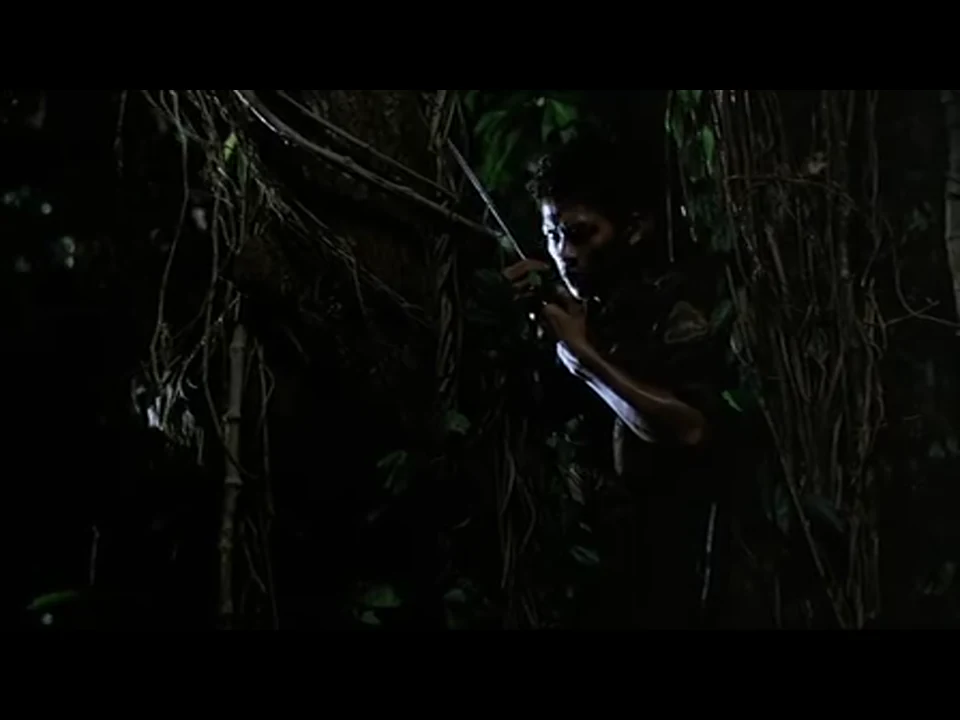
The communication device sends a call but does not turn the forest back into a mappable action-space. Bilibili timecode 01:08:47.
Open full-size still- Displayed still
- 01:08:47
- Discussion passage
- 01:08:36 - 01:09:10
Frame-checked against the single-part Bilibili repost stream BV12QcAzME5g: the page API reports 6,867 seconds and the retrieved qn16 media runs 6,866.48 seconds. Bilibili supplies no subtitle track; dialogue sense was cross-checked against a third-party English SRT bearing the same DVDRip release name.
Single-part user repost on Bilibili; the page and anonymous Player API were verified as playable. No platform subtitle track is present.
Still checked: 2026-08-13 · Carrier access checked: 2026-08-13
Image
Most of the frame remains dark; the soldier's face, hand, and nearby vines appear only intermittently.
He stops, raises a handheld radio to his mouth, and then remains listening in place.
Sound
He calls headquarters twice; no reply from headquarters is heard within the segment.
Forest insects continue to surround the brief human call.
Relation to the concept
Test whether forest sound exceeds orientation and action-cueing to acquire a duration of its own.
Sources and further reading
- Bilibili · 冰山阴影_ · public repost page
01:08:47 · The communication device sends a call but does not turn the forest back into a mappable action-space. Bilibili timecode 01:08:47.
Tropical Malady
สัตว์ประหลาด! (2004)
Concept relation awaiting verification
A gaze through the leaves
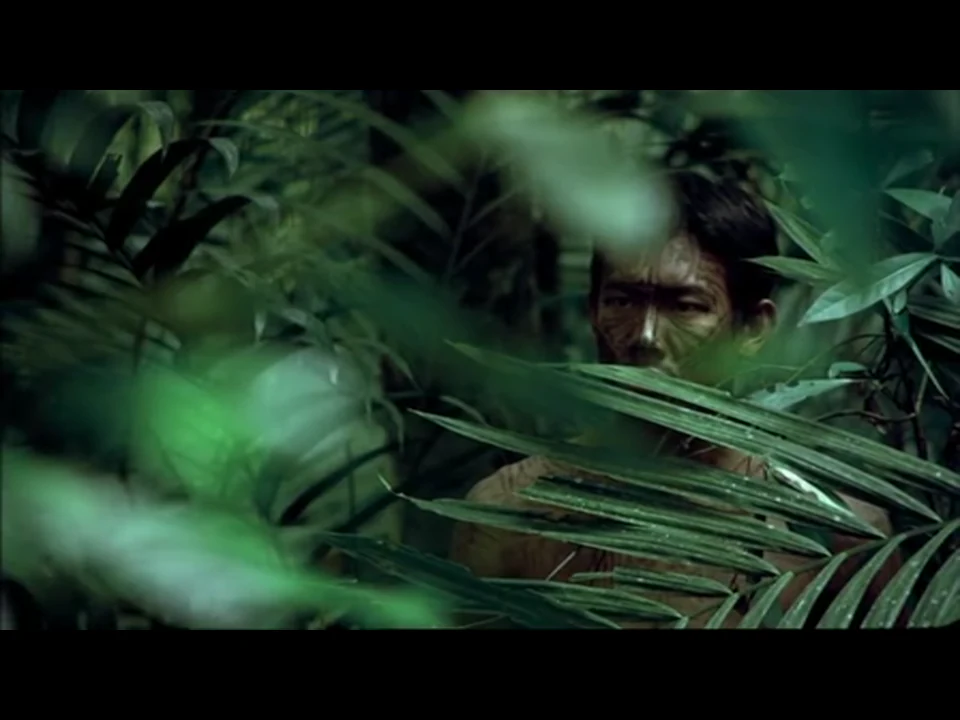
The body first appears as a difficult-to-identify fragment; a following intertitle links the gaze to the soldier's sound device. Bilibili timecode 01:17:54.
Open full-size still- Displayed still
- 01:17:54
- Discussion passage
- 01:17:18 - 01:18:10
Frame-checked against the single-part Bilibili repost stream BV12QcAzME5g: the page API reports 6,867 seconds and the retrieved qn16 media runs 6,866.48 seconds. Bilibili supplies no subtitle track; dialogue sense was cross-checked against a third-party English SRT bearing the same DVDRip release name.
Single-part user repost on Bilibili; the page and anonymous Player API were verified as playable. No platform subtitle track is present.
Still checked: 2026-08-13 · Carrier access checked: 2026-08-13
Image
A bare-chested figure moves low to the ground and is then screened by leaves, leaving only eyes and part of the face visible.
After this gaze, the film cuts to Thai text on black and then back to the forest; the exact-release English SRT renders the writing as the ghost being drawn to the soldier's 'sound device.'
Sound
Sparse forest sounds and several near-silent intervals accompany the figure's movement; the segment contains no spoken dialogue.
No spoken reading accompanies the black intertitle; the information about the 'sound device' is supplied only in writing.
Relation to the concept
Occlusion prevents immediate recognition of face and gaze-object; the intertitle then recomposes what was seen.
Sources and further reading
- Bilibili · 冰山阴影_ · public repost page
01:17:54 · The body first appears as a difficult-to-identify fragment; a following intertitle links the gaze to the soldier's sound device. Bilibili timecode 01:17:54.
Tropical Malady
สัตว์ประหลาด! (2004)
Concept relation awaiting verification
The monkey addresses the soldier
Editing joins the monkey in the tree, the soldier's upward look, and a spoken warning. Bilibili timecode 01:29:20.
Open full-size still- Displayed still
- 01:29:20
- Discussion passage
- 01:29:05 - 01:30:16
Frame-checked against the single-part Bilibili repost stream BV12QcAzME5g: the page API reports 6,867 seconds and the retrieved qn16 media runs 6,866.48 seconds. Bilibili supplies no subtitle track; dialogue sense was cross-checked against a third-party English SRT bearing the same DVDRip release name.
Single-part user repost on Bilibili; the page and anonymous Player API were verified as playable. No platform subtitle track is present.
Still checked: 2026-08-13 · Carrier access checked: 2026-08-13
Image
The soldier looks up after hearing a call; the film cuts to a monkey on a branch and back to the soldier.
Thai subtitles appear across the shot/reverse-shot, and editing attributes the speech to the monkey's shot.
Sound
A voice calls 'soldier' and then describes the tiger as a shadow, pursuer, and companion to its prey.
The speech offers two paths: kill the tiger to release it from the ghost world, or let the tiger devour the soldier so that he enters the tiger's world.
Relation to the concept
Monkey calls, subtitles, and shot/reverse-shot organize animal sound as speech that changes the hunt.
Sources and further reading
- Bilibili · 冰山阴影_ · public repost page
01:29:20 · Editing joins the monkey in the tree, the soldier's upward look, and a spoken warning. Bilibili timecode 01:29:20.
Tropical Malady
สัตว์ประหลาด! (2004)
Concept relation awaiting verification
Tiger and soldier hold one another's gaze
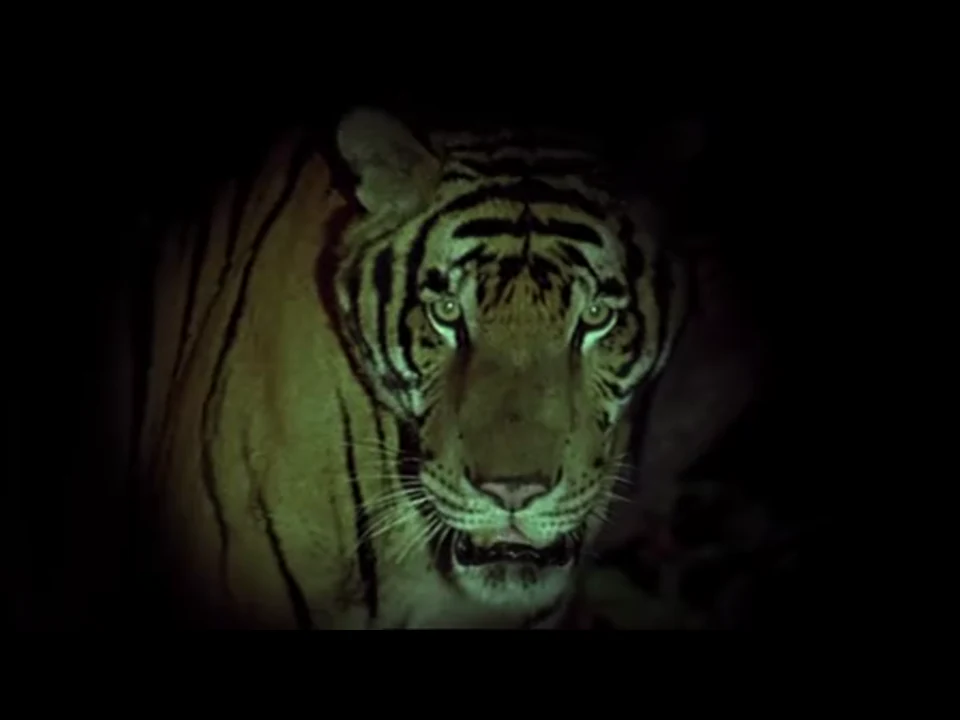
Alternating close views suspend the hunt between the frontal gazes of tiger and soldier. Bilibili timecode 01:45:12.
Open full-size still- Displayed still
- 01:45:12
- Discussion passage
- 01:44:42 - 01:46:02
Frame-checked against the single-part Bilibili repost stream BV12QcAzME5g: the page API reports 6,867 seconds and the retrieved qn16 media runs 6,866.48 seconds. Bilibili supplies no subtitle track; dialogue sense was cross-checked against a third-party English SRT bearing the same DVDRip release name.
Single-part user repost on Bilibili; the page and anonymous Player API were verified as playable. No platform subtitle track is present.
Still checked: 2026-08-13 · Carrier access checked: 2026-08-13
Image
Flashlight reveals the tiger's face; the film cuts among the tiger frontally, the soldier's face, and his hand holding the light.
The soldier does not fire and the tiger does not spring; both remain still and look toward one another.
Sound
Forest sound and low tiger vocalization continue; a first-person voice then enters in conjunction with the tiger's shots.
The voice successively names self, mother, father, fear, and sadness.
Relation to the concept
Gaze and voice cease to function merely as cues for shooting.
Sources and further reading
- Bilibili · 冰山阴影_ · public repost page
01:45:12 · Alternating close views suspend the hunt between the frontal gazes of tiger and soldier. Bilibili timecode 01:45:12.
Tropical Malady
สัตว์ประหลาด! (2004)
Concept relation awaiting verification
Giving over body and memory
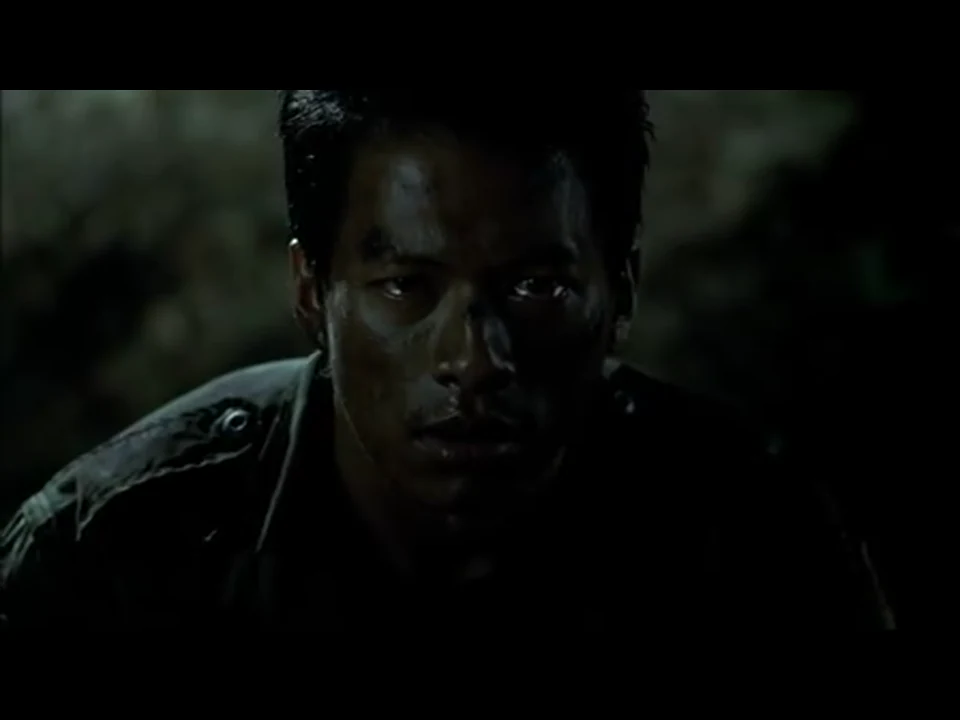
The soldier's close-up, an image of a tiger extending a long tongue toward a kneeling human figure, and forest sound join body, memory, and 'our song.' Bilibili timecode 01:48:40.
Open full-size still- Displayed still
- 01:48:40
- Discussion passage
- 01:47:52 - 01:49:17
Frame-checked against the single-part Bilibili repost stream BV12QcAzME5g: the page API reports 6,867 seconds and the retrieved qn16 media runs 6,866.48 seconds. Bilibili supplies no subtitle track; dialogue sense was cross-checked against a third-party English SRT bearing the same DVDRip release name.
Single-part user repost on Bilibili; the page and anonymous Player API were verified as playable. No platform subtitle track is present.
Still checked: 2026-08-13 · Carrier access checked: 2026-08-13
Image
The film alternates between the soldier's frontal close-up and an image of a tiger extending a long tongue toward a kneeling human figure; the soldier keeps staring.
At the segment's end, the film leaves the face for the dark canopy.
Sound
A voice addresses the 'monster' and gives over spirit, flesh, and memories.
The speech says that every drop of blood sings 'our song' and ends by asking, 'Do you hear it?' Forest sound continues.
Relation to the concept
The final question asks for a sound-relation that cannot be exhausted by the action of the hunt.
Sources and further reading
- Bilibili · 冰山阴影_ · public repost page
01:48:40 · The soldier's close-up, an image of a tiger extending a long tongue toward a kneeling human figure, and forest sound join body, memory, and 'our song.' Bilibili timecode 01:48:40.
Europe ’51
Europa ’51 (1952)
Candidate reading
Local adjustments still work, yet use no longer exhausts what is seen
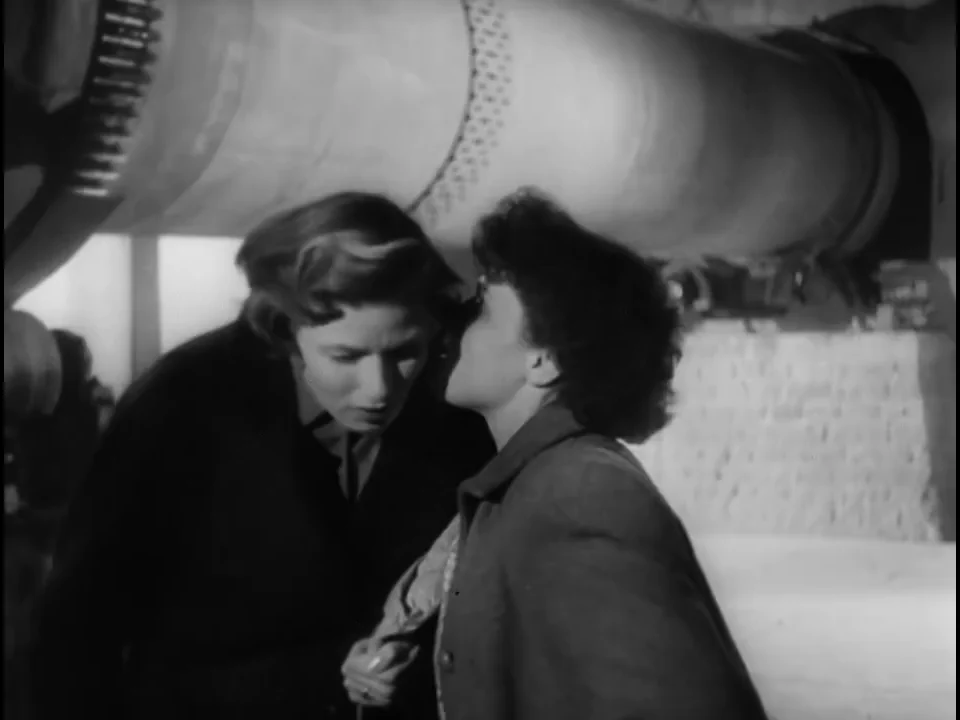
Cylindrical machinery occupies the upper frame while Irene turns and leans toward the worker below; mechanical noise and dialogue coexist in the same shop-floor sound field. Scale, sound, and bodily distance can each be checked at this moment. Bilibili timecode 01:00:00.
Open full-size still- Displayed still
- 01:00:00
- Discussion passage
- approx. 00:59:45–01:00:35 (still anchor 01:00:00)
The 01:00:00 still and its surrounding viewing interval were checked continuously on the single-part Bilibili repost BV15x4y1m7fS. This range provides reproducible coordinates for machinery, passage, bodily position, and sound; it does not claim the exact beginning and end of the complete factory passage. Every other release or cut requires fresh location.
Watch continuously from 00:59:45 to 01:00:35. Record separately the machine's scale in the frame, whether mechanical noise and dialogue coexist, and how the women alter bodily distance. After confirming that the communicative adjustment succeeds, compare the window with the film-wide context of taking a shift, seeking help, and caring to test whether use still fails to exhaust what is seen. The coordinate binds only BV15x4y1m7fS. Public availability and the uploader's authorization to redistribute the film are separate questions.
Still checked: 2026-08-14 · Carrier access checked: 2026-08-14
Image
An enormous cylindrical machine spans the upper frame; pipes, supports, and its body divide the background into dense industrial layers.
Irene and the worker stand in a narrow passage beneath the machine; Irene turns sideways and leans toward the other woman, who faces her.
Sound
Continuous mechanical noise and the women's dialogue occur together; their bodies remain close while they speak.
Relation to the concept
The visual scale of the machinery and its unrelenting roar acquire force in distinct registers; the atlas records each strand before reading them together as an emerging pure optical-sound situation.
Sources and further reading
- Cinema 2: The Time-Image
Minnesota 1989 translation: ch. 1, p. 2; ch. 3, pp. 45–46 · Chapter 1 places Europa '51 in the postwar lineage of pure optical-sound situations and the seer. Chapter 3 analyses the factory as an audio-visual ‘abstraction’: a few features send the same object through different circuits and open Irene's mental vision of prisoners rather than reviving a recollection. The account of seeing more when practical recognition fails comes from Marrati. The primary text supplies neither a coordinate for this Bilibili carrier nor a shot-by-shot description of this still; the atlas separately verifies the scene window and audio-visual facts.
- Gilles Deleuze: Cinema and Philosophy
Paola Marrati, Gilles Deleuze: Cinema and Philosophy, English translation (2008), pp. 58–60 · Marrati uses Irene's factory experience to distinguish practical recognition from seeing. The character does not first acquire knowledge about the factory and then act on it; rather, the failure of habitual recognition lets things appear with a force not exhausted by action. This interpretation supports the scene's conceptual boundary without replacing verification of the specific carrier.
- Cinema After Deleuze
Richard Rushton, Cinema After Deleuze (2012), pp. 63–65 · Rushton interprets the factory vision as ‘pure seeing’ released from established habits of looking and places Irene's break with middle-class conventions within the narrative process that ends in social exclusion and psychiatric confinement. He does not claim that the institution directly diagnoses this one factory vision, nor does he provide the time coordinate of the atlas still.
- Bilibili · 久久莫相忘_ · single-part complete film Europa '51 · repost
01:00:00 · Cylindrical machinery occupies the upper frame while Irene turns and leans toward the worker below; mechanical noise and dialogue coexist in the same shop-floor sound field. Scale, sound, and bodily distance can each be checked at this moment. Bilibili timecode 01:00:00.
Once Upon a Time in Anatolia
Bir Zamanlar Anadolu’da (2011)
Atlas shot reading
Headlights still do not find an answer
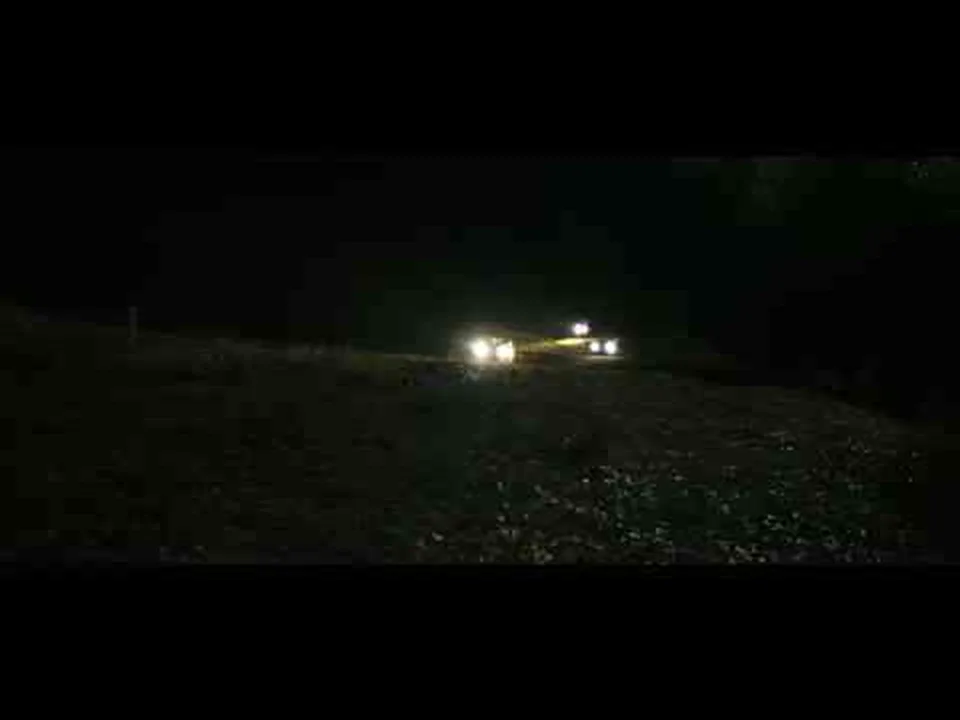
Headlights illuminate only a small patch of slope. Route words—old bridge, dam, opposite hill—return while digging repeatedly proves futile.
Open full-size still- Displayed still
- 00:35:30
- Feature time
- 00:35:30
Stills and jumps use the user-supplied Bilibili carrier. The feature occupies 00:00:00–02:31:07; roughly 1 hour 43 minutes of unrelated tail padding follows.
The still and link retain the film guide's recorded shot locator.
Image
Headlights illuminate only a small patch of slope. Route words—old bridge, dam, opposite hill—return while digging repeatedly proves futile.
Relation to the concept
Landscape no longer offers readable cues for action but exposes gaps among memory, language, and space. This is what detaches the optical situation from the sensory-motor circuit.
Sources and further reading
- Cinema 2, Chapter 1
Pure optical/sound situations and the neorealist turn
- Open Death-Images issue
Further research on death, witness, and image responsibility
- Official Cannes film archive
Premiere, credits, and edition coordinates
- Cinema Guild press kit
Director statements, credits, and production context
Once Upon a Time in Anatolia
Bir Zamanlar Anadolu’da (2011)
Atlas shot reading
Seeing a truth does not enter it into the record
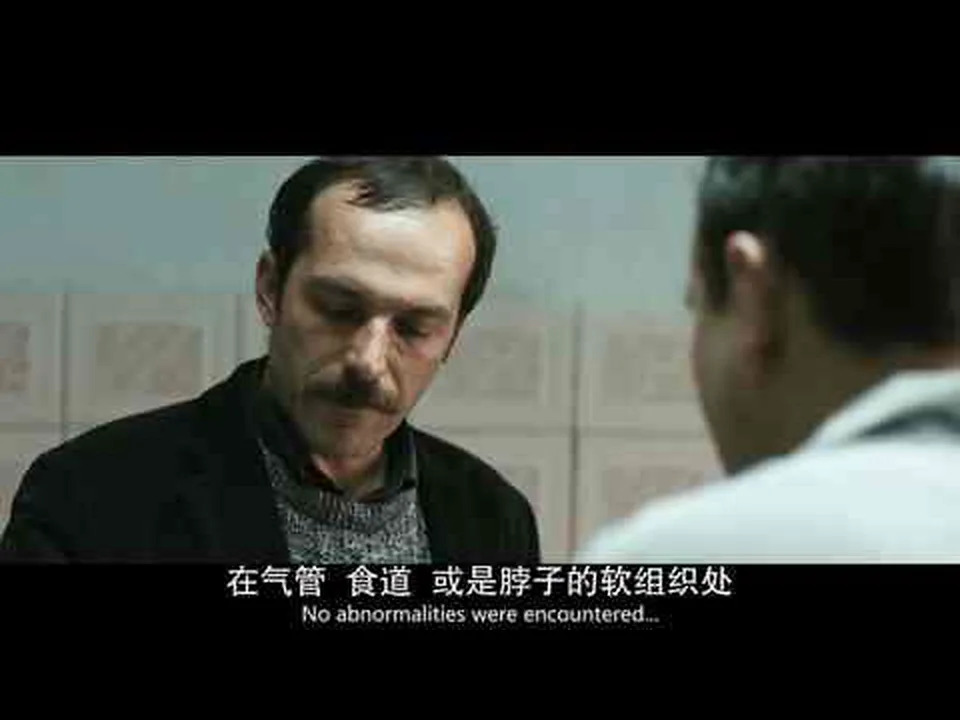
The assistant finds soil in the trachea and lungs and asks whether the victim was buried alive; after pausing, the doctor dictates ‘no abnormality observed.’
Open full-size still- Displayed still
- 02:24:20
- Feature time
- 02:24:20
Stills and jumps use the user-supplied Bilibili carrier. The feature occupies 00:00:00–02:31:07; roughly 1 hour 43 minutes of unrelated tail padding follows.
The still and link retain the film guide's recorded shot locator.
Image
The assistant finds soil in the trachea and lungs and asks whether the victim was buried alive; after pausing, the doctor dictates ‘no abnormality observed.’
Relation to the concept
Perception has occurred, yet institutional action deletes it. The time-image does not automatically deliver truth; it leaves the ethical interval among seeing, judging, and recording to the viewer.
Sources and further reading
- Cinema 2, Chapter 1
Pure optical/sound situations and the neorealist turn
- Open Death-Images issue
Further research on death, witness, and image responsibility
- Official Cannes film archive
Premiere, credits, and edition coordinates
- Cinema Guild press kit
Director statements, credits, and production context
Kaili Blues
路边野餐 (2015)
Atlas shot reading
The clinic already holds several times
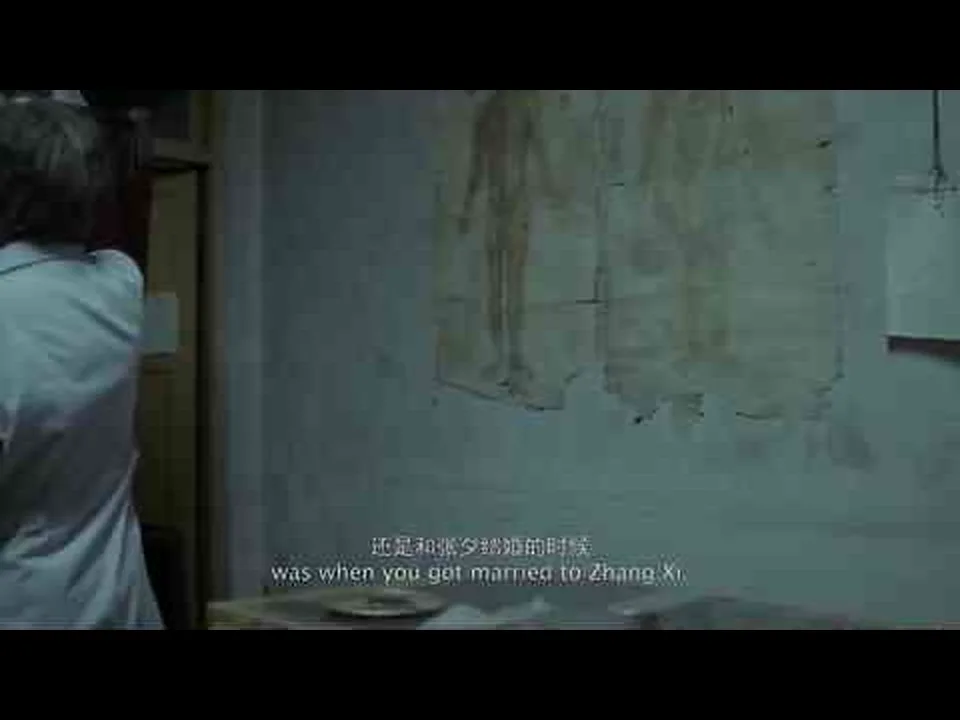
Clinic, television report about a ‘wild man,’ walls, patients, and Chen Sheng’s daily work share one cramped space; local rumour and practical affairs are not separated into different worlds.
Open full-size still- Displayed still
- 02:00:30
- Feature time
- 00:00:35
The user carrier runs 04:50:33. The target film occupies approximately 01:59:55–03:50:00, with unrelated padding on both sides; its first narrative shot appears around 02:00:25. Storyboard review places the celebrated Dangmai take at roughly 02:55:35–03:36:40 on the carrier (about 41:05). The atlas displays both feature and carrier axes.
The still and link retain the film guide's recorded shot locator.
Image
Clinic, television report about a ‘wild man,’ walls, patients, and Chen Sheng’s daily work share one cramped space; local rumour and practical affairs are not separated into different worlds.
Sound
Broadcast sound, clinic conversation, ambient noise, and poetry originate differently yet overlap in one present; sound first perforates the image with several temporal entrances.
Relation to the concept
A pure optical and sound situation does not require all action to cease. Perception already exceeds current tasks such as treatment or search, and the place begins to bear a past not absorbed by action.
Sources and further reading
- From temporal directions to actual / virtual
Test exchange instead of treating the reversed clock as a single symbol
- Cinema 2, Chapter 5
Sheets of past, peaks of present, and searches through memory
- MCLC review of Kaili Blues
Verify the continuous route through motorcycle, pickup, ferry, barbershop, and concert
- Minnesota: distinguishing the two long takes
Avoid confusing the title passage near minute 29 with the forty-one-minute Dangmai take
- Compare Long Day’s Journey into Night
Move from relayed transport to a 3D viewing regime and continuous dream-space
Mulholland Drive
Mulholland Drive (2001)
Atlas shot reading
The singer falls; the song does not
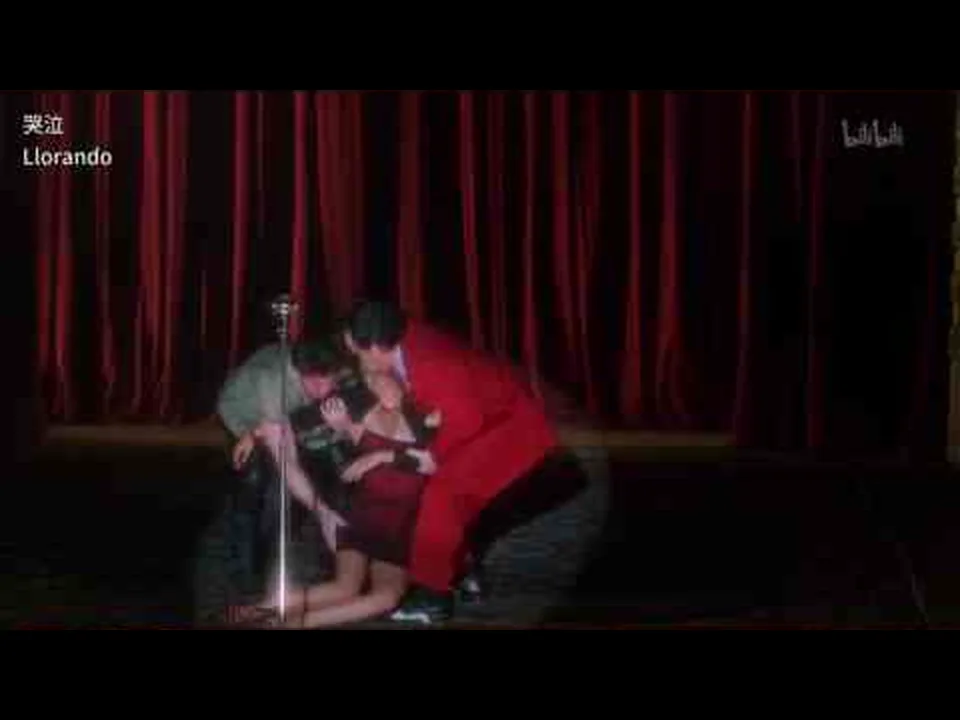
Rebekah Del Rio collapses and is carried away while microphone, red curtain, and audience remain. Betty and Rita already know ‘there is no band,’ yet their bodies continue to bear the performance.
Open full-size still- Displayed still
- 01:52:10
- Feature time
- 01:52:10
All three stills and feature times use Bilibili’s official PGC ep378235 (02:27:00; internal BVID BV1g5411V7eS). Continuous audio facts for Club Silencio and the blue box were checked second by second against playable excerpts; excerpt time axes are not presented as the official feature axis.
The still and link retain the film guide's recorded shot locator.
Image
Rebekah Del Rio collapses and is carried away while microphone, red curtain, and audience remain. Betty and Rita already know ‘there is no band,’ yet their bodies continue to bear the performance.
Sound
The recording of ‘Llorando’ continues for about twenty seconds after the visible body falls. Voice loses its present source but not its intensity; exposing synchronization does not cancel the tears.
Relation to the concept
Voice and body become relatively autonomous series. The sonsign asks how sound moves, attaches, and acts instead of ending judgment with ‘real voice / false voice.’
Sources and further reading
- Crystal essay: move beyond dream / reality
Check actual face, virtual face, exchange point, and consequence
- Pisters: The Neuro-Image guide
Connect identity change to brain, screen, and powers of the false
- Criterion: Lynch on audition and Silencio
Verify two treatments of the same material and the recording’s source
- Mactaggart: hearing loss and Club Silencio
Peer-reviewed study of audition, synchronization, and voice after collapse
- BFI: a cosmology beyond dream / reality
Keep the two-part solution as one reading rather than the final word
L’Eclisse
L’eclisse (1962)
Atlas shot reading
The room acknowledges the ending before the couple
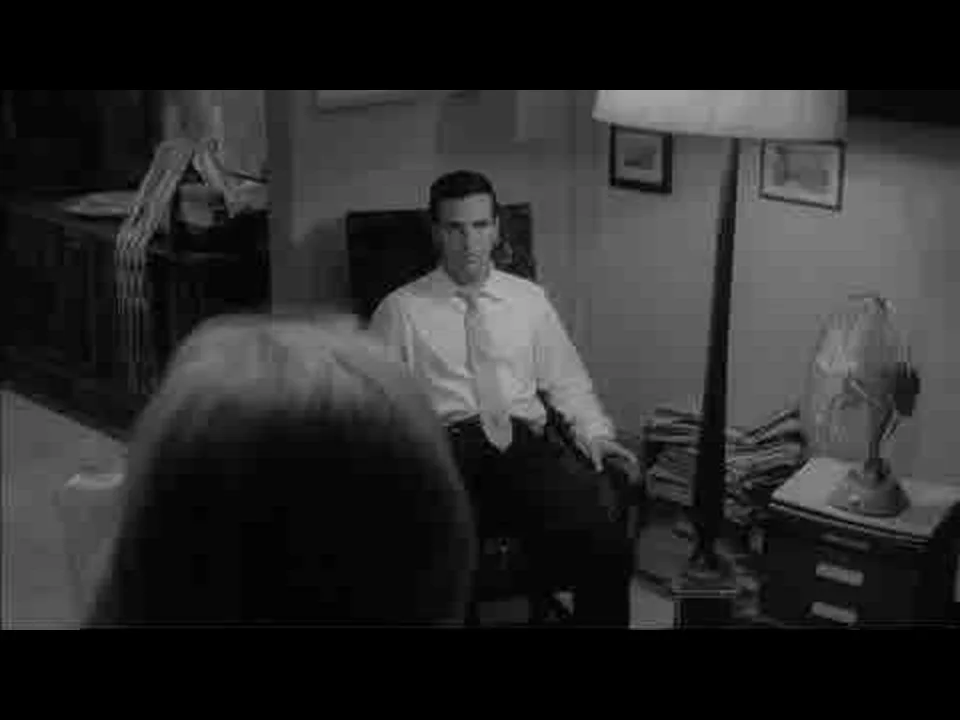
Lamp, fan, table, doorframe, and blinds repeatedly separate Vittoria and Riccardo. She walks, turns away, and touches objects without organizing a decisive conversation.
Open full-size still- Displayed still
- 00:06:00
- Feature time
- 00:06:00
- Carrier part
- 1
The user page aggregates two editions of the same film into 04:13:13. Part 1 is the complete 02:06:02 feature; parts 2–11 are a ten-part duplicate. All three stills and jumps are locked to part 1, and the aggregate page runtime is excluded from the film time axis.
The still and link retain the film guide's recorded shot locator.
Image
Lamp, fan, table, doorframe, and blinds repeatedly separate Vittoria and Riccardo. She walks, turns away, and touches objects without organizing a decisive conversation.
Sound
Fan hum, heels, electric razor, and long silences occupy the soundtrack. Language no longer governs the scene; machine and gait keep time for the relation.
Relation to the concept
The sensory-motor schema loosens within ordinary gestures: seeing, hearing, and touching continue but cannot extend into an action that completes the breakup. A pure optical and sound situation begins in this suspension.
Sources and further reading
- Cinema 2, Chapter 1
Broken action, pure optical/sound situations, and empty periods
- Cinema 2, Chapter 9
Readable relations after sound becomes an autonomous series
- Rushton: L’eclisse, pp.65–71
Unpeopled space, relational residues, and a world not filled by inhabitants
- BFI: audiovisual reading of the seven-minute ending
Verify lights, objects, and sounds continuing after character exit
- Senses of Cinema: objects and fractured desire
Return opening composition and object-rhythm to Antonioni’s form
- Compare Goodbye, Dragon Inn
Move from an unoccupied meeting place to a cinema persisting after dispersal
L’Eclisse
L’eclisse (1962)
Atlas shot reading
The market can price even silence
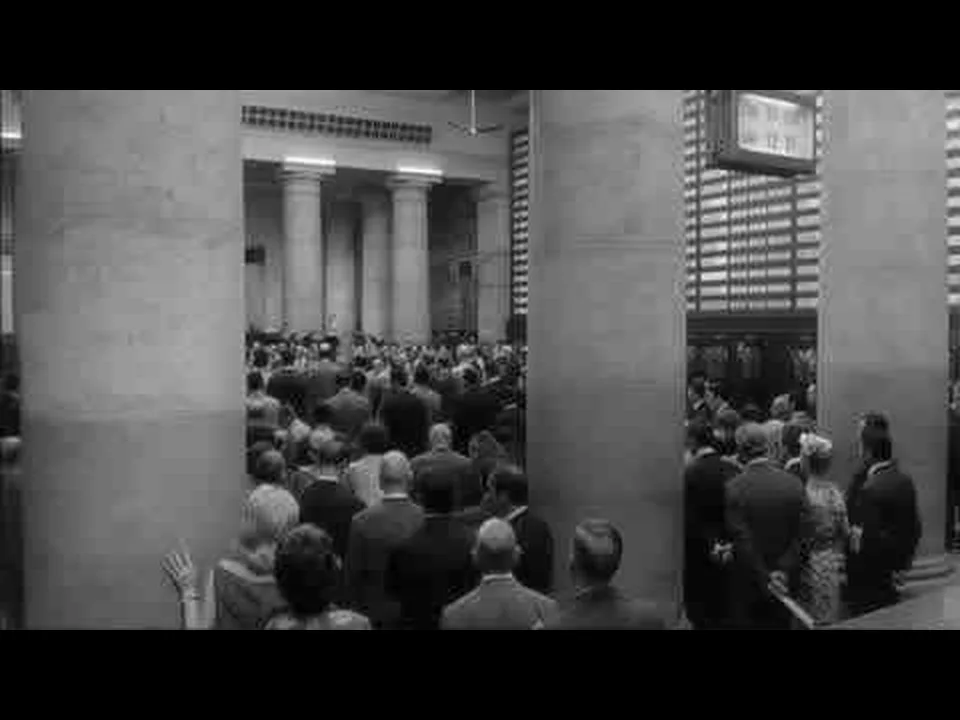
Calls, gestures, boards, telephones, and crowded bodies between columns suddenly stop and rearrange; the prior trading actions resume immediately when commemoration ends.
Open full-size still- Displayed still
- 00:23:11
- Feature time
- 00:23:11
- Carrier part
- 1
The user page aggregates two editions of the same film into 04:13:13. Part 1 is the complete 02:06:02 feature; parts 2–11 are a ten-part duplicate. All three stills and jumps are locked to part 1, and the aggregate page runtime is excluded from the film time axis.
The still and link retain the film guide's recorded shot locator.
Image
Calls, gestures, boards, telephones, and crowded bodies between columns suddenly stop and rearrange; the prior trading actions resume immediately when commemoration ends.
Sound
Relative silence on this carrier lasts only about twenty seconds, approximately 00:23:12.5–00:23:32.4. Telephones and room resonance never fully vanish, and the noise restarts.
Relation to the concept
Sound exposes a systemic rhythm beyond individual intention: death does not reorganize the action-chain but is absorbed as a brief pause. The sonsign lies in ‘noise–incomplete silence–noise returning,’ not merely in a loud market.
Sources and further reading
- Cinema 2, Chapter 1
Broken action, pure optical/sound situations, and empty periods
- Cinema 2, Chapter 9
Readable relations after sound becomes an autonomous series
- Rushton: L’eclisse, pp.65–71
Unpeopled space, relational residues, and a world not filled by inhabitants
- BFI: audiovisual reading of the seven-minute ending
Verify lights, objects, and sounds continuing after character exit
- Senses of Cinema: objects and fractured desire
Return opening composition and object-rhythm to Antonioni’s form
- Compare Goodbye, Dragon Inn
Move from an unoccupied meeting place to a cinema persisting after dispersal
Films and scenes

The revelation of the Pompeii casts is not exhausted by Katherine's departure; the optical situation retains its pressure after an action has been completed.
IMDb identification poster ↗Related film readings · 34 films
Late Spring · 1949 — The vase still life intervenes between the daughter’s smile and tears, placing change within time’s unchanging form.
Germany Year Zero · 1948 — Ruins exceed the reach of reparative action. The child becomes a seer before the intolerable, and the action-chain collapses from within.
Europe ’51 · 1952 — The factory passage does not leave Irene wholly unable to act: she can still approach, converse, and leave. Yet the machines' scale, the narrow passage, and the mechanical sound are no longer exhausted by the site's use as a ‘workplace’; the atlas reads this remainder as her shift from managing a situation toward enduring and seeing it anew as a seer.
Stromboli · 1950 — The volcano’s beauty and pain exceed any executable response, turning the protagonist from agent into a seer struck by a limit situation.
L’Avventura · 1960 — The disappearance escapes the logic of a solvable mystery; islands, architecture, and bodily attitudes give duration to the void within relations.
India Song · 1975 — Voices separate from visible bodies, while image and sound form autonomous series that meet at the edge of an absent event.
Umberto D. · 1952 — The maid’s small morning tasks receive their full duration. Seeing, waiting, and fatigue give everyday life optical density of its own.
L’Eclisse · 1962 — After characters and rendezvous withdraw from the ending, places, objects, wind, and city noise persist. Time appears independently of relational action.
Pickpocket · 1959 — Hands, pockets, wallets, and relays connect a space that can never be surveyed as a whole. Tactile relations replace mastery through complete action-space.
Early Summer · 1951 — The camera withdraws to hold the figure, then advances into a corridor that now belongs to her home. False continuity detaches space from action’s coordinates.
An Autumn Afternoon · 1962 — The father’s tears after the wedding remain within the everyday; death, separation, and grief flow through the same temporal series.
Pierrot le fou · 1965 — Words, colours, bodies, songs, and quotations form multiple series. Thought is forced in the intervals between them.
PlayTime · 1967 — Glass, reflections, machine noise, and distant actions disperse the comic centre. Sonic gags gain effects independent of visible action.
Gertrud · 1964 — Choice exceeds calculable consequences and becomes a mode of existence. Bodily attitudes and disconnected planar relations let belief replace knowledge.
Jeanne Dielman, 23 quai du Commerce, 1080 Bruxelles · 1975 — Cooking, cleaning, waiting, and counting appear in their full duration. Minute disorder first develops in body and ceremony.
Journey to Italy · 1954 · At the threshold — The revelation of the Pompeii casts is not exhausted by Katherine's departure; the optical situation retains its pressure after an action has been completed.
The Ganges Woman · 1974 — Two atemporal voices and the visible image each form autonomous series. The irrational cut preserves their boundaries so sound and image meet only at their limits.
The Lorry · 1977 — Sound acquires the reader's body while the visual is emptied into an unoccupied cab, roads, and a phantom lorry. As the lorry moves toward the sea, terrestrial movement enters Duras's oceanic perception.
Five Dedicated to Ozu · 2003 — Human action leaves the centre; waves, driftwood, moonlight, frogs, and rain become temporal events that must be watched and heard.
Mulholland Drive · 2001 — Identity, performance, and memory rewrite one another. Criterion: an actual/virtual circuit.
Tropical Malady · 2004 — The film’s rupture produces a new perceptual regime among love, legend, human-animal becoming, and forest, testing the postwar European model in return.
Once Upon a Time in Anatolia · 2011 — Headlights repeatedly illuminate similar slopes and fountains, yet the suspect can only answer 'not here.' The search accumulates no mastery of the steppe; it releases wind, an apple rolling into a stream, car conversations about illness and family, and the pause produced when the mayor's daughter serves tea. Even after the body is found, transported, and examined, the doctor suppresses a detail that could alter responsibility. Procedure finishes while the event remains unexhausted: the time of death stays among landscape, fatigue, and a judgment left unwritten.
Goodbye, Dragon Inn · 2003 — Theatre space, spectral spectators, waiting, and cinematic memory deprive action of its object; this relation provides the time-image criterion.
Kaili Blues · 2015 — Criterion: the Dangmai sequence lets search, past, future premonition, and spatial traversal coexist within one present.
Still Life · 2006 — Demolition space, broken relations, and sudden unreal objects remove the coordinates of action; local history provides the analysis’s core scale.
Bicycle Thieves · 1948 — The search should organize Rome as a space of purposeful action, yet it carries father and son through crowds, streets, and encounters that never cohere. When the boy witnesses his father’s failed theft, seeing replaces solution: the character becomes a seer within a situation he can no longer answer.
Paisà · 1946 — Six episodes join encounters, mistranslations, and abrupt deaths while withholding transitions that would explain them. Characters enter after a fact has begun and leave before its consequences can be mastered; the inexhaustible before and after of the event presses directly on perception.
Tokyo Story · 1953 — Trains and buses deliver the parents to Tokyo without re-forming the family as a community of action. Low viewpoints, abbreviated visits, empty rooms, and smokestacks break the trip into everyday intervals. After the mother’s death, objects and spaces continue, and time appears as the persistence of ordinary life.
Nashville · 1975 — The wide frame holds campaigning, performance, traffic, and private life at once, while multiple soundtracks let one city pass through dispersed lives. Assassination restores no centre; the stage absorbs disorder with another familiar song. Once collective action breaks down, the city is doubled by the sounds and media clichés it produces.
Au hasard Balthazar · 1966 — Balthazar makes no ethical choice, yet bears the effects of every human choice and non-choice. Reins, blows, loads, and wounds write human relations onto the animal body. Dying among sheep, he gives no verdict; the event suffered by the innocent separates from motive and becomes a spiritual affect.
The Enigma of Kaspar Hauser · 1974 — Writing, table manners, and logical puzzles try to insert Kaspar into social action, while his landscape visions open another passage in the image. Fields, mountains, and desert are not psychological illustrations; they split the small figure's local situation in two. Society can train his acts but cannot absorb his seeing.
Readings in the same thematic group
From the Cloud to the Resistance · 1979 — Mythic text, postwar resistance, and filmed land form distinct strata. Speech acts awaken the image’s historical pressure across irrational cuts.
Chronicle of Anna Magdalena Bach · 1968 — Anna's narration, letters, and the son's account form free indirect discourse. Live performance lets music acquire a resistant force independent of score and biographical explanation.
Her Venetian Name in Deserted Calcutta · 1976 — The soundtrack of India Song is placed over a different field of ruins. Names remain in an earlier stratum of memory while the ruins belong to another present; sound and image do not coincide on-screen and approach one another only at their limits.
Criteria
Can action use up this sound or image? What does the remainder compel us to notice?
Distinctions and counterexamples
A striking empty shot, prominent sound, voice-over, or slow motion remains sensory-motor when it establishes location, explains plot, or cues a target; asynchrony by itself is not an opsign or sonsign either.
Common confusion: Scope: an opsign or a sonsign may hold independently. Chapter 9's audio-visual disjunction and lectosign are later relations and must not be folded back into this definition.
Texts and sources
Cinema 2, ch. 1–2
- 01Cinema 2: The Time-Image
Authoritative source for the standard translation, translators, ISBN, and publication date.
View source and edition →
Research disagreements
Is 1945 a rupture or a model?
Postwar Europe is a crucial constellation within the time-image’s multiple global sites of emergence.
Replacement or coexistence?
The time-image reverses the subordination of time to movement; both regimes persist and can shift locally within one film.
How do we use Deleuze precisely?
Test four layers: sensory-motor relation, actual/virtual circuit, audio-visual connection, and regime of truth.
Where contemporary images push this concept
Counterexample against conceptual overreachCandidate reading · versioned passage review pending
The Plains: one viewpoint carries a year of roads
A fixed rear-seat view and off-camera conversation may seem to let sound and image proceed separately while still serving commute, homecoming, and biography. The countertest asks whether seeing and hearing truly fail to reconnect with an existing action plan before an opsign–sonsign relation is named.
Scope and limits If sound merely adds character information to the observational frame, or street views merely illustrate conversation, sound and image have not gained separate temporal autonomy and opsign–sonsign terminology should be withheld.
- David Easteal: The Plains director siteDirector site/press kit · formal factsDirector self-description explains intention, not viewer experience or a time-image conclusion.
- Bearing time: the expanded thirteen chaptersResearch book manuscript · ChineseThe 'generative time-image' is a proposition of this manuscript, not a term from Cinema 2.

Extending the concept into contemporary conditionsCandidate reading · versioned passage review pending
The Zone of Interest: how outside sound enters domestic life
Domestic compositions maintain the visible order of garden, breakfast, and work, while trains, gunshots, and cries beyond the wall establish another temporal series that the frame cannot absorb. The pure auditory situation is therefore not atmosphere but a force making visible routine bear the offscreen event.
Scope and limits If the sounds merely create horrific contrast or inform us of the camp's location, without persistently changing temporal judgement of onscreen action, they should be called offscreen narrative sound rather than an autonomous sonsign.
- Cannes: The Zone of Interest official film pageFestival official page · film factsThe synopsis and sound credit do not replace sequence-level audiovisual analysis; specific sound sources require the film edition.
- Emilija Talijan: Attention and ambience in The Zone of InterestPeer-reviewed article · ambience and witnessingThe article is scholarly interpretation, not authorial intention or every viewer’s experience; log sound source, attention, and ethical judgement separately.
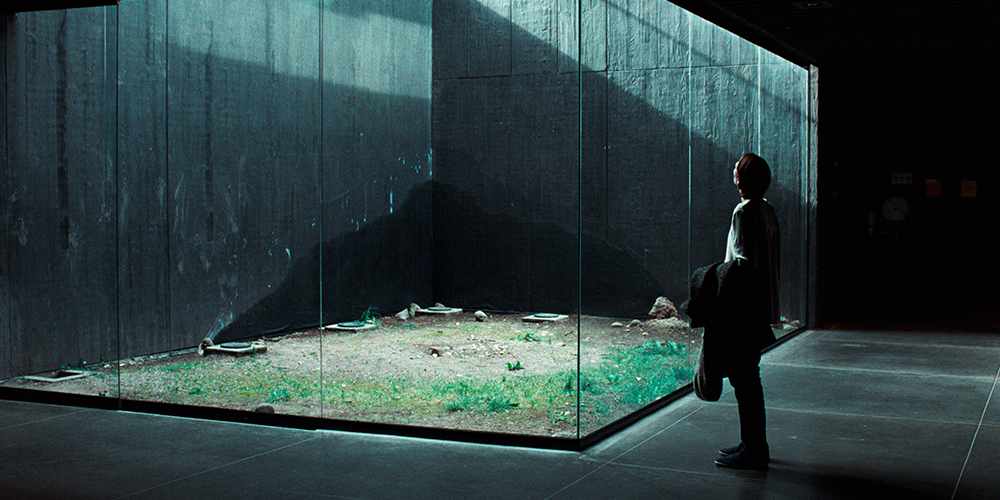
Testing the concept against a new mechanismPassage located, but the concept relation remains under review
Memoria: a sound pulls the present toward an undecided past
This check covers only 00:01:40–00:01:56 of the opening: the dim bedroom, a reclining body, and Jessica sitting up after the blast are visible; a low blast interrupts the nearly silent sound field at about 00:01:45.490, while no emitting object appears in the frame. The passage locates sound organising bodily response before a visible source, but it does not establish how the blast recurs across the complete film or, by itself, verify a sonsign.
Scope and limits If versioned sequences show each sound stably identified by later shots and functioning only as a puzzle clue, the pure auditory relation is reclaimed by causal narration; temporary absence of a source does not justify the sonsign.
- Bilibili: 09:42 opening excerpt from MemoriaUser-reposted excerpt · versioned viewing carrierThis is not the complete feature. It supports review of the opening bedroom passage only, not later recurrences, the final source, or the mix edition; public availability is not evidence of upload authorisation or official distribution.
- Neon: Memoria official film pageDistributor film page · film factsThe synopsis does not prove the sound’s ontology or the ending’s interpretation; sequence analysis needs an edition.
- Mariela Herrero: Los tiempos resuenan…Scholarly article · sound, landscape, and nonlinear timeThe article provides a theoretical bridge, not the timecodes of appearances, repetitions, or before/after confirmation.
Concepts to distinguish
Compare them
- Sensory-motor schemaschème sensori-moteur
The sensory-motor schema is not the definition of the movement-image but one specific body-world organization within it. A body receives movement from its milieu, selects perceptions according to its needs, retains what it cannot immediately discharge as affection, and answers the milieu through action. Its crisis does not mean that characters cease moving; the link from perception and affection to an action capable of changing the situation comes loose.
→ - The seervoyant
The agent loses mastery over the situation and sees what habitual action concealed. The seer is a body struck by something too strong, too beautiful, terrible, or intolerable.
→ - Any-space-whateverespace quelconque
A space stripped of stable coordinates, total continuity, and practical use: ruins, empty lots, fractured streets, waiting rooms, or virtual spaces built from light, colour, and fragments. Relations can be recomposed within it.
→