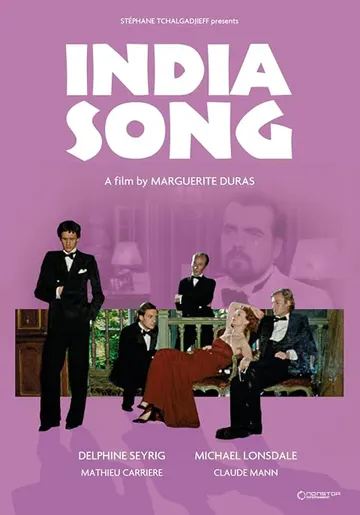
Marguerite Duras / 玛格丽特·杜拉斯 · 1975
India Song
India Song
Voices separate from visible bodies, while image and sound form autonomous series that meet at the edge of an absent event.
Film details
- Original title
- India Song
- Director
- Marguerite Duras / 玛格丽特·杜拉斯
- Year
- 1975
- Region
- France
Film analysis: how shots organize concepts
Bodies in empty rooms and absent voices each preserve a film of their own, exchanging the pressure of an absent event only across the interval.
- 01Bodies refuse to perform the voices
Slow walking, leaning, and dancing in the ballroom do not lip-sync with off-screen memories, names, and social conversation.
Voice ceases to be an attribute of the body, and visual attitude no longer explains the speaker. - 02The unseen occupies the sound field
The beggar woman's song, embassy memories, and the vice-consul's cries cross mirrors, empty halls, and heat without receiving matching event-images.
Absence is not an informational blank but an autonomous temporal layer preserved by sound. - 03Two images reach their limits
Mirrors, corridors, empty halls, and still attitudes drain visible action while voices repeatedly approach a catastrophe that is never reconstructed.
The irrational audio-visual cut makes the spectator read the distance rather than pair the two tracks again.
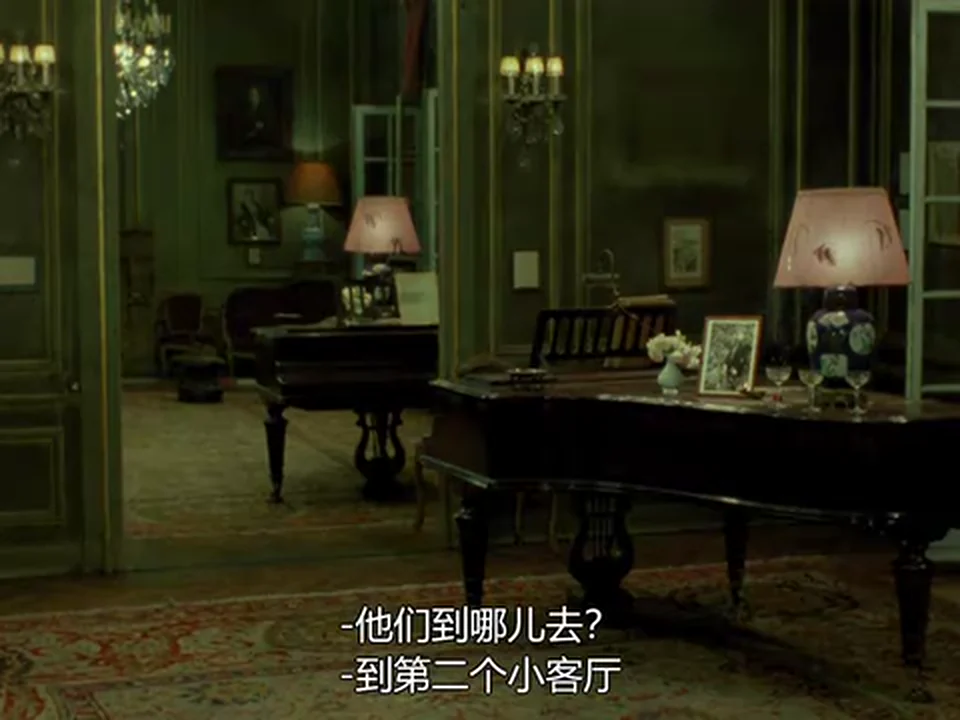 第9分段 00:48
Voices ask where the figures have gone while the image holds on an empty salon. The event remains in sound; the present space remains visible.
Two connected salons show pianos, lamps, mirrors, and framed photographs; no person enters the image.
Burned-in Chinese subtitles place a dialogue about the figures' location over an unoccupied space.
Two off-screen voices ask where the figures went and answer that they moved to the second salon.
The voices continue with references to the ambassador and champagne while the image supplies no speaking body.
SITE ANALYSISSound preserves relations and an event already underway while the empty rooms form another present. Sound and image do not complete each other; they remain autonomous series meeting at absence.
Cinema 2, chapters 7 and 9; atlas shot analysis.Bilibili at 第9分段 00:48 Open original still ↗Bilibili part 9 timeline, frame-verified to within one second.Complete 20-part film, total runtime 1:54:08; player, playurl, and anonymous media responses were verified for all twenty parts. Bilibili submission label: repost.
Bilibili complete 20-part upload · 忆君夕阳时 · verified 2026-08-14Analysis and scene sources
Shots and scenes
Primary texts, scholarship, and locators
Theory coordinate: Cinema 2, Minnesota 1989, ch. 9, pp. 250, 256–258
- 01Cinema 2: The Time-Image
Authoritative source for the standard translation, translators, ISBN, and publication date.
Open the atlas source record →
This film in books and research
Gilles Deleuze : cinéma et philosophie · Atlas analysis
India Song
Marrati pp. 74–101 · site test
Film relation: This site carries the criteria of broken action and direct time into audiovisual separation: empty rooms, absent bodies, and offscreen voices each maintain a series no longer related as illustration and illustrated object.
Shot question: When voices speak of characters after visible space has emptied, can the spectator still pin those voices back to one body and chronology?
Conclusion: Audiovisual disjunction is not failed synchronization; two autonomous series touch at their limits, making incommensurability itself a new relation.
Sensory-Motor Rupture: How a Character Becomes a Seer
Opsign and sonsign: not slowness, but autonomous series beyond action
Claim: The key to a pure optical or sound situation is not a slower rhythm but the moment when image or sound no longer supplies information for the next action; each preserves a time that reaction cannot exhaust.
Conclusion: Separate image and sound into two columns and track which one escapes action cues and acquires its own duration. Either column may independently form an opsign or sonsign; only when both unfold autonomously and meet at a common limit should the analysis proceed to audio-visual disjunction and the lectosign.
Cinema 2: The Time-Image · Chapter 9, pp. 251–261; chapter 10, pp. 262–265Deleuze on Cinema · Sections on ‘Opsigns’ and the sound-image, pp. 107–118, 165–177
The Irrational Cut: How the Interstice Becomes a Lectosign
Audio-visual disjunction establishes an incommensurable common limit
Claim: Sound-image and visual image unfold autonomously and touch through distance rather than restored synchronization.
Conclusion: List the internal organization of sound and image separately, then locate each limit; relation is produced by the distance between limits.
Cinema 2: The Time-Image · pp. 251, 257, 260–261Cinema 2: The Time-Image · pp. 250, 256–258Deleuze's Cinema Books · pp. 162–171
The Irrational Cut: How the Interstice Becomes a Lectosign
Two strata of an absent event
Film comparison: Voices preserve relational history while rooms and attitudes form a visual stratum.
Viewing gateways and editions
- Verified complete Bilibili multipart carrier: 印度之歌 India Song (1975/玛格丽特·杜拉斯)bilibili.comOpen film page ↗
- Page access
- Accessible when checked
- Version extent
- Recorded as a complete version
- Source type
- User-uploaded page
Edition note: Complete 20-part film, total runtime 1:54:08; the sound-image separation in part 9 has a still-led analysis.
Link checked: 2026-08-14
- Criterion Collectioncriterion.comOpen film page ↗
- Source type
- Distributor or streaming platform