Sensory-Motor Rupture: How a Character Becomes a Seer
From the gap between completed movement and an unmastered situation to the temporal threshold of pure optical or sound situations
Concept relation
- 01Perception meets a situation beyond its existing schema→
- 02Movement continues but remains inadequate to the situation→
- 03Sight and sound are no longer exhausted by reaction→
- 04The seer reaches the threshold of the time-image
Sensory-motor rupture occurs when perception may still lead to completed movement, yet action is no longer adequate to the situation. The seer receives sights and sounds that no response exhausts, and time becomes the pressure of the image rather than the measure of action.
Cinema 2 briefly mentions Germany Year Zero, Journey to Italy, and Europa '51 in chapter 1; chapter 3 directly analyzes Europa '51's factory passage and the postwar seer. The perception–action–consequence analysis of individual scenes is this atlas's shot analysis.
Primary coordinates
DELEUZE PRIMARY TEXTa cinema of the seer
FACT → RELATION → TEST
The act is completed; the situation remains unmastered
Rupture occurs between local motor success and the failure of the action-chain as a whole.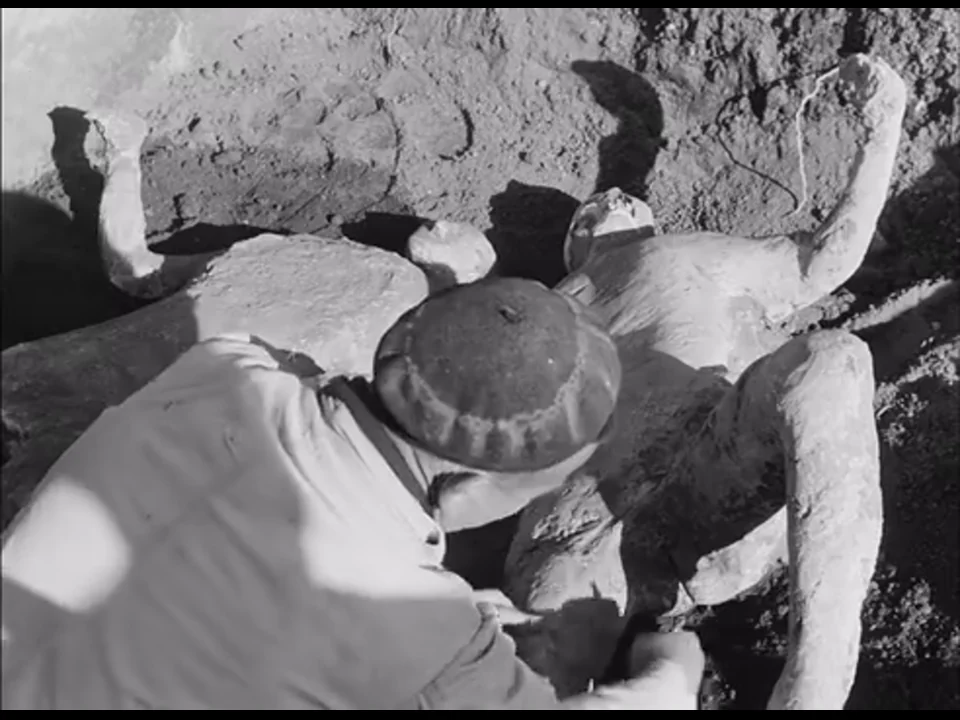
The technical operation successfully restores bodily contours while depriving the watching couple of their capacity to keep bearing the sight. Bilibili timecode 01:15:10.
Bilibili at 01:15:10 Open scene evidence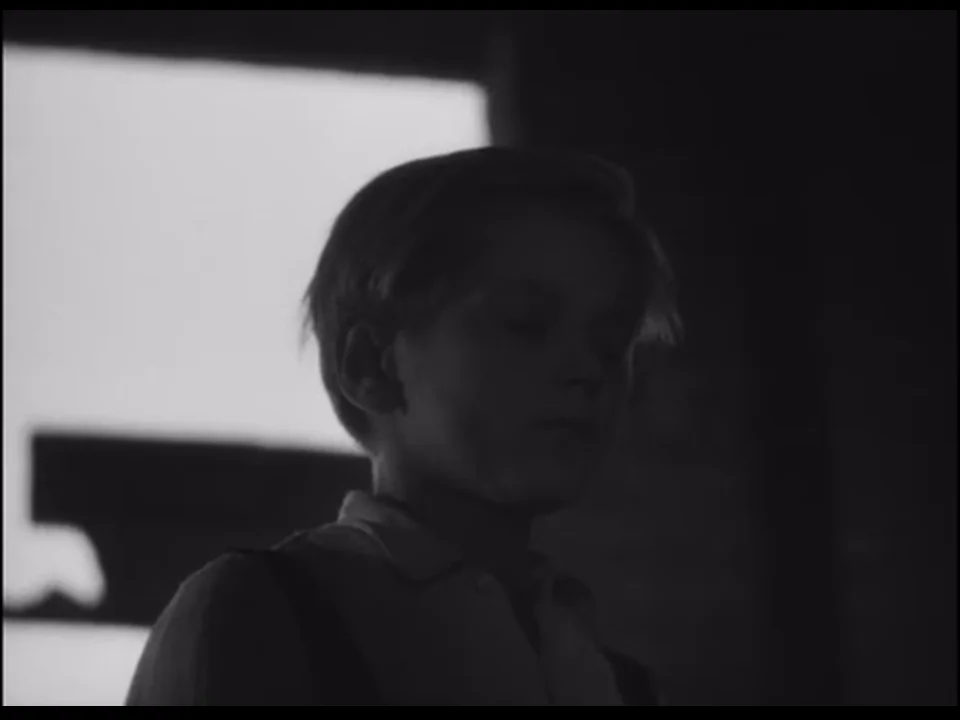
The long wandering turns streets, church, ruined buildings, traffic, and children's play from usable action-space into a city layer that must be watched. Bilibili timecode 01:12:18.
Bilibili at 01:12:18 Open scene evidenceThe archaeological procedure at Pompeii succeeds: casting, clearing, and identification make two bodies visible. Katherine cannot extend what she sees into an act capable of treating her marriage. The more exact the technical operation, the clearer the inadequacy of personal action.[1, ch. 1, p. 2]
In the final movement of Germany Year Zero, Edmund keeps walking, stopping, picking up, looking, and climbing. Each movement is completed, yet none repairs his father's death, restores the family, or opens a next step. The atlas therefore judges that movement remains while its extensible bond with the world disappears. Deleuze on page 2 places the child in the seer lineage only by saying that he ‘dies from what he sees’; Marrati on pages 56–57 discusses the final wandering through Bazin. Neither source performs this shot-by-shot action analysis for the atlas.[1, p. 2][3, pp. 56–57]
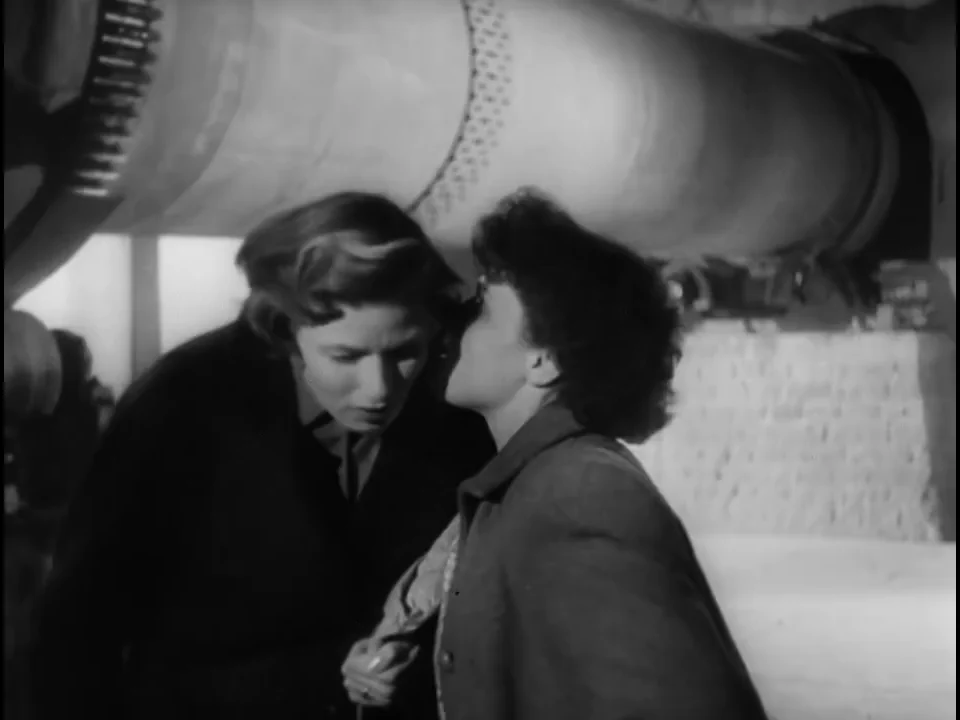
Cylindrical machinery occupies the upper frame while Irene turns and leans toward the worker below; mechanical noise and dialogue coexist in the same shop-floor sound field. Scale, sound, and bodily distance can each be checked at this moment. Bilibili timecode 01:00:00.
Bilibili at 01:00:00 Open scene evidence01:15:10The technical operation successfully restores bodily contours while depriving the watching couple of their capacity to keep bearing the sight. Bilibili timecode 01:15:10.
Workers use trowels, brushes, and hands to remove volcanic material; pale plaster gradually exposes a head, teeth, arms, and legs against dark soil.
Two adjacent bodies are identified as a man and a woman; the film alternates among the remains and Alex's and Katherine's responses.
The on-site commentary explains how plaster fills the cavity left after a body disintegrates and successively identifies legs, arms, skull, and teeth.
Tools continue scraping soil; after the observers suggest the two may have been husband and wife, Katherine says she cannot bear it and asks to leave.
SITE ANALYSISTechnical reconstruction's success and sensory-motor response's failure must both remain visible; neither the bodies nor the couple alone is sufficient.
Bilibili at 01:15:10 Open original still ↗Frame-checked against the single-part Bilibili repost stream BV1h5MVzfEdW: the page API reports 5,141 seconds, while the retrieved qn16 media runs 5,140.78 seconds at 492×360. Player v2 supplies no usable subtitle track; English dialogue sense was aligned by scene content with an English SDH subtitle file from the Criterion Blu-ray. Every timecode follows the Bilibili carrier.Complete single-part film on Bilibili; the page, anonymous Player API, media bytes, and full 5,140.78-second duration were verified. Submission label: repost.
Bilibili · Steppenwolffff · public repost page · verified 2026-08-13In Europa '51, machines, workers, rollers, and passages are no longer unified by the use ‘workplace’ into one recognized object. When Irene later says that she thought she saw prisoners, she is not comparing the factory to a prison: Deleuze stresses that a few audio-visual features send the same object through another circuit and open a mental vision. The character does not cease all action; she begins to see relations that use does not exhaust.[1, ch. 1, pp. 2, 20–21; ch. 3, pp. 45–46][4, pp. 107–113]
Marrati locates the postwar turn in a changed relation between image and action: reality no longer appears as a situation to be mastered, and seeing acquires autonomous value. The seer is produced by the situation rather than predetermined by a passive character type.[3, pp. 57–61]
FACT → RELATION → TEST
The image unexhausted by action carries time
When the shot no longer submits to route and task, pressures of past, present, and future can coexist within one passage.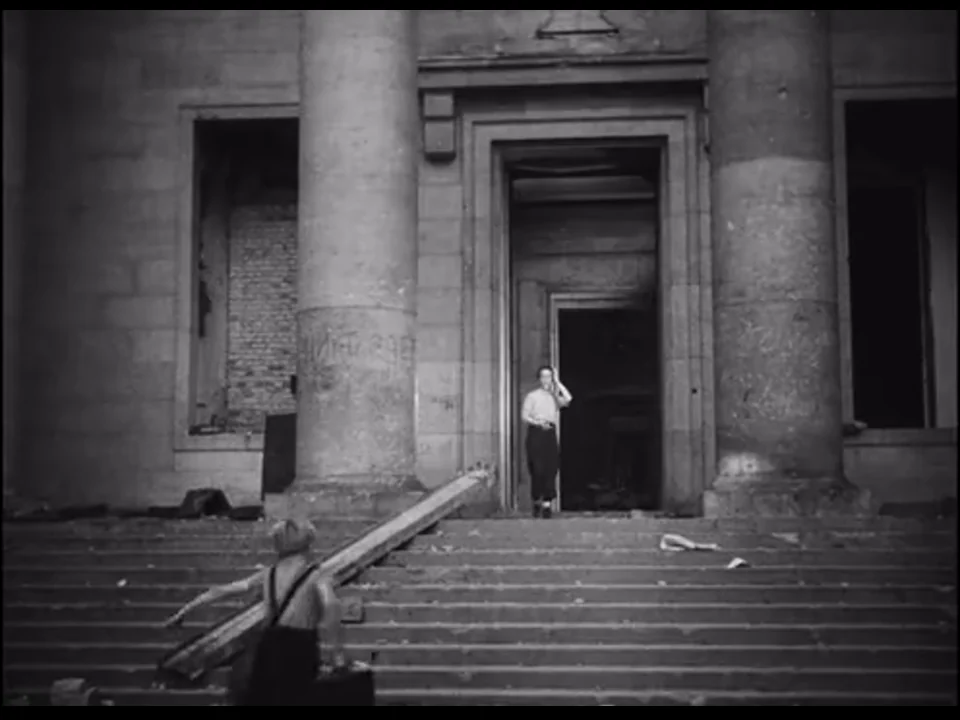
A recorded political voice meets the ruined Chancellery; the source of the voice and visible history are separated. Bilibili timecode 00:27:50.
Bilibili at 00:27:50 Open scene evidenceThe long wandering turns streets, church, ruined buildings, traffic, and children's play from usable action-space into a city layer that must be watched. Bilibili timecode 01:12:18.
Bilibili at 01:12:18 Open scene evidence
Photographs, black screen, and a second title sequence headed 'A Spirit's Path' sever the everyday love story of the first half. Bilibili timecode 00:58:55.
Bilibili at 00:58:55 Open scene evidenceGermany Year Zero's ending leaves children's play, traffic, church, and ruined buildings within Edmund's continuing wandering; the immediate past of his father's death is not converted by the route into a reparative task. Earlier, a recorded political speech crosses the ruined Chancellery. The atlas reads these two passages together as the double pressure of historical and immediate past upon the final present. Deleuze on page 2 says only that the child ‘dies from what he sees’; page 3 gives the general formula linking motor helplessness to greater visual and auditory capacity. Neither passage develops the atlas's three-tense cross-reading.[1, ch. 1, pp. 2–3]
Tropical Malady is not a film discussed in Cinema 2. The atlas treats the photographs, blackout, tiger image, near-silence, and nocturnal forest opening around the second title sequence as a cross-period test. The title break alone establishes only a reset of viewing conditions: the continuity of the first half's romantic actions stops there. Whether a seer structure forms must still be tested throughout the ensuing night forest by asking if sound, occlusion, and bodily movement persistently refuse coordinates for a next action. Only then may the criterion transfer; this is an atlas inference, not Deleuze's judgment on the film.[1, ch. 1, pp. 2–5][4, pp. 107–113]
FACT → RELATION → TEST
Opsign and sonsign: not slowness, but autonomous series beyond action
The key to a pure optical or sound situation is not a slower rhythm but the moment when image or sound no longer supplies information for the next action; each preserves a time that reaction cannot exhaust.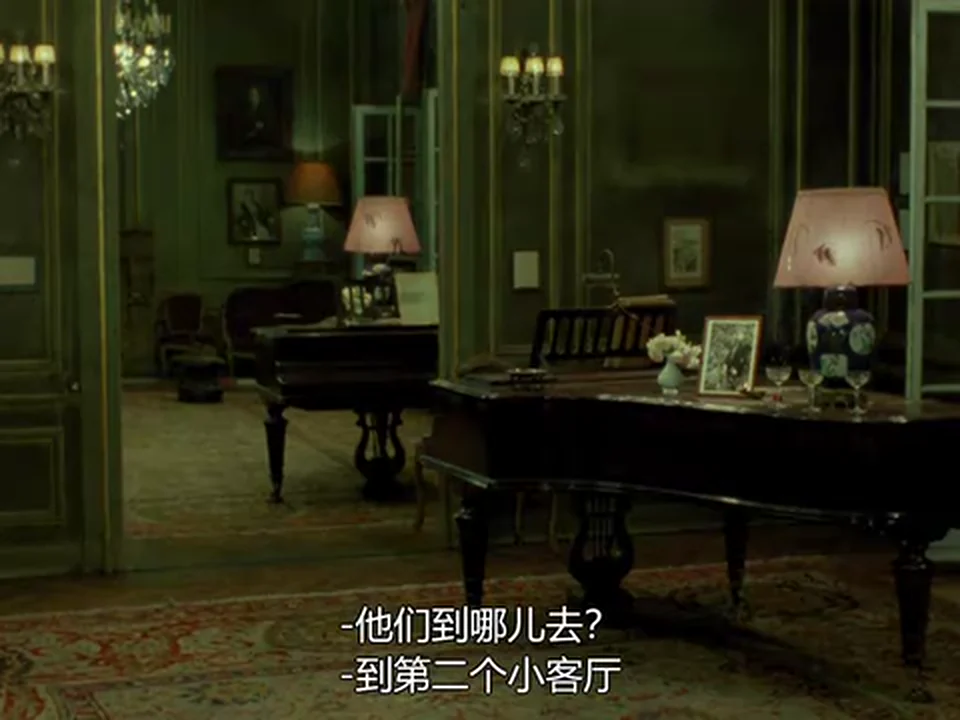 第9分段 00:48
Voices ask where the figures have gone while the image holds on an empty salon. The event remains in sound; the present space remains visible.
Two connected salons show pianos, lamps, mirrors, and framed photographs; no person enters the image.
Burned-in Chinese subtitles place a dialogue about the figures' location over an unoccupied space.
Two off-screen voices ask where the figures went and answer that they moved to the second salon.
The voices continue with references to the ambassador and champagne while the image supplies no speaking body.
SITE ANALYSISSound preserves relations and an event already underway while the empty rooms form another present. Sound and image do not complete each other; they remain autonomous series meeting at absence.
Cinema 2, chapters 7 and 9; atlas shot analysis.Bilibili at 第9分段 00:48 Open original still ↗Bilibili part 9 timeline, frame-verified to within one second.Complete 20-part film, total runtime 1:54:08; player, playurl, and anonymous media responses were verified for all twenty parts. Bilibili submission label: repost.
Bilibili complete 20-part upload · 忆君夕阳时 · verified 2026-08-14Chapter 9 of Cinema 2 moves audio-visual relations away from an action centre: sound can leave the visible mouth, and the image can refuse to illustrate sound.[1, Chapter 9, pp. 251–261; chapter 10, pp. 262–265]
For the atlas shot log, first list the space, body, and absence supplied by the image separately from the source, duration, and history supplied by sound. This is an atlas method, not a sentence attributed to Cinema 2.
India Song's voices preserve a relational history that no visible body can authenticate, while Chronicle of Anna Magdalena Bach makes score, hands, instruments, and documentary time enter the same act of viewing. Both films remind us that a sonsign is not a synonym for voice-over and an opsign is not a synonym for an empty shot; the criterion is whether each changes the temporal position of viewing.[4, Sections on ‘Opsigns’ and the sound-image, pp. 107–118, 165–177]
Film comparisons
Journey to Italy
Technical success / personal inadequacyThe Pompeii operation succeeds while Katherine's marital action cannot extend.
Deleuze briefly mentions this film here · ch. 1, p. 201:15:10The technical operation successfully restores bodily contours while depriving the watching couple of their capacity to keep bearing the sight. Bilibili timecode 01:15:10.
Workers use trowels, brushes, and hands to remove volcanic material; pale plaster gradually exposes a head, teeth, arms, and legs against dark soil.
Two adjacent bodies are identified as a man and a woman; the film alternates among the remains and Alex's and Katherine's responses.
The on-site commentary explains how plaster fills the cavity left after a body disintegrates and successively identifies legs, arms, skull, and teeth.
Tools continue scraping soil; after the observers suggest the two may have been husband and wife, Katherine says she cannot bear it and asks to leave.
SITE ANALYSISTechnical reconstruction's success and sensory-motor response's failure must both remain visible; neither the bodies nor the couple alone is sufficient.
Bilibili at 01:15:10 Open original still ↗Frame-checked against the single-part Bilibili repost stream BV1h5MVzfEdW: the page API reports 5,141 seconds, while the retrieved qn16 media runs 5,140.78 seconds at 492×360. Player v2 supplies no usable subtitle track; English dialogue sense was aligned by scene content with an English SDH subtitle file from the Criterion Blu-ray. Every timecode follows the Bilibili carrier.Complete single-part film on Bilibili; the page, anonymous Player API, media bytes, and full 5,140.78-second duration were verified. Submission label: repost.
Bilibili · Steppenwolffff · public repost page · verified 2026-08-13Germany Year Zero
Movement persists / future closesWalking and climbing are completed but no longer generate a continuable world.
Deleuze briefly mentions this film here · ch. 1, pp. 2–301:12:18The long wandering turns streets, church, ruined buildings, traffic, and children's play from usable action-space into a city layer that must be watched. Bilibili timecode 01:12:18.
Edmund crosses streets and broken walls alone, pauses outside a church, and enters a building without intact walls.
He watches children playing, vehicles, and the street below, repeatedly touches debris and architectural fragments; after climbing upward, he falls from the building, and a woman in the street approaches his body.
The long passage is formed mainly by sustained orchestral music, traffic, distant children's voices, and urban ambience; Edmund speaks almost no dialogue.
SITE ANALYSISWandering must let space and sound endure beyond route-finding and turn the child's motor helplessness into intensified seeing; the finale satisfies both conditions.
Bilibili at 01:12:18 Open original still ↗Frame-checked against the single-part Bilibili repost stream BV1hP4y1k78i: the page API reports 4,388 seconds and the retrieved qn16 media runs 4,387.37 seconds. Bilibili supplies no subtitle track; audible facts record only clearly discernible German speech, music, and ambient sound in the image sequence.Complete single-part Bilibili film; the page and anonymous Player API were verified as playable. Bilibili submission label: repost.
Bilibili · La-Jeunesse- · public repost page · verified 2026-08-13Europe ’51
Audio-visual features open another circuitIndustrial space is no longer exhausted by the use ‘workplace’; a few audio-visual features open a mental vision.
Deleuze discusses this film directly here · ch. 1, pp. 2, 20–21; ch. 3, pp. 45–46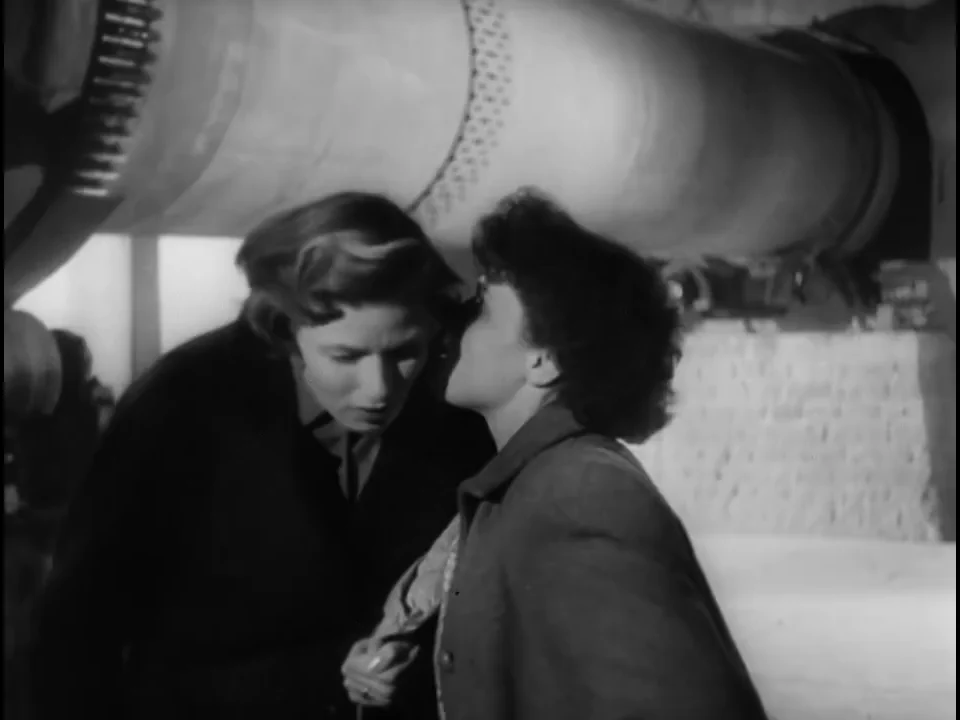 01:00:00
Cylindrical machinery occupies the upper frame; Irene and the worker converse at close range in the narrow passage below it while mechanical sound and dialogue coexist.
A huge cylindrical machine occupies the upper frame.
Irene and the worker stand close together in the narrow passage beneath the machine.
Continuous mechanical sound coexists with the women's dialogue.
SITE ANALYSISThis still and approximate verification interval support only the audio-visual facts of machine scale, bodily distance, and the coexistence of mechanical sound and dialogue. Read with Deleuze's discussion of the factory's audio-visual ‘abstraction’ and the seer, Marrati's account of the failure of practical recognition, and Rushton's interpretation of ‘pure seeing,’ the atlas understands the passage as follows: local communication can still succeed, yet the factory is no longer exhausted by its use as a ‘workplace.’ This is not a causal fact that a single still can establish directly.
Deleuze, Cinema 2, Minnesota 1989 English translation, ch. 1, p. 2 and ch. 3, pp. 45–46; Marrati, Gilles Deleuze: Cinema and Philosophy, 2008 English translation, pp. 58–60; Rushton, Cinema After Deleuze, 2012, pp. 63–65.Bilibili at 01:00:00 Open original still ↗The 01:00:00 still has been checked; 00:59:45–01:00:35 is an approximate verification interval on the single-part Bilibili timeline.Single-part Bilibili repost; the still at 01:00:00 has been checked, and the image and timestamp come from the same public upload. 00:59:45–01:00:35 is only an approximate verification interval, not a claim about the exact beginning and end of the complete factory passage.
Bilibili · Europa '51 complete film · verified 2026-08-14Tropical Malady
A reset of the audio-visual regimeThe forest after the intertitle tests the seer beyond the postwar corpus.
00:58:55Photographs, black screen, and a second title sequence headed 'A Spirit's Path' sever the everyday love story of the first half. Bilibili timecode 00:58:55.
After the final interior shot of the first half, photographs of the two men appear and the image turns black.
The black screen gives way to a hand-drawn tiger, the Thai word for 'spirit,' and a second set of credits; the exact-release English SRT renders the written sequence as 'A Spirit's Path' and a shaman legend, after which the image enters the forest at night.
The preceding sound stops at the black interval, so the aural break coincides with the visual rupture.
After the photographs turn to black, the track settles into sustained near-silence; no spoken dialogue or narration is heard over the tiger cards.
SITE ANALYSISThe two halves are not directly deducible through one continuous action chain, while tiger, legend, and the same performers keep them related; both conditions hold.
Bilibili at 00:58:55 Open original still ↗Frame-checked against the single-part Bilibili repost stream BV12QcAzME5g: the page API reports 6,867 seconds and the retrieved qn16 media runs 6,866.48 seconds. Bilibili supplies no subtitle track; dialogue sense was cross-checked against a third-party English SRT bearing the same DVDRip release name.Single-part user repost on Bilibili; the page and anonymous Player API were verified as playable. No platform subtitle track is present.
Bilibili · 冰山阴影_ · public repost page · verified 2026-08-13Put the claim back into more films
These films are not a list of examples but pressure tests: when the same concept meets different spaces, bodies, sounds, and narrations, which relations still hold and which must be withdrawn?
When does action give way to seeing?
Begin with postwar situations in Rossellini and Antonioni: first test whether action can still change the world, then track which sights and sounds leave time in a situation the character cannot master.
Germany Year Zero
Ruins break the action-chain from within
Edmund still walks, trades, poisons, and climbs, yet none of these movements repairs the family or opens a future. Time is no longer an interval measured between acts; it is the present the child endures before the intolerable.
01:12:18- CONCEPT MOVE
- Movement succeeds locally while the situation remains unmastered; the agent becomes a seer.
- SHOT EVIDENCE
- Replay the ending and log each walk, pause, pickup, look, and climb; ask whether the image supplies an actionable next task.
- BOUNDARY
- The tragic theme of the ruins is not the rupture by itself; the test is the continuing failure of action to alter the situation.
Cinema 2, ch. 1, p. 2
LOCATORFinal wandering and climb; Cinema 2, ch. 1, p. 2
Europe ’51
The factory turns ethical action into an optical situation too strong to master
Once Irene enters the factory, machines, workers, rollers, and passages no longer await her management. She encounters not a social task ready to solve but an intensity that changes her perceptual regime; seeing comes before a new ethics of action.
01:00:00- CONCEPT MOVE
- The situation escapes the character's inherited moral task, and the pure optical situation acquires its own pressure.
- SHOT EVIDENCE
- Compare the factory entrance, machine rhythm, and Irene's facial response: does her seeing still gather information for a predetermined act?
- BOUNDARY
- Factory subject matter or a changed opinion is insufficient; the image must show the old recognition–response chain losing its command.
Cinema 2, ch. 1, p. 2; ch. 3, pp. 45–46
LOCATORFactory passage; Cinema 2, ch. 3, pp. 45–46
When does sound stop serving the image?
From Duras's autonomous voices to Straub's live performance, separate the times of sound and image first, then locate their contact at the boundaries of absence, body, and history.
India Song
Voices leave bodies and sound and image form autonomous series
Voices no longer explain the psychology of visible bodies. Image and sound unfold along separate temporal lines and meet at the edge of an absent event. Viewing must track who speaks, who is seen, and who never appears.
第9分段 00:48- CONCEPT MOVE
- Sound and image remain heterogeneous, and the interval itself bears the event's temporal pressure.
- SHOT EVIDENCE
- Listen once with eyes closed, then replay with the image: record the past addressed by sound, the present shown by image, and where they touch through absence.
- BOUNDARY
- Voice-over or asynchrony is not automatically audio-visual reading; sound must have a temporal series not governed by the image.
Cinema 2, ch. 9, pp. 250, 256–258
LOCATORDance, empty corridors, and the crossing of absent voices
Tropical Malady
Black screen cuts intimacy into another forest-time, while sound and gaze suspend the hunt before action
Touch, smiles, and everyday dialogue in the first half are severed by the tiger title card. The radio does not restore the forest as a mappable command-space, and the frontal gazes of tiger and soldier prevent recognition from becoming an immediate shot. Sound, writing, animal, and body jointly change the rules of viewing.
00:58:55- CONCEPT MOVE
- The irrational cut withdraws the first half's action coordinates; sound and image then extend separate series of waiting, recognition, and prophecy.
- SHOT EVIDENCE
- Replay the black title card, unanswered radio, gaze through leaves, monkey's address, and tiger/soldier encounter in order; record how sound or writing gains priority over action in each passage.
- BOUNDARY
- Black screen, forest sound, or animal gaze alone is insufficient; the action-chain must be severed across the two halves while sound and image generate a new temporal relation in the interval.
Eight atlas shot records with Bilibili timecodes
Cinema 2, ch. 9: conceptual baseline for audio-visual autonomy
LOCATOR00:58:55, 01:08:47, 01:17:54, 01:29:20, 01:45:12, 01:48:40
How scholarship advances the problem
Paola Marrati
Gilles Deleuze: Cinema and PhilosophyRecasts the postwar break as a reorganization of reality, action, and subjectivity.
Used to distinguish the seer's receptivity from outward passivity.Open full citation ↓Ronald Bogue
Deleuze on CinemaProvides a stepwise account of opsigns, sonsigns, and sensory-motor rupture.
Used to turn shot facts into a repeatable three-part test.Open full citation ↓References
- 01
DELEUZE PRIMARY TEXT Gilles Deleuze, Cinema 2: The Time-Image, trans. Hugh Tomlinson and Robert Galeta (University of Minnesota Press, 1989).
Chapter 1, pp. 2–5, 20–21; chapter 3, pp. 45–46Publisher record and purchase access - 02
DELEUZE PRIMARY TEXT Gilles Deleuze, Cinema 3 seminar, Lecture 9A, 24 January 1984, Purdue Deleuze Seminars.
English transcript, pp. 7–9Open English transcript PDF - 03
SCHOLARSHIP Paola Marrati, Gilles Deleuze: Cinema and Philosophy (Johns Hopkins University Press, 2008).
Chapter 4, “Postwar Cinema,” pp. 57–61Publisher record and purchase access · DOI 10.56021/9780801888021 - 04
SCHOLARSHIP Ronald Bogue, Deleuze on Cinema (Routledge, 2003).
Chapter 4, “Opsigns,” pp. 107–113Publisher record and preview