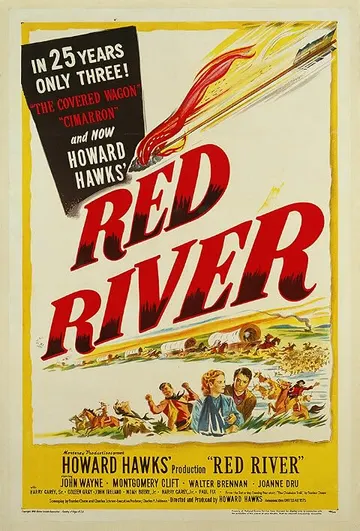
Howard Hawks / 霍华德·霍克斯 · 1948
Red River
Red River
Deleuze names Red River in Cinema 1, chapter 10, p. 165, within Hawks and the small form rather than directly presenting it as a model of the large form. Open landscape and collective task can still pose an S–A–S′ hypothesis. The atlas then countertests it through the claim passage at 00:15:38, stampede at 00:51:20, and transfer of command at 01:21:08: does an encompassing situation genuinely precede action, or is it progressively disclosed and reorganized by local acts, differences of speed, and relayed functions? The relation among these three shots is the atlas's responsibility, not a shot-by-shot gloss of p. 165.
Film details
- Original title
- Red River
- Director
- Howard Hawks / 霍华德·霍克斯
- Year
- 1948
- Region
- United States
Film analysis: how shots organize concepts
Why can Red River pose the large form S–A–S′ while still requiring a countertest through the small form A–S–A′?
Open landscape, herd, and collective task first make situation appear to encompass the figures, allowing an S–A–S′ hypothesis. Yet Deleuze names the film in Cinema 1, chapter 10, p. 165, within Hawks and the small form. Claiming, stampede, and transfer are not three ready-made slots in a formula but three tests of whether situation precedes action or is progressively disclosed and reorganized through local acts, differences of speed, and relayed functions.
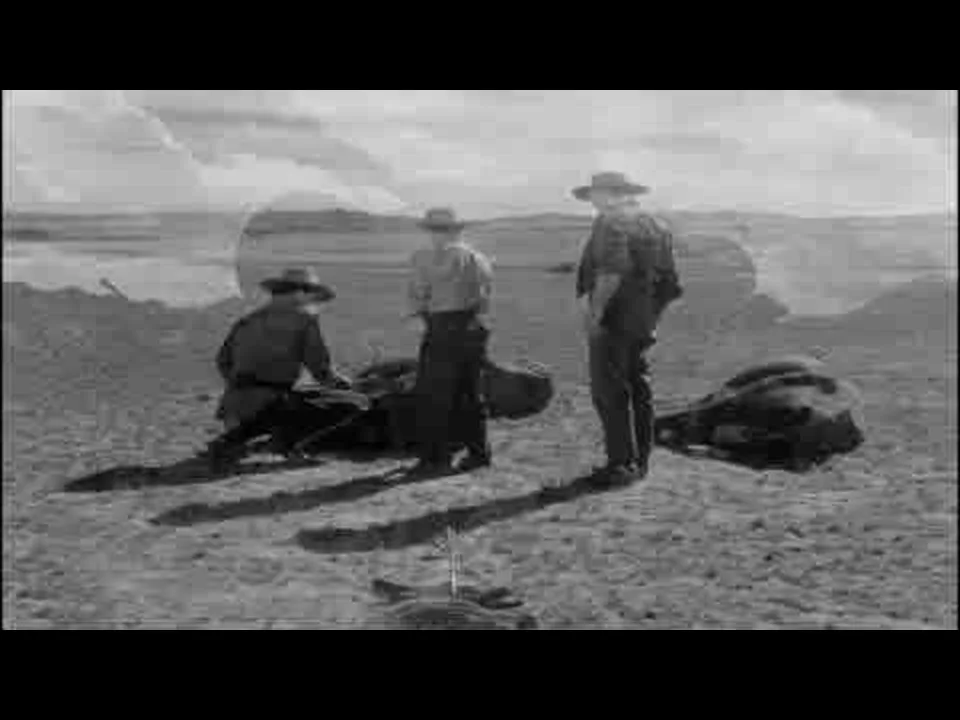
Dunson uses gun, grave, brand, and naming to write a ranch origin onto the riverbank, covering prior relations to the land with his future plan.
The passage poses only the S hypothesis of the large form: sign, violence, and labour produce landscape as a commandable whole. If later action is not sufficiently determined by that whole, the S–A–S′ judgement must be narrowed or withdrawn.
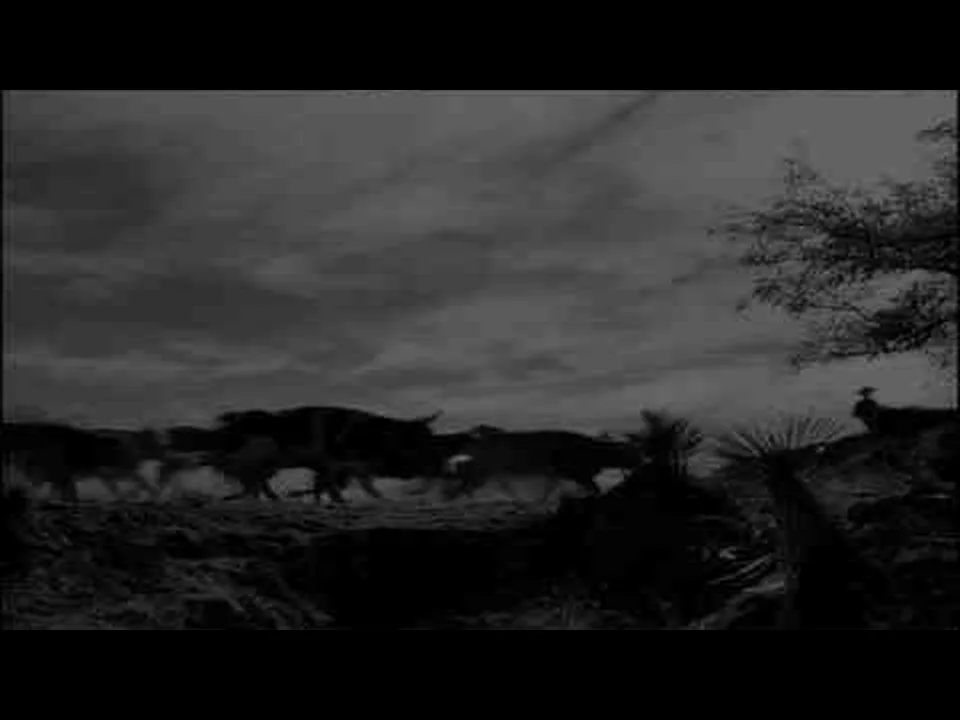
Night erases individual riders within the whole as disturbance propagates through the herd. Human cries, horses, and dense cattle movement amplify one another faster than command can follow.
The passage countertests heroic command over the whole: response continues but is distributed across humans, horses, cattle, and night milieu. It weakens the central-command reading, yet stampede alone proves neither a crisis of action nor the small form.
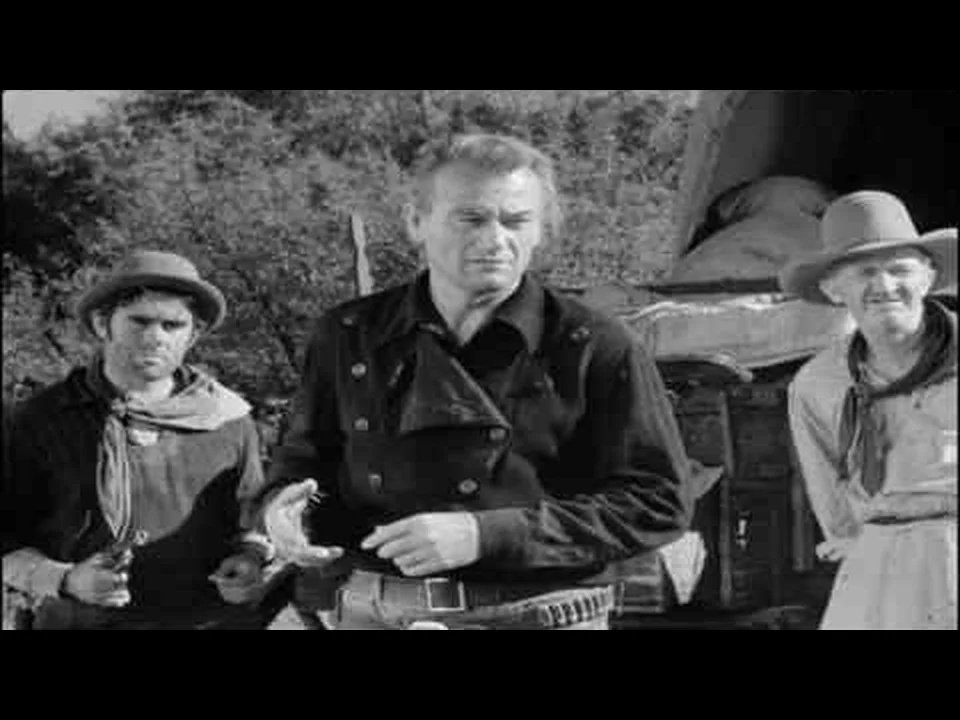
Matthew does not dissolve the drive. He redistributes direction, punishment, and trust away from Dunson while the same people and cattle continue moving.
Two formulas must be tested here. If the transfer completes the transformation of a prior whole, it can constitute S′; if the local act first discloses obedience, destination, and functional relations within the outfit, it approaches A–S–A′.
EDITION NOTE The three stills and jumps use the user-supplied complete 02:13:26 single-part Bilibili edition; studio marks are part of the edition's beginning.
Close-reading questions
- 01Does the opening scale between silhouettes, vast sky, and land genuinely establish a whole prior to action, or do claiming, naming, and branding produce that Encompasser in reverse?
- 02During the river crossing, how do current, shouts, dust, riders, and cattle column change milieu from background into a functional line that must be relayed step by step?
- 03After Matthew takes over and Dunson pursues his own outfit, does that local act complete the S′ of the large form or disclose the functional relations of A–S–A′ from within? Which surrounding shots are needed to decide?
Scene–concept relations
- 01Beside the grave, land begins to be written as property
Atlas candidate reading:Action-image: large form
Criterion for holding or withdrawal: This shot poses only the S hypothesis of the large form. S–A–S′ holds only if subsequent action emerges from this encompassing situation and transforms it into S′; expansive scenery alone proves nothing.
- 02The herd amplifies one disturbance into an event beyond command
Atlas candidate reading:Sensory-motor schema · Countertest:Action-image: large form
Criterion for holding or withdrawal: If shot-level review shows local acts progressively disclosing and reorganizing the situation, the passage approaches Hawksian functional relations. If an encompassing situation still stably generates and reabsorbs action, it supports the pure large form more strongly. Stampede alone does not prove a crisis of the action-image.
- 03The route continues while the position of command changes hands
Countertest:Action-image: large form · Atlas candidate reading:Action-image: small form
Criterion for holding or withdrawal: If the act of taking command progressively discloses and alters a situation not fully given in advance, it supports an A–S–A′ candidate. If it merely emerges from a fully presented global conflict and completes S′, the large-form reading remains viable.
About scene-relation labels
Support requires one scene's audiovisual facts and textual relation to be checked, with a named source and locator. Candidate readings, adjacent concepts, and countertests carry separate labels.
Shots and scenes
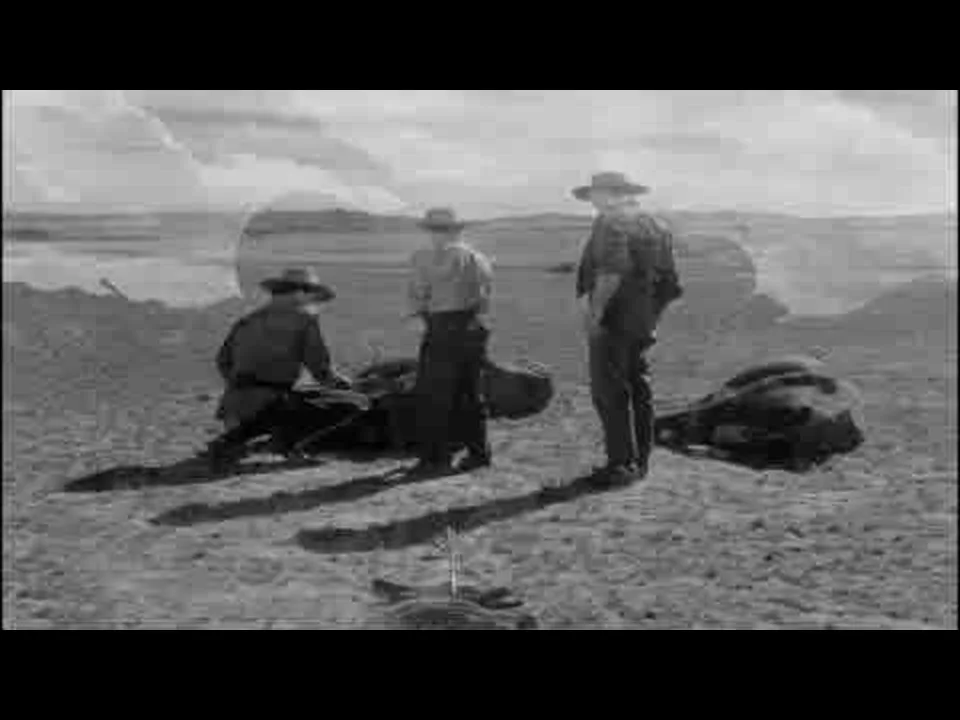
This shot poses only the S hypothesis of the large form. S–A–S′ holds only if subsequent action emerges from this encompassing situation and transforms it into S′; expansive scenery alone proves nothing.
Open viewing position ↗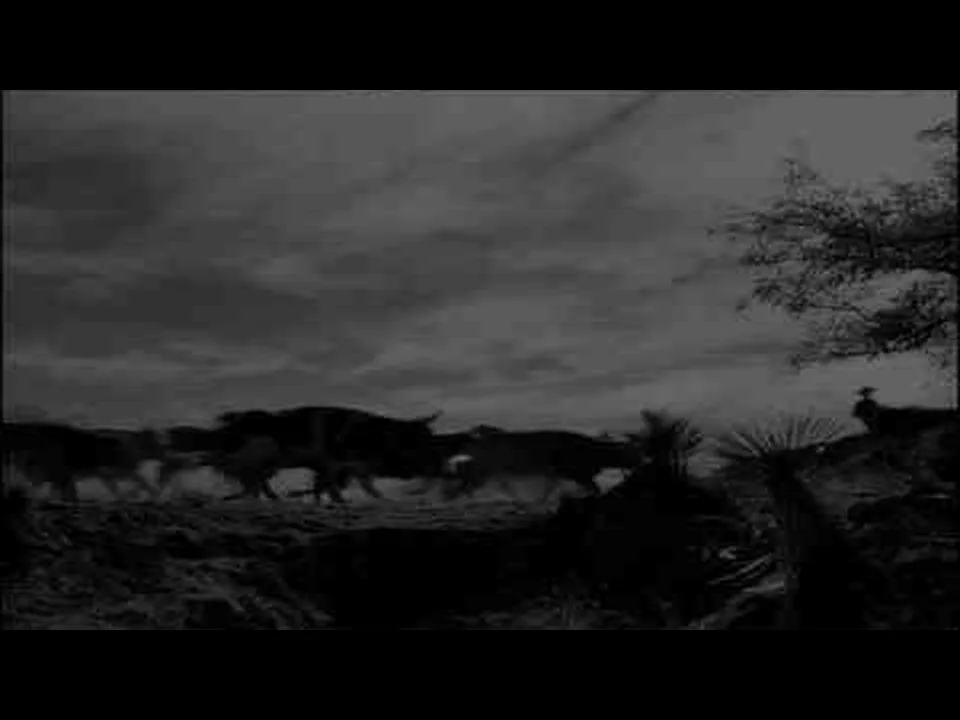
If shot-level review shows local acts progressively disclosing and reorganizing the situation, the passage approaches Hawksian functional relations. If an encompassing situation still stably generates and reabsorbs action, it supports the pure large form more strongly. Stampede alone does not prove a crisis of the action-image.
Open viewing position ↗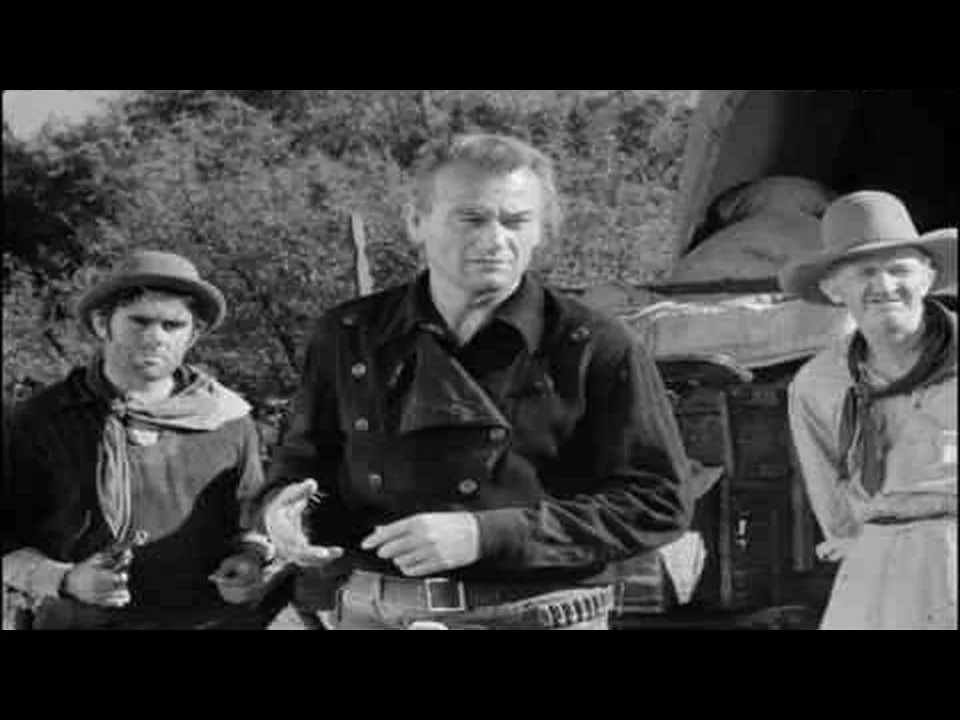
If the act of taking command progressively discloses and alters a situation not fully given in advance, it supports an A–S–A′ candidate. If it merely emerges from a fully presented global conflict and completes S′, the large-form reading remains viable.
Open viewing position ↗Primary texts, scholarship, and locators
Theory coordinate: Cinema 1, Minnesota 1986, ch. 10, p. 165
- 01Cinema 1: The Movement-Image
Standard Minnesota English translation and a principal citation edition in Anglophone scholarship.
Open the atlas source record →
Viewing gateways and editions
- Verified complete Bilibili carrier: 红河 (1948)bilibili.comOpen film page ↗
- Page access
- Accessible when checked
- Version extent
- Recorded as a complete version
- Source type
- User-uploaded page
Edition note: Complete single-part 133-minute edition · 2:13:26. Initial black leads to the studio marks and title; THE END / A MONTEREY PRODUCTION closes the film, followed by a few seconds of black. Timecodes begin at video zero and include the studio marks.
Link checked: 2026-08-25