Concept definition
The small form of the action-image follows A–S–A′. It begins from an action A already underway whose meaning remains equivocal; indices of lack or ambiguity progressively disclose the situation S in which that act is embedded, forcing a revised action A′. The situation is not given in advance as a known whole but inferred through local gestures, misrecognitions, clues, gags, and the consequences of action.
What the concept explains
The small form enters action midway. A gesture, misrecognition, gag, or anomalous clue appears first; its lack or equivocity discloses a situation, and each disclosed situation revises the next act. A–S–A′ is an inferential chain that keeps rewriting the world in which action occurs, not praise for a 'small story.'
Sensory-Motor Rupture: How a Character Becomes a SeerDiagrams and film passages
Two action forms: begin with a situation or discover it through action
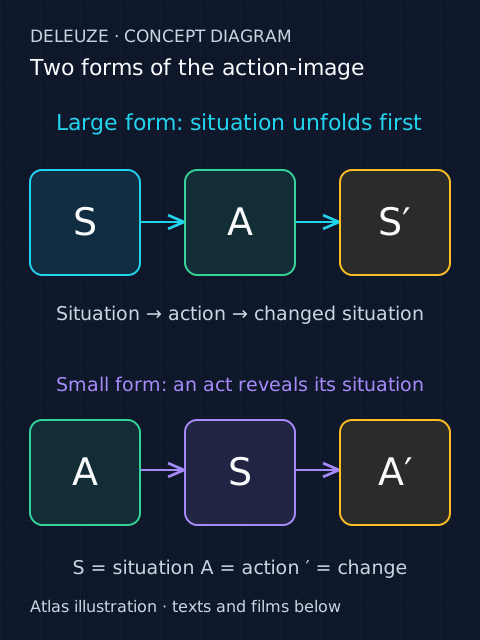
A comparison of organizing directions, not fixed genres or a sequence of higher and lower stages.
Open full-size diagramLarge form: S → A → S′
The milieu and distribution of forces unfold first; figures respond through a duel, mission, or cooperation. Then compare what has changed in the situation. Large names an organizing form, not budget, spectacle, or story size.
Small form: A → S → A′
Enter through a gesture, gag, mistaken recognition, or clue; infer the situation from its gaps and equivocity. The discovery then changes the next action. City Lights’ first encounter and drunk/sober contrast allow this inference to be examined.
Check whether the proposed change actually occurs
The primes in S′ and A′ indicate a change to be compared. Departure at the end of Stagecoach does not alone establish a changed town order; touch recognition in City Lights can contract an action chain into affect. An ending does not guarantee closure of the formula.
Diagram references
The Great Dictator
The Great Dictator (1940)
Supported by the scene
One face exchanges social positions: the fugitive is arrested and the barber welcomed
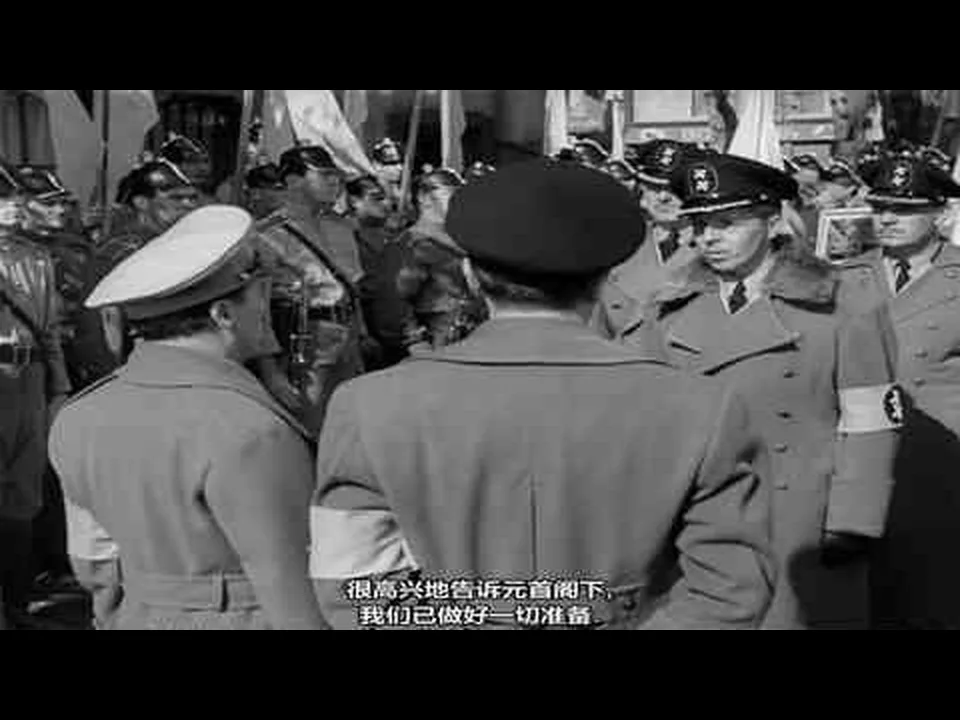
This welcoming image must be read with the preceding arrest of a drenched Hynkel as the fugitive. Inversion arises from crossing two chains of misrecognition, not from one uniform still.
Open full-size still- Displayed still
- 01:53:12
- Discussion passage
- approx. 01:50:07—01:54:27 (the mistaken-identity chain in which officers welcome the barber as Hynkel containing the 01:53:12 still)
Reviewed passage by passage on the single-part BV1XikCYxEUQ carrier. The API runtime is 7,535,155 ms, the container is 02:05:35.155, and Bilibili's integer metadata displays 02:05:36. 01:53:12 is the still anchor and 01:50:07—01:54:27 the atlas's working passage, not a claim to final cut-by-cut boundaries.
Still anchor 01:53:12; watch 01:50:07–01:54:27 and separately record which visible cues cause one body to be arrested and the other welcomed. The timecode applies only to the 02:05:35.155 BV1XikCYxEUQ container (02:05:36 in Bilibili's integer metadata). The specific restoration or master was not independently established; other editions require fresh location.
Still checked: 2026-09-01 · Carrier access checked: 2026-09-01
Image
A drenched Hynkel, stripped of the visible apparatus of power, is arrested by soldiers as the fugitive or barber, while the film advances the escaping barber in uniform.
The barber reaches the military assembly, is ceremonially welcomed as Hynkel, and enters the parade convoy.
The 01:53:12 anchor shows only the welcoming chain. The complete reversal requires cross-checking it with the other chain in which Hynkel is arrested.
Sound
Commands, recognitions, ceremonial address, military music, and crowd sound distinguish the two social positions. The Chinese-subtitled carrier was checked passage by passage without a line-by-line soundtrack transcript.
Relation to the concept
Minute visible indices—uniform, gait, and how a body is treated—let local acts disclose radically different social situations; chapter 10, pp. 171–172 directly coordinates the film.
Sources and further reading
- Cinema 1: The Movement-Image
Minnesota 1986 translation, chapter 10, pp. 171–172; chapter 11, pp. 183–187 · Pages 171–172 directly name the film's one-face/two-situations mechanism; pp. 183–187 define inversion. Neither explicitly classifies the 01:50:07–01:54:27 arrest and welcome as an inversion.
- Deleuze’s Cinema Books: Three Introductions to the Taxonomy of Images
David Deamer, Deleuze’s Cinema Books (2016), pp. 104–119 · Deamer reconstructs the reflection-image as three transformations through which the two action forms criticize one another: attraction, inversion, and discourse, treated respectively on pp. 105–109, 110–114, and 115–119. This taxonomic reconstruction does not classify The Great Dictator's globe ballet or mistaken-identity passage for the atlas.
- Bilibili · BV1XikCYxEUQ · reviewed 02:05:35.155 single-part carrier with Chinese subtitles; the first still comes from the decoded stream, the second and third from native previews, with a non-film banner cropped from the third before proportional letterboxing
01:53:12 · This welcoming image must be read with the preceding arrest of a drenched Hynkel as the fugitive. Inversion arises from crossing two chains of misrecognition, not from one uniform still.
- Open the single-part Chinese-subtitled Great Dictator carrier on Bilibili
Still anchor 01:53:12; watch 01:50:07–01:54:27 and separately record which visible cues cause one body to be arrested and the other welcomed. The timecode applies only to the 02:05:35.155 BV1XikCYxEUQ container (02:05:36 in Bilibili's integer metadata). The specific restoration or master was not independently established; other editions require fresh location.
The Great Dictator
The Great Dictator (1940)
Supported by the scene
The final address: discourse becomes a problem rather than declaring action victorious
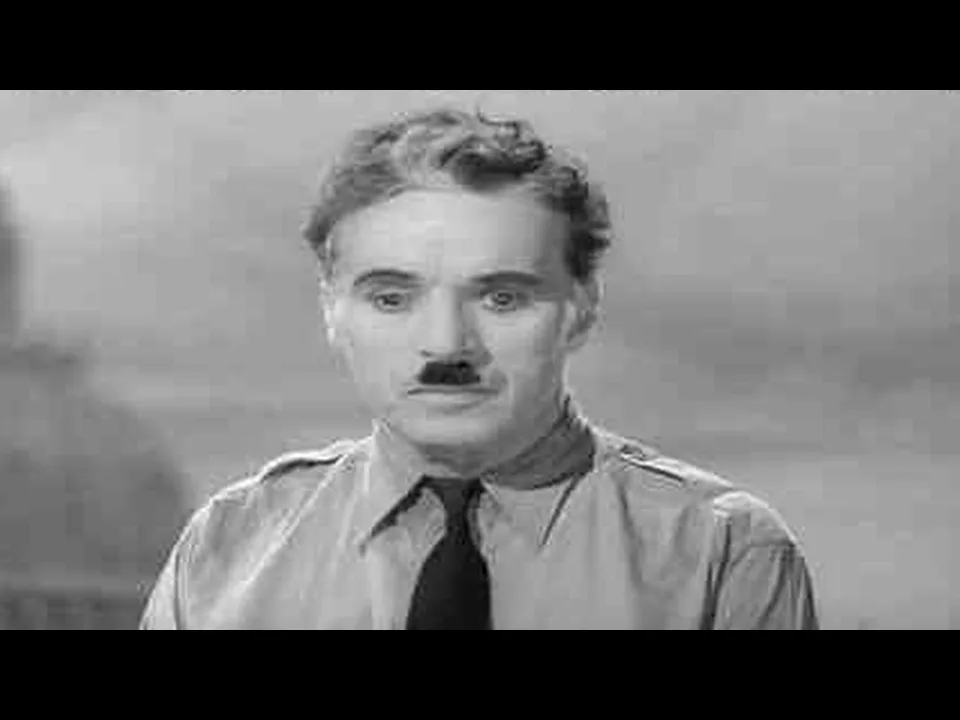
The uniform still belongs to the dictator's position while the mode of address changes. The frontal close-up gives the spectator the problem of who can speak, to whom, and whether discourse can become action.
Open full-size still- Displayed still
- 01:59:21
- Discussion passage
- approx. 01:59:09—02:03:08 (the sustained frontal close-up of the barber's final address in Hynkel's uniform containing the 01:59:21 still)
Reviewed passage by passage on the single-part BV1XikCYxEUQ carrier. The API runtime is 7,535,155 ms, the container is 02:05:35.155, and Bilibili's integer metadata displays 02:05:36. 01:59:21 is the still anchor and 01:59:09—02:03:08 the atlas's working passage, not a claim to final cut-by-cut boundaries.
Still anchor 01:59:21; watch 01:59:09–02:03:08, comparing podium totality, frontal close-up, duration of address, and the cut to Hannah rather than substituting one famous line for image analysis. The timecode applies only to the 02:05:35.155 BV1XikCYxEUQ container (02:05:36 in Bilibili's integer metadata). The specific restoration or master was not independently established; other editions require fresh location.
Still checked: 2026-09-01 · Carrier access checked: 2026-09-01
Image
The barber stands before several microphones under Hynkel's identity; the camera moves from podium and military setting to a sustained frontal close-up.
The close-up progressively reduces the ceremonial background so that face, gaze, and duration of address become the main image-event; after the speech the film cuts to Hannah.
The 01:59:21 anchor comes from Bilibili's native preview. The atlas cropped a non-film banner at the top without removing face, uniform, or filmic background information.
Sound
The barber shifts to sustained intelligible English address, audibly contrasting with Hynkel's earlier pseudo-German, noise, and threatening delivery. The atlas does not reproduce the speech at length.
Relation to the concept
Minute differences of face, uniform, and address are lengthened into a direct problem of social situation; discourse pushes the small form to its limit.
Sources and further reading
- Cinema 1: The Movement-Image
Minnesota 1986 translation, chapter 10, pp. 171–173 · Pages 172–173 directly use The Great Dictator's final address and intelligible language for the figure of discourse; the atlas is responsible for the 01:59:09–02:03:08 boundary, still, and itemized facts.
- Cinema 2: The Time-Image
Minnesota 1989 translation, chapter 2, p. 33 · Page 33 retrospectively specifies discourse as the reflection-image's genetic sign; it is not a shot-by-shot transcription of the final address.
- Deleuze’s Cinema Books: Three Introductions to the Taxonomy of Images
David Deamer, Deleuze’s Cinema Books (2016), pp. 104–119 · Deamer reconstructs the reflection-image as three transformations through which the two action forms criticize one another: attraction, inversion, and discourse, treated respectively on pp. 105–109, 110–114, and 115–119. This taxonomic reconstruction does not classify The Great Dictator's globe ballet or mistaken-identity passage for the atlas.
- Bilibili · BV1XikCYxEUQ · reviewed 02:05:35.155 single-part carrier with Chinese subtitles; the first still comes from the decoded stream, the second and third from native previews, with a non-film banner cropped from the third before proportional letterboxing
01:59:21 · The uniform still belongs to the dictator's position while the mode of address changes. The frontal close-up gives the spectator the problem of who can speak, to whom, and whether discourse can become action.
- Open the single-part Chinese-subtitled Great Dictator carrier on Bilibili
Still anchor 01:59:21; watch 01:59:09–02:03:08, comparing podium totality, frontal close-up, duration of address, and the cut to Hannah rather than substituting one famous line for image analysis. The timecode applies only to the 02:05:35.155 BV1XikCYxEUQ container (02:05:36 in Bilibili's integer metadata). The specific restoration or master was not independently established; other editions require fresh location.
Red River
Red River (1948)
Candidate reading
The route continues while the position of command changes hands
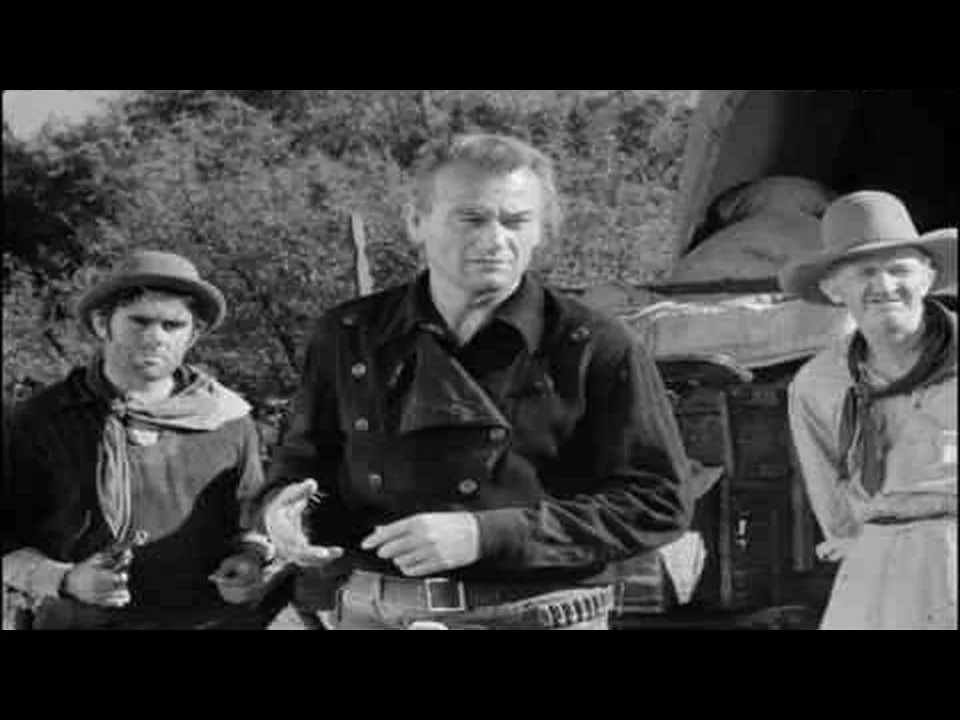
The drive remains on the same route, while the authority to distribute direction, punishment, and trust has become contested.
Open full-size still- Displayed still
- 01:21:08
- Discussion passage
- Matthew takes command of the drive passage containing the 01:21:08 still
The 01:21:08 still anchor is verified on the 02:13:26 single-part Bilibili edition. The passage is located by that anchor; its endpoints still require shot-level delimitation.
The direct still anchor is 01:21:08; review the declarations, responses, route decision, and Dunson's departure before and after it.
Still checked: 2026-08-25 · Carrier access checked: 2026-08-25
Image
Matthew faces an off-screen addressee at centre, flanked by two cowboys with a covered wagon behind; their positions place an individual declaration inside the relations of the outfit.
The still does not show the complete chain before and after the transfer; mutiny, changed destination, and Dunson's departure require continuous viewing.
Sound
Matthew's declaration, the group's responses, and ambient sound still await line-by-line transcription; this entry treats positions and ensuing changes in action as a chain for review.
Relation to the concept
The local act of taking command may make the outfit's obedience, destination, and functional relations visible afterward, making it an A–S–A′ candidate rather than a settled conclusion.
Sources and further reading
- Cinema 1: The Movement-Image
Minnesota 1986 translation, chapter 10, p. 165 · Deleuze names Red River in the chapter on the small form and Hawksian functionalism. The three-shot segmentation and conceptual relations below are the atlas's responsibility, not a shot-by-shot paraphrase of p. 165.
- Bilibili · user-supplied complete single-part edition of Red River
01:21:08 · The drive remains on the same route, while the authority to distribute direction, punishment, and trust has become contested.
- Open the complete Red River carrier on Bilibili
The direct still anchor is 01:21:08; review the declarations, responses, route decision, and Dunson's departure before and after it.
City Lights
City Lights (1931)
Candidate reading
Why does she take the flower buyer for a wealthy motorist?
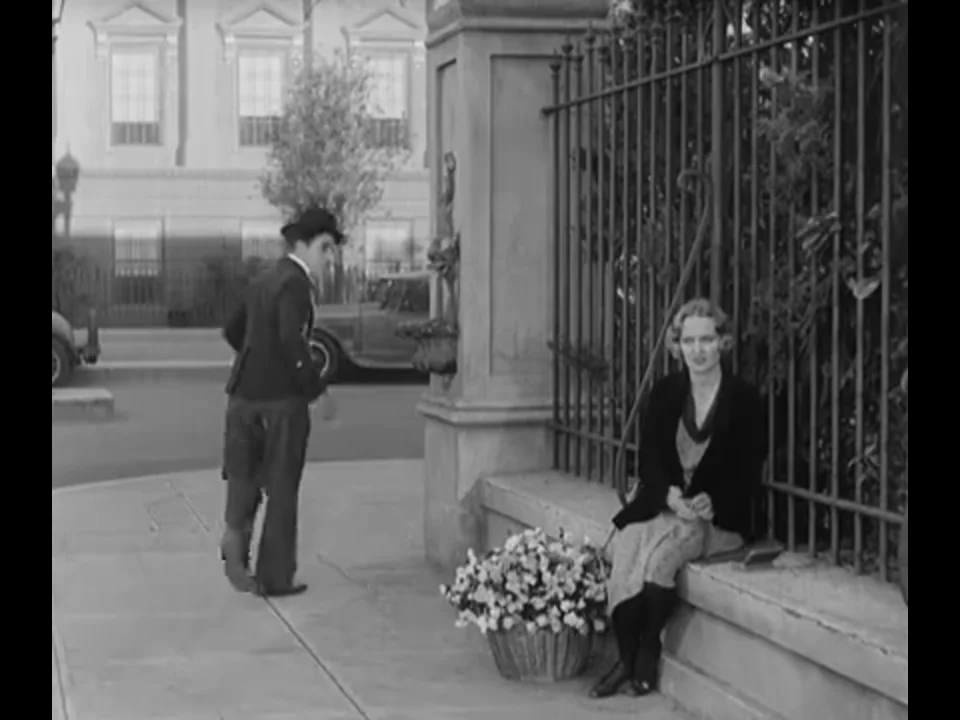
Flower, money, an approaching figure, and a departing car are visible across the passage; whether door sounds also enter the mistake still requires sound-by-sound review.
Open full-size still- Displayed still
- 00:09:25
- Discussion passage
- 约 00:07:20—00:09:38 (flower seller's misrecognition of the customer's identity containing the 00:09:25 still)
Reviewed passage by passage on the single-part Bilibili carrier with a decoded-stream duration of 01:26:47. 00:09:25 is the still anchor and 约 00:07:20—00:09:38 is the atlas's working boundary. Approximately 25.8 seconds of black at the end are excluded from narrative analysis.
Still anchor 00:09:25; watch 00:07:20–00:09:38 and separately record the order of flower, money, footsteps, door, and departing car.
Still checked: 2026-09-01 · Carrier access checked: 2026-09-01
Image
The flower seller sits by the street selling flowers; after a flower falls, she searches with hand and cane, and the Tramp retrieves it and notices that she is blind.
The Tramp then walks away and looks back; a car departs from near them while the flower seller retains the inference that her customer is wealthy.
Sound
The precise way car-door sounds participate in the mistake still requires sound-by-sound review on this master, including attribution of the first and second closures; no unverified sound source is treated as settled causality.
Relation to the concept
A local purchase produces an identity situation through an equivocal index, making an A–S–A′ candidate; the door-sound sequence is not yet exhaustively verified, so the relation is not conclusive.
Sources and further reading
- Cinema 1: The Movement-Image
Minnesota 1986 translation, chapter 10, pp. 160–171, especially pp. 169–171 · From p. 160 Deleuze defines A–S–A′ and its indices. Page 169 directly names City Lights as an example of a 'personality split of a pivotal character,' but does not assign the drunk or sober passages or a rule of recognition shot by shot. The atlas tests the paired drunken welcome and sober rejection as its concrete filmic realization. The scene directly named on p. 171 is the thread-unravelling passage around 00:52:32–00:53:54, not the final tactile recognition. Boundaries and theoretical relations for the opening mistake, sober rejection, and final recognition remain the atlas's responsibility.
- Bilibili · public single-part repost of City Lights located and reviewed by the atlas; the specific score, restoration, and master could not be independently established
00:09:25 · Flower, money, an approaching figure, and a departing car are visible across the passage; whether door sounds also enter the mistake still requires sound-by-sound review.
- Open the single-part City Lights carrier on Bilibili
Still anchor 00:09:25; watch 00:07:20–00:09:38 and separately record the order of flower, money, footsteps, door, and departing car.
City Lights
City Lights (1931)
Candidate reading
When the millionaire wakes sober, why is last night's friend left outside?
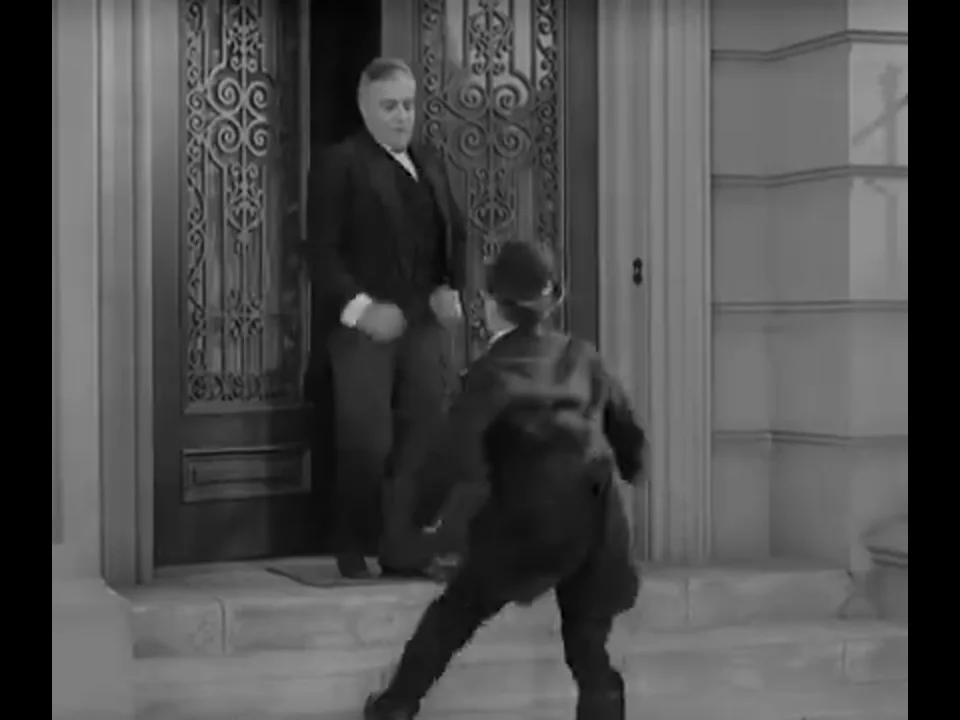
Once the millionaire is sober, last night's friend is left outside; drunken welcome and sober rejection must be compared as a pair.
Open full-size still- Displayed still
- 00:35:30
- Discussion passage
- 约 00:34:14—00:35:48 (millionaire's sober rejection of the Tramp containing the 00:35:30 still)
Reviewed passage by passage on the single-part Bilibili carrier with a decoded-stream duration of 01:26:47. 00:35:30 is the still anchor and 约 00:34:14—00:35:48 is the atlas's working boundary. Approximately 25.8 seconds of black at the end are excluded from narrative analysis.
Still anchor 00:35:30; watch 00:34:14–00:35:48, then revisit the drunken encounter around 00:11:30–00:15:50 and compare address, access, and permission to act.
Still checked: 2026-09-01 · Carrier access checked: 2026-09-01
Image
The passage begins from morning and the millionaire's sobriety; when the Tramp reaches the mansion, he does not receive the previous night's treatment as friend, and the butler keeps him beyond the entrance.
This passage must be read against the drunken encounter around 00:11:30–00:15:50; isolated, the doorway rejection shows only S→A and cannot compose a complete A–S–A′ by itself.
Sound
An intertitle marks the change of state with sober dawn awakening a different man; the atlas does not medicalize this difference into a clinical personality diagnosis.
Relation to the concept
Page 169 directly cites the pivotal character's personality split in City Lights; the atlas locates doorway rejection as the sober side and pairs it with the drunken encounter to test whether this concretization holds.
Sources and further reading
- Cinema 1: The Movement-Image
Minnesota 1986 translation, chapter 10, pp. 160–171, especially pp. 169–171 · From p. 160 Deleuze defines A–S–A′ and its indices. Page 169 directly names City Lights as an example of a 'personality split of a pivotal character,' but does not assign the drunk or sober passages or a rule of recognition shot by shot. The atlas tests the paired drunken welcome and sober rejection as its concrete filmic realization. The scene directly named on p. 171 is the thread-unravelling passage around 00:52:32–00:53:54, not the final tactile recognition. Boundaries and theoretical relations for the opening mistake, sober rejection, and final recognition remain the atlas's responsibility.
- Bilibili · public single-part repost of City Lights located and reviewed by the atlas; the specific score, restoration, and master could not be independently established
00:35:30 · Once the millionaire is sober, last night's friend is left outside; drunken welcome and sober rejection must be compared as a pair.
- Open the single-part City Lights carrier on Bilibili
Still anchor 00:35:30; watch 00:34:14–00:35:48, then revisit the drunken encounter around 00:11:30–00:15:50 and compare address, access, and permission to act.
City Lights
City Lights (1931)
Countertest
She recognizes him by touch; why does the film stop on a smile?
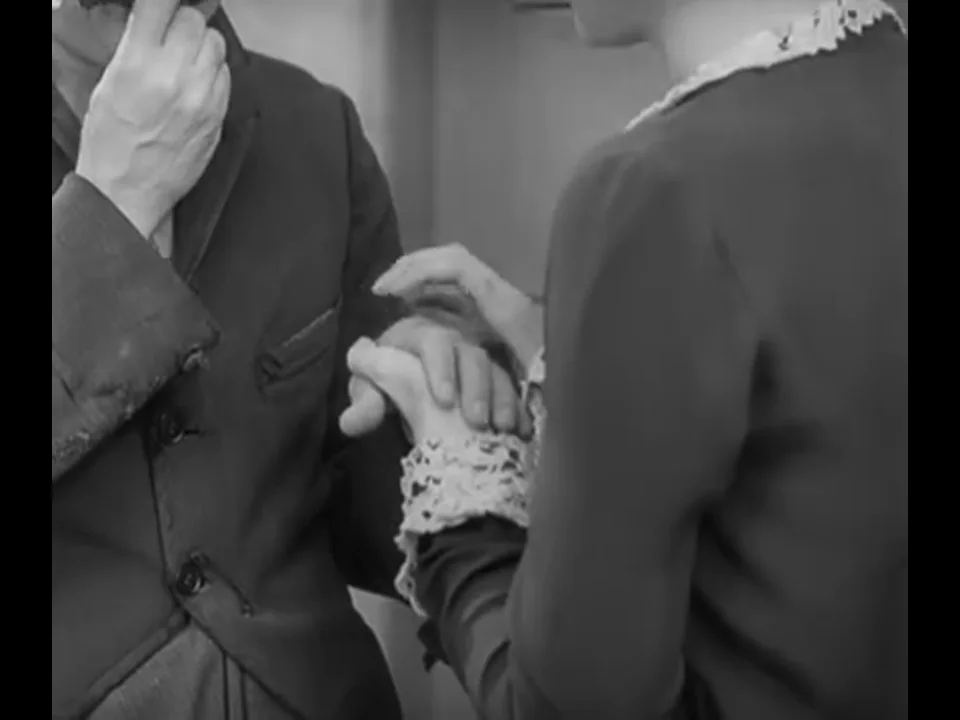
Touch completes recognition; the film then remains with two faces and a smile without showing how the pair will relate next.
Open full-size still- Displayed still
- 01:25:25
- Discussion passage
- 约 01:24:56—01:26:12 (final touch-and-recognition passage containing the 01:25:25 still)
Reviewed passage by passage on the single-part Bilibili carrier with a decoded-stream duration of 01:26:47. 01:25:25 is the still anchor and 约 01:24:56—01:26:12 is the atlas's working boundary. Approximately 25.8 seconds of black at the end are excluded from narrative analysis.
Still anchor 01:25:25; watch 01:24:56–01:26:12 and record in order the handclasp, change of expression, 'You?', response, and final smile.
Still checked: 2026-09-01 · Carrier access checked: 2026-09-01
Image
After the flower seller holds the Tramp's hand, her expression changes; the intertitle 'You?' appears, followed by cuts between their faces.
The Tramp asks whether she can see now; the passage ends within the close relation of faces and hands without showing their subsequent life together.
Sound
The score edition on this silent-film carrier could not be independently established; tactile recognition and visible intertitles suffice to locate the passage, and music carries no classificatory burden.
Relation to the concept
Touch makes the identity situation visible, while the film supplies no determinate A′ beyond it; the passage therefore countertests the limit of small form rather than automatically proving the formula complete.
Sources and further reading
- Cinema 1: The Movement-Image
Minnesota 1986 translation, chapter 10, pp. 160–171, especially pp. 169–171 · From p. 160 Deleuze defines A–S–A′ and its indices. Page 169 directly names City Lights as an example of a 'personality split of a pivotal character,' but does not assign the drunk or sober passages or a rule of recognition shot by shot. The atlas tests the paired drunken welcome and sober rejection as its concrete filmic realization. The scene directly named on p. 171 is the thread-unravelling passage around 00:52:32–00:53:54, not the final tactile recognition. Boundaries and theoretical relations for the opening mistake, sober rejection, and final recognition remain the atlas's responsibility.
- Bilibili · public single-part repost of City Lights located and reviewed by the atlas; the specific score, restoration, and master could not be independently established
01:25:25 · Touch completes recognition; the film then remains with two faces and a smile without showing how the pair will relate next.
- Open the single-part City Lights carrier on Bilibili
Still anchor 01:25:25; watch 01:24:56–01:26:12 and record in order the handclasp, change of expression, 'You?', response, and final smile.
The Great Dictator
The Great Dictator (1940)
Adjacent question
The inflatable globe intervenes: how weightless dance refers indirectly to world rule
The globe joins a local, weightless bodily game to the political situation of world rule through a third term. It poses an attraction figure without letting one still complete the classification.
Open full-size still- Displayed still
- 00:55:40
- Discussion passage
- approx. 00:54:08—00:56:16 (Hynkel's office dance while he holds the inflatable globe containing the 00:55:40 still)
Reviewed passage by passage on the single-part BV1XikCYxEUQ carrier. The API runtime is 7,535,155 ms, the container is 02:05:35.155, and Bilibili's integer metadata displays 02:05:36. 00:55:40 is the still anchor and 00:54:08—00:56:16 the atlas's working passage, not a claim to final cut-by-cut boundaries.
Still anchor 00:55:40; watch 00:54:08–00:56:16 continuously, record how the globe changes the scale of action, and include the burst in the countertest. The timecode applies only to the 02:05:35.155 BV1XikCYxEUQ container (02:05:36 in Bilibili's integer metadata). The specific restoration or master was not independently established; other editions require fresh location.
Still checked: 2026-09-01 · Carrier access checked: 2026-09-01
Image
Alone in his office, Hynkel takes down the inflatable globe and redirects its rises and falls with hands, head, hips, and feet.
He presses the globe near face and chest before tossing it again; the sphere eventually bursts and the dance stops.
The 00:55:40 anchor shows only the lifting pose. The political relation of world rule requires the office insignia, the complete dance, and the globe's rupture to be read together.
Sound
Continuous orchestral music organizes the movement, while no intelligible speech explains the globe during the dance proper. This audit did not identify the recording edition or transcribe the track beat by beat.
Relation to the concept
A local act expands through a third term toward an immense implied situation; small action alone does not prove A–S–A′.
Sources and further reading
- Cinema 1: The Movement-Image
Minnesota 1986 translation, chapter 11, pp. 182–183 · The primary text provides the general mechanism of attraction but does not classify The Great Dictator's globe ballet scene by scene. The time window, decomposition of facts, and candidate classification are the atlas's responsibility.
- Deleuze’s Cinema Books: Three Introductions to the Taxonomy of Images
David Deamer, Deleuze’s Cinema Books (2016), pp. 104–119 · Deamer reconstructs the reflection-image as three transformations through which the two action forms criticize one another: attraction, inversion, and discourse, treated respectively on pp. 105–109, 110–114, and 115–119. This taxonomic reconstruction does not classify The Great Dictator's globe ballet or mistaken-identity passage for the atlas.
- Bilibili · BV1XikCYxEUQ · reviewed 02:05:35.155 single-part carrier with Chinese subtitles; the first still comes from the decoded stream, the second and third from native previews, with a non-film banner cropped from the third before proportional letterboxing
00:55:40 · The globe joins a local, weightless bodily game to the political situation of world rule through a third term. It poses an attraction figure without letting one still complete the classification.
- Open the single-part Chinese-subtitled Great Dictator carrier on Bilibili
Still anchor 00:55:40; watch 00:54:08–00:56:16 continuously, record how the globe changes the scale of action, and include the burst in the countertest. The timecode applies only to the 02:05:35.155 BV1XikCYxEUQ container (02:05:36 in Bilibili's integer metadata). The specific restoration or master was not independently established; other editions require fresh location.
Red River
Red River (1948)
Atlas shot reading
The route continues under a new centre of command
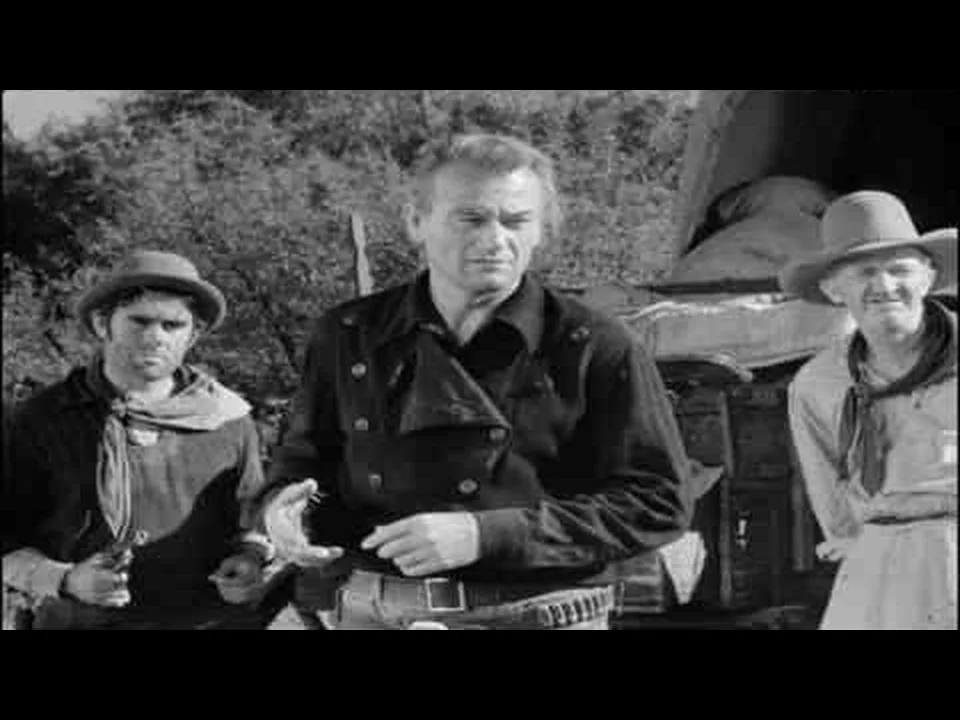
Matthew does not dissolve the drive. He redistributes direction, punishment, and trust away from Dunson while the same people and cattle continue moving.
Open full-size still- Displayed still
- 01:21:08
- Feature time
- 01:21:08
The three stills and jumps use the user-supplied complete 02:13:26 single-part Bilibili edition; studio marks are part of the edition's beginning.
The still and link retain the film guide's recorded shot locator.
Image
Matthew does not dissolve the drive. He redistributes direction, punishment, and trust away from Dunson while the same people and cattle continue moving.
Relation to the concept
Two formulas must be tested here. If the transfer completes the transformation of a prior whole, it can constitute S′; if the local act first discloses obedience, destination, and functional relations within the outfit, it approaches A–S–A′.
Sources and further reading
- Cinema 1, Chapter 10 · p. 165
The Hawks/small-form context in which Deleuze names Red River
- Cinema 1, Chapter 9
Use the large form S–A–S′ as a general formula to be tested
- Criterion essay on Red River
A deeper reading of route, relation, and Hawksian form
- Criterion interview with editor Christian Nyby
Audit the moving whole through editing labour
- Compare Rio Bravo
Return from transferred command to local functional relay
Films and scenes
The primary text on p. 169 directly names a 'personality split of a pivotal character' in City Lights; the atlas identifies drunken welcome and sober rejection as the paired states. The gag directly cited on p. 171 is the unravelling thread. The atlas also treats the first encounter from 00:07:20 to 00:09:38 as a candidate equivocal index, although exact attribution of door sounds still requires review, and the touch recognition from 01:24:56 to 01:26:12 as a limit of small form because hand and face contract A–S–A′ into shyness and laughter without clearly producing a new practical action. All three shot-level judgments belong to the atlas.
IMDb identification poster ↗Related film readings · 6 films
City Lights · 1931 · Candidate reading — The primary text on p. 169 directly names a 'personality split of a pivotal character' in City Lights; the atlas identifies drunken welcome and sober rejection as the paired states. The gag directly cited on p. 171 is the unravelling thread. The atlas also treats the first encounter from 00:07:20 to 00:09:38 as a candidate equivocal index, although exact attribution of door sounds still requires review, and the touch recognition from 01:24:56 to 01:26:12 as a limit of small form because hand and face contract A–S–A′ into shyness and laughter without clearly producing a new practical action. All three shot-level judgments belong to the atlas.
Sherlock Jr. · 1924 — When the projectionist enters the screen, his body remains still while garden, street, precipice, snowfield, and shore strike through cuts. The train passage reverses the relation, carrying him continuously across roof, water tower, and track in one shot. Disjunctive editing and bodily trajectory make the cinema-machine a comic agent.
The Gold Rush · 1925 — Cabin, hunger, and dreams of wealth keep reversing through slight differences: a shoe becomes dinner, and the Tramp becomes a chicken in Big Jim's eyes. No character masters the total situation; each improvises at a critical instant. Comedy makes action from a minute perceptual shift while letting survival slide toward devouring.
Ugetsu · 1953 — Misty lake, back rooms, fields, and garden extend space through adjacent fragments rather than a total viewpoint. Overflow from the bath leads to fields and then to a meal months later. One line of the universe passes through the seductive ghost and returns to the dead wife's presence, joining living, dead, and social oppression.
The Great Dictator · 1940 — The same face and moustache need only a change of uniform, posture, and vocal regime to occupy the incommensurable situations of victim and executioner. At 00:54:08–00:56:16, the globe ballet contracts world conquest into balloon, dance, and rupture; the atlas treats it as a candidate attraction under chapter 11, pp. 182–183. At 01:50:07–01:54:27, misrecognition exchanges prisoner and ruler, making it a candidate inversion under pp. 183–187. Both are shot-level atlas inferences. The final address at 01:59:09–02:03:08 has direct support in chapter 10, pp. 171–173: an ordinary voice replaces Hynkel's pseudo-German terror and makes the political problem implicit in the doubled role into Deleuze's discursive figure. This establishes discourse as image-object, not the completed transformation of democratic institutions within the film.
Red River · 1948 — Deleuze names Red River in Cinema 1, chapter 10, p. 165, within Hawks and the small form rather than directly presenting it as a model of the large form. Open landscape and collective task can still pose an S–A–S′ hypothesis. The atlas then countertests it through the claim passage at 00:15:38, stampede at 00:51:20, and transfer of command at 01:21:08: does an encompassing situation genuinely precede action, or is it progressively disclosed and reorganized by local acts, differences of speed, and relayed functions? The relation among these three shots is the atlas's responsibility, not a shot-by-shot gloss of p. 165.
Criteria
What initially unintelligible act does the shot give us? Which index of lack or equivocity makes its situation inferable, and how does that inference rewrite the next action? If the situation is fully established from the outset, A–S–A′ is not the most precise account.
Distinctions and counterexamples
Everyday life, local conflict, and minute gestures may still be governed by a situation known in advance. The small form is diagnostic only when an index of action produces new knowledge of the situation and thereby changes the next act.
Common confusion: A minor character, low budget, short film, local framing, or trivial event does not define the small form. 'Small' means that analysis begins from a local act through which a situation is disclosed; the world of the image need not itself be small.
Texts and sources
Cinema 1, ch. 10, pp. 160–177 (Minnesota 1986)
- 01Cinema 1: The Movement-Image
Standard Minnesota English translation and a principal citation edition in Anglophone scholarship.
View source and edition →
Research disagreements
Replacement or coexistence?
The time-image reverses the subordination of time to movement; both regimes persist and can shift locally within one film.
Taxonomy or generator?
Fixed labels invite mere example-hunting; an open taxonomy requires new concepts to transform existing relations and explain across cases.
How do we use Deleuze precisely?
Test four layers: sensory-motor relation, actual/virtual circuit, audio-visual connection, and regime of truth.
Concepts to distinguish
Compare them
- Movement-imageimage-mouvement
The movement-image is a regime in which movement differentiates into perception, affection, impulse, action, reflection, and mental relation to organize the image directly, while time appears indirectly through movement and montage. The relation-image is a decisive realization within the mental-image's problem-field, not an additional source-level rank parallel to it, and films need not pass through one fixed action-chain.
→ - Impulse-imageimage-pulsion
The impulse-image stands between affection and action. Deleuze divides its naturalist structure into four terms arranged in two pairs: originary world/derived milieu and elementary impulse/real behaviour. A historically, geographically, and socially determinate derived milieu remains present while elementary impulse penetrates real behaviour from within; impulse seizes object-fragments from that milieu and thereby exposes an uncoordinated originary world. Symptom and fetish are not additional structural terms but two classes of signs: a symptom is the appearance of impulse in the derived milieu, while a fetish is the appearance of the seized object-fragment itself. Stroheim realizes this structure through decay, descent, and entropy; Buñuel through repetition, cycles, and restart. These are distinct realizations, not cumulative thresholds that every example must satisfy.
→ - Action-image: large formgrande forme de l'image-action
The large form of the action-image follows S–A–S′. A milieu, collective, historical pressure, or danger first composes an encompassing situation S; that pressure leaves an internal imprint upon the character and concentrates itself in action A as effort, duel, or collective coordination; action then carries the milieu into a situation S′ different from the initial one. Its decisive question is how a situation demands action and whether action actually reorganizes that situation.
→ - Reflection-imageimage-réflexion
Following Cinema 2, pp. 32–33, which retrospectively revisits the first semiotics, the atlas gathers the figures developed in Cinema 1, chapters 10–11—attraction, inversion, and discourse—under reflection-image. All three still transform the situation–action relation from within the action forms: attraction uses a substitute or rehearsal to miniaturize, prefigure, or stage another situation or act; inversion exchanges large and small powers; discourse makes an implicit problem into an audible and visible object of thought. Reflection-image must not be prematurely equated with chapter 12's relation-image.
→ - Mental-imageimage mentale
In Cinema 1's strict usage, the mental-image first names a problem-field: images take relations, symbolic acts, and intellectual feelings as their objects rather than representing states inside a character's head. Relations are external to their terms and irreducible to the attributes of any one term; symbolic acts and intellectual feelings must likewise become operations of image, sound, and editing rather than plot content. The atlas gives mental-image and relation-image separate pages only as reading interfaces for this problem-field and its Hitchcockian realization through Thirdness. The source does not rank them as parallel levels or make the former a superclass of recollection- and dream-images.
→ - Relation-imageimage-relation
The relation-image is the decisive Hitchcockian realization within the mental-image's problem-field: it makes relation itself the image's object and specifies its signs through Peircean Thirdness. A mark sustains a natural or habitual series, a demark redirects that series through an anomalous term, and a symbol makes a concrete term bear an abstract relation; Hitchcock further composes director, film, and the spectator who must enter the inference as a triadic apparatus. The separate atlas page is an explanatory interface, not evidence that the source ranks mental-image and relation-image as parallel levels.
→ - Crisis of the action-imagecrise de l'image-action
The crisis of the action-image is not the disappearance of movement but the loss of a credible bond among situation, perception, and action capable of changing the world. Cinema 1 lists a constellation of five surface symptoms: dispersive situations that replace a totality with gaps; deliberately weak links among events; wandering that displaces goal-directed travel; consciousness of clichés, as figures and spectators begin to recognize how ready-made schemata obscure real relations; and the exposure or denunciation of conspiracy—the network of control behind the plot. These are external negative conditions for a new image-regime, not a checklist that every film and every sequence must complete.
→