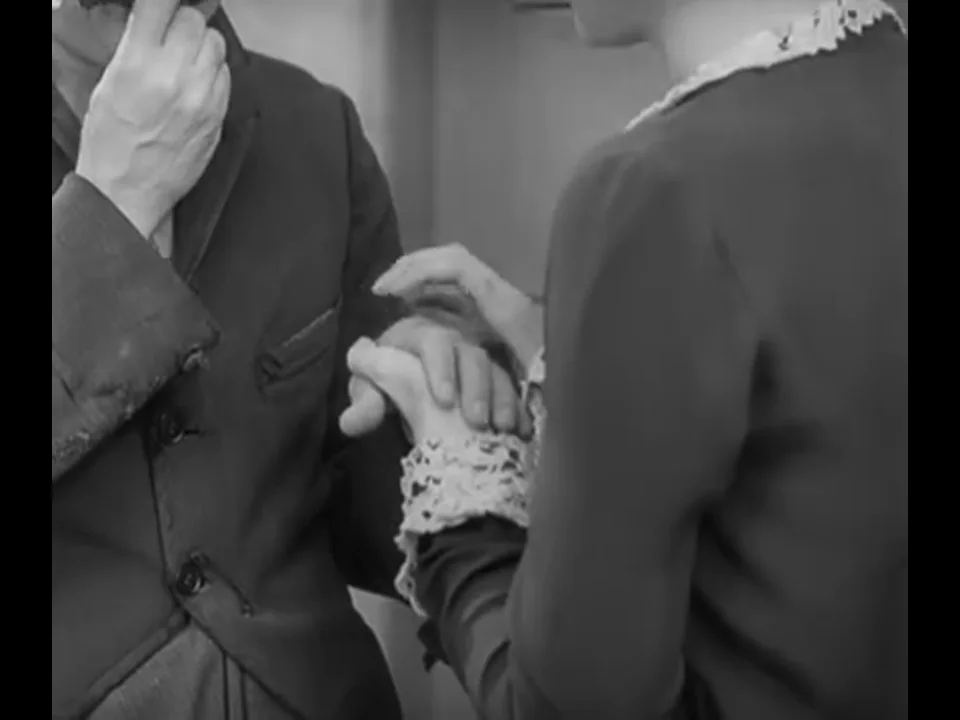
 01:25:25
Forms of action · SHOT EVIDENCE
She recognizes him by touch; why does the film stop on a smile?
Once she recognizes him, why does the film stop there instead of showing how they relate next? Is A–S–A′ completed here, or contracted to an affective limit?
Film and viewing version
City Lights · City Lights · Charles Chaplin / 查理·卓别林 · 1931
Reviewed passage by passage on the single-part Bilibili carrier with a decoded-stream duration of 01:26:47. 01:25:25 is the still anchor and 约 01:24:56—01:26:12 is the atlas's working boundary. Approximately 25.8 seconds of black at the end are excluded from narrative analysis.
Version boundary: The timecodes on this page apply only to the named viewing carrier. Restorations, differing leaders, or platform transcodes may shift them.
Passage and still timecodes
约 01:24:56—01:26:12 (final touch-and-recognition passage containing the 01:25:25 still)
The window locates the passage; its boundaries remain approximate
The passage window and still anchor are separate coordinates: the Bilibili still at 01:25:25 was checked on 2026-09-01; it does not turn an approximate passage on another carrier into exact bounds.
Visible facts
- 01
After the flower seller holds the Tramp's hand, her expression changes; the intertitle 'You?' appears, followed by cuts between their faces.
- 02
The Tramp asks whether she can see now; the passage ends within the close relation of faces and hands without showing their subsequent life together.
Audible facts
- 01
The score edition on this silent-film carrier could not be independently established; tactile recognition and visible intertitles suffice to locate the passage, and music carries no classificatory burden.
Action relation
Touch completes recognition of identity but does not immediately unfold into a determinate new action A′; capacity to act contracts into facial response, hesitation, and smile.
Temporal relation
All prior mistake, giving, and absence return in one touch, not as a memory sequence but as pressure within present bodily response.
Conceptual reading
The passage can test the small form's limit where it contracts into affect before A′; it is not sufficient evidence for a time-image. If analysis cannot show how touch changes recognition and leaves only a 'moving ending,' the conceptual relation should be withdrawn.
Concepts used in the judgement
- Action-image: small formpetite forme de l'image-action · COUNTERTEST
Touch makes the identity situation visible, while the film supplies no determinate A′ beyond it; the passage therefore countertests the limit of small form rather than automatically proving the formula complete.
→ - Movement-imageimage-mouvement · ADJACENT
Recognition remains organized by bodily contact, facial response, and cutting. Here the action-image contracts toward the affection-image while remaining within the movement-image regime; the atlas does not reclassify it as a time-image on that basis.
→
Primary and scholarly coordinates
- 01Cinema 1: The Movement-Image
Minnesota 1986 translation, chapter 10, pp. 160–171, especially pp. 169–171
From p. 160 Deleuze defines A–S–A′ and its indices. Page 169 directly names City Lights as an example of a 'personality split of a pivotal character,' but does not assign the drunk or sober passages or a rule of recognition shot by shot. The atlas tests the paired drunken welcome and sober rejection as its concrete filmic realization. The scene directly named on p. 171 is the thread-unravelling passage around 00:52:32–00:53:54, not the final tactile recognition. Boundaries and theoretical relations for the opening mistake, sober rejection, and final recognition remain the atlas's responsibility.
Terminological coordinates
- small form of the action-image / A–S–A′petite forme de l’image-action / A–S–A′
Test whether a new act genuinely follows once the situation becomes visible.
→ - movement-imageimage-mouvement
Observe bodily action contracting into facial affect without equating suspension automatically with the time-image.
→
Chapter relations
Viewing and still sources
Direct scene · Still anchor 01:25:25; watch 01:24:56–01:26:12 and record in order the handclasp, change of expression, 'You?', response, and final smile.