Concept definition
The movement-image is a regime in which movement differentiates into perception, affection, impulse, action, reflection, and mental relation to organize the image directly, while time appears indirectly through movement and montage. The relation-image is a decisive realization within the mental-image's problem-field, not an additional source-level rank parallel to it, and films need not pass through one fixed action-chain.
What the concept explains
The movement-image is neither an action genre nor a label for prewar cinema. Analysis first identifies whether perception, affection, impulse, action, reflection, or mental relation governs the shot, then asks how local movements keep changing the whole. Relation-image realizes the mental problem through Thirdness rather than adding a separate rank, while time is composed indirectly through movement and montage.
Sensory-Motor Rupture: How a Character Becomes a SeerDiagrams and film passages
How does seeing lead into action?
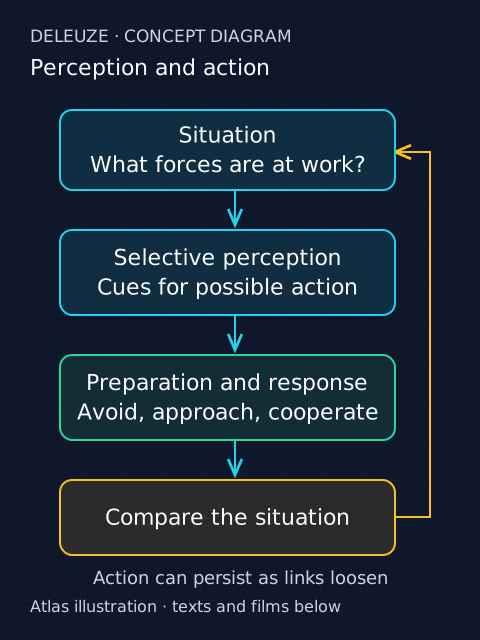
Atlas diagram: arrows describe relations between perception and action, not an evolutionary sequence in film history.
Open full-size diagramA situation offers cues for action
Identify what a figure sees, hears, and recognizes, then how that information leads to avoidance, approach, pursuit, or cooperation. The sensory-motor schema organizes perception in relation to possible action; visible displacement alone does not identify it.
Action changes the situation in return
Editing, spatial direction, and the task link perception to movement; a response opens a new perception. A held close-up can remain inside this circuit by preparing, delaying, or intensifying the next action.
The crisis concerns the connection
To examine a crisis of action, ask whether responses still organize the world that is seen. Figures may keep walking, talking, and performing tasks while local responses no longer account for everything they encounter. Compare functioning actions with moments in which action loses that organizing power.
City Lights
City Lights (1931)
Adjacent question
She recognizes him by touch; why does the film stop on a smile?
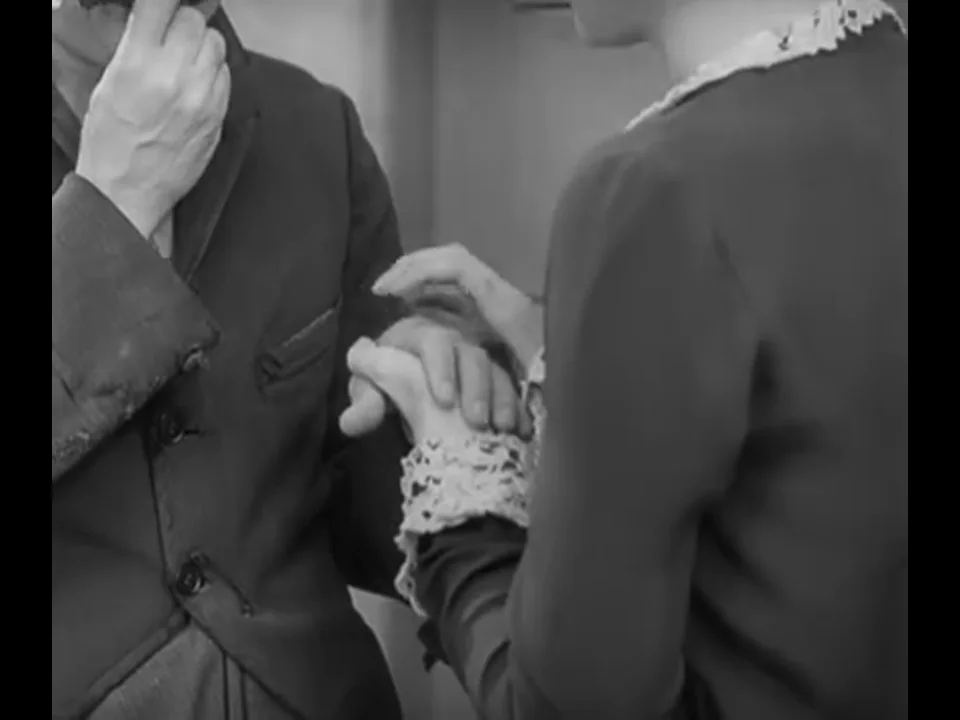
Touch completes recognition; the film then remains with two faces and a smile without showing how the pair will relate next.
Open full-size still- Displayed still
- 01:25:25
- Discussion passage
- 约 01:24:56—01:26:12 (final touch-and-recognition passage containing the 01:25:25 still)
Reviewed passage by passage on the single-part Bilibili carrier with a decoded-stream duration of 01:26:47. 01:25:25 is the still anchor and 约 01:24:56—01:26:12 is the atlas's working boundary. Approximately 25.8 seconds of black at the end are excluded from narrative analysis.
Still anchor 01:25:25; watch 01:24:56–01:26:12 and record in order the handclasp, change of expression, 'You?', response, and final smile.
Still checked: 2026-09-01 · Carrier access checked: 2026-09-01
Image
After the flower seller holds the Tramp's hand, her expression changes; the intertitle 'You?' appears, followed by cuts between their faces.
The Tramp asks whether she can see now; the passage ends within the close relation of faces and hands without showing their subsequent life together.
Sound
The score edition on this silent-film carrier could not be independently established; tactile recognition and visible intertitles suffice to locate the passage, and music carries no classificatory burden.
Relation to the concept
Recognition remains organized by bodily contact, facial response, and cutting. Here the action-image contracts toward the affection-image while remaining within the movement-image regime; the atlas does not reclassify it as a time-image on that basis.
Sources and further reading
- Cinema 1: The Movement-Image
Minnesota 1986 translation, chapter 10, pp. 160–171, especially pp. 169–171 · From p. 160 Deleuze defines A–S–A′ and its indices. Page 169 directly names City Lights as an example of a 'personality split of a pivotal character,' but does not assign the drunk or sober passages or a rule of recognition shot by shot. The atlas tests the paired drunken welcome and sober rejection as its concrete filmic realization. The scene directly named on p. 171 is the thread-unravelling passage around 00:52:32–00:53:54, not the final tactile recognition. Boundaries and theoretical relations for the opening mistake, sober rejection, and final recognition remain the atlas's responsibility.
- Bilibili · public single-part repost of City Lights located and reviewed by the atlas; the specific score, restoration, and master could not be independently established
01:25:25 · Touch completes recognition; the film then remains with two faces and a smile without showing how the pair will relate next.
- Open the single-part City Lights carrier on Bilibili
Still anchor 01:25:25; watch 01:24:56–01:26:12 and record in order the handclasp, change of expression, 'You?', response, and final smile.
Rio Bravo
Rio Bravo (1959)
Atlas shot reading
One coin first discloses the whole situation
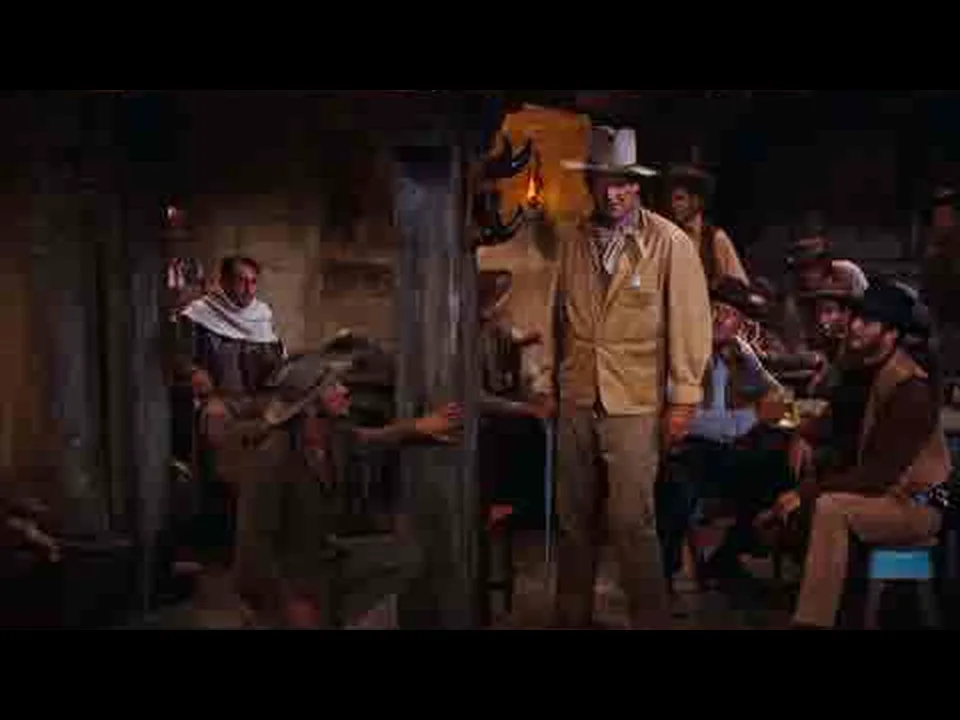
Dude reaches for a coin dropped into a spittoon and Chance kicks it away. Without exposition, dignity, alcoholism, friendship, and charity become visible through action.
Open full-size still- Displayed still
- 00:03:08
- Feature time
- 00:03:08
The three stills and jumps use the user-supplied complete 02:21:06 single-part Bilibili edition; time begins at the film's opening credits.
The still and link retain the film guide's recorded shot locator.
Image
Dude reaches for a coin dropped into a spittoon and Chance kicks it away. Without exposition, dignity, alcoholism, friendship, and charity become visible through action.
Relation to the concept
Action does not execute a known task. It first gives the situation a readable form: A occurs, and S emerges from its result.
Sources and further reading
- Cinema 1, Chapter 10
The small form A–S–A′ of the action-image
- BFI interview with Howard Hawks
The director on audiences, performance, and filmmaking judgment
- Continue with Red River
Compare relayed cooperation with a transfer of command
- Continue with The Big Sky
Carry local tactics into river, trade, and colonial route
Rio Bravo
Rio Bravo (1959)
Atlas shot reading
Dynamite turns function into relay
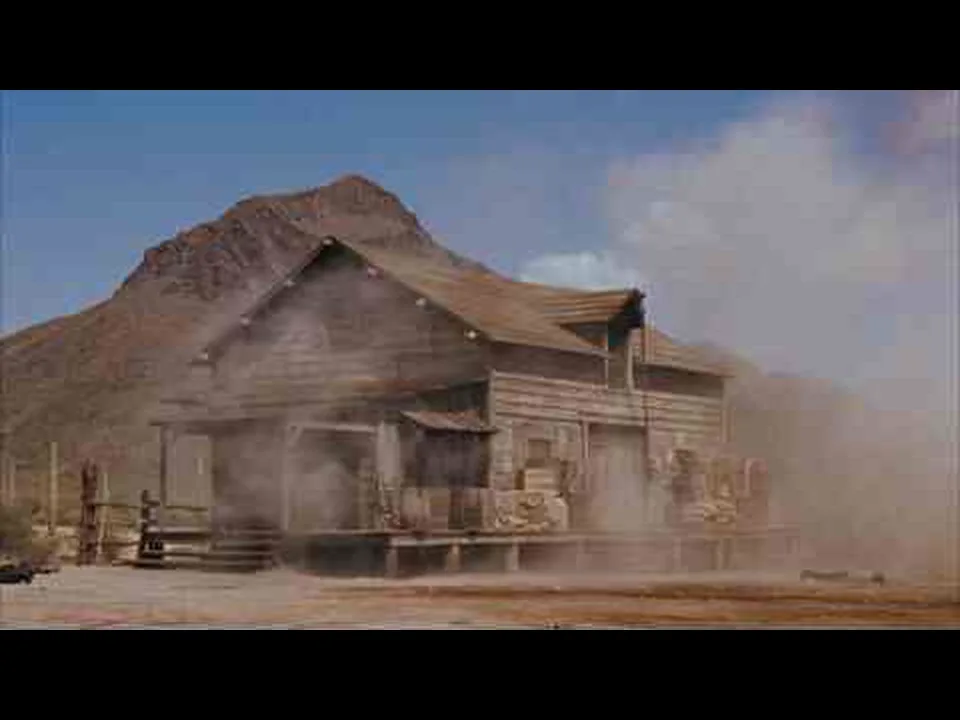
One person throws dynamite and another detonates it by gunfire; cover, observation, and movement relay across positions. Explosions alter the actionable structure of warehouse and street.
Open full-size still- Displayed still
- 02:11:54
- Feature time
- 02:11:54
The three stills and jumps use the user-supplied complete 02:21:06 single-part Bilibili edition; time begins at the film's opening credits.
The still and link retain the film guide's recorded shot locator.
Image
One person throws dynamite and another detonates it by gunfire; cover, observation, and movement relay across positions. Explosions alter the actionable structure of warehouse and street.
Relation to the concept
Victory does not prove that one person becomes whole. It shows local acts forming a new A′ through functional substitution; the group is the result of relayed action.
Sources and further reading
- Cinema 1, Chapter 10
The small form A–S–A′ of the action-image
- BFI interview with Howard Hawks
The director on audiences, performance, and filmmaking judgment
- Continue with Red River
Compare relayed cooperation with a transfer of command
- Continue with The Big Sky
Carry local tactics into river, trade, and colonial route
The Big Sky
The Big Sky (1952)
Atlas shot reading
Amputation detaches capacity from fixed identity
Injury interrupts prior division of labour. Diagnosis, decision, bodily restraint, and treatment must pass provisionally among hands; rank cannot replace the skill required now.
Open full-size still- Displayed still
- 00:49:43
- Feature time
- 00:49:43
Stills and timecodes use the user-supplied 02:01:45 / 122-minute theatrical cut and do not present it as the roughly 138–140-minute long edition.
The still and link retain the film guide's recorded shot locator.
Image
Injury interrupts prior division of labour. Diagnosis, decision, bodily restraint, and treatment must pass provisionally among hands; rank cannot replace the skill required now.
Relation to the concept
A group forms provisionally only through relayed capacities. The characters do not cooperate because they first share an identity; local action produces a relation that can continue.
Sources and further reading
- Rushton guide, pp. 42–44
Local action, ASA′, and an unfounded community
- Cinema 1, Chapter 10
Strict coordinates for the small-form action-image
- UCLA film archive
Edition, exhibition, and Hawks context
- Compare Rio Bravo
The same functional relay under different frontier power
The Big Sky
The Big Sky (1952)
Atlas shot reading
Trade makes unequal cooperation visible
Goods, firearms, translation, marriage, and kinship negotiation overlap in one camp. Teal Eye is both companion and a term within exchange.
Open full-size still- Displayed still
- 01:47:03
- Feature time
- 01:47:03
Stills and timecodes use the user-supplied 02:01:45 / 122-minute theatrical cut and do not present it as the roughly 138–140-minute long edition.
The still and link retain the film guide's recorded shot locator.
Image
Goods, firearms, translation, marriage, and kinship negotiation overlap in one camp. Teal Eye is both companion and a term within exchange.
Relation to the concept
Heterogeneous figures can complete a route together without deciding it together. The movement-image's increase in capacity must be read alongside unequal agency in colonial exchange.
Sources and further reading
- Rushton guide, pp. 42–44
Local action, ASA′, and an unfounded community
- Cinema 1, Chapter 10
Strict coordinates for the small-form action-image
- UCLA film archive
Edition, exhibition, and Hawks context
- Compare Rio Bravo
The same functional relay under different frontier power
Films and scenes
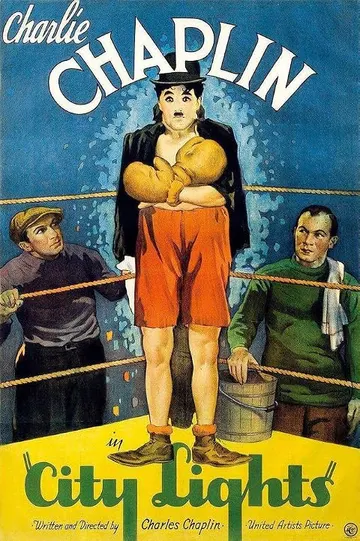
Page 169 of chapter 10 directly gives City Lights as an example of a 'personality split of a pivotal character,' but does not assign the millionaire's drunk or sober passages or a recognition rule shot by shot. The atlas tests drunken welcome and sober rejection as the concrete filmic realization of that phrase. Page 171 directly names the thread-unravelling gag. The atlas separately locates the first meeting and ending: the film juxtaposes a dropped flower, its recovery, a coin, an approaching figure, and a departing car for the viewer; the flower seller can draw on touch, transaction, and sound, while exact door-sound attribution still requires track-level review. She finally recognizes the Tramp by touch, contracting the action-chain into affect. These shot relations remain the atlas's interpretation.
IMDb identification poster ↗Related film readings · 33 films
Stagecoach · 1939 — Cinema 1 chapter 9 defines S–A–S′ on pp. 141–142. Page 146 directly uses Stagecoach's alternation between coach interior and exterior to explain Ford's Encompasser and treats the circular S–A–S as a first approximation; p. 147 then distinguishes Ford's spiral as S–A–S′, moving toward a new situation. The atlas therefore locates three passages without treating a long shot as proof by itself. Around 00:35:10, the coach is reduced beneath Monument Valley and the sky, proposing rather than proving an encompassing situation. From 01:13:30 to 01:15:20, cross-cutting distributes driver, reins, horses, gunfighters, and passengers across a collective act, giving firmer evidence for A. From 01:33:50 to 01:35:28, Ringo is released and leaves with Dallas in a small cart. That departure may form S′, but it is also a countertest: the film clearly shows Ringo leaving town with Dallas after his release without directly showing whether legal and class positions inside the town are redistributed. Deleuze's criticism on p. 150 of American montage reducing social causes to a personal duel, together with the distinctions among whole mission, local action, and duel on pp. 151–152, sets the textual boundary for asking whether a changed situation for the pair amounts to a changed situation as a whole. The atlas is responsible for the three timecodes and for relating them in this way.
Battleship Potemkin · 1925 — The Odessa Steps organize direction, scale, collective bodies, and the soldiers’ machine into conflicting series; three stone-lion shots turn quantitative difference into a qualitative leap. Montage generates an organic whole through opposition, rupture, and rising pathos.
Man with a Movie Camera · 1929 — Eye, lens, city, machine, and editing table connect through superimposition and accelerated intervals without submission to a stable human viewpoint. The camera enters movement between things, releasing perception from a centred subject toward matter’s dispersed state.
The Passion of Joan of Arc · 1928 — Close-ups strip the courtroom of continuous space, confronting Joan’s eyes, tears, and lips with the judges’ wrinkles. The face ceases to serve action and becomes a surface of intensive variation; fear, faith, and cruelty are perceived directly as qualities.
The Last Laugh · 1924 — The camera rides the lift, crosses the lobby, and sways with drunkenness, composing the doorman’s dignity together with hotel space. Once his uniform is taken, the building changes from stage of prestige to apparatus of oppression; camera movement performs the perceptual change.
Greed · 1924 — Three passages are now located, while their theoretical relation remains a candidate reading constrained by counterevidence. From 02:51:30 to 02:57:31, the giant gold tooth sign is first proposed for sale as an exchange object; the old meat and demand for change that immediately follow still belong to ordinary exchange and a practical budget. The passage therefore first contests the claim that a golden object is automatically a fetish. From 03:02:06 to 03:02:42, Trina counts her savings, brings the money close to her face, and addresses it as second-person 'you': grasping and hoarding as real behaviours or gestures may be symptom candidates. Only when money is withdrawn from exchange and use into something solely kept and caressed does it approach a fetish candidate. From 03:50:45 to 03:55:39, the money bag, money, dead horse, broken canteen, handcuffs, and caged bird enter one exhausted desert milieu, but money, teeth, and the caged bird cannot be collapsed in advance into one class of object-fragments or fetishes: the canteen, handcuffs, and bird first belong to material relations of water loss, restraint, and exhausted life respectively. Page 125 generally defines the four structural terms and symptom or fetish while directly listing Greed's desert ending as a localized originary world. Page 128 directly names the film's impulse for gold, then defines partial object and fetish in general; pp. 126–130 also develop descent, entropy, and environmental exhaustion. Exact timecodes, the tooth's exchange function, the caress of money, and distinctions among the final objects remain the atlas's responsibility.
The General · 1926 — War, railway, flood, and broken bridge first compose an immense situation that dwarfs the little man. Continuous trajectories and the ‘miniaturization’ of machines then let a small body transform the whole through the locomotive. The General places burlesque directly inside the large form S–A–S′.
Seven Samurai · 1954 — Village maps, formations, and reconnaissance gather every given condition of defence, then force a higher question: ‘What is a samurai at this historical moment?’ The rain battle secures the village, but burial mounds and peasant song answer that the peasants are the true victors and the samurai have become displaced shadows.
High Noon · 1952 — Clocks, tracks, and emptied streets compress the town into a one-hour countdown. Kane repeatedly asks for help, yet action cannot organize the community. The duel completes a classical action-image, but the badge dropped in the dust prevents victory from restoring trust.
Persona · 1966 — The close-up progressively withdraws the face’s functions of individuation, social role, and communication. Composite half-faces, the twice-told story of motherhood, and burning film detach affect from private psychology and expose the face’s terror before emptiness.
Edge of Tomorrow · 2014 — Death-reset turns the battlefield into a repeatedly trainable map of action. Cage uses memory to shorten routes, correct posture, and anticipate enemies. The loop intensifies rather than breaks the sensory-motor schema while exposing the shared duration that victory deletes.
Aguirre, the Wrath of God · 1972 — Rapids, mud, and forest might support heroic action, but Aguirre subordinates the expedition to a sublime plan to betray God, king, and everyone else. The farther the raft travels, the more the plan becomes empty speech; corpses, mist, and monkeys reduce a history of conquest to one isolated body's terminal performance.
City Lights · 1931 · Candidate reading — Page 169 of chapter 10 directly gives City Lights as an example of a 'personality split of a pivotal character,' but does not assign the millionaire's drunk or sober passages or a recognition rule shot by shot. The atlas tests drunken welcome and sober rejection as the concrete filmic realization of that phrase. Page 171 directly names the thread-unravelling gag. The atlas separately locates the first meeting and ending: the film juxtaposes a dropped flower, its recovery, a coin, an approaching figure, and a departing car for the viewer; the flower seller can draw on touch, transaction, and sound, while exact door-sound attribution still requires track-level review. She finally recognizes the Tramp by touch, contracting the action-chain into affect. These shot relations remain the atlas's interpretation.
Napoléon · 1927 — Mounted on horseback or hurled like a weapon, the camera is first freed from fixed support. Superimpositions and the triptych screen then juxtapose, collide, and expand local movements. Present battle and immense history are not unified by one viewpoint; they produce a mathematical sublime between interval and whole.
North by Northwest · 1959 — The three passages require distinct evidentiary levels. At 00:00:50 the diagonal grid, title, and directional arrows propose that relational positions precede personal identity, but geometrical resemblance alone does not establish Thirdness. The farmland passage around 01:12:00 first composes a habitual series of waiting, road, vehicles, and fields; a stranger observes that the plane is dusting where there are no crops, and this relational contradiction makes it the demark that reroutes the series. At 02:15:59 the match cut joins cliff rescue to an embrace in the train berth, countertesting an overextended relation-image through sensory-motor closure and marital resolution. Deleuze, p. 203, and Rushton, pp. 48–53, supply the sign criteria; the edition bounds and comparison among opening, field, and ending are the atlas's responsibility.
M · 1931 — Police and underworld tighten the city through raids, maps, and divided labour, yet the real duel is not between them. The underworld tribunal presents crime as manageable habit, while M pleads an uncontrollable impulse. The clash between organized action and affective compulsion marks Lang's passage from expressionist shadow to austere realism.
Sunrise: A Song of Two Humans · 1927 — The dark marsh and luminous city are not two settings but two forces of a marriage moving through seduction, murder, and reconciliation. After the false report of drowning, searchlights cut across the lake and shadow changes by degrees into light. Milieu, faces, and movement together carry a passage from falling toward renewed illumination.
The Crowd · 1928 — The camera travels against the street crowd, enters a skyscraper, and finds one desk among countless windows, embedding the individual in an exchangeable mass. John repeatedly answers the city with effort only to return to the same situation. The large form S–A–S′ fails, turning upward mobility into an S–A–S loop.
Sherlock Jr. · 1924 — When the projectionist enters the screen, his body remains still while garden, street, precipice, snowfield, and shore strike through cuts. The train passage reverses the relation, carrying him continuously across roof, water tower, and track in one shot. Disjunctive editing and bodily trajectory make the cinema-machine a comic agent.
Steamboat Bill, Jr. · 1928 — The cyclone turns the town into a continuously transforming milieu: façades fall, buildings slide, and wind transports bodies. Keaton's small body does not overpower disaster but passes through it by exact position and improvised trajectory. Burlesque small form thereby carries a sublime scale usually reserved for epic large form.
The Gold Rush · 1925 — Cabin, hunger, and dreams of wealth keep reversing through slight differences: a shoe becomes dinner, and the Tramp becomes a chicken in Big Jim's eyes. No character masters the total situation; each improvises at a critical instant. Comedy makes action from a minute perceptual shift while letting survival slide toward devouring.
Au hasard Balthazar · 1966 — Balthazar makes no ethical choice, yet bears the effects of every human choice and non-choice. Reins, blows, loads, and wounds write human relations onto the animal body. Dying among sheep, he gives no verdict; the event suffered by the innocent separates from motive and becomes a spiritual affect.
The Exterminating Angel · 1962 — The drawing room has no visible barrier, yet the guests cannot cross its threshold; civility regresses into occupation, hunger, and attack. The arrival and interior attitudes recur with imperfect differences, and bad repetition closes the space. Only by restaging the decisive arrangement does the boundary loosen, before forming again in the church.
Throne of Blood · 1957 — The foggy forest and spirit offer not an instruction for action but a question whose conditions must be understood. Washizu treats prophecy as an executable plan; the more urgently he acts, the more the castle becomes a spider's web. The final arrows are not an enemy's answer but the misunderstood question tightening from within.
The Man Who Shot Liberty Valance · 1962 — The duel restores order, but Tom performs it while Ransom receives its credit. By yielding the deed, the cowboy lets the West's unwritten force pass into the senator's written law. The flashback does not restore fact to public status: action forms an ethical spiral, and the new situation rests on a preserved legend.
Diary of a Country Priest · 1951 — Doors, tabletops, hands, diary pages, and exhausted steps construct the priest's path fragment by fragment; space is never given whole. The face no longer governs emotion, as tactile fragments bear judgment, illness, and faith. Each halt is both interrupted action and another station toward the Cross, producing spiritual affect through broken connections.
Ugetsu · 1953 — Misty lake, back rooms, fields, and garden extend space through adjacent fragments rather than a total viewpoint. Overflow from the bath leads to fields and then to a meal months later. One line of the universe passes through the seductive ghost and returns to the dead wife's presence, joining living, dead, and social oppression.
Rio Bravo · 1959 — The jail scarcely needs the prisoner's body to acquire meaning; it operates as a functional node to be held or breached. Sheriff, recovering alcoholic, disabled old man, and young gunfighter represent no organic community. They form a provisional group through capacities to guard, hear, carry, and shoot, while the final combination of dynamite and rifle compresses Western space into exchangeable functions.
Red River · 1948 — Deleuze names Red River in Cinema 1, chapter 10, p. 165, within Hawks and the small form rather than directly presenting it as a model of the large form. Open landscape and collective task can still pose an S–A–S′ hypothesis. The atlas then countertests it through the claim passage at 00:15:38, stampede at 00:51:20, and transfer of command at 01:21:08: does an encompassing situation genuinely precede action, or is it progressively disclosed and reorganized by local acts, differences of speed, and relayed functions? The relation among these three shots is the atlas's responsibility, not a shot-by-shot gloss of p. 165.
Scarface · 1932 — Tony builds an apparently effective gangster habit through assassination, machine-gun fire, and territorial seizure, while recurring X marks inscribe death within each success. The milieu is no stable community but an alliance ready to reverse. When his sister is shot, possessiveness, arrogance, and fear converge into a crack, and the actions that organized situations abruptly fail.
The Big Sky · 1952 — Sky first encompasses land, river, and expedition; the Missouri then stretches the static Western milieu into a long fluid route. Companions of different backgrounds do not fuse into a national community but connect through paddling, negotiation, guarding, and improvisation. The escape by a low branch in the rapids turns the gap between immense nature and small-group action into a locally usable function.
Intolerance · 1916 — The vertical of Babylon's wall divides the elevated king and lower chariots within one geometric frame; parallel montage then makes four epochs recall one another. In the finale, the Babylonian chariot and modern car-train rescues accelerate together. Distant civilizations converge as editorial intervals contract, indirectly producing time through the expansion and contraction of a whole of movement.
Cabiria · 1914 — Temple, colossus, fire, and crowds remain layered in the frontal staging of early cinema, yet the camera travels slowly across and into those planes. Pastrone makes camera movement an ordinary way of organizing space rather than a conspicuous trick. The shot records not only displacement of figures but remeasures the relations among set, crowd, and action as it moves.
Criteria
Which differentiation—perception, affection, impulse, action, reflection, or mental relation—governs the shot, and how does it alter connections among parts so that the whole changes qualitatively?
Distinctions and counterexamples
Running bodies, moving vehicles, or a resolved task do not identify a specific movement-image, while a close-up or affection-image with suspended action does not thereby leave the movement-image regime.
Common confusion: Historical scope: the movement-image persists alongside the time-image.
Texts and sources
Cinema 1; Cinema 2, ch. 1–2
- 01Cinema 1: The Movement-Image
Standard Minnesota English translation and a principal citation edition in Anglophone scholarship.
View source and edition → - 02Cinema 2: The Time-Image
Authoritative source for the standard translation, translators, ISBN, and publication date.
View source and edition →
Research disagreements
Replacement or coexistence?
The time-image reverses the subordination of time to movement; both regimes persist and can shift locally within one film.
Taxonomy or generator?
Fixed labels invite mere example-hunting; an open taxonomy requires new concepts to transform existing relations and explain across cases.
How do we use Deleuze precisely?
Test four layers: sensory-motor relation, actual/virtual circuit, audio-visual connection, and regime of truth.
How the movement-image differentiates and enters crisis
Impulse, the two action forms, reflection, and the mental/relation field address distinct problems rather than evolutionary stages. The crisis of action concerns the failure of the sensory-motor schema.
Enter each differentiation
- Impulse-imageimage-pulsion
The impulse-image stands between affection and action. Deleuze divides its naturalist structure into four terms arranged in two pairs: originary world/derived milieu and elementary impulse/real behaviour. A historically, geographically, and socially determinate derived milieu remains present while elementary impulse penetrates real behaviour from within; impulse seizes object-fragments from that milieu and thereby exposes an uncoordinated originary world. Symptom and fetish are not additional structural terms but two classes of signs: a symptom is the appearance of impulse in the derived milieu, while a fetish is the appearance of the seized object-fragment itself. Stroheim realizes this structure through decay, descent, and entropy; Buñuel through repetition, cycles, and restart. These are distinct realizations, not cumulative thresholds that every example must satisfy.
→ - Action-image: large formgrande forme de l'image-action
The large form of the action-image follows S–A–S′. A milieu, collective, historical pressure, or danger first composes an encompassing situation S; that pressure leaves an internal imprint upon the character and concentrates itself in action A as effort, duel, or collective coordination; action then carries the milieu into a situation S′ different from the initial one. Its decisive question is how a situation demands action and whether action actually reorganizes that situation.
→ - Action-image: small formpetite forme de l'image-action
The small form of the action-image follows A–S–A′. It begins from an action A already underway whose meaning remains equivocal; indices of lack or ambiguity progressively disclose the situation S in which that act is embedded, forcing a revised action A′. The situation is not given in advance as a known whole but inferred through local gestures, misrecognitions, clues, gags, and the consequences of action.
→ - Reflection-imageimage-réflexion
Following Cinema 2, pp. 32–33, which retrospectively revisits the first semiotics, the atlas gathers the figures developed in Cinema 1, chapters 10–11—attraction, inversion, and discourse—under reflection-image. All three still transform the situation–action relation from within the action forms: attraction uses a substitute or rehearsal to miniaturize, prefigure, or stage another situation or act; inversion exchanges large and small powers; discourse makes an implicit problem into an audible and visible object of thought. Reflection-image must not be prematurely equated with chapter 12's relation-image.
→ - Mental-imageimage mentale
In Cinema 1's strict usage, the mental-image first names a problem-field: images take relations, symbolic acts, and intellectual feelings as their objects rather than representing states inside a character's head. Relations are external to their terms and irreducible to the attributes of any one term; symbolic acts and intellectual feelings must likewise become operations of image, sound, and editing rather than plot content. The atlas gives mental-image and relation-image separate pages only as reading interfaces for this problem-field and its Hitchcockian realization through Thirdness. The source does not rank them as parallel levels or make the former a superclass of recollection- and dream-images.
→ - Relation-imageimage-relation
The relation-image is the decisive Hitchcockian realization within the mental-image's problem-field: it makes relation itself the image's object and specifies its signs through Peircean Thirdness. A mark sustains a natural or habitual series, a demark redirects that series through an anomalous term, and a symbol makes a concrete term bear an abstract relation; Hitchcock further composes director, film, and the spectator who must enter the inference as a triadic apparatus. The separate atlas page is an explanatory interface, not evidence that the source ranks mental-image and relation-image as parallel levels.
→ - Crisis of the action-imagecrise de l'image-action
The crisis of the action-image is not the disappearance of movement but the loss of a credible bond among situation, perception, and action capable of changing the world. Cinema 1 lists a constellation of five surface symptoms: dispersive situations that replace a totality with gaps; deliberately weak links among events; wandering that displaces goal-directed travel; consciousness of clichés, as figures and spectators begin to recognize how ready-made schemata obscure real relations; and the exposure or denunciation of conspiracy—the network of control behind the plot. These are external negative conditions for a new image-regime, not a checklist that every film and every sequence must complete.
→ - Sensory-motor schemaschème sensori-moteur
The sensory-motor schema is not the definition of the movement-image but one specific body-world organization within it. A body receives movement from its milieu, selects perceptions according to its needs, retains what it cannot immediately discharge as affection, and answers the milieu through action. Its crisis does not mean that characters cease moving; the link from perception and affection to an action capable of changing the situation comes loose.
→ - Pure optical / sound situationopsigne / sonsigne
A visual or auditory situation acquires a duration autonomous from cues for action or narration. Unable to translate what is seen or heard immediately into an effective response, the figure becomes a seer, listener, or witness. This is a threshold of the time-image, not direct time by itself.
→