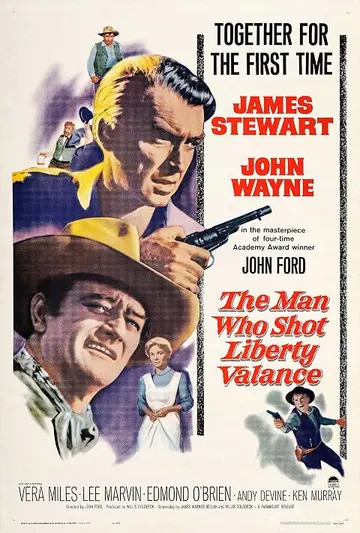
John Ford / 约翰·福特 · 1962
The Man Who Shot Liberty Valance
The Man Who Shot Liberty Valance
The duel restores order, but Tom performs it while Ransom receives its credit. By yielding the deed, the cowboy lets the West's unwritten force pass into the senator's written law. The flashback does not restore fact to public status: action forms an ethical spiral, and the new situation rests on a preserved legend.
Film details
- Original title
- The Man Who Shot Liberty Valance
- Director
- John Ford / 约翰·福特
- Year
- 1962
- Region
- United States
Film analysis: how shots organize concepts
A successful act is performed by one man, inherited by another, and turned by archival refusal into the legend founding a new law.
- 01Two laws contest the milieu
Ransom enters town with law books and literacy lessons, while Valance answers with whip, gun, and public humiliation.
Written institutions cannot yet transform the milieu; action remains governed by the West's unwritten force. - 02Action separates from credit
The duel first appears to be Ransom's victory; a second flashback reveals Tom firing from concealment.
The author of action changes while its social consequence remains; the hero's position becomes a transferable relation. - 03The archive chooses legend
After hearing the truth, the editor tears up his notes and preserves the story the public already accepts.
Fact is suppressed to stabilize the new institution; the large form closes as an ethical spiral rather than simple restoration.
Close-reading questions
- 01Ransom teaches from law books while Valance answers with whip and gun: written law → bodily humiliation → preparation for duel. How do two laws contest the same milieu?
- 02The duel first appears successful from Ransom's perspective, then a later flashback reveals Tom's hidden shot; how does second viewing change the action's author without changing its public consequence?
- 03The editor decides, “When the legend becomes fact, print the legend”: true account → archival refusal → stabilized national narrative. Why must the new situation rest on a suppressed action?
Shots and scenes
Primary texts, scholarship, and locators
Theory coordinate: Cinema 1, Minnesota 1986, ch. 9, pp. 147, 153, 155
- 01Cinema 1: The Movement-Image
Standard Minnesota English translation and a principal citation edition in Anglophone scholarship.
Open the atlas source record →
Viewing gateways and editions
No direct viewing link is listed; film search gateways are available above.