Concept definition
The sensory-motor schema is not the definition of the movement-image but one specific body-world organization within it. A body receives movement from its milieu, selects perceptions according to its needs, retains what it cannot immediately discharge as affection, and answers the milieu through action. Its crisis does not mean that characters cease moving; the link from perception and affection to an action capable of changing the situation comes loose.
What the concept explains
The sensory-motor schema names a body-world organization in which perception can be prolonged into an effective response: the body selects interested features, opens an affective interval, and acts to alter the situation. Its crisis concerns the credibility of that prolongation, not an occasional failure.
Sensory-Motor Rupture: How a Character Becomes a SeerDiagrams and film passages
How does seeing lead into action?
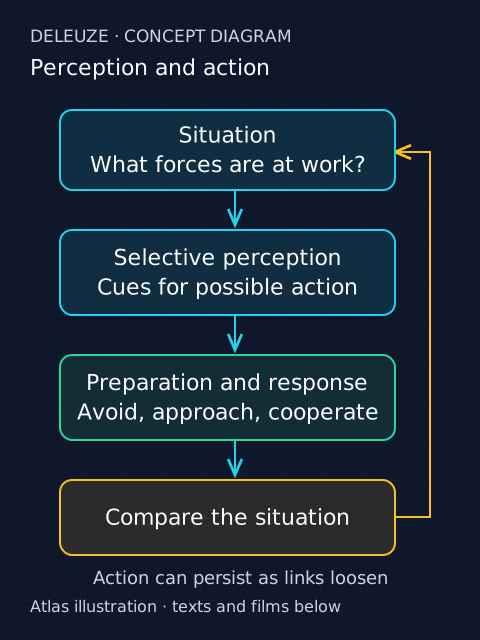
Atlas diagram: arrows describe relations between perception and action, not an evolutionary sequence in film history.
Open full-size diagramA situation offers cues for action
Identify what a figure sees, hears, and recognizes, then how that information leads to avoidance, approach, pursuit, or cooperation. The sensory-motor schema organizes perception in relation to possible action; visible displacement alone does not identify it.
Action changes the situation in return
Editing, spatial direction, and the task link perception to movement; a response opens a new perception. A held close-up can remain inside this circuit by preparing, delaying, or intensifying the next action.
The crisis concerns the connection
To examine a crisis of action, ask whether responses still organize the world that is seen. Figures may keep walking, talking, and performing tasks while local responses no longer account for everything they encounter. Compare functioning actions with moments in which action loses that organizing power.
Germany Year Zero
Germania anno zero (1948)
Supported by the scene
The cemetery emerges from rubble
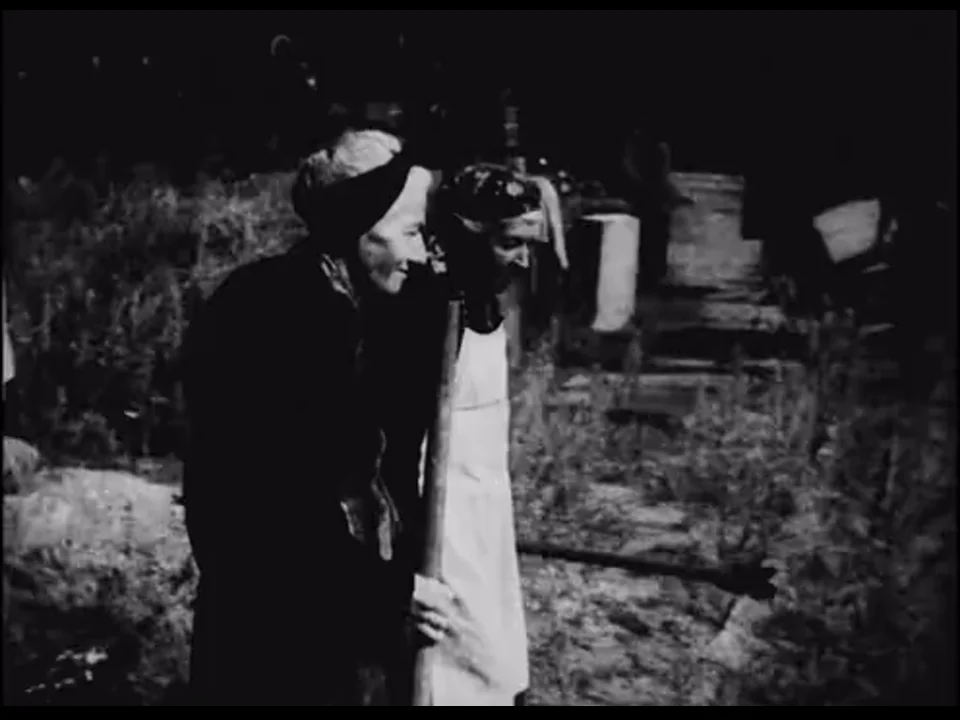
After the title, the city appears not as a coherent background for action but as cemetery, rubble, and survival labour layered together. Bilibili timecode 00:02:35.
Open full-size still- Displayed still
- 00:02:35
- Discussion passage
- 00:02:05 - 00:02:54
Frame-checked against the single-part Bilibili repost stream BV1hP4y1k78i: the page API reports 4,388 seconds and the retrieved qn16 media runs 4,387.37 seconds. Bilibili supplies no subtitle track; audible facts record only clearly discernible German speech, music, and ambient sound in the image sequence.
Complete single-part Bilibili film; the page and anonymous Player API were verified as playable. Bilibili submission label: repost.
Still checked: 2026-08-13 · Carrier access checked: 2026-08-13
Image
The camera first pans across damaged buildings and the city skyline, then cuts into an overgrown cemetery.
People dig and carry materials among graves, markers, and rubble; a pale board crosses the foreground.
Sound
The opening orchestral music continues over the city views and the first images of labour in the cemetery.
Relation to the concept
Test whether perception still extends naturally into action adequate to transform the situation.
Sources and further reading
- Cinema 2: The Time-Image
Minnesota 1989 translation: Preface, p. xi; ch. 1, p. 2. 2004 Simplified Chinese edition: ch. 1, p. 3. · Brief primary-text mention: Deleuze uses the child in Germany Year Zero to connect motor helplessness with a greater capacity to see and hear. Preface p. x and the chapter's following passages are adjacent conceptual context, not direct pages on the film; the scene windows, facts, and criteria are this atlas's shot analysis.
- Bilibili · La-Jeunesse- · public repost page
00:02:35 · After the title, the city appears not as a coherent background for action but as cemetery, rubble, and survival labour layered together. Bilibili timecode 00:02:35.
Germany Year Zero
Germania anno zero (1948)
Supported by the scene
The teacher hands Hitler's record to the child
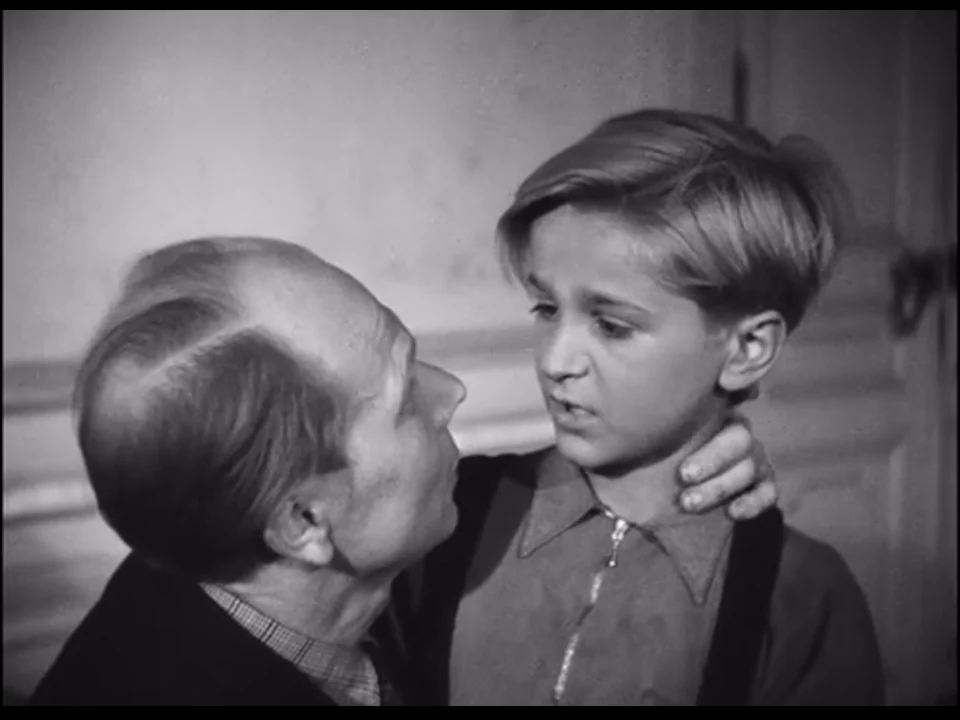
The former teacher gives Edmund a record of a Hitler speech and a player to sell at the ruined Chancellery. Bilibili timecode 00:24:40.
Open full-size still- Displayed still
- 00:24:40
- Discussion passage
- 00:23:58 - 00:26:11
Frame-checked against the single-part Bilibili repost stream BV1hP4y1k78i: the page API reports 4,388 seconds and the retrieved qn16 media runs 4,387.37 seconds. Bilibili supplies no subtitle track; audible facts record only clearly discernible German speech, music, and ambient sound in the image sequence.
Complete single-part Bilibili film; the page and anonymous Player API were verified as playable. Bilibili submission label: repost.
Still checked: 2026-08-13 · Carrier access checked: 2026-08-13
Image
The teacher keeps Edmund in front of him, repeatedly grips his shoulder and neck, and speaks at close range.
Edmund remains nearly still while the teacher's hand and face dominate the frame.
Sound
The teacher asks why Edmund is out of school and why the family lacks food, then gives him a Hitler speech record and player to sell, telling him to claim the record as his own if questioned.
Relation to the concept
Test whether perception still extends naturally into action adequate to transform the situation.
Sources and further reading
- Cinema 2: The Time-Image
Minnesota 1989 translation: Preface, p. xi; ch. 1, p. 2. 2004 Simplified Chinese edition: ch. 1, p. 3. · Brief primary-text mention: Deleuze uses the child in Germany Year Zero to connect motor helplessness with a greater capacity to see and hear. Preface p. x and the chapter's following passages are adjacent conceptual context, not direct pages on the film; the scene windows, facts, and criteria are this atlas's shot analysis.
- Bilibili · La-Jeunesse- · public repost page
00:24:40 · The former teacher gives Edmund a record of a Hitler speech and a player to sell at the ruined Chancellery. Bilibili timecode 00:24:40.
Germany Year Zero
Germania anno zero (1948)
Supported by the scene
The glass turns speech into irreversible action
After an act mistaken for a solution to the family's hardship, the child can only watch his father drink from the glass. Bilibili timecode 00:52:15.
Open full-size still- Displayed still
- 00:52:15
- Discussion passage
- 00:50:11 - 00:52:42
Frame-checked against the single-part Bilibili repost stream BV1hP4y1k78i: the page API reports 4,388 seconds and the retrieved qn16 media runs 4,387.37 seconds. Bilibili supplies no subtitle track; audible facts record only clearly discernible German speech, music, and ambient sound in the image sequence.
Complete single-part Bilibili film; the page and anonymous Player API were verified as playable. Bilibili submission label: repost.
Still checked: 2026-08-13 · Carrier access checked: 2026-08-13
Image
Edmund moves between table and bed, places powder in a drink, and the father later drinks from the glass.
As the father drinks, Edmund stands beside the bed with his gaze fixed on the glass and his father.
Sound
Low German conversation is heard in the room, along with small sounds of glassware and tableware; music supplies no triumphant closure to the act.
Relation to the concept
Test whether perception still extends naturally into action adequate to transform the situation.
Sources and further reading
- Cinema 2: The Time-Image
Minnesota 1989 translation: Preface, p. xi; ch. 1, p. 2. 2004 Simplified Chinese edition: ch. 1, p. 3. · Brief primary-text mention: Deleuze uses the child in Germany Year Zero to connect motor helplessness with a greater capacity to see and hear. Preface p. x and the chapter's following passages are adjacent conceptual context, not direct pages on the film; the scene windows, facts, and criteria are this atlas's shot analysis.
- Bilibili · La-Jeunesse- · public repost page
00:52:15 · After an act mistaken for a solution to the family's hardship, the child can only watch his father drink from the glass. Bilibili timecode 00:52:15.
Germany Year Zero
Germania anno zero (1948)
Supported by the scene
The explanation for the act is withdrawn
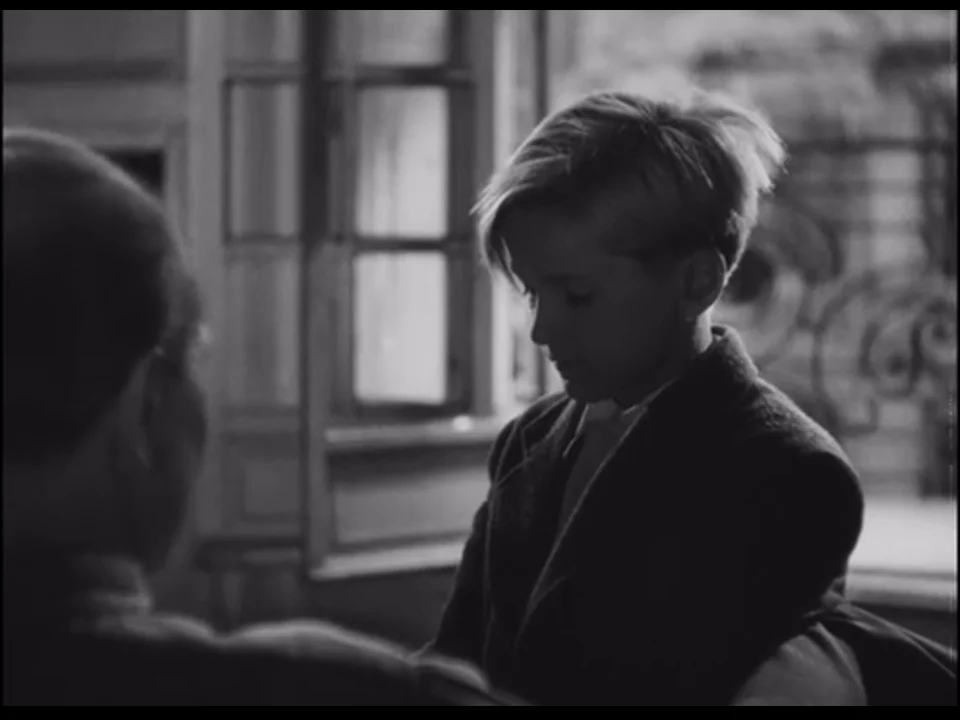
The child brings the completed act back to its source in speech but receives no explanation capable of bearing its consequence. Bilibili timecode 01:03:18.
Open full-size still- Displayed still
- 01:03:18
- Discussion passage
- 01:02:58 - 01:04:11
Frame-checked against the single-part Bilibili repost stream BV1hP4y1k78i: the page API reports 4,388 seconds and the retrieved qn16 media runs 4,387.37 seconds. Bilibili supplies no subtitle track; audible facts record only clearly discernible German speech, music, and ambient sound in the image sequence.
Complete single-part Bilibili film; the page and anonymous Player API were verified as playable. Bilibili submission label: repost.
Still checked: 2026-08-13 · Carrier access checked: 2026-08-13
Image
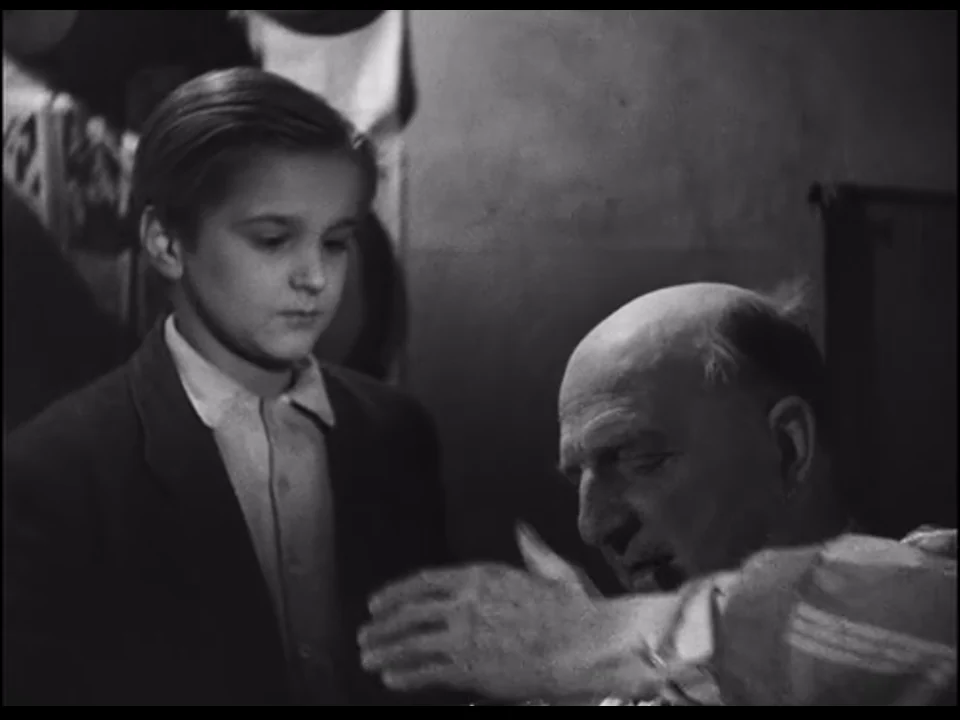
Neatly dressed in a dark jacket, Edmund stands before the teacher, first lowering his head and then retreating under the teacher's agitated gestures and speech.
The teacher drives him toward the open balcony doors; Edmund curls beside the bright exit and then leaves.
Sound
The German argument sharply intensifies as the teacher rebukes him continuously; Edmund's voice is quieter and brief.
Relation to the concept
Test whether perception still extends naturally into action adequate to transform the situation.
Sources and further reading
- Cinema 2: The Time-Image
Minnesota 1989 translation: Preface, p. xi; ch. 1, p. 2. 2004 Simplified Chinese edition: ch. 1, p. 3. · Brief primary-text mention: Deleuze uses the child in Germany Year Zero to connect motor helplessness with a greater capacity to see and hear. Preface p. x and the chapter's following passages are adjacent conceptual context, not direct pages on the film; the scene windows, facts, and criteria are this atlas's shot analysis.
- Bilibili · La-Jeunesse- · public repost page
01:03:18 · The child brings the completed act back to its source in speech but receives no explanation capable of bearing its consequence. Bilibili timecode 01:03:18.
Germany Year Zero
Germania anno zero (1948)
Supported by the scene
Final wandering and the sight too much to bear
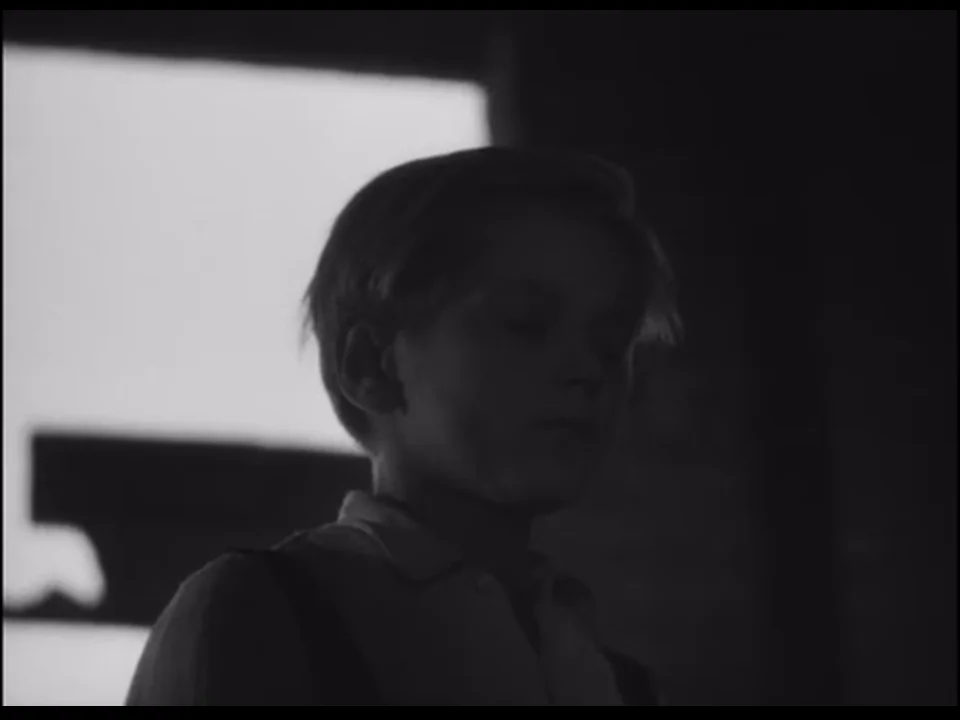
The long wandering turns streets, church, ruined buildings, traffic, and children's play from usable action-space into a city layer that must be watched. Bilibili timecode 01:12:18.
Open full-size still- Displayed still
- 01:12:18
- Discussion passage
- 01:05:01 - 01:12:44
Frame-checked against the single-part Bilibili repost stream BV1hP4y1k78i: the page API reports 4,388 seconds and the retrieved qn16 media runs 4,387.37 seconds. Bilibili supplies no subtitle track; audible facts record only clearly discernible German speech, music, and ambient sound in the image sequence.
Complete single-part Bilibili film; the page and anonymous Player API were verified as playable. Bilibili submission label: repost.
Still checked: 2026-08-13 · Carrier access checked: 2026-08-13
Image
Edmund crosses streets and broken walls alone, pauses outside a church, and enters a building without intact walls.
He watches children playing, vehicles, and the street below, repeatedly touches debris and architectural fragments; after climbing upward, he falls from the building, and a woman in the street approaches his body.
Sound
The long passage is formed mainly by sustained orchestral music, traffic, distant children's voices, and urban ambience; Edmund speaks almost no dialogue.
Relation to the concept
Test whether perception still extends naturally into action adequate to transform the situation.
Sources and further reading
- Cinema 2: The Time-Image
Minnesota 1989 translation: Preface, p. xi; ch. 1, p. 2. 2004 Simplified Chinese edition: ch. 1, p. 3. · Brief primary-text mention: Deleuze uses the child in Germany Year Zero to connect motor helplessness with a greater capacity to see and hear. Preface p. x and the chapter's following passages are adjacent conceptual context, not direct pages on the film; the scene windows, facts, and criteria are this atlas's shot analysis.
- Bilibili · La-Jeunesse- · public repost page
01:12:18 · The long wandering turns streets, church, ruined buildings, traffic, and children's play from usable action-space into a city layer that must be watched. Bilibili timecode 01:12:18.
Journey to Italy
Viaggio in Italia (1954)
Supported by the scene
Plaster returns an instant of death to the present
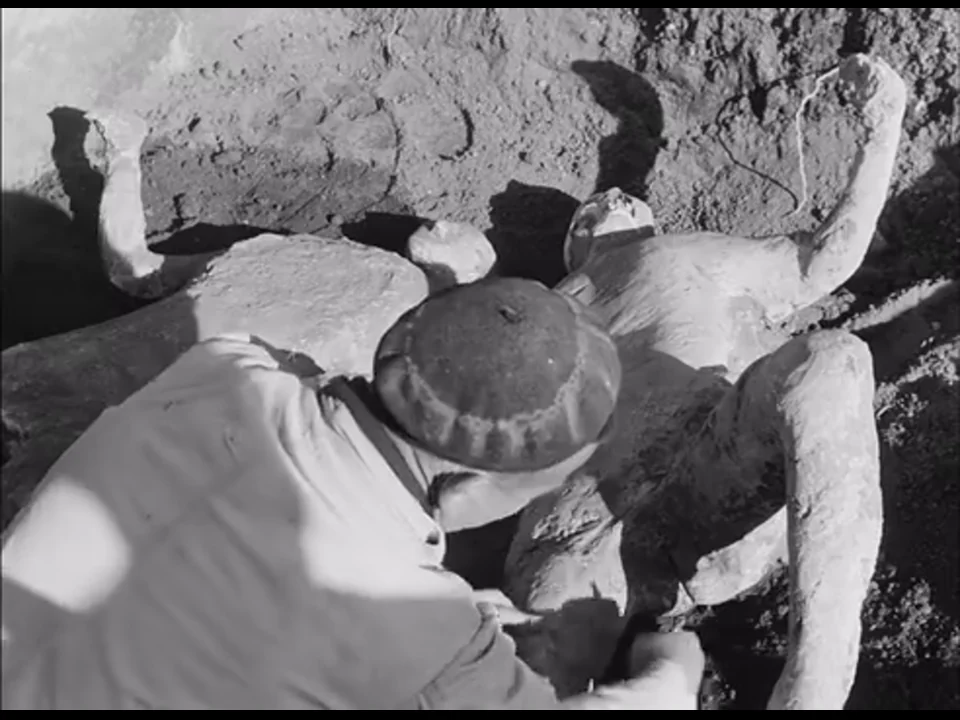
The technical operation successfully restores bodily contours while depriving the watching couple of their capacity to keep bearing the sight. Bilibili timecode 01:15:10.
Open full-size still- Displayed still
- 01:15:10
- Discussion passage
- 01:13:22 - 01:15:28
Frame-checked against the single-part Bilibili repost stream BV1h5MVzfEdW: the page API reports 5,141 seconds, while the retrieved qn16 media runs 5,140.78 seconds at 492×360. Player v2 supplies no usable subtitle track; English dialogue sense was aligned by scene content with an English SDH subtitle file from the Criterion Blu-ray. Every timecode follows the Bilibili carrier.
Complete single-part film on Bilibili; the page, anonymous Player API, media bytes, and full 5,140.78-second duration were verified. Submission label: repost.
Still checked: 2026-08-13 · Carrier access checked: 2026-08-13
Image
Workers use trowels, brushes, and hands to remove volcanic material; pale plaster gradually exposes a head, teeth, arms, and legs against dark soil.
Two adjacent bodies are identified as a man and a woman; the film alternates among the remains and Alex's and Katherine's responses.
Sound
The on-site commentary explains how plaster fills the cavity left after a body disintegrates and successively identifies legs, arms, skull, and teeth.
Tools continue scraping soil; after the observers suggest the two may have been husband and wife, Katherine says she cannot bear it and asks to leave.
Relation to the concept
Technical action succeeds while personal action fails; this difference fixes the schema's rupture within the scene.
Sources and further reading
- Cinema 2: The Time-Image
Minnesota 1989 translation: ch. 1, p. 2 (listed as The Lonely Woman [Viaggio in Italia]). · Brief primary-text mention: on this page Deleuze includes Katherine among female tourists struck by unfolding images and visual clichés; the fuller argument for the turn from agent to seer comes from the surrounding chapter. This site analyzes each scene window, audio-visual fact, and criterion shot by shot.
- Bilibili · Steppenwolffff · public repost page
01:15:10 · The technical operation successfully restores bodily contours while depriving the watching couple of their capacity to keep bearing the sight. Bilibili timecode 01:15:10.
Journey to Italy
Viaggio in Italia (1954)
Supported by the scene
The crowd takes Katherine away, then presses the couple together
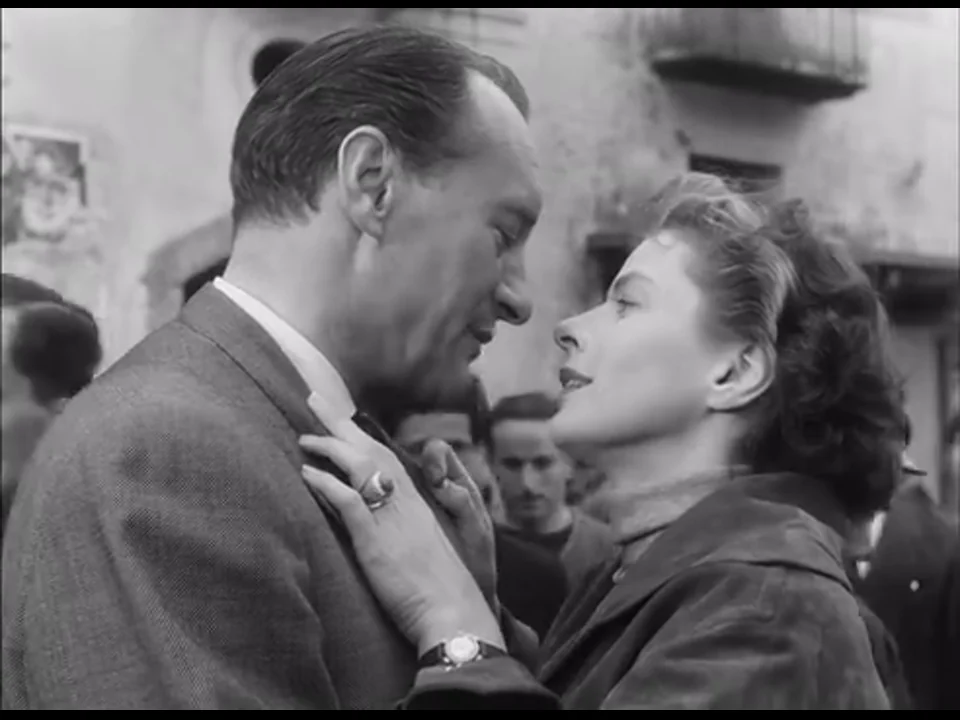
Reconciliation is not the couple's next planned step; it emerges after the procession interrupts, separates, and makes them call out. Bilibili timecode 01:24:50.
Open full-size still- Displayed still
- 01:24:50
- Discussion passage
- 01:21:18 - 01:25:28
Frame-checked against the single-part Bilibili repost stream BV1h5MVzfEdW: the page API reports 5,141 seconds, while the retrieved qn16 media runs 5,140.78 seconds at 492×360. Player v2 supplies no usable subtitle track; English dialogue sense was aligned by scene content with an English SDH subtitle file from the Criterion Blu-ray. Every timecode follows the Bilibili carrier.
Complete single-part film on Bilibili; the page, anonymous Player API, media bytes, and full 5,140.78-second duration were verified. Submission label: repost.
Still checked: 2026-08-13 · Carrier access checked: 2026-08-13
Image
A religious procession stops the car; after the couple get out, ranks, band, sacred image, and spectators keep crossing the frame around them.
The moving crowd carries Katherine away from Alex; he passes through the crowd, finds her, and they grasp and embrace one another.
Sound
Band music, bells, prayer, cheering, and repeated cries of 'miracle' fill the street.
Katherine calls Alex's name from within the crowd; after they reunite she says she does not want to lose him, while their voices remain surrounded by the collective sound field.
Relation to the concept
Stoppage, separation, and search rearrange perception and action, while the outcome is triggered by a collective event.
Sources and further reading
- Cinema 2: The Time-Image
Minnesota 1989 translation: ch. 1, p. 2 (listed as The Lonely Woman [Viaggio in Italia]). · Brief primary-text mention: on this page Deleuze includes Katherine among female tourists struck by unfolding images and visual clichés; the fuller argument for the turn from agent to seer comes from the surrounding chapter. This site analyzes each scene window, audio-visual fact, and criterion shot by shot.
- Bilibili · Steppenwolffff · public repost page
01:24:50 · Reconciliation is not the couple's next planned step; it emerges after the procession interrupts, separates, and makes them call out. Bilibili timecode 01:24:50.
North by Northwest
North by Northwest (1959)
Supported by the scene
From cliffside pull to train berth: how action and marriage reclose relation
The anchor has already left the cliff. The preceding rescue pull continues through a match cut into an embrace in the berth. The cut compresses unseen escape, marriage, and travel rather than leaving relation unresolved.
Open full-size still- Displayed still
- 02:15:59
- Discussion passage
- approx. 02:15:40—02:16:08 (the ending after the match cut, with the couple embracing in the train berth containing the 02:15:59 still)
Reviewed passage by passage on the 02:16:25 single-part dubbed BV1m2XTYuERk carrier. 02:15:59 is the still anchor and 02:15:40—02:16:08 the atlas's working passage, not a claim to final cut-by-cut boundaries. Credits, transitions, and end titles may introduce seconds of drift across masters.
Still anchor 02:15:59; watch 02:15:40–02:16:08 and separately record the cliffside hand pull, cut point, berth pull and embrace, married form of address, and exterior train view to test whether relation remains unresolved. The timecode applies only to the 02:16:25 single-part dubbed BV1m2XTYuERk carrier. The specific master or restoration was not independently established; other editions require fresh location.
Still checked: 2026-09-01 · Carrier access checked: 2026-09-01
Image
On the Mount Rushmore cliff, Eve hangs at the rock edge while Thornhill holds her hand and pulls upward.
Before the rescue is shown as a completed climb, the film matches the upward pull into a train berth: Thornhill draws Eve toward him and the couple embrace in the compartment.
The 02:15:59 anchor shows the berth embrace, not the cliff; an exterior train view at the passage's end carries the journey forward.
Sound
After the match cut, the dubbed dialogue addresses Eve with a married form of address, presenting the relation as an accomplished marriage. This record does not invent the unshown wedding process from that line.
Relation to the concept
Pull, rescue, and embrace compress danger and successful response into a continuous gesture, showing clearly how sensory-motor action regains the ending.
Sources and further reading
- Cinema 1: The Movement-Image
Minnesota 1986 translation, chapter 12, pp. 204–205 · Pages 204–205 discuss the spectator's inclusion in the relational network and Hitchcock's completion of the movement-image at the threshold of the mental image. The primary text does not name the 02:15:40–02:16:08 cliff-to-berth cut; the atlas is responsible for the passage facts and countertest.
- Cinema After Deleuze
Richard Rushton, Cinema After Deleuze (2012), pp. 48–53 · Across these pages Rushton develops five general features of Hitchcock's relation-image through Strangers on a Train and Vertigo. North by Northwest enters only as a listed example of wrong identity, the exchange-of-crime tradition, and the crop-duster demark. The book does not supply the atlas's shot-level analysis of the title grid, the attack, or the final match cut.
- Bilibili · BV1m2XTYuERk · reviewed 02:16:25 single-part dubbed carrier; the specific master and restoration were not independently established
02:15:59 · The anchor has already left the cliff. The preceding rescue pull continues through a match cut into an embrace in the berth. The cut compresses unseen escape, marriage, and travel rather than leaving relation unresolved.
- Open the single-part dubbed North by Northwest carrier on Bilibili
Still anchor 02:15:59; watch 02:15:40–02:16:08 and separately record the cliffside hand pull, cut point, berth pull and embrace, married form of address, and exterior train view to test whether relation remains unresolved. The timecode applies only to the 02:16:25 single-part dubbed BV1m2XTYuERk carrier. The specific master or restoration was not independently established; other editions require fresh location.
Europe ’51
Europa ’51 (1952)
Supported by the scene
Local adjustments still work, yet use no longer exhausts what is seen
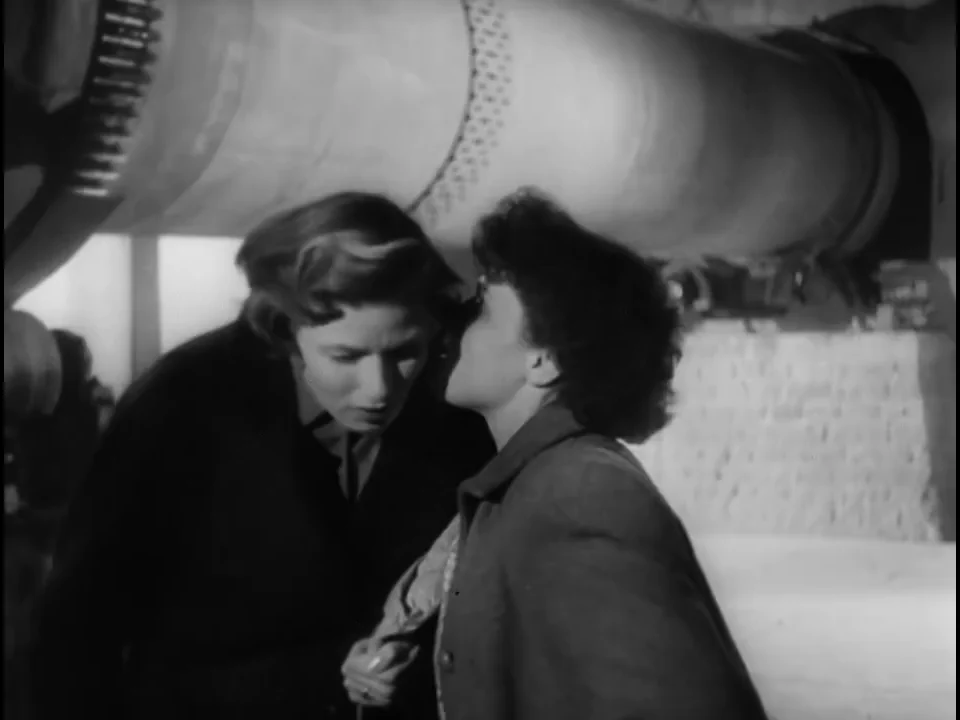
Cylindrical machinery occupies the upper frame while Irene turns and leans toward the worker below; mechanical noise and dialogue coexist in the same shop-floor sound field. Scale, sound, and bodily distance can each be checked at this moment. Bilibili timecode 01:00:00.
Open full-size still- Displayed still
- 01:00:00
- Discussion passage
- approx. 00:59:45–01:00:35 (still anchor 01:00:00)
The 01:00:00 still and its surrounding viewing interval were checked continuously on the single-part Bilibili repost BV15x4y1m7fS. This range provides reproducible coordinates for machinery, passage, bodily position, and sound; it does not claim the exact beginning and end of the complete factory passage. Every other release or cut requires fresh location.
Watch continuously from 00:59:45 to 01:00:35. Record separately the machine's scale in the frame, whether mechanical noise and dialogue coexist, and how the women alter bodily distance. After confirming that the communicative adjustment succeeds, compare the window with the film-wide context of taking a shift, seeking help, and caring to test whether use still fails to exhaust what is seen. The coordinate binds only BV15x4y1m7fS. Public availability and the uploader's authorization to redistribute the film are separate questions.
Still checked: 2026-08-14 · Carrier access checked: 2026-08-14
Image
An enormous cylindrical machine spans the upper frame; pipes, supports, and its body divide the background into dense industrial layers.
Irene and the worker stand in a narrow passage beneath the machine; Irene turns sideways and leans toward the other woman, who faces her.
Sound
Continuous mechanical noise and the women's dialogue occur together; their bodies remain close while they speak.
Relation to the concept
Local responses remain effective while perception is not exhausted by them, a more exact claim than saying simply that the character cannot act.
Sources and further reading
- Cinema 2: The Time-Image
Minnesota 1989 translation: ch. 1, p. 2; ch. 3, pp. 45–46 · Chapter 1 places Europa '51 in the postwar lineage of pure optical-sound situations and the seer. Chapter 3 analyses the factory as an audio-visual ‘abstraction’: a few features send the same object through different circuits and open Irene's mental vision of prisoners rather than reviving a recollection. The account of seeing more when practical recognition fails comes from Marrati. The primary text supplies neither a coordinate for this Bilibili carrier nor a shot-by-shot description of this still; the atlas separately verifies the scene window and audio-visual facts.
- Gilles Deleuze: Cinema and Philosophy
Paola Marrati, Gilles Deleuze: Cinema and Philosophy, English translation (2008), pp. 58–60 · Marrati uses Irene's factory experience to distinguish practical recognition from seeing. The character does not first acquire knowledge about the factory and then act on it; rather, the failure of habitual recognition lets things appear with a force not exhausted by action. This interpretation supports the scene's conceptual boundary without replacing verification of the specific carrier.
- Cinema After Deleuze
Richard Rushton, Cinema After Deleuze (2012), pp. 63–65 · Rushton interprets the factory vision as ‘pure seeing’ released from established habits of looking and places Irene's break with middle-class conventions within the narrative process that ends in social exclusion and psychiatric confinement. He does not claim that the institution directly diagnoses this one factory vision, nor does he provide the time coordinate of the atlas still.
- Bilibili · 久久莫相忘_ · single-part complete film Europa '51 · repost
01:00:00 · Cylindrical machinery occupies the upper frame while Irene turns and leans toward the worker below; mechanical noise and dialogue coexist in the same shop-floor sound field. Scale, sound, and bodily distance can each be checked at this moment. Bilibili timecode 01:00:00.
Red River
Red River (1948)
Candidate reading
The herd amplifies one disturbance into an event beyond command
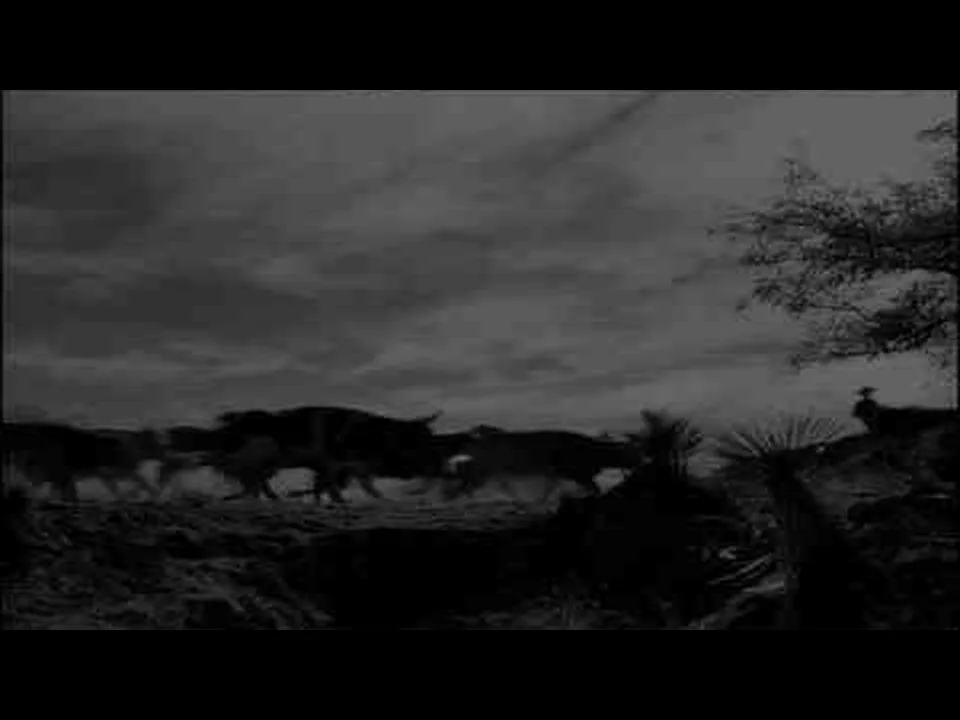
Herd, darkness, and rider form a distributed movement in which no single command equals the whole action circuit.
Open full-size still- Displayed still
- 00:51:20
- Discussion passage
- night stampede passage containing the 00:51:20 still
The 00:51:20 still anchor is verified on the 02:13:26 single-part Bilibili edition. The passage is located by that anchor; its endpoints still require shot-level delimitation.
The direct still anchor is 00:51:20; begin before the disturbance to review the order of propagation and response.
Still checked: 2026-08-25 · Carrier access checked: 2026-08-25
Image
The herd crosses the low-lit frame laterally; speed, occlusion, and density weaken individual outlines, while the rider at right occupies another vertical level.
A single frame establishes density and direction of movement, not the cause of the stampede, the efficacy of commands, or the passage's full causality.
Sound
Disturbance, hoofbeats, cries, and music have not yet been transcribed by track; claims about sonic propagation remain questions for review.
Relation to the concept
The passage can test how perception, delay, and response are distributed across humans, horses, cattle, and night milieu; audio-visual causality still requires itemized review.
Sources and further reading
- Cinema 1: The Movement-Image
Minnesota 1986 translation, chapter 10, p. 165 · Deleuze names Red River in the chapter on the small form and Hawksian functionalism. The three-shot segmentation and conceptual relations below are the atlas's responsibility, not a shot-by-shot paraphrase of p. 165.
- Bilibili · user-supplied complete single-part edition of Red River
00:51:20 · Herd, darkness, and rider form a distributed movement in which no single command equals the whole action circuit.
- Open the complete Red River carrier on Bilibili
The direct still anchor is 00:51:20; begin before the disturbance to review the order of propagation and response.
Stagecoach
Stagecoach (1939)
Candidate reading
The chase is not one heroic act but a set of simultaneous responses
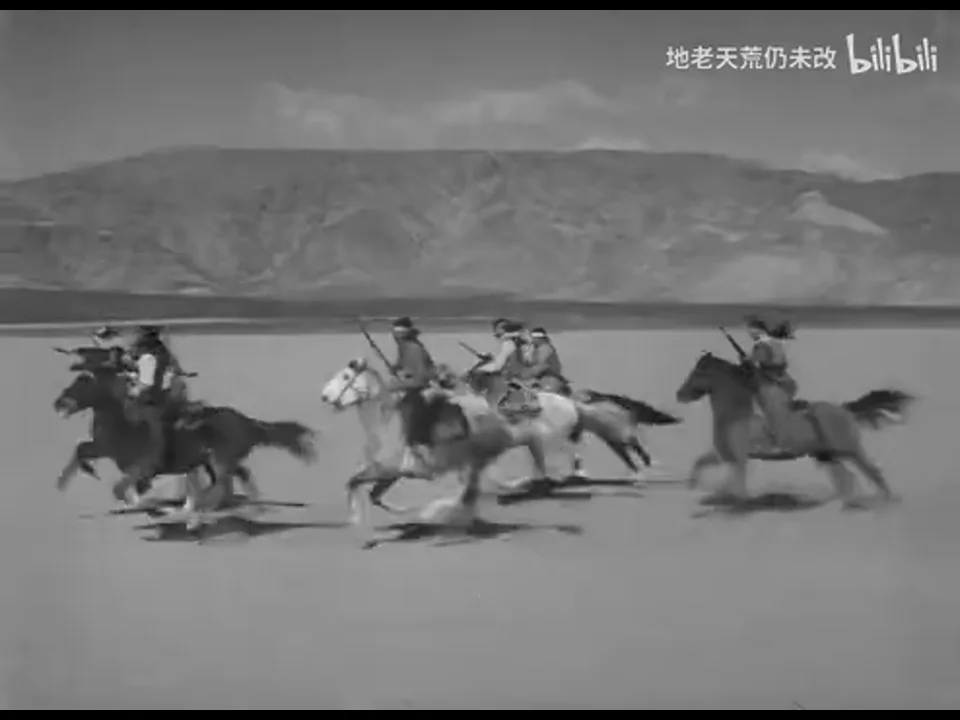
Reins, horses, shooters, coach body, and pursuers divide action into interdependent local tasks.
Open full-size still- Displayed still
- 01:14:00
- Discussion passage
- 约 01:13:30—01:15:20 (stagecoach chase and coordinated-defence passage containing the 01:14:00 still)
Reviewed passage by passage on the single-part Bilibili carrier with a decoded-stream duration of 01:35:33. 01:14:00 is the still anchor and 约 01:13:30—01:15:20 is the atlas's working boundary for analysis; cut points may shift slightly across masters.
Still anchor 01:14:00; watch 01:13:30–01:15:20 and record who sees, who responds, and where the result lands at each cut.
Still checked: 2026-09-01 · Carrier access checked: 2026-09-01
Image
The coach remains in rapid motion; driving, balancing, shooting, and approaching the target are carried by different figures and positions.
Editing cuts among coach body, horses, pursuers, and passengers' local acts; one anchor does not contain the complete causal chain of attack and defence.
Sound
Gunfire, hoofbeats, wheels, cries, and music coexist, but their sequence and sources have not been itemized; the atlas does not substitute sonic intensity for analysis of mechanism.
Relation to the concept
The montage can trace how threat is perceived and local acts are linked; because audio-visual order has not been itemized, the relation remains a candidate.
Sources and further reading
- Cinema 1: The Movement-Image
Minnesota 1986 translation, chapter 9, pp. 141–152, especially p. 146 · Pages 141–142 formulate S–A–S′. Page 146 directly uses Stagecoach's alternation of interiors and exteriors to describe the Encompasser and presents S–A–S, the restoration of a circular order, as a first approximation. Page 147 then distinguishes Ford's spiral: the situation reached differs from the one left, producing S–A–S′. Page 150 criticizes the reduction of social causes to individual confrontation, while pp. 151–152 discuss how global mission, local acts, and decisive action redistribute forces. Deleuze does not assign the atlas's three passages one by one; shot boundaries, visible facts, and candidate or countertest relations remain the atlas's responsibility.
- Bilibili · public single-part repost of Stagecoach located and reviewed by the atlas; the specific master and restoration could not be independently established
01:14:00 · Reins, horses, shooters, coach body, and pursuers divide action into interdependent local tasks.
- Open the single-part Stagecoach carrier on Bilibili
Still anchor 01:14:00; watch 01:13:30–01:15:20 and record who sees, who responds, and where the result lands at each cut.
City Lights
City Lights (1931)
Candidate reading
Why does she take the flower buyer for a wealthy motorist?
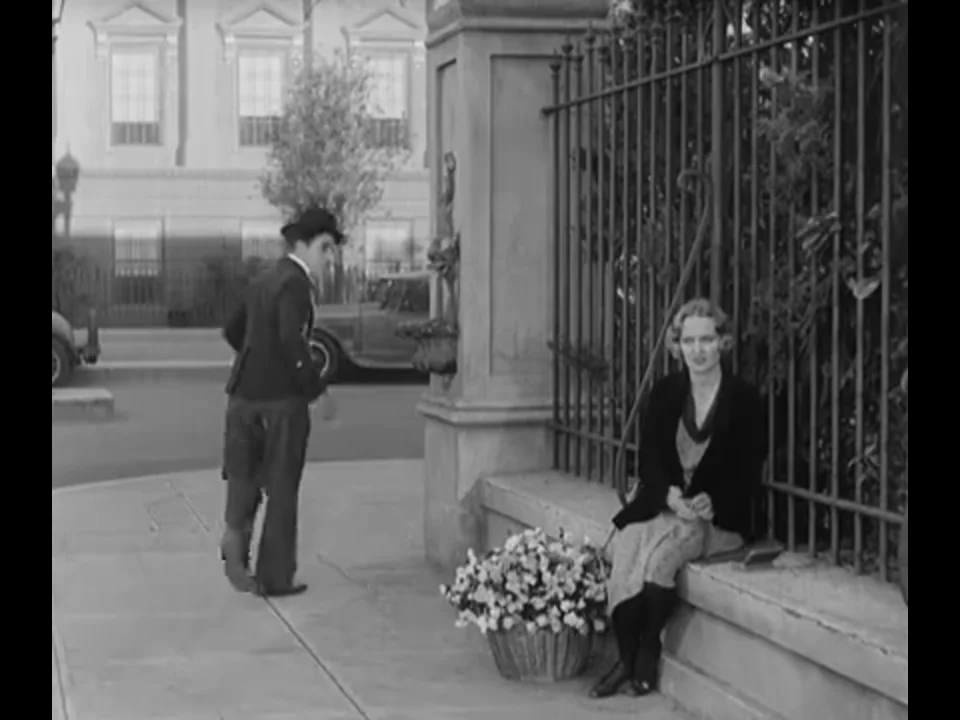
Flower, money, an approaching figure, and a departing car are visible across the passage; whether door sounds also enter the mistake still requires sound-by-sound review.
Open full-size still- Displayed still
- 00:09:25
- Discussion passage
- 约 00:07:20—00:09:38 (flower seller's misrecognition of the customer's identity containing the 00:09:25 still)
Reviewed passage by passage on the single-part Bilibili carrier with a decoded-stream duration of 01:26:47. 00:09:25 is the still anchor and 约 00:07:20—00:09:38 is the atlas's working boundary. Approximately 25.8 seconds of black at the end are excluded from narrative analysis.
Still anchor 00:09:25; watch 00:07:20–00:09:38 and separately record the order of flower, money, footsteps, door, and departing car.
Still checked: 2026-09-01 · Carrier access checked: 2026-09-01
Image
The flower seller sits by the street selling flowers; after a flower falls, she searches with hand and cane, and the Tramp retrieves it and notices that she is blind.
The Tramp then walks away and looks back; a car departs from near them while the flower seller retains the inference that her customer is wealthy.
Sound
The precise way car-door sounds participate in the mistake still requires sound-by-sound review on this master, including attribution of the first and second closures; no unverified sound source is treated as settled causality.
Relation to the concept
The scene tests how partial perception leads to a mistaken yet effective response; sound sources and act order must first be clarified.
Sources and further reading
- Cinema 1: The Movement-Image
Minnesota 1986 translation, chapter 10, pp. 160–171, especially pp. 169–171 · From p. 160 Deleuze defines A–S–A′ and its indices. Page 169 directly names City Lights as an example of a 'personality split of a pivotal character,' but does not assign the drunk or sober passages or a rule of recognition shot by shot. The atlas tests the paired drunken welcome and sober rejection as its concrete filmic realization. The scene directly named on p. 171 is the thread-unravelling passage around 00:52:32–00:53:54, not the final tactile recognition. Boundaries and theoretical relations for the opening mistake, sober rejection, and final recognition remain the atlas's responsibility.
- Bilibili · public single-part repost of City Lights located and reviewed by the atlas; the specific score, restoration, and master could not be independently established
00:09:25 · Flower, money, an approaching figure, and a departing car are visible across the passage; whether door sounds also enter the mistake still requires sound-by-sound review.
- Open the single-part City Lights carrier on Bilibili
Still anchor 00:09:25; watch 00:07:20–00:09:38 and separately record the order of flower, money, footsteps, door, and departing car.
Rear Window
Rear Window (1954)
Adjacent question
Camera, racing photographs, and cast: how a viewing position is explained
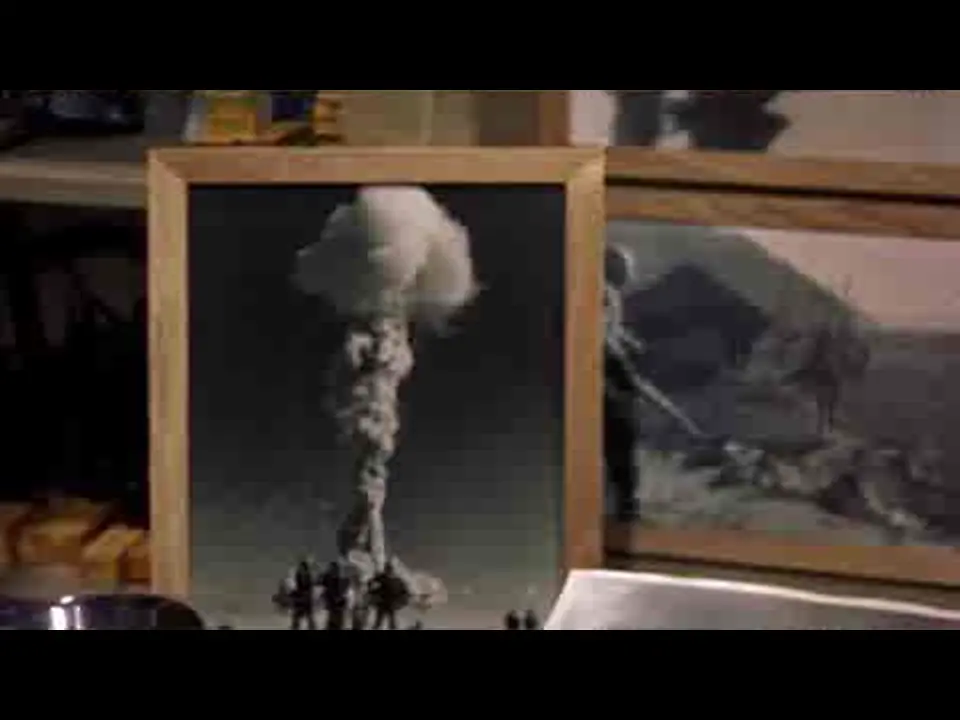
The photographic series does more than state an occupation: it links danger, camera, accident, and Jeff's fixed position of looking.
Open full-size still- Displayed still
- 00:02:15
- Discussion passage
- approx. 00:01:40—00:02:25 (the opening tour across two racing-crash photographs containing the 00:02:15 still)
Reviewed passage by passage on the 01:50:54 single-part Bilibili carrier with hard Chinese and English subtitles. 00:02:15 is the still anchor and 00:01:40—00:02:25 is the atlas's working boundary; opening credits and transitions may introduce seconds of drift across masters.
Still anchor 00:02:15; watch 00:01:40–00:02:25 continuously, recording what each object explains and whether that explanation remains operative in the later viewing apparatus. The timecode applies only to the 01:50:54 single-part BV1zvyTYMEqk carrier with hard Chinese and English subtitles; Blu-ray, DVD, and other streaming editions require fresh location.
Still checked: 2026-09-01 · Carrier access checked: 2026-09-01
Image
The camera moves from the courtyard and sleeping Jeff to his leg cast, then across racing-crash photographs, a damaged camera, and magazine covers.
The 00:02:15 anchor juxtaposes two racing-crash photographs; it does not by itself show the injury occurring.
Sound
The visual inventory has no explanatory voice-over; the following telephone exchange more explicitly supplies Jeff's profession and condition.
Relation to the concept
The cast separates perception from direct action without thereby making the film a time-image; action is delegated to others and optical apparatuses.
Sources and further reading
- Cinema 1: The Movement-Image
Minnesota 1986 translation, chapter 12, p. 201 · Page 201 directly uses Rear Window's opening: the camera passes sleeping Jeff, cast, racing photographs, and a damaged camera to explain his work as a photographer and his broken leg. The primary text names this opening relation; the atlas is responsible for the 00:01:40–00:02:25 boundary and shot-by-shot description.
- Deleuze’s Cinema Books: Three Introductions to the Taxonomy of Images
David Deamer, Deleuze’s Cinema Books (2016), pp. 132–135 · Deamer reconstructs the general taxonomy here: mark and demark are compositional signs of natural relations, while symbol is the genetic sign of abstract relations. These pages do not perform the atlas's shot analysis of Rear Window.
- Bilibili · public 01:50:54 single-part repost of Rear Window with hard Chinese and English subtitles, located and reviewed by the atlas; the specific master and restoration were not independently established
00:02:15 · The photographic series does more than state an occupation: it links danger, camera, accident, and Jeff's fixed position of looking.
- Open the single-part hard-subtitled Rear Window carrier on Bilibili
Still anchor 00:02:15; watch 00:01:40–00:02:25 continuously, recording what each object explains and whether that explanation remains operative in the later viewing apparatus. The timecode applies only to the 01:50:54 single-part BV1zvyTYMEqk carrier with hard Chinese and English subtitles; Blu-ray, DVD, and other streaming editions require fresh location.
Rear Window
Rear Window (1954)
Countertest
After the flashbulb: does relation return to action or make the observer an object?
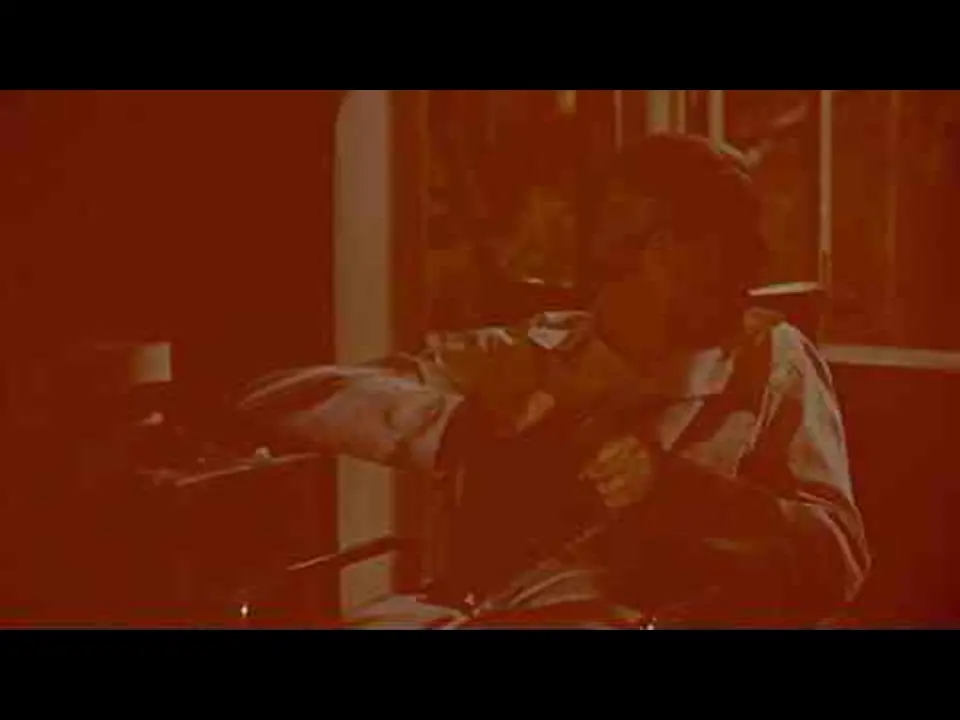
The flash is both a defensive act and a temporary image of the illuminated man's damaged vision. Relation persists, but direct struggle now occupies it.
Open full-size still- Displayed still
- 01:47:05
- Discussion passage
- approx. 01:45:40—01:47:20 (the passage in which Jeff uses flashbulbs to delay Thorwald's approach containing the 01:47:05 still)
Reviewed passage by passage on the 01:50:54 single-part Bilibili carrier with hard Chinese and English subtitles. 01:47:05 is the still anchor and 01:45:40—01:47:20 is the atlas's working boundary; opening credits and transitions may introduce seconds of drift across masters.
Still anchor 01:47:05; watch 01:45:40–01:47:20 and separately record the confrontation after Thorwald enters the dark room, his question, loading, afterimage, recovered vision, and renewed approach instead of treating one coloured frame as the concept. The timecode applies only to the 01:50:54 single-part BV1zvyTYMEqk carrier with hard Chinese and English subtitles; Blu-ray, DVD, and other streaming editions require fresh location.
Still checked: 2026-09-01 · Carrier access checked: 2026-09-01
Image
Thorwald enters the dark room and advances on Jeff; Jeff loads flashbulbs and fires them, after which the image shows a red or orange circular afterimage.
Repeated flashes only delay the approach; Thorwald ultimately seizes Jeff and forces him toward the window.
Sound
Around 01:46:00, Thorwald asks Jeff what he wants from him; loading and firing of bulbs, footsteps, and struggle follow.
Relation to the concept
The flashbulb's stimulus–delay–renewed approach has clear sensory-motor causality and countertests an overextended relation-image classification.
Sources and further reading
- Cinema 1: The Movement-Image
Minnesota 1986 translation, chapter 12, pp. 200–205, especially pp. 204–205 · Pages 200–202 explain how relation becomes an image-object; pp. 204–205 include the spectator in the relational web and explain Jeff's optical position “because he is in a state of immobility.” The primary text does not analyze the flashbulb struggle shot by shot; the atlas uses it as a countertest between relation-image and direct action.
- Deleuze’s Cinema Books: Three Introductions to the Taxonomy of Images
David Deamer, Deleuze’s Cinema Books (2016), pp. 132–135 · Deamer reconstructs the general taxonomy here: mark and demark are compositional signs of natural relations, while symbol is the genetic sign of abstract relations. These pages do not perform the atlas's shot analysis of Rear Window.
- Bilibili · public 01:50:54 single-part repost of Rear Window with hard Chinese and English subtitles, located and reviewed by the atlas; the specific master and restoration were not independently established
01:47:05 · The flash is both a defensive act and a temporary image of the illuminated man's damaged vision. Relation persists, but direct struggle now occupies it.
- Open the single-part hard-subtitled Rear Window carrier on Bilibili
Still anchor 01:47:05; watch 01:45:40–01:47:20 and separately record the confrontation after Thorwald enters the dark room, his question, loading, afterimage, recovered vision, and renewed approach instead of treating one coloured frame as the concept. The timecode applies only to the 01:50:54 single-part BV1zvyTYMEqk carrier with hard Chinese and English subtitles; Blu-ray, DVD, and other streaming editions require fresh location.
North by Northwest
North by Northwest (1959)
Adjacent question
The title grid enters the city: does relation appear before character?

At 00:00:50 the image is still a graphic title, not a street view. Only afterward does the grid continue into a glass façade, reflected traffic, and urban crowds. That continuity proposes a relational reading without letting one composition prove it.
Open full-size still- Displayed still
- 00:00:50
- Discussion passage
- approx. 00:00:15—00:02:15 (the green title grid bearing the white film title containing the 00:00:50 still)
Reviewed passage by passage on the 02:16:25 single-part dubbed BV1m2XTYuERk carrier. 00:00:50 is the still anchor and 00:00:15—00:02:15 the atlas's working passage, not a claim to final cut-by-cut boundaries. Credits, transitions, and end titles may introduce seconds of drift across masters.
Still anchor 00:00:50; watch 00:00:15–00:02:15 and distinguish in order the green graphic grid, glass façade, reflected traffic, street crowds, and character entrance without describing the anchor prematurely as a street view. The timecode applies only to the 02:16:25 single-part dubbed BV1m2XTYuERk carrier. The specific master or restoration was not independently established; other editions require fresh location.
Still checked: 2026-09-01 · Carrier access checked: 2026-09-01
Image
The credits first move diagonal lines, intersections, lettering, and directional arrows along coordinates on a green field; the 00:00:50 anchor has not yet entered live-action city space.
The graphic grid then joins the mullions of a glass curtain wall, which reflects vehicles, before the image moves into streets, building entrances, and crossing crowds.
Thornhill and his secretary enter the urban circulation near the end of the working passage, but the Kaplan misidentification has not yet occurred within it.
Sound
A continuous orchestral score governs the graphic titles and their transition into city images. Character dialogue enters only after the title passage; the atlas does not treat the score's structure by itself as evidence of a relation-image.
Relation to the concept
Urban circulation remains composed of walking, traffic, and professional action; the passage shows no breakdown of the sensory-motor circuit.
Sources and further reading
- Cinema 1: The Movement-Image
Minnesota 1986 translation, chapter 12, p. 202 · Page 202 explains that Hitchcock makes relation itself the object of an image and conceives the film from the outset in relation to spectator response. The primary text does not name the 00:00:15–00:02:15 title grid; the time window, visible facts, and candidate argument are the atlas's responsibility.
- Cinema After Deleuze
Richard Rushton, Cinema After Deleuze (2012), pp. 48–53 · Across these pages Rushton develops five general features of Hitchcock's relation-image through Strangers on a Train and Vertigo. North by Northwest enters only as a listed example of wrong identity, the exchange-of-crime tradition, and the crop-duster demark. The book does not supply the atlas's shot-level analysis of the title grid, the attack, or the final match cut.
- Bilibili · BV1m2XTYuERk · reviewed 02:16:25 single-part dubbed carrier; the specific master and restoration were not independently established
00:00:50 · At 00:00:50 the image is still a graphic title, not a street view. Only afterward does the grid continue into a glass façade, reflected traffic, and urban crowds. That continuity proposes a relational reading without letting one composition prove it.
- Open the single-part dubbed North by Northwest carrier on Bilibili
Still anchor 00:00:50; watch 00:00:15–00:02:15 and distinguish in order the green graphic grid, glass façade, reflected traffic, street crowds, and character entrance without describing the anchor prematurely as a street view. The timecode applies only to the 02:16:25 single-part dubbed BV1m2XTYuERk carrier. The specific master or restoration was not independently established; other editions require fresh location.
North by Northwest
North by Northwest (1959)
Adjacent question
Where there are no crops to spray: how the crop-duster becomes a demark
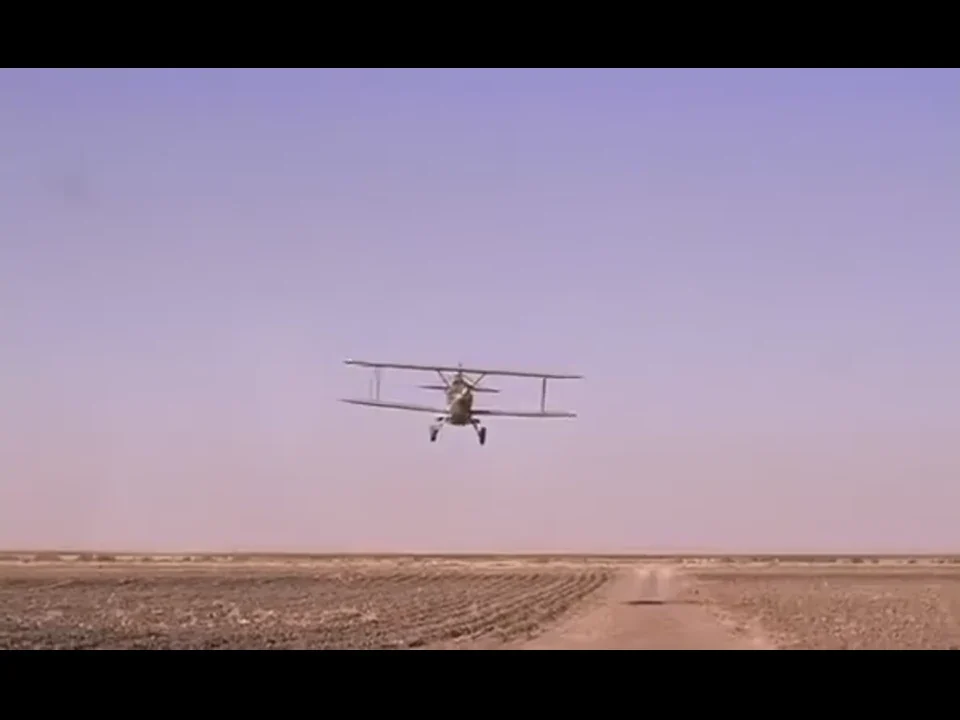
Deleuze's direct criterion precedes confirmation of the attack: the plane appears where there are no crops to spray. The low attack at 01:12:00 is a later visible fact checked by the atlas, not a substitute for that relational anomaly.
Open full-size still- Displayed still
- 01:12:00
- Discussion passage
- approx. 01:07:45—01:14:40 (the attack passage in which the crop-duster flies head-on and closes on the barren roadside horizon containing the 01:12:00 still)
Reviewed passage by passage on the 02:16:25 single-part dubbed BV1m2XTYuERk carrier. 01:12:00 is the still anchor and 01:07:45—01:14:40 the atlas's working passage, not a claim to final cut-by-cut boundaries. Credits, transitions, and end titles may introduce seconds of drift across masters.
Still anchor 01:12:00; watch 01:07:45–01:14:40, first recording the ordinary road and aircraft series, then separately the no-crops dialogue, low turn, evasions, and explosion so that the later attack does not replace the criterion for the demark. The timecode applies only to the 02:16:25 single-part dubbed BV1m2XTYuERk carrier. The specific master or restoration was not independently established; other editions require fresh location.
Still checked: 2026-09-01 · Carrier access checked: 2026-09-01
Image
Thornhill waits alone beside an open highway. Cars and a bus follow the road, another passenger waits and boards in the ordinary way, and the distant plane remains a small term in the environment.
After the bus takes the other passenger away, the plane changes its relation of distance and repeatedly dives toward Thornhill; he drops, runs, and takes cover in a field.
The 01:12:00 anchor shows the plane bearing head-on toward barren ground and a dirt road; the pursuit then continues into a causal chain involving a truck, tanker, and explosion.
Sound
The other waiting passenger's dubbed dialogue first notes that the plane is dusting where there are no crops to spray. After the bus leaves, the engine grows louder with the approach.
Relation to the concept
Once anomaly becomes attack, the scene rapidly resumes the sensory-motor causality of stimulus, dodge, flight, and collision; this sets the boundary of the demark reading.
Sources and further reading
- Cinema 1: The Movement-Image
Minnesota 1986 translation, chapter 12, p. 203 · Page 203 directly identifies as a demark the plane's appearance where there are no crops to spray. It neither specifies the atlas's 01:12:00 carrier anchor nor describes the ensuing attack shot by shot; the atlas is responsible for the window, still, and attack facts.
- Cinema After Deleuze
Richard Rushton, Cinema After Deleuze (2012), pp. 48–53 · Across these pages Rushton develops five general features of Hitchcock's relation-image through Strangers on a Train and Vertigo. North by Northwest enters only as a listed example of wrong identity, the exchange-of-crime tradition, and the crop-duster demark. The book does not supply the atlas's shot-level analysis of the title grid, the attack, or the final match cut.
- Bilibili · BV1m2XTYuERk · reviewed 02:16:25 single-part dubbed carrier; the specific master and restoration were not independently established
01:12:00 · Deleuze's direct criterion precedes confirmation of the attack: the plane appears where there are no crops to spray. The low attack at 01:12:00 is a later visible fact checked by the atlas, not a substitute for that relational anomaly.
- Open the single-part dubbed North by Northwest carrier on Bilibili
Still anchor 01:12:00; watch 01:07:45–01:14:40, first recording the ordinary road and aircraft series, then separately the no-crops dialogue, low turn, evasions, and explosion so that the later attack does not replace the criterion for the demark. The timecode applies only to the 02:16:25 single-part dubbed BV1m2XTYuERk carrier. The specific master or restoration was not independently established; other editions require fresh location.
The Birds
The Birds (1963)
Adjacent question
The first strike over the bay: a demark is not another mark
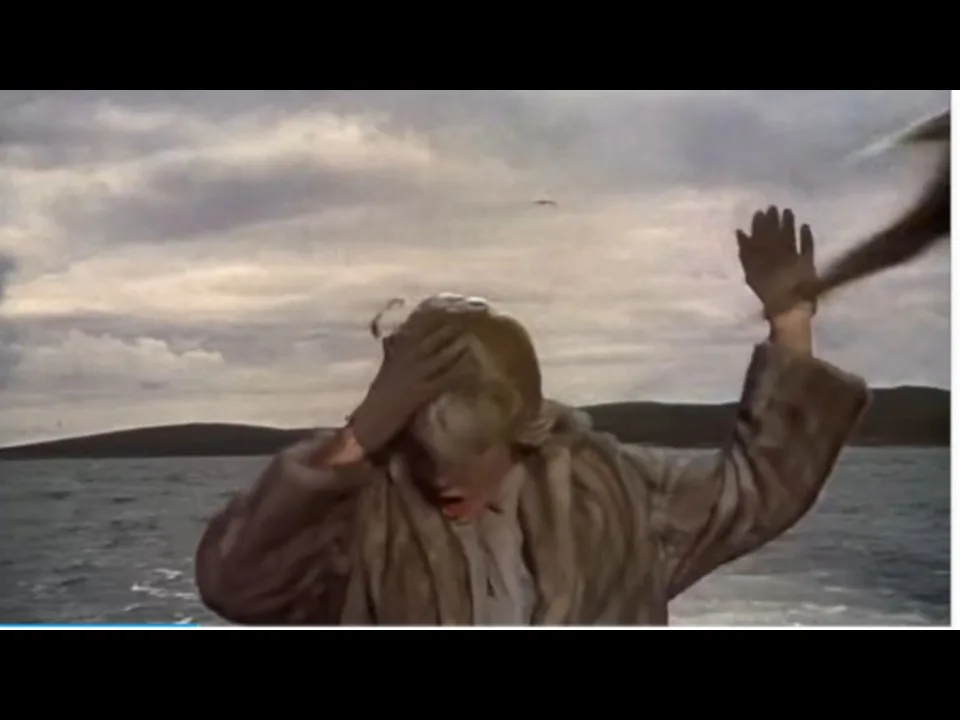
It abruptly changes from a familiar part of the landscape into an attacker; the anomaly lies in that change of relational position, not in the gull's appearance.
Open full-size still- Displayed still
- 00:25:23
- Discussion passage
- approx. 00:25:00—00:25:42 (00:25:23 still holds the gull passing as Melanie covers her head)
Reviewed passage by passage on the 01:59:24 single-part Bilibili repost. 00:25:23 is the still anchor and 00:25:00—00:25:42 is the atlas's working boundary. Bilibili's official feature page ep291861 runs 01:59:30, so the two carriers cannot share second-level coordinates.
Watch 00:25:00–00:25:42 continuously, first establishing the purpose and environmental continuity of the crossing, then marking the gull's entry, impact, wound, and Mitch's response in sequence. The timecode applies only to the 01:59:24 single-part repost BV1jJ411g7Yj; the official feature page, Blu-ray, and other streaming editions require fresh location.
Still checked: 2026-09-01 · Carrier access checked: 2026-09-01
Image
Melanie pilots the skiff alone toward the dock while Mitch watches her approach; the bay crossing still advances toward a clear goal.
A single gull dives from above, strikes past her head, and leaves a wound; the film then cuts toward Mitch on shore and Melanie's injured reaction.
Sound
The skiff engine, water, and harbour ambience sustain the ordinary continuity of the crossing; a sharp bird cry cuts in with the impact.
No explanatory dialogue supplies a cause for the attack; Mitch can respond only through calls and gestures after the anomaly has occurred.
Relation to the concept
The strike briefly interrupts the crossing, but landing, treatment, and inquiry restore local responses; one interruption does not by itself make a time-image.
Sources and further reading
- Cinema 1: The Movement-Image
Minnesota 1986 translation, chapter 12, p. 204 · Page 204 directly states that “the first gull which strikes the heroine is a demark.” The primary text does not supply the atlas's 00:25:23 carrier coordinate; the atlas is responsible for the window and shot facts.
- Deleuze’s Cinema Books: Three Introductions to the Taxonomy of Images
David Deamer, Deleuze’s Cinema Books (2016), pp. 132–137 · Deamer reconstructs the operative difference among mark, demark, and symbol: a habitual series, an anomalous term departing from that series, and a concrete term bearing abstract relations. The pages provide criteria rather than classifying these three passages for the atlas.
- Bilibili · public 01:59:24 single-part repost of The Birds, reviewed passage by passage by the atlas; the specific master, grade, and restoration were not independently established
00:25:23 · It abruptly changes from a familiar part of the landscape into an attacker; the anomaly lies in that change of relational position, not in the gull's appearance.
The Birds
The Birds (1963)
Adjacent question
The song continues as the flock takes form: when number begins to bear relations
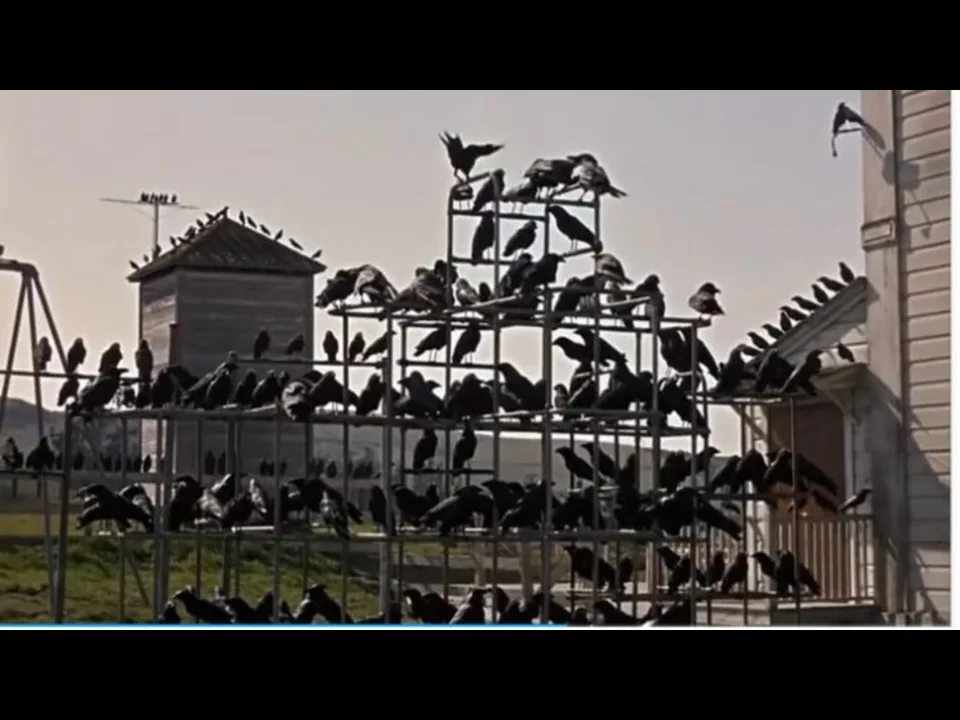
The flock makes play equipment, the children's song, the school boundary, and the imminent evacuation parts of the same danger.
Open full-size still- Displayed still
- 01:11:22
- Discussion passage
- approx. 01:09:45—01:12:15 (01:11:22 still shows the flock covering the climbing frame and nearby rooflines)
Reviewed passage by passage on the 01:59:24 single-part Bilibili repost. 01:11:22 is the still anchor and 01:09:45—01:12:15 is the atlas's working boundary. Bilibili's official feature page ep291861 runs 01:59:30, so the two carriers cannot share second-level coordinates.
Watch 01:09:45–01:12:15 continuously, recording the birds' positions at every cutback, whether the children's song continues, when Melanie turns, and how the classroom changes from learning space to point of evacuation. The timecode applies only to the 01:59:24 single-part repost BV1jJ411g7Yj; the official feature page, Blu-ray, and other streaming editions require fresh location.
Still checked: 2026-09-01 · Carrier access checked: 2026-09-01
Image
Melanie smokes alone on a bench outside the school. The film repeatedly cuts from her to the climbing frame behind her; more crows have landed on each return while she does not turn around.
A passing crow finally guides her look backward. The climbing frame, nearby roofs, and ground are now crowded with birds, after which she enters the classroom to organize the children's departure.
Sound
Children repeat the same song off screen; it continues across successive cuts between Melanie and the climbing frame.
After the flock is discovered, the song gives way to scattered bird calls, shouts, and warnings to evacuate.
Relation to the concept
Delayed perception produces relational pressure, after which the children still run under instruction. The scene pushes action toward its limit without wholly cancelling the chain of response.
Sources and further reading
- Cinema 1: The Movement-Image
Minnesota 1986 translation, chapter 12, p. 204 · Page 204 states that “the thousands of birds … are a symbol.” It names neither the playground nor 01:11:22. The atlas uses that film-level judgement to constrain its playground analysis rather than passing off shot description as the primary text.
- Deleuze’s Cinema Books: Three Introductions to the Taxonomy of Images
David Deamer, Deleuze’s Cinema Books (2016), pp. 132–137 · Deamer reconstructs the operative difference among mark, demark, and symbol: a habitual series, an anomalous term departing from that series, and a concrete term bearing abstract relations. The pages provide criteria rather than classifying these three passages for the atlas.
- Bilibili · public 01:59:24 single-part repost of The Birds, reviewed passage by passage by the atlas; the specific master, grade, and restoration were not independently established
01:11:22 · The flock makes play equipment, the children's song, the school boundary, and the imminent evacuation parts of the same danger.
Vertigo
Vertigo (1958)
Adjacent question
The absent Carlotta already governs the investigation
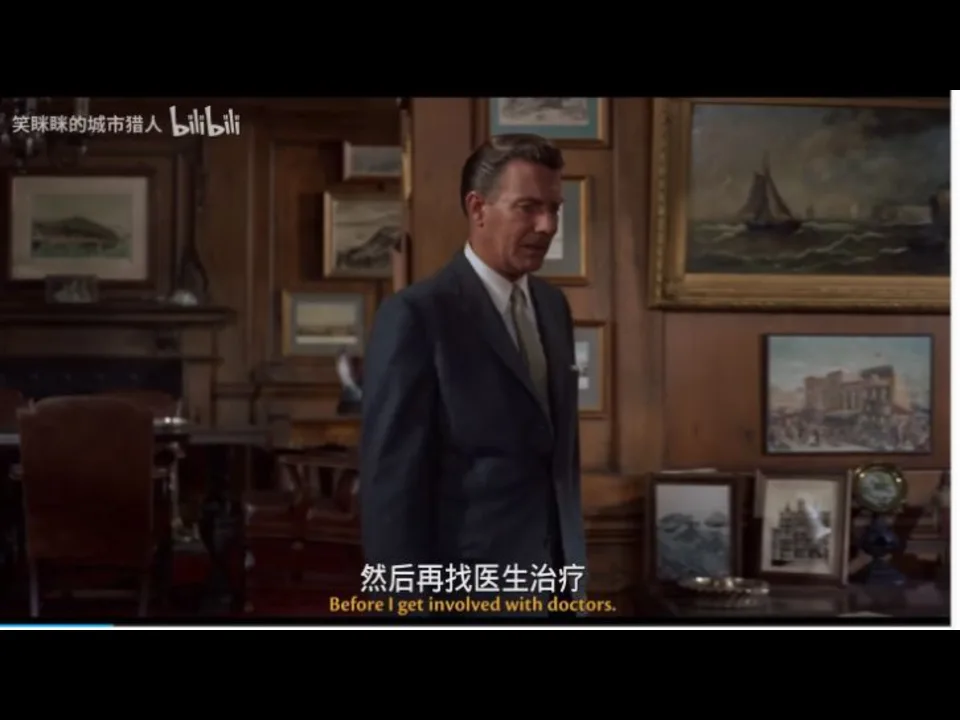
Before the assignment begins, the absent Madeleine and the still earlier Carlotta already govern what Scottie will be asked to see through Elster's account.
Open full-size still- Displayed still
- 00:15:30
- Discussion passage
- approx. 00:12:00—00:15:50 (00:15:30 still shows Elster standing in an office crowded with maritime images)
Reviewed passage by passage on the 02:07:27 single-part Bilibili repost with hard Chinese and English subtitles. 00:15:30 is the still anchor and 00:12:00—00:15:50 is the atlas's working boundary. Bilibili's official feature page ep291561 runs 02:07:49, and the repost may trim opening or closing material, so their timelines are not interchangeable.
Watch 00:12:00–00:15:50 continuously and record every name, kinship position, source of knowledge, and condition under which Scottie accepts the assignment. The timecode applies only to the 02:07:27 repost BV1ECSHYoEwW; this carrier may trim opening or closing material, so the official feature page, Blu-ray, and other restorations require fresh location.
Still checked: 2026-09-01 · Carrier access checked: 2026-09-01
Image
Elster brings Scottie into a wood-panelled office and the men alternate in medium views; images of ships, harbours, and buildings are visible on the walls and desk.
Only Elster and Scottie appear in this interval; the image inserts no portrait or flashback of Madeleine or Carlotta.
Sound
Elster asks Scottie to follow his wife and explains her anomalous behaviour as the influence of the dead Carlotta. Scottie questions the possession story but ultimately accepts the task of observation.
In dialogue, Elster identifies himself as husband, places Scottie as observer, designates Madeleine as the woman to be followed, and uses Carlotta's family history to explain her behaviour.
Relation to the concept
Following remains goal-directed action. The passage shows relation governing action, not a completed rupture of the sensory-motor schema.
Sources and further reading
- Cinema 1: The Movement-Image
Minnesota 1986 translation, chapter 12, pp. 197, 204–205 · These pages define the mental image's objects, Hitchcock's relational web, and the spectator's position, and directly explain Vertigo through variations in the relations of the Same. They do not analyze the atlas's chosen commission, letter, or green-light passages shot by shot; Rushton and the atlas's scene review bear those specific classifications.
- Deleuze’s Cinema Books: Three Introductions to the Taxonomy of Images
David Deamer, Deleuze’s Cinema Books (2016), pp. 132–137 · Deamer supplies general criteria for mark, demark, symbol, and relation-image; he does not establish that a particular letter, colour, or camera movement has already acquired any of those statuses.
- Cinema After Deleuze
Richard Rushton, Cinema After Deleuze (2012), pp. 53–54 · Rushton develops Vertigo's relational structure through Elster's commission, Judy's disruption of the existing series, spectator foreknowledge, and Scottie's remaking of the desired object. The substantive film argument ends on p. 57; p. 58 adds no film evidence.
- Bilibili · public 02:07:27 single-part repost of Vertigo with hard Chinese and English subtitles, reviewed passage by passage by the atlas; the uploader's collection notice describes a practice of trimming opening or closing material
00:15:30 · Before the assignment begins, the absent Madeleine and the still earlier Carlotta already govern what Scottie will be asked to see through Elster's account.
Vertigo
Vertigo (1958)
Countertest
The return in green light: how desire manufactures its object
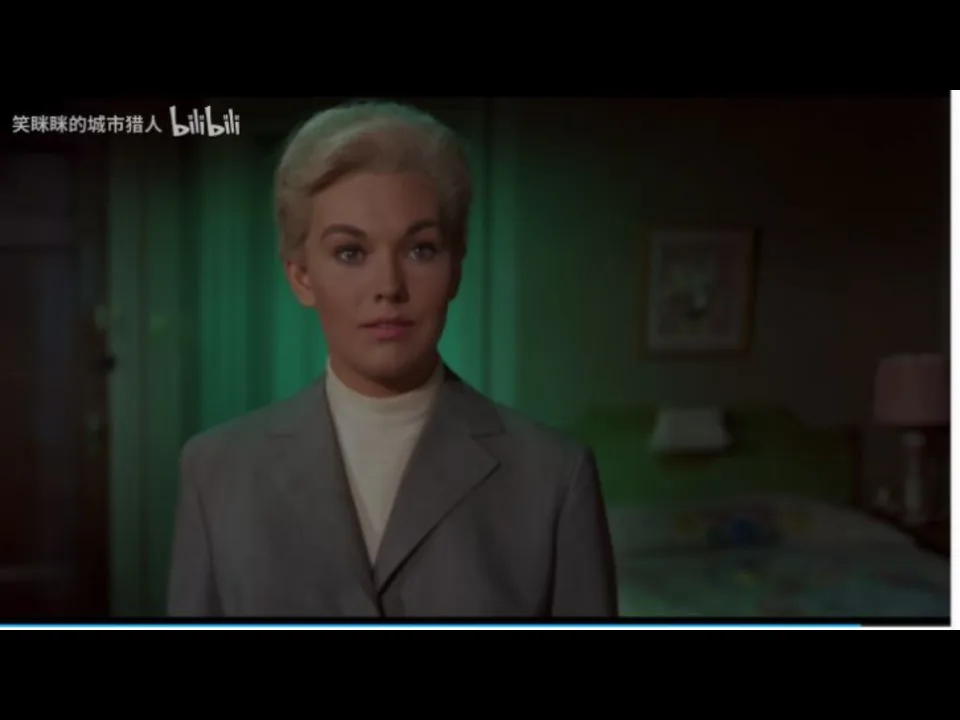
The spectator knows she is Judy while watching Scottie greet her as Madeleine returned; the overlap is first a relation of desire, knowledge, and control.
Open full-size still- Displayed still
- 01:55:20
- Discussion passage
- approx. 01:53:45—01:56:50 (01:55:20 still shows Judy after the hair-and-suit makeover against green-lit curtains and wall)
Reviewed passage by passage on the 02:07:27 single-part Bilibili repost with hard Chinese and English subtitles. 01:55:20 is the still anchor and 01:53:45—01:56:50 is the atlas's working boundary. Bilibili's official feature page ep291561 runs 02:07:49, and the repost may trim opening or closing material, so their timelines are not interchangeable.
Watch 01:53:45–01:56:50 and record costume, hair colour, hairstyle, green light, Scottie's reaction, embrace, circular camera movement, and stable overlap separately before judging which term actually changes the relation. The timecode applies only to the 02:07:27 repost BV1ECSHYoEwW; this carrier may trim opening or closing material, so the official feature page, Blu-ray, and other restorations require fresh location.
Still checked: 2026-09-01 · Carrier access checked: 2026-09-01
Image
Judy enters from the direction of the bathroom in a grey suit with her blonde hair pinned up; the curtains and wall are lit green.
Scottie approaches and embraces her as the camera circles the couple. The hotel room briefly overlaps with the earlier stable space before returning to the green room.
Sound
Dialogue recedes; the score expands as Judy appears, Scottie approaches, and the couple embrace.
Relation to the concept
Scottie's remaking action obtains visible results in clothing and body, countertesting any automatic account of the green light as a sensory-motor rupture.
Sources and further reading
- Cinema 1: The Movement-Image
Minnesota 1986 translation, chapter 12, pp. 197, 204–205 · These pages define the mental image's objects, Hitchcock's relational web, and the spectator's position, and directly explain Vertigo through variations in the relations of the Same. They do not analyze the atlas's chosen commission, letter, or green-light passages shot by shot; Rushton and the atlas's scene review bear those specific classifications.
- Cinema After Deleuze
Richard Rushton, Cinema After Deleuze (2012), pp. 56–57 · Rushton explains Scottie's remaking of Judy as regaining the object of desire and keeps spectator foreknowledge within the relational web; he does not directly analyze the green lighting or the 360-degree camera movement.
- Cinema 2: The Time-Image
Minnesota 1989 translation, chapter 4, pp. 68–70, 78–81 · These pages supply general criteria for actual–virtual relations and the crystal without naming Vertigo. The atlas therefore retains only a candidate and requires additional evidence of reciprocal circuit and indiscernibility.
- Bilibili · public 02:07:27 single-part repost of Vertigo with hard Chinese and English subtitles, reviewed passage by passage by the atlas; the uploader's collection notice describes a practice of trimming opening or closing material
01:55:20 · The spectator knows she is Judy while watching Scottie greet her as Madeleine returned; the overlap is first a relation of desire, knowledge, and control.
Strangers on a Train
Strangers on a Train (1951)
Adjacent question
Foot contact starts the conversation: Bruno treats an offhand assent as agreement
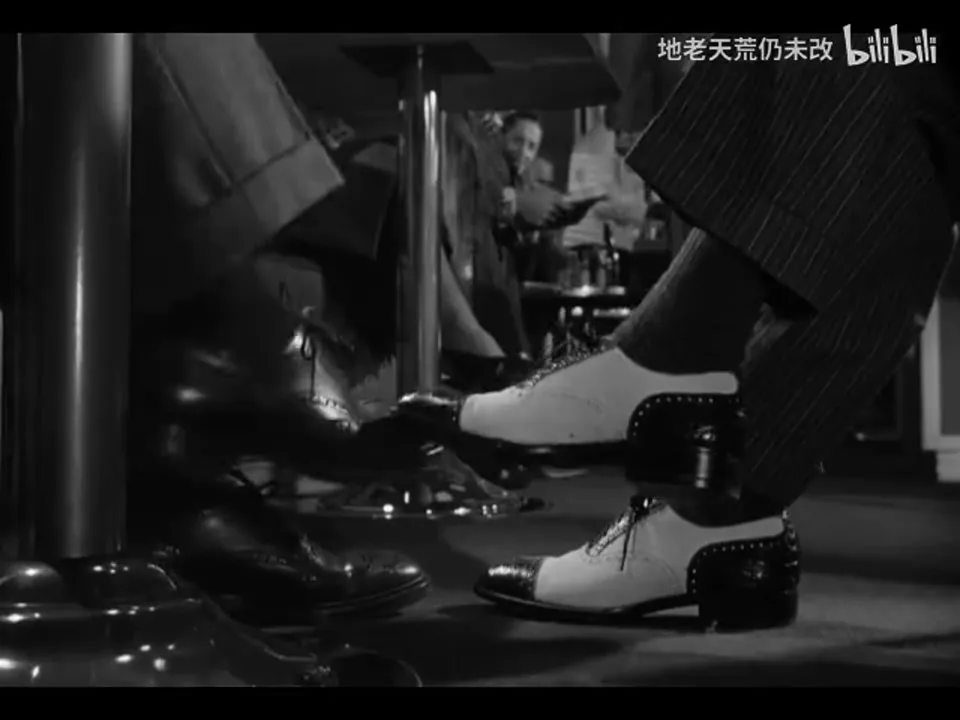
The foot contact produces only an encounter; Bruno then interprets it as acquaintance and rewrites Guy's words as consent to exchange murders.
Open full-size still- Displayed still
- 00:02:05
- Discussion passage
- approx. 00:00:52—00:09:30 (00:02:05 still shows Guy's dark shoe touching Bruno's two-tone brogue; the relational interpretation is completed in the ensuing conversation)
Reviewed passage by passage on the 01:40:27 single-part hard-subtitled Bilibili repost BV1SY6fYdEnV. 00:02:05 is the still anchor and 00:00:52—00:09:30 is the atlas's working boundary for the argument. These coordinates bind only this carrier; every other release or cut requires fresh location.
Watch 00:00:52–00:09:30 continuously: first record only shoes, rails, contact, lighter, and seating, then record how Bruno turns Guy's replies step by step into an exchange of murders. The timecode applies only to the 01:40:27 repost BV1SY6fYdEnV; Blu-ray, theatrical, and preview cuts require fresh location. A publicly reachable page and authorization to redistribute the feature are separate questions.
Still checked: 2026-09-01 · Carrier access checked: 2026-09-01
Image
The opening separately follows two pairs of shoes into the station—two-tone brogues and plainer dark shoes—while withholding both faces.
After crossing rails, the edit enters the compartment. Guy moves his foot into Bruno's, joining two previously parallel series.
Sound
Train and station sounds precede dialogue. After the contact, Guy apologizes first; Bruno takes the opening to recognize him as a tennis player and then introduces himself.
The ensuing conversation moves from newspapers, marriage, and Bruno's father to each man killing for the other. Guy treats the proposal as absurd talk, while Bruno retains his response as an agreement.
Relation to the concept
Contact, conversation, and murder retain a clear action-chain; the scene shows relation governing action, not the collapse of the action schema.
Sources and further reading
- Cinema 1: The Movement-Image
Minnesota 1986 translation, chapter 12, pp. 197–205, especially p. 201 · Page 201 defines the Hitchcockian third as relation and uses exchanged crimes to show relation entering action; pp. 203–204 distinguish mark, demark, and symbol in general. The primary text supplies neither the atlas's carrier coordinates nor a shot-by-shot assignment of eyeglasses and lighter to sign types; Rushton and carrier review bear that object-level chain.
- Deleuze’s Cinema Books: Three Introductions to the Taxonomy of Images
David Deamer, Deleuze’s Cinema Books (2016), pp. 132–137 · Deamer reconstructs the general taxonomy of relation-image, mark, demark, symbol, and spectator implication. It helps police the inference boundary but does not analyze Strangers on a Train shot by shot.
- Cinema After Deleuze
Richard Rushton, Cinema After Deleuze (2012), pp. 48–50 · Rushton develops five traits through Strangers on a Train: relational third, initiating action, exchange of crimes, series of marks and demarks, and film–spectator relation. Pages 49–50 treat the opening encounter, pp. 50–52 the exchanged crimes, lighter, and glasses, and pp. 52–53 the final proof and spectator trap.
- Bilibili · 地老天荒仍未改 · public 01:40:27 single-part repost of Strangers on a Train with hard Chinese and English subtitles; access without login, playback URL, and all three anchors checked, while the platform submission label does not establish authorization
00:02:05 · The foot contact produces only an encounter; Bruno then interprets it as acquaintance and rewrites Guy's words as consent to exchange murders.
Strangers on a Train
Strangers on a Train (1951)
Countertest
Exposed in Bruno's palm: how A to G reverses evidence
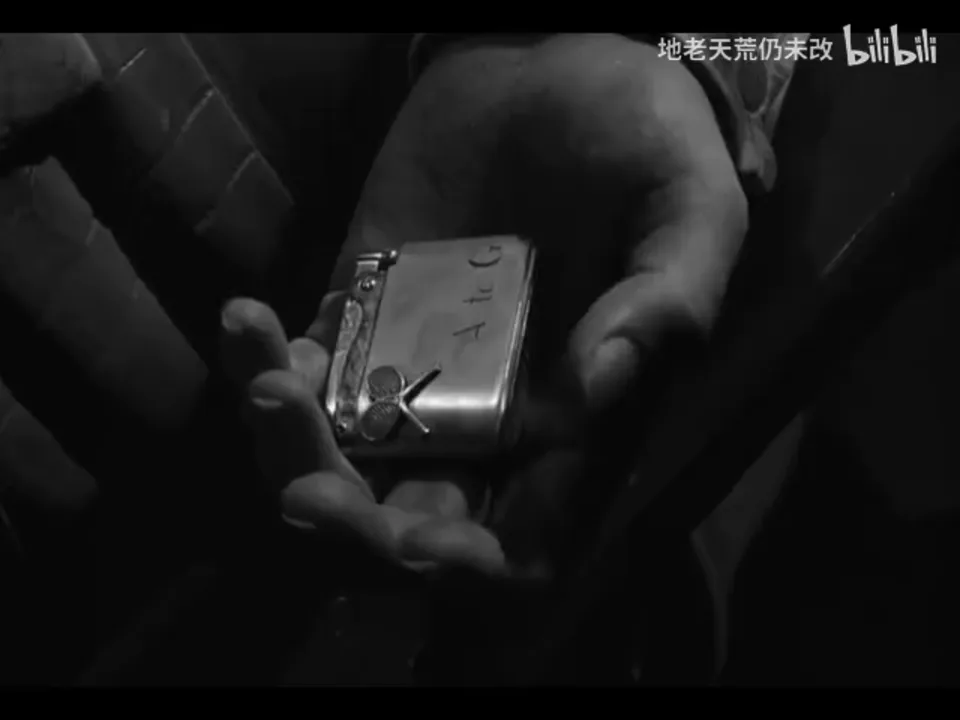
Bruno meant to leave it at the murder site to frame Guy. As he is dying, his clenched hand slowly opens and the object remains on his body. Together with the boatman's identification and Bruno's immediate denial, it shows that the framing attempt failed.
Open full-size still- Displayed still
- 01:38:45
- Discussion passage
- approx. 01:37:55—01:39:08 (01:38:45 still shows the A-to-G lighter exposed in Bruno's opened hand)
Reviewed passage by passage on the 01:40:27 single-part hard-subtitled Bilibili repost BV1SY6fYdEnV. 01:38:45 is the still anchor and 01:37:55—01:39:08 is the atlas's working boundary for the argument. These coordinates bind only this carrier; every other release or cut requires fresh location.
First watch from 01:24:30 for Bruno's concealment, dropping, and recovery of the lighter, then watch 01:37:55–01:39:08 continuously. Separate the object's location, holder, intended use, and actual evidentiary function into four columns. The timecode applies only to the 01:40:27 repost BV1SY6fYdEnV; Blu-ray, theatrical, and preview cuts require fresh location. A publicly reachable page and authorization to redistribute the feature are separate questions.
Still checked: 2026-09-01 · Carrier access checked: 2026-09-01
Image
After the carousel runs out of control and collapses, Bruno lies beside the wreckage while Guy, police, and fairground workers gather nearby.
As Bruno is dying, his clenched hand slowly opens. The film cuts to the open palm, where the lighter engraved A to G with crossed tennis rackets lies exposed.
Sound
After the boatman identifies Bruno, Guy tells Turley that Bruno has the lighter and meant to plant it on the island. Bruno denies this and insists that the lighter is still on the island.
Guy asks to go through Bruno's pockets while Bruno is still alive. Turley refuses permission, noting that Bruno says he does not have the lighter.
After Bruno is pronounced dead, Turley picks up the lighter from the already opened palm, asks Guy to identify it, and then confirms that Guy was right.
Ambient noise, rescue instructions, and brief dialogue replace the fairground's earlier cyclical music.
Relation to the concept
Guy's pursuit and carousel struggle help the truth emerge. Relation-image here returns to effective action and restored truth rather than automatically passing into the time-image.
Sources and further reading
- Cinema 1: The Movement-Image
Minnesota 1986 translation, chapter 12, pp. 197–205, especially p. 201 · Page 201 defines the Hitchcockian third as relation and uses exchanged crimes to show relation entering action; pp. 203–204 distinguish mark, demark, and symbol in general. The primary text supplies neither the atlas's carrier coordinates nor a shot-by-shot assignment of eyeglasses and lighter to sign types; Rushton and carrier review bear that object-level chain.
- Deleuze’s Cinema Books: Three Introductions to the Taxonomy of Images
David Deamer, Deleuze’s Cinema Books (2016), pp. 132–137 · Deamer reconstructs the general taxonomy of relation-image, mark, demark, symbol, and spectator implication. It helps police the inference boundary but does not analyze Strangers on a Train shot by shot.
- Cinema After Deleuze
Richard Rushton, Cinema After Deleuze (2012), pp. 51–52 · Rushton develops five traits through Strangers on a Train: relational third, initiating action, exchange of crimes, series of marks and demarks, and film–spectator relation. Pages 49–50 treat the opening encounter, pp. 50–52 the exchanged crimes, lighter, and glasses, and pp. 52–53 the final proof and spectator trap.
- Figures of Style in Strangers on a Train
Peter J. Dellolio, “Figures of Style in Strangers on a Train,” open PDF p. 2 and pp. 5–6 · Dellolio analyzes how canted framing, gate bars, the eyeglass reflection, and carousel write the Guy–Bruno parallel into space, and identifies the dying gesture that exposes the lighter on p. 2. The paper uses an Expressionist and psychological framework; the atlas borrows its verifiable shot observations without equating that psychology with Deleuze's relation-image.
- Bilibili · 地老天荒仍未改 · public 01:40:27 single-part repost of Strangers on a Train with hard Chinese and English subtitles; access without login, playback URL, and all three anchors checked, while the platform submission label does not establish authorization
01:38:45 · Bruno meant to leave it at the murder site to frame Guy. As he is dying, his clenched hand slowly opens and the object remains on his body. Together with the boatman's identification and Bruno's immediate denial, it shows that the framing attempt failed.
Late Spring
晩春 (1949)
Countertest
The vase does not explain Noriko's tears; the cuts give change a temporal form
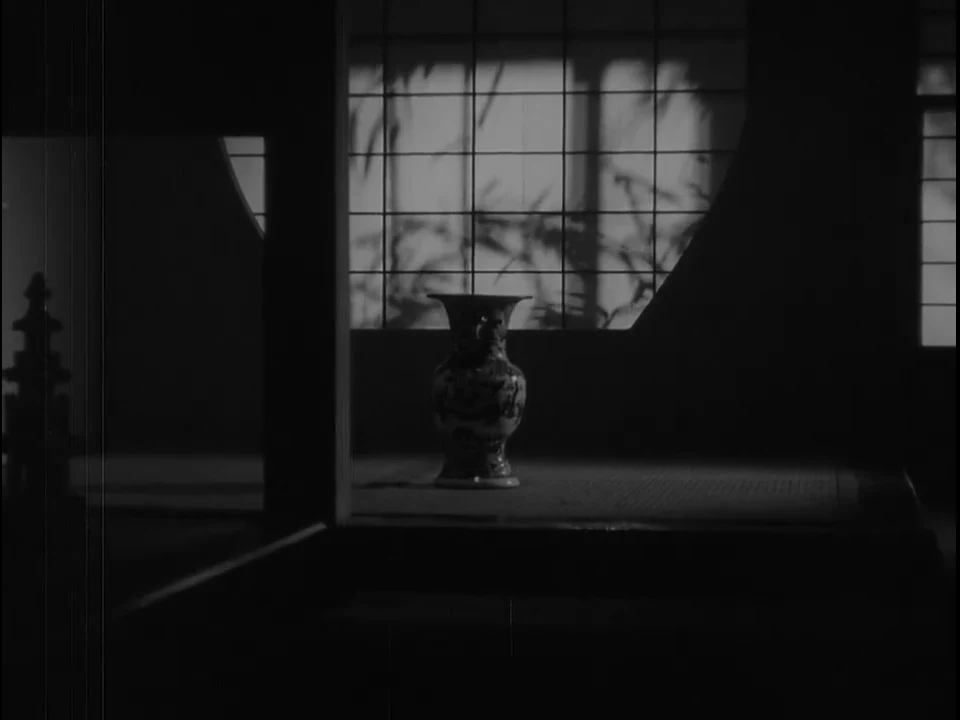
During the second vase shot, the vase remains nearly motionless while bamboo shadows continue moving across the shoji. The still records composition only. The 27.277-second interval from 01:28:20.380 to 01:28:47.657 begins with the first cut to the vase, passes through Noriko's face and the second vase shot, and ends at the cut into the rock garden; the preceding smiling face lies outside these stored bounds. Bilibili timecode 01:28:42.
Open full-size still- Displayed still
- 01:28:42
- Discussion passage
- 01:28:20.380 - 01:28:47.657
Within a continuous 01:28:15–01:28:55 window on the complete single-part Bilibili carrier BV1dN4y1B7tF, the atlas used cut detection and then frame-by-frame review to verify four cut points: first vase at 01:28:20.380, back to Noriko at 01:28:26.469, second vase at 01:28:37.397, and cut to the Ryōan-ji rock garden at 01:28:47.657. These coordinates bind only this 01:47:59 carrier; other restorations, releases, and leader lengths require fresh location.
Watch continuously from 01:28:15 to 01:28:50. First record visible differences between Noriko's two facial shots, then time both vase shots, and separately note snoring, music, and the cut to the rock garden. Do not begin by asking what the vase symbolizes. The coordinate binds only BV1dN4y1B7tF. Public reachability and the uploader's authorization to redistribute the feature are separate questions.
Still checked: 2026-09-03 · Carrier access checked: 2026-09-03
Image
In the shot immediately preceding the stored interval, Noriko lies down smiling. The stored bounds begin with the first vase shot, return to Noriko as tears gather in her eyes, cut to the same vase a second time, and end at the instant of cutting into the Ryōan-ji rock garden. Viewed with the adjacent shot, the order is Noriko's face–vase–Noriko's face–vase–rock garden.
On this carrier, the first vase shot lasts about 6.089 seconds and the second about 10.260 seconds. During the second, the vase remains nearly motionless while bamboo shadows continue moving on the shoji.
Sound
On p. 297, Parks uses continuing snoring to establish temporal contiguity across the shots; on p. 298, he reports that a musical theme enters about four seconds into the second vase shot and bridges to the rock-garden scene. This is Parks's written account of his material; treating it as an audible fact of this carrier still requires a separate check of its soundtrack.
Relation to the concept
The countertest asks whether the cuts merely delay Noriko's next action. If plot-use fully explains the vase, the sensory-motor chain has not genuinely loosened.
Sources and further reading
- Cinema 2: The Time-Image
Minnesota 1989 translation, ch. 1, pp. 16–17 · Deleuze distinguishes still life from empty space and uses the vase to explain change occurring in an unchanging form. The primary text gives no seconds for this Bilibili carrier; the atlas separately verifies the four cuts.
- The Riddle of the Vase: Ozu Yasujirō’s Late Spring (1949)
Japanese Cinema: Texts and Contexts (2007), pp. 78–89; point-of-view debate on p. 86 · Nornes surveys conflicting interpretations and notes that Bordwell and Thompson correct Richie's and Schrader's loose descriptions of point of view. His emphasis on p. 86, however, is that this formal correction still does not explain why the vase is ‘oddly powerful.’ Rejecting the shortcut from ‘she sees the vase’ to a fixed emotional symbol is the atlas's methodological boundary, not Nornes's single conclusion.
- Change, Horizon, and Event in Ozu’s Late Spring (1949)
Film-Philosophy 20.2–3 (2016), pp. 292–298, DOI 10.3366/film.2016.0016 · Parks places Deleuze's temporal reading alongside shot legibility, sound continuity, and shot length. He reports four seconds for the first vase shot and nine for the second, whereas this carrier yields 6.089 and 10.260 seconds. Because the article does not identify its transfer or timing method here, the discrepancy is recorded without attributing it conclusively to an edition difference.
- Bilibili · bili_29513417942 · complete single-part Late Spring · user repost
01:28:42 · During the second vase shot, the vase remains nearly motionless while bamboo shadows continue moving across the shoji. The still records composition only. The 27.277-second interval from 01:28:20.380 to 01:28:47.657 begins with the first cut to the vase, passes through Noriko's face and the second vase shot, and ends at the cut into the rock garden; the preceding smiling face lies outside these stored bounds. Bilibili timecode 01:28:42.
Rio Bravo
Rio Bravo (1959)
Atlas shot reading
Waiting becomes a shared rhythm
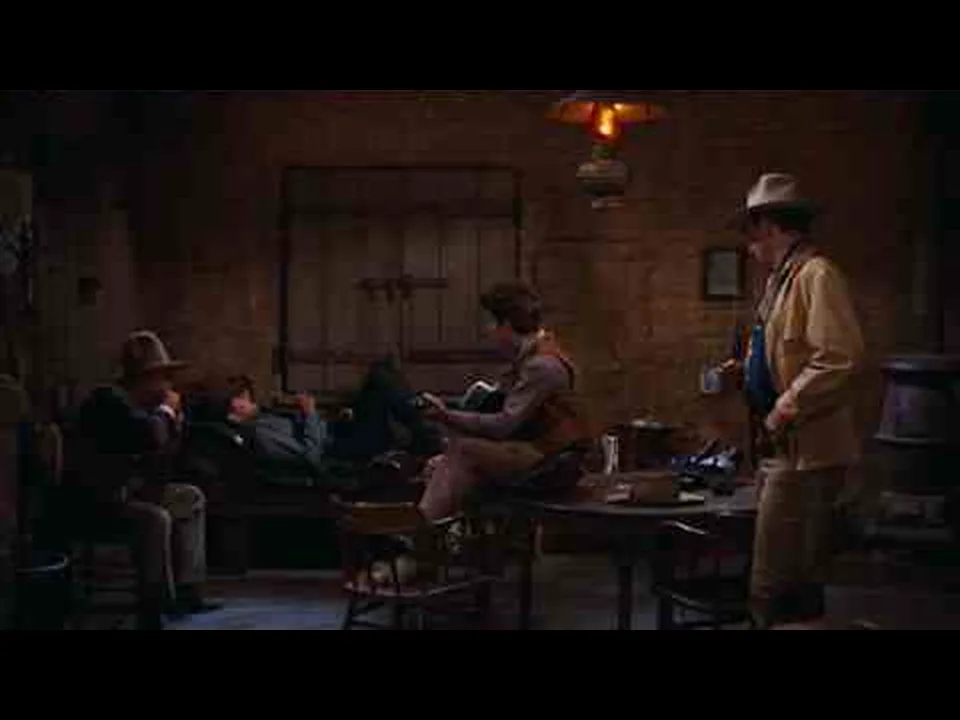
The siege remains, yet Dude, Colorado, and Stumpy compose waiting into song. Gunfighter, alcoholic, old man, and youth provisionally exchange foreground positions.
Open full-size still- Displayed still
- 01:45:04
- Feature time
- 01:45:04
The three stills and jumps use the user-supplied complete 02:21:06 single-part Bilibili edition; time begins at the film's opening credits.
The still and link retain the film guide's recorded shot locator.
Image
The siege remains, yet Dude, Colorado, and Stumpy compose waiting into song. Gunfighter, alcoholic, old man, and youth provisionally exchange foreground positions.
Relation to the concept
Music is not decoration that suspends action. It recalibrates attention, breath, and trust so the next act can be borne by a provisional collective rather than a lone hero.
Sources and further reading
- Cinema 1, Chapter 10
The small form A–S–A′ of the action-image
- BFI interview with Howard Hawks
The director on audiences, performance, and filmmaking judgment
- Continue with Red River
Compare relayed cooperation with a transfer of command
- Continue with The Big Sky
Carry local tactics into river, trade, and colonial route
Red River
Red River (1948)
Atlas shot reading
One disturbance is amplified through the herd
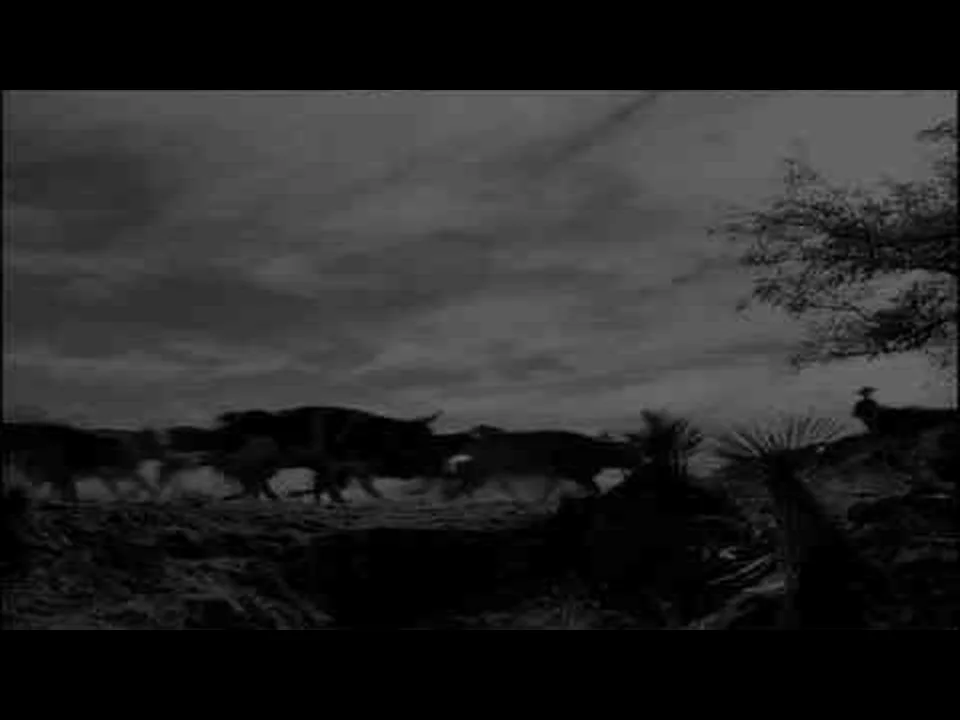
Night erases individual riders within the whole as disturbance propagates through the herd. Human cries, horses, and dense cattle movement amplify one another faster than command can follow.
Open full-size still- Displayed still
- 00:51:20
- Feature time
- 00:51:20
The three stills and jumps use the user-supplied complete 02:13:26 single-part Bilibili edition; studio marks are part of the edition's beginning.
The still and link retain the film guide's recorded shot locator.
Image
Night erases individual riders within the whole as disturbance propagates through the herd. Human cries, horses, and dense cattle movement amplify one another faster than command can follow.
Relation to the concept
The passage countertests heroic command over the whole: response continues but is distributed across humans, horses, cattle, and night milieu. It weakens the central-command reading, yet stampede alone proves neither a crisis of action nor the small form.
Sources and further reading
- Cinema 1, Chapter 10 · p. 165
The Hawks/small-form context in which Deleuze names Red River
- Cinema 1, Chapter 9
Use the large form S–A–S′ as a general formula to be tested
- Criterion essay on Red River
A deeper reading of route, relation, and Hawksian form
- Criterion interview with editor Christian Nyby
Audit the moving whole through editing labour
- Compare Rio Bravo
Return from transferred command to local functional relay
The Big Sky
The Big Sky (1952)
Atlas shot reading
A low branch turns milieu into opportunity
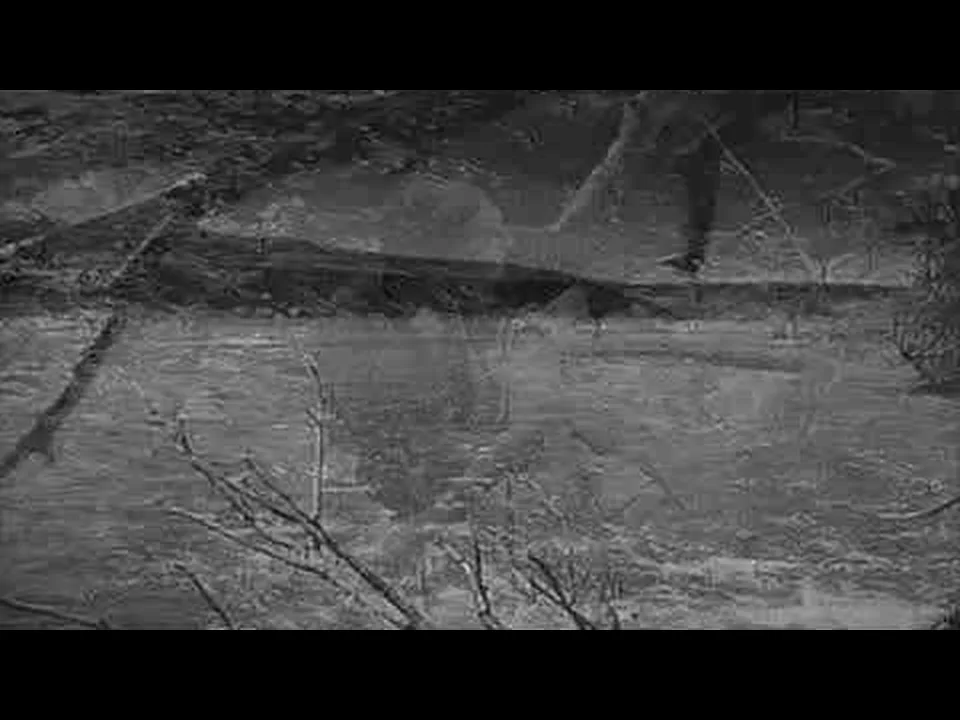
Rapids undo the planned line and the men use a low branch over the bank to escape. No catapult is built; the key is the body's timely reading of a property in the milieu.
Open full-size still- Displayed still
- 00:46:16
- Feature time
- 00:46:16
Stills and timecodes use the user-supplied 02:01:45 / 122-minute theatrical cut and do not present it as the roughly 138–140-minute long edition.
The still and link retain the film guide's recorded shot locator.
Image
Rapids undo the planned line and the men use a low branch over the bank to escape. No catapult is built; the key is the body's timely reading of a property in the milieu.
Relation to the concept
The action-image is not a grand will conquering nature but perception selecting from the milieu a property that can continue action; A rewrites the immediate S.
Sources and further reading
- Rushton guide, pp. 42–44
Local action, ASA′, and an unfounded community
- Cinema 1, Chapter 10
Strict coordinates for the small-form action-image
- UCLA film archive
Edition, exhibition, and Hawks context
- Compare Rio Bravo
The same functional relay under different frontier power
Films and scenes
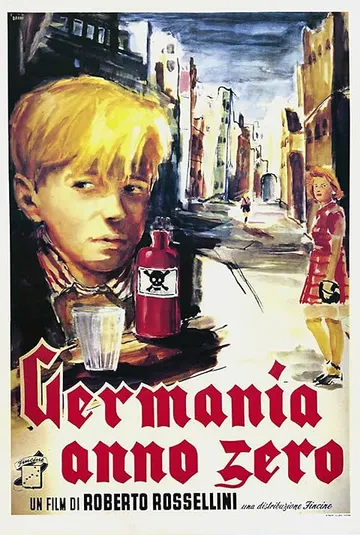
Walking, trading, and poisoning continue without repairing the family or opening a future, separating continued movement from the schema's lost efficacy in the world.
IMDb identification poster ↗Related film readings · 46 films
Late Spring · 1949 — The vase still life intervenes between the daughter’s smile and tears, placing change within time’s unchanging form.
Germany Year Zero · 1948 · At the threshold — Walking, trading, and poisoning continue without repairing the family or opening a future, separating continued movement from the schema's lost efficacy in the world.
Europe ’51 · 1952 — The factory passage does not leave Irene wholly unable to act: she can still approach, converse, and leave. Yet the machines' scale, the narrow passage, and the mechanical sound are no longer exhausted by the site's use as a ‘workplace’; the atlas reads this remainder as her shift from managing a situation toward enduring and seeing it anew as a seer.
Stromboli · 1950 — The volcano’s beauty and pain exceed any executable response, turning the protagonist from agent into a seer struck by a limit situation.
L’Avventura · 1960 — The disappearance escapes the logic of a solvable mystery; islands, architecture, and bodily attitudes give duration to the void within relations.
Umberto D. · 1952 — The maid’s small morning tasks receive their full duration. Seeing, waiting, and fatigue give everyday life optical density of its own.
Pickpocket · 1959 — Hands, pockets, wallets, and relays connect a space that can never be surveyed as a whole. Tactile relations replace mastery through complete action-space.
Faces · 1968 — Laughter, fatigue, drunkenness, and suddenly frozen faces unsettle stable psychology. The linkage of bodily attitudes directly reveals time wearing relations down.
A Woman Under the Influence · 1974 — Hesitation, excess, and waiting exceed family norms and retain their own bodily time. Deleuze mentions the film only briefly in Cinema 2, so the specific reading of gesture remains the responsibility of this atlas.
Journey to Italy · 1954 — Katherine is struck by unfolding landscapes and visual clichés, discovering something beyond what she can personally bear. She no longer resolves what she sees through action but becomes a seer.
Bicycle Thieves · 1948 — The search should organize Rome as a space of purposeful action, yet it carries father and son through crowds, streets, and encounters that never cohere. When the boy witnesses his father’s failed theft, seeing replaces solution: the character becomes a seer within a situation he can no longer answer.
Paisà · 1946 — Six episodes join encounters, mistranslations, and abrupt deaths while withholding transitions that would explain them. Characters enter after a fact has begun and leave before its consequences can be mastered; the inexhaustible before and after of the event presses directly on perception.
Stagecoach · 1939 — Cinema 1 chapter 9 defines S–A–S′ on pp. 141–142. Page 146 directly uses Stagecoach's alternation between coach interior and exterior to explain Ford's Encompasser and treats the circular S–A–S as a first approximation; p. 147 then distinguishes Ford's spiral as S–A–S′, moving toward a new situation. The atlas therefore locates three passages without treating a long shot as proof by itself. Around 00:35:10, the coach is reduced beneath Monument Valley and the sky, proposing rather than proving an encompassing situation. From 01:13:30 to 01:15:20, cross-cutting distributes driver, reins, horses, gunfighters, and passengers across a collective act, giving firmer evidence for A. From 01:33:50 to 01:35:28, Ringo is released and leaves with Dallas in a small cart. That departure may form S′, but it is also a countertest: the film clearly shows Ringo leaving town with Dallas after his release without directly showing whether legal and class positions inside the town are redistributed. Deleuze's criticism on p. 150 of American montage reducing social causes to a personal duel, together with the distinctions among whole mission, local action, and duel on pp. 151–152, sets the textual boundary for asking whether a changed situation for the pair amounts to a changed situation as a whole. The atlas is responsible for the three timecodes and for relating them in this way.
Rear Window · 1954 — Window frame, telephoto lens, and point-of-view editing turn the neighbours’ actions into relations to be inferred, while the immobilized Jeff cannot enter the scene. Observer, observed object, and the conjecture joining them all become image-content; relation itself becomes a third term.
Vertigo · 1958 — Cinema 1, pp. 204–205 both supplies a general criterion for Hitchcock's inclusion of spectator response within a director–film–spectator relation and directly explains Vertigo through variations in the Same's relations to the dead woman, husband, and detective; it does not analyze the atlas's three chosen passages shot by shot. Rushton, pp. 53–57, gives a more specific chain: Elster's commission scripts Scottie's viewing through the absent Carlotta; Judy's unsent letter confirms the deception for the spectator before Scottie; the remaking of Judy then unfolds inside that knowledge gap. Three atlas scene records bind commission, confession, and green-lit remaking to the 02:07:27 repost timeline. A boundary is equally important: Rushton p. 124 explicitly classifies the dolly zoom as the affection-image par excellence, so it cannot serve by itself as positive relation-image evidence. The green light's actual–virtual reading likewise remains a candidate pending evidence of a reciprocal circuit.
The Birds · 1963 — Cinema 1, p. 204 directly calls the first gull attacking the heroine a demark and the thousands of birds or flock as a whole a symbol, but it does not analyze the pet-shop or playground editing for the atlas. The three scene records therefore separate evidentiary levels: the pet shop at 00:02:00–00:07:10 only proposes an ordinary relation of merchandise, gift, and captivity; the bay crossing at 00:25:00–00:25:42 receives direct primary support for a gull that reroutes that relation; the playground at 01:09:45–01:12:15 tests how the flock changes school/play, song/alarm, perching/encirclement, and classroom order/urgent evacuation together. The children's song continues through the flock's accumulation, timing each cutback and delaying alarm.
Strangers on a Train · 1951 — Cinema 1, p. 201 directly invokes an exchange of crimes and murders to explain how Hitchcock surrounds and penetrates action with a fabric of relations; it does not classify the lighter, touching shoes, or spectacles shot by shot. Rushton, pp. 48–53, supplies the more specific chain: accidental foot contact on the train initiates a relation between strangers; Bruno construes Guy's words as an exchange of crimes. The lighter begins as Anne's gift to Guy. When Guy lends it to Bruno for a cigarette, Bruno reads its 'A to G' inscription—Anne to Guy—and draws the Anne–Guy gift relation into the Guy–Bruno criminal relation, making the lighter a mark of that relation; he later tries to turn it into a demark that would place Guy at the murder site. Barbara's spectacles abruptly reconnect a dinner-party strangling game to Miriam's murder. On p. 53 Rushton follows Robin Wood's account of the “spectator trap” to show that implication is not merely informational: the film first encourages the audience to treat Miriam's death as the removal of Guy's obstacle, then turns that desire back on the audience through the dinner-party strangling game. That the audience witnesses Bruno's act before Guy does is the atlas's carrier-based record of a knowledge gap; it is not folded into the same claim about Thirdness. Deamer, pp. 132–137, is used only to calibrate the general taxonomy of mark, demark, symbol, and spectator relation. The atlas remains responsible for its three Bilibili timecodes and shot-level applications; these are not presented as Deleuze's own shot analysis.
The General · 1926 — War, railway, flood, and broken bridge first compose an immense situation that dwarfs the little man. Continuous trajectories and the ‘miniaturization’ of machines then let a small body transform the whole through the locomotive. The General places burlesque directly inside the large form S–A–S′.
Seven Samurai · 1954 — Village maps, formations, and reconnaissance gather every given condition of defence, then force a higher question: ‘What is a samurai at this historical moment?’ The rain battle secures the village, but burial mounds and peasant song answer that the peasants are the true victors and the samurai have become displaced shadows.
Taxi Driver · 1976 — Windshield, rear-view mirror, neon, and aimless cruising fragment New York into loose clichés. Travis sees everything yet cannot form an adequate response. He forces an action-chain through violence, which the media repackages as heroism, exposing crisis and cliché-production together.
High Noon · 1952 — Clocks, tracks, and emptied streets compress the town into a one-hour countdown. Kane repeatedly asks for help, yet action cannot organize the community. The duel completes a classical action-image, but the badge dropped in the dust prevents victory from restoring trust.
Groundhog Day · 1993 — The same morning first becomes an optimizer of action: Phil uses memory to predict others and manipulate outcomes. The loop changes direction when knowledge no longer serves escape; practice, care, and action without return turn repetition into the production of capacities and relations.
Edge of Tomorrow · 2014 — Death-reset turns the battlefield into a repeatedly trainable map of action. Cage uses memory to shorten routes, correct posture, and anticipate enemies. The loop intensifies rather than breaks the sensory-motor schema while exposing the shared duration that victory deletes.
Nashville · 1975 — The wide frame holds campaigning, performance, traffic, and private life at once, while multiple soundtracks let one city pass through dispersed lives. Assassination restores no centre; the stage absorbs disorder with another familiar song. Once collective action breaks down, the city is doubled by the sounds and media clichés it produces.
Aguirre, the Wrath of God · 1972 — Rapids, mud, and forest might support heroic action, but Aguirre subordinates the expedition to a sublime plan to betray God, king, and everyone else. The farther the raft travels, the more the plan becomes empty speech; corpses, mist, and monkeys reduce a history of conquest to one isolated body's terminal performance.
City Lights · 1931 — Cinema 1 chapter 10 gives the general structure of small form A–S–A′ and its lacking or equivocal indices on pp. 160–163. Page 169 directly names City Lights as an example of a 'personality split of a pivotal character,' without assigning the millionaire's drunk or sober passages or a rule of recognition shot by shot. The atlas tests the drunken welcome from 00:11:30 to 00:15:50 and sober rejection from 00:34:14 to 00:35:48 as the concrete filmic realization of that phrase. The sequence directly named on p. 171 is the thread-unravelling gag around 00:52:32–00:53:54, not the final recognition. In the first meeting from 00:07:20 to 00:09:38, the film juxtaposes a dropped flower, its recovery, a coin, an approaching figure, and a departing car for the viewer; the flower seller can draw on touch, transaction, and sound, while exact attribution of each door sound still requires track-level review. In the touch recognition from 01:24:56 to 01:26:12, the action chain contracts into an affective instant of face, hand, shyness, and smile, without automatically establishing a new practical A′ or turning the film into a time-image. The theoretical relations assigned to all three located groups remain the atlas's responsibility.
North by Northwest · 1959 — The three passages require distinct evidentiary levels. At 00:00:50 the diagonal grid, title, and directional arrows propose that relational positions precede personal identity, but geometrical resemblance alone does not establish Thirdness. The farmland passage around 01:12:00 first composes a habitual series of waiting, road, vehicles, and fields; a stranger observes that the plane is dusting where there are no crops, and this relational contradiction makes it the demark that reroutes the series. At 02:15:59 the match cut joins cliff rescue to an embrace in the train berth, countertesting an overextended relation-image through sensory-motor closure and marital resolution. Deleuze, p. 203, and Rushton, pp. 48–53, supply the sign criteria; the edition bounds and comparison among opening, field, and ending are the atlas's responsibility.
M · 1931 — Police and underworld tighten the city through raids, maps, and divided labour, yet the real duel is not between them. The underworld tribunal presents crime as manageable habit, while M pleads an uncontrollable impulse. The clash between organized action and affective compulsion marks Lang's passage from expressionist shadow to austere realism.
Sunrise: A Song of Two Humans · 1927 — The dark marsh and luminous city are not two settings but two forces of a marriage moving through seduction, murder, and reconciliation. After the false report of drowning, searchlights cut across the lake and shadow changes by degrees into light. Milieu, faces, and movement together carry a passage from falling toward renewed illumination.
The Crowd · 1928 — The camera travels against the street crowd, enters a skyscraper, and finds one desk among countless windows, embedding the individual in an exchangeable mass. John repeatedly answers the city with effort only to return to the same situation. The large form S–A–S′ fails, turning upward mobility into an S–A–S loop.
Sherlock Jr. · 1924 — When the projectionist enters the screen, his body remains still while garden, street, precipice, snowfield, and shore strike through cuts. The train passage reverses the relation, carrying him continuously across roof, water tower, and track in one shot. Disjunctive editing and bodily trajectory make the cinema-machine a comic agent.
Steamboat Bill, Jr. · 1928 — The cyclone turns the town into a continuously transforming milieu: façades fall, buildings slide, and wind transports bodies. Keaton's small body does not overpower disaster but passes through it by exact position and improvised trajectory. Burlesque small form thereby carries a sublime scale usually reserved for epic large form.
The Gold Rush · 1925 — Cabin, hunger, and dreams of wealth keep reversing through slight differences: a shoe becomes dinner, and the Tramp becomes a chicken in Big Jim's eyes. No character masters the total situation; each improvises at a critical instant. Comedy makes action from a minute perceptual shift while letting survival slide toward devouring.
The Exterminating Angel · 1962 — The drawing room has no visible barrier, yet the guests cannot cross its threshold; civility regresses into occupation, hunger, and attack. The arrival and interior attitudes recur with imperfect differences, and bad repetition closes the space. Only by restaging the decisive arrangement does the boundary loosen, before forming again in the church.
Throne of Blood · 1957 — The foggy forest and spirit offer not an instruction for action but a question whose conditions must be understood. Washizu treats prophecy as an executable plan; the more urgently he acts, the more the castle becomes a spider's web. The final arrows are not an enemy's answer but the misunderstood question tightening from within.
Dog Day Afternoon · 1975 — The robbery loses its planned sequence almost immediately, leaving Sonny to shuttle among doorway, telephone, and crowd. Action remains intense but sweeps the same ground like a windscreen wiper. Media, police, and onlookers keep rewriting the event, undoing qualified action-space into an any-space-whatever without an exit.
The Man Who Shot Liberty Valance · 1962 — The duel restores order, but Tom performs it while Ransom receives its credit. By yielding the deed, the cowboy lets the West's unwritten force pass into the senator's written law. The flashback does not restore fact to public status: action forms an ethical spiral, and the new situation rests on a preserved legend.
Diary of a Country Priest · 1951 — Doors, tabletops, hands, diary pages, and exhausted steps construct the priest's path fragment by fragment; space is never given whole. The face no longer governs emotion, as tactile fragments bear judgment, illness, and faith. Each halt is both interrupted action and another station toward the Cross, producing spiritual affect through broken connections.
Rome, Open City · 1945 — Partisans, a civilian household, a priest, and the occupiers might have converged into one line of resistance, yet raids, a street chase, abrupt gunfire, torture, and execution cut it into displaced encounters. Pina runs after the truck and suddenly falls while the children can only look on. Action no longer encompasses the event; postwar reality first appears as dispersion and gaps.
Rio Bravo · 1959 — The jail scarcely needs the prisoner's body to acquire meaning; it operates as a functional node to be held or breached. Sheriff, recovering alcoholic, disabled old man, and young gunfighter represent no organic community. They form a provisional group through capacities to guard, hear, carry, and shoot, while the final combination of dynamite and rifle compresses Western space into exchangeable functions.
Red River · 1948 — Deleuze names Red River in Cinema 1, chapter 10, p. 165, within Hawks and the small form rather than directly presenting it as a model of the large form. Open landscape and collective task can still pose an S–A–S′ hypothesis. The atlas then countertests it through the claim passage at 00:15:38, stampede at 00:51:20, and transfer of command at 01:21:08: does an encompassing situation genuinely precede action, or is it progressively disclosed and reorganized by local acts, differences of speed, and relayed functions? The relation among these three shots is the atlas's responsibility, not a shot-by-shot gloss of p. 165.
Scarface · 1932 — Tony builds an apparently effective gangster habit through assassination, machine-gun fire, and territorial seizure, while recurring X marks inscribe death within each success. The milieu is no stable community but an alliance ready to reverse. When his sister is shot, possessiveness, arrogance, and fear converge into a crack, and the actions that organized situations abruptly fail.
The Big Sky · 1952 — Sky first encompasses land, river, and expedition; the Missouri then stretches the static Western milieu into a long fluid route. Companions of different backgrounds do not fuse into a national community but connect through paddling, negotiation, guarding, and improvisation. The escape by a low branch in the rapids turns the gap between immense nature and small-group action into a locally usable function.
Readings in the same thematic group
India Song · 1975 — Voices separate from visible bodies, while image and sound form autonomous series that meet at the edge of an absent event.
Chronicle of Anna Magdalena Bach · 1968 — Anna's narration, letters, and the son's account form free indirect discourse. Live performance lets music acquire a resistant force independent of score and biographical explanation.
Tropical Malady · 2004 — The film’s rupture produces a new perceptual regime among love, legend, human-animal becoming, and forest, testing the postwar European model in return.
Criteria
Record what the figure perceives, how the body is affected, and what action follows; then ask whether that action alters the milieu and supplies usable cues for the next perception. At which link does the circuit break?
Distinctions and counterexamples
Silence, slowness, confusion, or failed action is not yet a crisis. If the shot still organizes the situation as a diagnosable task with an actionable next step and eventual solution, the circuit remains operative.
Common confusion: Silence, waiting, slowness, or a failed act is insufficient by itself. Movement need not stop during the crisis, and a local circuit may reconnect. The movement-image also includes perceptual, affective, impulse, and relational types that cannot be reduced to this schema.
Texts and sources
Cinema 1, chs. 4–10, 12; Cinema 2, chs. 1–2
- 01Cinema 1: The Movement-Image
Standard Minnesota English translation and a principal citation edition in Anglophone scholarship.
View source and edition → - 02Cinema 2: The Time-Image
Authoritative source for the standard translation, translators, ISBN, and publication date.
View source and edition →
Research disagreements
Is 1945 a rupture or a model?
Postwar Europe is a crucial constellation within the time-image’s multiple global sites of emergence.
Replacement or coexistence?
The time-image reverses the subordination of time to movement; both regimes persist and can shift locally within one film.
How do we use Deleuze precisely?
Test four layers: sensory-motor relation, actual/virtual circuit, audio-visual connection, and regime of truth.
Where contemporary images push this concept
Testing the concept against a new mechanismCandidate reading · same-session trace pending
TikTok For You: what decides the next image?
The sensory-motor schema serves here only as a comparative criterion. The feed couples perception, swiping, and the next response into an operational circuit, but this interface loop is not the action-image in which a character changes a situation through action.
Scope and limits Without same-account, same-version sequence logs showing that feedback changes subsequent ranking, the relation establishes only that the interface solicits action, not that the circuit has been reorganised by the platform.
- TikTok: How TikTok recommends videos #ForYouOfficial platform document · dated 2020 versionThis is corporate self-description, not a source-code audit or a complete account of the 2026 implementation; preserve version and interface evidence.
- Niko Pajkovic: Algorithms and taste-makingPeer-reviewed article · Netflix recommender systemThe object is a Netflix sample, not every platform; combine it with version logs and interface records.
Counterexample against conceptual overreachCandidate reading · versioned passage review pending
All That Breathes: the city changes first in the air
Rescue retains a clear goal, so long takes or polluted landscapes do not place the film outside the sensory-motor schema. More productively, it asks how far action can repair conditions—air and politics—that exceed the scale of individual intervention.
Scope and limits If shot analysis shows care repeatedly succeeding and advancing the narrative, the crisis claim should be withdrawn; the large scale of an ecological subject is not itself image evidence that action has failed.
- Cannes: All That Breathes official film pageFestival institutional page · ecological film factsA synopsis does not replace multispecies shot analysis; social context needs additional sources.
- Bidisha Banerjee: Care and disgust in more-than-human worldsPeer-reviewed article · All That Breathes and planetary careThe abstract is a theoretical bridge; specific film passages still need edition, timecode, and still.
Counterexample against conceptual overreachCandidate reading · versioned passage review pending
The Plains: one viewpoint carries a year of roads
A fixed camera and extreme duration do not automatically break the sensory-motor schema; commuting remains an action with origin, route, and destination. It becomes a boundary case only when repetition prevents relation, weather, and contingency from being contained by the purposeful journey.
Scope and limits If every passage remains fully organised by the destination and a biographical account of the driver, extended viewing is a matter of observational scale and does not establish a crisis of action.
- David Easteal: The Plains director siteDirector site/press kit · formal factsDirector self-description explains intention, not viewer experience or a time-image conclusion.
- Sreyashi Ray: Airborne HospitalityPeer-reviewed article · air as a multispecies mediumThis is an ecology/cultural-theory bridge; shared air is not a conflict-free commons and does not replace shot evidence.
Testing the concept against a new mechanismCandidate reading · build and state-transition record pending
Before Your Eyes: the eyelid cuts the present for you
The game couples seeing and blinking into an executable circuit while assigning command status to a bodily act not fully governed by intention. It tests not circuit strength but whether action in the sensory-motor schema is still purposively completed by a subject.
Scope and limits If state records show perception still extending reliably into executable action, blinking merely substitutes eye movement for another input and the sensory-motor circuit has not entered crisis. The relation can be upgraded only when perception loses a controllable outlet into action and the bodily command frustrates the action goal itself.
- Vanderhoef / Payne: Blink and you’ll miss itPeer-reviewed article · blinking and felt timeThe article is a scholarly bridge between experience and mechanism; physiological input is not automatically the virtual or freedom.
- Kristen M. Daly: Cinema 3.0: The Interactive-ImageScholarly article · external naming of interactive imageCinema 3.0 is Daly’s framework, not a third cinema theory written by Deleuze.
Concepts to distinguish
Compare them
- Pure optical / sound situationopsigne / sonsigne
A visual or auditory situation acquires a duration autonomous from cues for action or narration. Unable to translate what is seen or heard immediately into an effective response, the figure becomes a seer, listener, or witness. This is a threshold of the time-image, not direct time by itself.
→ - The seervoyant
The agent loses mastery over the situation and sees what habitual action concealed. The seer is a body struck by something too strong, too beautiful, terrible, or intolerable.
→ - Any-space-whateverespace quelconque
A space stripped of stable coordinates, total continuity, and practical use: ruins, empty lots, fractured streets, waiting rooms, or virtual spaces built from light, colour, and fragments. Relations can be recomposed within it.
→