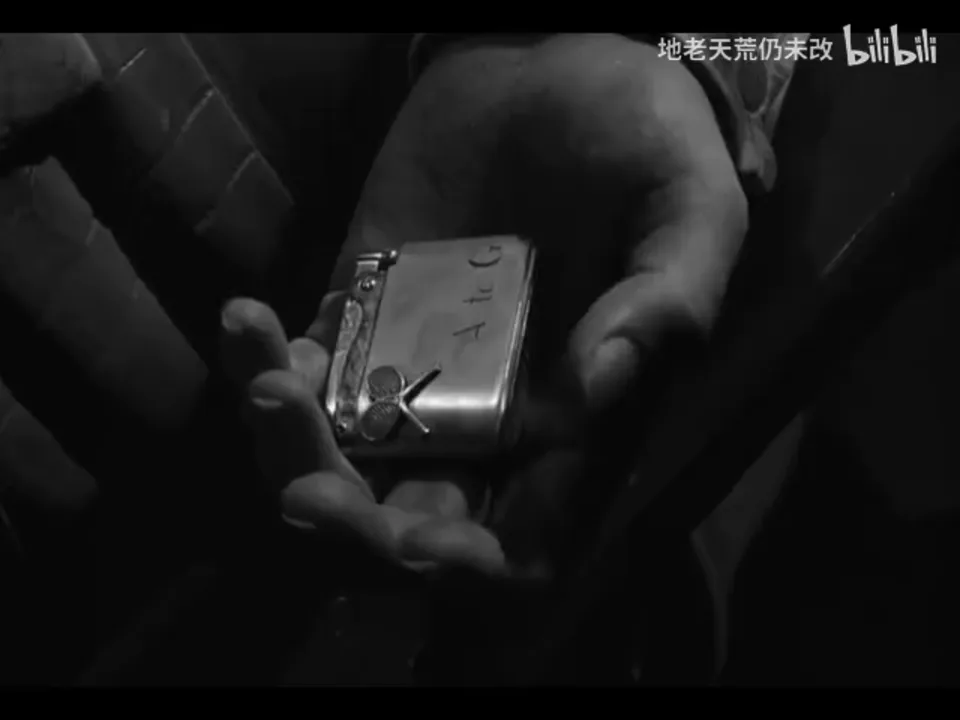
 01:38:45
Mental and relational image · SHOT EVIDENCE
Exposed in Bruno's palm: how A to G reverses evidence
If the lighter always meant only love or evidence, why must it change hands, be concealed, fall into a storm drain, and return to Bruno's hand—and which relation changes with each displacement?
Film and viewing version
Strangers on a Train · Strangers on a Train · Alfred Hitchcock / 阿尔弗雷德·希区柯克 · 1951
Reviewed passage by passage on the 01:40:27 single-part hard-subtitled Bilibili repost BV1SY6fYdEnV. 01:38:45 is the still anchor and 01:37:55—01:39:08 is the atlas's working boundary for the argument. These coordinates bind only this carrier; every other release or cut requires fresh location.
Version boundary: The timecodes on this page apply only to the named viewing carrier. Restorations, differing leaders, or platform transcodes may shift them.
Passage and still timecodes
approx. 01:37:55—01:39:08 (01:38:45 still shows the A-to-G lighter exposed in Bruno's opened hand)
The window locates the passage; its boundaries remain approximate
The passage window and still anchor are separate coordinates: the Bilibili still at 01:38:45 was checked on 2026-09-01; it does not turn an approximate passage on another carrier into exact bounds.
Visible facts
- 01
After the carousel runs out of control and collapses, Bruno lies beside the wreckage while Guy, police, and fairground workers gather nearby.
- 02
As Bruno is dying, his clenched hand slowly opens. The film cuts to the open palm, where the lighter engraved A to G with crossed tennis rackets lies exposed.
Audible facts
- 01
After the boatman identifies Bruno, Guy tells Turley that Bruno has the lighter and meant to plant it on the island. Bruno denies this and insists that the lighter is still on the island.
- 02
Guy asks to go through Bruno's pockets while Bruno is still alive. Turley refuses permission, noting that Bruno says he does not have the lighter.
- 03
After Bruno is pronounced dead, Turley picks up the lighter from the already opened palm, asks Guy to identify it, and then confirms that Guy was right.
- 04
Ambient noise, rescue instructions, and brief dialogue replace the fairground's earlier cyclical music.
Action relation
The lighter begins as Anne's intimate gift to Guy, and Bruno recruits its inscription into the exchanged murder. He later tries to plant it at the crime scene so the object transfers guilt for him. Guy asks to search Bruno while he is still alive. Turley refuses and says he must take Bruno's denial at face value; the film does not identify this decision as a formal procedure. As Bruno dies, his hand opens and reveals the lighter. It proves that Bruno possessed the object and had just lied; together with the boatman's identification, it changes the police judgement.
Temporal relation
The inscription A to G originally means Anne to Guy; Rushton notes that Bruno's criminal scheme makes it readable again as Antony to Guy. The lighter recurs in the opening, concealment, storm-drain delay, and final recognition, changing the relation among gift, contract, planted evidence, and proof rather than repeating one meaning.
Conceptual reading
The lighter moves from keepsake to relational mark, then to Bruno's attempted means of demarking himself from the series, and finally reverses into evidence that he possessed the object and lied about it. The boatman's identification supplies the identity claim; together they change the police judgement. The relation-image lies in this changed function, not in the metal object or inscription's inherent meaning. The atlas follows Rushton's mark–demark reading and explicitly does not attribute this prop-level naming to Deleuze shot by shot.
Concepts used in the judgement
- Relation-imageimage-relation · SCENE SUPPORT
One concrete object changes position among gift, bond of exchange, framing device, and reversed evidence, clearly showing sign function as dependent on a relational series; Rushton, pp. 51–52, directly supports this reading.
→ - Mental-imageimage mentale · SCENE SUPPORT
The lighter makes the exchanged crime a concrete object of inference for characters, police, and spectator.
→ - Sensory-motor schemaschème sensori-moteur · COUNTERTEST
Guy's pursuit and carousel struggle help the truth emerge. Relation-image here returns to effective action and restored truth rather than automatically passing into the time-image.
→
Primary and scholarly coordinates
- 01Cinema 1: The Movement-Image
Minnesota 1986 translation, chapter 12, pp. 197–205, especially p. 201
Page 201 defines the Hitchcockian third as relation and uses exchanged crimes to show relation entering action; pp. 203–204 distinguish mark, demark, and symbol in general. The primary text supplies neither the atlas's carrier coordinates nor a shot-by-shot assignment of eyeglasses and lighter to sign types; Rushton and carrier review bear that object-level chain.
- 02Deleuze’s Cinema Books: Three Introductions to the Taxonomy of Images
David Deamer, Deleuze’s Cinema Books (2016), pp. 132–137
Deamer reconstructs the general taxonomy of relation-image, mark, demark, symbol, and spectator implication. It helps police the inference boundary but does not analyze Strangers on a Train shot by shot.
- 03Cinema After Deleuze
Richard Rushton, Cinema After Deleuze (2012), pp. 51–52
Rushton develops five traits through Strangers on a Train: relational third, initiating action, exchange of crimes, series of marks and demarks, and film–spectator relation. Pages 49–50 treat the opening encounter, pp. 50–52 the exchanged crimes, lighter, and glasses, and pp. 52–53 the final proof and spectator trap.
- 04Figures of Style in Strangers on a Train
Peter J. Dellolio, “Figures of Style in Strangers on a Train,” open PDF p. 2 and pp. 5–6
Dellolio analyzes how canted framing, gate bars, the eyeglass reflection, and carousel write the Guy–Bruno parallel into space, and identifies the dying gesture that exposes the lighter on p. 2. The paper uses an Expressionist and psychological framework; the atlas borrows its verifiable shot observations without equating that psychology with Deleuze's relation-image.
Terminological coordinates
Chapter relations
Viewing and still sources
Direct scene · First watch from 01:24:30 for Bruno's concealment, dropping, and recovery of the lighter, then watch 01:37:55–01:39:08 continuously. Separate the object's location, holder, intended use, and actual evidentiary function into four columns. The timecode applies only to the 01:40:27 repost BV1SY6fYdEnV; Blu-ray, theatrical, and preview cuts require fresh location. A publicly reachable page and authorization to redistribute the feature are separate questions.