Concept definition
The relation-image is the decisive Hitchcockian realization within the mental-image's problem-field: it makes relation itself the image's object and specifies its signs through Peircean Thirdness. A mark sustains a natural or habitual series, a demark redirects that series through an anomalous term, and a symbol makes a concrete term bear an abstract relation; Hitchcock further composes director, film, and the spectator who must enter the inference as a triadic apparatus. The separate atlas page is an explanatory interface, not evidence that the source ranks mental-image and relation-image as parallel levels.
What the concept explains
The relation-image is the decisive Hitchcockian realization of this problem-field: it raises Peircean Thirdness from the content of character relations into the image's frame. A natural or habitual series must first exist before its marks can interpret one another. A demark is not anomaly in general but the anomalous term that forces an established series to change course; a symbol is a concrete term bearing an abstract relation irreducible to any one term's attributes. Spectatorial interpretation no longer stands outside the film but enters a director–film–spectator triad.
Sensory-Motor Rupture: How a Character Becomes a SeerDiagrams and film passages
Relation becomes what the image asks us to think
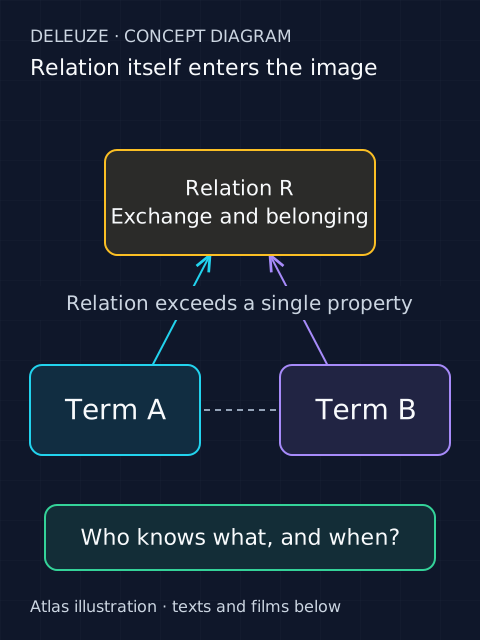
Diagram of Thirdness. The mental-image also concerns symbolic acts and intellectual feelings; this diagram focuses on Hitchcock’s realization of relation as an image-object.
Open full-size diagramIdentify terms and an established series
Ordinary birds, an aircraft, a ring, or a lighter first have customary uses and relations. Begin with those concrete connections; an unusual object alone does not explain what has changed.
Thirdness: relation exceeds an object’s properties
A ring can connect marriage, a missing person, and an act of watching; an exchange of murders places two actions within a pact neither action explains alone. Thirdness concerns relation itself entering the image, not a requirement for three people onscreen.
Ask who knows what, and when
Hitchcock makes the spectator’s knowledge part of the relation. An object can leave a habitual series or concretize an abstract relation, prompting figures and viewers to reinterpret an action. Distinguishing mark, demark, and symbol requires tracing both the earlier relation and its change.
Rear Window
Rear Window (1954)
Supported by the scene
Camera, racing photographs, and cast: how a viewing position is explained
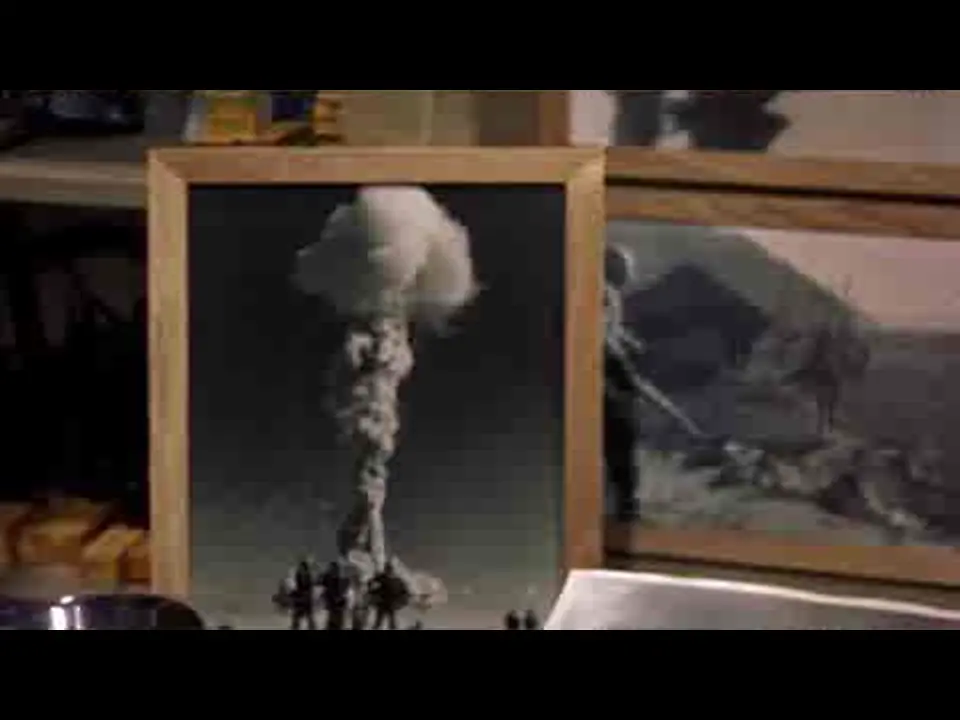
The photographic series does more than state an occupation: it links danger, camera, accident, and Jeff's fixed position of looking.
Open full-size still- Displayed still
- 00:02:15
- Discussion passage
- approx. 00:01:40—00:02:25 (the opening tour across two racing-crash photographs containing the 00:02:15 still)
Reviewed passage by passage on the 01:50:54 single-part Bilibili carrier with hard Chinese and English subtitles. 00:02:15 is the still anchor and 00:01:40—00:02:25 is the atlas's working boundary; opening credits and transitions may introduce seconds of drift across masters.
Still anchor 00:02:15; watch 00:01:40–00:02:25 continuously, recording what each object explains and whether that explanation remains operative in the later viewing apparatus. The timecode applies only to the 01:50:54 single-part BV1zvyTYMEqk carrier with hard Chinese and English subtitles; Blu-ray, DVD, and other streaming editions require fresh location.
Still checked: 2026-09-01 · Carrier access checked: 2026-09-01
Image
The camera moves from the courtyard and sleeping Jeff to his leg cast, then across racing-crash photographs, a damaged camera, and magazine covers.
The 00:02:15 anchor juxtaposes two racing-crash photographs; it does not by itself show the injury occurring.
Sound
The visual inventory has no explanatory voice-over; the following telephone exchange more explicitly supplies Jeff's profession and condition.
Relation to the concept
Camera, accident, and cast interpret one another and establish the later triad of observer, object, and inference; if only exposition remains, the relation should be withdrawn.
Sources and further reading
- Cinema 1: The Movement-Image
Minnesota 1986 translation, chapter 12, p. 201 · Page 201 directly uses Rear Window's opening: the camera passes sleeping Jeff, cast, racing photographs, and a damaged camera to explain his work as a photographer and his broken leg. The primary text names this opening relation; the atlas is responsible for the 00:01:40–00:02:25 boundary and shot-by-shot description.
- Deleuze’s Cinema Books: Three Introductions to the Taxonomy of Images
David Deamer, Deleuze’s Cinema Books (2016), pp. 132–135 · Deamer reconstructs the general taxonomy here: mark and demark are compositional signs of natural relations, while symbol is the genetic sign of abstract relations. These pages do not perform the atlas's shot analysis of Rear Window.
- Bilibili · public 01:50:54 single-part repost of Rear Window with hard Chinese and English subtitles, located and reviewed by the atlas; the specific master and restoration were not independently established
00:02:15 · The photographic series does more than state an occupation: it links danger, camera, accident, and Jeff's fixed position of looking.
- Open the single-part hard-subtitled Rear Window carrier on Bilibili
Still anchor 00:02:15; watch 00:01:40–00:02:25 continuously, recording what each object explains and whether that explanation remains operative in the later viewing apparatus. The timecode applies only to the 01:50:54 single-part BV1zvyTYMEqk carrier with hard Chinese and English subtitles; Blu-ray, DVD, and other streaming editions require fresh location.
Rear Window
Rear Window (1954)
Supported by the scene
Lisa raises the wedding ring: how one object redirects several relations
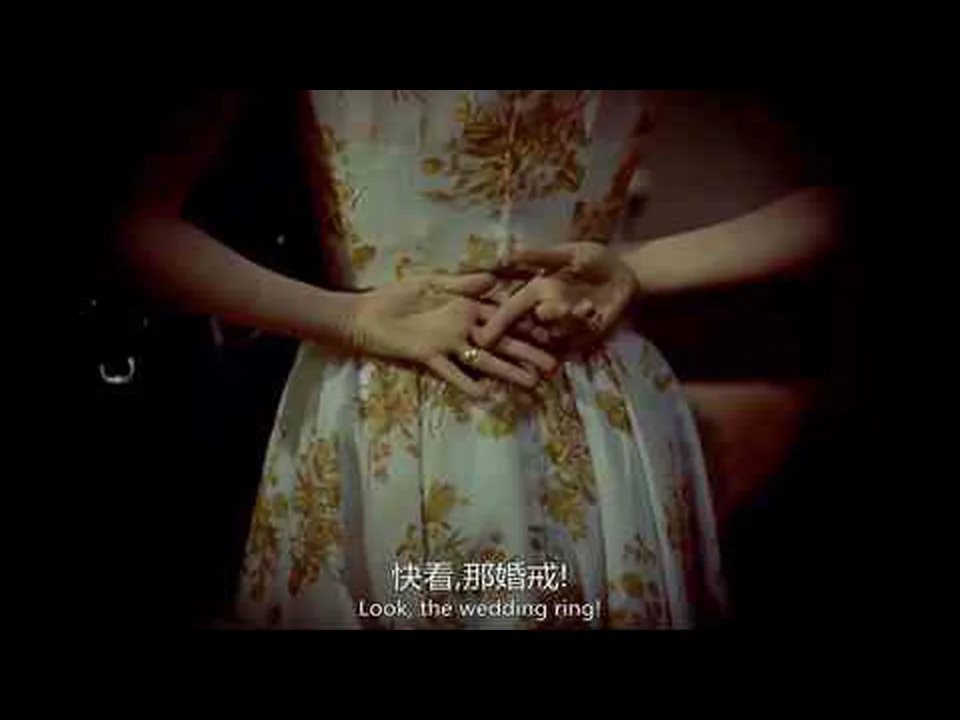
The ring belongs to the missing wife's marital relation and, through Lisa's display, enters the knowledge relations among Jeff, Stella, Thorwald, and the spectator.
Open full-size still- Displayed still
- 01:40:25
- Discussion passage
- approx. 01:39:40—01:40:35 (the passage in which Lisa displays the wedding ring and Jeff and Stella recognize its force containing the 01:40:25 still)
Reviewed passage by passage on the 01:50:54 single-part Bilibili carrier with hard Chinese and English subtitles. 01:40:25 is the still anchor and 01:39:40—01:40:35 is the atlas's working boundary; opening credits and transitions may introduce seconds of drift across masters.
Still anchor 01:40:25; watch 01:39:40–01:40:35, recording in order Lisa's gesture, Jeff and Stella's recognition, and Thorwald's returned look. The timecode applies only to the 01:50:54 single-part BV1zvyTYMEqk carrier with hard Chinese and English subtitles; Blu-ray, DVD, and other streaming editions require fresh location.
Still checked: 2026-09-01 · Carrier access checked: 2026-09-01
Image
Lisa raises the ring at the opposite window and displays it toward Jeff; the film cuts back to Jeff and Stella watching and responding.
Thorwald then notices Lisa's gesture and turns his look across the courtyard, threatening the previously one-way arrangement of vision.
Sound
Jeff and Stella's dialogue identifies the ring as an object Mrs. Thorwald would not willingly leave behind. Hard subtitles provide Chinese and English text but are not treated as an independent master check.
Relation to the concept
This is a symbol directly named by the primary text: a concrete ring bears an abstract marital relation and, through its display, reorganizes relations of looking.
Sources and further reading
- Cinema 1: The Movement-Image
Minnesota 1986 translation, chapter 12, p. 204 · Page 204 directly lists “the wedding ring of Rear Window” as a symbol and defines the symbol as a concrete bearer of abstract relations. The primary text does not specify 01:40:25 on this carrier; the time window, visible facts, and argument about the display reorganizing relations of looking are the atlas's responsibility.
- Deleuze’s Cinema Books: Three Introductions to the Taxonomy of Images
David Deamer, Deleuze’s Cinema Books (2016), pp. 132–135 · Deamer reconstructs the general taxonomy here: mark and demark are compositional signs of natural relations, while symbol is the genetic sign of abstract relations. These pages do not perform the atlas's shot analysis of Rear Window.
- Bilibili · public 01:50:54 single-part repost of Rear Window with hard Chinese and English subtitles, located and reviewed by the atlas; the specific master and restoration were not independently established
01:40:25 · The ring belongs to the missing wife's marital relation and, through Lisa's display, enters the knowledge relations among Jeff, Stella, Thorwald, and the spectator.
- Open the single-part hard-subtitled Rear Window carrier on Bilibili
Still anchor 01:40:25; watch 01:39:40–01:40:35, recording in order Lisa's gesture, Jeff and Stella's recognition, and Thorwald's returned look. The timecode applies only to the 01:50:54 single-part BV1zvyTYMEqk carrier with hard Chinese and English subtitles; Blu-ray, DVD, and other streaming editions require fresh location.
North by Northwest
North by Northwest (1959)
Supported by the scene
Where there are no crops to spray: how the crop-duster becomes a demark
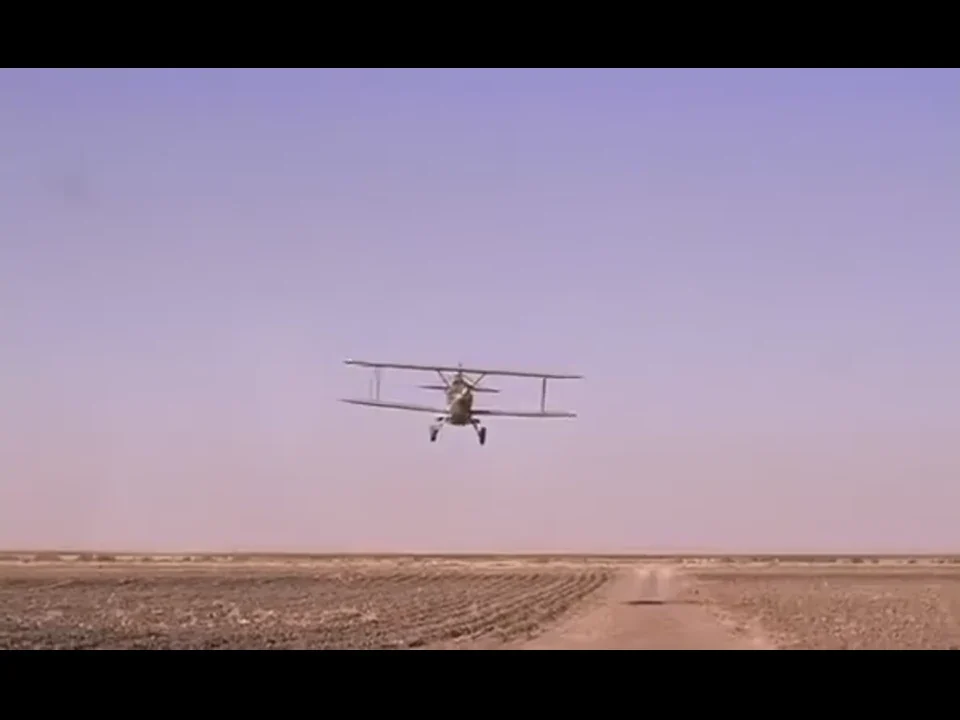
Deleuze's direct criterion precedes confirmation of the attack: the plane appears where there are no crops to spray. The low attack at 01:12:00 is a later visible fact checked by the atlas, not a substitute for that relational anomaly.
Open full-size still- Displayed still
- 01:12:00
- Discussion passage
- approx. 01:07:45—01:14:40 (the attack passage in which the crop-duster flies head-on and closes on the barren roadside horizon containing the 01:12:00 still)
Reviewed passage by passage on the 02:16:25 single-part dubbed BV1m2XTYuERk carrier. 01:12:00 is the still anchor and 01:07:45—01:14:40 the atlas's working passage, not a claim to final cut-by-cut boundaries. Credits, transitions, and end titles may introduce seconds of drift across masters.
Still anchor 01:12:00; watch 01:07:45–01:14:40, first recording the ordinary road and aircraft series, then separately the no-crops dialogue, low turn, evasions, and explosion so that the later attack does not replace the criterion for the demark. The timecode applies only to the 02:16:25 single-part dubbed BV1m2XTYuERk carrier. The specific master or restoration was not independently established; other editions require fresh location.
Still checked: 2026-09-01 · Carrier access checked: 2026-09-01
Image
Thornhill waits alone beside an open highway. Cars and a bus follow the road, another passenger waits and boards in the ordinary way, and the distant plane remains a small term in the environment.
After the bus takes the other passenger away, the plane changes its relation of distance and repeatedly dives toward Thornhill; he drops, runs, and takes cover in a field.
The 01:12:00 anchor shows the plane bearing head-on toward barren ground and a dirt road; the pursuit then continues into a causal chain involving a truck, tanker, and explosion.
Sound
The other waiting passenger's dubbed dialogue first notes that the plane is dusting where there are no crops to spray. After the bus leaves, the engine grows louder with the approach.
Relation to the concept
Cinema 1, p. 203 directly makes this plane a demark: one term departs from its customary series so that natural relation enters the image. Support extends only this far and does not turn the primary text into a shot commentary on the attack.
Sources and further reading
- Cinema 1: The Movement-Image
Minnesota 1986 translation, chapter 12, p. 203 · Page 203 directly identifies as a demark the plane's appearance where there are no crops to spray. It neither specifies the atlas's 01:12:00 carrier anchor nor describes the ensuing attack shot by shot; the atlas is responsible for the window, still, and attack facts.
- Cinema After Deleuze
Richard Rushton, Cinema After Deleuze (2012), pp. 48–53 · Across these pages Rushton develops five general features of Hitchcock's relation-image through Strangers on a Train and Vertigo. North by Northwest enters only as a listed example of wrong identity, the exchange-of-crime tradition, and the crop-duster demark. The book does not supply the atlas's shot-level analysis of the title grid, the attack, or the final match cut.
- Bilibili · BV1m2XTYuERk · reviewed 02:16:25 single-part dubbed carrier; the specific master and restoration were not independently established
01:12:00 · Deleuze's direct criterion precedes confirmation of the attack: the plane appears where there are no crops to spray. The low attack at 01:12:00 is a later visible fact checked by the atlas, not a substitute for that relational anomaly.
- Open the single-part dubbed North by Northwest carrier on Bilibili
Still anchor 01:12:00; watch 01:07:45–01:14:40, first recording the ordinary road and aircraft series, then separately the no-crops dialogue, low turn, evasions, and explosion so that the later attack does not replace the criterion for the demark. The timecode applies only to the 02:16:25 single-part dubbed BV1m2XTYuERk carrier. The specific master or restoration was not independently established; other editions require fresh location.
The Birds
The Birds (1963)
Supported by the scene
The first strike over the bay: a demark is not another mark
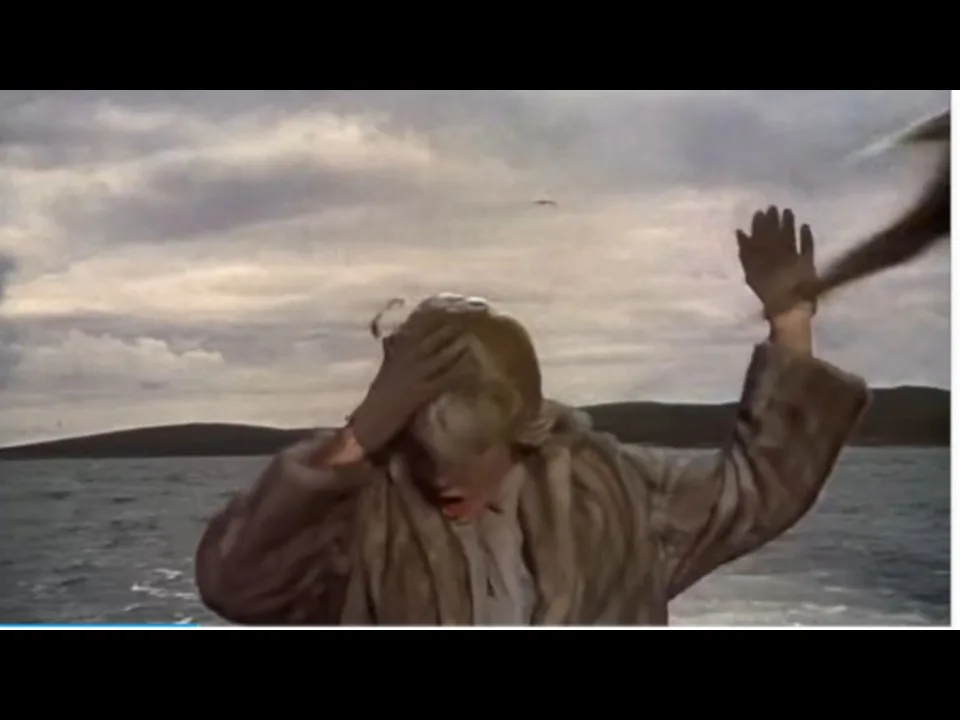
It abruptly changes from a familiar part of the landscape into an attacker; the anomaly lies in that change of relational position, not in the gull's appearance.
Open full-size still- Displayed still
- 00:25:23
- Discussion passage
- approx. 00:25:00—00:25:42 (00:25:23 still holds the gull passing as Melanie covers her head)
Reviewed passage by passage on the 01:59:24 single-part Bilibili repost. 00:25:23 is the still anchor and 00:25:00—00:25:42 is the atlas's working boundary. Bilibili's official feature page ep291861 runs 01:59:30, so the two carriers cannot share second-level coordinates.
Watch 00:25:00–00:25:42 continuously, first establishing the purpose and environmental continuity of the crossing, then marking the gull's entry, impact, wound, and Mitch's response in sequence. The timecode applies only to the 01:59:24 single-part repost BV1jJ411g7Yj; the official feature page, Blu-ray, and other streaming editions require fresh location.
Still checked: 2026-09-01 · Carrier access checked: 2026-09-01
Image
Melanie pilots the skiff alone toward the dock while Mitch watches her approach; the bay crossing still advances toward a clear goal.
A single gull dives from above, strikes past her head, and leaves a wound; the film then cuts toward Mitch on shore and Melanie's injured reaction.
Sound
The skiff engine, water, and harbour ambience sustain the ordinary continuity of the crossing; a sharp bird cry cuts in with the impact.
No explanatory dialogue supplies a cause for the attack; Mitch can respond only through calls and gestures after the anomaly has occurred.
Relation to the concept
The primary text directly identifies the first attacking gull as a demark: deviation in relational position precedes any psychological explanation of the bird.
Sources and further reading
- Cinema 1: The Movement-Image
Minnesota 1986 translation, chapter 12, p. 204 · Page 204 directly states that “the first gull which strikes the heroine is a demark.” The primary text does not supply the atlas's 00:25:23 carrier coordinate; the atlas is responsible for the window and shot facts.
- Deleuze’s Cinema Books: Three Introductions to the Taxonomy of Images
David Deamer, Deleuze’s Cinema Books (2016), pp. 132–137 · Deamer reconstructs the operative difference among mark, demark, and symbol: a habitual series, an anomalous term departing from that series, and a concrete term bearing abstract relations. The pages provide criteria rather than classifying these three passages for the atlas.
- Bilibili · public 01:59:24 single-part repost of The Birds, reviewed passage by passage by the atlas; the specific master, grade, and restoration were not independently established
00:25:23 · It abruptly changes from a familiar part of the landscape into an attacker; the anomaly lies in that change of relational position, not in the gull's appearance.
Vertigo
Vertigo (1958)
Supported by the scene
The absent Carlotta already governs the investigation
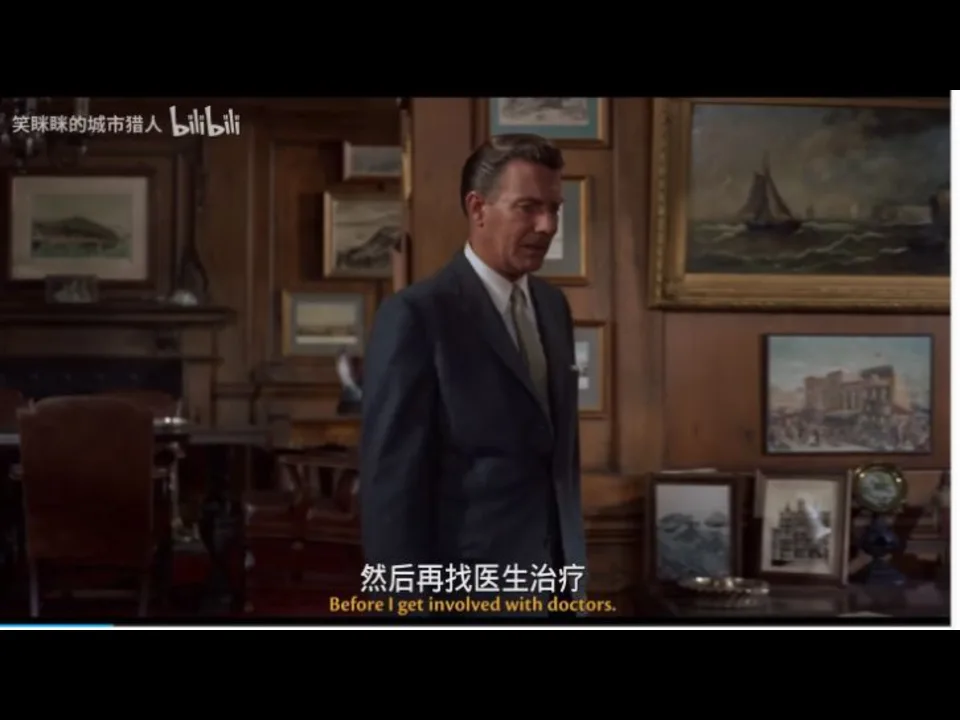
Before the assignment begins, the absent Madeleine and the still earlier Carlotta already govern what Scottie will be asked to see through Elster's account.
Open full-size still- Displayed still
- 00:15:30
- Discussion passage
- approx. 00:12:00—00:15:50 (00:15:30 still shows Elster standing in an office crowded with maritime images)
Reviewed passage by passage on the 02:07:27 single-part Bilibili repost with hard Chinese and English subtitles. 00:15:30 is the still anchor and 00:12:00—00:15:50 is the atlas's working boundary. Bilibili's official feature page ep291561 runs 02:07:49, and the repost may trim opening or closing material, so their timelines are not interchangeable.
Watch 00:12:00–00:15:50 continuously and record every name, kinship position, source of knowledge, and condition under which Scottie accepts the assignment. The timecode applies only to the 02:07:27 repost BV1ECSHYoEwW; this carrier may trim opening or closing material, so the official feature page, Blu-ray, and other restorations require fresh location.
Still checked: 2026-09-01 · Carrier access checked: 2026-09-01
Image
Elster brings Scottie into a wood-panelled office and the men alternate in medium views; images of ships, harbours, and buildings are visible on the walls and desk.
Only Elster and Scottie appear in this interval; the image inserts no portrait or flashback of Madeleine or Carlotta.
Sound
Elster asks Scottie to follow his wife and explains her anomalous behaviour as the influence of the dead Carlotta. Scottie questions the possession story but ultimately accepts the task of observation.
In dialogue, Elster identifies himself as husband, places Scottie as observer, designates Madeleine as the woman to be followed, and uses Carlotta's family history to explain her behaviour.
Relation to the concept
Elster's commission lets an absent third term govern investigator, object, and spectator positions, with scholarly support from Rushton, pp. 53–54.
Sources and further reading
- Cinema 1: The Movement-Image
Minnesota 1986 translation, chapter 12, pp. 197, 204–205 · These pages define the mental image's objects, Hitchcock's relational web, and the spectator's position, and directly explain Vertigo through variations in the relations of the Same. They do not analyze the atlas's chosen commission, letter, or green-light passages shot by shot; Rushton and the atlas's scene review bear those specific classifications.
- Deleuze’s Cinema Books: Three Introductions to the Taxonomy of Images
David Deamer, Deleuze’s Cinema Books (2016), pp. 132–137 · Deamer supplies general criteria for mark, demark, symbol, and relation-image; he does not establish that a particular letter, colour, or camera movement has already acquired any of those statuses.
- Cinema After Deleuze
Richard Rushton, Cinema After Deleuze (2012), pp. 53–54 · Rushton develops Vertigo's relational structure through Elster's commission, Judy's disruption of the existing series, spectator foreknowledge, and Scottie's remaking of the desired object. The substantive film argument ends on p. 57; p. 58 adds no film evidence.
- Bilibili · public 02:07:27 single-part repost of Vertigo with hard Chinese and English subtitles, reviewed passage by passage by the atlas; the uploader's collection notice describes a practice of trimming opening or closing material
00:15:30 · Before the assignment begins, the absent Madeleine and the still earlier Carlotta already govern what Scottie will be asked to see through Elster's account.
Vertigo
Vertigo (1958)
Supported by the scene
The unsent letter moves the spectator ahead of Scottie
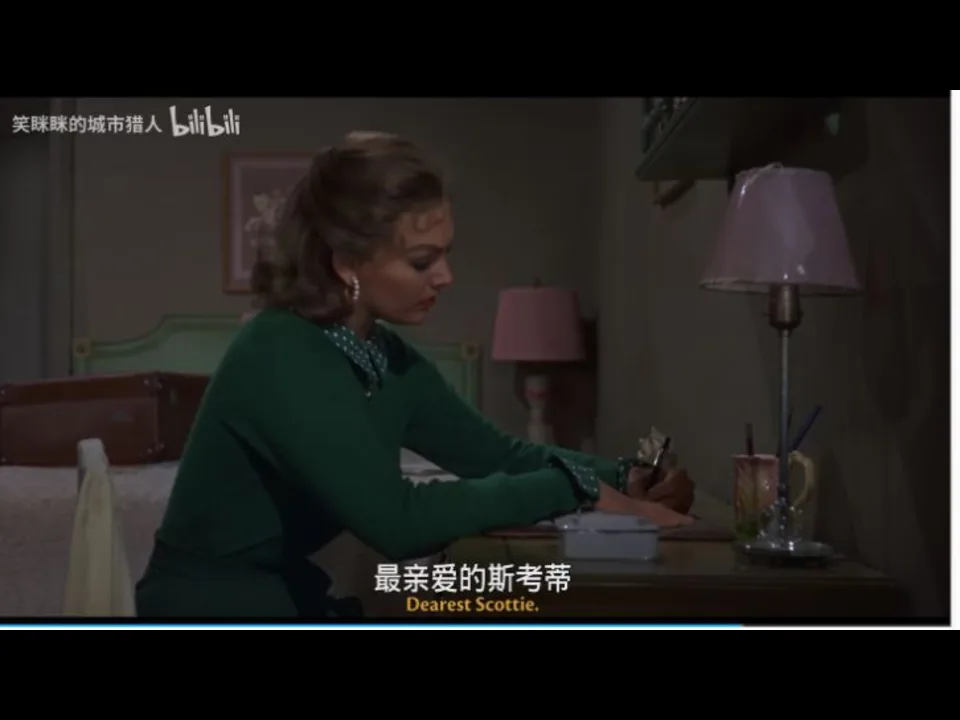
The letter is never sent, yet it changes the film's distribution of knowledge: the spectator learns Judy's relation to Madeleine while Scottie remains unaware.
Open full-size still- Displayed still
- 01:39:20
- Discussion passage
- approx. 01:38:30—01:40:30 (01:39:20 still shows Judy writing at the desk as the English hard subtitle reads “Dearest Scottie”)
Reviewed passage by passage on the 02:07:27 single-part Bilibili repost with hard Chinese and English subtitles. 01:39:20 is the still anchor and 01:38:30—01:40:30 is the atlas's working boundary. Bilibili's official feature page ep291561 runs 02:07:49, and the repost may trim opening or closing material, so their timelines are not interchangeable.
Watch 01:38:30–01:40:30 continuously, separating packing, writing, voice-over reading, recollection, non-delivery, and the decision to stay, and record who gains knowledge at each step. The timecode applies only to the 02:07:27 repost BV1ECSHYoEwW; this carrier may trim opening or closing material, so the official feature page, Blu-ray, and other restorations require fresh location.
Still checked: 2026-09-01 · Carrier access checked: 2026-09-01
Image
Alone in the hotel room, Judy begins packing, then sits to write. A recollection shows her dressed as Madeleine ascending the tower and another body falling.
After finishing the letter, she tears it up; the letter is not given to Scottie.
Sound
Judy's voice-over reading gives the prior deception directly to the spectator, including Elster's arrangement and her position in playing Madeleine.
Scottie is absent from the room and does not hear Judy's voice-over reading.
Relation to the concept
The unsent letter places the spectator within an asymmetrical knowledge network, while Judy as demark breaks the earlier Carlotta–Madeleine series.
Sources and further reading
- Cinema 1: The Movement-Image
Minnesota 1986 translation, chapter 12, pp. 197, 204–205 · These pages define the mental image's objects, Hitchcock's relational web, and the spectator's position, and directly explain Vertigo through variations in the relations of the Same. They do not analyze the atlas's chosen commission, letter, or green-light passages shot by shot; Rushton and the atlas's scene review bear those specific classifications.
- Deleuze’s Cinema Books: Three Introductions to the Taxonomy of Images
David Deamer, Deleuze’s Cinema Books (2016), pp. 132–137 · Deamer supplies general criteria for mark, demark, symbol, and relation-image; he does not establish that a particular letter, colour, or camera movement has already acquired any of those statuses.
- Cinema After Deleuze
Richard Rushton, Cinema After Deleuze (2012), pp. 55–57 · Rushton writes that “Judy is no doubt the demark in Vertigo” and that “the audience must know more than Scottie.” The atlas's 01:39:20 coordinate and shot facts come from carrier review, not the book.
- Bilibili · public 02:07:27 single-part repost of Vertigo with hard Chinese and English subtitles, reviewed passage by passage by the atlas; the uploader's collection notice describes a practice of trimming opening or closing material
01:39:20 · The letter is never sent, yet it changes the film's distribution of knowledge: the spectator learns Judy's relation to Madeleine while Scottie remains unaware.
Vertigo
Vertigo (1958)
Supported by the scene
The return in green light: how desire manufactures its object
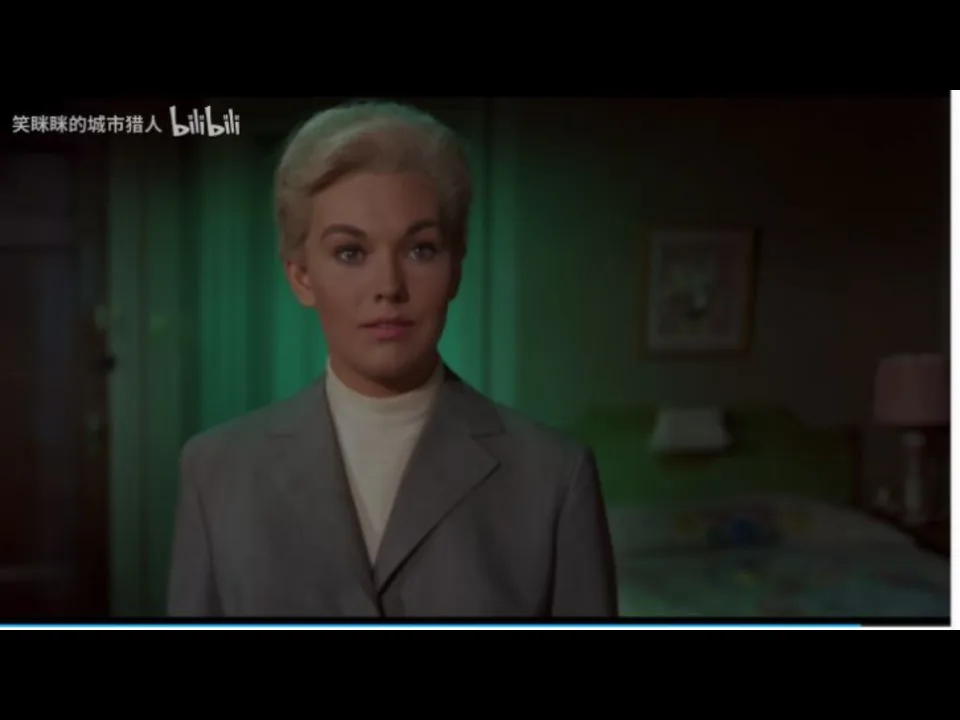
The spectator knows she is Judy while watching Scottie greet her as Madeleine returned; the overlap is first a relation of desire, knowledge, and control.
Open full-size still- Displayed still
- 01:55:20
- Discussion passage
- approx. 01:53:45—01:56:50 (01:55:20 still shows Judy after the hair-and-suit makeover against green-lit curtains and wall)
Reviewed passage by passage on the 02:07:27 single-part Bilibili repost with hard Chinese and English subtitles. 01:55:20 is the still anchor and 01:53:45—01:56:50 is the atlas's working boundary. Bilibili's official feature page ep291561 runs 02:07:49, and the repost may trim opening or closing material, so their timelines are not interchangeable.
Watch 01:53:45–01:56:50 and record costume, hair colour, hairstyle, green light, Scottie's reaction, embrace, circular camera movement, and stable overlap separately before judging which term actually changes the relation. The timecode applies only to the 02:07:27 repost BV1ECSHYoEwW; this carrier may trim opening or closing material, so the official feature page, Blu-ray, and other restorations require fresh location.
Still checked: 2026-09-01 · Carrier access checked: 2026-09-01
Image
Judy enters from the direction of the bathroom in a grey suit with her blonde hair pinned up; the curtains and wall are lit green.
Scottie approaches and embraces her as the camera circles the couple. The hotel room briefly overlaps with the earlier stable space before returning to the green room.
Sound
Dialogue recedes; the score expands as Judy appears, Scottie approaches, and the couple embrace.
Relation to the concept
Spectator foreknowledge, Scottie's desire, and Judy's controlled performance jointly determine the present image; relation is not an added theme but a condition of the image's formation.
Sources and further reading
- Cinema 1: The Movement-Image
Minnesota 1986 translation, chapter 12, pp. 197, 204–205 · These pages define the mental image's objects, Hitchcock's relational web, and the spectator's position, and directly explain Vertigo through variations in the relations of the Same. They do not analyze the atlas's chosen commission, letter, or green-light passages shot by shot; Rushton and the atlas's scene review bear those specific classifications.
- Cinema After Deleuze
Richard Rushton, Cinema After Deleuze (2012), pp. 56–57 · Rushton explains Scottie's remaking of Judy as regaining the object of desire and keeps spectator foreknowledge within the relational web; he does not directly analyze the green lighting or the 360-degree camera movement.
- Cinema 2: The Time-Image
Minnesota 1989 translation, chapter 4, pp. 68–70, 78–81 · These pages supply general criteria for actual–virtual relations and the crystal without naming Vertigo. The atlas therefore retains only a candidate and requires additional evidence of reciprocal circuit and indiscernibility.
- Bilibili · public 02:07:27 single-part repost of Vertigo with hard Chinese and English subtitles, reviewed passage by passage by the atlas; the uploader's collection notice describes a practice of trimming opening or closing material
01:55:20 · The spectator knows she is Judy while watching Scottie greet her as Madeleine returned; the overlap is first a relation of desire, knowledge, and control.
Strangers on a Train
Strangers on a Train (1951)
Supported by the scene
Foot contact starts the conversation: Bruno treats an offhand assent as agreement
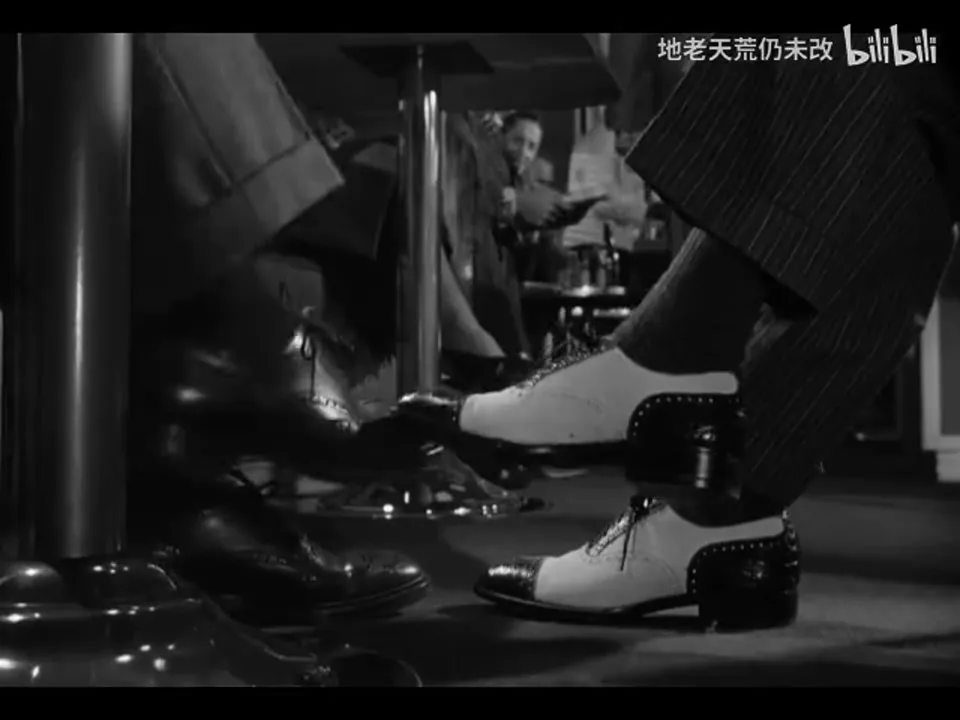
The foot contact produces only an encounter; Bruno then interprets it as acquaintance and rewrites Guy's words as consent to exchange murders.
Open full-size still- Displayed still
- 00:02:05
- Discussion passage
- approx. 00:00:52—00:09:30 (00:02:05 still shows Guy's dark shoe touching Bruno's two-tone brogue; the relational interpretation is completed in the ensuing conversation)
Reviewed passage by passage on the 01:40:27 single-part hard-subtitled Bilibili repost BV1SY6fYdEnV. 00:02:05 is the still anchor and 00:00:52—00:09:30 is the atlas's working boundary for the argument. These coordinates bind only this carrier; every other release or cut requires fresh location.
Watch 00:00:52–00:09:30 continuously: first record only shoes, rails, contact, lighter, and seating, then record how Bruno turns Guy's replies step by step into an exchange of murders. The timecode applies only to the 01:40:27 repost BV1SY6fYdEnV; Blu-ray, theatrical, and preview cuts require fresh location. A publicly reachable page and authorization to redistribute the feature are separate questions.
Still checked: 2026-09-01 · Carrier access checked: 2026-09-01
Image
The opening separately follows two pairs of shoes into the station—two-tone brogues and plainer dark shoes—while withholding both faces.
After crossing rails, the edit enters the compartment. Guy moves his foot into Bruno's, joining two previously parallel series.
Sound
Train and station sounds precede dialogue. After the contact, Guy apologizes first; Bruno takes the opening to recognize him as a tennis player and then introduces himself.
The ensuing conversation moves from newspapers, marriage, and Bruno's father to each man killing for the other. Guy treats the proposal as absurd talk, while Bruno retains his response as an agreement.
Relation to the concept
An accidental action is taken over by a third relation that continues to reorganize both agents and the spectator; Rushton, pp. 49–50, explicitly uses the opening to explain initiation of the web.
Sources and further reading
- Cinema 1: The Movement-Image
Minnesota 1986 translation, chapter 12, pp. 197–205, especially p. 201 · Page 201 defines the Hitchcockian third as relation and uses exchanged crimes to show relation entering action; pp. 203–204 distinguish mark, demark, and symbol in general. The primary text supplies neither the atlas's carrier coordinates nor a shot-by-shot assignment of eyeglasses and lighter to sign types; Rushton and carrier review bear that object-level chain.
- Deleuze’s Cinema Books: Three Introductions to the Taxonomy of Images
David Deamer, Deleuze’s Cinema Books (2016), pp. 132–137 · Deamer reconstructs the general taxonomy of relation-image, mark, demark, symbol, and spectator implication. It helps police the inference boundary but does not analyze Strangers on a Train shot by shot.
- Cinema After Deleuze
Richard Rushton, Cinema After Deleuze (2012), pp. 48–50 · Rushton develops five traits through Strangers on a Train: relational third, initiating action, exchange of crimes, series of marks and demarks, and film–spectator relation. Pages 49–50 treat the opening encounter, pp. 50–52 the exchanged crimes, lighter, and glasses, and pp. 52–53 the final proof and spectator trap.
- Bilibili · 地老天荒仍未改 · public 01:40:27 single-part repost of Strangers on a Train with hard Chinese and English subtitles; access without login, playback URL, and all three anchors checked, while the platform submission label does not establish authorization
00:02:05 · The foot contact produces only an encounter; Bruno then interprets it as acquaintance and rewrites Guy's words as consent to exchange murders.
Strangers on a Train
Strangers on a Train (1951)
Supported by the scene
Strangulation reflected in a fallen lens: this is not Miriam's point of view
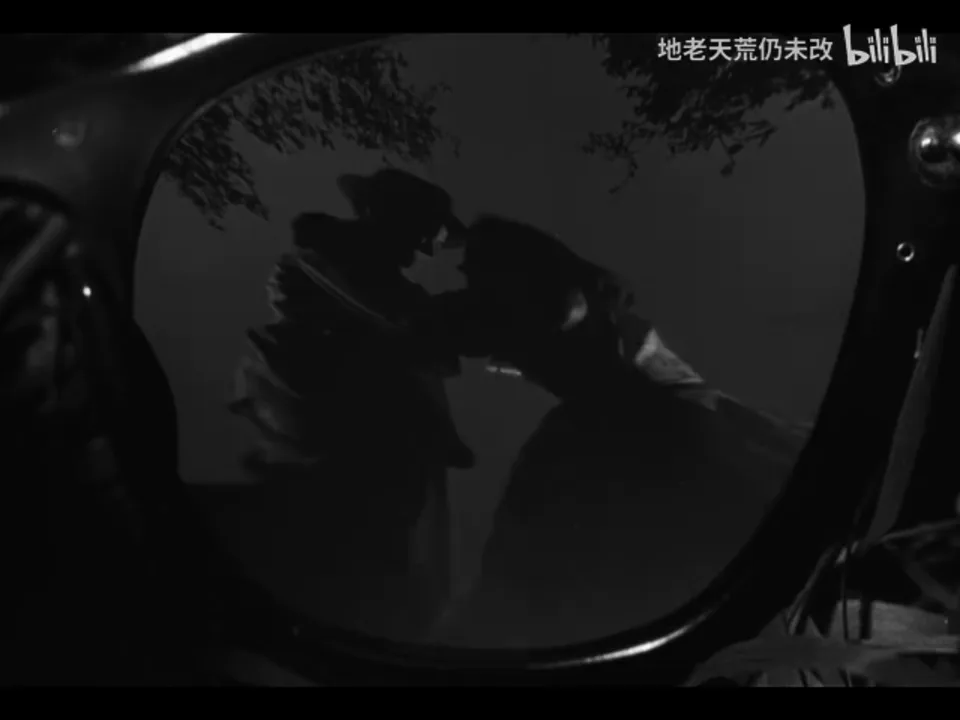
The strangulation is not presented in a frontal master shot but as a distorted reflection on the fallen lens. The lens organizes what the spectator sees without representing Miriam's point of view.
Open full-size still- Displayed still
- 00:26:30
- Discussion passage
- approx. 00:24:20—00:27:05 (00:26:30 still shows Bruno strangling Miriam in one lens of her fallen eyeglasses)
Reviewed passage by passage on the 01:40:27 single-part hard-subtitled Bilibili repost BV1SY6fYdEnV. 00:26:30 is the still anchor and 00:24:20—00:27:05 is the atlas's working boundary for the argument. These coordinates bind only this carrier; every other release or cut requires fresh location.
Watch 00:24:20–00:27:05, separately recording Bruno's pursuit, how the tunnel scream is temporarily reframed as horseplay at the exit, the fallen glasses, lens reflection, sound continuity, and subsequent removal of the glasses; do not treat reflection alone as conceptual proof. The timecode applies only to the 01:40:27 repost BV1SY6fYdEnV; Blu-ray, theatrical, and preview cuts require fresh location. A publicly reachable page and authorization to redistribute the feature are separate questions.
Still checked: 2026-09-01 · Carrier access checked: 2026-09-01
Image
Bruno follows Miriam and two companions into the fairground, rings the bell on the strength tester, and trails their boat through the Tunnel of Love.
Miriam's glasses fall on the grass. The strangulation is shown principally in one reflected lens, bending and compressing the two bodies while the frame remains visible.
Sound
Distant fairground music, machinery, and cries continue over the lens image without supplying an on-scene witness capable of intervention.
A scream first sounds inside the Tunnel of Love; as the boat emerges, Miriam's protests and laughter temporarily frame it as horseplay. Breathing and ambient sound dominate the later strangulation on the island.
Relation to the concept
Rushton p. 51 identifies the resemblance between Barbara's and Miriam's glasses, and Bruno's resulting trances, as a demark; p. 53 discusses spectator implication. Dellolio, pp. 5–6, analyzes the lens reflection. Connecting this reflected murder to Guy's wish, Barbara, and spectator knowledge is the atlas's cross-scene synthesis.
Sources and further reading
- Cinema 1: The Movement-Image
Minnesota 1986 translation, chapter 12, pp. 197–205, especially p. 201 · Page 201 defines the Hitchcockian third as relation and uses exchanged crimes to show relation entering action; pp. 203–204 distinguish mark, demark, and symbol in general. The primary text supplies neither the atlas's carrier coordinates nor a shot-by-shot assignment of eyeglasses and lighter to sign types; Rushton and carrier review bear that object-level chain.
- Deleuze’s Cinema Books: Three Introductions to the Taxonomy of Images
David Deamer, Deleuze’s Cinema Books (2016), pp. 132–137 · Deamer reconstructs the general taxonomy of relation-image, mark, demark, symbol, and spectator implication. It helps police the inference boundary but does not analyze Strangers on a Train shot by shot.
- Cinema After Deleuze
Richard Rushton, Cinema After Deleuze (2012), pp. 51, 53 · Rushton develops five traits through Strangers on a Train: relational third, initiating action, exchange of crimes, series of marks and demarks, and film–spectator relation. Pages 49–50 treat the opening encounter, pp. 50–52 the exchanged crimes, lighter, and glasses, and pp. 52–53 the final proof and spectator trap.
- Figures of Style in Strangers on a Train
Peter J. Dellolio, “Figures of Style in Strangers on a Train,” open PDF pp. 5–6 · Dellolio analyzes how canted framing, gate bars, the eyeglass reflection, and carousel write the Guy–Bruno parallel into space, and identifies the dying gesture that exposes the lighter on p. 2. The paper uses an Expressionist and psychological framework; the atlas borrows its verifiable shot observations without equating that psychology with Deleuze's relation-image.
- Bilibili · 地老天荒仍未改 · public 01:40:27 single-part repost of Strangers on a Train with hard Chinese and English subtitles; access without login, playback URL, and all three anchors checked, while the platform submission label does not establish authorization
00:26:30 · The strangulation is not presented in a frontal master shot but as a distorted reflection on the fallen lens. The lens organizes what the spectator sees without representing Miriam's point of view.
Strangers on a Train
Strangers on a Train (1951)
Supported by the scene
Exposed in Bruno's palm: how A to G reverses evidence
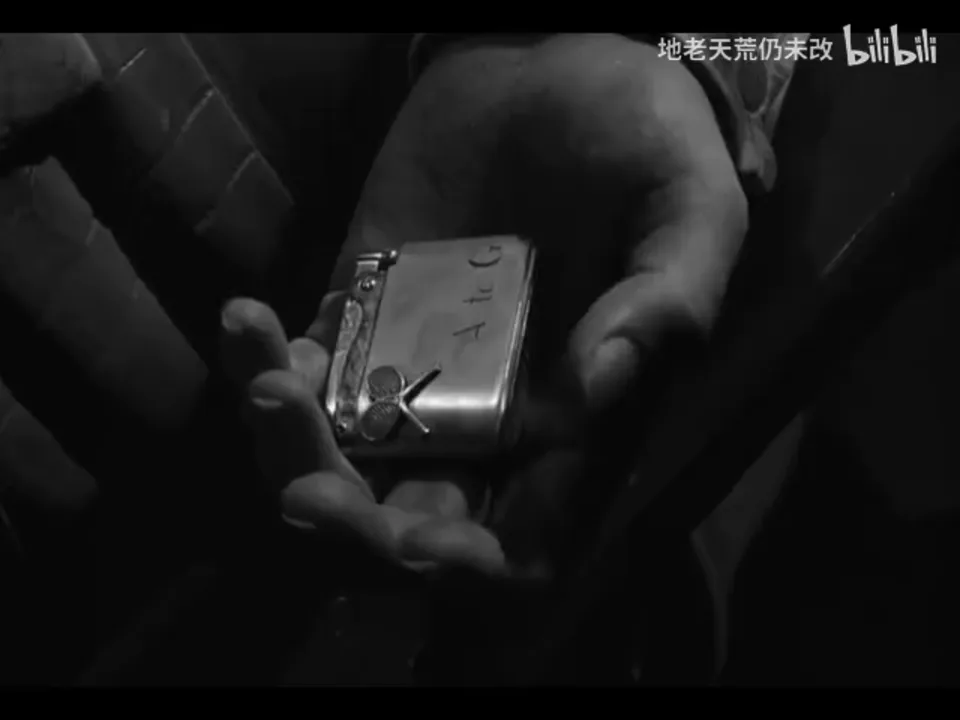
Bruno meant to leave it at the murder site to frame Guy. As he is dying, his clenched hand slowly opens and the object remains on his body. Together with the boatman's identification and Bruno's immediate denial, it shows that the framing attempt failed.
Open full-size still- Displayed still
- 01:38:45
- Discussion passage
- approx. 01:37:55—01:39:08 (01:38:45 still shows the A-to-G lighter exposed in Bruno's opened hand)
Reviewed passage by passage on the 01:40:27 single-part hard-subtitled Bilibili repost BV1SY6fYdEnV. 01:38:45 is the still anchor and 01:37:55—01:39:08 is the atlas's working boundary for the argument. These coordinates bind only this carrier; every other release or cut requires fresh location.
First watch from 01:24:30 for Bruno's concealment, dropping, and recovery of the lighter, then watch 01:37:55–01:39:08 continuously. Separate the object's location, holder, intended use, and actual evidentiary function into four columns. The timecode applies only to the 01:40:27 repost BV1SY6fYdEnV; Blu-ray, theatrical, and preview cuts require fresh location. A publicly reachable page and authorization to redistribute the feature are separate questions.
Still checked: 2026-09-01 · Carrier access checked: 2026-09-01
Image
After the carousel runs out of control and collapses, Bruno lies beside the wreckage while Guy, police, and fairground workers gather nearby.
As Bruno is dying, his clenched hand slowly opens. The film cuts to the open palm, where the lighter engraved A to G with crossed tennis rackets lies exposed.
Sound
After the boatman identifies Bruno, Guy tells Turley that Bruno has the lighter and meant to plant it on the island. Bruno denies this and insists that the lighter is still on the island.
Guy asks to go through Bruno's pockets while Bruno is still alive. Turley refuses permission, noting that Bruno says he does not have the lighter.
After Bruno is pronounced dead, Turley picks up the lighter from the already opened palm, asks Guy to identify it, and then confirms that Guy was right.
Ambient noise, rescue instructions, and brief dialogue replace the fairground's earlier cyclical music.
Relation to the concept
One concrete object changes position among gift, bond of exchange, framing device, and reversed evidence, clearly showing sign function as dependent on a relational series; Rushton, pp. 51–52, directly supports this reading.
Sources and further reading
- Cinema 1: The Movement-Image
Minnesota 1986 translation, chapter 12, pp. 197–205, especially p. 201 · Page 201 defines the Hitchcockian third as relation and uses exchanged crimes to show relation entering action; pp. 203–204 distinguish mark, demark, and symbol in general. The primary text supplies neither the atlas's carrier coordinates nor a shot-by-shot assignment of eyeglasses and lighter to sign types; Rushton and carrier review bear that object-level chain.
- Deleuze’s Cinema Books: Three Introductions to the Taxonomy of Images
David Deamer, Deleuze’s Cinema Books (2016), pp. 132–137 · Deamer reconstructs the general taxonomy of relation-image, mark, demark, symbol, and spectator implication. It helps police the inference boundary but does not analyze Strangers on a Train shot by shot.
- Cinema After Deleuze
Richard Rushton, Cinema After Deleuze (2012), pp. 51–52 · Rushton develops five traits through Strangers on a Train: relational third, initiating action, exchange of crimes, series of marks and demarks, and film–spectator relation. Pages 49–50 treat the opening encounter, pp. 50–52 the exchanged crimes, lighter, and glasses, and pp. 52–53 the final proof and spectator trap.
- Figures of Style in Strangers on a Train
Peter J. Dellolio, “Figures of Style in Strangers on a Train,” open PDF p. 2 and pp. 5–6 · Dellolio analyzes how canted framing, gate bars, the eyeglass reflection, and carousel write the Guy–Bruno parallel into space, and identifies the dying gesture that exposes the lighter on p. 2. The paper uses an Expressionist and psychological framework; the atlas borrows its verifiable shot observations without equating that psychology with Deleuze's relation-image.
- Bilibili · 地老天荒仍未改 · public 01:40:27 single-part repost of Strangers on a Train with hard Chinese and English subtitles; access without login, playback URL, and all three anchors checked, while the platform submission label does not establish authorization
01:38:45 · Bruno meant to leave it at the murder site to frame Guy. As he is dying, his clenched hand slowly opens and the object remains on his body. Together with the boatman's identification and Bruno's immediate denial, it shows that the framing attempt failed.
Rear Window
Rear Window (1954)
Candidate reading
After the flashbulb: does relation return to action or make the observer an object?
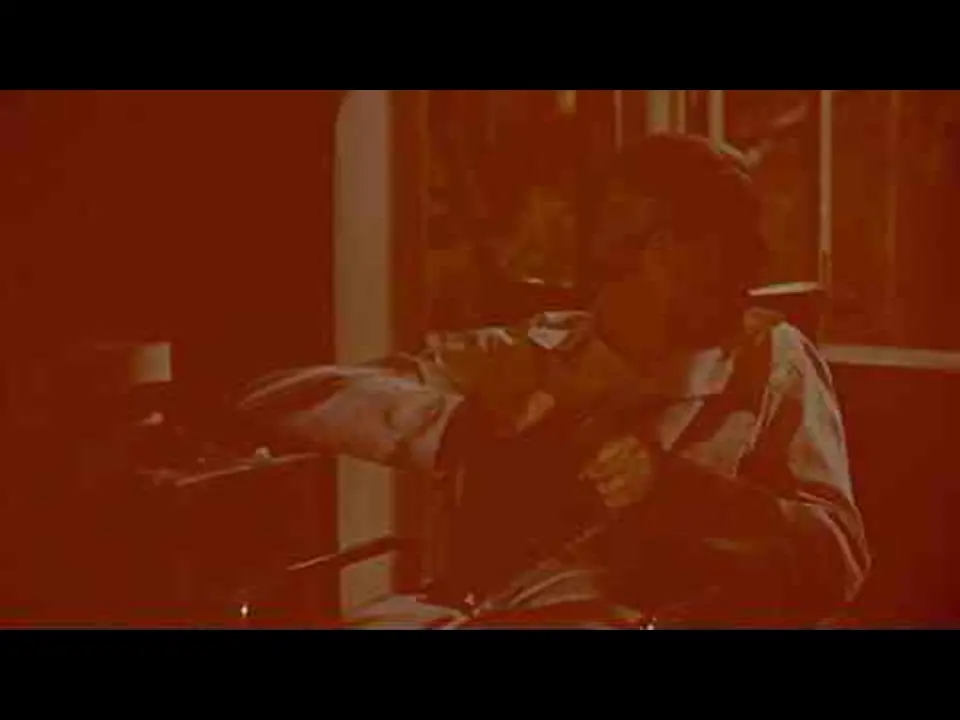
The flash is both a defensive act and a temporary image of the illuminated man's damaged vision. Relation persists, but direct struggle now occupies it.
Open full-size still- Displayed still
- 01:47:05
- Discussion passage
- approx. 01:45:40—01:47:20 (the passage in which Jeff uses flashbulbs to delay Thorwald's approach containing the 01:47:05 still)
Reviewed passage by passage on the 01:50:54 single-part Bilibili carrier with hard Chinese and English subtitles. 01:47:05 is the still anchor and 01:45:40—01:47:20 is the atlas's working boundary; opening credits and transitions may introduce seconds of drift across masters.
Still anchor 01:47:05; watch 01:45:40–01:47:20 and separately record the confrontation after Thorwald enters the dark room, his question, loading, afterimage, recovered vision, and renewed approach instead of treating one coloured frame as the concept. The timecode applies only to the 01:50:54 single-part BV1zvyTYMEqk carrier with hard Chinese and English subtitles; Blu-ray, DVD, and other streaming editions require fresh location.
Still checked: 2026-09-01 · Carrier access checked: 2026-09-01
Image
Thorwald enters the dark room and advances on Jeff; Jeff loads flashbulbs and fires them, after which the image shows a red or orange circular afterimage.
Repeated flashes only delay the approach; Thorwald ultimately seizes Jeff and forces him toward the window.
Sound
Around 01:46:00, Thorwald asks Jeff what he wants from him; loading and firing of bulbs, footsteps, and struggle follow.
Relation to the concept
Thorwald's returned look includes Jeff within the network he had organized; the flash afterimage alone is not sufficient evidence of a relation-image.
Sources and further reading
- Cinema 1: The Movement-Image
Minnesota 1986 translation, chapter 12, pp. 200–205, especially pp. 204–205 · Pages 200–202 explain how relation becomes an image-object; pp. 204–205 include the spectator in the relational web and explain Jeff's optical position “because he is in a state of immobility.” The primary text does not analyze the flashbulb struggle shot by shot; the atlas uses it as a countertest between relation-image and direct action.
- Deleuze’s Cinema Books: Three Introductions to the Taxonomy of Images
David Deamer, Deleuze’s Cinema Books (2016), pp. 132–135 · Deamer reconstructs the general taxonomy here: mark and demark are compositional signs of natural relations, while symbol is the genetic sign of abstract relations. These pages do not perform the atlas's shot analysis of Rear Window.
- Bilibili · public 01:50:54 single-part repost of Rear Window with hard Chinese and English subtitles, located and reviewed by the atlas; the specific master and restoration were not independently established
01:47:05 · The flash is both a defensive act and a temporary image of the illuminated man's damaged vision. Relation persists, but direct struggle now occupies it.
- Open the single-part hard-subtitled Rear Window carrier on Bilibili
Still anchor 01:47:05; watch 01:45:40–01:47:20 and separately record the confrontation after Thorwald enters the dark room, his question, loading, afterimage, recovered vision, and renewed approach instead of treating one coloured frame as the concept. The timecode applies only to the 01:50:54 single-part BV1zvyTYMEqk carrier with hard Chinese and English subtitles; Blu-ray, DVD, and other streaming editions require fresh location.
North by Northwest
North by Northwest (1959)
Candidate reading
The title grid enters the city: does relation appear before character?

At 00:00:50 the image is still a graphic title, not a street view. Only afterward does the grid continue into a glass façade, reflected traffic, and urban crowds. That continuity proposes a relational reading without letting one composition prove it.
Open full-size still- Displayed still
- 00:00:50
- Discussion passage
- approx. 00:00:15—00:02:15 (the green title grid bearing the white film title containing the 00:00:50 still)
Reviewed passage by passage on the 02:16:25 single-part dubbed BV1m2XTYuERk carrier. 00:00:50 is the still anchor and 00:00:15—00:02:15 the atlas's working passage, not a claim to final cut-by-cut boundaries. Credits, transitions, and end titles may introduce seconds of drift across masters.
Still anchor 00:00:50; watch 00:00:15–00:02:15 and distinguish in order the green graphic grid, glass façade, reflected traffic, street crowds, and character entrance without describing the anchor prematurely as a street view. The timecode applies only to the 02:16:25 single-part dubbed BV1m2XTYuERk carrier. The specific master or restoration was not independently established; other editions require fresh location.
Still checked: 2026-09-01 · Carrier access checked: 2026-09-01
Image
The credits first move diagonal lines, intersections, lettering, and directional arrows along coordinates on a green field; the 00:00:50 anchor has not yet entered live-action city space.
The graphic grid then joins the mullions of a glass curtain wall, which reflects vehicles, before the image moves into streets, building entrances, and crossing crowds.
Thornhill and his secretary enter the urban circulation near the end of the working passage, but the Kaplan misidentification has not yet occurred within it.
Sound
A continuous orchestral score governs the graphic titles and their transition into city images. Character dialogue enters only after the title passage; the atlas does not treat the score's structure by itself as evidence of a relation-image.
Relation to the concept
The continuity from graphic to urban relations proposes a candidate. Chapter 12, p. 202 does not directly analyze this title sequence, so any retrospective link from later relations remains subject to withdrawal.
Sources and further reading
- Cinema 1: The Movement-Image
Minnesota 1986 translation, chapter 12, p. 202 · Page 202 explains that Hitchcock makes relation itself the object of an image and conceives the film from the outset in relation to spectator response. The primary text does not name the 00:00:15–00:02:15 title grid; the time window, visible facts, and candidate argument are the atlas's responsibility.
- Cinema After Deleuze
Richard Rushton, Cinema After Deleuze (2012), pp. 48–53 · Across these pages Rushton develops five general features of Hitchcock's relation-image through Strangers on a Train and Vertigo. North by Northwest enters only as a listed example of wrong identity, the exchange-of-crime tradition, and the crop-duster demark. The book does not supply the atlas's shot-level analysis of the title grid, the attack, or the final match cut.
- Bilibili · BV1m2XTYuERk · reviewed 02:16:25 single-part dubbed carrier; the specific master and restoration were not independently established
00:00:50 · At 00:00:50 the image is still a graphic title, not a street view. Only afterward does the grid continue into a glass façade, reflected traffic, and urban crowds. That continuity proposes a relational reading without letting one composition prove it.
- Open the single-part dubbed North by Northwest carrier on Bilibili
Still anchor 00:00:50; watch 00:00:15–00:02:15 and distinguish in order the green graphic grid, glass façade, reflected traffic, street crowds, and character entrance without describing the anchor prematurely as a street view. The timecode applies only to the 02:16:25 single-part dubbed BV1m2XTYuERk carrier. The specific master or restoration was not independently established; other editions require fresh location.
North by Northwest
North by Northwest (1959)
Countertest
From cliffside pull to train berth: how action and marriage reclose relation
The anchor has already left the cliff. The preceding rescue pull continues through a match cut into an embrace in the berth. The cut compresses unseen escape, marriage, and travel rather than leaving relation unresolved.
Open full-size still- Displayed still
- 02:15:59
- Discussion passage
- approx. 02:15:40—02:16:08 (the ending after the match cut, with the couple embracing in the train berth containing the 02:15:59 still)
Reviewed passage by passage on the 02:16:25 single-part dubbed BV1m2XTYuERk carrier. 02:15:59 is the still anchor and 02:15:40—02:16:08 the atlas's working passage, not a claim to final cut-by-cut boundaries. Credits, transitions, and end titles may introduce seconds of drift across masters.
Still anchor 02:15:59; watch 02:15:40–02:16:08 and separately record the cliffside hand pull, cut point, berth pull and embrace, married form of address, and exterior train view to test whether relation remains unresolved. The timecode applies only to the 02:16:25 single-part dubbed BV1m2XTYuERk carrier. The specific master or restoration was not independently established; other editions require fresh location.
Still checked: 2026-09-01 · Carrier access checked: 2026-09-01
Image
On the Mount Rushmore cliff, Eve hangs at the rock edge while Thornhill holds her hand and pulls upward.
Before the rescue is shown as a completed climb, the film matches the upward pull into a train berth: Thornhill draws Eve toward him and the couple embrace in the compartment.
The 02:15:59 anchor shows the berth embrace, not the cliff; an exterior train view at the passage's end carries the journey forward.
Sound
After the match cut, the dubbed dialogue addresses Eve with a married form of address, presenting the relation as an accomplished marriage. This record does not invent the unshown wedding process from that line.
Relation to the concept
The cut asks the spectator to understand the relation between two spaces and omitted events, yet primarily closes relation as action and marital resolution. It tests the tendency to classify every ingenious cut as a relation-image.
Sources and further reading
- Cinema 1: The Movement-Image
Minnesota 1986 translation, chapter 12, pp. 204–205 · Pages 204–205 discuss the spectator's inclusion in the relational network and Hitchcock's completion of the movement-image at the threshold of the mental image. The primary text does not name the 02:15:40–02:16:08 cliff-to-berth cut; the atlas is responsible for the passage facts and countertest.
- Cinema After Deleuze
Richard Rushton, Cinema After Deleuze (2012), pp. 48–53 · Across these pages Rushton develops five general features of Hitchcock's relation-image through Strangers on a Train and Vertigo. North by Northwest enters only as a listed example of wrong identity, the exchange-of-crime tradition, and the crop-duster demark. The book does not supply the atlas's shot-level analysis of the title grid, the attack, or the final match cut.
- Bilibili · BV1m2XTYuERk · reviewed 02:16:25 single-part dubbed carrier; the specific master and restoration were not independently established
02:15:59 · The anchor has already left the cliff. The preceding rescue pull continues through a match cut into an embrace in the berth. The cut compresses unseen escape, marriage, and travel rather than leaving relation unresolved.
- Open the single-part dubbed North by Northwest carrier on Bilibili
Still anchor 02:15:59; watch 02:15:40–02:16:08 and separately record the cliffside hand pull, cut point, berth pull and embrace, married form of address, and exterior train view to test whether relation remains unresolved. The timecode applies only to the 02:16:25 single-part dubbed BV1m2XTYuERk carrier. The specific master or restoration was not independently established; other editions require fresh location.
The Birds
The Birds (1963)
Candidate reading
Caged birds, the shop-assistant role, and lovebirds: how ordinary relations are established
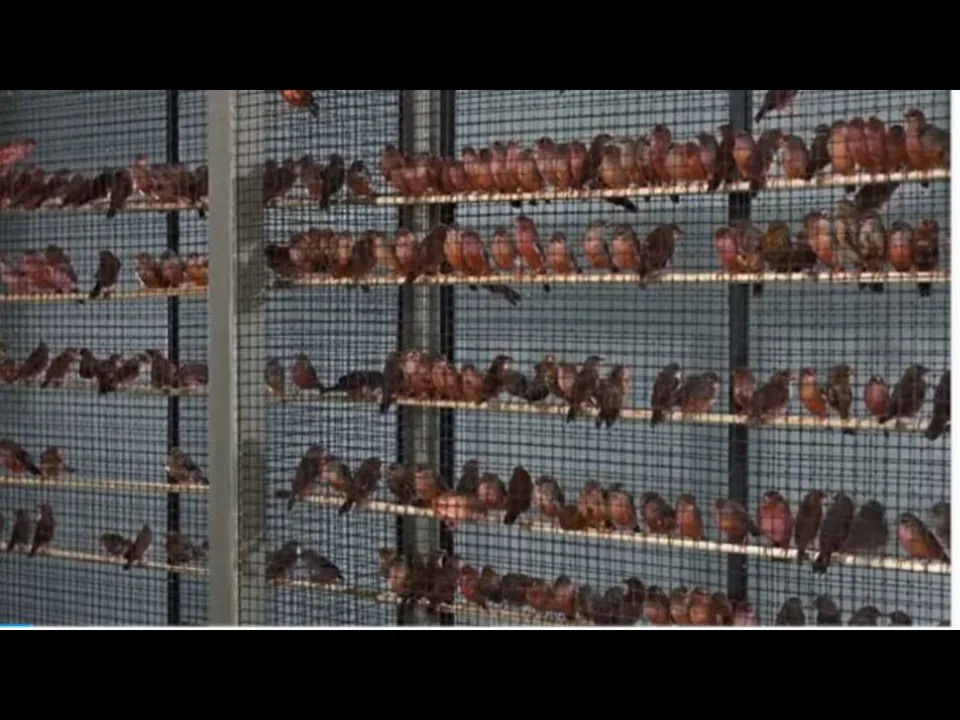
Before any attack, birds enter interpersonal exchange as merchandise, classified objects, and a lovebird gift; number alone is not yet a mark.
Open full-size still- Displayed still
- 00:04:31
- Discussion passage
- approx. 00:02:00—00:07:10 (00:04:31 still shows birds filling a wall of cages)
Reviewed passage by passage on the 01:59:24 single-part Bilibili repost. 00:04:31 is the still anchor and 00:02:00—00:07:10 is the atlas's working boundary. Bilibili's official feature page ep291861 runs 01:59:30, so the two carriers cannot share second-level coordinates.
Watch 00:02:00–00:07:10 continuously and record each shift of the birds among merchandise, classified object, gift, and medium of flirtation. The timecode applies only to the 01:59:24 single-part repost BV1jJ411g7Yj; the official feature page, Blu-ray, and other streaming editions require fresh location.
Still checked: 2026-09-01 · Carrier access checked: 2026-09-01
Image
The passage cuts among Melanie, Mitch, cage racks, and individual cages as the two figures change position across the counter and caged birds.
The 00:04:31 anchor shows neither Mitch nor Melanie: stacked cages fill the frame and small birds line the perches.
Sound
Bird calls continue through the conversation. Mitch repeatedly asks about species and care, and Melanie's answers gradually reveal her unfamiliarity with the shop.
In the dialogue, lovebirds names both a species and the gift Mitch wants for his sister.
Relation to the concept
Birds initiate interpersonal exchange as a third term, but this passage alone does not establish a relation-image; it must hold together with the later series.
Sources and further reading
- Cinema 1: The Movement-Image
Minnesota 1986 translation, chapter 12, pp. 197, 203–204 · Page 197 gives the mental image's three classes of thought-object; pp. 203–204 distinguish mark, demark, and symbol. Page 204 directly names the first attacking gull and the flock as a whole, but it does not analyze the pet shop or playground shot by shot.
- Deleuze’s Cinema Books: Three Introductions to the Taxonomy of Images
David Deamer, Deleuze’s Cinema Books (2016), pp. 132–137 · Deamer reconstructs the operative difference among mark, demark, and symbol: a habitual series, an anomalous term departing from that series, and a concrete term bearing abstract relations. The pages provide criteria rather than classifying these three passages for the atlas.
- Cinema After Deleuze
Richard Rushton, Cinema After Deleuze (2012), p. 50 · Rushton lists Melanie and Mitch's meeting as an initiating event in the relational chain; he does not thereby classify the pet-shop passage shot by shot as a mark.
- Bilibili · public 01:59:24 single-part repost of The Birds, reviewed passage by passage by the atlas; the specific master, grade, and restoration were not independently established
00:04:31 · Before any attack, birds enter interpersonal exchange as merchandise, classified objects, and a lovebird gift; number alone is not yet a mark.
The Birds
The Birds (1963)
Candidate reading
The song continues as the flock takes form: when number begins to bear relations
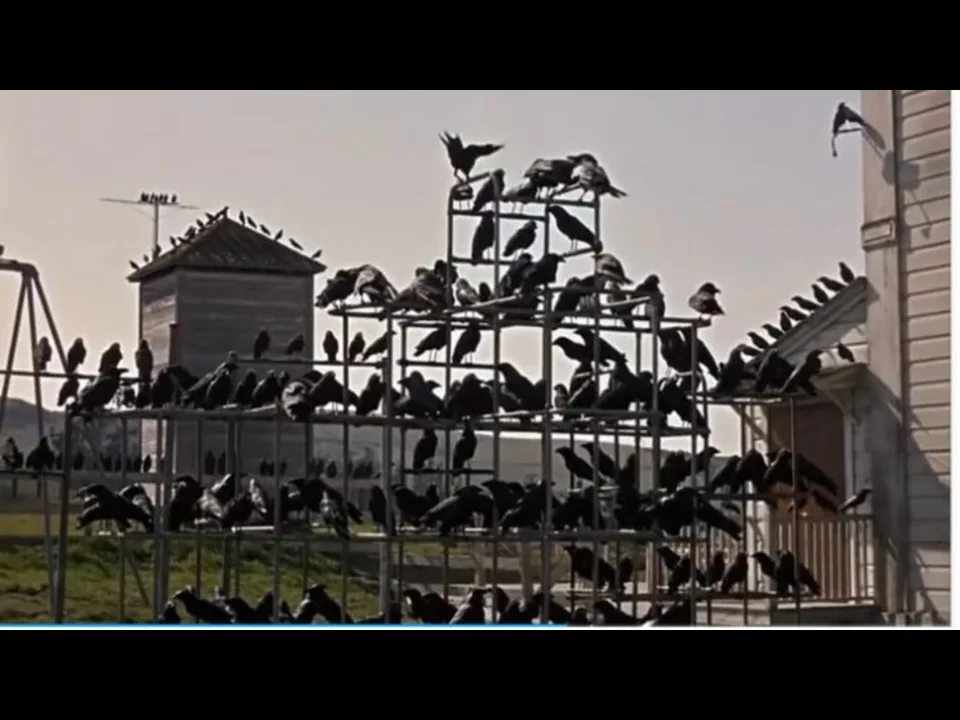
The flock makes play equipment, the children's song, the school boundary, and the imminent evacuation parts of the same danger.
Open full-size still- Displayed still
- 01:11:22
- Discussion passage
- approx. 01:09:45—01:12:15 (01:11:22 still shows the flock covering the climbing frame and nearby rooflines)
Reviewed passage by passage on the 01:59:24 single-part Bilibili repost. 01:11:22 is the still anchor and 01:09:45—01:12:15 is the atlas's working boundary. Bilibili's official feature page ep291861 runs 01:59:30, so the two carriers cannot share second-level coordinates.
Watch 01:09:45–01:12:15 continuously, recording the birds' positions at every cutback, whether the children's song continues, when Melanie turns, and how the classroom changes from learning space to point of evacuation. The timecode applies only to the 01:59:24 single-part repost BV1jJ411g7Yj; the official feature page, Blu-ray, and other streaming editions require fresh location.
Still checked: 2026-09-01 · Carrier access checked: 2026-09-01
Image
Melanie smokes alone on a bench outside the school. The film repeatedly cuts from her to the climbing frame behind her; more crows have landed on each return while she does not turn around.
A passing crow finally guides her look backward. The climbing frame, nearby roofs, and ground are now crowded with birds, after which she enters the classroom to organize the children's departure.
Sound
Children repeat the same song off screen; it continues across successive cuts between Melanie and the climbing frame.
After the flock is discovered, the song gives way to scattered bird calls, shouts, and warnings to evacuate.
Relation to the concept
Page 204 supports the flock as a whole as symbol; treating this particular playground passage as its concrete bearer is a site-level candidate tested against that criterion.
Sources and further reading
- Cinema 1: The Movement-Image
Minnesota 1986 translation, chapter 12, p. 204 · Page 204 states that “the thousands of birds … are a symbol.” It names neither the playground nor 01:11:22. The atlas uses that film-level judgement to constrain its playground analysis rather than passing off shot description as the primary text.
- Deleuze’s Cinema Books: Three Introductions to the Taxonomy of Images
David Deamer, Deleuze’s Cinema Books (2016), pp. 132–137 · Deamer reconstructs the operative difference among mark, demark, and symbol: a habitual series, an anomalous term departing from that series, and a concrete term bearing abstract relations. The pages provide criteria rather than classifying these three passages for the atlas.
- Bilibili · public 01:59:24 single-part repost of The Birds, reviewed passage by passage by the atlas; the specific master, grade, and restoration were not independently established
01:11:22 · The flock makes play equipment, the children's song, the school boundary, and the imminent evacuation parts of the same danger.
Films and scenes
Rear Window first uses its opening camera movement to join cast, crash photographs, damaged camera, and courtyard into a position of looking. At 01:40:25 the wedding ring—directly named as a symbol in the primary text—contracts disappearance, marriage, crime, Jeff's inference, and spectator knowledge into one concrete object. The 01:47:05 flash confrontation remains a countertest: when looking contracts into stimulus, delay, and defence, does relation still govern action?
IMDb identification poster ↗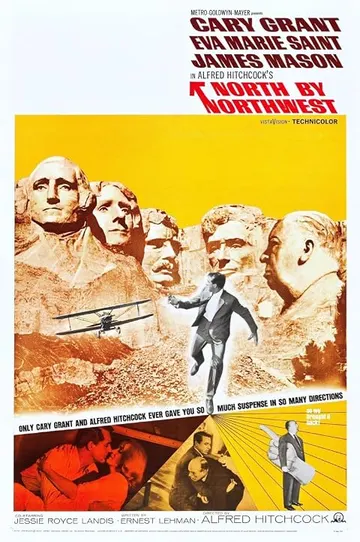
The farmland passage in North by Northwest first establishes a habitual series of waiting, road, vehicles, and fields. The observation that there are no crops to spray makes the crop-duster a relational contradiction rather than a sign by mere visual oddity. That contradiction reroutes the established interpretation and meets the demark criterion. The opening grid remains a candidate, while the marital closure in the train berth countertests whether relation still exceeds action.
IMDb identification poster ↗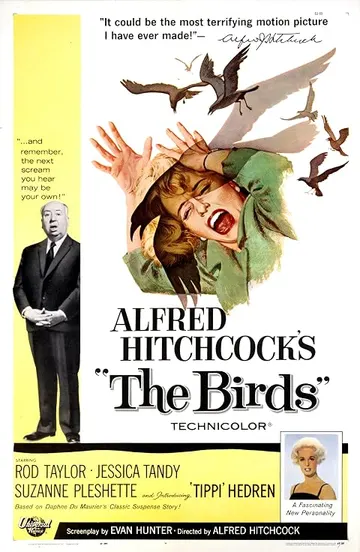
Cinema 1, p. 204 directly distinguishes two signs in The Birds: the first gull attacking the heroine reroutes prior relations and is therefore a demark, while the thousands of birds or flock as a whole form a symbol bearing abstract relation. The atlas binds pet shop, bay crossing, and playground to 00:04:31, 00:25:23, and 01:11:22. The pet shop only proposes an ordinary human–bird relation; the playground must show the flock changing song, the use of school space, and evacuation rather than substituting quantity for the criterion of symbol.
IMDb identification poster ↗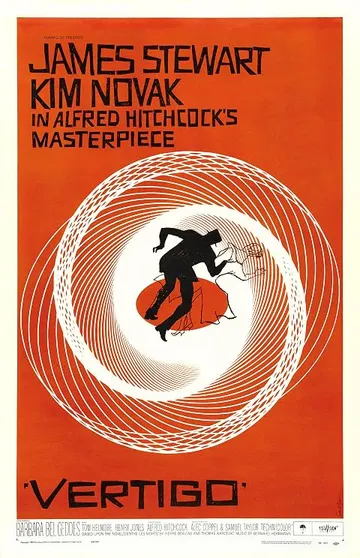
Cinema 1, pp. 204–205 both supplies a general criterion for Hitchcock's incorporation of spectator response into a relational web and directly explains Vertigo through variations in the Same's relations to the dead woman, husband, and detective. It does not, however, parse the atlas's chosen commission, unsent-letter, and green-lit remaking passages shot by shot. Rushton, pp. 53–57, supports that locatable mechanism: Elster's commission governs observation through the absent Carlotta, Judy's unsent letter lets the spectator know the deception before Scottie, and remaking then unfolds within that knowledge gap. The atlas provides carrier coordinates for all three passages. The boundary is Rushton p. 124, which classifies the dolly zoom as an affection-image; positive relation-image evidence therefore lies in commission, spectator foreknowledge, and the remaking apparatus rather than in the vertigo effect itself.
IMDb identification poster ↗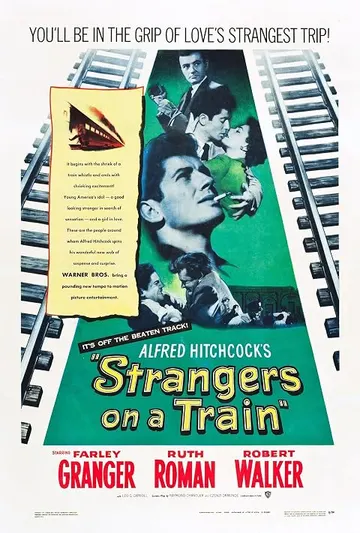
Strangers on a Train makes relation precede and reorganize its two agents. Bruno interprets the accidental foot contact at 00:02:05 as an exchange contract; the lens at 00:26:30 directly joins killer, victim, and a lost optical device, while Guy's voiced wish and the spectator who already knows the exchange enter through surrounding passages; and at 01:38:45 the lighter has moved from gift to relational mark and framing device before reversing into evidence that Bruno possessed the object and lied about it. Together with the boatman's identification, it changes the police judgement. Cinema 1, p. 201 directly uses exchanged crimes to show a third relation entering action, while Rushton, pp. 49–53, directly analyzes encounter, glasses, lighter, and the film–spectator relation. The atlas supplies the three checked carrier coordinates. The specific mark–demark functions of glasses and lighter belong to Rushton and the atlas's shot judgement rather than to a shot-by-shot naming by Deleuze.
IMDb identification poster ↗Related film readings · 5 films
Rear Window · 1954 · Meets the test — Rear Window first uses its opening camera movement to join cast, crash photographs, damaged camera, and courtyard into a position of looking. At 01:40:25 the wedding ring—directly named as a symbol in the primary text—contracts disappearance, marriage, crime, Jeff's inference, and spectator knowledge into one concrete object. The 01:47:05 flash confrontation remains a countertest: when looking contracts into stimulus, delay, and defence, does relation still govern action?
Vertigo · 1958 · Meets the test — Cinema 1, pp. 204–205 both supplies a general criterion for Hitchcock's incorporation of spectator response into a relational web and directly explains Vertigo through variations in the Same's relations to the dead woman, husband, and detective. It does not, however, parse the atlas's chosen commission, unsent-letter, and green-lit remaking passages shot by shot. Rushton, pp. 53–57, supports that locatable mechanism: Elster's commission governs observation through the absent Carlotta, Judy's unsent letter lets the spectator know the deception before Scottie, and remaking then unfolds within that knowledge gap. The atlas provides carrier coordinates for all three passages. The boundary is Rushton p. 124, which classifies the dolly zoom as an affection-image; positive relation-image evidence therefore lies in commission, spectator foreknowledge, and the remaking apparatus rather than in the vertigo effect itself.
The Birds · 1963 · Meets the test — Cinema 1, p. 204 directly distinguishes two signs in The Birds: the first gull attacking the heroine reroutes prior relations and is therefore a demark, while the thousands of birds or flock as a whole form a symbol bearing abstract relation. The atlas binds pet shop, bay crossing, and playground to 00:04:31, 00:25:23, and 01:11:22. The pet shop only proposes an ordinary human–bird relation; the playground must show the flock changing song, the use of school space, and evacuation rather than substituting quantity for the criterion of symbol.
Strangers on a Train · 1951 · Meets the test — Strangers on a Train makes relation precede and reorganize its two agents. Bruno interprets the accidental foot contact at 00:02:05 as an exchange contract; the lens at 00:26:30 directly joins killer, victim, and a lost optical device, while Guy's voiced wish and the spectator who already knows the exchange enter through surrounding passages; and at 01:38:45 the lighter has moved from gift to relational mark and framing device before reversing into evidence that Bruno possessed the object and lied about it. Together with the boatman's identification, it changes the police judgement. Cinema 1, p. 201 directly uses exchanged crimes to show a third relation entering action, while Rushton, pp. 49–53, directly analyzes encounter, glasses, lighter, and the film–spectator relation. The atlas supplies the three checked carrier coordinates. The specific mark–demark functions of glasses and lighter belong to Rushton and the atlas's shot judgement rather than to a shot-by-shot naming by Deleuze.
North by Northwest · 1959 · Meets the test — The farmland passage in North by Northwest first establishes a habitual series of waiting, road, vehicles, and fields. The observation that there are no crops to spray makes the crop-duster a relational contradiction rather than a sign by mere visual oddity. That contradiction reroutes the established interpretation and meets the demark criterion. The opening grid remains a candidate, while the marital closure in the train berth countertests whether relation still exceeds action.
Criteria
First list the habitual series, then identify the demark that makes it deviate or contradict itself, or the concrete symbol that bears several relations or variations of one relation. Finally show how the film lets spectators know or discover the relation ahead of a character and incorporates that response into framing, editing, and suspense rather than merely making them wait for a solution.
Distinctions and counterexamples
Detective solution, a network of characters, cross-cutting, or an anomalous prop may still treat relation as information consumed by action. Relation ceases to be a plot clue only when it transforms the organization of perception, affection, and action and includes the spectator within it.
Common confusion: Relations among characters, three people in a frame, multilinear narration, suspense clues, or a twist ending do not automatically constitute Thirdness. Relation must become the image's object and frame, transforming perception, affection, action, and the spectator's position.
Texts and sources
Cinema 1, ch. 12, pp. 197–205 (Minnesota 1986)
- 01Cinema 1: The Movement-Image
Standard Minnesota English translation and a principal citation edition in Anglophone scholarship.
View source and edition →
Research disagreements
Replacement or coexistence?
The time-image reverses the subordination of time to movement; both regimes persist and can shift locally within one film.
Taxonomy or generator?
Fixed labels invite mere example-hunting; an open taxonomy requires new concepts to transform existing relations and explain across cases.
How do we use Deleuze precisely?
Test four layers: sensory-motor relation, actual/virtual circuit, audio-visual connection, and regime of truth.
Concepts to distinguish
Compare them
- Movement-imageimage-mouvement
The movement-image is a regime in which movement differentiates into perception, affection, impulse, action, reflection, and mental relation to organize the image directly, while time appears indirectly through movement and montage. The relation-image is a decisive realization within the mental-image's problem-field, not an additional source-level rank parallel to it, and films need not pass through one fixed action-chain.
→ - Impulse-imageimage-pulsion
The impulse-image stands between affection and action. Deleuze divides its naturalist structure into four terms arranged in two pairs: originary world/derived milieu and elementary impulse/real behaviour. A historically, geographically, and socially determinate derived milieu remains present while elementary impulse penetrates real behaviour from within; impulse seizes object-fragments from that milieu and thereby exposes an uncoordinated originary world. Symptom and fetish are not additional structural terms but two classes of signs: a symptom is the appearance of impulse in the derived milieu, while a fetish is the appearance of the seized object-fragment itself. Stroheim realizes this structure through decay, descent, and entropy; Buñuel through repetition, cycles, and restart. These are distinct realizations, not cumulative thresholds that every example must satisfy.
→ - Action-image: large formgrande forme de l'image-action
The large form of the action-image follows S–A–S′. A milieu, collective, historical pressure, or danger first composes an encompassing situation S; that pressure leaves an internal imprint upon the character and concentrates itself in action A as effort, duel, or collective coordination; action then carries the milieu into a situation S′ different from the initial one. Its decisive question is how a situation demands action and whether action actually reorganizes that situation.
→ - Action-image: small formpetite forme de l'image-action
The small form of the action-image follows A–S–A′. It begins from an action A already underway whose meaning remains equivocal; indices of lack or ambiguity progressively disclose the situation S in which that act is embedded, forcing a revised action A′. The situation is not given in advance as a known whole but inferred through local gestures, misrecognitions, clues, gags, and the consequences of action.
→ - Reflection-imageimage-réflexion
Following Cinema 2, pp. 32–33, which retrospectively revisits the first semiotics, the atlas gathers the figures developed in Cinema 1, chapters 10–11—attraction, inversion, and discourse—under reflection-image. All three still transform the situation–action relation from within the action forms: attraction uses a substitute or rehearsal to miniaturize, prefigure, or stage another situation or act; inversion exchanges large and small powers; discourse makes an implicit problem into an audible and visible object of thought. Reflection-image must not be prematurely equated with chapter 12's relation-image.
→ - Mental-imageimage mentale
In Cinema 1's strict usage, the mental-image first names a problem-field: images take relations, symbolic acts, and intellectual feelings as their objects rather than representing states inside a character's head. Relations are external to their terms and irreducible to the attributes of any one term; symbolic acts and intellectual feelings must likewise become operations of image, sound, and editing rather than plot content. The atlas gives mental-image and relation-image separate pages only as reading interfaces for this problem-field and its Hitchcockian realization through Thirdness. The source does not rank them as parallel levels or make the former a superclass of recollection- and dream-images.
→ - Crisis of the action-imagecrise de l'image-action
The crisis of the action-image is not the disappearance of movement but the loss of a credible bond among situation, perception, and action capable of changing the world. Cinema 1 lists a constellation of five surface symptoms: dispersive situations that replace a totality with gaps; deliberately weak links among events; wandering that displaces goal-directed travel; consciousness of clichés, as figures and spectators begin to recognize how ready-made schemata obscure real relations; and the exposure or denunciation of conspiracy—the network of control behind the plot. These are external negative conditions for a new image-regime, not a checklist that every film and every sequence must complete.
→