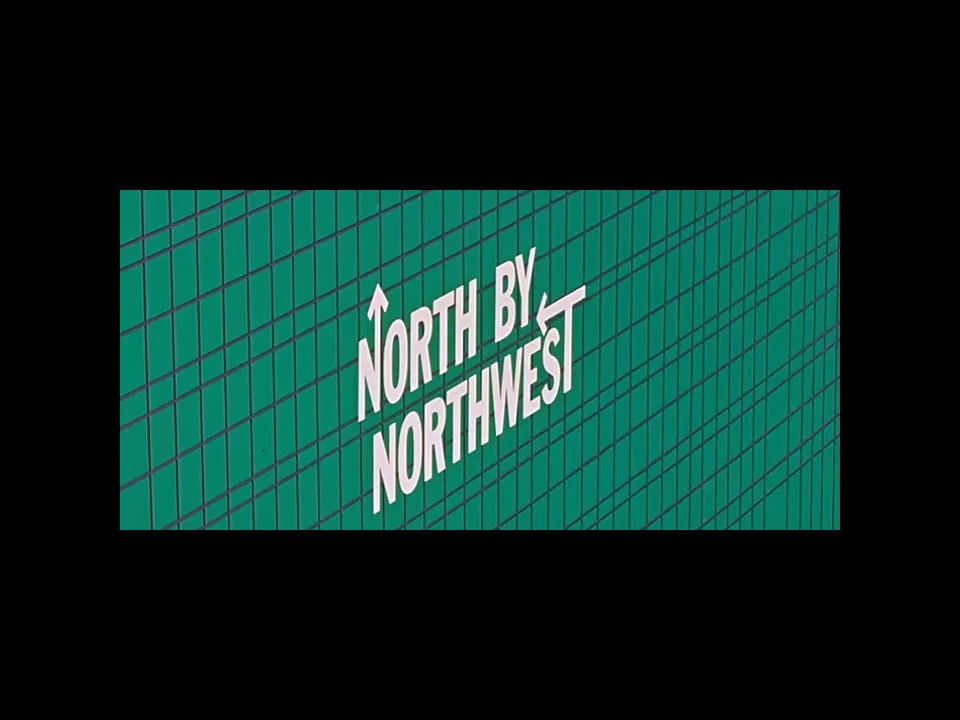
 00:00:50
Mental and relational image · SHOT EVIDENCE
The title grid enters the city: does relation appear before character?
Does the title sequence merely make a clever transition into New York, or first establish a relational space in which positions will be assigned, occupied, and mistaken?
Film and viewing version
North by Northwest · North by Northwest · Alfred Hitchcock / 阿尔弗雷德·希区柯克 · 1959
Reviewed passage by passage on the 02:16:25 single-part dubbed BV1m2XTYuERk carrier. 00:00:50 is the still anchor and 00:00:15—00:02:15 the atlas's working passage, not a claim to final cut-by-cut boundaries. Credits, transitions, and end titles may introduce seconds of drift across masters.
Version boundary: The timecodes on this page apply only to the named viewing carrier. Restorations, differing leaders, or platform transcodes may shift them.
Passage and still timecodes
approx. 00:00:15—00:02:15 (the green title grid bearing the white film title containing the 00:00:50 still)
The window locates the passage; its boundaries remain approximate
The passage window and still anchor are separate coordinates: the Bilibili still at 00:00:50 was checked on 2026-09-01; it does not turn an approximate passage on another carrier into exact bounds.
Visible facts
- 01
The credits first move diagonal lines, intersections, lettering, and directional arrows along coordinates on a green field; the 00:00:50 anchor has not yet entered live-action city space.
- 02
The graphic grid then joins the mullions of a glass curtain wall, which reflects vehicles, before the image moves into streets, building entrances, and crossing crowds.
- 03
Thornhill and his secretary enter the urban circulation near the end of the working passage, but the Kaplan misidentification has not yet occurred within it.
Audible facts
- 01
A continuous orchestral score governs the graphic titles and their transition into city images. Character dialogue enters only after the title passage; the atlas does not treat the score's structure by itself as evidence of a relation-image.
Action relation
Grid, façade, and crowd first present the city as an arrangement of positions and channels; only then does a character appear as one moving term within it. This can prefigure the later relations of names, institutions, and misidentification, but no wrong identity has yet been produced.
Temporal relation
A graphic-to-live-action transformation compresses abstract coordinates, architectural surface, and urban circulation into one continuous present. It does not directly present past or future and is insufficient to reclassify the passage as a time-image.
Conceptual reading
Visual resemblance between grid and façade is not sufficient to prove a relation-image. The title passage remains a candidate prelude to relational form only if the later film repeatedly subjects the character's position to names, institutions, others' actions, and relations known by the spectator. If that link can be supplied only by thematic association, withdraw it.
Concepts used in the judgement
- Relation-imageimage-relation · CANDIDATE
The continuity from graphic to urban relations proposes a candidate. Chapter 12, p. 202 does not directly analyze this title sequence, so any retrospective link from later relations remains subject to withdrawal.
→ - Mental-imageimage mentale · CANDIDATE
The titles may make positional relation itself an object of viewing, but grid, moving type, or city montage alone is not a sufficient condition for a mental image.
→ - Sensory-motor schemaschème sensori-moteur · ADJACENT
Urban circulation remains composed of walking, traffic, and professional action; the passage shows no breakdown of the sensory-motor circuit.
→
Primary and scholarly coordinates
- 01Cinema 1: The Movement-Image
Minnesota 1986 translation, chapter 12, p. 202
Page 202 explains that Hitchcock makes relation itself the object of an image and conceives the film from the outset in relation to spectator response. The primary text does not name the 00:00:15–00:02:15 title grid; the time window, visible facts, and candidate argument are the atlas's responsibility.
- 02Cinema After Deleuze
Richard Rushton, Cinema After Deleuze (2012), pp. 48–53
Across these pages Rushton develops five general features of Hitchcock's relation-image through Strangers on a Train and Vertigo. North by Northwest enters only as a listed example of wrong identity, the exchange-of-crime tradition, and the crop-duster demark. The book does not supply the atlas's shot-level analysis of the title grid, the attack, or the final match cut.
Terminological coordinates
- relation-imageimage-relation
Requires relation to keep governing character and spectator rather than turning geometry directly into a concept.
→ - mental imageimage mentale
Tests whether relation becomes an image-object rather than remaining visual design.
→ - sensory-motor schemaschème sensori-moteur
Prevents a striking title transition from being mistaken for a crisis of action.
→
Chapter relations
Viewing and still sources
Direct scene · Still anchor 00:00:50; watch 00:00:15–00:02:15 and distinguish in order the green graphic grid, glass façade, reflected traffic, street crowds, and character entrance without describing the anchor prematurely as a street view. The timecode applies only to the 02:16:25 single-part dubbed BV1m2XTYuERk carrier. The specific master or restoration was not independently established; other editions require fresh location.