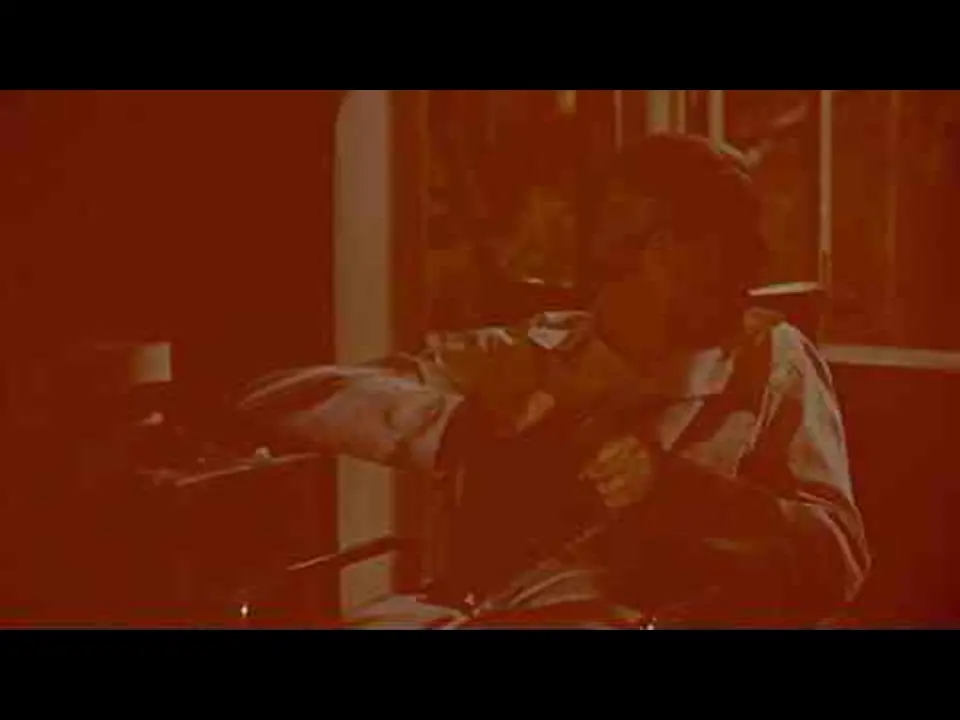
 01:47:05
Mental and relational image · SHOT EVIDENCE
After the flashbulb: does relation return to action or make the observer an object?
Once the target finds the observer, does relation still govern the image, or has the film returned to a direct chain of stimulus, defence, and failure?
Film and viewing version
Rear Window · Rear Window · Alfred Hitchcock / 阿尔弗雷德·希区柯克 · 1954
Reviewed passage by passage on the 01:50:54 single-part Bilibili carrier with hard Chinese and English subtitles. 01:47:05 is the still anchor and 01:45:40—01:47:20 is the atlas's working boundary; opening credits and transitions may introduce seconds of drift across masters.
Version boundary: The timecodes on this page apply only to the named viewing carrier. Restorations, differing leaders, or platform transcodes may shift them.
Passage and still timecodes
approx. 01:45:40—01:47:20 (the passage in which Jeff uses flashbulbs to delay Thorwald's approach containing the 01:47:05 still)
The window locates the passage; its boundaries remain approximate
The passage window and still anchor are separate coordinates: the Bilibili still at 01:47:05 was checked on 2026-09-01; it does not turn an approximate passage on another carrier into exact bounds.
Visible facts
- 01
Thorwald enters the dark room and advances on Jeff; Jeff loads flashbulbs and fires them, after which the image shows a red or orange circular afterimage.
- 02
Repeated flashes only delay the approach; Thorwald ultimately seizes Jeff and forces him toward the window.
Audible facts
- 01
Around 01:46:00, Thorwald asks Jeff what he wants from him; loading and firing of bulbs, footsteps, and struggle follow.
Action relation
The inferential circuit previously sustained by distant viewing and delegated action contracts into close defence; photographic apparatus shifts from explanatory and observational device to a tool that briefly blocks attack.
Temporal relation
Each flash creates a brief perceptual blank and gains seconds of delay, but the intervals do not change the outcome of action; they divide the approach into repeated recoveries.
Conceptual reading
Calling the red afterimage a relation-image in isolation would mistake an optical effect for Thirdness. A mental or relational reading remains only a candidate when the flash is returned to the reversal in which the observer has been identified and becomes an observed, attacked object. If analysis reduces to flash defence and causal struggle, the passage belongs to sensory-motor action.
Concepts used in the judgement
- Mental-imageimage mentale · CANDIDATE
The reversal of observer and object remains an object of thought, but close struggle begins to override that organization.
→ - Relation-imageimage-relation · CANDIDATE
Thorwald's returned look includes Jeff within the network he had organized; the flash afterimage alone is not sufficient evidence of a relation-image.
→ - Sensory-motor schemaschème sensori-moteur · COUNTERTEST
The flashbulb's stimulus–delay–renewed approach has clear sensory-motor causality and countertests an overextended relation-image classification.
→
Primary and scholarly coordinates
- 01Cinema 1: The Movement-Image
Minnesota 1986 translation, chapter 12, pp. 200–205, especially pp. 204–205
Pages 200–202 explain how relation becomes an image-object; pp. 204–205 include the spectator in the relational web and explain Jeff's optical position “because he is in a state of immobility.” The primary text does not analyze the flashbulb struggle shot by shot; the atlas uses it as a countertest between relation-image and direct action.
- 02Deleuze’s Cinema Books: Three Introductions to the Taxonomy of Images
David Deamer, Deleuze’s Cinema Books (2016), pp. 132–135
Deamer reconstructs the general taxonomy here: mark and demark are compositional signs of natural relations, while symbol is the genetic sign of abstract relations. These pages do not perform the atlas's shot analysis of Rear Window.
Terminological coordinates
- mental imageimage mentale
Tests whether reversal of positions remains the image's object of thought.
→ - relation-imageimage-relation
Does not equate the flash effect with Thirdness; traces how the observer enters the network.
→ - sensory-motor schemaschème sensori-moteur
Uses the direct defensive chain to test the limit of the relational reading.
→
Chapter relations
Viewing and still sources
Direct scene · Still anchor 01:47:05; watch 01:45:40–01:47:20 and separately record the confrontation after Thorwald enters the dark room, his question, loading, afterimage, recovered vision, and renewed approach instead of treating one coloured frame as the concept. The timecode applies only to the 01:50:54 single-part BV1zvyTYMEqk carrier with hard Chinese and English subtitles; Blu-ray, DVD, and other streaming editions require fresh location.