Concept definition
The large form of the action-image follows S–A–S′. A milieu, collective, historical pressure, or danger first composes an encompassing situation S; that pressure leaves an internal imprint upon the character and concentrates itself in action A as effort, duel, or collective coordination; action then carries the milieu into a situation S′ different from the initial one. Its decisive question is how a situation demands action and whether action actually reorganizes that situation.
What the concept explains
The large form begins not with a hero but with a situation that unfolds before the hero. The milieu distributes forces, leaves an internal imprint upon figures, and concentrates those dispersed forces into a duel or collective act. S′ must therefore be demonstrated through a comparable transformation of S rather than asserted by a victorious ending.
Sensory-Motor Rupture: How a Character Becomes a SeerDiagrams and film passages
Two action forms: begin with a situation or discover it through action
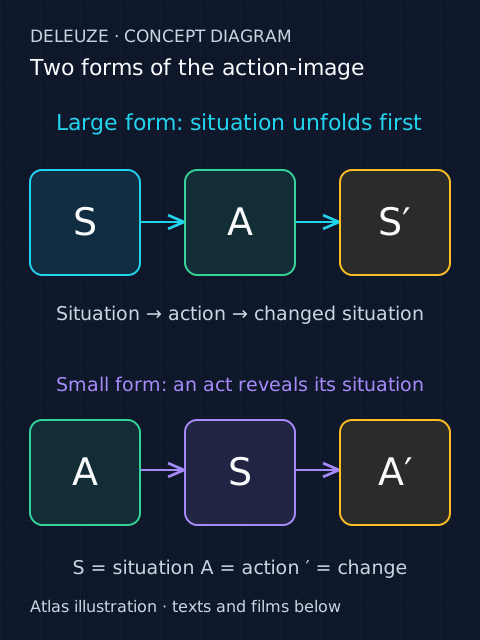
A comparison of organizing directions, not fixed genres or a sequence of higher and lower stages.
Open full-size diagramLarge form: S → A → S′
The milieu and distribution of forces unfold first; figures respond through a duel, mission, or cooperation. Then compare what has changed in the situation. Large names an organizing form, not budget, spectacle, or story size.
Small form: A → S → A′
Enter through a gesture, gag, mistaken recognition, or clue; infer the situation from its gaps and equivocity. The discovery then changes the next action. City Lights’ first encounter and drunk/sober contrast allow this inference to be examined.
Check whether the proposed change actually occurs
The primes in S′ and A′ indicate a change to be compared. Departure at the end of Stagecoach does not alone establish a changed town order; touch recognition in City Lights can contract an action chain into affect. An ending does not guarantee closure of the formula.
Diagram references
Red River
Red River (1948)
Candidate reading
Beside the grave, land begins to be written as property
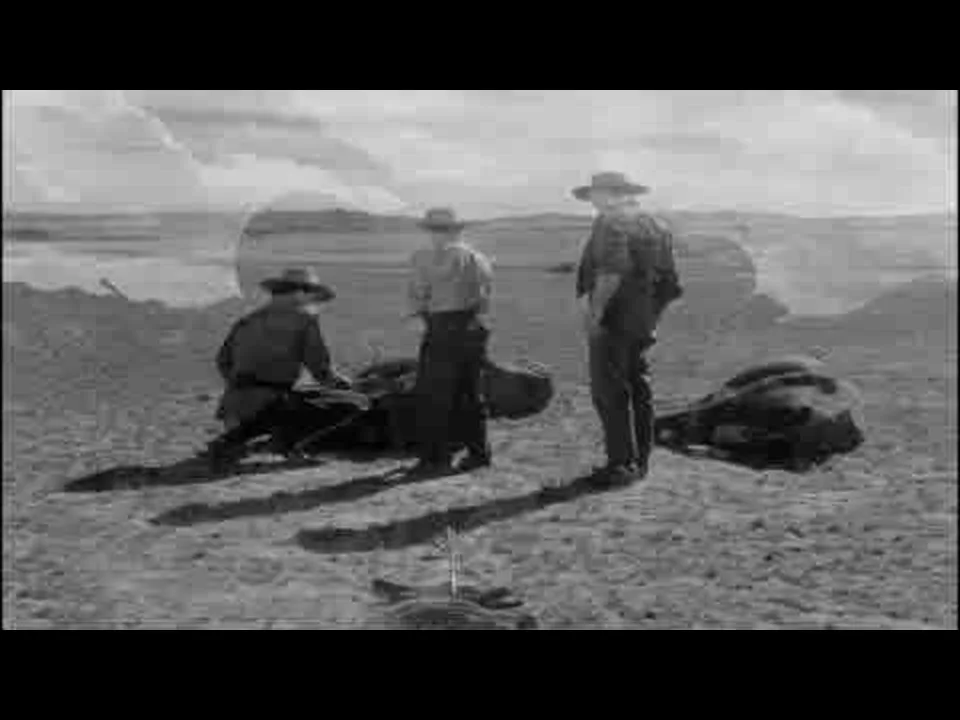
The landscape appears to encompass the figures, yet grave, naming, and brand are actively producing it as a situation that can be owned and commanded.
Open full-size still- Displayed still
- 00:15:38
- Discussion passage
- land-claim, grave, and branding passage containing the 00:15:38 still
The 00:15:38 still anchor is verified on the 02:13:26 single-part Bilibili edition. The passage is located by that anchor; its endpoints still require shot-level delimitation.
The direct still anchor is 00:15:38; the full passage still awaits shot-level endpoints.
Still checked: 2026-08-25 · Carrier access checked: 2026-08-25
Image
Three men occupy an open landscape; one kneels beside a calf while two stand. Figures and animals remain low in the frame, leaving horizon and sky to set the dominant scale.
Only scale and position visible in the still are treated here as checked facts; grave, claim, and branding must be followed across the passage.
Sound
The image anchor has been checked, while dialogue and sound still await itemized transcription; sound carries none of this entry's conceptual burden.
Relation to the concept
Composition and acts of claiming can pose the opening hypothesis of S–A–S′, but this passage neither equals the complete formula nor reproduces a shot-level conclusion by Deleuze on p. 165.
Sources and further reading
- Cinema 1: The Movement-Image
Minnesota 1986 translation, chapter 10, p. 165 · Deleuze names Red River in the chapter on the small form and Hawksian functionalism. The three-shot segmentation and conceptual relations below are the atlas's responsibility, not a shot-by-shot paraphrase of p. 165.
- Bilibili · user-supplied complete single-part edition of Red River
00:15:38 · The landscape appears to encompass the figures, yet grave, naming, and brand are actively producing it as a situation that can be owned and commanded.
- Open the complete Red River carrier on Bilibili
The direct still anchor is 00:15:38; the full passage still awaits shot-level endpoints.
Red River
Red River (1948)
Countertest
The herd amplifies one disturbance into an event beyond command
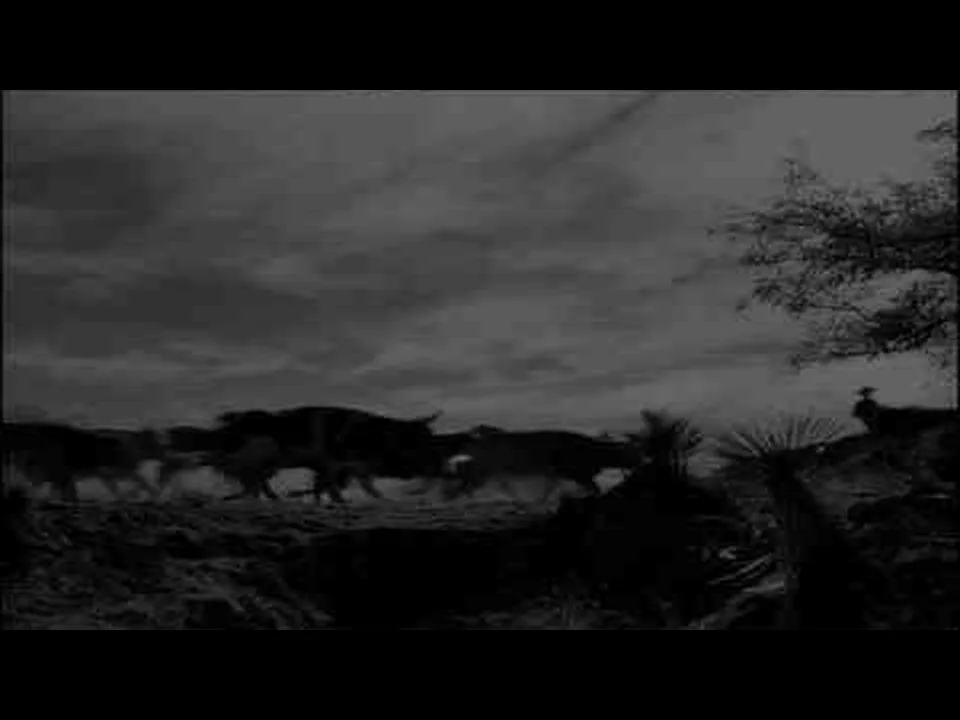
Herd, darkness, and rider form a distributed movement in which no single command equals the whole action circuit.
Open full-size still- Displayed still
- 00:51:20
- Discussion passage
- night stampede passage containing the 00:51:20 still
The 00:51:20 still anchor is verified on the 02:13:26 single-part Bilibili edition. The passage is located by that anchor; its endpoints still require shot-level delimitation.
The direct still anchor is 00:51:20; begin before the disturbance to review the order of propagation and response.
Still checked: 2026-08-25 · Carrier access checked: 2026-08-25
Image
The herd crosses the low-lit frame laterally; speed, occlusion, and density weaken individual outlines, while the rider at right occupies another vertical level.
A single frame establishes density and direction of movement, not the cause of the stampede, the efficacy of commands, or the passage's full causality.
Sound
Disturbance, hoofbeats, cries, and music have not yet been transcribed by track; claims about sonic propagation remain questions for review.
Relation to the concept
The stampede countertests whether one encompassing situation can be represented by a central hero's action. It weakens that reading without automatically reclassifying the whole film as small form.
Sources and further reading
- Cinema 1: The Movement-Image
Minnesota 1986 translation, chapter 10, p. 165 · Deleuze names Red River in the chapter on the small form and Hawksian functionalism. The three-shot segmentation and conceptual relations below are the atlas's responsibility, not a shot-by-shot paraphrase of p. 165.
- Bilibili · user-supplied complete single-part edition of Red River
00:51:20 · Herd, darkness, and rider form a distributed movement in which no single command equals the whole action circuit.
- Open the complete Red River carrier on Bilibili
The direct still anchor is 00:51:20; begin before the disturbance to review the order of propagation and response.
Red River
Red River (1948)
Countertest
The route continues while the position of command changes hands
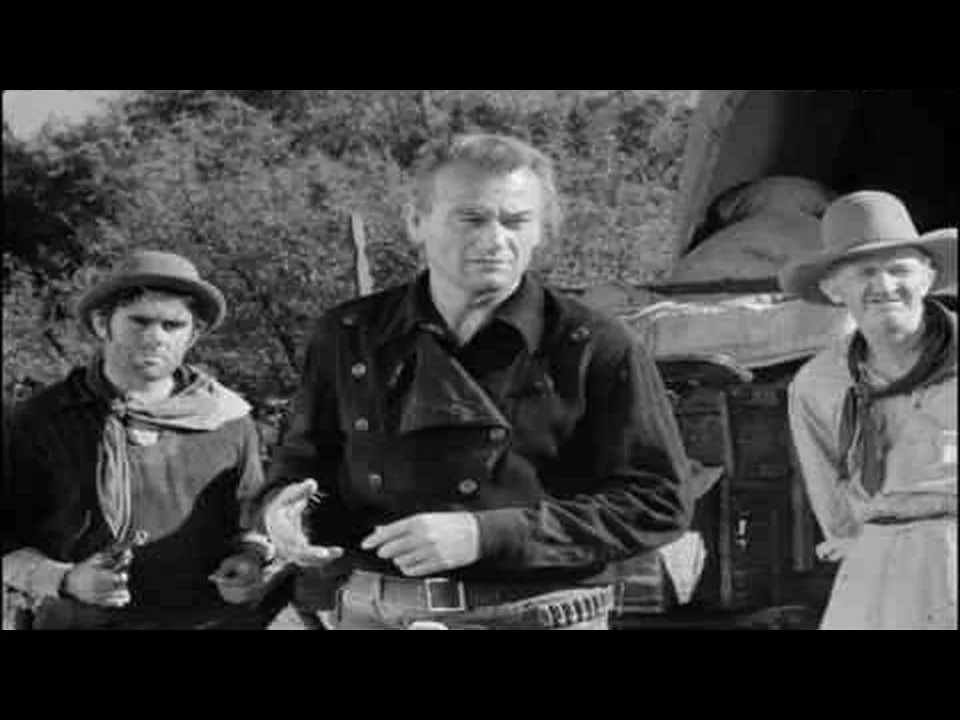
The drive remains on the same route, while the authority to distribute direction, punishment, and trust has become contested.
Open full-size still- Displayed still
- 01:21:08
- Discussion passage
- Matthew takes command of the drive passage containing the 01:21:08 still
The 01:21:08 still anchor is verified on the 02:13:26 single-part Bilibili edition. The passage is located by that anchor; its endpoints still require shot-level delimitation.
The direct still anchor is 01:21:08; review the declarations, responses, route decision, and Dunson's departure before and after it.
Still checked: 2026-08-25 · Carrier access checked: 2026-08-25
Image
Matthew faces an off-screen addressee at centre, flanked by two cowboys with a covered wagon behind; their positions place an individual declaration inside the relations of the outfit.
The still does not show the complete chain before and after the transfer; mutiny, changed destination, and Dunson's departure require continuous viewing.
Sound
Matthew's declaration, the group's responses, and ambient sound still await line-by-line transcription; this entry treats positions and ensuing changes in action as a chain for review.
Relation to the concept
The transfer does not automatically equal S′; it requires a countercheck of whether an encompassing situation genuinely precedes and sufficiently determines the act.
Sources and further reading
- Cinema 1: The Movement-Image
Minnesota 1986 translation, chapter 10, p. 165 · Deleuze names Red River in the chapter on the small form and Hawksian functionalism. The three-shot segmentation and conceptual relations below are the atlas's responsibility, not a shot-by-shot paraphrase of p. 165.
- Bilibili · user-supplied complete single-part edition of Red River
01:21:08 · The drive remains on the same route, while the authority to distribute direction, punishment, and trust has become contested.
- Open the complete Red River carrier on Bilibili
The direct still anchor is 01:21:08; review the declarations, responses, route decision, and Dunson's departure before and after it.
Stagecoach
Stagecoach (1939)
Candidate reading
The coach enters the landscape: condition or compositional effect?
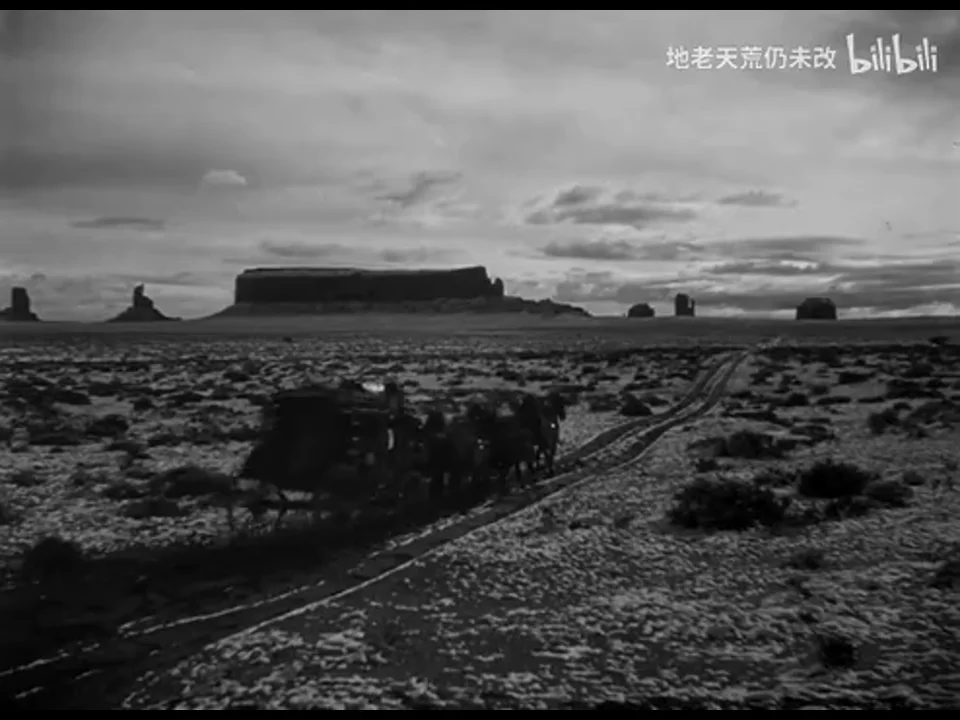
The coach is compressed into a moving unit within the landscape. This poses an encompassing-situation hypothesis but a long shot alone cannot prove S–A–S′.
Open full-size still- Displayed still
- 00:35:10
- Discussion passage
- 约 00:34:50—00:36:20 (pale open ground and Monument Valley route passage containing the 00:35:10 still)
Reviewed passage by passage on the single-part Bilibili carrier with a decoded-stream duration of 01:35:33. 00:35:10 is the still anchor and 约 00:34:50—00:36:20 is the atlas's working boundary for analysis; cut points may shift slightly across masters.
Still anchor 00:35:10; watch continuously from 00:34:50 to 00:36:20 and compare interior with exterior rather than isolating one landscape.
Still checked: 2026-09-01 · Carrier access checked: 2026-09-01
Image
The coach moves along the valley route into depth; coach and horses are markedly smaller than mesas, pale open ground, and sky, and faces are not legible at this anchor.
The passage alternates between the coach interior and the exterior route; each exact cut still requires master-specific frame review.
Sound
The carrier contains dialogue, wheel or hoof sounds, and music, but no track-by-track transcription has been completed; sound carries none of this entry's large-form verdict.
Relation to the concept
Page 146 directly coordinates the film with the Encompasser. This passage poses only a candidate S; later action and S′ must verify the complete formula.
Sources and further reading
- Cinema 1: The Movement-Image
Minnesota 1986 translation, chapter 9, pp. 141–152, especially p. 146 · Pages 141–142 formulate S–A–S′. Page 146 directly uses Stagecoach's alternation of interiors and exteriors to describe the Encompasser and presents S–A–S, the restoration of a circular order, as a first approximation. Page 147 then distinguishes Ford's spiral: the situation reached differs from the one left, producing S–A–S′. Page 150 criticizes the reduction of social causes to individual confrontation, while pp. 151–152 discuss how global mission, local acts, and decisive action redistribute forces. Deleuze does not assign the atlas's three passages one by one; shot boundaries, visible facts, and candidate or countertest relations remain the atlas's responsibility.
- Bilibili · public single-part repost of Stagecoach located and reviewed by the atlas; the specific master and restoration could not be independently established
00:35:10 · The coach is compressed into a moving unit within the landscape. This poses an encompassing-situation hypothesis but a long shot alone cannot prove S–A–S′.
- Open the single-part Stagecoach carrier on Bilibili
Still anchor 00:35:10; watch continuously from 00:34:50 to 00:36:20 and compare interior with exterior rather than isolating one landscape.
Stagecoach
Stagecoach (1939)
Candidate reading
The chase is not one heroic act but a set of simultaneous responses
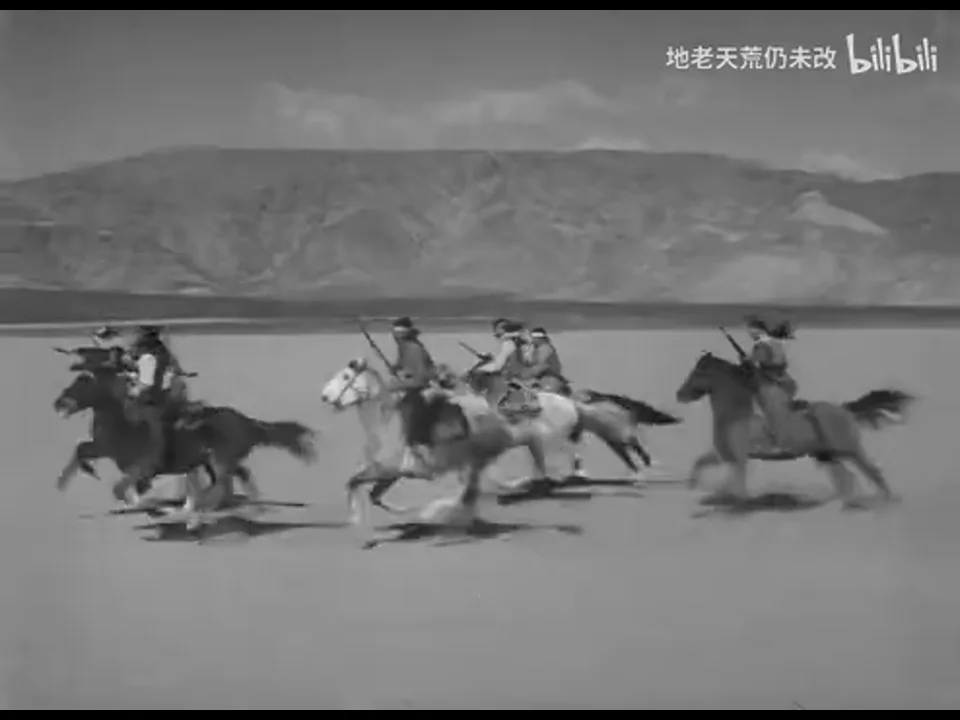
Reins, horses, shooters, coach body, and pursuers divide action into interdependent local tasks.
Open full-size still- Displayed still
- 01:14:00
- Discussion passage
- 约 01:13:30—01:15:20 (stagecoach chase and coordinated-defence passage containing the 01:14:00 still)
Reviewed passage by passage on the single-part Bilibili carrier with a decoded-stream duration of 01:35:33. 01:14:00 is the still anchor and 约 01:13:30—01:15:20 is the atlas's working boundary for analysis; cut points may shift slightly across masters.
Still anchor 01:14:00; watch 01:13:30–01:15:20 and record who sees, who responds, and where the result lands at each cut.
Still checked: 2026-09-01 · Carrier access checked: 2026-09-01
Image
The coach remains in rapid motion; driving, balancing, shooting, and approaching the target are carried by different figures and positions.
Editing cuts among coach body, horses, pursuers, and passengers' local acts; one anchor does not contain the complete causal chain of attack and defence.
Sound
Gunfire, hoofbeats, wheels, cries, and music coexist, but their sequence and sources have not been itemized; the atlas does not substitute sonic intensity for analysis of mechanism.
Relation to the concept
Global danger generates coordinated action tending toward restoration, making this a strong candidate A; the ending must still be tested for a genuine S′.
Sources and further reading
- Cinema 1: The Movement-Image
Minnesota 1986 translation, chapter 9, pp. 141–152, especially p. 146 · Pages 141–142 formulate S–A–S′. Page 146 directly uses Stagecoach's alternation of interiors and exteriors to describe the Encompasser and presents S–A–S, the restoration of a circular order, as a first approximation. Page 147 then distinguishes Ford's spiral: the situation reached differs from the one left, producing S–A–S′. Page 150 criticizes the reduction of social causes to individual confrontation, while pp. 151–152 discuss how global mission, local acts, and decisive action redistribute forces. Deleuze does not assign the atlas's three passages one by one; shot boundaries, visible facts, and candidate or countertest relations remain the atlas's responsibility.
- Bilibili · public single-part repost of Stagecoach located and reviewed by the atlas; the specific master and restoration could not be independently established
01:14:00 · Reins, horses, shooters, coach body, and pursuers divide action into interdependent local tasks.
- Open the single-part Stagecoach carrier on Bilibili
Still anchor 01:14:00; watch 01:13:30–01:15:20 and record who sees, who responds, and where the result lands at each cut.
Stagecoach
Stagecoach (1939)
Countertest
Leaving town after Ringo's release: new situation or self-preservation of the old order?
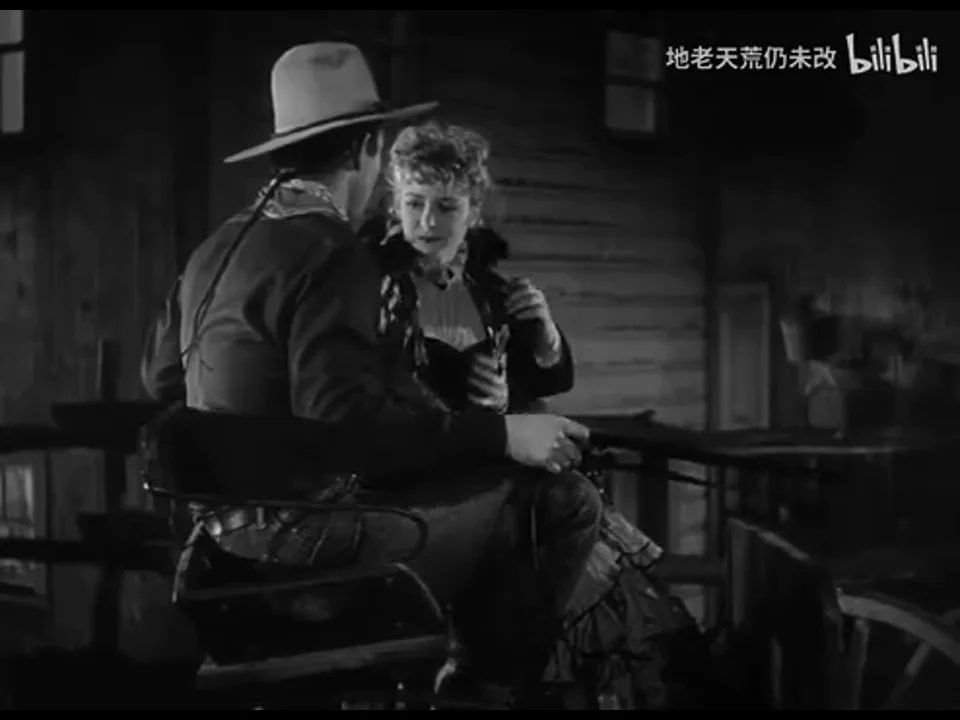
After Ringo is released, he and Dallas ride out of town; the passage does not show whether legal and class positions within the town are redistributed.
Open full-size still- Displayed still
- 01:34:30
- Discussion passage
- 约 01:33:50—01:35:28 (Ringo's release and departure with Dallas containing the 01:34:30 still)
Reviewed passage by passage on the single-part Bilibili carrier with a decoded-stream duration of 01:35:33. 01:34:30 is the still anchor and 约 01:33:50—01:35:28 is the atlas's working boundary for analysis; cut points may shift slightly across masters.
Still anchor 01:34:30; watch 01:33:50–01:35:28 and test whether laughter frames Ringo's release and the cart's departure as reconciliation or obscures the absence of visible change within the town.
Still checked: 2026-09-01 · Carrier access checked: 2026-09-01
Image
Ringo and Dallas sit in the cart while Curley and the doctor remain in the street; the cart then leaves town and the relation shifts from proximity to a receding route.
The anchor shows the pair seated together after Ringo's release; by itself it does not establish their social status or future life.
Sound
Dialogue and laughter participate in the decision to let Ringo go, but subtitle and soundtrack have not been checked line by line; only Ringo's release and the pair's departure are treated as located facts here.
Relation to the concept
The ending can be read as S′ for the pair while leaving any change in the town's old order unresolved. That evidentiary gap prevents the atlas from treating Fordian reconciliation as unconditional proof.
Sources and further reading
- Cinema 1: The Movement-Image
Minnesota 1986 translation, chapter 9, pp. 141–152, especially p. 146 · Pages 141–142 formulate S–A–S′. Page 146 directly uses Stagecoach's alternation of interiors and exteriors to describe the Encompasser and presents S–A–S, the restoration of a circular order, as a first approximation. Page 147 then distinguishes Ford's spiral: the situation reached differs from the one left, producing S–A–S′. Page 150 criticizes the reduction of social causes to individual confrontation, while pp. 151–152 discuss how global mission, local acts, and decisive action redistribute forces. Deleuze does not assign the atlas's three passages one by one; shot boundaries, visible facts, and candidate or countertest relations remain the atlas's responsibility.
- Bilibili · public single-part repost of Stagecoach located and reviewed by the atlas; the specific master and restoration could not be independently established
01:34:30 · After Ringo is released, he and Dallas ride out of town; the passage does not show whether legal and class positions within the town are redistributed.
- Open the single-part Stagecoach carrier on Bilibili
Still anchor 01:34:30; watch 01:33:50–01:35:28 and test whether laughter frames Ringo's release and the cart's departure as reconciliation or obscures the absence of visible change within the town.
Red River
Red River (1948)
Atlas shot reading
The brand turns open landscape into property
Dunson uses gun, grave, brand, and naming to write a ranch origin onto the riverbank, covering prior relations to the land with his future plan.
Open full-size still- Displayed still
- 00:15:38
- Feature time
- 00:15:38
The three stills and jumps use the user-supplied complete 02:13:26 single-part Bilibili edition; studio marks are part of the edition's beginning.
The still and link retain the film guide's recorded shot locator.
Image
Dunson uses gun, grave, brand, and naming to write a ranch origin onto the riverbank, covering prior relations to the land with his future plan.
Relation to the concept
The passage poses only the S hypothesis of the large form: sign, violence, and labour produce landscape as a commandable whole. If later action is not sufficiently determined by that whole, the S–A–S′ judgement must be narrowed or withdrawn.
Sources and further reading
- Cinema 1, Chapter 10 · p. 165
The Hawks/small-form context in which Deleuze names Red River
- Cinema 1, Chapter 9
Use the large form S–A–S′ as a general formula to be tested
- Criterion essay on Red River
A deeper reading of route, relation, and Hawksian form
- Criterion interview with editor Christian Nyby
Audit the moving whole through editing labour
- Compare Rio Bravo
Return from transferred command to local functional relay
Films and scenes
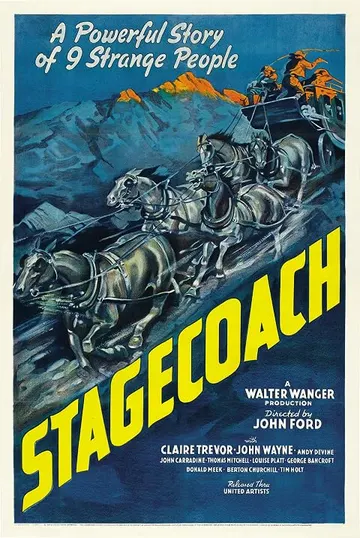
Chapter 9 defines S–A–S′ on pp. 141–142. Page 146 directly uses Stagecoach's alternation of coach interior and exterior to explain the Encompasser and treats the circular S–A–S as a first approximation; only p. 147 advances Ford's spiral toward a new situation, S′, while pp. 151–152 distinguish whole mission, local action, and duel. The atlas locates the valley route at 00:35:10, chase coordination from 01:13:30 to 01:15:20, and departure from 01:33:50 to 01:35:28 as material for testing S, A, and the ending situation. The last passage shows only that Ringo is released and leaves town with Dallas; it does not directly show whether the town's order changes. Page 150 also criticizes the personal duel for obscuring social causes. The atlas therefore does not label the departure S′ automatically, but keeps in play both a changed situation and the restoration of the old order after the pair depart.
IMDb identification poster ↗Related film readings · 5 films
Stagecoach · 1939 · Candidate reading — Chapter 9 defines S–A–S′ on pp. 141–142. Page 146 directly uses Stagecoach's alternation of coach interior and exterior to explain the Encompasser and treats the circular S–A–S as a first approximation; only p. 147 advances Ford's spiral toward a new situation, S′, while pp. 151–152 distinguish whole mission, local action, and duel. The atlas locates the valley route at 00:35:10, chase coordination from 01:13:30 to 01:15:20, and departure from 01:33:50 to 01:35:28 as material for testing S, A, and the ending situation. The last passage shows only that Ringo is released and leaves town with Dallas; it does not directly show whether the town's order changes. Page 150 also criticizes the personal duel for obscuring social causes. The atlas therefore does not label the departure S′ automatically, but keeps in play both a changed situation and the restoration of the old order after the pair depart.
The General · 1926 — War, railway, flood, and broken bridge first compose an immense situation that dwarfs the little man. Continuous trajectories and the ‘miniaturization’ of machines then let a small body transform the whole through the locomotive. The General places burlesque directly inside the large form S–A–S′.
High Noon · 1952 — Clocks, tracks, and emptied streets compress the town into a one-hour countdown. Kane repeatedly asks for help, yet action cannot organize the community. The duel completes a classical action-image, but the badge dropped in the dust prevents victory from restoring trust.
Throne of Blood · 1957 — The foggy forest and spirit offer not an instruction for action but a question whose conditions must be understood. Washizu treats prophecy as an executable plan; the more urgently he acts, the more the castle becomes a spider's web. The final arrows are not an enemy's answer but the misunderstood question tightening from within.
Red River · 1948 — Deleuze names Red River in Cinema 1, chapter 10, p. 165, within Hawks and the small form rather than directly presenting it as a model of the large form. Open landscape and collective task can still pose an S–A–S′ hypothesis. The atlas then countertests it through the claim passage at 00:15:38, stampede at 00:51:20, and transfer of command at 01:21:08: does an encompassing situation genuinely precede action, or is it progressively disclosed and reorganized by local acts, differences of speed, and relayed functions? The relation among these three shots is the atlas's responsibility, not a shot-by-shot gloss of p. 165.
Criteria
Specify the encompassing pressure of S, trace how it contracts through bodies and groups into A, then compare the institutional, spatial, and force relations of S with S′. If only a task is completed while the situation remains unchanged, the circuit has not been demonstrated.
Distinctions and counterexamples
A large battle, superhero, or completed mission does not automatically produce S–A–S′. If the milieu is only scenery for action, or action redistributes none of its forces, spaces, or collective positions, the form does not close.
Common confusion: Spectacle, production scale, long or wide framing, feature length, and heroic protagonists do not define 'large.' The term names the structural direction in which an encompassing situation precedes action, not a film's size, budget, or value.
Texts and sources
Cinema 1, ch. 9, pp. 141–159 (Minnesota 1986)
- 01Cinema 1: The Movement-Image
Standard Minnesota English translation and a principal citation edition in Anglophone scholarship.
View source and edition →
Research disagreements
Replacement or coexistence?
The time-image reverses the subordination of time to movement; both regimes persist and can shift locally within one film.
Taxonomy or generator?
Fixed labels invite mere example-hunting; an open taxonomy requires new concepts to transform existing relations and explain across cases.
How do we use Deleuze precisely?
Test four layers: sensory-motor relation, actual/virtual circuit, audio-visual connection, and regime of truth.
Concepts to distinguish
Compare them
- Movement-imageimage-mouvement
The movement-image is a regime in which movement differentiates into perception, affection, impulse, action, reflection, and mental relation to organize the image directly, while time appears indirectly through movement and montage. The relation-image is a decisive realization within the mental-image's problem-field, not an additional source-level rank parallel to it, and films need not pass through one fixed action-chain.
→ - Impulse-imageimage-pulsion
The impulse-image stands between affection and action. Deleuze divides its naturalist structure into four terms arranged in two pairs: originary world/derived milieu and elementary impulse/real behaviour. A historically, geographically, and socially determinate derived milieu remains present while elementary impulse penetrates real behaviour from within; impulse seizes object-fragments from that milieu and thereby exposes an uncoordinated originary world. Symptom and fetish are not additional structural terms but two classes of signs: a symptom is the appearance of impulse in the derived milieu, while a fetish is the appearance of the seized object-fragment itself. Stroheim realizes this structure through decay, descent, and entropy; Buñuel through repetition, cycles, and restart. These are distinct realizations, not cumulative thresholds that every example must satisfy.
→ - Action-image: small formpetite forme de l'image-action
The small form of the action-image follows A–S–A′. It begins from an action A already underway whose meaning remains equivocal; indices of lack or ambiguity progressively disclose the situation S in which that act is embedded, forcing a revised action A′. The situation is not given in advance as a known whole but inferred through local gestures, misrecognitions, clues, gags, and the consequences of action.
→ - Reflection-imageimage-réflexion
Following Cinema 2, pp. 32–33, which retrospectively revisits the first semiotics, the atlas gathers the figures developed in Cinema 1, chapters 10–11—attraction, inversion, and discourse—under reflection-image. All three still transform the situation–action relation from within the action forms: attraction uses a substitute or rehearsal to miniaturize, prefigure, or stage another situation or act; inversion exchanges large and small powers; discourse makes an implicit problem into an audible and visible object of thought. Reflection-image must not be prematurely equated with chapter 12's relation-image.
→ - Mental-imageimage mentale
In Cinema 1's strict usage, the mental-image first names a problem-field: images take relations, symbolic acts, and intellectual feelings as their objects rather than representing states inside a character's head. Relations are external to their terms and irreducible to the attributes of any one term; symbolic acts and intellectual feelings must likewise become operations of image, sound, and editing rather than plot content. The atlas gives mental-image and relation-image separate pages only as reading interfaces for this problem-field and its Hitchcockian realization through Thirdness. The source does not rank them as parallel levels or make the former a superclass of recollection- and dream-images.
→ - Relation-imageimage-relation
The relation-image is the decisive Hitchcockian realization within the mental-image's problem-field: it makes relation itself the image's object and specifies its signs through Peircean Thirdness. A mark sustains a natural or habitual series, a demark redirects that series through an anomalous term, and a symbol makes a concrete term bear an abstract relation; Hitchcock further composes director, film, and the spectator who must enter the inference as a triadic apparatus. The separate atlas page is an explanatory interface, not evidence that the source ranks mental-image and relation-image as parallel levels.
→ - Crisis of the action-imagecrise de l'image-action
The crisis of the action-image is not the disappearance of movement but the loss of a credible bond among situation, perception, and action capable of changing the world. Cinema 1 lists a constellation of five surface symptoms: dispersive situations that replace a totality with gaps; deliberately weak links among events; wandering that displaces goal-directed travel; consciousness of clichés, as figures and spectators begin to recognize how ready-made schemata obscure real relations; and the exposure or denunciation of conspiracy—the network of control behind the plot. These are external negative conditions for a new image-regime, not a checklist that every film and every sequence must complete.
→