Concept definition
The impulse-image stands between affection and action. Deleuze divides its naturalist structure into four terms arranged in two pairs: originary world/derived milieu and elementary impulse/real behaviour. A historically, geographically, and socially determinate derived milieu remains present while elementary impulse penetrates real behaviour from within; impulse seizes object-fragments from that milieu and thereby exposes an uncoordinated originary world. Symptom and fetish are not additional structural terms but two classes of signs: a symptom is the appearance of impulse in the derived milieu, while a fetish is the appearance of the seized object-fragment itself. Stroheim realizes this structure through decay, descent, and entropy; Buñuel through repetition, cycles, and restart. These are distinct realizations, not cumulative thresholds that every example must satisfy.
What the concept explains
The impulse-image is not an emotion waiting to become action. Naturalist cinema makes four structural terms interact in two pairs: originary world/derived milieu and elementary impulse/real behaviour. Actual streets, households, and institutions remain concrete while elementary impulse penetrates real behaviour and tears object-fragments from the milieu, exposing an originary world. Symptom and fetish are the two classes of signs of this process: a symptom manifests impulse, while a fetish manifests the seized object-fragment.
Sensory-Motor Rupture: How a Character Becomes a SeerDiagrams and film passages
Greed
Greed (1924)
Countertest
The gold tooth is first something saleable, not a fetish on sight
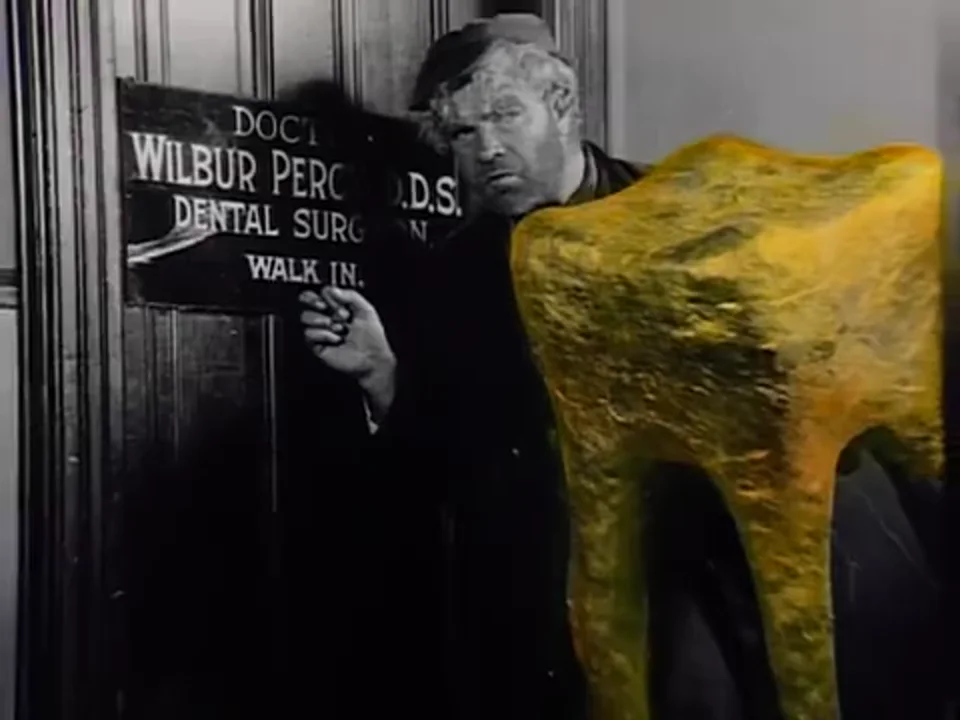
The former professional sign has descended into saleable property, yet exchangeability is not the same as fetishization.
Open full-size still- Displayed still
- 02:51:55
- Discussion passage
- 约 02:51:30—02:57:31 (gold-tooth sign, meat purchase, and change passage containing the 02:51:55 still)
Reviewed passage by passage on the long-reconstruction Bilibili carrier with a decoded-stream duration of 03:56:21. 02:51:55 is the still anchor and 约 02:51:30—02:57:31 is the atlas's working boundary. Still photographs, reconstruction cards, and moving footage must be read as distinct layers.
Still anchor 02:51:55; watch 02:51:30–02:57:31 and separately record the tooth's function, the cheaper meat that is three days old, the payer, and the demand for change. This long-reconstruction carrier has a decoded-stream duration of 03:56:21 and is not the lost original full cut.
Still checked: 2026-09-01 · Carrier access checked: 2026-09-01
Image
The large gold tooth changes from the dental parlour's professional sign into an object McTeague can move and sell; the subsequent meat purchase turns on budget, payment, and change.
Trina demands saving, asks about change, and makes McTeague bear the expense; these acts first belong to economic behaviour under scarcity.
Sound
Narrative information in the silent film is supplied mainly by intertitles; the edition of the reconstruction score could not be independently established and is not used as impulse-image evidence.
Relation to the concept
The gold tooth and change first belong to exchange and use, countertesting the claim that money on screen is automatically fetish. The gold impulse on p. 128 must be shown through a change in the object's function.
Sources and further reading
- Cinema 1: The Movement-Image
Minnesota 1986 translation, chapter 8, pp. 125–130, especially pp. 125 and 128 · Page 125 generally defines originary world or derived milieu, elementary impulse or real behaviour, and symptom or fetish, while directly listing Greed's desert ending as a localized originary world. Pages 126–127 discuss Stroheimian descent, entropy, and degradation. Page 128 directly names the film's impulse for gold, then defines partial object and fetish in general; pp. 129–130 address exhaustion of milieu, fragments, and remnants. The primary text does not classify the atlas's three anchors one by one as symptom or fetish; specific gestures, objects, and withdrawal criteria remain the atlas's responsibility.
- Bilibili · public repost of the long reconstruction of Greed located and reviewed by the atlas, with a decoded-stream duration of 03:56:21; not the lost original full cut
02:51:55 · The former professional sign has descended into saleable property, yet exchangeability is not the same as fetishization.
- Open the long reconstruction of Greed on Bilibili
Still anchor 02:51:55; watch 02:51:30–02:57:31 and separately record the tooth's function, the cheaper meat that is three days old, the payer, and the demand for change. This long-reconstruction carrier has a decoded-stream duration of 03:56:21 and is not the lost original full cut.
Greed
Greed (1924)
Candidate reading
Counting, holding, addressing money: symptom and fetish separate here
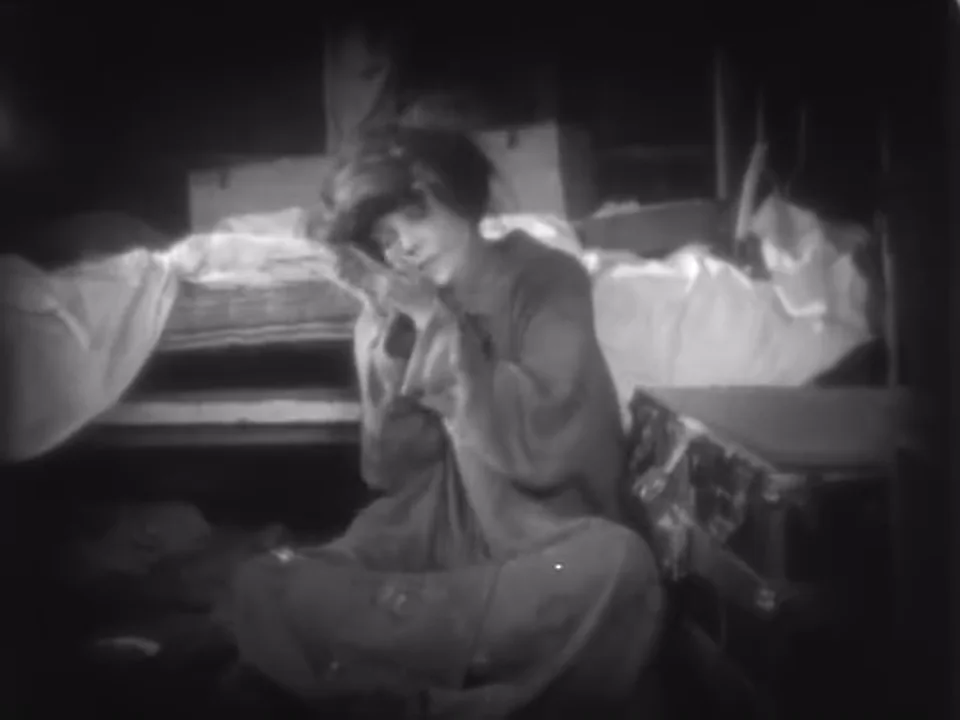
Counting and repeated holding make impulse appear as gesture; only if money is isolated as an object-fragment to be kept rather than used does it become a fetish candidate.
Open full-size still- Displayed still
- 03:02:30
- Discussion passage
- 约 03:02:06—03:02:42 (Trina counting and caressing her savings containing the 03:02:30 still)
Reviewed passage by passage on the long-reconstruction Bilibili carrier with a decoded-stream duration of 03:56:21. 03:02:30 is the still anchor and 约 03:02:06—03:02:42 is the atlas's working boundary. Still photographs, reconstruction cards, and moving footage must be read as distinct layers.
Still anchor 03:02:30; watch 03:02:06–03:02:42 and check in order number, counting, holding, proximity to the face, and direct address in the intertitles. This carrier is a long reconstruction.
Still checked: 2026-09-01 · Carrier access checked: 2026-09-01
Image
Trina counts, holds, and brings money near her face; the low-resolution carrier establishes the relation between money and gesture but not the denomination or material of each piece.
Intertitles emphasize 'four hundred and fifty,' labouring and saving for the money, and 'no one shall ever get you'; Trina addresses the savings directly as second-person 'you'.
Sound
This is a silent passage; the reconstruction score supplies no dialogue evidence for distinguishing symptom from fetish, so the atlas limits itself to gesture, intertitles, and object-function.
Relation to the concept
The passage permits testing symptom and fetish together but their evidence differs: gesture manifests impulse, while money isolated from use is the partial-object candidate.
Sources and further reading
- Cinema 1: The Movement-Image
Minnesota 1986 translation, chapter 8, pp. 125–130, especially pp. 125 and 128 · Page 125 generally defines originary world or derived milieu, elementary impulse or real behaviour, and symptom or fetish, while directly listing Greed's desert ending as a localized originary world. Pages 126–127 discuss Stroheimian descent, entropy, and degradation. Page 128 directly names the film's impulse for gold, then defines partial object and fetish in general; pp. 129–130 address exhaustion of milieu, fragments, and remnants. The primary text does not classify the atlas's three anchors one by one as symptom or fetish; specific gestures, objects, and withdrawal criteria remain the atlas's responsibility.
- Bilibili · public repost of the long reconstruction of Greed located and reviewed by the atlas, with a decoded-stream duration of 03:56:21; not the lost original full cut
03:02:30 · Counting and repeated holding make impulse appear as gesture; only if money is isolated as an object-fragment to be kept rather than used does it become a fetish candidate.
- Open the long reconstruction of Greed on Bilibili
Still anchor 03:02:30; watch 03:02:06–03:02:42 and check in order number, counting, holding, proximity to the face, and direct address in the intertitles. This carrier is a long reconstruction.
Greed
Greed (1924)
Candidate reading
Death Valley exhausts use: is money the only fetish candidate?
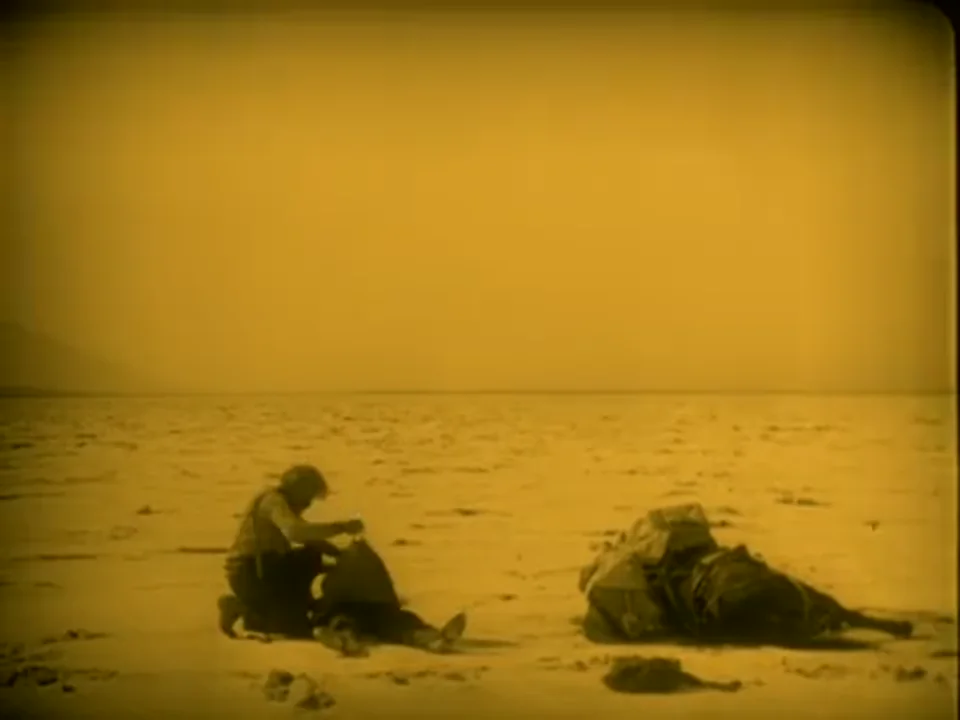
Canteen, horse, handcuff, and bird first show the milieu exhausting relations of survival; the money bag and chromatically stressed money are the stricter fetish candidates.
Open full-size still- Displayed still
- 03:54:15
- Discussion passage
- 约 03:50:45—03:55:39;重构尾卡约 03:55:51—03:56:09 (Death Valley fight, handcuff, broken canteen, and birdcage passage containing the 03:54:15 still)
Reviewed passage by passage on the long-reconstruction Bilibili carrier with a decoded-stream duration of 03:56:21. 03:54:15 is the still anchor and 约 03:50:45—03:55:39;重构尾卡约 03:55:51—03:56:09 is the atlas's working boundary. Still photographs, reconstruction cards, and moving footage must be read as distinct layers.
Still anchor 03:54:15; watch 03:50:45–03:55:39 and log money bag, horse, handcuff, canteen, money, and birdcage separately. 03:55:51–03:56:09 belongs to the reconstruction's end-card layer; the carrier has a decoded-stream duration of 03:56:21 and is not the lost original full cut.
Still checked: 2026-09-01 · Carrier access checked: 2026-09-01
Image
The passage contains struggle over a money bag, the dead horse, handcuffs around 03:52:48, the broken canteen around 03:53:21, money and blood stressed by tint around 03:53:51, and McTeague approaching the birdcage.
Desert and salt flat offer no visible shelter; objects' prior uses fail one by one under thirst, death, and restraint, but failed objects do not thereby all become fetishes.
Sound
Causality in the silent film is organized by moving image and intertitles. The 'lust of gold' wording around 03:55:51–03:56:09 belongs to the reconstruction's end-card layer and cannot retroactively prove every earlier piece of money.
Relation to the concept
Page 125 directly links the film's desert ending, and pp. 128–130 supply coordinates of gold impulse, fetish, and exhausted milieu. The atlas treats only bag or money as the stronger fetish candidate while retaining the other objects as material relations.
Sources and further reading
- Cinema 1: The Movement-Image
Minnesota 1986 translation, chapter 8, pp. 125–130, especially pp. 125 and 128 · Page 125 generally defines originary world or derived milieu, elementary impulse or real behaviour, and symptom or fetish, while directly listing Greed's desert ending as a localized originary world. Pages 126–127 discuss Stroheimian descent, entropy, and degradation. Page 128 directly names the film's impulse for gold, then defines partial object and fetish in general; pp. 129–130 address exhaustion of milieu, fragments, and remnants. The primary text does not classify the atlas's three anchors one by one as symptom or fetish; specific gestures, objects, and withdrawal criteria remain the atlas's responsibility.
- Bilibili · public repost of the long reconstruction of Greed located and reviewed by the atlas, with a decoded-stream duration of 03:56:21; not the lost original full cut
03:54:15 · Canteen, horse, handcuff, and bird first show the milieu exhausting relations of survival; the money bag and chromatically stressed money are the stricter fetish candidates.
- Open the long reconstruction of Greed on Bilibili
Still anchor 03:54:15; watch 03:50:45–03:55:39 and log money bag, horse, handcuff, canteen, money, and birdcage separately. 03:55:51–03:56:09 belongs to the reconstruction's end-card layer; the carrier has a decoded-stream duration of 03:56:21 and is not the lost original full cut.
Films and scenes

Three passages are located, but the conceptual relation remains contested. From 02:51:30 to 02:57:31, the gold tooth is first proposed for sale as a former professional sign; the old meat and demand for change that follow still belong to ordinary exchange and therefore provide counterevidence. Only in the counting, grasping, and caressing from 03:02:06 to 03:02:42 do real behaviours or gestures become symptom candidates and money withdrawn from exchange approach a fetish candidate. From 03:50:45 to 03:55:39, the money bag, dead horse, broken canteen, handcuffs, and caged bird are pressed into an exhausted desert milieu. Money, teeth, and the caged bird may become object-fragments or fetishes, but cannot be collapsed in advance into one sign class; the canteen, handcuffs, and bird first belong to material relations of water loss, restraint, and exhausted life respectively. Page 125 generally defines the four terms and two sign classes while directly listing Greed's desert ending as a localized originary world. Page 128 directly names the gold impulse, then defines partial object and fetish in general. Because the atlas is responsible for the three timecodes and sign classifications, the relation is marked contested rather than demonstrated.
IMDb identification poster ↗Related film readings · 2 films
Greed · 1924 · Contested — Three passages are located, but the conceptual relation remains contested. From 02:51:30 to 02:57:31, the gold tooth is first proposed for sale as a former professional sign; the old meat and demand for change that follow still belong to ordinary exchange and therefore provide counterevidence. Only in the counting, grasping, and caressing from 03:02:06 to 03:02:42 do real behaviours or gestures become symptom candidates and money withdrawn from exchange approach a fetish candidate. From 03:50:45 to 03:55:39, the money bag, dead horse, broken canteen, handcuffs, and caged bird are pressed into an exhausted desert milieu. Money, teeth, and the caged bird may become object-fragments or fetishes, but cannot be collapsed in advance into one sign class; the canteen, handcuffs, and bird first belong to material relations of water loss, restraint, and exhausted life respectively. Page 125 generally defines the four terms and two sign classes while directly listing Greed's desert ending as a localized originary world. Page 128 directly names the gold impulse, then defines partial object and fetish in general. Because the atlas is responsible for the three timecodes and sign classifications, the relation is marked contested rather than demonstrated.
The Exterminating Angel · 1962 — The drawing room has no visible barrier, yet the guests cannot cross its threshold; civility regresses into occupation, hunger, and attack. The arrival and interior attitudes recur with imperfect differences, and bad repetition closes the space. Only by restaging the decisive arrangement does the boundary loosen, before forming again in the church.
Criteria
Within a specific shot, first distinguish how the four-part structure operates: how an originary world appears within a derived milieu, and how elementary impulse penetrates real behaviour while seizing object-fragments. Then identify which of the two types of signs makes this operation visible—a symptom, or a fetish as the appearance of an object-fragment—before determining whether the film follows Stroheimian descent/entropy, Buñuelian repetition/cycle, or another demonstrable realization.
Distinctions and counterexamples
Greed, sexuality, violence, or addiction may remain explicable as ordinary narrative goals. The impulse-image begins only when the four structural terms—originary world/derived milieu and elementary impulse/real behaviour—form a relation within the image and the sign-function of symptom or fetish can be identified. The two types of signs need not co-occur; Stroheimian decay/descent/entropy and Buñuelian repetition/cycle/restart are likewise distinct realizations, not cumulative thresholds every case must pass.
Common confusion: Strong desire, violence, animality, sexuality, or a character 'losing control' is insufficient. Analysis must demonstrate how the four structural terms—originary world/derived milieu and elementary impulse/real behaviour—work together and identify the sign-function of symptom or fetish. The two classes of signs need not both appear, nor do decay, entropy, repetition, and cycles form a cumulative checklist; impulse must not be reduced to an ordinary action that has simply not yet succeeded.
Texts and sources
Cinema 1, ch. 8, pp. 123–140 (Minnesota 1986)
- 01Cinema 1: The Movement-Image
Standard Minnesota English translation and a principal citation edition in Anglophone scholarship.
View source and edition →
Research disagreements
Replacement or coexistence?
The time-image reverses the subordination of time to movement; both regimes persist and can shift locally within one film.
Taxonomy or generator?
Fixed labels invite mere example-hunting; an open taxonomy requires new concepts to transform existing relations and explain across cases.
How do we use Deleuze precisely?
Test four layers: sensory-motor relation, actual/virtual circuit, audio-visual connection, and regime of truth.
Concepts to distinguish
Compare them
- Movement-imageimage-mouvement
The movement-image is a regime in which movement differentiates into perception, affection, impulse, action, reflection, and mental relation to organize the image directly, while time appears indirectly through movement and montage. The relation-image is a decisive realization within the mental-image's problem-field, not an additional source-level rank parallel to it, and films need not pass through one fixed action-chain.
→ - Action-image: large formgrande forme de l'image-action
The large form of the action-image follows S–A–S′. A milieu, collective, historical pressure, or danger first composes an encompassing situation S; that pressure leaves an internal imprint upon the character and concentrates itself in action A as effort, duel, or collective coordination; action then carries the milieu into a situation S′ different from the initial one. Its decisive question is how a situation demands action and whether action actually reorganizes that situation.
→ - Action-image: small formpetite forme de l'image-action
The small form of the action-image follows A–S–A′. It begins from an action A already underway whose meaning remains equivocal; indices of lack or ambiguity progressively disclose the situation S in which that act is embedded, forcing a revised action A′. The situation is not given in advance as a known whole but inferred through local gestures, misrecognitions, clues, gags, and the consequences of action.
→ - Reflection-imageimage-réflexion
Following Cinema 2, pp. 32–33, which retrospectively revisits the first semiotics, the atlas gathers the figures developed in Cinema 1, chapters 10–11—attraction, inversion, and discourse—under reflection-image. All three still transform the situation–action relation from within the action forms: attraction uses a substitute or rehearsal to miniaturize, prefigure, or stage another situation or act; inversion exchanges large and small powers; discourse makes an implicit problem into an audible and visible object of thought. Reflection-image must not be prematurely equated with chapter 12's relation-image.
→ - Mental-imageimage mentale
In Cinema 1's strict usage, the mental-image first names a problem-field: images take relations, symbolic acts, and intellectual feelings as their objects rather than representing states inside a character's head. Relations are external to their terms and irreducible to the attributes of any one term; symbolic acts and intellectual feelings must likewise become operations of image, sound, and editing rather than plot content. The atlas gives mental-image and relation-image separate pages only as reading interfaces for this problem-field and its Hitchcockian realization through Thirdness. The source does not rank them as parallel levels or make the former a superclass of recollection- and dream-images.
→ - Relation-imageimage-relation
The relation-image is the decisive Hitchcockian realization within the mental-image's problem-field: it makes relation itself the image's object and specifies its signs through Peircean Thirdness. A mark sustains a natural or habitual series, a demark redirects that series through an anomalous term, and a symbol makes a concrete term bear an abstract relation; Hitchcock further composes director, film, and the spectator who must enter the inference as a triadic apparatus. The separate atlas page is an explanatory interface, not evidence that the source ranks mental-image and relation-image as parallel levels.
→ - Crisis of the action-imagecrise de l'image-action
The crisis of the action-image is not the disappearance of movement but the loss of a credible bond among situation, perception, and action capable of changing the world. Cinema 1 lists a constellation of five surface symptoms: dispersive situations that replace a totality with gaps; deliberately weak links among events; wandering that displaces goal-directed travel; consciousness of clichés, as figures and spectators begin to recognize how ready-made schemata obscure real relations; and the exposure or denunciation of conspiracy—the network of control behind the plot. These are external negative conditions for a new image-regime, not a checklist that every film and every sequence must complete.
→