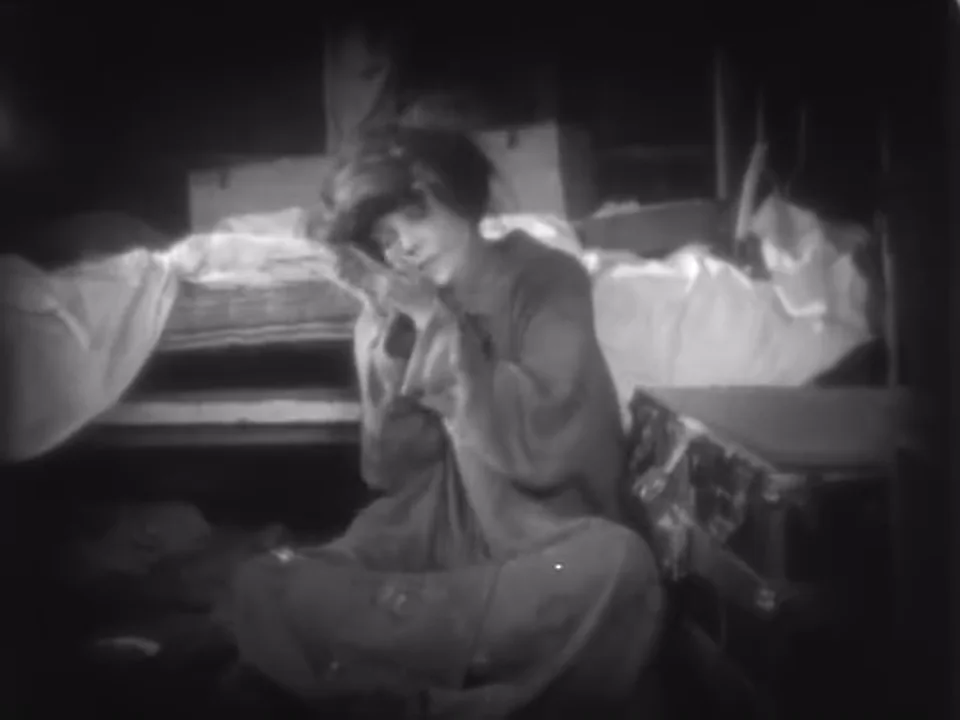
 03:02:30
Impulse and originary world · SHOT EVIDENCE
Counting, holding, addressing money: symptom and fetish separate here
When does 'saving for the future' cease to point toward a future and turn into repetition of present possession?
Film and viewing version
Greed · Greed · Erich von Stroheim / 埃里克·冯·施特罗海姆 · 1924
Reviewed passage by passage on the long-reconstruction Bilibili carrier with a decoded-stream duration of 03:56:21. 03:02:30 is the still anchor and 约 03:02:06—03:02:42 is the atlas's working boundary. Still photographs, reconstruction cards, and moving footage must be read as distinct layers.
Version boundary: The timecodes on this page apply only to the named viewing carrier. Restorations, differing leaders, or platform transcodes may shift them.
Passage and still timecodes
约 03:02:06—03:02:42 (Trina counting and caressing her savings containing the 03:02:30 still)
The window locates the passage; its boundaries remain approximate
The passage window and still anchor are separate coordinates: the Bilibili still at 03:02:30 was checked on 2026-09-01; it does not turn an approximate passage on another carrier into exact bounds.
Visible facts
- 01
Trina counts, holds, and brings money near her face; the low-resolution carrier establishes the relation between money and gesture but not the denomination or material of each piece.
- 02
Intertitles emphasize 'four hundred and fifty,' labouring and saving for the money, and 'no one shall ever get you'; Trina addresses the savings directly as second-person 'you'.
Audible facts
- 01
This is a silent passage; the reconstruction score supplies no dialogue evidence for distinguishing symptom from fetish, so the atlas limits itself to gesture, intertitles, and object-function.
Action relation
Counting, holding, bringing close to the face, and direct address are symptom candidates for impulse entering real behaviour. A fetish candidate appears only when savings cease to serve exchange or security and become an object-fragment to be possessed and kept from others.
Temporal relation
'Laboured and saved' compresses past accumulation into present possession; numerical increase opens no future use but makes preservation itself a repeated act.
Conceptual reading
Symptom is the appearance of impulse in counting, holding, and address; fetish is the appearance of seized money as partial object, and the two must not be conflated. If later evidence shows the savings still serving a concrete life plan, the fetish relation should be weakened or withdrawn while the gestural symptom candidate may remain.
Concepts used in the judgement
Primary and scholarly coordinates
- 01Cinema 1: The Movement-Image
Minnesota 1986 translation, chapter 8, pp. 125–130, especially pp. 125 and 128
Page 125 generally defines originary world or derived milieu, elementary impulse or real behaviour, and symptom or fetish, while directly listing Greed's desert ending as a localized originary world. Pages 126–127 discuss Stroheimian descent, entropy, and degradation. Page 128 directly names the film's impulse for gold, then defines partial object and fetish in general; pp. 129–130 address exhaustion of milieu, fragments, and remnants. The primary text does not classify the atlas's three anchors one by one as symptom or fetish; specific gestures, objects, and withdrawal criteria remain the atlas's responsibility.
Terminological coordinates
Chapter relations
Viewing and still sources
Direct scene · Still anchor 03:02:30; watch 03:02:06–03:02:42 and check in order number, counting, holding, proximity to the face, and direct address in the intertitles. This carrier is a long reconstruction.