Crisis of the action-image
crise de l'image-actioncrisis of the action-image
Concept definition
The crisis of the action-image is not the disappearance of movement but the loss of a credible bond among situation, perception, and action capable of changing the world. Cinema 1 lists a constellation of five surface symptoms: dispersive situations that replace a totality with gaps; deliberately weak links among events; wandering that displaces goal-directed travel; consciousness of clichés, as figures and spectators begin to recognize how ready-made schemata obscure real relations; and the exposure or denunciation of conspiracy—the network of control behind the plot. These are external negative conditions for a new image-regime, not a checklist that every film and every sequence must complete.
What the concept explains
The crisis of the action-image is a crisis of belief. Figures continue to chase, resist, work, and speak, but the image no longer guarantees that perception can be prolonged into a response commensurate with the situation. Dispersion, weak linkage, wandering, consciousness of clichés, and the exposure or denunciation of conspiracy—the network of control behind the plot—form a constellation of surface symptoms. They are external negative conditions, not a five-item checklist for every film or sequence.
Intellectual lineage: Cinema 1 diagnoses the crisis within American cinema and through postwar neorealist symptoms; Cinema 2 begins again from pure optical and sound situations. This is a genetic route, not a period table dividing all cinema at 1945.
Sensory-Motor Rupture: How a Character Becomes a SeerThe Irrational Cut: How the Interstice Becomes a LectosignDiagrams and film passages
How does seeing lead into action?
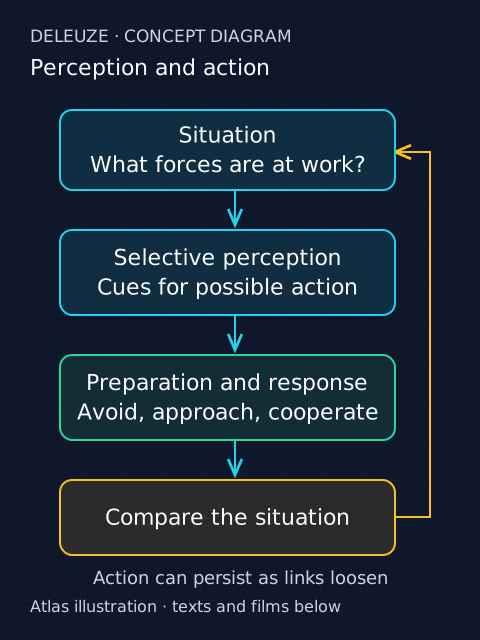
Atlas diagram: arrows describe relations between perception and action, not an evolutionary sequence in film history.
Open full-size diagramA situation offers cues for action
Identify what a figure sees, hears, and recognizes, then how that information leads to avoidance, approach, pursuit, or cooperation. The sensory-motor schema organizes perception in relation to possible action; visible displacement alone does not identify it.
Action changes the situation in return
Editing, spatial direction, and the task link perception to movement; a response opens a new perception. A held close-up can remain inside this circuit by preparing, delaying, or intensifying the next action.
The crisis concerns the connection
To examine a crisis of action, ask whether responses still organize the world that is seen. Figures may keep walking, talking, and performing tasks while local responses no longer account for everything they encounter. Compare functioning actions with moments in which action loses that organizing power.
Films and scenes
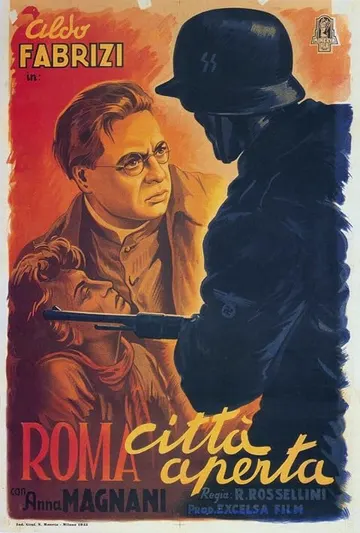
This atlas close-reading keeps two scenes in Rome, Open City distinct. First, Pina runs after the truck carrying Francesco away and is shot down in the street; her run remains a definite action, but it cannot alter the raid in time. At the end, the children witness Don Pietro's execution from behind the fence and slope, unable either to rescue him or convert what they see into victory, before walking back toward Rome. The gap between these scenes shows that movement and resistance persist while the totality of heroic action can no longer contain the event. This is a threshold of crisis, not an automatic declaration of direct time.
IMDb identification poster ↗Related film readings · 5 films
Taxi Driver · 1976 — Windshield, rear-view mirror, neon, and aimless cruising fragment New York into loose clichés. Travis sees everything yet cannot form an adequate response. He forces an action-chain through violence, which the media repackages as heroism, exposing crisis and cliché-production together.
High Noon · 1952 — Clocks, tracks, and emptied streets compress the town into a one-hour countdown. Kane repeatedly asks for help, yet action cannot organize the community. The duel completes a classical action-image, but the badge dropped in the dust prevents victory from restoring trust.
Nashville · 1975 — The wide frame holds campaigning, performance, traffic, and private life at once, while multiple soundtracks let one city pass through dispersed lives. Assassination restores no centre; the stage absorbs disorder with another familiar song. Once collective action breaks down, the city is doubled by the sounds and media clichés it produces.
Dog Day Afternoon · 1975 — The robbery loses its planned sequence almost immediately, leaving Sonny to shuttle among doorway, telephone, and crowd. Action remains intense but sweeps the same ground like a windscreen wiper. Media, police, and onlookers keep rewriting the event, undoing qualified action-space into an any-space-whatever without an exit.
Rome, Open City · 1945 · Candidate threshold reading — This atlas close-reading keeps two scenes in Rome, Open City distinct. First, Pina runs after the truck carrying Francesco away and is shot down in the street; her run remains a definite action, but it cannot alter the raid in time. At the end, the children witness Don Pietro's execution from behind the fence and slope, unable either to rescue him or convert what they see into victory, before walking back toward Rome. The gap between these scenes shows that movement and resistance persist while the totality of heroic action can no longer contain the event. This is a threshold of crisis, not an automatic declaration of direct time.
Criteria
Identify the symptoms actually present and how they combine, without forcing all five into the sequence. Then explain how these surface features deprive action of its power to integrate the world, and whether that failure produces a new optical or sound relation or remains a plot setback.
Distinctions and counterexamples
A failed act, passive character, or postwar film may reconnect the sensory-motor circuit. Even when crisis is established, one cannot infer a time-image unless new optical, sound, or temporal relations actually organize the image.
Common confusion: This crisis is one historical and semiotic condition under which direct time-images can emerge, not a sufficient condition of the time-image. Failure, slowness, passive characters, open endings, or any one of the five symptoms alone does not prove that time now directly organizes cinematic connection.
Texts and sources
Cinema 1, ch. 12, pp. 205–216 (Minnesota 1986); Cinema 2, ch. 1, pp. 1–13 (Minnesota 1989)
- 01Cinema 1: The Movement-Image
Standard Minnesota English translation and a principal citation edition in Anglophone scholarship.
View source and edition → - 02Cinema 2: The Time-Image
Authoritative source for the standard translation, translators, ISBN, and publication date.
View source and edition →
Research disagreements
Replacement or coexistence?
The time-image reverses the subordination of time to movement; both regimes persist and can shift locally within one film.
Taxonomy or generator?
Fixed labels invite mere example-hunting; an open taxonomy requires new concepts to transform existing relations and explain across cases.
How do we use Deleuze precisely?
Test four layers: sensory-motor relation, actual/virtual circuit, audio-visual connection, and regime of truth.
Concepts to distinguish
Compare them
- Movement-imageimage-mouvement
The movement-image is a regime in which movement differentiates into perception, affection, impulse, action, reflection, and mental relation to organize the image directly, while time appears indirectly through movement and montage. The relation-image is a decisive realization within the mental-image's problem-field, not an additional source-level rank parallel to it, and films need not pass through one fixed action-chain.
→ - Impulse-imageimage-pulsion
The impulse-image stands between affection and action. Deleuze divides its naturalist structure into four terms arranged in two pairs: originary world/derived milieu and elementary impulse/real behaviour. A historically, geographically, and socially determinate derived milieu remains present while elementary impulse penetrates real behaviour from within; impulse seizes object-fragments from that milieu and thereby exposes an uncoordinated originary world. Symptom and fetish are not additional structural terms but two classes of signs: a symptom is the appearance of impulse in the derived milieu, while a fetish is the appearance of the seized object-fragment itself. Stroheim realizes this structure through decay, descent, and entropy; Buñuel through repetition, cycles, and restart. These are distinct realizations, not cumulative thresholds that every example must satisfy.
→ - Action-image: large formgrande forme de l'image-action
The large form of the action-image follows S–A–S′. A milieu, collective, historical pressure, or danger first composes an encompassing situation S; that pressure leaves an internal imprint upon the character and concentrates itself in action A as effort, duel, or collective coordination; action then carries the milieu into a situation S′ different from the initial one. Its decisive question is how a situation demands action and whether action actually reorganizes that situation.
→ - Action-image: small formpetite forme de l'image-action
The small form of the action-image follows A–S–A′. It begins from an action A already underway whose meaning remains equivocal; indices of lack or ambiguity progressively disclose the situation S in which that act is embedded, forcing a revised action A′. The situation is not given in advance as a known whole but inferred through local gestures, misrecognitions, clues, gags, and the consequences of action.
→ - Reflection-imageimage-réflexion
Following Cinema 2, pp. 32–33, which retrospectively revisits the first semiotics, the atlas gathers the figures developed in Cinema 1, chapters 10–11—attraction, inversion, and discourse—under reflection-image. All three still transform the situation–action relation from within the action forms: attraction uses a substitute or rehearsal to miniaturize, prefigure, or stage another situation or act; inversion exchanges large and small powers; discourse makes an implicit problem into an audible and visible object of thought. Reflection-image must not be prematurely equated with chapter 12's relation-image.
→ - Mental-imageimage mentale
In Cinema 1's strict usage, the mental-image first names a problem-field: images take relations, symbolic acts, and intellectual feelings as their objects rather than representing states inside a character's head. Relations are external to their terms and irreducible to the attributes of any one term; symbolic acts and intellectual feelings must likewise become operations of image, sound, and editing rather than plot content. The atlas gives mental-image and relation-image separate pages only as reading interfaces for this problem-field and its Hitchcockian realization through Thirdness. The source does not rank them as parallel levels or make the former a superclass of recollection- and dream-images.
→ - Relation-imageimage-relation
The relation-image is the decisive Hitchcockian realization within the mental-image's problem-field: it makes relation itself the image's object and specifies its signs through Peircean Thirdness. A mark sustains a natural or habitual series, a demark redirects that series through an anomalous term, and a symbol makes a concrete term bear an abstract relation; Hitchcock further composes director, film, and the spectator who must enter the inference as a triadic apparatus. The separate atlas page is an explanatory interface, not evidence that the source ranks mental-image and relation-image as parallel levels.
→