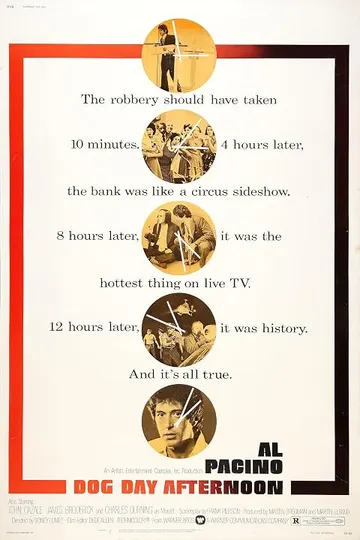
Sidney Lumet / 西德尼·吕美特 · 1975
Dog Day Afternoon
Dog Day Afternoon
The robbery loses its planned sequence almost immediately, leaving Sonny to shuttle among doorway, telephone, and crowd. Action remains intense but sweeps the same ground like a windscreen wiper. Media, police, and onlookers keep rewriting the event, undoing qualified action-space into an any-space-whatever without an exit.
Film details
- Original title
- Dog Day Afternoon
- Director
- Sidney Lumet / 西德尼·吕美特
- Year
- 1975
- Region
- United States
Film analysis: how shots organize concepts
The robbery target immediately becomes an impasse; dense action shuttles at the bank door while media and police undo qualified space into any-space-whatever.
- 01The plan delinks at the start
One accomplice leaves, the vault contains little cash, and the robbers improvise calls and demands.
The task can no longer follow perceived cues continuously; its target becomes a space of suspension. - 02The doorway becomes an oscillating axis
Sonny repeatedly rushes between the bank interior and police outside, appearing at the doorway and retreating.
Action sweeps the same ground like a windscreen wiper; movement persists while situation remains unchanged. - 03Media rewrites the event
The cry of “Attica” draws a crowd response as television, police negotiation, and hostage relations contest meaning.
The crime no longer belongs to a single agent; the bank becomes an any-space-whatever of disconnected forces.
Close-reading questions
- 01An accomplice leaves and the vault holds too little cash: planned robbery → improvised negotiation → broken action-chain. How does the bank change from target into an any-space-whatever trapping everyone?
- 02Sonny repeatedly runs to the doorway shouting “Attica”; how do bank interior, street crowd, and television cameras rewrite one crime as competing events?
- 03The vehicle finally moves toward the airport, yet telephone, weapons, and police route still determine everyone; why is apparent escape only the final pass of a windscreen-wiper movement?
Analysis and scene sources
Shots and scenes
Primary texts, scholarship, and locators
Theory coordinate: Cinema 1, Minnesota 1986, ch. 12, p. 208
- 01Cinema 1: The Movement-Image
Standard Minnesota English translation and a principal citation edition in Anglophone scholarship.
Open the atlas source record →
Viewing gateways and editions
No direct viewing link is listed; film search gateways are available above.