Concept definition
A space stripped of stable coordinates, total continuity, and practical use: ruins, empty lots, fractured streets, waiting rooms, or virtual spaces built from light, colour, and fragments. Relations can be recomposed within it.
What the concept explains
An any-space-whatever is despecified from a determinate state of things, total coordinates, and practical use, allowing qualities and powers carried by light, colour, shadow, fragments, or disconnection to recombine. It belongs to the affection-image in Cinema 1 and can also condition the postwar break in Cinema 2.
Intellectual lineage: Cinema 1 first locates the any-space-whatever as a spatial form of the affection-image and qualisign. Cinema 2 later redeploys the same power of despecification as a condition of the postwar sensory-motor break; that later use is neither its sole nor its original location.
Sensory-Motor Rupture: How a Character Becomes a SeerDiagrams and film passages
Germany Year Zero
Germania anno zero (1948)
Supported by the scene
The cemetery emerges from rubble
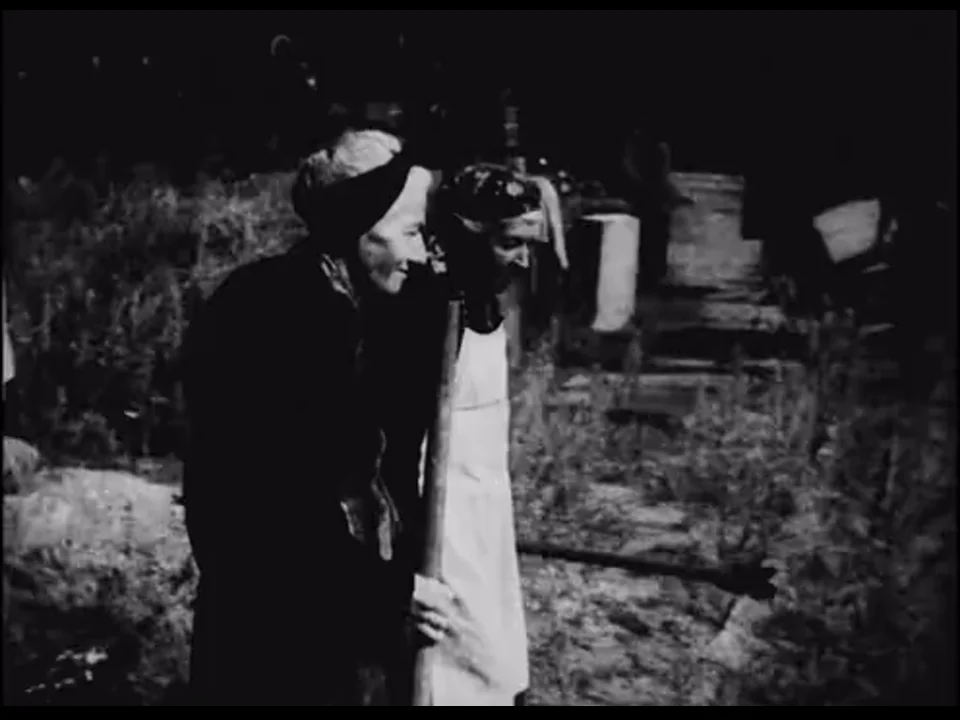
After the title, the city appears not as a coherent background for action but as cemetery, rubble, and survival labour layered together. Bilibili timecode 00:02:35.
Open full-size still- Displayed still
- 00:02:35
- Discussion passage
- 00:02:05 - 00:02:54
Frame-checked against the single-part Bilibili repost stream BV1hP4y1k78i: the page API reports 4,388 seconds and the retrieved qn16 media runs 4,387.37 seconds. Bilibili supplies no subtitle track; audible facts record only clearly discernible German speech, music, and ambient sound in the image sequence.
Complete single-part Bilibili film; the page and anonymous Player API were verified as playable. Bilibili submission label: repost.
Still checked: 2026-08-13 · Carrier access checked: 2026-08-13
Image
The camera first pans across damaged buildings and the city skyline, then cuts into an overgrown cemetery.
People dig and carry materials among graves, markers, and rubble; a pale board crosses the foreground.
Sound
The opening orchestral music continues over the city views and the first images of labour in the cemetery.
Relation to the concept
Cemetery, worksite, and ruin begin to interpenetrate, providing a test for any-space-whatever relations.
Sources and further reading
- Cinema 2: The Time-Image
Minnesota 1989 translation: Preface, p. xi; ch. 1, p. 2. 2004 Simplified Chinese edition: ch. 1, p. 3. · Brief primary-text mention: Deleuze uses the child in Germany Year Zero to connect motor helplessness with a greater capacity to see and hear. Preface p. x and the chapter's following passages are adjacent conceptual context, not direct pages on the film; the scene windows, facts, and criteria are this atlas's shot analysis.
- Bilibili · La-Jeunesse- · public repost page
00:02:35 · After the title, the city appears not as a coherent background for action but as cemetery, rubble, and survival labour layered together. Bilibili timecode 00:02:35.
Germany Year Zero
Germania anno zero (1948)
Supported by the scene
A historical voice crosses the ruined Chancellery
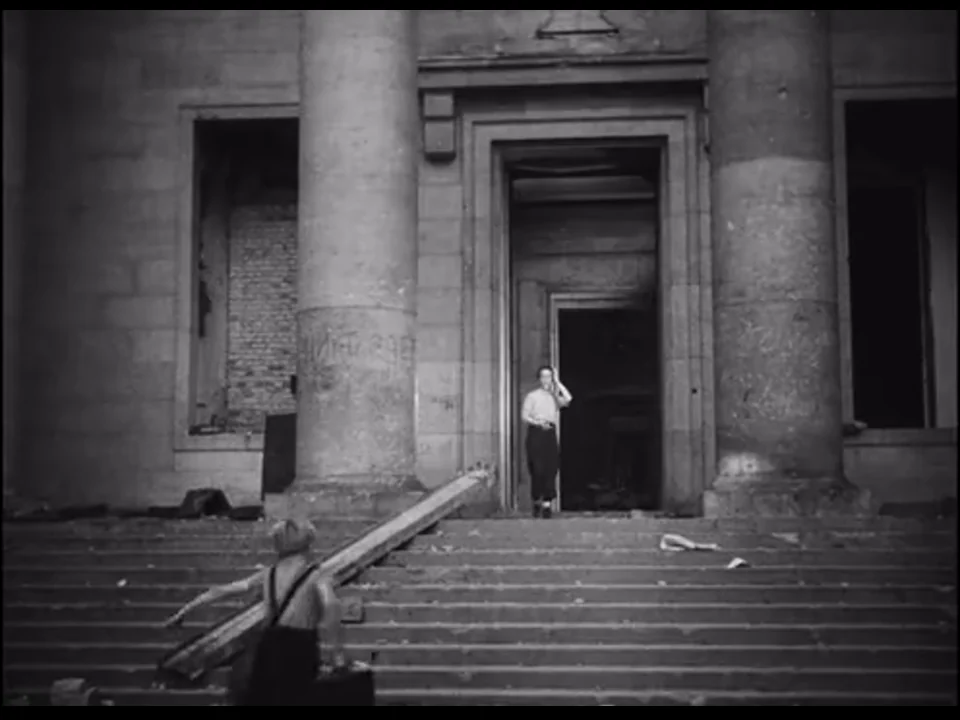
A recorded political voice meets the ruined Chancellery; the source of the voice and visible history are separated. Bilibili timecode 00:27:50.
Open full-size still- Displayed still
- 00:27:50
- Discussion passage
- 00:27:41 - 00:28:24
Frame-checked against the single-part Bilibili repost stream BV1hP4y1k78i: the page API reports 4,388 seconds and the retrieved qn16 media runs 4,387.37 seconds. Bilibili supplies no subtitle track; audible facts record only clearly discernible German speech, music, and ambient sound in the image sequence.
Complete single-part Bilibili film; the page and anonymous Player API were verified as playable. Bilibili submission label: repost.
Still checked: 2026-08-13 · Carrier access checked: 2026-08-13
Image
Edmund carries a case of records through the ruins while soldiers, visitors, and children move among broken walls.
The facade, monumental steps, and empty doorways repeatedly reduce the figures to small bodies within the frame.
Sound
A portable gramophone plays a German political speech with an amplified, archival timbre; brief location conversation is also audible.
Relation to the concept
The destroyed centre of power loses its former use and spatial continuity.
Sources and further reading
- Cinema 2: The Time-Image
Minnesota 1989 translation: Preface, p. xi; ch. 1, p. 2. 2004 Simplified Chinese edition: ch. 1, p. 3. · Brief primary-text mention: Deleuze uses the child in Germany Year Zero to connect motor helplessness with a greater capacity to see and hear. Preface p. x and the chapter's following passages are adjacent conceptual context, not direct pages on the film; the scene windows, facts, and criteria are this atlas's shot analysis.
- Bilibili · La-Jeunesse- · public repost page
00:27:50 · A recorded political voice meets the ruined Chancellery; the source of the voice and visible history are separated. Bilibili timecode 00:27:50.
Germany Year Zero
Germania anno zero (1948)
Supported by the scene
Final wandering and the sight too much to bear
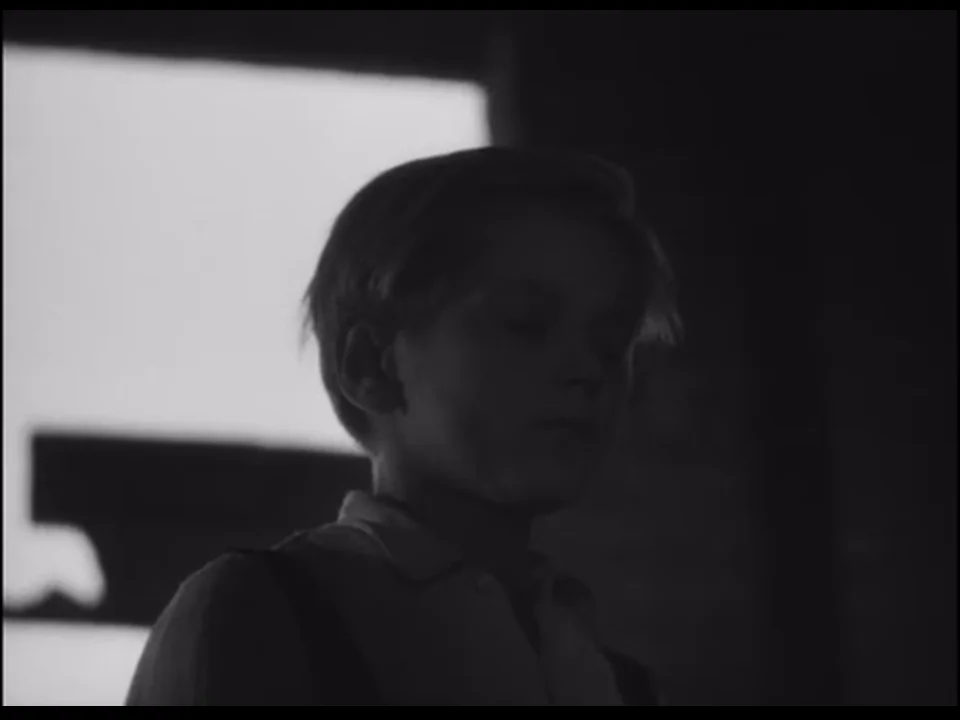
The long wandering turns streets, church, ruined buildings, traffic, and children's play from usable action-space into a city layer that must be watched. Bilibili timecode 01:12:18.
Open full-size still- Displayed still
- 01:12:18
- Discussion passage
- 01:05:01 - 01:12:44
Frame-checked against the single-part Bilibili repost stream BV1hP4y1k78i: the page API reports 4,388 seconds and the retrieved qn16 media runs 4,387.37 seconds. Bilibili supplies no subtitle track; audible facts record only clearly discernible German speech, music, and ambient sound in the image sequence.
Complete single-part Bilibili film; the page and anonymous Player API were verified as playable. Bilibili submission label: repost.
Still checked: 2026-08-13 · Carrier access checked: 2026-08-13
Image
Edmund crosses streets and broken walls alone, pauses outside a church, and enters a building without intact walls.
He watches children playing, vehicles, and the street below, repeatedly touches debris and architectural fragments; after climbing upward, he falls from the building, and a woman in the street approaches his body.
Sound
The long passage is formed mainly by sustained orchestral music, traffic, distant children's voices, and urban ambience; Edmund speaks almost no dialogue.
Relation to the concept
The ruined building and streets retain only fractured routes, openings, walls, and relations of height.
Sources and further reading
- Cinema 2: The Time-Image
Minnesota 1989 translation: Preface, p. xi; ch. 1, p. 2. 2004 Simplified Chinese edition: ch. 1, p. 3. · Brief primary-text mention: Deleuze uses the child in Germany Year Zero to connect motor helplessness with a greater capacity to see and hear. Preface p. x and the chapter's following passages are adjacent conceptual context, not direct pages on the film; the scene windows, facts, and criteria are this atlas's shot analysis.
- Bilibili · La-Jeunesse- · public repost page
01:12:18 · The long wandering turns streets, church, ruined buildings, traffic, and children's play from usable action-space into a city layer that must be watched. Bilibili timecode 01:12:18.
Tropical Malady
สัตว์ประหลาด! (2004)
Concept relation awaiting verification
The radio does not restore coordinates
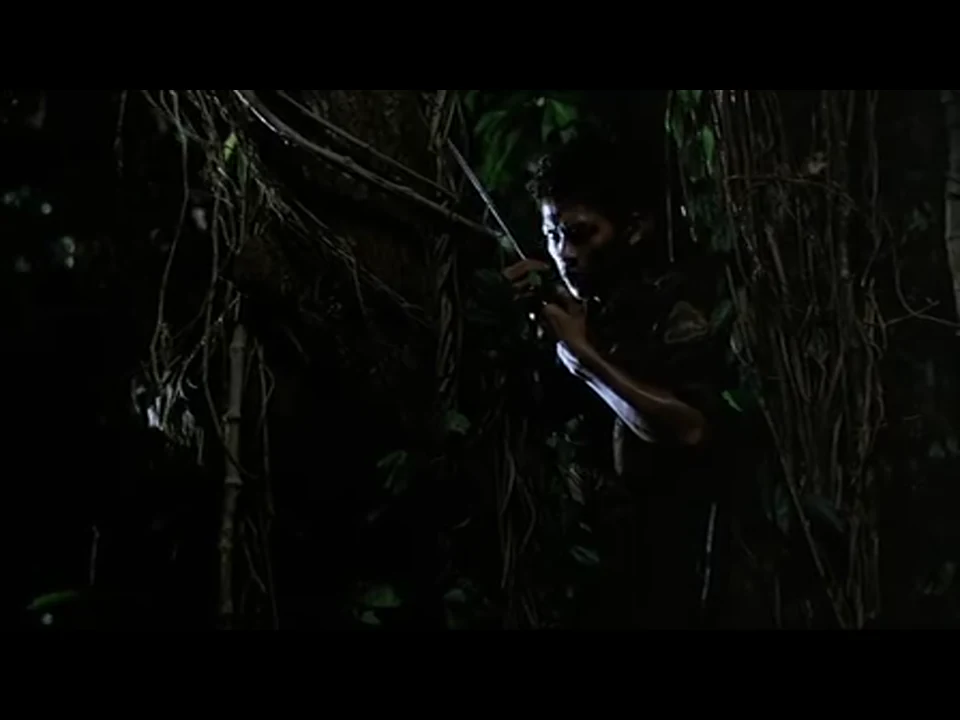
The communication device sends a call but does not turn the forest back into a mappable action-space. Bilibili timecode 01:08:47.
Open full-size still- Displayed still
- 01:08:47
- Discussion passage
- 01:08:36 - 01:09:10
Frame-checked against the single-part Bilibili repost stream BV12QcAzME5g: the page API reports 6,867 seconds and the retrieved qn16 media runs 6,866.48 seconds. Bilibili supplies no subtitle track; dialogue sense was cross-checked against a third-party English SRT bearing the same DVDRip release name.
Single-part user repost on Bilibili; the page and anonymous Player API were verified as playable. No platform subtitle track is present.
Still checked: 2026-08-13 · Carrier access checked: 2026-08-13
Image
Most of the frame remains dark; the soldier's face, hand, and nearby vines appear only intermittently.
He stops, raises a handheld radio to his mouth, and then remains listening in place.
Sound
He calls headquarters twice; no reply from headquarters is heard within the segment.
Forest insects continue to surround the brief human call.
Relation to the concept
Darkness and vines withdraw the total spatial coordinates available to action.
Sources and further reading
- Bilibili · 冰山阴影_ · public repost page
01:08:47 · The communication device sends a call but does not turn the forest back into a mappable action-space. Bilibili timecode 01:08:47.
Films and scenes

Cemetery, worksite, and ruin interpenetrate until the city no longer supplies a whole capable of organizing Edmund's action.
IMDb identification poster ↗Related film readings · 17 films
Germany Year Zero · 1948 · At the threshold — Cemetery, worksite, and ruin interpenetrate until the city no longer supplies a whole capable of organizing Edmund's action.
L’Avventura · 1960 — The disappearance escapes the logic of a solvable mystery; islands, architecture, and bodily attitudes give duration to the void within relations.
Teorema · 1968 — The visitor’s arrival distributes consequences like a theorem, yet his departure leaves an unsolved problem. Bodies, desert, and scream force thought toward an outside.
L’Eclisse · 1962 — After characters and rendezvous withdraw from the ending, places, objects, wind, and city noise persist. Time appears independently of relational action.
Pickpocket · 1959 — Hands, pockets, wallets, and relays connect a space that can never be surveyed as a whole. Tactile relations replace mastery through complete action-space.
Early Summer · 1951 — The camera withdraws to hold the figure, then advances into a corridor that now belongs to her home. False continuity detaches space from action’s coordinates.
PlayTime · 1967 — Glass, reflections, machine noise, and distant actions disperse the comic centre. Sonic gags gain effects independent of visible action.
Stalker · 1979 — The Zone refuses to become a transparent environment, returning the milieu to indeterminate opacity and the seed to the morbidity of something aborting. Rain and wet matter stage a hesitant search between material and spiritual.
Tropical Malady · 2004 — The film’s rupture produces a new perceptual regime among love, legend, human-animal becoming, and forest, testing the postwar European model in return.
Once Upon a Time in Anatolia · 2011 — Headlights repeatedly illuminate similar slopes and fountains, yet the suspect can only answer 'not here.' The search accumulates no mastery of the steppe; it releases wind, an apple rolling into a stream, car conversations about illness and family, and the pause produced when the mayor's daughter serves tea. Even after the body is found, transported, and examined, the doctor suppresses a detail that could alter responsibility. Procedure finishes while the event remains unexhausted: the time of death stays among landscape, fatigue, and a judgment left unwritten.
Goodbye, Dragon Inn · 2003 — Theatre space, spectral spectators, waiting, and cinematic memory deprive action of its object; this relation provides the time-image criterion.
Still Life · 2006 — Demolition space, broken relations, and sudden unreal objects remove the coordinates of action; local history provides the analysis’s core scale.
Au hasard Balthazar · 1966 — Balthazar makes no ethical choice, yet bears the effects of every human choice and non-choice. Reins, blows, loads, and wounds write human relations onto the animal body. Dying among sheep, he gives no verdict; the event suffered by the innocent separates from motive and becomes a spiritual affect.
Dog Day Afternoon · 1975 — The robbery loses its planned sequence almost immediately, leaving Sonny to shuttle among doorway, telephone, and crowd. Action remains intense but sweeps the same ground like a windscreen wiper. Media, police, and onlookers keep rewriting the event, undoing qualified action-space into an any-space-whatever without an exit.
Rome, Open City · 1945 — Partisans, a civilian household, a priest, and the occupiers might have converged into one line of resistance, yet raids, a street chase, abrupt gunfire, torture, and execution cut it into displaced encounters. Pina runs after the truck and suddenly falls while the children can only look on. Action no longer encompasses the event; postwar reality first appears as dispersion and gaps.
The Scarlet Empress · 1934 — White wall, door, veil, pillow, and sheets detach young Sophia's face from courtly coordinates. White is not innocence but an affective space that reflects, refracts, and imprisons light. Later, a close-up divided by shadow makes choice visible: she renounces intimacy for the cold conquest of power. Alternating light and dark no longer explains psychology; it directly composes a mode of existence.
Vampyr · 1932 — Pale grey light, drifting shadows, a scythe detached from its owner, and the road seen upward from inside a coffin strip inn, mill, and manor of stable coordinates. Allan Grey is not an agent who masters horror but Deleuze's grey figure of uncertainty. He moves between real connection and virtual supernatural possibility, while space itself bears the choice not yet decided.
Criteria
Does the space contain action, or dissolve the coordinates action requires?
Distinctions and counterexamples
A ruin, empty room, anonymous street, or waiting area is only possible material. If its coordinates still reliably serve pursuit, tasks, and orientation, desolation alone does not make it an any-space-whatever.
Common confusion: Dual location: in Cinema 1 the any-space-whatever first belongs to the affection-image and qualisign; in Cinema 2 it can also become a spatial condition of the postwar sensory-motor break. Empty shots and ruins are only possible forms.
Texts and sources
Cinema 1, ch. 7; Cinema 2, ch. 1
- 01Cinema 1: The Movement-Image
Standard Minnesota English translation and a principal citation edition in Anglophone scholarship.
View source and edition → - 02Cinema 2: The Time-Image
Authoritative source for the standard translation, translators, ISBN, and publication date.
View source and edition →
Research disagreements
Replacement or coexistence?
The time-image reverses the subordination of time to movement; both regimes persist and can shift locally within one film.
Taxonomy or generator?
Fixed labels invite mere example-hunting; an open taxonomy requires new concepts to transform existing relations and explain across cases.
How do we use Deleuze precisely?
Test four layers: sensory-motor relation, actual/virtual circuit, audio-visual connection, and regime of truth.
Concepts to distinguish
Compare them
- Sensory-motor schemaschème sensori-moteur
The sensory-motor schema is not the definition of the movement-image but one specific body-world organization within it. A body receives movement from its milieu, selects perceptions according to its needs, retains what it cannot immediately discharge as affection, and answers the milieu through action. Its crisis does not mean that characters cease moving; the link from perception and affection to an action capable of changing the situation comes loose.
→ - Pure optical / sound situationopsigne / sonsigne
A visual or auditory situation acquires a duration autonomous from cues for action or narration. Unable to translate what is seen or heard immediately into an effective response, the figure becomes a seer, listener, or witness. This is a threshold of the time-image, not direct time by itself.
→ - The seervoyant
The agent loses mastery over the situation and sees what habitual action concealed. The seer is a body struck by something too strong, too beautiful, terrible, or intolerable.
→