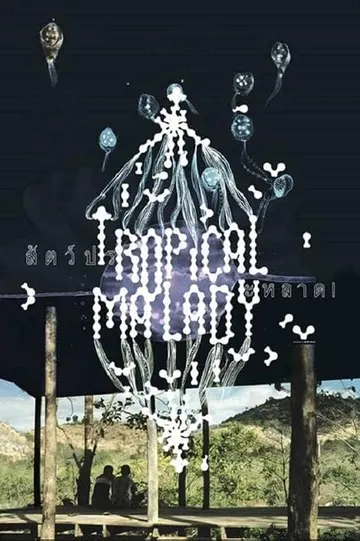
Apichatpong Weerasethakul / 阿彼察邦·韦拉斯哈古 · 2004
Tropical Malady
สัตว์ประหลาด!
The film’s rupture produces a new perceptual regime among love, legend, human-animal becoming, and forest, testing the postwar European model in return.
Film details
- Original title
- สัตว์ประหลาด!
- Director
- Apichatpong Weerasethakul / 阿彼察邦·韦拉斯哈古
- Year
- 2004
- Region
- Thailand
Film analysis: how shots organize concepts
Photographs, black screen, and a second title sequence headed 'A Spirit's Path' sever the everyday love story of the first half. Bilibili timecode 00:58:55.
After the final interior shot of the first half, photographs of the two men appear and the image turns black.
The black screen gives way to a hand-drawn tiger, the Thai word for 'spirit,' and a second set of credits; the exact-release English SRT renders the written sequence as 'A Spirit's Path' and a shaman legend, after which the image enters the forest at night.
The preceding sound stops at the black interval, so the aural break coincides with the visual rupture.
After the photographs turn to black, the track settles into sustained near-silence; no spoken dialogue or narration is heard over the tiger cards.
SITE ANALYSISThe two halves are not directly deducible through one continuous action chain, while tiger, legend, and the same performers keep them related; both conditions hold.
Bilibili at 00:58:55 Open original still ↗Frame-checked against the single-part Bilibili repost stream BV12QcAzME5g: the page API reports 6,867 seconds and the retrieved qn16 media runs 6,866.48 seconds. Bilibili supplies no subtitle track; dialogue sense was cross-checked against a third-party English SRT bearing the same DVDRip release name.Single-part user repost on Bilibili; the page and anonymous Player API were verified as playable. No platform subtitle track is present.
Bilibili · 冰山阴影_ · public repost page · verified 2026-08-13Close reading and primary texts
สัตว์ประหลาด! · 2004 · Apichatpong Weerasethakul / 阿彼察邦·韦拉斯哈古
Our Song Continues in the Forest
Rupture, soundscape, queer time, and becoming in Tropical Malady
The second opening carries one field of intimacy from everyday social time into the forest’s more-than-human time: the black screen frees the interval, forest sound takes over orientation, and grounded bodies with tiger–human looking recast love as a becoming across species, sound, and memory.
The Time-Image appeared in 1985 and Tropical Malady in 2004. The primary texts by Deleuze and by Deleuze–Guattari do not discuss the film; they provide the theoretical basis, film scholarship supplies the academic context, and this site brings both into contact with specific shots.
Primary passages and argumentative function
DELEUZE PRIMARY TEXTThe interval is set free, the interstice becomes irreducible and stands on its own.
DELEUZE PRIMARY TEXTWhat is real is the becoming itself, the block of becoming.
SITE FILM ARGUMENT
How touch passes through the black interval
Everyday intimacy in fingers brought to a mouth returns after the black screen as tracking, devouring, and bodily offering; the interval keeps two non-deducible series in relation.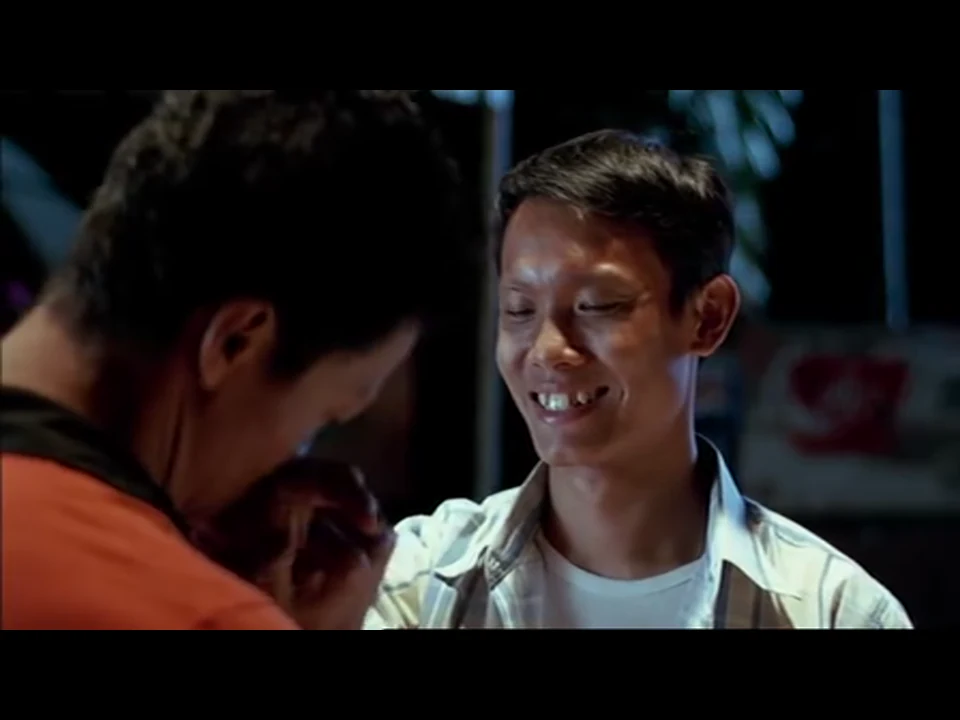
The everyday half organizes intimacy through touch, hesitation, and a smile. Bilibili timecode 00:52:02.
Open video position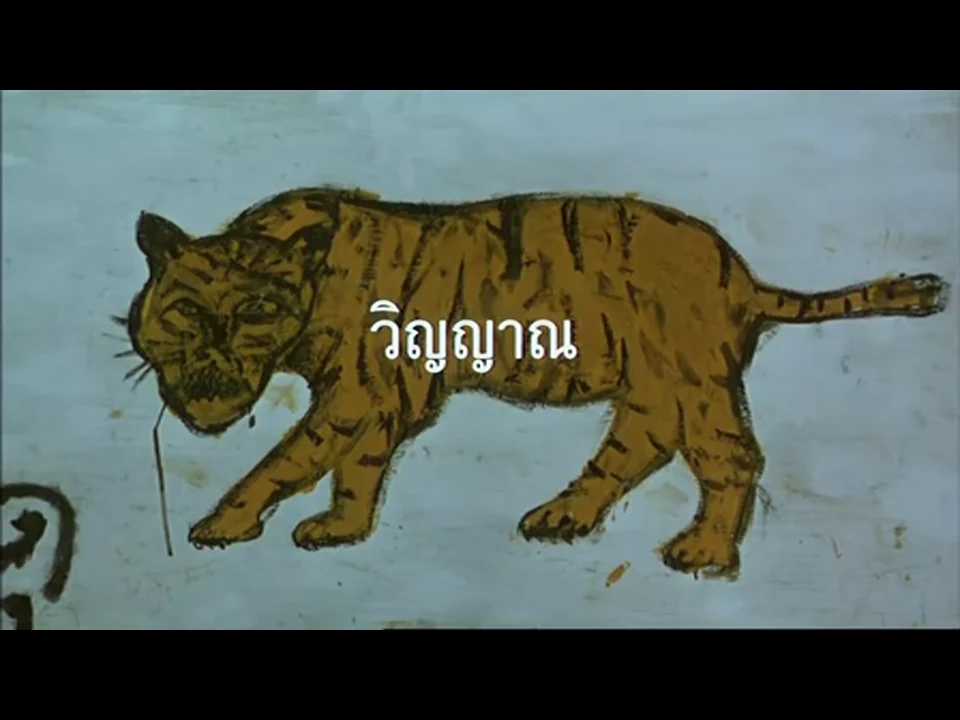
Photographs, black screen, and a second title sequence headed 'A Spirit's Path' sever the everyday love story of the first half. Bilibili timecode 00:58:55.
Open video positionAt 00:52:02 one man brings the other’s fingers to his mouth. The gesture secures no proposal, identity, or next task; ‘tomorrow,’ the unwashed hand, pauses, and smiles let touch occupy its own duration. Fuhrmann’s queer everydayness and Caillard’s stray intimacy take formal shape here: intimacy is not the result of social recognition but a temporary entry into another person’s time.[8, pp. 122–159][9, pp. 82–85]
Almost seven minutes later, photographs, black screen, and a tiger card marked ‘spirit’ withdraw names, places, and causal continuation, and the film begins again. The first half is not cancelled: touch returns as tracking, devouring, bodily offering, and ‘our song.’ Kim describes the film’s temporal structure as a mixture of virtual presents, reality, imagination, dream, and sheets of past—a nonchronological vertical time. The atlas uses that account to test the relation between the two parts. In this site's analysis, Deleuze’s freed interval becomes a concrete test: the black screen independently enables romance and forest legend to rewrite one another.[3, KCI abstract][1, p. 277][8, pp. 122–159]
SITE FILM ARGUMENT
The forest takes over the right to communicate
The radio loses its reply, a gaze returns through leaves, and monkey calls enter the position of speech; sound ceases to be subsidiary information for human action.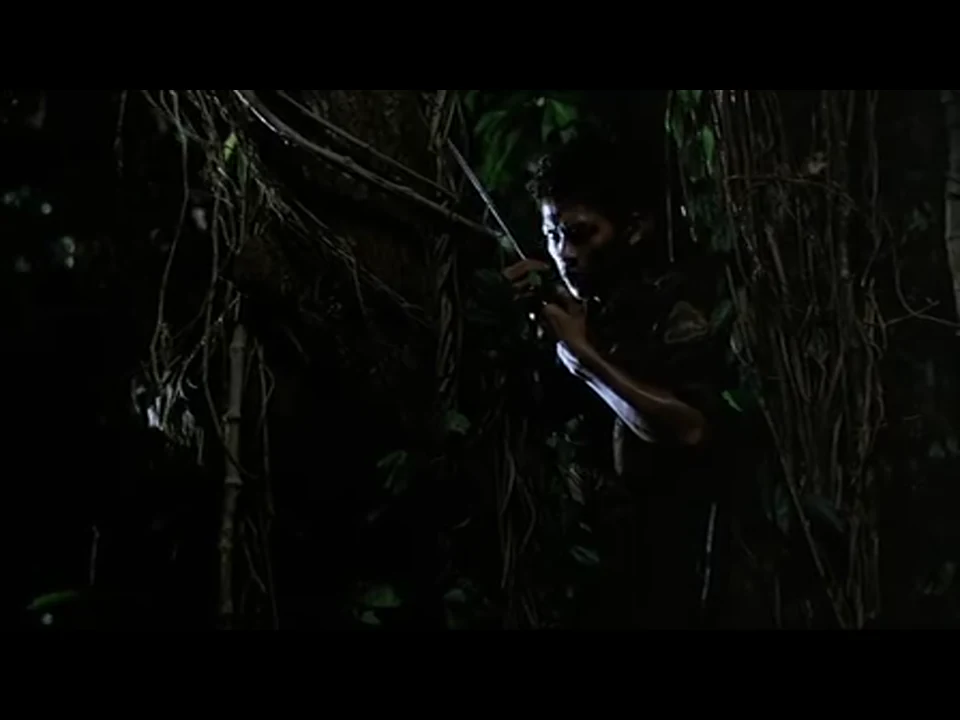
The communication device sends a call but does not turn the forest back into a mappable action-space. Bilibili timecode 01:08:47.
Open video position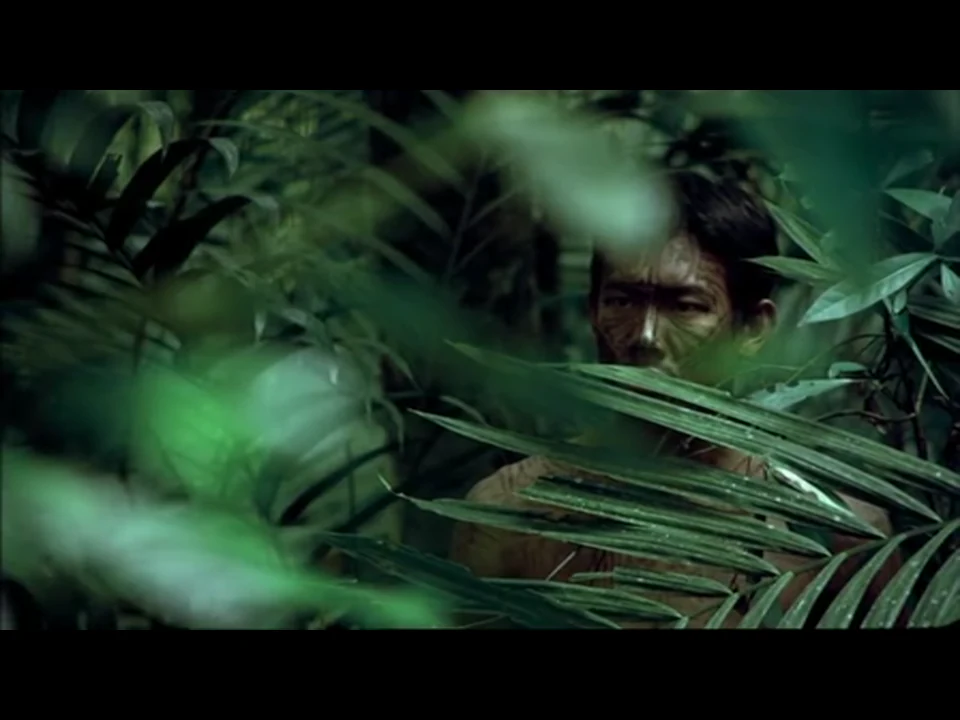
The body first appears as a difficult-to-identify fragment; a following intertitle links the gaze to the soldier's sound device. Bilibili timecode 01:17:54.
Open video position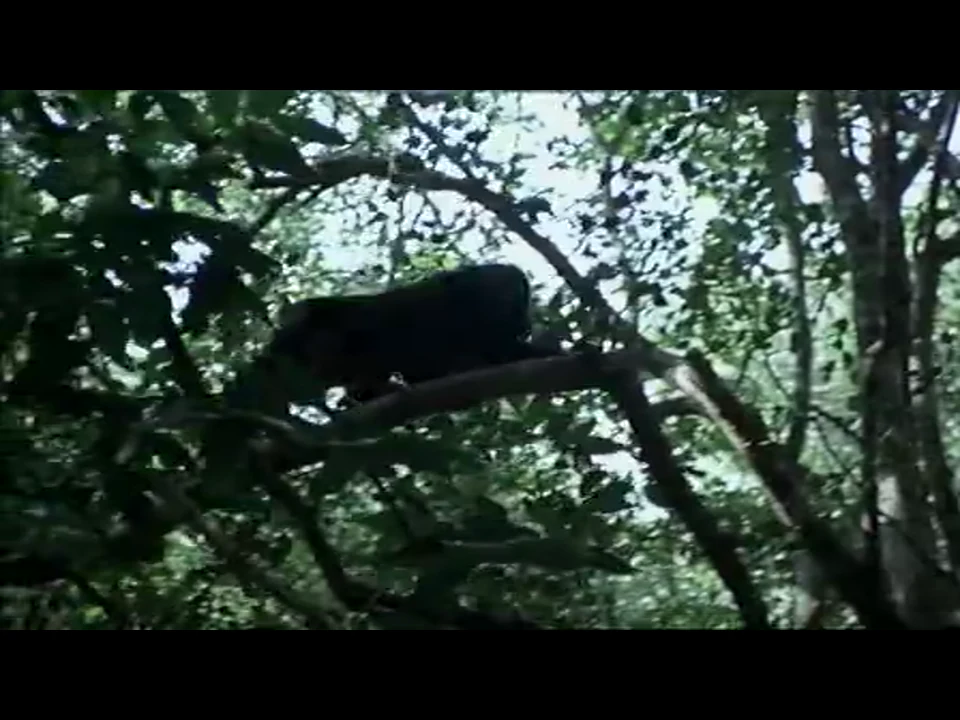
Editing joins the monkey in the tree, the soldier's upward look, and a spoken warning. Bilibili timecode 01:29:20.
Open video positionAt 01:08:47 the soldier calls headquarters twice and receives no answer. The radio should reconnect his body to position and command; without reply it leaves only a suspended voice inside the insects. At 01:17:54 eyes and a partial face appear among leaves before an intertitle explains that a spirit was attracted by the ‘sound device.’ The instrument changes from detector to a source that exposes the human, while the forest changes from surveyed object to an environment that hears him.[5, pp. 291–300][4, pp. 67–72, esp. p. 70][7, pp. 93–94, 99–101]
At 01:29:20 monkey calls, subtitles, and shot/reverse-shot organize animal sound as speech that changes the hunt: kill the tiger, or let the tiger devour him so that he enters the tiger’s world. Lovatt shows environmental sound breaking language’s monopoly on understanding; Boehler explains how darkness and unlocatable sounds force aural reorientation; Ingawanij describes the soldier’s increasing bodily receptivity to unseen sound. Sound receives its own framing as the communication device loses sovereignty over hearing.[4, pp. 67–72, esp. p. 70][5, pp. 291–300][7, pp. 93–94, 99–101][1, p. 277]
SITE FILM ARGUMENT
Becoming changes bodily capacity
Bare feet, mud, and low posture first establish the soldier’s bodily metamorphosis; becoming-animal becomes a testable claim in this site's analysis when the tiger also changes from hunted target to speaking and returning gaze.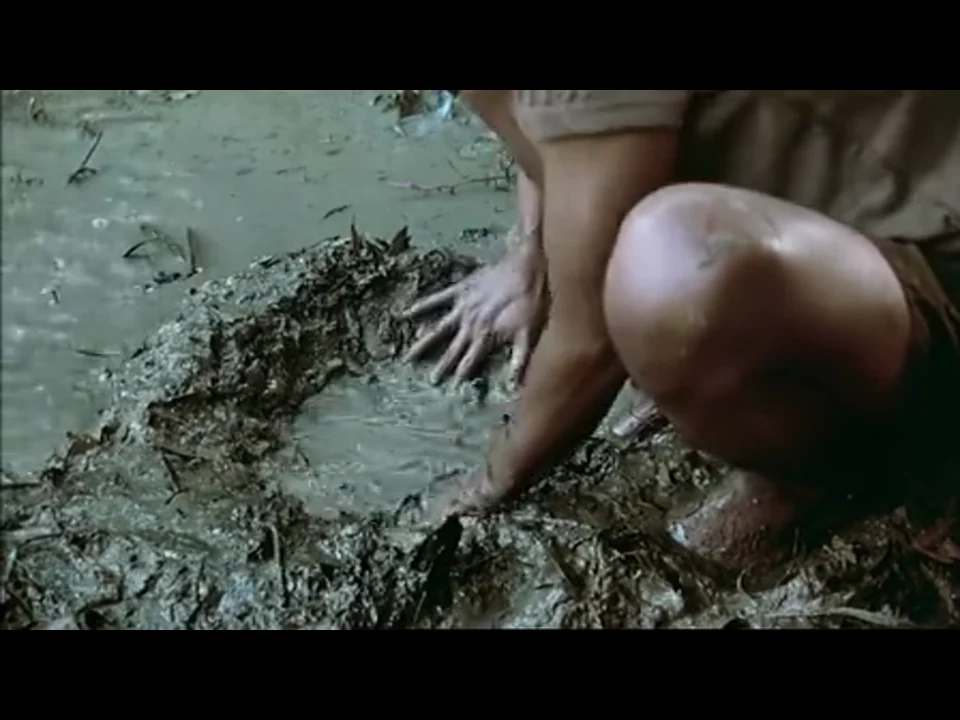
Upright walking gives way to a posture in which hands, feet, and knees share contact with the ground. Bilibili timecode 01:30:38.
Open video position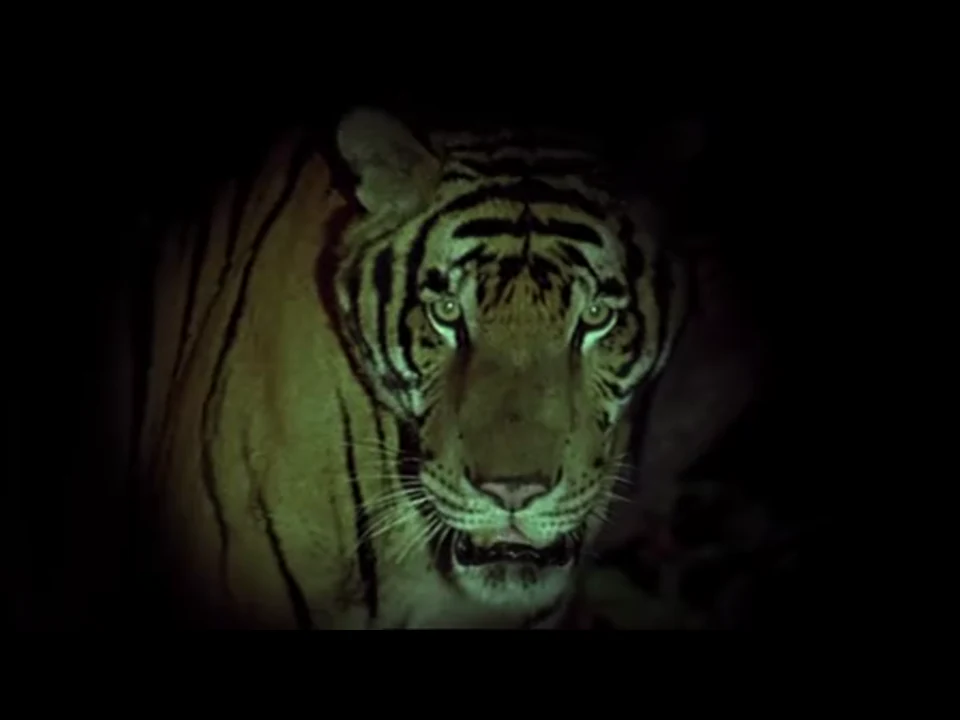
Alternating close views suspend the hunt between the frontal gazes of tiger and soldier. Bilibili timecode 01:45:12.
Open video positionAt 01:30:38 the soldier crouches barefoot in muddy water, puts both hands to the ground, and moves low through undergrowth. Change does not rely on a human-to-tiger effect but occurs at the level of capacity: upright walking gives way to new contacts among hands, feet, and mud; distant vision gives way to touch, listening, and proximity to the ground. Ingawanij describes this metamorphosis as bodily learning of new actions, as an observer controlling an environment becomes a surface permeable to it.[7, pp. 99–101][2, p. 238]
At 01:45:12 the flashlight makes the tiger’s face frontally visible. The target of the hunt is identified, yet action does not extend into a shot. Creed describes the tiger as familiar and strange, lover and killer; Caillard reads the frontal encounter as an ethical intimacy between human and animal. The atlas further distinguishes, in the images, the tiger as aimed-at prey, returning gaze, and position of speech. These changes first establish bodily metamorphosis; they do not by themselves establish becoming-animal. This site identifies becoming-animal only when two changes coincide: the soldier’s posture, contact, and perception shift continuously, while the tiger’s image-position also changes. Their relation changes through proximity, without imitation or a fixed endpoint.[6, p. 139][9, pp. 82–85][2, p. 238][1, p. 277]
SITE FILM ARGUMENT
‘Our song’ composes queer time
The ending lets touch from the first half and devouring from the second coexist in sound; the relation continues producing consequences after disappearance, metamorphosis, and unstable identity.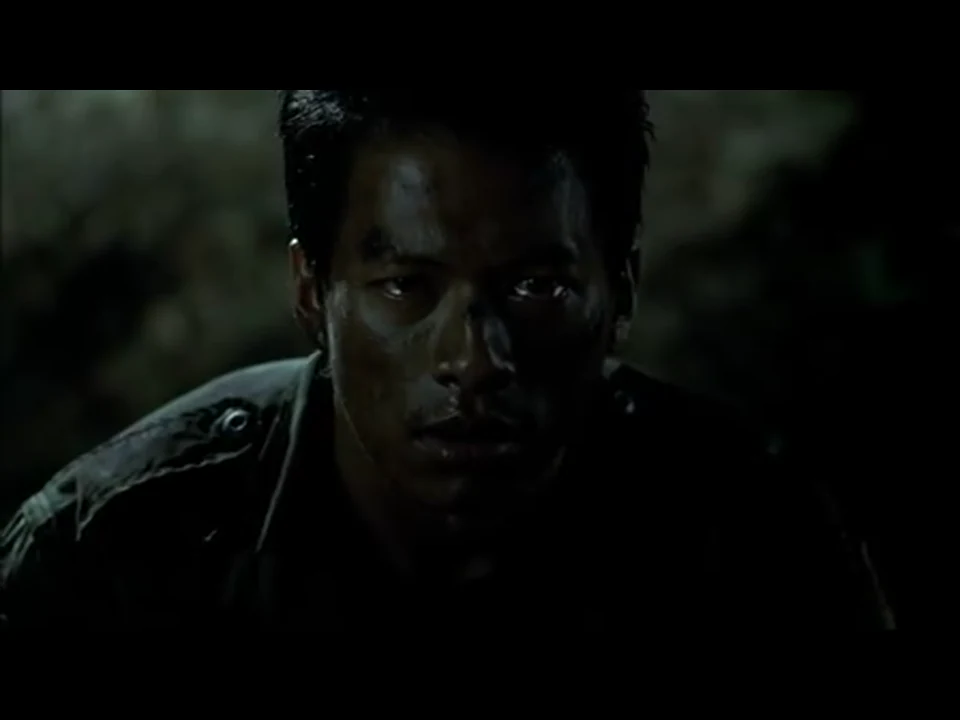
The soldier's close-up, an image of a tiger extending a long tongue toward a kneeling human figure, and forest sound join body, memory, and 'our song.' Bilibili timecode 01:48:40.
Open video positionAt 01:48:40 the film alternates among the soldier’s sweat- and mud-covered face, an image of a tiger extending a long tongue toward a kneeling human figure, and the dark canopy. A voice offers spirit, flesh, and memories to the ‘monster’ and connects blood to hearing through ‘our song.’ No gunshot, proof of death, or reunion unifies the two parts; intimacy, devouring, fear, offering, and subjective disappearance remain together.[4, pp. 67–72, esp. p. 70][8, pp. 122–159]
Lovatt’s haptic sound explains how blood, song, breath, forest ambience, and the listener’s body jointly carry memory. Fuhrmann’s queering of impermanence shows desire refusing a timeline in which loss must culminate in detachment. Caillard reads the ending as reconciliation; the atlas retains this competing interpretation while noting that the film confirms neither a kill nor complete fusion. Using Kim’s account of virtual time as a framework, the atlas reads the ending’s sound as an actual effect of the first half’s love. Queer time lies in a relation continuing to produce consequences after identity cannot be completed.[4, pp. 67–72, esp. p. 70][8, pp. 122–159][9, pp. 82–85][3, KCI abstract]
How scholarship advances the film
Kim Ho-young
Kim directly analyzes the film through Deleuze’s time-image, emphasizing virtual presents and the mixture of reality, imagination, dream, and sheets of past.
- Use for this film
- Support the vertical, nonchronological relation between the two parts.
- Critical pressure
- Temporal structure must be demonstrated through concrete cuts, returns, and coexistences.
Philippa Lovatt
Lovatt shows environmental sound acquiring haptic intensity and joining sound, body, and memory.
- Use for this film
- Analyze failed radio, foregrounded forest sound, and the final song.
- Critical pressure
- Sound analysis must specify auditory organization rather than stop at atmosphere.
May Adadol Ingawanij
Ingawanij returns the film’s metamorphosis to Khmer forest stories and precolonial Southeast Asian border thought; Boehler supplies Isan geography, borders, and Cold War marginalization.
- Use for this film
- Explain the grounded body and sensory learning while using regional scholarship to establish the forest’s historical density.
- Critical pressure
- The forest must retain Isan geography and local cosmology rather than become universal mystery.
Arnika Fuhrmann
Fuhrmann organizes everyday same-sex desire, impermanence, and ghostliness into an account of queer time.
- Use for this film
- Connect ordinary intimacy in the first half with disappearance, attachment, and persistence in the second.
- Critical pressure
- Queer time is established through altered rules of intimacy, loss, and futurity, not identity labels alone.
Barbara Creed
Creed examines the tiger as stranger, familiar being, lover, and killer, and the dissolution of the human–animal boundary.
- Use for this film
- Analyze the transformation of the target relation in tiger–soldier looking.
- Critical pressure
- The uncanny and animality require a parallel regional-historical reading.
Limits of the argument
- 01
The gap between the two parts must keep two image-series in relation without making one directly deducible from the other.
- 02
Sound exceeds sensory-motor function when it gains organization beyond orientation, warning, and emotional scoring.
- 03
Becoming-animal requires human and animal to change together through proximity; unilateral postural change establishes bodily metamorphosis only.
- 04
Regional scholarship establishes the Isan forest’s geopolitical border, Cold War history, and local cosmology, which are read alongside its perceptual organization in the images.
- 05
Queer time changes the temporal rules of intimacy, loss, futurity, and completed identity.
References
- 01Open source
PRIMARY THEORY Gilles Deleuze, Cinema 2: The Time-Image, trans. Hugh Tomlinson and Robert Galeta (University of Minnesota Press, 1989).
pp. 3, 180, 277Publisher record - 02Open source
PRIMARY THEORY Gilles Deleuze and Félix Guattari, A Thousand Plateaus, trans. Brian Massumi (University of Minnesota Press, 1987), p. 238.
p. 238Publisher record - 03Open source
SCHOLARSHIP Kim Ho-young, “Gille Deleuze’s Time-image in Tropical Malady by Apichatpong Weerasethakul,” 서강인문논총 43 (2015): 367–394.
pp. 367–394KCI peer-reviewed record and abstract - 04Open source
SCHOLARSHIP Philippa Lovatt, “‘Every drop of my blood sings our song. There can you hear it?’: Haptic sound and embodied memory in the films of Apichatpong Weerasethakul,” The New Soundtrack 3.1 (2013): 61–79.
pp. 61–79Peer-reviewed; university repository record · DOI 10.3366/sound.2013.0036 - 05Open source
SCHOLARSHIP Natalie Boehler, “The Jungle as Border Zone: The Aesthetics of Nature in the Work of Apichatpong Weerasethakul,” ASEAS 4.2 (2011): 290–304.
pp. 290–304Open peer-reviewed article · DOI 10.4232/10.ASEAS-4.2-6 - 06Open source
SCHOLARSHIP Barbara Creed, “Tropical Malady: Film & the Question of the Uncanny Human-Animal,” eTropic 10 (2011): 131–140.
pp. 131–140Open peer-reviewed article · DOI 10.25120/etropic.10.0.2011.3414 - 07Open source
SCHOLARSHIP May Adadol Ingawanij, “Animism and the Performative Realist Cinema of Apichatpong Weerasethakul,” in Screening Nature: Cinema beyond the Human, ed. Anat Pick and Guinevere Narraway (Berghahn Books, 2013), pp. 91–109.
pp. 91–109Scholarly book chapter · DOI 10.1515/9781800732957-008 - 08Open source
SCHOLARSHIP Arnika Fuhrmann, “Tropical Malady: Same-Sex Desire, Casualness, and the Queering of Impermanence in the Cinema of Apichatpong Weerasethakul,” in Ghostly Desires (Duke University Press, 2016), pp. 122–159.
pp. 122–159Scholarly book chapter · DOI 10.1515/9780822374251-005 - 09Open source
SCHOLARSHIP Duncan Caillard, “Stray Dogs and Strange Beasts: Apichatpong Weerasethakul’s Queer Animal Ethics,” in The Films of Apichatpong Weerasethakul, ed. Anik Sarkar and Jayjit Sarkar (Liverpool University Press, 2024), pp. 69–88.
pp. 69–88Scholarly book chapter · DOI 10.3828/liverpool/9781837645138.003.0004
Close-reading questions
How does the second opening transform everyday intimacy into a time in which human, animal, spirit, sound, and memory enter one another?
- 01How does the break between the two halves establish a new perceptual regime?
- 02How do human, animal, legend, and forest form relations of metamorphosis?
- 03How do darkness, sound, and gaze undo everyday action-space?
Scene–concept relations
- 01A hand brought to the mouth
Atlas candidate reading:Body / brain
Criterion for holding or withdrawal: Intimacy is produced by the duration of the gesture and both men's responses; if touch merely served an explicit narrative task, this bodily relation would not hold.
- 02Tiger title card after black
Support tag · evidence chain incomplete:Irrational cut / interstice
Criterion for holding or withdrawal: The two halves are not directly deducible through one continuous action chain, while tiger, legend, and the same performers keep them related; both conditions hold.
- 03The radio does not restore coordinates
Support tag · evidence chain incomplete:Pure optical / sound situation · Support tag · evidence chain incomplete:Any-space-whatever
Criterion for holding or withdrawal: The call must fail within the segment to restore position, command, or response, while forest sound continues to occupy the auditory field.
- 04A gaze through the leaves
Support tag · evidence chain incomplete:Pure optical / sound situation · Atlas candidate reading:Lectosign
Criterion for holding or withdrawal: The image must first keep identity and the gaze's object uncertain; only afterward does the intertitle establish the relation to the sound device.
- 05The monkey addresses the soldier
Support tag · evidence chain incomplete:Pure optical / sound situation
Criterion for holding or withdrawal: The speech must alter the identities and future options of both sides of the hunt rather than merely report the tiger's location.
- 06The body lowers into mud
Adjacent, not equivalent:Body / brain
Criterion for holding or withdrawal: Transformation is established by continuous changes in visible posture, contact, and sensory arrangement, without requiring the character to declare that he becomes animal.
- 07Tiger and soldier hold one another's gaze
Support tag · evidence chain incomplete:The seer · Support tag · evidence chain incomplete:Pure optical / sound situation
Criterion for holding or withdrawal: Tiger and soldier must both be organized as viewers, and the encounter must not immediately submit to the outcome of a kill.
- 08Giving over body and memory
Support tag · evidence chain incomplete:Pure optical / sound situation · Adjacent, not equivalent:Body / brain
Criterion for holding or withdrawal: Voice, painting, and gaze must jointly make predation more than one-way; if the ending merely confirmed victor and victim, this reciprocal relation would not hold.
About scene-relation labels
Support requires one scene's audiovisual facts and textual relation to be checked, with a named source and locator. Candidate readings, adjacent concepts, and countertests carry separate labels.
Shots and scenes
Intimacy is produced by the duration of the gesture and both men's responses; if touch merely served an explicit narrative task, this bodily relation would not hold.
Open viewing position ↗The two halves are not directly deducible through one continuous action chain, while tiger, legend, and the same performers keep them related; both conditions hold.
Open viewing position ↗The call must fail within the segment to restore position, command, or response, while forest sound continues to occupy the auditory field.
Open viewing position ↗The image must first keep identity and the gaze's object uncertain; only afterward does the intertitle establish the relation to the sound device.
Open viewing position ↗The speech must alter the identities and future options of both sides of the hunt rather than merely report the tiger's location.
Open viewing position ↗Transformation is established by continuous changes in visible posture, contact, and sensory arrangement, without requiring the character to declare that he becomes animal.
Open viewing position ↗Tiger and soldier must both be organized as viewers, and the encounter must not immediately submit to the outcome of a kill.
Open viewing position ↗Voice, painting, and gaze must jointly make predation more than one-way; if the ending merely confirmed victor and victim, this reciprocal relation would not hold.
Open viewing position ↗Primary texts, scholarship, and locators
Theory coordinate: Editorial world-cinema proposition outside Cinema 2’s named cases
- 01Gilles Deleuze, Cinema 2: The Time-Image, trans. Hugh Tomlinson and Robert Galeta (University of Minnesota Press, 1989).
pp. 3, 180, 277
Open source ↗ - 02Gilles Deleuze and Félix Guattari, A Thousand Plateaus, trans. Brian Massumi (University of Minnesota Press, 1987), p. 238.
p. 238
Open source ↗ - 03Kim Ho-young, “Gille Deleuze’s Time-image in Tropical Malady by Apichatpong Weerasethakul,” 서강인문논총 43 (2015): 367–394.
pp. 367–394
Open source ↗ - 04Philippa Lovatt, “‘Every drop of my blood sings our song. There can you hear it?’: Haptic sound and embodied memory in the films of Apichatpong Weerasethakul,” The New Soundtrack 3.1 (2013): 61–79.
pp. 61–79
Open source ↗ - 05Natalie Boehler, “The Jungle as Border Zone: The Aesthetics of Nature in the Work of Apichatpong Weerasethakul,” ASEAS 4.2 (2011): 290–304.
pp. 290–304
Open source ↗ - 06Barbara Creed, “Tropical Malady: Film & the Question of the Uncanny Human-Animal,” eTropic 10 (2011): 131–140.
pp. 131–140
Open source ↗ - 07May Adadol Ingawanij, “Animism and the Performative Realist Cinema of Apichatpong Weerasethakul,” in Screening Nature: Cinema beyond the Human, ed. Anat Pick and Guinevere Narraway (Berghahn Books, 2013), pp. 91–109.
pp. 91–109
Open source ↗ - 08Arnika Fuhrmann, “Tropical Malady: Same-Sex Desire, Casualness, and the Queering of Impermanence in the Cinema of Apichatpong Weerasethakul,” in Ghostly Desires (Duke University Press, 2016), pp. 122–159.
pp. 122–159
Open source ↗ - 09Duncan Caillard, “Stray Dogs and Strange Beasts: Apichatpong Weerasethakul’s Queer Animal Ethics,” in The Films of Apichatpong Weerasethakul, ed. Anik Sarkar and Jayjit Sarkar (Liverpool University Press, 2024), pp. 69–88.
pp. 69–88
Open source ↗
This film in books and research
《吉尔·德勒兹身体创造学研究》 · Atlas extension
Tropical Malady
Film relation: Site extension: the soldier gives up upright walking and forms new contacts among hands, feet, knees, and mud, presenting becoming at the level of capacity rather than a tiger-transformation effect.
Shot question: When does the body cease to observe and control the environment and become a sensible surface permeable to the forest?
The Cinematic Body · Further discussion
Bodies do not only receive impacts; they orient and respond
pp. 50–51
Claim: Viewing is an exchange between the film's body and the spectator's body. Posture, breath, kinesthesia, and sensory memory help complete the image.
Extension: Sobchack stresses embodied intentionality, Marks situates haptic visuality in diasporic and intercultural memory, and Barker differentiates film–viewer contact across skin, musculature, and viscera.
Tension: Shaviro's tactile image is not Marks's 2000 concept of haptic visuality. The latter carries a specific politics of cultural memory and archives, and tactile proximity does not automatically create ethical proximity.
Sobchack, Carnal ThoughtsMarks, The Skin of the FilmBarker, The Tactile Eye
The Cinematic Body · Further discussion
Sound is not an annotation added to images
pp. 34–35
Claim: Sound and image jointly produce space, expectation, and rhythm; vibration, captions, audio description, and sign-language interpretation can also recompose the audiovisual object through distinct modalities.
Extension: Chion's audio-vision shows that sound and image produce a new perceptual object together; Eidsheim returns sound and listening to a vibrational practice formed by medium, space, technology, and bodies.
Tension: The tactile image cannot absorb every sonic problem. Sound, hearing, listening, sign-language interpretation, and caption reading must remain distinct; not hearing does not mean lacking access to the audiovisual object through other modalities.
Deleuze and World Cinemas
Tropical Malady dossier
Reading relation: Atlas extension: contemporary Southeast Asian cinema
The Intensive-Image in Deleuze’s Film-Philosophy
Tropical Malady dossier
Reading relation: Sound, darkness, and bodily transformation
Sensory-Motor Rupture: How a Character Becomes a Seer
The image unexhausted by action carries time
Claim: When the shot no longer submits to route and task, pressures of past, present, and future can coexist within one passage.
Conclusion: Action-images and time-images may alternate in one film; the analytical unit is the concrete passage.
Cinema 2: The Time-Image · ch. 1, pp. 2–3Cinema 2: The Time-Image · ch. 1, pp. 2–5Deleuze on Cinema · pp. 107–113
Sensory-Motor Rupture: How a Character Becomes a Seer
A reset of the audio-visual regime
Film comparison: The forest after the intertitle tests the seer beyond the postwar corpus.
The Irrational Cut: How the Interstice Becomes a Lectosign
The cut changes from transition into relation
Claim: The irrational cut belongs to neither adjoining series; with a duration of its own, it determines how the two relate.
Conclusion: Autonomous series, a transition not deducible from action, and an operative gap jointly establish the irrational cut.
Cinema 2: The Time-Image · pp. 173–180, 245–248Deleuze on Cinema · pp. 165–196
The Irrational Cut: How the Interstice Becomes a Lectosign
Reading means relinking strata
Claim: The lectosign requires the viewer to rebuild an open route across image, sound, text, history, and absence.
Conclusion: The first three tests establish the irrational cut; when the relation also demands relinking heterogeneous strata, the image functions as a lectosign.
Cinema 2: The Time-Image · pp. 253, 255, 259A Deleuzian Cineosis · pp. 362–365
The Irrational Cut: How the Interstice Becomes a Lectosign
A second opening resets the rules
Film comparison: Blackout, tiger image, forest sound, and text test the chain from cut to reading.
Time-image research chapters
We hear first, then learn where it came from
Bearing Time Chinese DOCX, paragraphs 513–583.
Claim: Sound can arrive before its object, outlast the body, and cross the cut while carrying invisible time on its own.
What to watch for: Make a sound-trace table before interpreting the image: when does sound lose its coordinates, and when does it rewrite the image?
Time-image research chapters
Why must intimacy share one future?
Bearing Time Chinese DOCX, paragraphs 806–874.
Claim: Intimacy need not follow the normative sequence of meeting, marriage, reproduction, and inheritance; relations have temporal rights of their own.
What to watch for: Track intervals of meeting, repeated promises, and unfulfilled plans: do these temporal differences change the relation’s visibility?
Time-image research chapters
When heterogeneous times rewrite one another rather than merely coexist on screen
Bearing Time Chinese DOCX, paragraphs 1088–1160.
Claim: The final chapter turns the time-image into a testable relation: at least two heterogeneous times rewrite one another, shot, sound, editing, or apparatus carries the change, and a replayable consequence remains.
What to watch for: Find the exchange first, then its consequence; if times are merely displayed side by side, the work remains at the level of subject matter.
Time-image research dossier · Atlas shot dossier
Tropical Malady
Image operation: Blackout, tiger intertitle, and forest sound cut romantic action and redistribute what can be seen and heard.
Film question: Does the interval separate the two movements, or reset their rule of connection?
Viewing gateways and editions
- Verified complete Bilibili carrier: 热带疾病(2004)bilibili.comOpen film page ↗
- Page access
- Accessible when checked
- Version extent
- Recorded as a complete version
- Source type
- User-uploaded page
Edition note: Complete single-part film, accompanied by eight still-led scene analyses.
Link checked: 2026-08-13