Concept definition
The time-image tends toward an image that must be read: picture, sound, text, data, and invisible relations form strata. Viewing becomes an ongoing work of comparison, recomposition, and concept formation.
What the concept explains
The lectosign asks the viewer to read heterogeneous strata from within the image: visible, sayable, sonic, textual, and spatial relations retain their differences yet must be recomposed structurally. Readability arises between strata, not from a hidden symbol awaiting decoding.
The Irrational Cut: How the Interstice Becomes a LectosignDiagrams and film passages
Tropical Malady
สัตว์ประหลาด! (2004)
Candidate reading
A gaze through the leaves
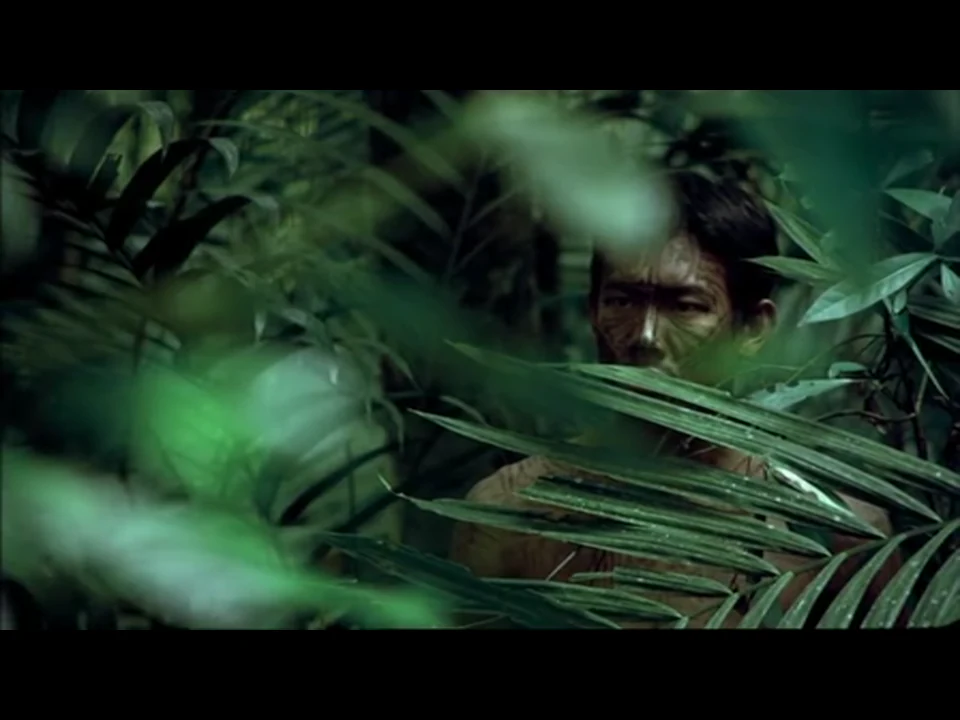
The body first appears as a difficult-to-identify fragment; a following intertitle links the gaze to the soldier's sound device. Bilibili timecode 01:17:54.
Open full-size still- Displayed still
- 01:17:54
- Discussion passage
- 01:17:18 - 01:18:10
Frame-checked against the single-part Bilibili repost stream BV12QcAzME5g: the page API reports 6,867 seconds and the retrieved qn16 media runs 6,866.48 seconds. Bilibili supplies no subtitle track; dialogue sense was cross-checked against a third-party English SRT bearing the same DVDRip release name.
Single-part user repost on Bilibili; the page and anonymous Player API were verified as playable. No platform subtitle track is present.
Still checked: 2026-08-13 · Carrier access checked: 2026-08-13
Image
A bare-chested figure moves low to the ground and is then screened by leaves, leaving only eyes and part of the face visible.
After this gaze, the film cuts to Thai text on black and then back to the forest; the exact-release English SRT renders the writing as the ghost being drawn to the soldier's 'sound device.'
Sound
Sparse forest sounds and several near-silent intervals accompany the figure's movement; the segment contains no spoken dialogue.
No spoken reading accompanies the black intertitle; the information about the 'sound device' is supplied only in writing.
Relation to the concept
Lectosign candidate: the relation holds only if failed radio calls, occlusion through leaves, the unvoiced intertitle, and memory of the first movement are relinked as four heterogeneous strata. If the writing merely supplies missing information, the lectosign label should be withdrawn.
Sources and further reading
- Bilibili · 冰山阴影_ · public repost page
01:17:54 · The body first appears as a difficult-to-identify fragment; a following intertitle links the gaze to the soldier's sound device. Bilibili timecode 01:17:54.
Late Spring
晩春 (1949)
Adjacent question
The vase does not explain Noriko's tears; the cuts give change a temporal form
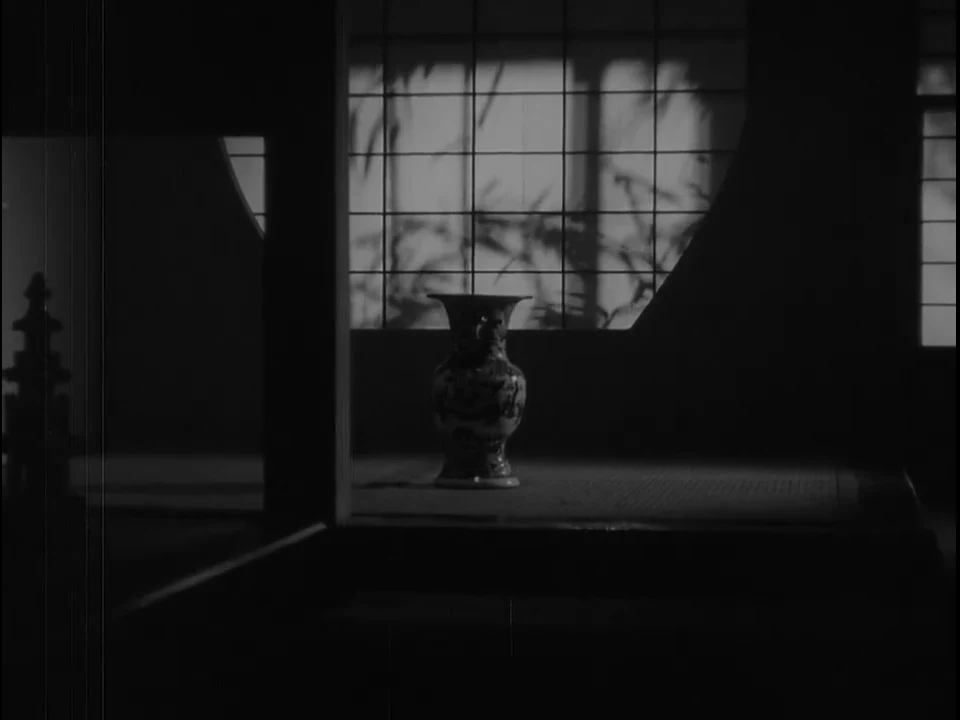
During the second vase shot, the vase remains nearly motionless while bamboo shadows continue moving across the shoji. The still records composition only. The 27.277-second interval from 01:28:20.380 to 01:28:47.657 begins with the first cut to the vase, passes through Noriko's face and the second vase shot, and ends at the cut into the rock garden; the preceding smiling face lies outside these stored bounds. Bilibili timecode 01:28:42.
Open full-size still- Displayed still
- 01:28:42
- Discussion passage
- 01:28:20.380 - 01:28:47.657
Within a continuous 01:28:15–01:28:55 window on the complete single-part Bilibili carrier BV1dN4y1B7tF, the atlas used cut detection and then frame-by-frame review to verify four cut points: first vase at 01:28:20.380, back to Noriko at 01:28:26.469, second vase at 01:28:37.397, and cut to the Ryōan-ji rock garden at 01:28:47.657. These coordinates bind only this 01:47:59 carrier; other restorations, releases, and leader lengths require fresh location.
Watch continuously from 01:28:15 to 01:28:50. First record visible differences between Noriko's two facial shots, then time both vase shots, and separately note snoring, music, and the cut to the rock garden. Do not begin by asking what the vase symbolizes. The coordinate binds only BV1dN4y1B7tF. Public reachability and the uploader's authorization to redistribute the feature are separate questions.
Still checked: 2026-09-03 · Carrier access checked: 2026-09-03
Image
In the shot immediately preceding the stored interval, Noriko lies down smiling. The stored bounds begin with the first vase shot, return to Noriko as tears gather in her eyes, cut to the same vase a second time, and end at the instant of cutting into the Ryōan-ji rock garden. Viewed with the adjacent shot, the order is Noriko's face–vase–Noriko's face–vase–rock garden.
On this carrier, the first vase shot lasts about 6.089 seconds and the second about 10.260 seconds. During the second, the vase remains nearly motionless while bamboo shadows continue moving on the shoji.
Sound
On p. 297, Parks uses continuing snoring to establish temporal contiguity across the shots; on p. 298, he reports that a musical theme enters about four seconds into the second vase shot and bridges to the rock-garden scene. This is Parks's written account of his material; treating it as an audible fact of this carrier still requires a separate check of its soundtrack.
Relation to the concept
The viewer must recompose shot length, facial difference, moving shadows, snoring, and music to explain how the transition is organized. Yet this remains chapter 1's still-life problem and must not be prematurely identified with the chapter 9 lectosign.
Sources and further reading
- Cinema 2: The Time-Image
Minnesota 1989 translation, ch. 1, pp. 16–17 · Deleuze distinguishes still life from empty space and uses the vase to explain change occurring in an unchanging form. The primary text gives no seconds for this Bilibili carrier; the atlas separately verifies the four cuts.
- The Riddle of the Vase: Ozu Yasujirō’s Late Spring (1949)
Japanese Cinema: Texts and Contexts (2007), pp. 78–89; point-of-view debate on p. 86 · Nornes surveys conflicting interpretations and notes that Bordwell and Thompson correct Richie's and Schrader's loose descriptions of point of view. His emphasis on p. 86, however, is that this formal correction still does not explain why the vase is ‘oddly powerful.’ Rejecting the shortcut from ‘she sees the vase’ to a fixed emotional symbol is the atlas's methodological boundary, not Nornes's single conclusion.
- Change, Horizon, and Event in Ozu’s Late Spring (1949)
Film-Philosophy 20.2–3 (2016), pp. 292–298, DOI 10.3366/film.2016.0016 · Parks places Deleuze's temporal reading alongside shot legibility, sound continuity, and shot length. He reports four seconds for the first vase shot and nine for the second, whereas this carrier yields 6.089 and 10.260 seconds. Because the article does not identify its transfer or timing method here, the discrepancy is recorded without attributing it conclusively to an edition difference.
- Bilibili · bili_29513417942 · complete single-part Late Spring · user repost
01:28:42 · During the second vase shot, the vase remains nearly motionless while bamboo shadows continue moving across the shoji. The still records composition only. The 27.277-second interval from 01:28:20.380 to 01:28:47.657 begins with the first cut to the vase, passes through Noriko's face and the second vase shot, and ends at the cut into the rock garden; the preceding smiling face lies outside these stored bounds. Bilibili timecode 01:28:42.
The Ganges Woman
La Femme du Gange (1974)
Atlas discussion reading
The voice points toward a ball and its figures while the image holds on a place with no speaker.
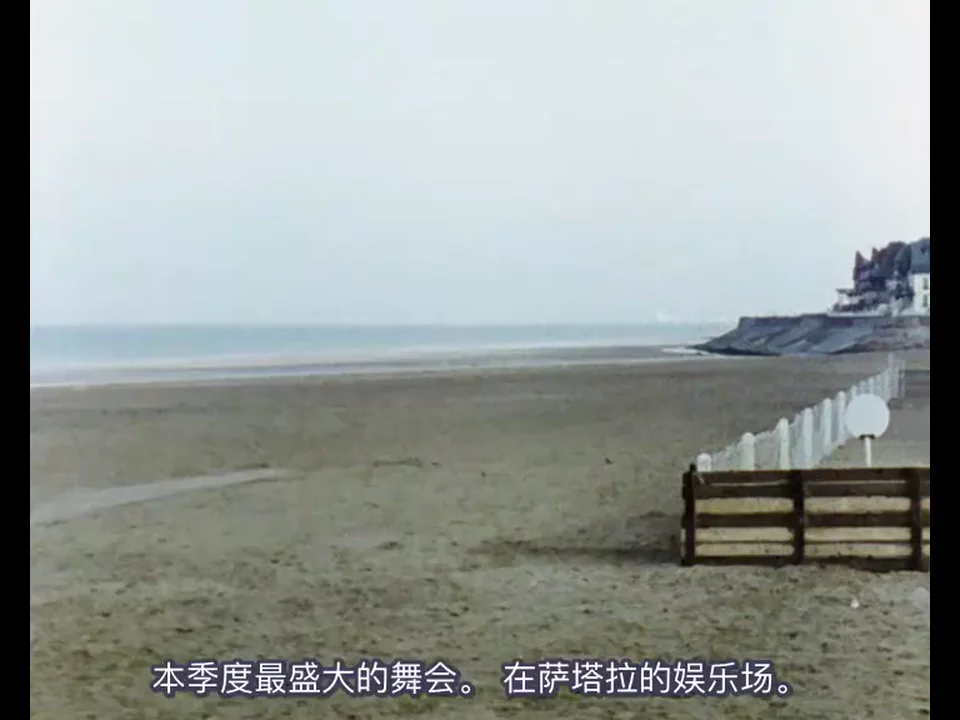
The voice points toward a ball and its figures while the image holds on a place with no speaker.
Open full-size still- Displayed still
- 第1分段 00:08:20 / Part 1 00:08:20
- Discussion passage
- 第1分段 00:08:00–00:08:40 / Part 1 00:08:00–00:08:40
- Carrier part
- 1
Part 1's empty-beach and off-screen voice passage was frame-checked.
Complete Bilibili carrier; the shot at 第1分段 00:08:20 was checked frame by frame, and the still and timestamp come from the same public upload.
Still checked: 2026-08-14
Image
Beach, bench, fence, and distant buildings remain empty; neither the ball nor a speaker appears.
Sound
An off-screen voice speaks of a grand ball without receiving a synchronized source in the empty view.
Relation to the concept
Sound and image unfold independently rather than through synchronized explanation; the viewer must read the interval among empty place, absent figures, and off-screen narration.
Sources and further reading
- Bilibili · La Femme du Gange, part 1
第1分段 00:08:20 / Part 1 00:08:20 · Complete Bilibili carrier; the shot at 第1分段 00:08:20 was checked frame by frame, and the still and timestamp come from the same public upload.
- Cinema 2: The Time-Image
Cinema 2, chapter 7, pp. 173–180; chapter 9, pp. 245–261.
From the Cloud to the Resistance
Dalla nube alla resistenza (1979)
Atlas discussion reading
Speech does not explain the land; voice and fields inscribed by struggle must be read together.
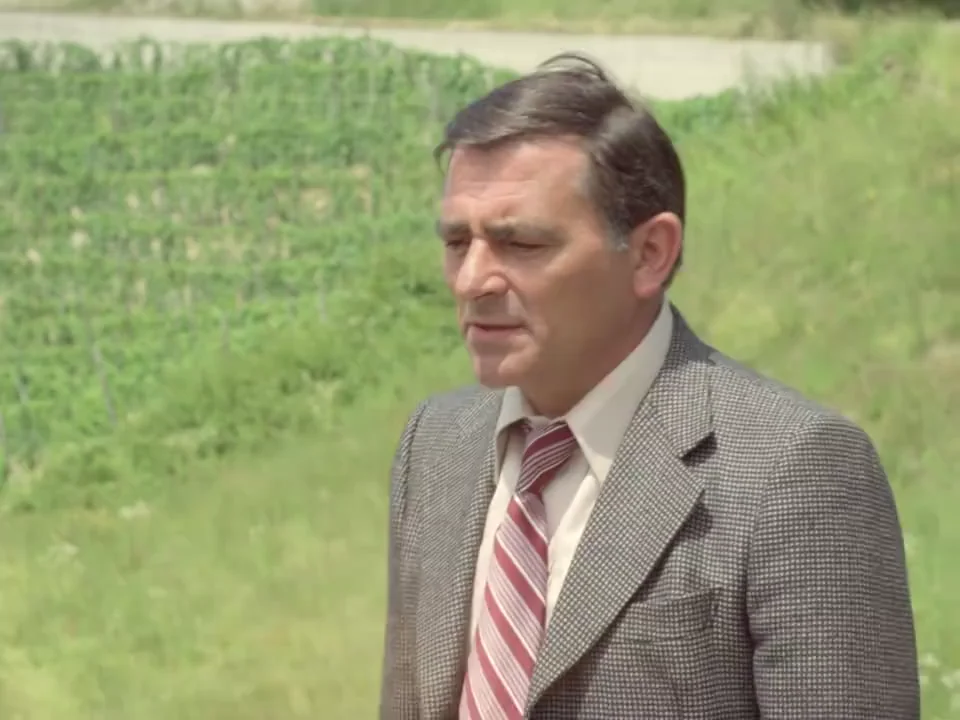
Speech does not explain the land; voice and fields inscribed by struggle must be read together.
Open full-size still- Displayed still
- 01:10:00
- Discussion passage
- 01:09:35–01:10:25
The monologue-in-the-fields passage was frame-checked.
Complete Bilibili carrier; the shot at 单片 01:10:00 was checked frame by frame, and the still and timestamp come from the same public upload.
Still checked: 2026-08-14
Image
The man speaks at the field's edge while crops, paths, and parcels remain clearly visible behind him.
The shot does not cut to dramatic action as an illustration of the speech.
Sound
The man delivers Pavese's text in a continuous, measured voice without erasing the outdoor sound field.
Relation to the concept
The land is read as a stratum marked by struggle while speech crosses without exhausting it; the two series reconnect history at their respective limits.
Sources and further reading
- Bilibili · From the Clouds to the Resistance complete film
01:10:00 · Complete Bilibili carrier; the shot at 单片 01:10:00 was checked frame by frame, and the still and timestamp come from the same public upload.
- Cinema 2: The Time-Image
Cinema 2, chapter 9, pp. 253, 255, 259.
Alphaville
Alphaville, une étrange aventure de Lemmy Caution (1965)
Atlas shot reading
Execution becomes a viewing protocol
The condemned answer questions, spectators applaud, bodies fall into water, and swimmers retrieve them. Voice, ritual, and bodily action operate like a repeatable script.
Open full-size still- Displayed still
- 00:42:15
- Feature time
- 00:42:15
Stills and jumps use the user-supplied Bilibili carrier. The feature occupies 00:00:00–01:39:10; coastal aerial footage after it is carrier padding.
The still and link retain the film guide's recorded shot locator.
Image
The condemned answer questions, spectators applaud, bodies fall into water, and swimmers retrieve them. Voice, ritual, and bodily action operate like a repeatable script.
Relation to the concept
Reading the image no longer means recognizing an event. It means reading how speech, space, and bodies compose a protocol of governance—the work of the lectosign.
Sources and further reading
- Cinema 2, Chapter 9
Cinema, thought, and the electronic automaton
- Cinema 2 edition record
Check primary-text and translation coordinates
- Criterion essay on Alphaville
Continue with Godard's operations on genre, city, and language
- Compare Synecdoche, New York
Move from a voice of control to doubles and earpiece commands
Alphaville
Alphaville, une étrange aventure de Lemmy Caution (1965)
Atlas shot reading
‘I love you’ is not a password
Natacha pauses, tests, and speaks word by word a relational phrase cancelled by the dictionary. Her voice and face do not suddenly recover a ready-made ‘human nature.’
Open full-size still- Displayed still
- 01:38:00
- Feature time
- 01:38:00
Stills and jumps use the user-supplied Bilibili carrier. The feature occupies 00:00:00–01:39:10; coastal aerial footage after it is carrier padding.
The still and link retain the film guide's recorded shot locator.
Image
Natacha pauses, tests, and speaks word by word a relational phrase cancelled by the dictionary. Her voice and face do not suddenly recover a ready-made ‘human nature.’
Relation to the concept
The utterance changes what the two can do together as it is spoken. Its force comes not from a dictionary entry but from making a new relation begin to exist.
Sources and further reading
- Cinema 2, Chapter 9
Cinema, thought, and the electronic automaton
- Cinema 2 edition record
Check primary-text and translation coordinates
- Criterion essay on Alphaville
Continue with Godard's operations on genre, city, and language
- Compare Synecdoche, New York
Move from a voice of control to doubles and earpiece commands
Synecdoche, New York
Synecdoche, New York (2008)
Atlas shot reading
Months have already passed inside breakfast
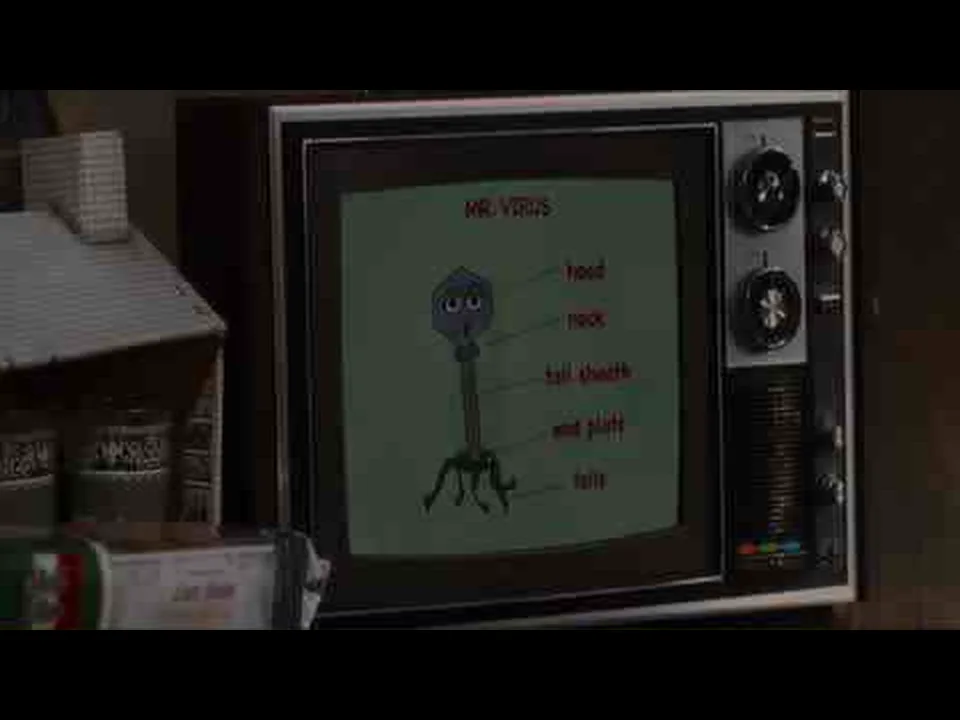
Broadcast dates, newspapers, seasonal programmes, food, and bodily symptoms traverse months inside one apparently continuous breakfast, while the characters treat change as ordinary noise.
Open full-size still- Displayed still
- 00:04:00
- Feature time
- 00:04:00
- Carrier part
- 1
The user-supplied Bilibili page divides the feature across fourteen parts and appends Tom and Jerry padding to each. The atlas captures only checked feature windows and always records both part number and within-part time.
The still and link retain the film guide's recorded shot locator.
Image
Broadcast dates, newspapers, seasonal programmes, food, and bodily symptoms traverse months inside one apparently continuous breakfast, while the characters treat change as ordinary noise.
Relation to the concept
Time is not a theme later added to life. Editing first deprives the present of a stable peak and forces viewers to read incompatible temporal markers.
Sources and further reading
- Actual, virtual, and crystal dossier
Audit nesting and doubles with strict criteria
- Cinema 2, Chapter 4
The crystal's minimal circuit and exchanging faces
- Sony Pictures Classics press kit
Kaufman interview, production notes, and credits
- Compare Black Swan
Compare how a role system acquires a body
Pierrot le fou
Pierrot le fou (1965)
Atlas shot reading
Guests do not discuss ads; ads speak through guests
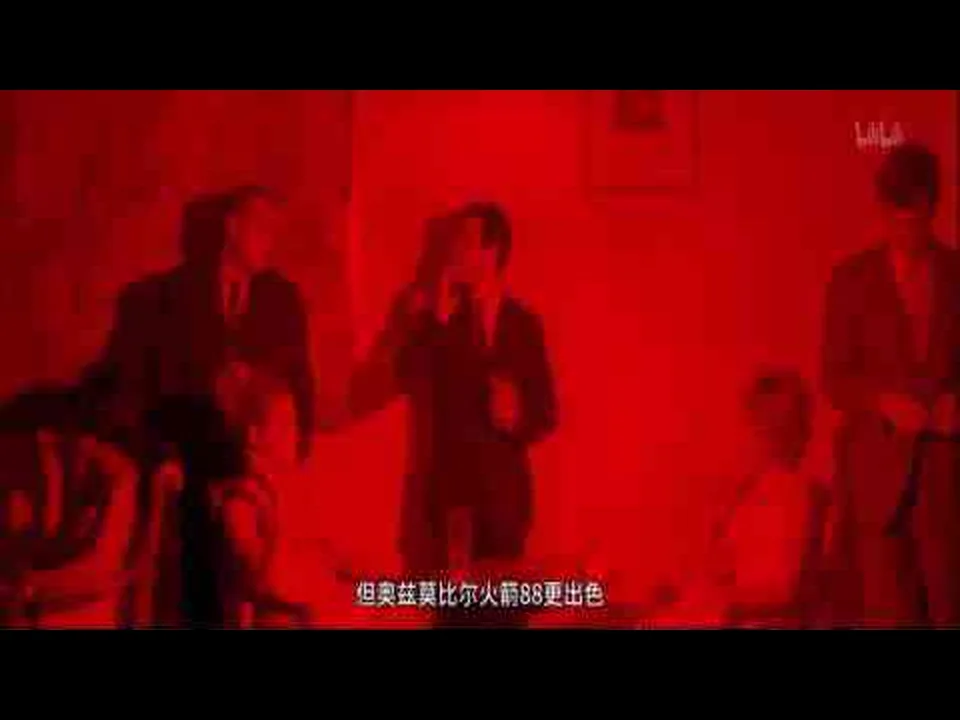
Red, yellow, and blue monochrome light compress guests into advertising-like planes; composition resembles product images taking turns on screen rather than neutral social space.
Open full-size still- Displayed still
- 00:06:44
- Feature time
- 00:06:44
All three stills and jumps use Bilibili’s official PGC ep368800 (01:50:45; internal BVID BV1zz4y1k7Ej). Official access can vary by membership and region; shot locator, edition record, and theoretical source remain separately documented.
The still and link retain the film guide's recorded shot locator.
Image
Red, yellow, and blue monochrome light compress guests into advertising-like planes; composition resembles product images taking turns on screen rather than neutral social space.
Sound
Characters exchange no experience and take turns reciting formulae for cars and toiletries. Speech still leaves mouths but has lost a unique speaking position.
Relation to the concept
The lectosign asks viewers to read how colour fields, commodity speech, and bodies compose rather than search for psychology. Cliché is not a theme but a media machine preformatting what can be said.
Sources and further reading
- Cinema 2, Chapter 7
Shock to thought, categories, and connections no longer totalized
- Cinema 2, Chapter 9
Autonomous audiovisual series and the interval
- Deleuze seminar, 29 Jan 1985
Primary seminar discussion of the Vietnam skit, category, and irrational cut
- Criterion: self-portrait in a shattered lens
Verify the party, advertising speech, and fragmentary form
- Pantenburg: open Godard / Farocki study
Continue tracing seascape, horizon, and disembodied voice
- Compare Passion
Move from categorical interruption to vertical juxtaposition of painting, factory, and studio
Passion
Passion (1982)
Atlas shot reading
Goya is not one painting but histories invading one another
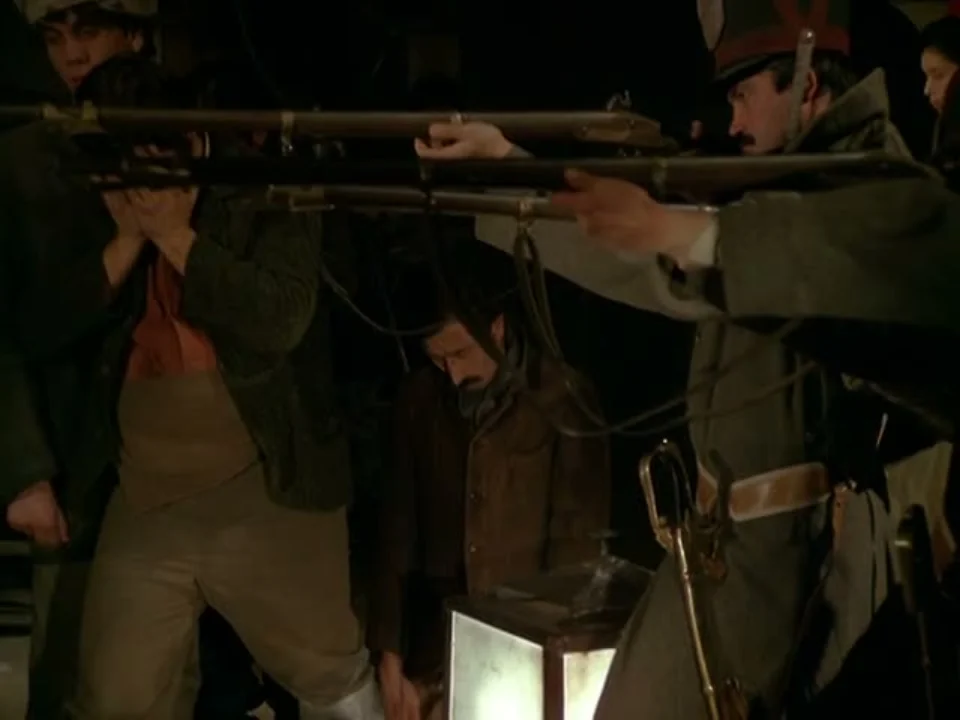
Actors playing the firing squad level rifles while a light box remains visible inside the composition; this tableau then alternates with royal portraiture, exposed bodies, cinematographic machinery, and Isabelle’s factory body in a continually reorganized series.
Open full-size still- Displayed still
- PAL 00:16:55
- Feature time
- PAL 00:16:55
Frame research uses the public Internet Archive reference copy (01:24:18, 25fps PAL speed-up). Its three images are checked frames, while watch links are marked as edition locators rather than direct Bilibili shots. In 87–88-minute editions these events usually occur about 4% later; align by visual and spoken checkpoints. User-supplied BV1gPKPzZEfZ is Ryusuke Hamaguchi’s 2008 namesake and remains excluded from Godard’s record.
Open the named edition and locate the moment using the still and timecode.
Image
Actors playing the firing squad level rifles while a light box remains visible inside the composition; this tableau then alternates with royal portraiture, exposed bodies, cinematographic machinery, and Isabelle’s factory body in a continually reorganized series.
Sound
Mozart’s Requiem runs alongside production phrases such as ‘the light doesn’t work’ and ‘follow the story.’ Historical mourning, studio judgment, and labour dispute do not merge into one authoritative voice.
Relation to the concept
Category does not apply one theme to heterogeneous material; it lets execution, nude, royalty, factory, and strike rewrite one another’s visibility. The lectosign must preserve differences among layers for their relation to be legible.
Sources and further reading
- Cinema 2, Chapter 7
Category, thought, and connection no longer guaranteed by a whole
- Cinema 2, Chapter 8
Bodily attitudes, work, and belief in this world
- Cinema 2, Chapter 10
Conclusion on open image, information, and outside
- Ilse Lafer: Passion in Work
Trace Goya, factory, strike, and unfinished production page by page
- Deleuze seminar: pictorial category
Primary account of tableaux as vertically developing categories
- Cinémathèque française edition record
Verify the 87-minute edition, production, and music
Films and scenes
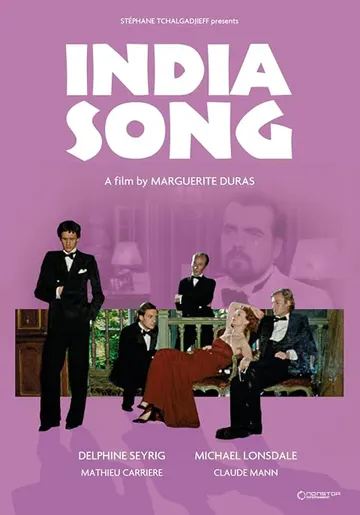
The relational history preserved by voices and the empty rooms, attitudes, and absent event in the image cannot explain one another and must be read as heterogeneous strata.
IMDb identification poster ↗Related film readings · 16 films
Late Spring · 1949 — The vase still life intervenes between the daughter’s smile and tears, placing change within time’s unchanging form.
Passion · 1982 — Tableaux vivants, factory labour, and failed production remain unresolved. The film turns theorem into problem and relinks bodies, images, and sounds across intervals.
India Song · 1975 · Candidate reading — The relational history preserved by voices and the empty rooms, attitudes, and absent event in the image cannot explain one another and must be read as heterogeneous strata.
Pierrot le fou · 1965 — Words, colours, bodies, songs, and quotations form multiple series. Thought is forced in the intervals between them.
PlayTime · 1967 — Glass, reflections, machine noise, and distant actions disperse the comic centre. Sonic gags gain effects independent of visible action.
Muriel · 1963 — The Algerian War past remains fragmentary as short montage, rooms, and speech continually transform it across different sheets.
From the Cloud to the Resistance · 1979 — Mythic text, postwar resistance, and filmed land form distinct strata. Speech acts awaken the image’s historical pressure across irrational cuts.
The Ganges Woman · 1974 — Two atemporal voices and the visible image each form autonomous series. The irrational cut preserves their boundaries so sound and image meet only at their limits.
The Lorry · 1977 — Sound acquires the reader's body while the visual is emptied into an unoccupied cab, roads, and a phantom lorry. As the lorry moves toward the sea, terrestrial movement enters Duras's oceanic perception.
Five Dedicated to Ozu · 2003 — Human action leaves the centre; waves, driftwood, moonlight, frogs, and rain become temporal events that must be watched and heard.
Synecdoche, New York · 2008 — Caden copies New York inside a warehouse and assigns actors to copy friends, strangers, and himself. Each double demands more rooms, rehearsals, and doubles of doubles. The stage no longer abbreviates life; it expands like a crystalline seed into an environment that reabsorbs marriage, ageing, and death. Sammy first makes a profession of watching Caden and later assumes his role, showing that a copy is not a static image: it changes how the original can next live until neither person nor set retains an outside to which it can return.
Enter the Void · 2009 — City, memory, body, and possible futures interweave; viewing proceeds by reading relations among image strata.
Tropical Malady · 2004 — The film’s rupture produces a new perceptual regime among love, legend, human-animal becoming, and forest, testing the postwar European model in return.
Alphaville · 1965 — Alpha 60's voice, an ever-contracting dictionary, and ubiquitous interrogation turn power from a single tyrant into an information network. Lemmy enters with the body of an old detective film and with poetry, making action, language, and feeling into noise the machine cannot process. The controlled city develops a rhythmic fault from within.
Readings in the same thematic group
Chronicle of Anna Magdalena Bach · 1968 — Anna's narration, letters, and the son's account form free indirect discourse. Live performance lets music acquire a resistant force independent of score and biographical explanation.
Her Venetian Name in Deserted Calcutta · 1976 — The soundtrack of India Song is placed over a different field of ruins. Names remain in an earlier stratum of memory while the ruins belong to another present; sound and image do not coincide on-screen and approach one another only at their limits.
Criteria
Beyond showing objects, which invisible relations does the image ask you to read?
Distinctions and counterexamples
Subtitle, intertitle, data interface, symbol, or explanatory voice-over is not itself a lectosign. If text or sound merely supplies missing information, viewing remains recognition rather than structural reading.
Common confusion: Criterion: viewing must recompose image, sound, text, data, and invisible relations.
Texts and sources
Cinema 2, ch. 9
- 01Cinema 2: The Time-Image
Authoritative source for the standard translation, translators, ISBN, and publication date.
View source and edition →
Research disagreements
Replacement or coexistence?
The time-image reverses the subordination of time to movement; both regimes persist and can shift locally within one film.
Taxonomy or generator?
Fixed labels invite mere example-hunting; an open taxonomy requires new concepts to transform existing relations and explain across cases.
How do we use Deleuze precisely?
Test four layers: sensory-motor relation, actual/virtual circuit, audio-visual connection, and regime of truth.
Where contemporary images push this concept
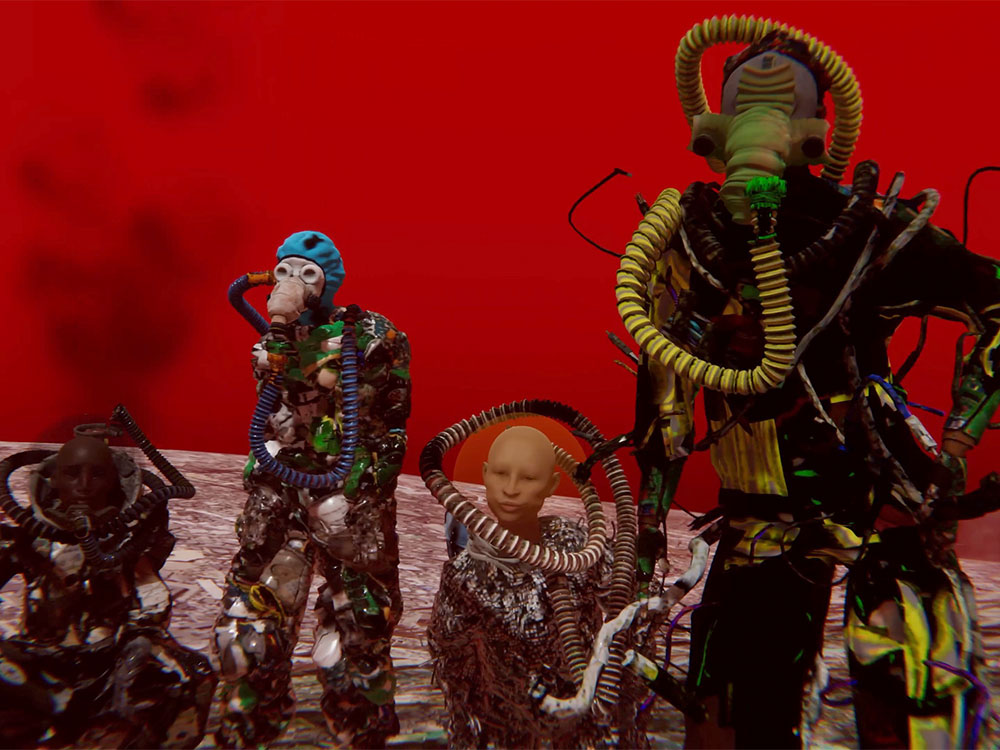
Testing the concept against a new mechanismCandidate reading · specific installation or screening edition pending
UKI: how does a game engine enter bodily control and electronic waste?
Engine images, live bodies, biotechnology, viral narrative, and electronic waste cannot be viewed as spectacle alone. The viewer must read across image, text, rule, and material consequence to reconstruct how the software environment organises bodily control and circulation. This tests the lectosign, not an equation of digitality with thought.
Scope and limits If the engine changes only texture and spatial style and the work can be understood without recomposing invisible institutional, data, or material relations, the lectosign lacks a mechanism and the analysis should return to media aesthetics.
- UKI: Shu Lea Cheang press kitArtist/project press kit · edition materialProject material is author/production self-description; edition, exhibition, and operability must be logged separately.
- Matthew Fuller: Third Nature on UKIPeer-reviewed article · techno-ecology and viral assemblageFuller’s Third Nature is his concept, not a Deleuze term; UKI project and film editions must be separated.

Testing the concept against a new mechanismCandidate reading · versioned passage review pending
The Zone of Interest: how outside sound enters domestic life
Domestic routine, the wall, offscreen sound, and historical knowledge require the viewer to read an institutional relation the image does not show. Seeing the garden and hearing gunfire does not complete testimony; the lectosign lies in recomposing visible order, invisible violence, and their coexistence.
Scope and limits If sound merely locates the camp and supplies background for onscreen action, requiring no recomposition across image, sound, and invisible institution, offscreen narrative sound is the sufficient description and lectosign terminology should be withheld.
- Cannes: The Zone of Interest official film pageFestival official page · film factsThe synopsis and sound credit do not replace sequence-level audiovisual analysis; specific sound sources require the film edition.
- Emilija Talijan: Attention and ambience in The Zone of InterestPeer-reviewed article · ambience and witnessingThe article is scholarly interpretation, not authorial intention or every viewer’s experience; log sound source, attention, and ethical judgement separately.
Concepts to distinguish
Compare them
- Irrational cut / intersticecoupure irrationnelle / interstice
Deducible continuity among shots, sounds, and images gives way to an irreducible interval between series. Thought is forced to happen within it.
→ - Noosignnoosigne
The noosign marks a crisis in the relation between image and thought. Classical cinema's promise that an organic whole and shock would automatically reach thought fails; the image instead confronts thought with the Outside, the unthought, and its own powerlessness, reopening the problem of belief in the world.
→ - Body / braincorps / cerveau
Everyday attitudes and gestus sediment time in the body; cinema of the brain turns space, light, colour, and connection into a map of thought. Body and brain form two distinct cinematic mechanisms of thought.
→ - Fabulationfabulation
Characters and filmmakers jointly remake reality through narration, performance, and re-enactment. Story no longer serves a prior truth; it creates a speaking position for a collective still in formation.
→ - Speech act and a people to comeacte de parole / peuple à venir
The storytelling speech-act crosses private affairs and politics, produces collective utterances, and prefigures the people who are missing.
→