Concept definition
Characters and filmmakers jointly remake reality through narration, performance, and re-enactment. Story no longer serves a prior truth; it creates a speaking position for a collective still in formation.
What the concept explains
Fabulation occurs when a real character and filmmaker or intercessor change together through narration, performance, or reenactment. Story no longer copies a prior truth but alters actual relations during filming and produces unfinished subject and collective positions.
Fabulation: How the Speech Act Prefigures a People to ComeDiagrams and film passages
Pour la suite du monde
Pour la suite du monde (1963)
Candidate reading
Preparing to revive the beluga hunt
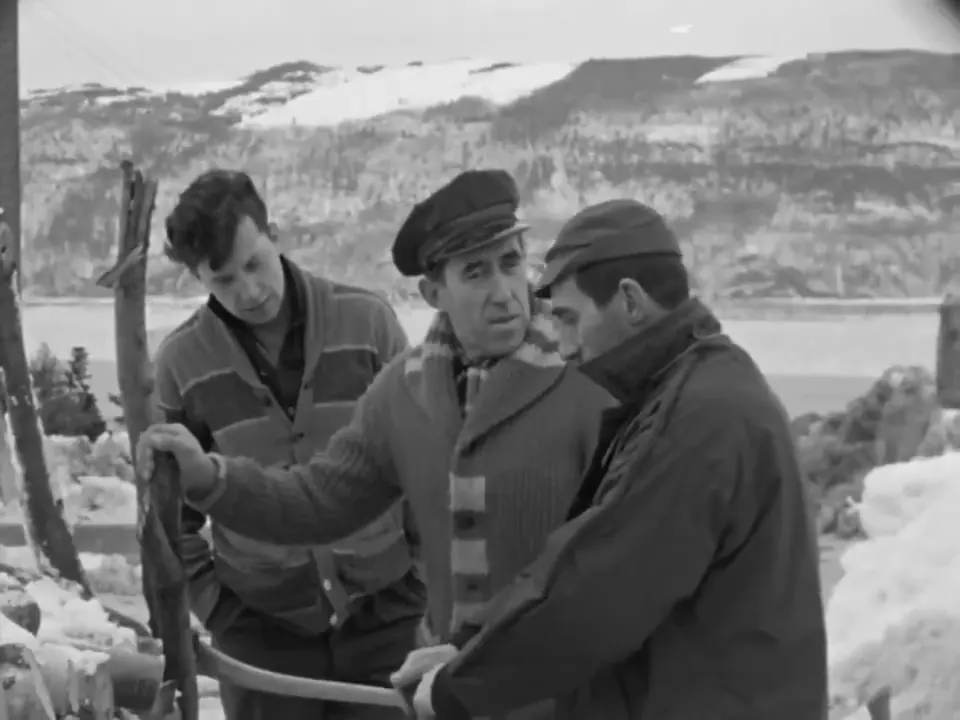
Preparations for the beluga hunt begin with a riverside discussion.
Open full-size still- Displayed still
- 00:10:00
- Discussion passage
- approx. 00:09:30—00:10:30
Official NFB English-version stream; anchor 00:10:00 verified. The displayed window locates that anchor; narrative boundaries await shot-level review.
Official free NFB stream in French with English subtitles. Download-to-own covers personal use worldwide or classroom use in Canada; it excludes public screenings and non-educational institutional use. An institutional licence covers institutional settings and free public screenings.
Still checked: 2026-08-13 · Carrier access checked: 2026-08-13
Image
Three island men confer above the river; one handles a wooden post or tool. The hunt concerns the beluga, locally called marsouin blanc.
Sound
French location dialogue discusses preparations still to be made; the official player supplies English subtitles.
Relation to the concept
Candidate beginning of fabulation: deliberation speaks an interrupted practice into a present plan. Without subsequent reenactment, shared labour, and a changed filming relation, this scene establishes only preparatory conversation.
Sources and further reading
- Cinema 2: The Time-Image
Minnesota 1989 translation: ch. 6, pp. 150–153; ch. 8, pp. 221–224 · Perrault: the white whale and fabulation in chapter 6; storytelling speech-act, fishing action, memory, and a people to come in chapter 8.
- Bilibili · 牛仔C麦 · user-provided public repost page
00:10:00 · Preparations for the beluga hunt begin with a riverside discussion.
- Pour la suite du monde — English version
Official free NFB stream in French with English subtitles. Download-to-own covers personal use worldwide or classroom use in Canada; it excludes public screenings and non-educational institutional use. An institutional licence covers institutional settings and free public screenings.
Pour la suite du monde
Pour la suite du monde (1963)
Candidate reading
Low-tide knowledge is spoken back into use
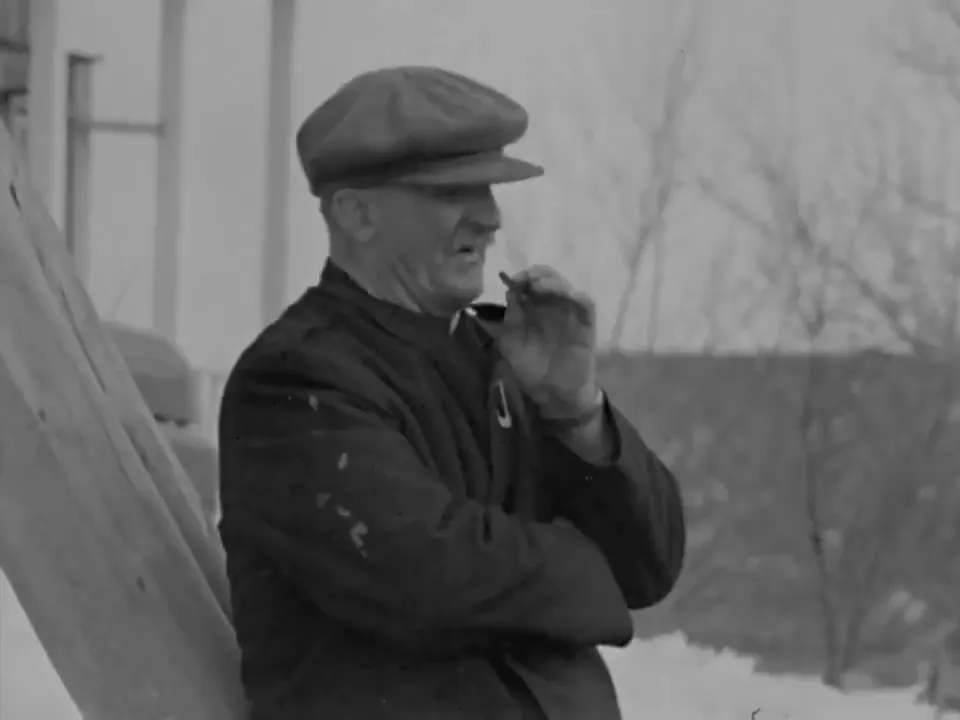
The elders restate the rule that the work must follow low tide.
Open full-size still- Displayed still
- 00:15:00
- Discussion passage
- approx. 00:14:30—00:15:30
Official NFB English-version stream; anchor 00:15:00 verified. The displayed window locates that anchor; narrative boundaries await shot-level review.
Official NFB full film; this window was checked against the official player.
Still checked: 2026-08-13 · Carrier access checked: 2026-08-13
Image
Older islanders converse face-to-face beside a building in winter.
Sound
The dialogue specifies that the work must take place at low tide.
Relation to the concept
Oral tidal knowledge enters the fabulation chain only when later judgement, post-setting, and collective labour take it up. If it merely supplies information about an old technique, the fabulation label should be withdrawn.
Sources and further reading
- Cinema 2: The Time-Image
Minnesota 1989 translation: ch. 6, pp. 150–153; ch. 8, pp. 221–224 · Perrault: the white whale and fabulation in chapter 6; storytelling speech-act, fishing action, memory, and a people to come in chapter 8.
- Bilibili · 牛仔C麦 · user-provided public repost page
00:15:00 · The elders restate the rule that the work must follow low tide.
- Pour la suite du monde — English version
Official NFB full film; this window was checked against the official player.
Pour la suite du monde
Pour la suite du monde (1963)
Candidate reading
Announcing the project to the island
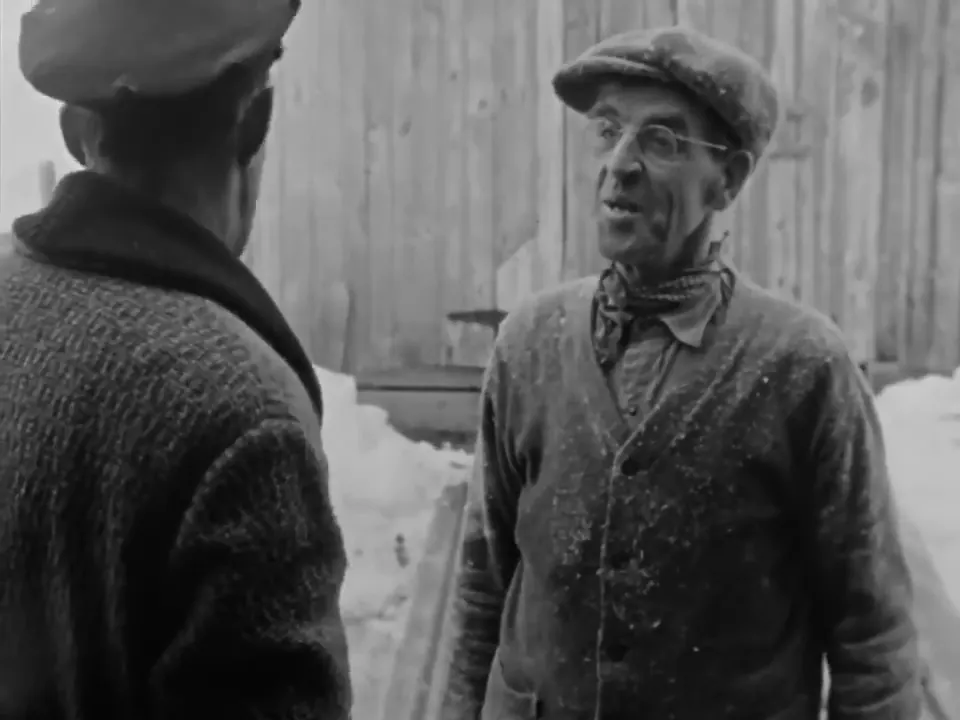
The shared project reaches islanders through face-to-face explanation.
Open full-size still- Displayed still
- 00:20:00
- Discussion passage
- approx. 00:19:30—00:20:30
Official NFB English-version stream; anchor 00:20:00 verified. The displayed window locates that anchor; narrative boundaries await shot-level review.
Official NFB full film; the 00:20:00 anchor is verified and the displayed window locates it.
Still checked: 2026-08-13 · Carrier access checked: 2026-08-13
Image
A man explains the project to two others outside a wooden building.
Sound
The exchange frames the task as informing residents and drawing them into a collective intention.
Relation to the concept
The public announcement is a fabulation candidate because it tries to turn listeners into participants. Only later recruitment, division of labour, and altered positions within the filming process can show that it is more than one-way mobilization.
Sources and further reading
- Cinema 2: The Time-Image
Minnesota 1989 translation: ch. 6, pp. 150–153; ch. 8, pp. 221–224 · Perrault: the white whale and fabulation in chapter 6; storytelling speech-act, fishing action, memory, and a people to come in chapter 8.
- Bilibili · 牛仔C麦 · user-provided public repost page
00:20:00 · The shared project reaches islanders through face-to-face explanation.
- Pour la suite du monde — English version
Official NFB full film; the 00:20:00 anchor is verified and the displayed window locates it.
Pour la suite du monde
Pour la suite du monde (1963)
Adjacent question
Financing the revived hunt
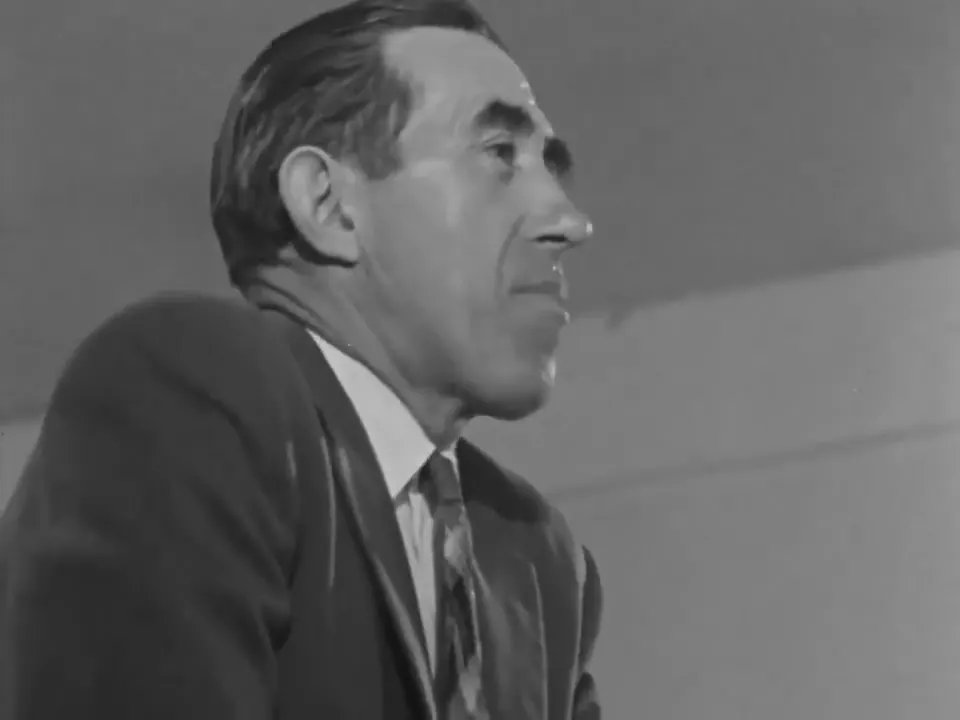
The meeting translates the hunt into financing and equipment.
Open full-size still- Displayed still
- 00:25:00
- Discussion passage
- approx. 00:24:30—00:25:30
Official NFB English-version stream; anchor 00:25:00 verified. The displayed window locates that anchor; narrative boundaries await shot-level review.
Official NFB full film; the viewing link establishes image access, while textual locators are listed separately.
Still checked: 2026-08-13 · Carrier access checked: 2026-08-13
Image
A seated man speaks during an indoor meeting; the frame concentrates on his profile and expression.
Sound
The discussion calculates a purchase in units priced at 500 dollars.
Relation to the concept
A budget is an adjacent material condition of fabulation, not fabulation itself. It enters the larger genesis only when it continues collective narration and changes who can participate in the reenactment.
Sources and further reading
- Cinema 2: The Time-Image
Minnesota 1989 translation: ch. 6, pp. 150–153; ch. 8, pp. 221–224 · Perrault: the white whale and fabulation in chapter 6; storytelling speech-act, fishing action, memory, and a people to come in chapter 8.
- Bilibili · 牛仔C麦 · user-provided public repost page
00:25:00 · The meeting translates the hunt into financing and equipment.
- Pour la suite du monde — English version
Official NFB full film; the viewing link establishes image access, while textual locators are listed separately.
Pour la suite du monde
Pour la suite du monde (1963)
Candidate reading
On the river, the hunt becomes an origin story
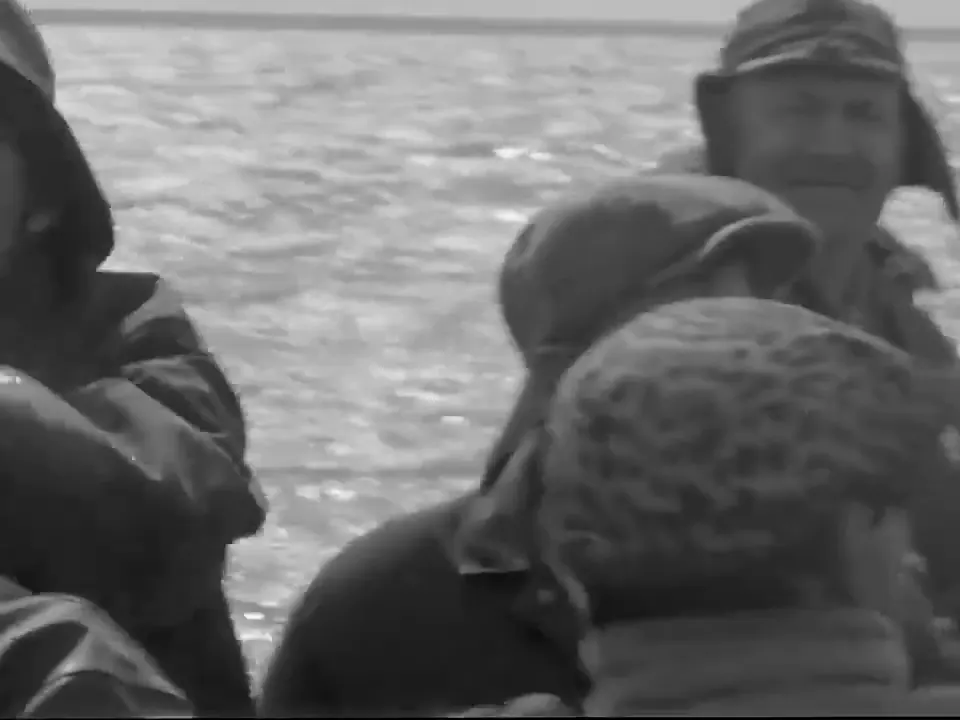
The river journey unfolds alongside a story about the hunt's origin.
Open full-size still- Displayed still
- 00:30:00
- Discussion passage
- approx. 00:29:30—00:30:30
Official NFB English-version stream; anchor 00:30:00 verified. The displayed window locates that anchor; narrative boundaries await shot-level review.
Official NFB full film; the atlas paraphrases rather than reproducing extended subtitles.
Still checked: 2026-08-13 · Carrier access checked: 2026-08-13
Image
Men cluster on a working boat while the river continues moving behind them.
Sound
Conversation invokes earlier times and attributes the practice’s invention to Indigenous inhabitants before the settlers.
Relation to the concept
The origin story remains conjectural and plural, making it a fabulation candidate. If the film merely preserves it as unchanged testimony without co-transforming speaker, practice, and filmmaker, the candidate relation fails.
Sources and further reading
- Cinema 2: The Time-Image
Minnesota 1989 translation: ch. 6, pp. 150–153; ch. 8, pp. 221–224 · Perrault: the white whale and fabulation in chapter 6; storytelling speech-act, fishing action, memory, and a people to come in chapter 8.
- Bilibili · 牛仔C麦 · user-provided public repost page
00:30:00 · The river journey unfolds alongside a story about the hunt's origin.
- Pour la suite du monde — English version
Official NFB full film; the atlas paraphrases rather than reproducing extended subtitles.
Pour la suite du monde
Pour la suite du monde (1963)
Candidate reading
How to outwit the whale
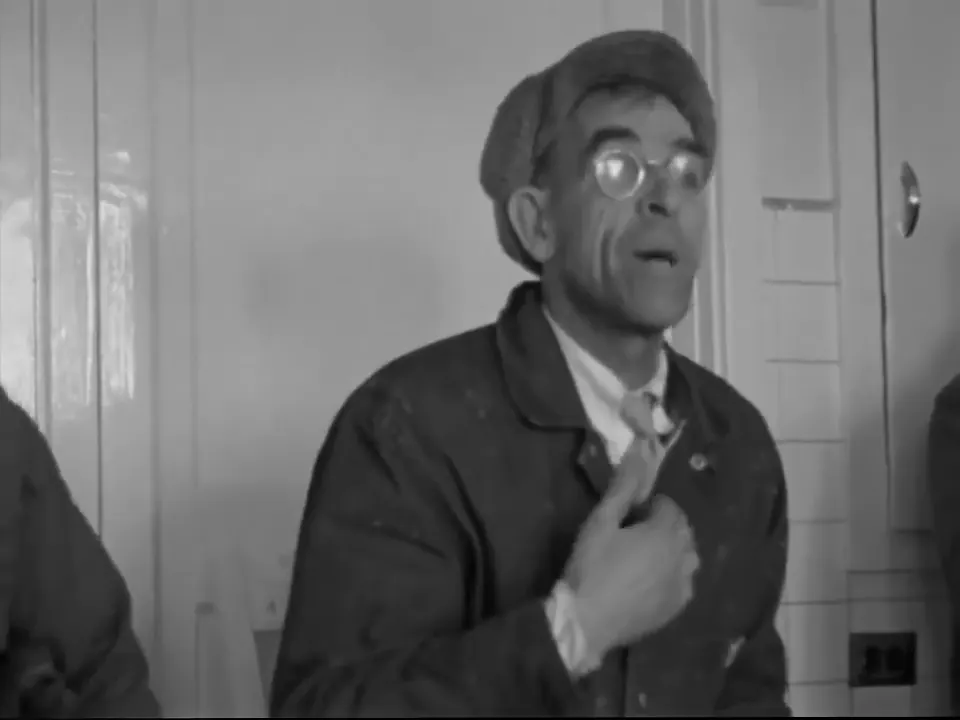
An elder explains how a hunter must outwit the whale.
Open full-size still- Displayed still
- 00:35:00
- Discussion passage
- approx. 00:34:30—00:35:30
Official NFB English-version stream; anchor 00:35:00 verified. The displayed window locates that anchor; narrative boundaries await shot-level review.
Official NFB full film; the 00:35:00 anchor is verified.
Still checked: 2026-08-13 · Carrier access checked: 2026-08-13
Image
An older man speaks indoors and gestures toward his chest while others listen.
Sound
He explains that the hunters must be more cunning than the whale.
Relation to the concept
The elder's instruction hands an old capacity to present listeners and therefore forms a fabulation candidate. It exceeds one-way transmission of tradition only when later bodily practice and filming act back upon the hunter identity.
Sources and further reading
- Cinema 2: The Time-Image
Minnesota 1989 translation: ch. 6, pp. 150–153; ch. 8, pp. 221–224 · Perrault: the white whale and fabulation in chapter 6; storytelling speech-act, fishing action, memory, and a people to come in chapter 8.
- Bilibili · 牛仔C麦 · user-provided public repost page
00:35:00 · An elder explains how a hunter must outwit the whale.
- Pour la suite du monde — English version
Official NFB full film; the 00:35:00 anchor is verified.
Pour la suite du monde
Pour la suite du monde (1963)
Adjacent question
Setting posts in the tide
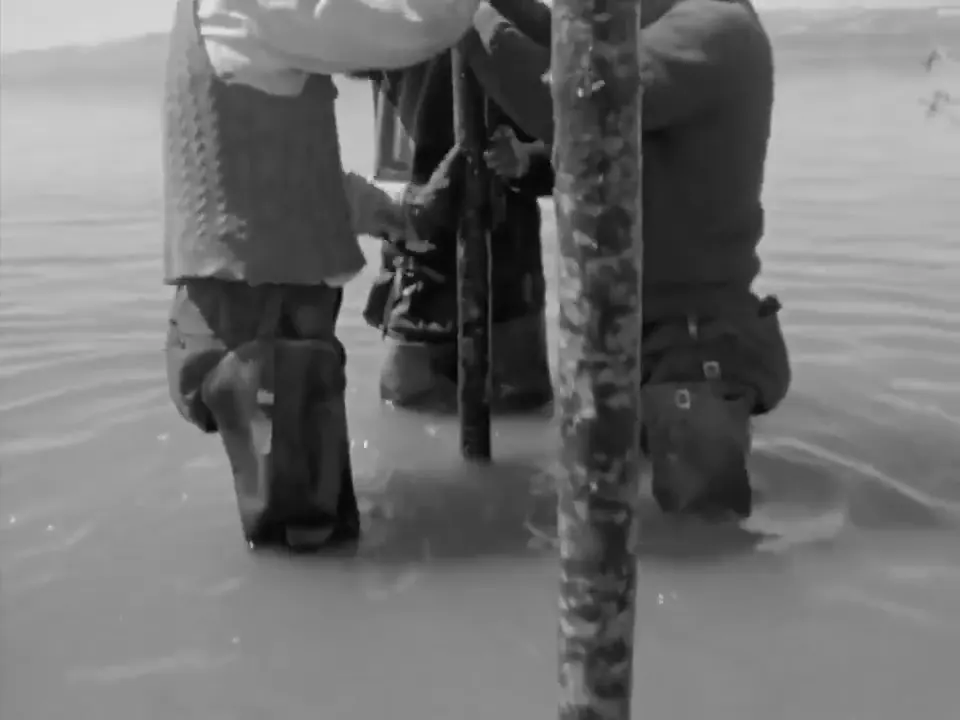
Deliberation, roles, and materials become shared construction in the water.
Open full-size still- Displayed still
- 00:43:56
- Discussion passage
- approx. 00:43:35—00:44:13
Official NFB English-version stream; anchor 00:44:02 verified. The displayed window locates that anchor; narrative boundaries await shot-level review.
Official NFB full film; the 00:44:02 visual anchor and scene dialogue are verified.
Still checked: 2026-08-13 · Carrier access checked: 2026-08-13
Image
Several islanders stand knee-deep in the tide among rows of set posts, steadying and adjusting an upright post; the sequence turns to the water, post rows, and close views of hands.
Sound
The dialogue discusses spacing posts about one pace (roughly three feet) apart, how water entering the boat impedes the work, and earlier labour in the water wearing leather boots.
Relation to the concept
Setting posts is first of all effective labour and remains adjacent to fabulation as the action-end of earlier narration and reenactment. Detached from the chain running from oral account and deliberation to construction, the scene cannot establish fabulation on its own.
Sources and further reading
- Cinema 2: The Time-Image
Minnesota 1989 translation: ch. 6, pp. 150–153; ch. 8, pp. 221–224 · Perrault: the white whale and fabulation in chapter 6; storytelling speech-act, fishing action, memory, and a people to come in chapter 8.
- Bilibili · 牛仔C麦 · user-provided public repost page
00:43:56 · Deliberation, roles, and materials become shared construction in the water.
- Pour la suite du monde — English version
Official NFB full film; the 00:44:02 visual anchor and scene dialogue are verified.
Pour la suite du monde
Pour la suite du monde (1963)
Candidate reading
Workshop debate over the origin of the posts
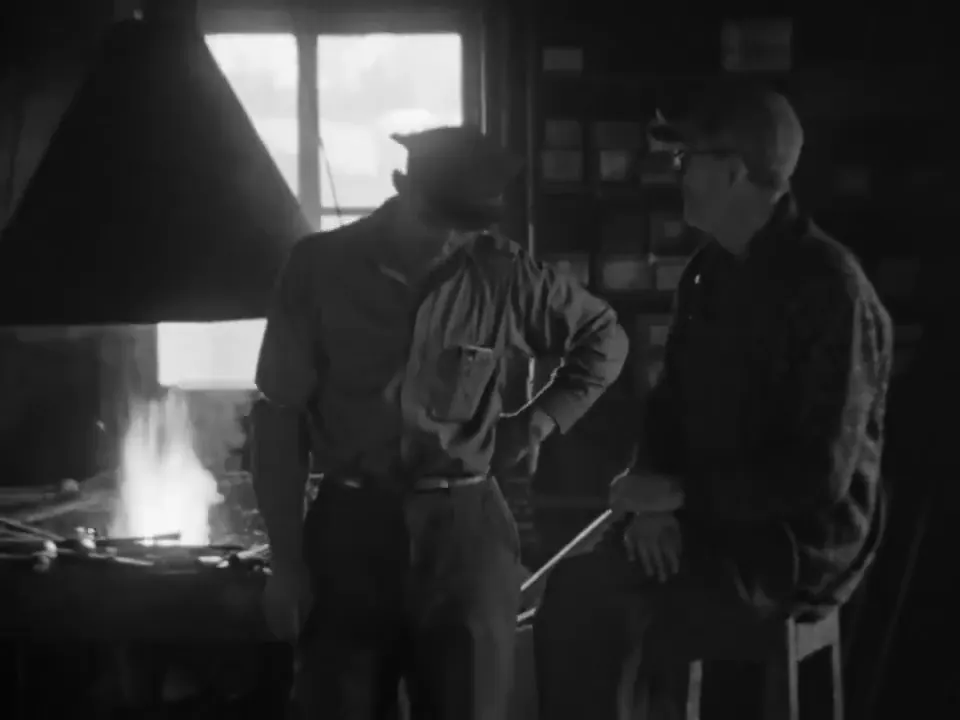
The origin of the post structure remains unsettled in a workshop exchange.
Open full-size still- Displayed still
- 01:10:00
- Discussion passage
- approx. 01:09:30—01:10:30
Official NFB English-version stream; anchor 01:10:00 verified. The displayed window locates that anchor; narrative boundaries await shot-level review.
Official NFB full film; the record separates speech within the film from historical verification.
Still checked: 2026-08-13 · Carrier access checked: 2026-08-13
Image
Two men converse beside a furnace fire in a workshop.
Sound
The exchange asks where Indigenous people obtained the idea for the posts.
Relation to the concept
The unresolved dispute keeps the origin story open and can serve as a fabulation candidate. If disagreement leaves only unverifiable information without changing the ongoing practice or positions of speech, the relation should be withdrawn.
Sources and further reading
- Cinema 2: The Time-Image
Minnesota 1989 translation: ch. 6, pp. 150–153; ch. 8, pp. 221–224 · Perrault: the white whale and fabulation in chapter 6; storytelling speech-act, fishing action, memory, and a people to come in chapter 8.
- Bilibili · 牛仔C麦 · user-provided public repost page
01:10:00 · The origin of the post structure remains unsettled in a workshop exchange.
- Pour la suite du monde — English version
Official NFB full film; the record separates speech within the film from historical verification.
Pour la suite du monde
Pour la suite du monde (1963)
Adjacent question
Gathering around the captured beluga
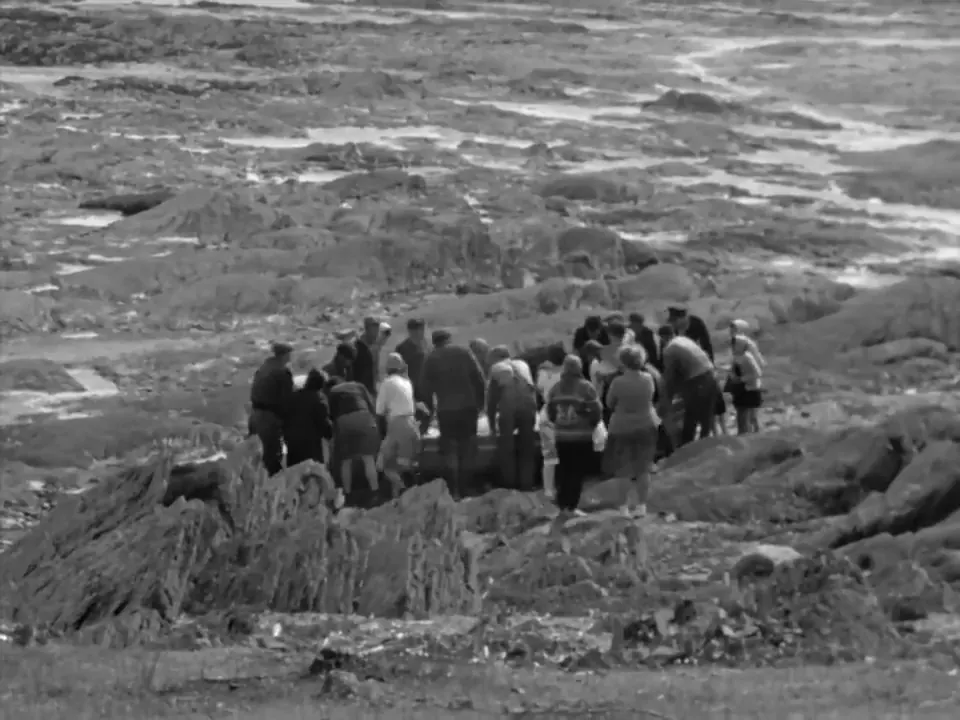
Islanders gather around the result of the hunt as collective labour gains a visible consequence.
Open full-size still- Displayed still
- 01:30:00
- Discussion passage
- approx. 01:29:30—01:30:30
Official NFB English-version stream; anchor 01:30:00 verified. The displayed window locates that anchor; narrative boundaries await shot-level review.
Official NFB full film; the 01:30:00 image and dialogue are verified.
Still checked: 2026-08-13 · Carrier access checked: 2026-08-13
Image
Islanders gather around the captured beluga as it is prepared for transport; the sequence cuts to a speaker beside a vehicle and to the assembled group again.
Sound
The dialogue expresses joy after the capture and mentions God; no formal prayer is identifiable in this window.
Relation to the concept
The captured result is an adjacent consequence of the fabulation chain. A shared achievement does not itself prove the double becoming of characters and filmmakers; it must be reconnected to prior narration and followed into later changes of representation.
Sources and further reading
- Cinema 2: The Time-Image
Minnesota 1989 translation: ch. 6, pp. 150–153; ch. 8, pp. 221–224 · Perrault: the white whale and fabulation in chapter 6; storytelling speech-act, fishing action, memory, and a people to come in chapter 8.
- Bilibili · 牛仔C麦 · user-provided public repost page
01:30:00 · Islanders gather around the result of the hunt as collective labour gains a visible consequence.
- Pour la suite du monde — English version
Official NFB full film; the 01:30:00 image and dialogue are verified.
Pour la suite du monde
Pour la suite du monde (1963)
Candidate reading
Delegating a spokesman at the aquarium
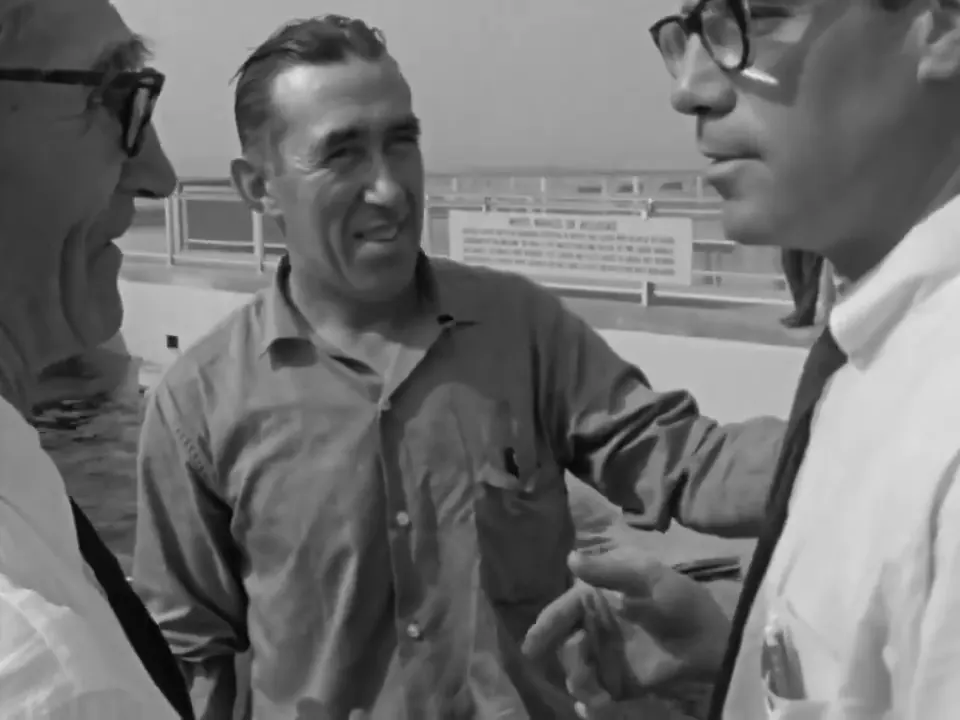
The group delegates one member to speak for them inside an institutional setting.
Open full-size still- Displayed still
- 01:40:00
- Discussion passage
- approx. 01:39:30—01:40:30
Official NFB English-version stream; anchor 01:40:00 verified. The displayed window locates that anchor; narrative boundaries await shot-level review.
Official NFB full film; the 01:40:00 anchor is verified and the displayed window locates it.
Still checked: 2026-08-13 · Carrier access checked: 2026-08-13
Image
Three men converse in an outdoor area of the aquarium; one occupies the position between the other two.
Sound
The exchange explicitly delegates one participant to speak for the group.
Relation to the concept
Explicit delegation changes the speaking relation between individual and collective and is therefore a strong fabulation candidate. It must still remain connected to the film's shared reenactment and filming intervention rather than being proven conclusively by the phrase 'speak for us' alone.
Sources and further reading
- Cinema 2: The Time-Image
Minnesota 1989 translation: ch. 6, pp. 150–153; ch. 8, pp. 221–224 · Perrault: the white whale and fabulation in chapter 6; storytelling speech-act, fishing action, memory, and a people to come in chapter 8.
- Bilibili · 牛仔C麦 · user-provided public repost page
01:40:00 · The group delegates one member to speak for them inside an institutional setting.
- Pour la suite du monde — English version
Official NFB full film; the 01:40:00 anchor is verified and the displayed window locates it.
Black God, White Devil
Deus e o Diabo na Terra do Sol (1964)
Atlas discussion reading
Bandit, mythical figure, and speaker are compressed into one face while allegiance remains in motion through speech.
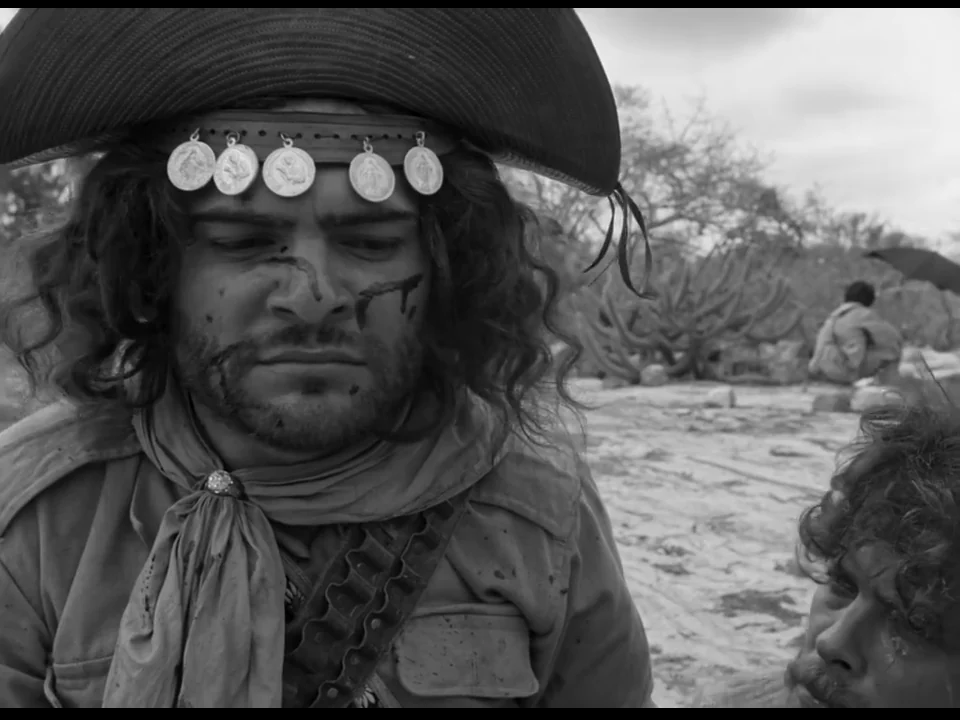
Bandit, mythical figure, and speaker are compressed into one face while allegiance remains in motion through speech.
Open full-size still- Displayed still
- 01:30:00
- Discussion passage
- 01:29:40–01:31:00
The verbal challenge between Corisco and Manuel was frame-checked.
Complete Bilibili carrier; the shot at 单片 01:30:00 was checked frame by frame, and the still and timestamp come from the same public upload.
Still checked: 2026-08-14
Image
Corisco's coin-hung hat, facial streaks, and frontal close-up bind costume, body, and mythical identity.
Manuel enters only from the lower edge, so their positions are not stabilized by balanced shot/reverse-shot.
Sound
Corisco challenges Manuel in loud, rhythmic speech closer to public performance than private conversation.
Relation to the concept
Figures change allegiance among peasant, believer, bandit, and myth; the collective is not pre-completed, and Corisco's performative speech turns that absence into a condition of creation.
Sources and further reading
- Bilibili · Black God, White Devil complete film
01:30:00 · Complete Bilibili carrier; the shot at 单片 01:30:00 was checked frame by frame, and the still and timestamp come from the same public upload.
- Cinema 2: The Time-Image
Cinema 2, chapter 8, pp. 222–223.
Films and scenes
Narration and filming jointly revive an interrupted hunting practice, changing the positions of islanders, filmmakers, and collective memory in the process.
IMDb identification poster ↗Related film readings · 11 films
Jaguar · 1967 — Participants narrate and perform their journey after the fact, making filmmakers and characters become other through the story.
Moi, un noir · 1958 — Borrowed names, post-recorded voices, and lived experience rewrite one another. Fiction opens minor speech and collective enunciation.
Pour la suite du monde · 1963 · Candidate reading — Narration and filming jointly revive an interrupted hunting practice, changing the positions of islanders, filmmakers, and collective memory in the process.
Black God, White Devil · 1964 — Popular myth, trance, violence, and shifting allegiance reveal a missing people and the task of creating them.
The Times That Are · 1967 — Alexis and Perrault become intercessors for one another through the journey to France. The search does not restore a fixed origin; character, filmmaker, and Québec's collective voice change together through storytelling.
Céline and Julie Go Boating · 1974 — A Paris chase loosens ordinary action; sweets then send the women into a repeatedly staged house story. They move from spectators and doubles to participants who rewrite the plot and rescue the child; bodies, play, and repetition fabricate another route through reality.
Close-Up · 1990 — Sabzian enters a family as ‘Makhmalbaf,’ and trial footage plus reenactment asks the actual participants to perform themselves. No single judge settles identity as true or false; the camera follows how a lie produces relations, shame, and creative desire.
This Is Not a Film · 2011 — A filmmaking ban confines the director to his apartment, yet phone, domestic camera, taped floor, and an unmade screenplay reassemble a cinematic machine. As Panahi speaks shots, blocking, and space, the absent film acquires form through voice and gesture.
Readings in the same thematic group
Police, Adjective · 2009 — Dictionary, blackboard, command, attitude, and rank assemble bodies into institutional ritual; gestus is a configuration of social relations.
The Hour of the Furnaces · 1968 — Montage, intertitles, pauses, and discussion organize projection as political action. Because the film presupposes a revolutionary people available to be addressed, it becomes a decisive comparison for testing the boundary of Deleuze's claim that the people are missing.
A Ridiculous Kind of Country · 1970 — Isolated figures question Québec belonging from different positions, turning country into a problem no single representative can close. Disagreement, relay, and transformation form collective utterances directed toward a people to come.
Criteria
Does narration change the actual relation among speaker, filmmaker, and collective?
Distinctions and counterexamples
Fiction, lying, interview, reenactment, or participatory performance does not automatically make fabulation. If a character only confirms the filmmaker's prior thesis, no double becoming occurs.
Common confusion: Criterion: fabulation produces subject and collective positions through narration and leaves observable relational changes.
Texts and sources
Cinema 2, ch. 6; ch. 8
- 01Cinema 2: The Time-Image
Authoritative source for the standard translation, translators, ISBN, and publication date.
View source and edition →
Research disagreements
Replacement or coexistence?
The time-image reverses the subordination of time to movement; both regimes persist and can shift locally within one film.
Taxonomy or generator?
Fixed labels invite mere example-hunting; an open taxonomy requires new concepts to transform existing relations and explain across cases.
How do we use Deleuze precisely?
Test four layers: sensory-motor relation, actual/virtual circuit, audio-visual connection, and regime of truth.
Where contemporary images push this concept
A concept relation that remains contestedCandidate reading · versioned passage review pending
Pepe: the hippo refuses translation into a human allegory
The murdered hippo's multilingual, ghostly-tense voice invents a position difficult for colonial classification to contain, but imaginative animal narration does not yet establish fabulation. The further test is a double becoming between the film-maker and the nonhuman speaking position: the author can no longer occupy transparent advocacy for the hippo, while the hippo's voice forces the existing human collective to become otherwise through a new relation of enunciation.
Scope and limits If the hippo's voice ultimately supplies an allegory for human colonial victims and a transparent meaning reabsorbs nonhuman difference, this is not generative fabulation but anthropomorphism serving a familiar symbol.
- FIDMarseille: Pepe official materialFestival official page · nonhuman narrative factsA festival description of ‘nonlinearity’ does not prove a nonhuman time-image; log the specific relations among language, river, and violence.
- Sanjay Surin: The right to remain opaquePeer-reviewed article · nonhuman subjectivity and formal opacityThe article is a contemporary scholarly extension, not a Deleuze primary text; nonhuman politics still returns to language and shots.
Concepts to distinguish
Compare them
- Irrational cut / intersticecoupure irrationnelle / interstice
Deducible continuity among shots, sounds, and images gives way to an irreducible interval between series. Thought is forced to happen within it.
→ - Noosignnoosigne
The noosign marks a crisis in the relation between image and thought. Classical cinema's promise that an organic whole and shock would automatically reach thought fails; the image instead confronts thought with the Outside, the unthought, and its own powerlessness, reopening the problem of belief in the world.
→ - Body / braincorps / cerveau
Everyday attitudes and gestus sediment time in the body; cinema of the brain turns space, light, colour, and connection into a map of thought. Body and brain form two distinct cinematic mechanisms of thought.
→ - Lectosignlectosigne
The time-image tends toward an image that must be read: picture, sound, text, data, and invisible relations form strata. Viewing becomes an ongoing work of comparison, recomposition, and concept formation.
→ - Speech act and a people to comeacte de parole / peuple à venir
The storytelling speech-act crosses private affairs and politics, produces collective utterances, and prefigures the people who are missing.
→