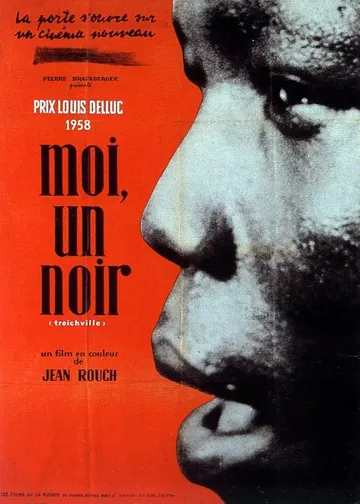
Jean Rouch / 让·鲁什 · 1958
Moi, un noir
Moi, un noir
Borrowed names, post-recorded voices, and lived experience rewrite one another. Fiction opens minor speech and collective enunciation.
Film details
- Original title
- Moi, un noir
- Director
- Jean Rouch / 让·鲁什
- Year
- 1958
- Region
- France / Côte d’Ivoire
Film analysis: how shots organize concepts
Assumed names, postsynchronized voices, and urban labour do not conceal true identity; they let filmed subjects invent speaking selves beyond assigned positions.
- 01Aliases open virtual identities
Young Nigerien migrants in Abidjan introduce themselves through movie-star names such as Edward G. Robinson and Eddie Constantine.
The alias does not copy a star; it opens a subject-position not yet actualized within material poverty. - 02Voice reclaims the image
After filming, participants add first-person commentary to images of their labour, desire, failures, and neighbourhood.
The recorded body ceases to be an object of study; voice acts back on what the image can mean. - 03Fantasy enters shared reality
Boxing, dance, heroic fantasy, and casual dock labour alternate as personal narration circulates among friends' responses.
Fabulation makes fictional identity a real resource for collective enunciation rather than a dream of escape.
Analysis and scene sources
Shots and scenes
Primary texts, scholarship, and locators
Theory coordinate: Cinema 2, ch. 6, p. 151; ch. 8, p. 223
- 01Cinema 2: The Time-Image
Authoritative source for the standard translation, translators, ISBN, and publication date.
Open the atlas source record →
This film in books and research
The Cinematic Body · Further discussion
The body is never an unmarked universal
pp. 88–89
Claim: Visibility, tactility, identification, and the right to refuse viewing are differentiated by racial histories, archival regimes, and relations of production.
Extension: hooks historicizes the oppositional gaze as a practice of Black female spectatorship; this site further tests refusal of identification as a bodily survival practice. Keeling tests cinematic perception through Black feminist and queer temporalities.
Tension: Universal contagion and passivity can erase who is more likely to be misrecognized, surveilled, or killed. Intensity has no inherently anticolonial direction, and both forming and dissolving identity can be political acts.
bell hooks, Black LooksStam and Spence: Colonialism, Racism and RepresentationDiawara: Black Spectatorship, Identification and ResistanceKeeling, The Witch's Flight
Fabulation: How the Speech Act Prefigures a People to Come
Fabulation is a double becoming
Claim: Real characters become other through storytelling, while their intervention changes the filmmaker's position.
Conclusion: A character's telling, performance, or reenactment must change both the character's position and the filmmaker's structure.
Cinema 2: The Time-Image · pp. 151, 223Deleuze on Cinema · pp. 135–164Cinema 2: The Time-Image · ch. 6, p. 150; ch. 8, pp. 221, 223Fabulation, Narration and the People to Come · pp. 202–226
Fabulation: How the Speech Act Prefigures a People to Come
Collective enunciation prefigures a people to come
Claim: A plural speaking position forms through disagreement, relay, response, and delegation; the people remains minor, unfinished, and future-facing.
Conclusion: The full chain requires double becoming, real consequences, a plural speaking position, and an unfinished collective.
Fabulation: How the Speech Act Prefigures a People to Come
Minor cinema: making a collective voice inside a major language
Claim: Minor cinema is not a label for an author's identity or a small production; it is a formal operation that pushes singular experience toward collective enunciation. Stutter, borrowed names, translation, and displacement create new addressee positions inside a major language.
Conclusion: Map speaker, addressee, translation path, and consequence. Minor cinema becomes testable when linguistic deviation changes who can be heard and who bears the response.
Cinema 2: The Time-Image · Chapter 8, pp. 215–224Gilles Deleuze's Time Machine · ‘Series and Fabulation: Minor Cinema,’ pp. 139–169
Fabulation: How the Speech Act Prefigures a People to Come
Characters become through voice
Film comparison: Assumed names, postsynchronized voices, and urban experience produce new subject positions.
Viewing gateways and editions
No direct viewing link is listed; film search gateways are available above.