ORIGINAL BILINGUAL RESEARCH GUIDE / 原创双语研究导读
The Cinematic Body
How images bypass interpretation to transform bodies, pleasures, and power
The Cinematic Body
The Cinematic Body · University of Minnesota Press · 1993
PB 978-0-8166-2294-8 · HB 978-0-8166-2293-1 · eBook 978-0-8166-8527-1 / 978-1-4529-0249-4
An original bilingual guide covering the Preface, eight chapters, and the Chapter I appendix, with 83 English-edition print anchors, eighteen terms, eight relation cards, eight outward perspectives, the site's six-layer BODIES loop, and a five-step reading path.
The copyright page states Copyright 1993 by the Regents of the University of Minnesota and all rights reserved; University of Minnesota Press is the publisher.
Covers tied to verified editions
Only distinct cover designs tied to publisher or bibliographic records are shown. Reprintings that reuse the same design are consolidated.
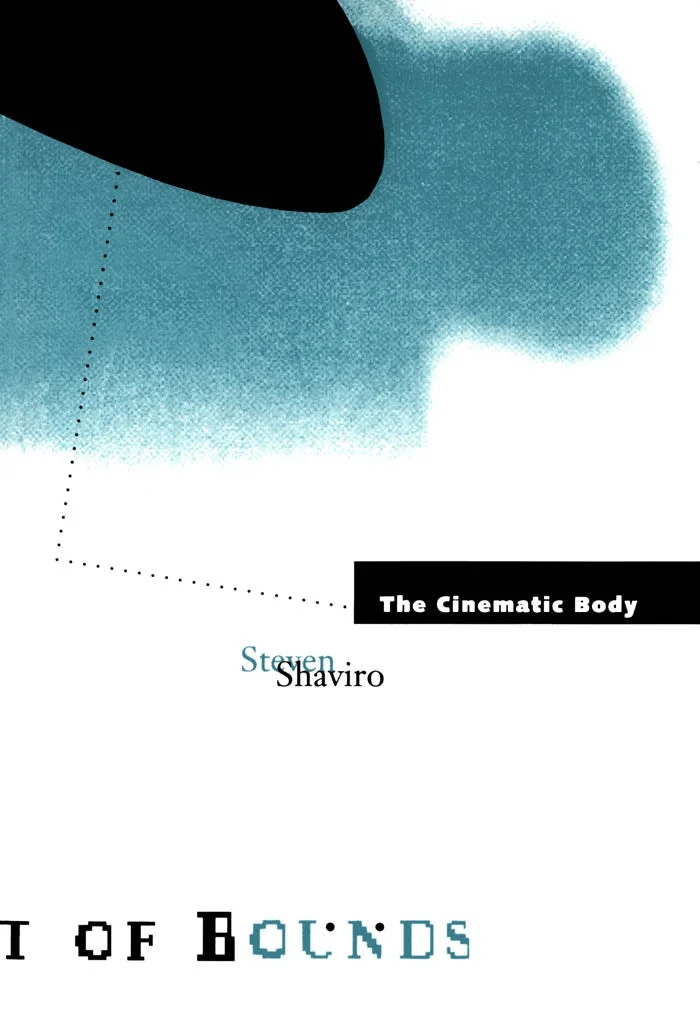
- Edition
- Theory out of Bounds, volume 2, English paperback
- Publisher
- University of Minnesota Press · 1993
- ISBN
- 978-0-8166-2294-8
- Credit
- Cover courtesy of University of Minnesota Press
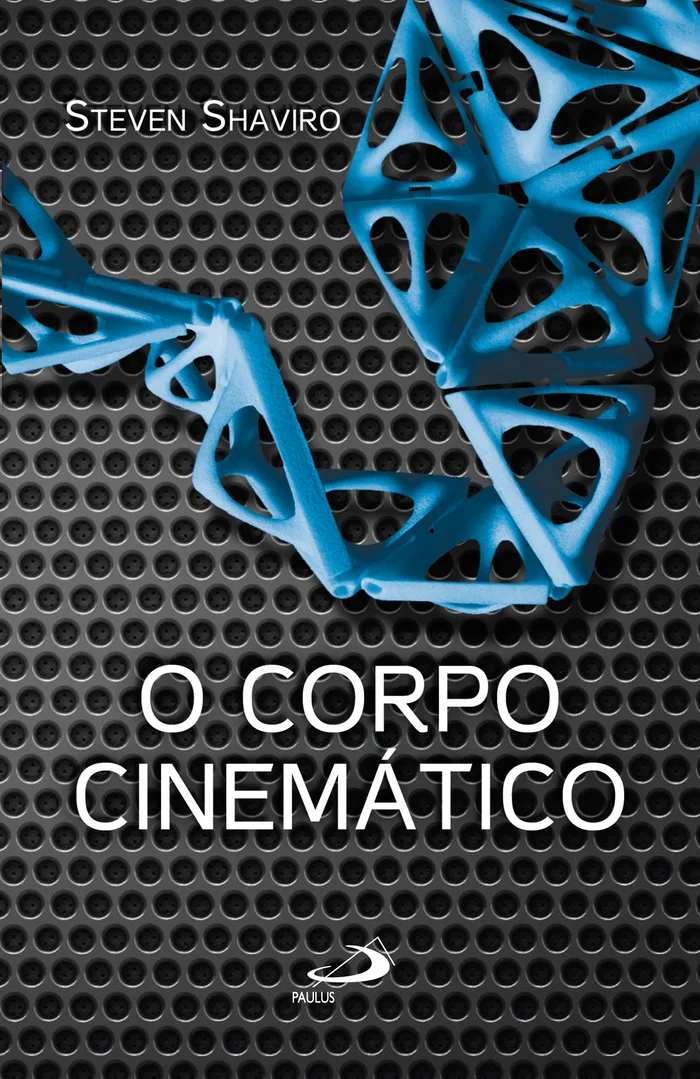
- Edition
- First Brazilian Portuguese edition, translated by Anna Carolina Negrini Fagundes Martino
- Publisher
- PAULUS · 2015
- ISBN
- 978-85-349-4136-5
- Credit
- Cover courtesy of PAULUS; shown for edition identification and criticism
The cinematic body is not an original hidden behind images, but an intensive field in which body, image, and apparatus produce and disrupt one another.
Shaviro rejects accounts that begin with lack, identification, suture, and the signifier. Starting from fascination, shock, boredom, disgust, pleasure, and shame, he tracks how light, sound, cutting, repetition, and performance affect bodies before interpretation. The cinematic apparatus disciplines and captures bodies while magnifying their inertia, plasticity, and capacity to change; politics occurs within this undecidable ambivalence.
SHAVIRO STUDY / CHAPTER-BY-CHAPTER ARGUMENT
How bodies encounter images before interpretation
Locators refer only to printed book pages. The even pages after units are blank or Roman-numeral dividers: 66, 82, 106, 126, 158, 200, 240, 254, 268, and 274 are not argument anchors.
PREFACE · PUBLISHED TITLE: Preface
SITE EDITORIAL SYNTHESISBegin from bodily response in a deliberately unbalanced polemic
Personal taste, prereflective response, and theoretical position are inseparable here.The Preface connects film study to postmodernism, body politics, masculinity, and masochistic aesthetics while openly rejecting the then-dominant psychoanalytic vocabulary of lack, castration, and the phallus. It draws on Deleuze, Guattari, Benjamin, Bataille, Blanchot, and Foucault without founding another orthodoxy.
- 01pp. vii–viii
Transversal writing and personal taste
Incongruous film choices and bodily responses resist reducing singular cases to representative patterns.
- 02pp. viii–ix
Politics happens in the flesh
Desire, fear, disgust, and shame already involve power before interpretation.
- 03pp. ix–x
Reject one orthodoxy without founding another
Theory is judged by its capacity to provoke divergent responses rather than compel agreement.
- p. vii
The book positions itself across film theory, postmodernism, body politics, masculinity, and masochistic aesthetics.
- pp. vii–viii
The form of writing cannot be separated from the cultural forms under discussion.
- p. viii
Prereflective bodily responses are foregrounded before form, meaning, and ideology.
- p. ix
Psychoanalytic film theory organized around lack, castration, and the phallus is judged a stultifying orthodoxy.
- pp. ix–x
Multiple theorists are invoked as alternative resources, not a new doctrine.
- p. x
Acknowledgment itself becomes an ambivalent gesture that cannot eliminate complicity.
CHAPTER ONE · PUBLISHED TITLE: Film Theory and Visual Fascination
SITE EDITORIAL SYNTHESISRebuild film theory from visual fascination
Images first touch bodies as material events; meaning and identification arrive later.The light, motion, and violence of Blue Steel shift analysis from plot to sensory force. The chapter then contests representational and psychoanalytic models, moving through lines of flight, literal perception, material construction, passive fascination, and tactile images toward a masochistic aesthetics of intensity, expenditure, and loosened ego boundaries.
- 01pp. 1–8
Blue Steel
Gender reversal is only the entry point; light, movement, and visual excess make subjectivity an atmospheric effect.
- 02pp. 9–13
Film Theory and Its Discontents
Identification, lack, and apparatus deception are challenged for predetermining what viewing can be.
- 03pp. 14–19
Fear of Images
Reducing images to signs of absent objects misses their material insistence as events.
- 04pp. 20–24
Lines of Flights
Resistance does not exit power; it follows trajectories of variation already inside an arrangement.
- 05pp. 25–33
Literal Perceptions
The camera detaches perception from supposedly natural anthropocentric conditions and suspends translation into hidden meaning.
- 06pp. 34–42
Materialist Constructions
Construction through sound, shots, and editing does not cancel material traces; it places them in new relations.
- 07pp. 43–49
Passivity and Fascination
The viewer is seized, made to wait, and has judgment delayed; passivity becomes a condition of being affected.
- 08pp. 50–55
The Tactile Image
Vision, sound, and rhythm compose contact at a distance rather than mere object recognition.
- 09pp. 56–65
Masochism
Pleasure-pain entanglement, delay, and sensory overload are synthesized into a model of actively seeking passivity.
- pp. 1–2
The reading of Blue Steel moves from plot and gender to light and visual excess.
- pp. 5–6
Character relations operate through contamination, repetition, and circuits of desire rather than linear psychological causality.
- pp. 9–10
The psychoanalytic premises of institutional film theory receive a direct critique.
- pp. 14–15
Theory's fear of images appears in its reduction of appearances to signs or substitutes.
- pp. 20–21
Lines of flight trace unstable forces from within relations of power.
- pp. 25–26
Literal perception begins with non-anthropocentric camera perception.
- pp. 34–35
Sounds and images act as material traces resistant to discursive capture, pulling speech toward nonsignifying sound.
- pp. 43–44
Fascination makes the viewer undergo the image and defer judgment.
- pp. 50–51
Images assault the eye, render perception passive, and turn stimulus back upon the viewer's body.
- pp. 56–57
Bersani and Deleuze are used to connect bodily excitation with shattered ego boundaries.
- pp. 60–61
Expenditure and the body's capacity to be affected are synthesized as an affirmative model of disequilibrium.
APPENDIX TO CHAPTER ONE · PUBLISHED TITLE: Appendix: Deleuze and Guattari's Theory of Sexuality
SITE EDITORIAL SYNTHESISFrom sexual norms to molecular connections of desire
Desire is not a lack awaiting interpretation but a real process producing connections across scales.Using Proust, the appendix distinguishes molar heterosexuality, personal homosexuality, and molecular sexuality. Compulsory heterosexuality is treated as a regulative social standard, while plants, insects, partial organs, and inclusive disjunction provide models of connection without unity or castration. Its headline claims belong to a 1993 polemical context and must not be treated as empirical classifications of present identities.
- 01pp. 67–69
Avoid Freud
Schizoanalysis follows the connections desire produces rather than what desire symbolizes.
- 02pp. 70–73
Compulsory Heterosexuality
Heterosexual dominance is an external regulation, not desire's intrinsic constitutive truth.
- 03pp. 74–75
All Desire Is Homosexual
The title attacks the presumption of innate heterosexuality; it is a rhetorical compression, not an empirical census.
- 04pp. 76–81
Molecular Sexuality
Partial organs retain their differences and connect contingently through an outside term; inclusive disjunction connects without totalizing.
- pp. 67–68
Schizoanalysis studies desiring-production rather than the correct interpretation of repression.
- pp. 70–71
Molar, personal, and molecular are coexisting scales, not three mutually exclusive identities.
- pp. 72–73
Compulsory heterosexuality is defined as regulative rather than constitutive.
- pp. 74–75
The all-desire claim depends on Proust's structure of public norms and secret desires.
- pp. 76–77
Hermaphroditism consists of partitioned partial organs, not a lost primordial unity.
- pp. 80–81
The inclusive 'or' preserves difference and turns the problem toward political mobilization of desire's potentials.
CHAPTER TWO · PUBLISHED TITLE: Contagious Allegories: George Romero
SITE EDITORIAL SYNTHESISZombie allegory works through contagion rather than decoding
Consumption, labor, and the life-death boundary form one circuit between zombie bodies and spectator responses.Romero's zombie is not a fixed symbol awaiting solution but a node through which capital, consumption, family, race, the military, and science infect one another. The suspension of perception and action makes viewers repel and mimic zombies at once; the cheap thrills of gore further expose spectatorial pleasure and complicity.
- 01pp. 83–87
Postmodern Zombies
Zombies press consumer desire, dead labor, and subjectless movement onto the surface of flesh.
- 02pp. 88–95
Survival or Sacrifice?
Survival only postpones death; it cannot establish a pure community in family, mall, military, or laboratory space.
- 03pp. 96–99
The Seductiveness of Horror
Waiting for an unseen threat makes the spectator's body repeat the film's delay.
- 04pp. 100–105
Cheap Thrills
Excess visibility bypasses elevated interpretation and directly produces arousal, boredom, and disgust.
- pp. 83–84
Zombies enter a network of consumption, dead labor, and capitalism rather than serving as one symbol.
- pp. 88–89
Women and Black protagonists across the trilogy are contrasted with repeatedly failing white male authority.
- pp. 91–92
The shopping mall places survival and commodity consumption in the same circuit.
- pp. 94–95
Military discipline, scientific governance, and the attempt to train Bub mirror one another.
- pp. 96–97
Horror's seduction depends on anticipation, waiting, and inability to act.
- pp. 100–101
Gore effects and pornography can solicit bodily response directly and can also produce boredom.
- pp. 104–105
Disgust does not guarantee moral distance; spectatorial pleasure remains implicated.
CHAPTER THREE · PUBLISHED TITLE: Comedies of Abjection: Jerry Lewis
SITE EDITORIAL SYNTHESISHow the comic body turns social norms into spasms
Excessive obedience makes rules malfunction, while bodily embarrassment exposes social coding.Lewis's figures are not innocent failures explained by inner psychology. They lose composure in public and obey work, family, and masculine norms so excessively and literally that obedience becomes disruption. The spastic body is therefore not the symptom of a true inner self but a simulacral surface where media, labor, and consumer codes collide.
- 01pp. 107–112
Embarrassment and Abjection
Comedy makes character and viewer jointly undergo bodily exposure and failed recovery of dignity.
- 02pp. 113–115
Conformism and Performance
Excessive conformity perverts the law without installing the character as an outside hero.
- 03pp. 116–119
From Psyche to Socius
Analysis moves from private psyche to television, advertising, office, store, and performance labor.
- 04pp. 120–125
The Spastic Body of Simulation
The body overimitates media clichés until the self becomes a temporary effect of colliding gestures.
- pp. 107–108
Comedy first arises from bodily embarrassment that psychological explanation cannot dissolve.
- pp. 111–112
Laughter implicates the viewer in exposure, shame, and abjection.
- pp. 113–114
The figure obeys so excessively that the norm slides into absurdity.
- pp. 116–117
The scale of analysis shifts from individual neurosis to labor, consumption, family, and media.
- pp. 120–121
Spastic gesture becomes a record of simulation and social coding on flesh.
- pp. 124–125
No authentic inner self awaits recovery; performance multiplies and disintegrates subjectivity.
CHAPTER FOUR · PUBLISHED TITLE: Bodies of Fear: David Cronenberg
SITE EDITORIAL SYNTHESISMedia do not erase flesh; they make it proliferate beyond control
Technology, gender, information, and fear must all operate materially on transformable flesh.Cronenberg makes anxieties usually left in fantasy or symbolism grow into organs, drugs, signals, wounds, and medical technologies. The monster is neither external evil nor safely interpretable repression; it is the attractive and repulsive face of the body's own capacity to change. Technology and gender are therefore material productions of bodies, not representations placed over them.
- 01pp. 127–131
In the Flesh
Technical media force bodies into stronger material presence rather than dematerializing them.
- 02pp. 132–133
Monstrous Ambivalence
The monster is the seduction and terror of the body's immanent capacity for metamorphosis.
- 03pp. 134–137
Scanners: The Politics of the Body
Information, drugs, reproduction, and corporate control become explosive bodily processes.
- 04pp. 138–141
Videodrome: Uncontrollable Flesh
Media signals grow into flesh and rewrite organs, leaving no uncontaminated outside for the subject.
- 05pp. 142–144
Bodies and Genders
Gender is power's material construction of bodies; resistance arises because that construction never finishes.
- 06pp. 145–147
The Fly: Intimacy and Alterity
Intimacy is forced to endure irreversible alterity within the body.
- 07pp. 148–149
Fantasy No More
Psychic anxiety is literalized as tissue, wound, and organ without thereby becoming unmediated fact.
- 08pp. 150–154
Dead Ringers: Masculine Embodiment
Twins, gynecological medicine, and female bodies expose the material dependencies of masculine autonomy.
- 09pp. 155–157
Shattering Pleasures
Continuity and effects, pushed to excess, can assault rather than consolidate the integral self.
- pp. 127–128
Technologization is not dematerialization; media return as flesh, fluid, wound, and organ.
- pp. 132–133
Monstrosity is the body's immanent and undecidable potential for change.
- pp. 134–135
Information, drugs, and organizational control are embodied as explosive, reproducible capacities.
- pp. 138–139
Videodrome's signal reorganizes flesh directly rather than merely deceiving consciousness.
- pp. 142–143
Gender politics must analyze how bodies are produced and regulated.
- pp. 145–146
The Fly makes intimacy an endurance of internal alterity.
- pp. 148–149
Fear moves from psychic fantasy into visible, tangible practices of flesh.
- pp. 150–151
Medical gaze, twin structure, and the crisis of masculine embodiment produce one another.
- pp. 155–156
Stylistic excess makes pleasure assault rather than repair subjective boundaries.
CHAPTER FIVE · PUBLISHED TITLE: Masculinity, Spectacle, and the Body of Querelle
SITE EDITORIAL SYNTHESISMasculine spectacle makes power and vulnerability share one body
The male body acquires power by being watched, styled, commanded, and wounded, thereby exposing power's dependencies.Through artificial sets, saturated color, stylized performance, and reversible looks, Querelle makes the male body an emblem of force, erotic image, and commodity at once. Rituals of discipline, exchange, violence, and desire produce the subject; vulnerability enables domination and allows relations to turn. The chapter ends with a masochistic aesthetics offering no guarantee of political purity.
- 01pp. 159–161
Pornographic Ambivalence
The male body displays force while exposing itself as an object of desire.
- 02pp. 162–163
The Question of Style
Artificial color, sets, and poses directly produce fascination and estrangement.
- 03pp. 164–165
Fassbinder and Genet
Disjunction between film and novel becomes irreducible media difference.
- 04pp. 166–168
Imitations of Life
Declared artifice produces resemblance and desire while canceling the priority of an authentic model.
- 05pp. 169–172
Voyeuristic Passivity
Repeated reversals of looking and being looked at prevent the gaze from settling in an active subject.
- 06pp. 173–176
The Masculine Image
Masculinity becomes a spectacle to be lit, styled, exchanged, and consumed.
- 07pp. 177–179
Rituals of Subjection
Discipline, naming, murder, and exchange produce subjects on flesh.
- 08pp. 180–184
Power and Vulnerability
Power depends on bodies being able to excite, submit, suffer, and respond.
- 09pp. 185–187
Abject Identification
Spectatorial investment does not stabilize the subject but draws it toward humiliation and self-shattering.
- 10pp. 188–189
To Invent the Woman
An all-male world of desire still depends on excluding and producing 'woman.'
- 11pp. 190–193
Disavowal, Passion, Erotic Play
Passionate investment despite known artifice is not simple deception by illusion.
- 12pp. 194–199
A Masochistic Aesthetics
Pleasure and pain, complicity and resistance remain dangerously undecidable.
- pp. 159–160
The sailor's body is both an emblem of masculine power and an erotic display.
- pp. 162–163
Artificial color, setting, and performance make style a mechanism of desire.
- pp. 164–165
The relation between Fassbinder and Genet is productive disjunction, not a contest of fidelity.
- pp. 166–167
Imitations of life cancel an origin of authenticity while continuing to produce resemblance.
- pp. 169–170
Repeated exchanges of looks place the voyeur in a passive position too.
- pp. 173–174
The masculine image becomes spectacle and commodity, joining power to objectification.
- pp. 177–178
Submission, naming, violence, and exchange produce the masculine subject through bodily rituals.
- pp. 180–181
Power operates through vulnerability, dependency, and capacity to be affected.
- pp. 185–186
Identification leads toward dissolution of ego boundaries rather than subjective stability.
- pp. 188–189
'Inventing woman' is both a condition of masculine desire and a critical limit of the film.
- pp. 190–191
Passion persists despite known performance, so disavowal is not only a defensive error.
- pp. 194–195
Masochistic aesthetics remains in the ambivalence where complicity and resistance cannot be cleanly separated.
CHAPTER SIX · PUBLISHED TITLE: Warhol's Bodies
SITE EDITORIAL SYNTHESISSurface is not the loss of reality but the proliferation of bodily traces
Warhol's camera does not reveal an authentic self; it fabricates personality, aura, and reality with performance.Repetition, indifference, long takes, screen tests, bad performance, and drag place personality on visible surfaces. The camera produces star aura and violates it through overexposure; artifice does not abolish the real but adds traces, junk, and bodily presence. 'Conceptual pornography' finally prevents the critic from standing outside mechanisms of commodification and normalization.
- 01pp. 201–203
Living the Hyperreal
Replication is an event that adds bodily traces, not the death of the real.
- 02pp. 204–207
Nothing Is Hidden
Surface hides no secret interior for the critic to excavate, yet still produces real effects.
- 03pp. 208–209
Bodies Are Stupid
Stupidity names bodily inertia, passivity, and plasticity, not an insult to intelligence.
- 04pp. 210–211
Film Portraits
Sustained exposure and slower projection produce a face-image no longer identical to the person.
- 05pp. 212–215
The Marriage of the Artificial and the Real
Performance and recording have no external metalevel; artifice participates in fabricating reality.
- 06pp. 216–217
The Aesthetics of Indifference
Minimalism and camp can both accumulate bodily effects through indifference.
- 07pp. 218–220
Bad Performance
Shallow, failed inhabitation of roles departs from both psychological truth and critical estrangement.
- 08pp. 221–225
The Aura
The camera fabricates seductive distance and consumes it through excessive visibility.
- 09pp. 226–228
Drag
Drag appropriates the mechanism that assigns gender by appearance rather than copying a preexisting 'woman.'
- 10pp. 229–231
Fabricating the Real
Superstars and camera jointly fabricate personality effects; gesture precedes the interpretation of identity.
- 11pp. 232–236
Immerse Yourself!
The more meaning is evacuated, the more image traces and material leftovers accumulate.
- 12pp. 237–239
Conceptual Pornography
Visibility produces titillation and boredom together, implicating the critic as well.
- pp. 201–202
Warholian simulation produces traces and events rather than canceling reality.
- pp. 204–205
Surface contains no hidden truth awaiting critical revelation.
- pp. 208–209
Bodily stupidity makes passivity and depthlessness conditions for the camera's action.
- pp. 210–211
Screen tests produce unfamiliar faces through temporal difference and sustained looking.
- pp. 212–213
Artifice and reality interpenetrate; performance cannot retreat to an unfilmed self.
- pp. 216–217
An aesthetics of indifference connects minimalism and camp, disturbing early/late hierarchies.
- pp. 218–219
Bad performance makes personality an incomplete external action.
- pp. 221–222
The camera grants star aura and violates it through exposure.
- pp. 226–227
Drag disrupts gender norms through intensive fabrication of appearance.
- pp. 230–231
Camera and performance fabricate the real together; gesture becomes a quasi-cause of identity.
- pp. 232–233
The evacuation of meaning increases rather than reduces image traces and material remains.
- pp. 237–238
Conceptual pornography places bodily response, boredom, and complicity in one mechanism.
CHAPTER SEVEN · PUBLISHED TITLE: A Note on Bresson
SITE EDITORIAL SYNTHESISReach the body's literal surface from two stylistic extremes
Warhol's long takes and Bresson's rigorous cutting can both evacuate psychological depth and release asubjective affect.The chapter first preserves the vast differences between Warhol and Bresson in religion, authorial control, acting, editing, and time, then proposes a limited affinity: both are literalists of the body. Bresson fragments the body into audiovisual parts through hands, feet, fatigue, automatic model behavior, and ellipsis; rigorous construction and mechanical recording jointly affirm the real.
- 01pp. 241–242
Warhol and Bresson
Irreducible stylistic differences remain; the affinity is limited to bodily literalism.
- 02pp. 243–245
Focus on the Body
Hands, feet, fatigue, and automatic gestures displace the interpretive privilege of facial psychology.
- 03pp. 246–250
Affirming the Real
Indifferent recording and rigorous audiovisual construction jointly evade clichéd realism.
- 04pp. 251–253
Literal Images
When psychological emotion is evacuated, asubjective bodily affect appears.
- pp. 241–242
The directors' differences are not erased by their shared label.
- pp. 243–244
Hands, feet, fatigue, and minute gestures displace facial psychology.
- p. 245
Model automatism and ellipsis remove the mediating links among will, cause, and action.
- pp. 246–247
Mechanical recording and rigorous construction reach the real together.
- pp. 248–249
Hands, torsos, looks, and spaces in Pickpocket become independent vectors requiring connection.
- pp. 251–252
Literal images evacuate psychological emotion while releasing asubjective affect.
CHAPTER EIGHT / CONCLUSIONS · PUBLISHED TITLE: Conclusions
SITE EDITORIAL SYNTHESISThe cinematic body is the apparatus's condition, substance, limit, and interruption
Body and image are no longer original and representation but changing relations of action, passion, movement, and stillness.Beginning from a viewer who cannot reliably identify characters yet remains affected by rhythm, color, and sound, the conclusion proposes the cinematic body. The body supports the cinematic process while continually swallowing its meanings. Through the Spinoza-Nietzsche-Deleuze countertradition, Benjamin's optical unconscious, the literal embodiments of two films, and Haraway's cyborg, Shaviro redirects film theory toward affect, transformation, and political ambivalence.
- 01pp. 255–256
The Cinematic Body
Physiological-affective response and screen bodies form a continuous circuit; the apparatus captures and multiplies bodies.
- 02pp. 257–260
Thinking the Body
The body does not think, yet its obstinacy forces thought toward life; excessive contact becomes an oscillation of abjection.
- 03pp. 261–263
Two Films
In the Realm of the Senses and Poison Ivy press social power to the threshold of excessive embodiment.
- 04pp. 264–267
Postmodernism and Film Theory
Body and apparatus form a technosocial hybrid; theory jumps among heterogeneous cases rather than totalizing them.
- p. 255
Even without stable character recognition, viewing occurs through rhythm, cuts, and light-dark variation.
- p. 256
The cinematic body is neither phenomenologically given nor fantasmatically constructed, and it interrupts the cinematic process.
- pp. 257–258
The body's obstinacy forces thought toward life not yet thought.
- pp. 259–260
Excessive cinematic contact makes abjection oscillate among fear, desire, and exaltation.
- pp. 261–262
The organ and castration in In the Realm of the Senses are maintained as material events.
- p. 263
Poison Ivy makes familial media images implode through excessive embodiment.
- pp. 263–264
The apparatus includes technology, production, distribution, and socioeconomic organization; the viewer is a cyborg hybrid.
- p. 267
Passivity and ambivalence do not cancel politics; the cinematic body is a site of affective intensity and continuing struggle.
WORKING GLOSSARY / 18 TERMS
From visual fascination to body politics
Each term separates definition, argumentative use, and criterion. Chinese wording follows this site's glossary and is not presented as a published translation.
cinematic body · corps cinématographique (descriptive search)
Cinematic body
A relational field in which body, image, and apparatus produce and interrupt one another, not merely a filmed body.
- USE
- Connects spectator response, screen bodies, technology, and institutional organization.
- CRITERION
- Identify at least one bodily change and one apparatus operation; retain the English on first use.
body / flesh / organism · corps / chair / organisme
Body / flesh / organism
Body is the general term; flesh stresses vulnerability, viscera, and tactility; organism names the hierarchical organization of organs.
- USE
- Prevents a technologized body from being mistaken for a dematerialized one.
- CRITERION
- The three terms are not interchangeable; each choice must be supported by context.
affect / affectivity · affect / affectivité
Affect / affectivity
The process by which a body is affected and its capacities change before reflection or naming; effect remains a distinct term.
- USE
- Moves viewing analysis from private emotion to capacity, intensity, and bodily relation.
- CRITERION
- Specify which capacity increases, decreases, or changes; intense emotion alone is insufficient.
intensity · intensité
Intensity
A degree by which bodily force, pleasure, or pain increases or decreases, not a generic synonym for strong.
- USE
- Compares how repetition, cutting, or delay changes the body within an action.
- CRITERION
- Identify a comparable change in rhythm, duration, pressure, or response.
prereflective · pré-réflexif
Prereflective
A sensory-bodily response already occurring before conscious judgment and interpretation.
- USE
- Explains why Shaviro begins from shock, fear, pleasure, disgust, and shame.
- CRITERION
- It is neither identical to the unconscious nor evidence that bodies stand outside history and culture.
visual fascination · fascination visuelle (descriptive search)
Visual fascination
A condition in which the viewer cannot easily withdraw, judgment is suspended, and the image is endured.
- USE
- Treats viewing as being seized rather than actively possessing an object.
- CRITERION
- Describe the concrete audiovisual mechanism of attraction, delay, or inability to withdraw.
passivity · passivité
Passivity
A body's openness to being affected by images, rhythms, and others, not ignorance or political inaction.
- USE
- Shows that power, pleasure, and resistance all depend on bodily susceptibility.
- CRITERION
- State what the body undergoes and how it changes; mere inaction does not establish passivity.
the tactile image · image tactile
Tactile image
Bodily contact at a distance composed through vision, sound, cuts, and rhythm.
- USE
- Analyzes how images touch, shock, or infect viewers.
- CRITERION
- A skin close-up is not automatically tactile; the sensory relation must be demonstrated.
literal perceptions / literal images · perceptions littérales / images littérales
Literal perceptions / literal images
Lets the image operate first as appearance and event, suspending translation into inner psychology or hidden symbol.
- USE
- Directs attention to gestures, fragments, audiovisual relations, and material traces.
- CRITERION
- Literalism is not naive photographic realism and does not deny rigorous cinematic construction.
cinematic apparatus · dispositif cinématographique
Cinematic apparatus
An arrangement in which photographic technology, production, distribution, institutions, and spectator bodies work together.
- USE
- Expands apparatus beyond ideological deception toward bodily production and management.
- CRITERION
- Do not reduce it to camera hardware or omit socioeconomic organization.
masochism / masochistic aesthetics · masochisme / esthétique masochiste
Masochism / masochistic aesthetics
A controversial model of actively seeking passivity and loosened ego boundaries through delay, disequilibrium, sensory overload, and pleasure-pain entanglement.
- USE
- Explains why horror, pornography, and masculine spectacle attract and repel at once.
- CRITERION
- Violence against a character is insufficient; the term must not be equated with diagnosis or actual BDSM practice.
abjection / abject · abjection / abject
Abjection / the abject
A bodily state in which rejection, excessive proximity, desire, and a crisis of ego boundaries occur together.
- USE
- Connects comic embarrassment, masculine identification, and the attraction-repulsion of cinematic contact.
- CRITERION
- Do not reduce it to baseness; retain the double movement of proximity and expulsion.
simulacrum / simulation · simulacre / simulation
Simulacrum / simulation
A simulacrum is a resemblance without a privileged original; simulation is the process producing such resemblances and reality effects.
- USE
- Explains why artifice in Lewis and Warhol is not the simple opposite of reality.
- CRITERION
- Keep the two terms distinct; copying or falsity alone does not establish a simulacral relation.
aura · aura
Aura
A seductive distance that the camera produces, commodifies, and erodes between star and viewer.
- USE
- Complicates the linear story that mechanical reproduction only destroys a preexisting aura.
- CRITERION
- This is Shaviro's redeployment of Benjamin, not Benjamin's own proposition.
line of flight · ligne de fuite
Line of flight
A real trajectory of variation within an existing arrangement of power that changes relations.
- USE
- Finds movements power cannot fully capture rather than imagining a pure outside.
- CRITERION
- The printed subsection title is the unusual plural Lines of Flights; movement or transgression alone is not a line of flight.
Body without Organs / deorganicized · corps sans organes
Body without Organs / deorganicization
A body released from the organism's hierarchical organization of organs into a surface of intensities and connections; it does not abolish organs.
- USE
- Connects molecular sexuality, Warhol's machinic body, and the postmodern technological body.
- CRITERION
- Specify which organization is loosened; never explain the term as simple disorganization.
desiring-production / molar heterosexuality / molecular sexuality
Desiring-production / molar heterosexuality / molecular sexuality
Desire produces real connections; molar and molecular name different scales of statistical norm and micrological connection.
- USE
- Analyzes how society organizes fixed sexual identities from multiple bodily potentials.
- CRITERION
- Retain the 1993 philosophical context; molecular sexuality is not a present-day identity category.
hypermimetic simulation · simulation hypermimétique (descriptive search)
Hypermimetic simulation
An excessive imitation that cancels the original-copy hierarchy and thereby produces reality effects.
- USE
- Connects productive replication in Blue Steel with Warhol's proliferation of surfaces.
- CRITERION
- This is Shaviro's wording and must not be labeled a fixed Deleuzian term.
EVIDENCE-LAYERED RELATIONS
Shaviro's argument, primary-text return, and site test
Summarizes arguments actually made in this book and supplies English-edition print pages.
Primary texts cited by Shaviro or connected to the argument; mediated page references identify their source.
Marks relations among Shaviro and resources including Benjamin, Bataille, Blanchot, and Foucault.
Turns concepts into operational tests grounded in shots, sounds, bodies, and rhythms.
Image as event, not an inferior copy of representation
- SHAVIRO STUDY
- From Fear of Images through literal perception and material construction, the image first occurs and acts as an appearance before entering systems of meaning.
- DELEUZE–GUATTARI PRIMARY ENTRY
- Primary entry: Cinema 1's Bergsonian plane of image-movement; Shaviro p.25 cites English p.58. That citation does not make Shaviro's broader rejection of representational theory Deleuze's position.
- CROSS-TEXT SYNTHESIS
- Bergson supplies the perception-movement background, Blanchot the stubborn presence of resemblance, and Vertov and Bresson literalism as audiovisual relation.
- SITE ANALYSIS
- First list changes produced by duration, movement, light, sound, and cutting. If the concept depends only on character symbolism, image-as-event remains unproven.
Passive fascination and the body's capacity to be affected
- SHAVIRO STUDY
- Passivity is the body's openness to rhythm, shock, boredom, desire, and fear, not a simple absence of political agency.
- DELEUZE–GUATTARI PRIMARY ENTRY
- Primary entries: the capacity to be affected in Nietzsche and Philosophy (Shaviro p.60 cites pp.61–62) and the body's forcing thought toward life in Cinema 2 (Shaviro p.258 cites p.189). Viewing as essentially passive remains Shaviro's argument.
- CROSS-TEXT SYNTHESIS
- Crary returns the observer to a historical body, while Benjamin's shock and optical unconscious show apparatus transforming apperception.
- SITE ANALYSIS
- Record where breath holds, recoil, irritation, waiting, or disorientation occurs; do not replace bodily timing with what was understood.
Tactile image and material construction
- SHAVIRO STUDY
- Tactility is not natural presence opposed to editing; strict combinations of sound, shots, and fragments can fabricate contact.
- DELEUZE–GUATTARI PRIMARY ENTRY
- Primary entries: Cinema 1 on Pickpocket's tactile space (Shaviro p.249 cites pp.108–109) and A Thousand Plateaus on the plane of consistency (p.248 cites p.266).
- CROSS-TEXT SYNTHESIS
- Benjamin's shock and mimetic faculty, Vertov's kino-eye, and Bresson's audiovisual fragments undo the opposition of matter and construction.
- SITE ANALYSIS
- Show shot by shot how sound or bodily fragments connect across cuts and alter space; saying an image feels tactile is not evidence.
Masochism, expenditure, and pleasure-pain entanglement
- SHAVIRO STUDY
- Viewing becomes an active pursuit of passivity, delayed completion, sensory overload, and loosened ego boundaries—one of the book's most controversial syntheses.
- DELEUZE–GUATTARI PRIMARY ENTRY
- Primary entries: Masochism distinguishes masochistic and sadistic logics; Nietzsche and Philosophy supplies capacity to be affected. Deleuze does not state in these entries that film viewing is ontologically masochistic.
- CROSS-TEXT SYNTHESIS
- Bersani's self-shattering and Bataille's unproductive expenditure are joined to viewing horror, pornography, and Querelle.
- SITE ANALYSIS
- Use the concept only when repetition, suspension, rhythm, or excess makes viewers desire continued exposure while pleasure and distress blur; violence against a character is insufficient.
Molar/molecular sexuality and the Body without Organs
- SHAVIRO STUDY
- Proust's three scales contest compulsory heterosexuality and describe nontotalizing desire through partial organs, transversal communication, and inclusive disjunction.
- DELEUZE–GUATTARI PRIMARY ENTRY
- Primary entries: Proust and Signs, Anti-Oedipus, and A Thousand Plateaus; page references follow Shaviro's citations. These scales of desire and present trans identity politics address different contexts.
- CROSS-TEXT SYNTHESIS
- Proust's plant-insect relation supplies a model of connection, Foucault explains the production of sexual identities by power, and Adrienne Rich supplies the political name compulsory heterosexuality.
- SITE ANALYSIS
- First mark whether the analysis concerns statistical norm, personal identity, or bodily microconnection; treating molecular as a group label is misuse.
Zombie contagion and sensory-motor suspension
- SHAVIRO STUDY
- Romero's zombies connect consumption, dead labor, racial and gender order, and spectator bodies in a circuit of contagion.
- DELEUZE–GUATTARI PRIMARY ENTRY
- Primary entry: Cinema 1 on the sensory-motor link and its crisis; Shaviro p.99 cites pp.155–159 and 197–215. The Romero application is Shaviro's operation.
- CROSS-TEXT SYNTHESIS
- Marxian dead labor and commodity circulation, Deleuze-Guattari's modern zombie claim, and horror-film studies intersect here.
- SITE ANALYSIS
- Mark when threat becomes visible, action is delayed, and bodies begin mimicking or waiting; 'zombies represent consumers' is insufficient.
Abject identification, masculine spectacle, and vulnerable power
- SHAVIRO STUDY
- Embarrassment, display, submission, and corporeal vulnerability disrupt classical identification; masculine power depends on becoming image, commodity, and woundable body.
- DELEUZE–GUATTARI PRIMARY ENTRY
- Primary entries: contract, delay, and masochism-sadism asymmetry in Masochism, and power, outside, and subjectivation in Foucault. Neither directly proposes abject identification.
- CROSS-TEXT SYNTHESIS
- Kristevan abjection, Bersanian self-shattering, Foucauldian subjectivation, and the Genet-Fassbinder structure of masculine desire overlap here.
- SITE ANALYSIS
- Record separately who is lit or watched, who names or commands, and who can be wounded or submit; a sexualized male body is not automatically subversive.
Warhol, Bresson, and the cinematic body
- SHAVIRO STUDY
- Two stylistic opposites release asubjective affect through surface, automatism, and nonpsychological performance, leading to the cinematic-body thesis.
- DELEUZE–GUATTARI PRIMARY ENTRY
- Primary entries: simulacrum and quasi-cause in Logic of Sense; program of experimentation and Body without Organs in A Thousand Plateaus; Pickpocket's tactile space in Cinema 1; body-thought in Cinema 2.
- CROSS-TEXT SYNTHESIS
- Benjamin's aura, Blanchot's residual presence, Baudrillard's simulation, Bresson's Notes on the Cinematographer, and Haraway's cyborg form the background.
- SITE ANALYSIS
- Do not prejudge value by long take versus rapid cutting; test whether each evacuates psychology, automatizes gesture, and makes bodily fragments produce audiovisual relations.
COMPARATIVE SCHOLARSHIP / SITE SYNTHESIS
Body, spectatorship and media: eight comparisons
Move beyond how images affect bodies to ask which bodies, organized by whom, through which technologies and institutions, and who can enter or refuse.
Can intensity escape the viewing position?
A body being affected does not mean the apparatus has been dismantled. Viewpoint, suture, sound, and institutions can use intensity to secure an existing position.
pp. 9–10 · Shaviro begins his direct critique of psychoanalytic film theory here; how power organizes viewing is this site's follow-up question.
- COMPARATIVE RESEARCH
- Mulvey and Doane keep the gendering of the gaze in view and track how spectatorship moves among identification, voyeurism, and masquerade.
- POINT OF TENSION
- Apparatus theory loses uncontrolled shock, disgust, and pleasure when it reduces bodies to positions; treating dislocation as sufficient evidence of escape also misses how intensity can serve domination.
- POSITION · Who sees without being seen? Where do subjective shots, reverse shots, and offscreen sound place the viewer?
- SUTURE · Which spatial and causal gaps does editing close, and when does bodily response exceed or reinforce that closure?
- POWER · After the stimulus, who still controls naming, judgment, and action?
Bodies do not only receive impacts; they orient and respond
Viewing is an exchange between the film's body and the spectator's body. Posture, breath, kinesthesia, and sensory memory help complete the image.
pp. 50–51 · Shaviro describes images as assaulting the eye, rendering perception passive, and turning stimulus back upon the viewer's body.
- COMPARATIVE RESEARCH
- Sobchack stresses embodied intentionality, Marks situates haptic visuality in diasporic and intercultural memory, and Barker differentiates film–viewer contact across skin, musculature, and viscera.
- POINT OF TENSION
- Shaviro's tactile image is not Marks's 2000 concept of haptic visuality. The latter carries a specific politics of cultural memory and archives, and tactile proximity does not automatically create ethical proximity.
- SENSORY CHAIN · Which light, texture, sound, or rhythm evokes weight, temperature, breath, or imbalance?
- ORIENTATION · How does the camera approach, withdraw, turn, or pause, and what corresponding orientation does it invite from the viewer?
- MEMORY · Whose place and history does the sensory material evoke, and does the film preserve what cannot be fully read in the filmed subject?
Desire exceeds identity; costs are still distributed by identity
Molecular mobility can undo naturalized identities, but it cannot cancel the unequal distribution of law, labor, medicine, and violence through identity categories.
pp. 72–73 · Here the book defines compulsory heterosexuality as an external regulation rather than desire's intrinsic constitution.
- COMPARATIVE RESEARCH
- Rizzo tests Deleuzian embodiment and becoming through feminist analysis; Clover returns cross-gendered spectator identification, pain, and survival to the institutions of horror genre.
- POINT OF TENSION
- The book's molecular transsexuality and claim that all desire is homosexual are 1993 philosophical provocations, not present-day trans identity theory, and they cannot erase communities, consent, or material sanctions.
- THREE POWERS · Who looks or is looked at, who controls offscreen or final speech, and who can convert perception into action?
- SANCTION · How do gesture, clothing, domestic work, and sexual relations repeat norms, and who is rewarded or punished for deviation?
- COST · Whose pain, humiliation, nudity, or death produces pleasure, and who gains income, power, or survival?
The body is never an unmarked universal
Visibility, tactility, identification, and the right to refuse viewing are differentiated by racial histories, archival regimes, and relations of production.
pp. 88–89 · Shaviro compares women and Black protagonists with failed white male authority across the trilogy, without building a theory of Black spectatorship or colonial images.
- COMPARATIVE RESEARCH
- hooks historicizes the oppositional gaze as a practice of Black female spectatorship; this site further tests refusal of identification as a bodily survival practice. Keeling tests cinematic perception through Black feminist and queer temporalities.
- POINT OF TENSION
- Universal contagion and passivity can erase who is more likely to be misrecognized, surveilled, or killed. Intensity has no inherently anticolonial direction, and both forming and dissolving identity can be political acts.
- VISIBILITY · Whom do lighting, skin rendering, naming, accent, and subtitles turn into evidence, danger, or background?
- REFUSAL · Whom does the film ask viewers to identify with, and where do doubt, laughter back, or refusal become viable modes of viewing?
- FULL CHAIN · Who films, preserves, classifies, explains, restores, and distributes, and how does sensory force depend on that archival chain?
When does a work become a variable screen event?
Post-cinema does not mean merely shot digitally. Version, device, network, and political economy must jointly change how images reach bodies.
pp. 263–264 · The book already expands apparatus to technology, production, distribution, and socioeconomic organization, describing the viewer as a machinic-organic hybrid.
- COMPARATIVE RESEARCH
- Shaviro's 2010 work moves the problem into digital technology, globalization, and financialization; Denson's discorrelated image addresses image operations beyond human perceptual scales.
- POINT OF TENSION
- The 1993 book did not predict streaming, smartphones, or generative images. Keeping the body as the sole center also cannot describe computation that first occurs among machines.
- VERSION · Do aspect ratio, compression, speed, looping, or live parameters turn the same work into different perceptual objects?
- DEVICE · How do cinema, phone, headphones, and feed previews recompose posture, waiting, distraction, and touch?
- SCALE · Which operations occur first between machines, and what does the image finally shown to humans selectively conceal?
Why does this image seize this body now?
Platforms organize visibility, default actions, and data capture. Viewing is an output that can also become input for the next screen.
pp. 263–264 · Shaviro's expanded apparatus opens institutional analysis, but the book does not yet confront real-time ranking, behavioral data, or recursive feedback.
- COMPARATIVE RESEARCH
- Chun links updating, habit, and networked subjectivity; Nieborg and Poell show how platform infrastructure, governance, and data feedback turn cultural works into continuously contingent commodities.
- POINT OF TENSION
- Saying an algorithm wants something collapses company goals, engineering culture, statistical outputs, and interface experience into one subject. Without documentation or controlled comparison, report presentation differences rather than internal causality.
- PRESENTATION · How do ranking, thumbnail, captions, and preview change for the same item across account, region, device, or time?
- DEFAULT · Which actions do autoplay, speed control, overlays, notifications, and exit routes permit, encourage, or obstruct?
- FEEDBACK · Which behaviors are documented as inputs to recommendations or creator metrics, and which mechanisms remain unknown?
Sound is not an annotation added to images
Sound and image jointly produce space, expectation, and rhythm; vibration, captions, audio description, and sign-language interpretation can also recompose the audiovisual object through distinct modalities.
pp. 34–35 · The book treats sounds and images as material traces resistant to discursive capture and pulls speech toward nonsignifying sound.
- COMPARATIVE RESEARCH
- Chion's audio-vision shows that sound and image produce a new perceptual object together; Eidsheim returns sound and listening to a vibrational practice formed by medium, space, technology, and bodies.
- POINT OF TENSION
- The tactile image cannot absorb every sonic problem. Sound, hearing, listening, sign-language interpretation, and caption reading must remain distinct; not hearing does not mean lacking access to the audiovisual object through other modalities.
- SEPARATE TRACKS · Record visible and audible facts separately before explaining how synchrony, offscreen sound, silence, or uncertain source changes the image.
- SOUND PATH · How do direction, dynamic range, low frequency, headphones or speakers, and reverberation reach different bodies?
- MODALITY · What information does original sound, closed captions, audio description, sign-language interpretation, or mute viewing each provide and recompose?
Whose body is presumed by ‘the spectator’?
Accessibility is not a patch added after completion. Captions, audio description, sign-language interpretation, input controls, venues, and pacing determine for which bodies a work can occur.
p. 256 · The book states that the cinematic body is neither phenomenologically given nor fantasmatically constructed, without developing disability and media accessibility as an independent analytic axis.
- COMPARATIVE RESEARCH
- Ellcessor distinguishes media availability, effective access, and equal participation; W3C user requirements translate captions, audio description, sign translation, keyboard access, speed, and autoplay control into concrete functions.
- POINT OF TENSION
- Passivity, vulnerability, or the Body without Organs cannot replace disabled people's histories and rights. Universalizing disability as everyone being vulnerable erases specific institutional barriers.
- FOUR LEVELS · Is the content merely available, or is it effectively accessible, usable, and participatory for authors and community members?
- CONTROL · Can users pause, change speed, disable autoplay or flashing, and customize captions, audio description, and input methods?
- THREE-WAY CHECK · Do disability representation, disabled authorship, and disabled audience access each hold? Do not let one substitute for the other two.
The site's six-layer loop for researching mediated bodies
Minimum research unit: a specific version of a media object, a situated body, a device, a platform or venue, and one viewing event. Record at least one fact, one interpretation, and one unknown at every layer.
- B
BODIES
Who sees, hears, or touches, and which capacities, fatigue, languages, or assistive technologies change the encounter?
MINIMUM EVIDENCE · Situated account, participant report, and access settings; no irrelevant medical data. - O
OUTPUTS
What do screen, speakers, captions, sign-language interpretation, vibration, and alerts actually output, and what reaches the body first?
MINIMUM EVIDENCE · Time-located records of visible, audible, textual, and haptic facts kept separate. - D
DEVICE & DISTRIBUTION
Which file, compression, aspect ratio, audio channel, device, network, region, and venue make this viewing possible?
MINIMUM EVIDENCE · Version, date, device, entry route, audio track, and caption record. - I
INTERFACE & INCLUSION
How do defaults organize action, and who can pause, return, change speed, disable stimuli, or use assistive technology?
MINIMUM EVIDENCE · Interaction path, settings, success and failure states; feature presence does not prove discoverability. - E
EXTRACTION & ECONOMY
Which behaviors are measured, who gains data, income, labor control, or visibility, and what remains unknown?
MINIMUM EVIDENCE · Policies, visible metrics, contracts, or research, with inference and unknowns listed separately. - S
SEQUENCE & FEEDBACK
What follows this viewing, and how do the next screen, alert, recommendation, comment, or remix rewrite the previous encounter?
MINIMUM EVIDENCE · Before-and-after sequence, account or setting comparison, and repeated observation.
Read films through bodies, sound and viewing positions
These film readings extend the guide’s comparisons: how actions become habits, how sound reorganizes space, and how viewers lose or change their positions.
Black Swan
The mirror first trains the body; then reflection, role, and wound acquire the power to shape it in return. The Black Swan is not a second personality hidden inside Nina but an assemblage of rehearsal discipline, competitive gazes, mirrors, and stage that produces her.
Mirror corrects the body
The studio encloses Nina within mirrored walls, instruction, and repeated movement; each posture receives immediate reflected feedback.
Reflection initially serves sensory-motor training, reducing the body to a correctable and comparable unit of performance.
Reflection starts prescribing the original
Mirrored movement hesitates or slips, while Lily's face, Black Swan makeup, and Nina's bodily surface pass into one another; scratches and feathers intervene in seeing and acting.
The two visible materials no longer form original and copy. The virtual here is not another fictional personality inside Nina's mind but a differential structure composed of role memory, movement patterns, others' gazes, and bodily habits; it acts on actual movement and is altered again by each rehearsal.
Perfection drives capacity to rupture
In the finale, choreography, light, applause, and winged transformation reach maximum coherence while the bleeding body loses the possibility of continuing after 'I was perfect.'
As the role acquires full actuality it exhausts the performer; becoming is not psychological reconciliation but one event in which capacity increases and life contracts.
Jeanne Dielman, 23 quai du Commerce, 1080 Bruxelles
Jeanne Dielman raises domestic labour from background action to a bodily-temporal institution; minute disorder is a break in how ritual persists, not a psychological symbol.
Ritual times the body
Boiling potatoes, bathing, wiping the table, taking payment, and switching off lights are shown in full; the fixed camera lets the spectator measure each start, duration, and finish.
The everyday is not material filling an editing gap but a way the body bears time; Cinema 2, ch. 8, p. 202 is the primary coordinate.
Disorder first changes the object
Overcooked potatoes, misplaced shoes, and brief deviations in light and change appear without the shot explaining their cause.
The time-image acquires pressure through minute differences in objects: action can still finish, yet it no longer restores the identity of the former order.
The body interrupts the institution
After the final client, repeated washing, dressing, and sitting no longer reconnect the body to domestic time.
Read beside Ozu's still lifes: Akerman makes duration show its crack, while Ozu lets it show a quiet order; both release time from the dramatic event.
Pickpocket
Hands, pockets, and crowds split whole bodies and continuous space, turning criminal action into a relation of touch, shame, and contact.
Hands act before persons
Close-ups at the racecourse and station isolate fingers, wallets, pockets, and routes of transfer, often cutting out faces and whole bodies.
Action no longer belongs to a whole agent; it is composed from tactile fragments.
Space is recomposed by contact
A trio relays stolen objects through stairs, carriages, and crowded passages while editing withholds an overview joining their bodies.
Space loses stable coordinates, retaining only the potential connection of one hand reaching another.
Touch changes the nature of action
Prison bars separate Michel and Jeanne as their hands and faces finally approach through the barrier.
The tactile circuit of skilled theft becomes contact without possession, and agency yields to an affective relation.
Tropical Malady
 00:58:55
Photographs, black screen, and a second title sequence headed 'A Spirit's Path' sever the everyday love story of the first half. Bilibili timecode 00:58:55.
After the final interior shot of the first half, photographs of the two men appear and the image turns black.
The black screen gives way to a hand-drawn tiger, the Thai word for 'spirit,' and a second set of credits; the exact-release English SRT renders the written sequence as 'A Spirit's Path' and a shaman legend, after which the image enters the forest at night.
The preceding sound stops at the black interval, so the aural break coincides with the visual rupture.
After the photographs turn to black, the track settles into sustained near-silence; no spoken dialogue or narration is heard over the tiger cards.
SITE ANALYSISThe two halves are not directly deducible through one continuous action chain, while tiger, legend, and the same performers keep them related; both conditions hold.
Bilibili at 00:58:55 Open original still ↗Frame-checked against the single-part Bilibili repost stream BV12QcAzME5g: the page API reports 6,867 seconds and the retrieved qn16 media runs 6,866.48 seconds. Bilibili supplies no subtitle track; dialogue sense was cross-checked against a third-party English SRT bearing the same DVDRip release name.Single-part user repost on Bilibili; the page and anonymous Player API were verified as playable. No platform subtitle track is present.
Bilibili · 冰山阴影_ · public repost page · verified 2026-08-13In the Mood for Love
Repeated routes and rehearsed dialogue let an unrealized relation remain active within actual life, making memory not hindsight but the virtual face of the present.
Everyday routes begin to repeat
Narrow corridors, stairs, and noodle stall return under the same music as passing, collecting food, and waiting differ slightly each time.
Repetition does more than condense time; it gives the unspoken relation increasing actual pressure.
Rehearsal changes the present relation
Chow and Su act out how their spouses began the affair and how confrontation might occur, with scenes only later revealing themselves as rehearsal.
The virtual scene is not a false detour; it changes what the two can actually say and do.
The secret becomes material residue
Years later, Chow whispers the secret into a hole at Angkor Wat and seals it with mud; he leaves while the camera remains.
The unrealized relation leaves personal action and persists as a virtual past in an actual site.
A Woman Under the Influence
The harder family commands try to restore Mabel as wife and mother, the more her body reveals times and intensities those roles cannot contain.
Everyday ritual loses measure
As Mabel greets her husband, hosts his workers, serves spaghetti, and gathers the children, her gestures, volume, and pauses exceed situational norms.
Domestic tasks continue, but the sensory-motor schema can no longer stabilize the body as a social role.
Commands produce disorder
Nick repeatedly orders her to sit, stop, and speak normally, summoning relatives and friends to watch and correct her.
Speech fails to manage the body and instead turns the household into an apparatus of escalating exposure.
Return is not restoration
The homecoming party rapidly breaks down; the couple clears the crowd, settles the children, and tidies the room, but can only provisionally recompose life together.
The ending preserves a fragile capacity after gestural change, not proof of restored normality.
Moi, un noir
Assumed names, postsynchronized voices, and urban labour do not conceal true identity; they let filmed subjects invent speaking selves beyond assigned positions.
Aliases open virtual identities
Young Nigerien migrants in Abidjan introduce themselves through movie-star names such as Edward G. Robinson and Eddie Constantine.
The alias does not copy a star; it opens a subject-position not yet actualized within material poverty.
Voice reclaims the image
After filming, participants add first-person commentary to images of their labour, desire, failures, and neighbourhood.
The recorded body ceases to be an object of study; voice acts back on what the image can mean.
Fantasy enters shared reality
Boxing, dance, heroic fantasy, and casual dock labour alternate as personal narration circulates among friends' responses.
Fabulation makes fictional identity a real resource for collective enunciation rather than a dream of escape.
Black God, White Devil
Drought, trance, song, and changing leaders prevent a people from being represented by one myth; it remains unfinished through flight and narration.
The land first closes action
Cracked sertão, dead cattle, debt, and the landowner's whip compress Manuel's labour into killing and flight.
Action does not improve the milieu; it drives the body from one apparatus of domination to another.
Myths contest the body
Sebastião's rites and Corisco's cangaceiro performance use song, dance, blades, guns, and trance to demand absolute allegiance.
A people is not completed in its leaders; bodily attitudes expose how myth produces and exhausts collectivity.
Running gives the conclusion to the future
After the leaders die, Manuel and Rosa keep running across open land while song declares that the sertão will become sea.
The image does not show a people already present; the speech act preserves transformation as a relation still to come.
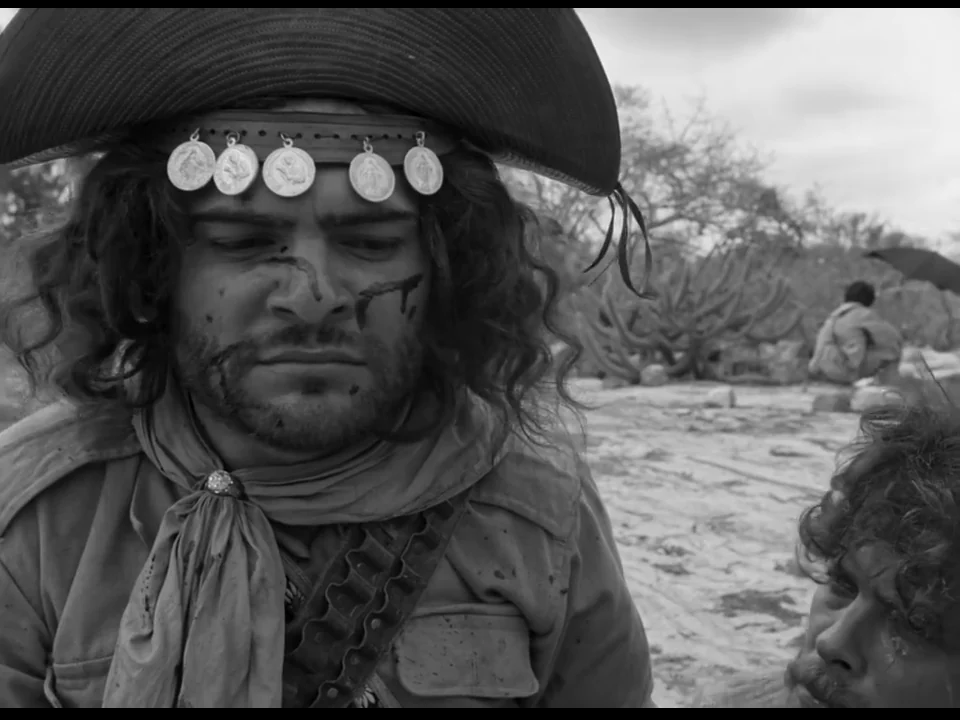 01:30:00
Bandit, mythical figure, and speaker are compressed into one face while allegiance remains in motion through speech.
Corisco's coin-hung hat, facial streaks, and frontal close-up bind costume, body, and mythical identity.
Manuel enters only from the lower edge, so their positions are not stabilized by balanced shot/reverse-shot.
Corisco challenges Manuel in loud, rhythmic speech closer to public performance than private conversation.
SITE ANALYSISFigures change allegiance among peasant, believer, bandit, and myth; the collective is not pre-completed, and Corisco's performative speech turns that absence into a condition of creation.
Cinema 2, chapter 8, pp. 222–223.Bilibili at 01:30:00 Open original still ↗The verbal challenge between Corisco and Manuel was frame-checked.Complete Bilibili carrier; the shot at 单片 01:30:00 was checked frame by frame, and the still and timestamp come from the same public upload.
Bilibili · Black God, White Devil complete film · verified 2026-08-14The Hour of the Furnaces
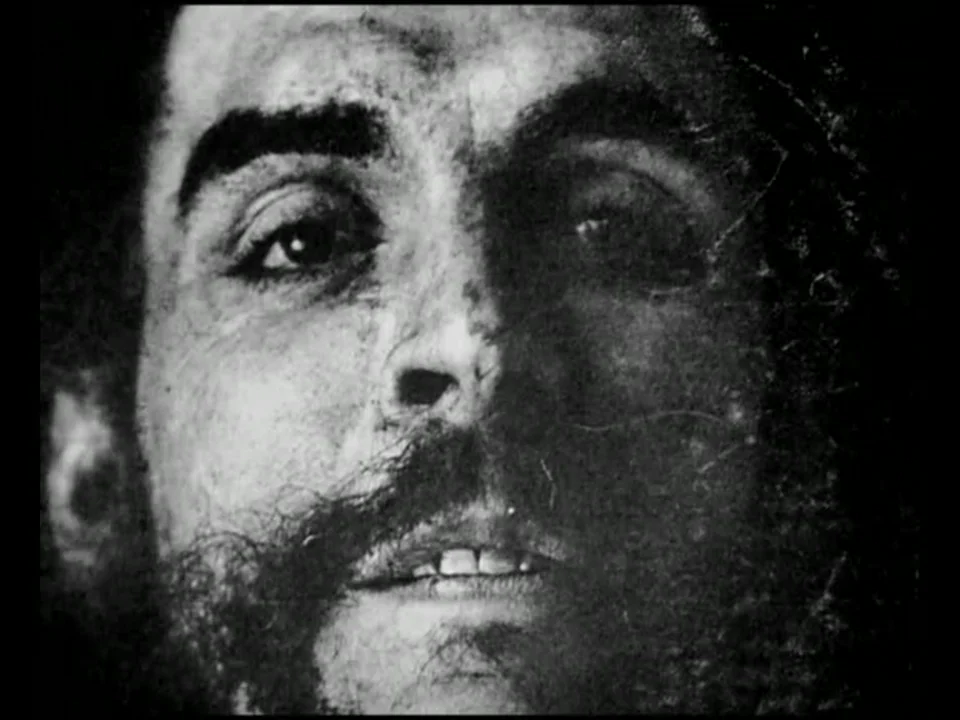 第1分段 01:22:30 / Part 1 01:22:30
The photograph is held for several minutes, turning projection from argument into a direct demand on the audience.
The same death photograph continues to fill the screen; eyes, wounds, and facial texture are not quickly displaced by another montage item.
The extended still is supported only by continuing percussion; no character dialogue supplies the audience's conclusion.
SITE ANALYSISThe prolonged gaze of the death image and percussion turn the absent revolutionary into a direct relation of address, presupposing a revolutionary audience able to respond and continue the action.
Bilibili at 第1分段 01:22:30 / Part 1 01:22:30 Open original still ↗The extended final image of Che Guevara in part 1 was frame-checked.Complete Bilibili carrier; the shot at 第1分段 01:22:30 was checked frame by frame, and the still and timestamp come from the same public upload.
Bilibili · The Hour of the Furnaces, part 1 · verified 2026-08-1424 City
Demolition, oral testimony, and performed witness rewrite one another's truth-status, making a factory past a memory produced by many and owned by none.
The site erases itself
Workshops, machines, moving crews, and demolition dust at Factory 420 are juxtaposed with images of the new development.
As testimony occurs, its material referent is disappearing; place cannot preserve the past intact.
Actors enter the testimonial series
Workers and performers including Joan Chen, Lü Liping, and Zhao Tao recount migration, love, and work in the same frontal interview form.
Professional identity cannot serve as final judge of authenticity; performance and witness must be tested through concrete detail rather than labels.
Memory circulates across materials
Old photographs, popular songs, dialects, silent faces, and new housing answer one another across decades.
The power of the false does not cancel history; it lets incompatible materials produce the city's sheets of past together.
Goodbye, Dragon Inn
Screen, leaks, footsteps, and empty seats outlast the act of viewing, making the closing cinema both actual ruin and virtual film memory.
Screen and audience do not close together
Dragon Inn sustains dense action on the large screen while spectators remain sparse, move slowly, and miss one another in the auditorium.
Screen action cannot organize the actual cinema; two temporal regimes coexist in one space.
Ambient sound takes the cinema
Leaks, footsteps, seats, toilet echoes, and extended silence cross corridors and empty halls, often without visible sources.
Sound no longer serves character action; the building acquires audible duration of its own.
Closure leaves a virtual cinema
After the audience leaves but before the staff finish closing the cinema, the camera preserves the empty screen and long corridors; the old actors' recognition also yields no shared future.
The actual cinema disappears while film memory continues to act as its virtual face.
SITE ANALYSIS / FIVE-STEP READING PATH
Read the Preface, appendix, and eight chapters in five passes
Each pass identifies the English-edition pages, reading objective, and analytical result to produce.
- 01
Enter the polemic before accepting its conclusions
Which theoretical premises does Shaviro reject, and what visual evidence does Blue Steel supply?
pp. vii–x, 1–24 · OUTPUT A one-page problem map with rejected premise and image evidence columns. - 02
Read the core tools at the level of bodies
How do body, flesh, affect, passivity, tactile, masochism, molar, and molecular each change the problem?
pp. 25–65 + 67–81 · OUTPUT Personal examples for the eighteen terms, with Shaviro's claims separated from Deleuze entries. - 03
Test the method through three kinds of body
How do Romero's contagion/waiting, Lewis's embarrassment/overconformity, and Cronenberg's technology/metamorphosis affect viewers?
pp. 83–105 + 107–125 + 127–157 · OUTPUT Three shot-by-shot observation cards limited to visible, audible, and bodily response. - 04
Endure political ambivalence in Querelle
Who looks, who is displayed, who commands, and who is wounded? How does the exclusion of women sustain the relation?
pp. 159–199 · OUTPUT A power-vulnerability map that does not automatically call male display subversive. - 05
Reassemble the book through Warhol and Bresson
How do stylistic opposites both evacuate psychological depth and make bodies support and interrupt the apparatus?
pp. 201–239 + 241–253 + 255–267 · OUTPUT A definition of the cinematic body in no more than 300 words, tagging each sentence as Shaviro study, primary-text entry, cross-text synthesis, or site analysis.
SOURCES / RIGHTS / ACCESS CONDITIONS
Editions, covers, sources, and access conditions
Find editions of the book, library records, author information, and related journal articles.
- 01Open source
ORIGINAL EDITION University of Minnesota Press edition record
Steven Shaviro, The Cinematic Body, Theory out of Bounds 2, 1993; paperback ISBN 978-0-8166-2294-8.The publisher page supplies the July 26, 1993 date, 292-page count, and official English cover download; the verified copy's copyright page also records a fifth printing in 2006.Publisher purchase and edition verification; not open-access full text. - 02Open source
PUBLISHED TRANSLATION PAULUS published Portuguese translation
O corpo cinemático, translated by Anna Carolina Negrini Fagundes Martino, PAULUS, 2015, ISBN 978-85-349-4136-5.Publisher material and the copyright page confirm publication by agreement with University of Minnesota Press and provide a verifiable cover.Published-translation information and edition identification; not open-access full text. - 03Open source
ACCESS / ACQUISITION JSTOR Books institutional access
The Cinematic Body, stable record DOI 10.5749/j.ctttt8tc.The copyright date remains 1993; the platform's NED label does not establish a revised edition.Access through a school or institution; not OA. - 04Open source
ACCESS / ACQUISITION Google Play Books
University of Minnesota Press digital record, also listing eISBN 978-1-4529-0249-4.Used to verify a digital carrier and retail route; its digital pagination does not replace print locators, and the route itself does not expand a rights claim.Purchase, rental, or platform preview depending on region and account. - 05Open source
ACCESS / ACQUISITION OverDrive / Libby library lending
The Cinematic Body, eISBN 978-0-8166-8527-1.Controlled digital-lending record for locating participating libraries.Requires eligibility at a participating library; not a public download. - 06Open source
CATALOGUE / HOLDINGS WorldCat holdings record
The Cinematic Body, OCLC 27034232.Used to find nearby print holdings and cross-check the 1993 edition.Bibliographic and library holdings search. - 07Open source
AUTHOR RETROSPECTIVE Author retrospective: The Cinematic Body Redux
Steven Shaviro, 'The Cinematic Body Redux,' Revista ECO-Pós 13.2.An openly available later reconsideration by the author; it is companion reading, not the book's full text or a revised edition.Open journal article page. - 08Open source
PRIMARY EDITION Deleuze, Cinema 1: The Movement-Image
Gilles Deleuze, translated by Hugh Tomlinson and Barbara Habberjam, University of Minnesota Press.Primary return for image-movement, sensory-motor relations, and Pickpocket's tactile space; relation-card pages still require checking in the primary text.Publisher edition page. - 09Open source
PRIMARY EDITION Deleuze, Cinema 2: The Time-Image
Gilles Deleuze, translated by Hugh Tomlinson and Robert Galeta, University of Minnesota Press.Primary return for the body's forcing thought toward life; Shaviro's masochistic film theory must not be projected back as Deleuze's own claim.Publisher edition page. - 10Open source
PRIMARY EDITION Deleuze and Guattari, A Thousand Plateaus
Translated by Brian Massumi, University of Minnesota Press.Primary return for lines of flight, programs of experimentation, the plane of consistency, and the Body without Organs.Publisher edition page; no site-hosted full text. - 11Open source
PRIMARY EDITION Deleuze and Guattari, Anti-Oedipus
Translated by Robert Hurley, Mark Seem, and Helen R. Lane, University of Minnesota Press.Primary return for desiring-production, Oedipalization, molar/molecular scales, and the sexuality appendix.BiblioVault scholarly-book catalogue record; no site-hosted full text. - 12Open source
COMPARATIVE SCHOLARSHIP Mulvey: Visual Pleasure and Narrative Cinema
Laura Mulvey, 'Visual Pleasure and Narrative Cinema,' Screen 16.3 (1975): 6–18.A foundational account of gendered looking through gaze, voyeurism, fetishism, and patriarchal narrative, and a direct object of Shaviro's dispute.Oxford Academic abstract and DOI record. - 13Open source
COMPARATIVE SCHOLARSHIP Doane: Film and the Masquerade
Mary Ann Doane, 'Film and the Masquerade: Theorising the Female Spectator,' Screen 23.3–4 (1982): 74–88.Complicates the unitary male-spectator model through female spectatorship and masquerade, making viewing position internally differentiated.Oxford Academic DOI record. - 14Open source
COMPARATIVE SCHOLARSHIP Sobchack, Carnal Thoughts
Vivian Sobchack, Carnal Thoughts: Embodiment and Moving Image Culture, University of California Press, 2004.Uses embodied subjectivity and reversible perception to show that viewers orient bodily and generate meaning rather than merely receive images.Publisher record, preview, and purchase route. - 15Open source
COMPARATIVE SCHOLARSHIP Marks, The Skin of the Film
Laura U. Marks, The Skin of the Film: Intercultural Cinema, Embodiment, and the Senses, Duke University Press, 2000.Situates haptic visuality in intercultural cinema, diasporic memory, sensory archives, and colonial histories; the concept postdates Shaviro's book.Duke University Press edition page. - 16Open source
COMPARATIVE SCHOLARSHIP Barker, The Tactile Eye
Jennifer M. Barker, The Tactile Eye: Touch and the Cinematic Experience, University of California Press, 2009.Differentiates film–viewer contact across skin, musculature, and viscera, providing a method for shot-level bodily orientation.Publisher record, preview, and purchase route. - 17Open source
COMPARATIVE SCHOLARSHIP Rizzo, Deleuze and Film: A Feminist Introduction
Teresa Rizzo, Deleuze and Film: A Feminist Introduction, Continuum, 2012.Tests the relation among Deleuzian becoming, bodies, affect, and concrete film analysis through a feminist method.Bloomsbury Academic edition page. - 18Open source
COMPARATIVE SCHOLARSHIP Clover, Men, Women, and Chain Saws
Carol J. Clover, Men, Women, and Chain Saws: Gender in the Modern Horror Film, Princeton University Press, 1992.Analyzes horror through the Final Girl, cross-gendered spectator identification, and genre pleasure; Shaviro explicitly cites and partly disputes it.Princeton University Press edition page. - 19Open source
COMPARATIVE SCHOLARSHIP bell hooks, Black Looks
bell hooks, Black Looks: Race and Representation, South End Press, 1992, including 'The Oppositional Gaze.'Historicizes refusal of identification and the oppositional gaze through Black female spectatorship, pressure-testing Shaviro's generalized passivity.Authorized Routledge later-edition page. - 20Open source
COMPARATIVE SCHOLARSHIP Stam and Spence: Colonialism, Racism and Representation
Robert Stam and Louise Spence, 'Colonialism, Racism and Representation,' Screen 24.2 (1983): 2–20.Moves analysis of colonial images beyond positive/negative stereotypes toward narrative position, formal convention, and historical relations of production.Oxford Academic abstract and DOI record. - 21Open source
COMPARATIVE SCHOLARSHIP Diawara: Black Spectatorship, Identification and Resistance
Manthia Diawara, 'Black Spectatorship: Problems of Identification and Resistance,' Screen 29.4 (1988): 66–79.Historicizes failed identification, refusal, and Black spectatorship without essentializing resistant viewing.Oxford Academic abstract and DOI record. - 22Open source
COMPARATIVE SCHOLARSHIP Keeling, The Witch's Flight
Kara Keeling, The Witch's Flight: The Cinematic, the Black Femme, and the Image of Common Sense, Duke University Press, 2007.Reworks cinematic perception, common sense, and time through later Black feminist and queer theory; it is not a source for Shaviro's 1993 book.Duke University Press edition page. - 23Open source
COMPARATIVE SCHOLARSHIP Shaviro, Post-Cinematic Affect
Steven Shaviro, Post-Cinematic Affect, Zero Books, 2010.Extends the author's body–affect problem into structures of feeling shaped by digital technology, globalization, and financialization.Authorized distributor and purchase page. - 25Open source
COMPARATIVE SCHOLARSHIP Chun, Updating to Remain the Same
Wendy Hui Kyong Chun, Updating to Remain the Same: Habitual New Media, MIT Press, 2016.Links updating, habit, and networked subjectivity, preventing platform power from being reduced to singular intense stimuli.MIT Press edition page. - 26Open source
COMPARATIVE SCHOLARSHIP Nieborg and Poell: The Platformization of Cultural Production
David B. Nieborg and Thomas Poell, 'The Platformization of Cultural Production: Theorizing the Contingent Cultural Commodity,' New Media & Society 20.11 (2018): 4275–4292.Shows how platform infrastructure, governance, and data feedback make cultural commodities contingent and continuously variable.SAGE journal DOI record. - 27Open source
COMPARATIVE SCHOLARSHIP Chion, Audio-Vision: Sound on Screen
Michel Chion, Audio-Vision: Sound on Screen, 2nd ed., Columbia University Press, 2019.Uses audio-vision to show that sound and image jointly generate a new perceptual object rather than simply adding separate tracks.Columbia University Press edition page. - 28Open source
COMPARATIVE SCHOLARSHIP Eidsheim, Sensing Sound
Nina Sun Eidsheim, Sensing Sound: Singing and Listening as Vibrational Practice, Duke University Press, 2015.Understands sound, vocal subjects, and listening as vibrational practices co-produced by media, space, technology, and bodies.Duke University Press edition page. - 29Open source
COMPARATIVE SCHOLARSHIP Ellcessor, Restricted Access
Elizabeth Ellcessor, Restricted Access: Media, Disability, and the Politics of Participation, NYU Press, 2016.Distinguishes technical availability, effective access, and equitable participation across regulation, use, form, and experience.NYU Press edition page. - 30Open source
ACCESSIBILITY REQUIREMENTS W3C: Media Accessibility User Requirements
W3C Protocols & Formats Working Group, Media Accessibility User Requirements, Working Group Note, December 3, 2015.Catalogues user needs for captions, audio description, sign translation, transcripts, keyboard operation, speed adjustment, and autoplay control; it is a requirements document, not a single conformance standard.Open W3C Working Group Note.