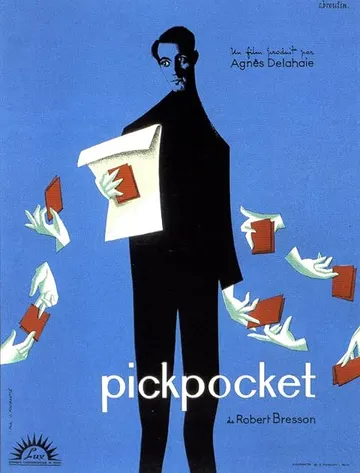
Robert Bresson / 罗伯特·布列松 · 1959
Pickpocket
Pickpocket
Hands, pockets, wallets, and relays connect a space that can never be surveyed as a whole. Tactile relations replace mastery through complete action-space.
Film details
- Original title
- Pickpocket
- Director
- Robert Bresson / 罗伯特·布列松
- Year
- 1959
- Region
- France
Film analysis: how shots organize concepts
Hands, pockets, and crowds split whole bodies and continuous space, turning criminal action into a relation of touch, shame, and contact.
- 01Hands act before persons
Close-ups at the racecourse and station isolate fingers, wallets, pockets, and routes of transfer, often cutting out faces and whole bodies.
Action no longer belongs to a whole agent; it is composed from tactile fragments. - 02Space is recomposed by contact
A trio relays stolen objects through stairs, carriages, and crowded passages while editing withholds an overview joining their bodies.
Space loses stable coordinates, retaining only the potential connection of one hand reaching another. - 03Touch changes the nature of action
Prison bars separate Michel and Jeanne as their hands and faces finally approach through the barrier.
The tactile circuit of skilled theft becomes contact without possession, and agency yields to an affective relation.
Analysis and scene sources
Shots and scenes
Primary texts, scholarship, and locators
Theory coordinate: Cinema 2, ch. 1, p. 13
- 01Cinema 2: The Time-Image
Authoritative source for the standard translation, translators, ISBN, and publication date.
Open the atlas source record →
This film in books and research
《吉尔·德勒兹身体创造学研究》 · Atlas extension
Pickpocket
Film relation: Site extension: hands, pockets, objects, accomplices, and station montage form machinic connections through which thought occurs as bodily technique.
Shot question: Is each hand an organ of a character, or does editing make it an independent vector connecting bodies?
The Cinematic Body · Further discussion
Bodies do not only receive impacts; they orient and respond
pp. 50–51
Claim: Viewing is an exchange between the film's body and the spectator's body. Posture, breath, kinesthesia, and sensory memory help complete the image.
Extension: Sobchack stresses embodied intentionality, Marks situates haptic visuality in diasporic and intercultural memory, and Barker differentiates film–viewer contact across skin, musculature, and viscera.
Tension: Shaviro's tactile image is not Marks's 2000 concept of haptic visuality. The latter carries a specific politics of cultural memory and archives, and tactile proximity does not automatically create ethical proximity.
Sobchack, Carnal ThoughtsMarks, The Skin of the FilmBarker, The Tactile Eye
Viewing gateways and editions
- Verified complete Bilibili carrier: 扒手 (1959)【罗伯特·布列松】bilibili.comOpen film page ↗
- Page access
- Accessible when checked
- Version extent
- Recorded as a complete version
- Source type
- User-uploaded page
Edition note: Complete single-part film · 1:16:20.
Link checked: 2026-08-14