DEEP GUIDE · PRINT LOCATORS · FILM MATRIX
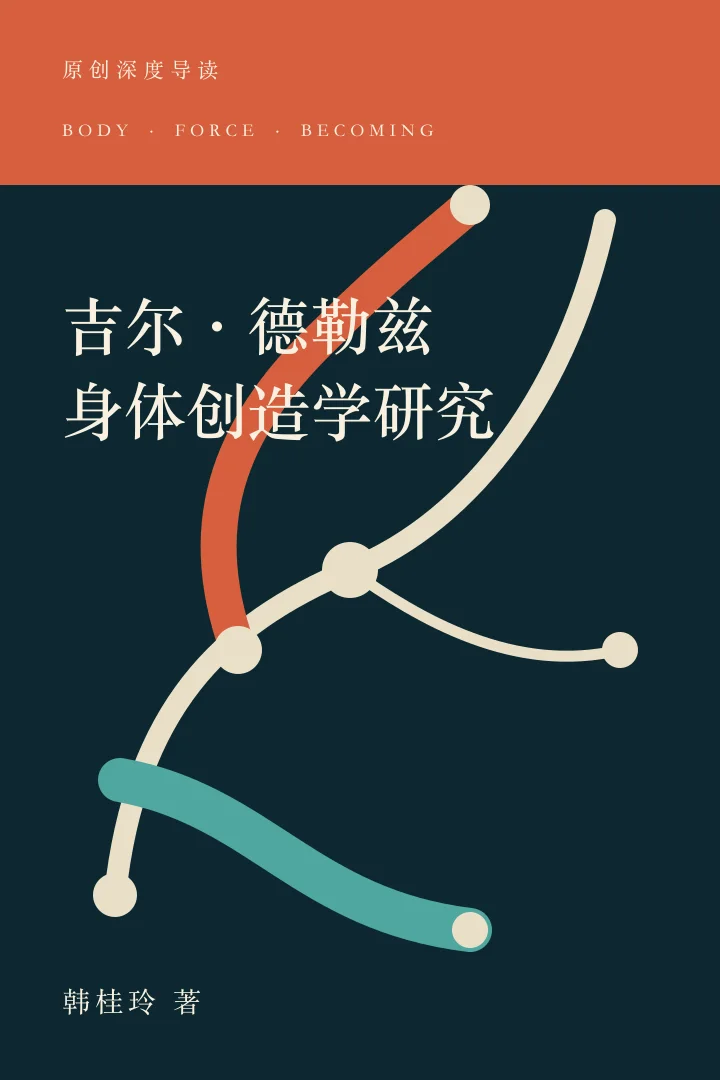
31《吉尔·德勒兹身体创造学研究》
From Bergson, Nietzsche, and embodied phenomenology to sensation, desiring-machines, will to power, rhizome, and fold
Creation is not an inspirational event in a disembodied mind but a recomposition of relations among body, sensation, desire, force, environment, and thought. The value of a creatology of the body lies in making the new testable as a change of capacity: what a body can do and undergo, and how it reconnects with other bodies and apparatuses.
Simplified Chinese · 南京师范大学出版社 · 2011 · ISBN 9787565102110
- UNITS
- 6
- LOCATORS
- 46
- CURATED BOOK CASES
- 0
- EXTENSIONS
- 16
CENTRAL ARGUMENT
Central argument and scope
CONTRIBUTION
Han Guiling synthesizes resources from different phases of Deleuze under the rubric of a creatology of the body. The first chapter constructs a lineage through Bergson, Nietzsche, Merleau-Ponty, Barthes, Foucault, and the Body without Organs. Sensation, desiring-production, will to power, and eternal return then explain the dynamics of creation, while rhizome and fold recast embodied thought as open connection and subjectivation.
PAGINATION
Printed pagination runs continuously from p.1 to p.198.
SCOPE
Six reading units, 46 single- or adjacent-double-page locators, 18 concept groups, eight relation cards, sixteen site-extension films, five outward perspectives, and a five-step route. The source book analyses no titled feature film.
CHAPTER ARGUMENT CHAINS
6 reading units with exact print locators
Why a theory of creation needs the body
Assigning creation solely to the rational mind erases the productive role of sensation, desire, milieu, and force. Creatology of the body is Han's synthetic framework for correcting that omission.
The introduction identifies the disembodied tendency of conventional creativity studies, sketches the development of the body problem across Deleuze's work, summarizes its features as production, relation, becoming, and anti-representation, reviews scholarship, and proposes a research sequence through sensation, desire, will to power, and embodied thought.
The body neglected by creativity studies
Rationalist models reduce the body to an executor and conceal the role of sensation and environment in the genesis of ideas.
Development of Deleuze's philosophy of the body
The body problem spans histories of philosophy, the collaboration with Guattari, and works on art and cinema; it cannot be compressed into one term.
Production, relation, becoming, anti-representation
A body is composed through connections and capacities, not a completed entity that later enters the world.
State of research
The review of scholarship identifies the still-unmade connection between philosophy of the body and studies of creativity.
Constructing a creatology of the body
Han rearranges concepts across works into a framework of sensation, desire, force, and embodied thought.
EXACT PRINT LOCATORS
- pp. 1–2
A research gap is posed: creativity studies privilege brain and reason while neglecting the body.
- pp. 8–9
The body problem develops across phases of Deleuze's work and cannot be reduced to one book or term.
- pp. 14–15
The philosophy of the body is summarized through production, relation, becoming, and anti-representation.
- pp. 19–20
The literature review locates the book between Deleuze studies and creativity research.
- pp. 21–22
Creatology of the body is explicitly proposed as the author's synthetic framework.
- pp. 23–24
The chapter sequence moves from intellectual lineages to sensation, desire, force, and embodied thought.
How five lineages converge in bodily creation
The body is not the opposite of mind but a crossing of image-selection, vital differentiation, relations of force, perceptual field, and redistribution of intensity. These lineages supplement one another without becoming identical.
Bergson makes the body a centre of action-selection among images; Nietzsche returns thought and value to a body composed of forces; Merleau-Ponty shows body and environment co-forming behaviour and perception; Barthes and Foucault add pleasure, discipline, and subjectivation; the Deleuze-Guattarian Body without Organs casts creation as a cautious experiment in loosening fixed organization.
Bergson: body as special image
The body is one image among others yet becomes special by delaying response and selecting action.
Élan vital
Life differentiates and invents form through material resistance; creation is not the execution of a predetermined blueprint.
Bergson's impetus for Deleuze
Image, duration, and vital differentiation jointly transform the relation between body and thought.
Nietzsche's critique of rational man
The independent rational subject is returned to a temporary outcome of body, drives, and multiple forces.
Praise of the body
The body is no longer thought's obstacle but a composition of relations more complex than consciousness.
Will to power determines the body
The body's nature arises from differential relations among forces rather than command by a centre.
The gay science
Affirmation, experiment, and bodily joy orient the evaluation of creation.
A creative inheritance of Nietzsche
Deleuze does not copy Nietzsche but reworks active/reactive, difference, and affirmation into new conceptual relations.
Body-field
The body organizes space through reach, action, distance, and orientation rather than occupying a point in homogeneous coordinates.
Structure of behaviour
Behaviour is co-formed by body and environment and cannot be split into pure external stimulus and internal response.
Perceptual field
Sensation is organized in a body-environment field rather than received by a mind as a copy of an object.
Barthes and bodily pleasure
Reading and text enter bodily intensity and pleasure, so meaning no longer monopolizes experience.
Foucault's aesthetics of the body
Discipline, practice, and subjectivation show a body being shaped and remaking itself through techniques.
Body without Organs
Creation does not abolish organs; it cautiously loosens fixed organ-function organization so intensities can form new connections.
EXACT PRINT LOCATORS
- pp. 25–26
The Bergsonian entry: the body is one image among others and a centre for selecting action.
- pp. 29–30
Élan vital resists reducing life to mechanical combination or predetermined purpose.
- pp. 35–36
Nietzsche's critique of rational man returns thought to body, drive, and force.
- pp. 40–41
Will to power is read as a differential relation among forces rather than a desire to dominate.
- pp. 48–49
Merleau-Ponty's body-field breaks the strict division between subjective interior and objective world.
- pp. 54–55
The perceptual field shows sensation co-organized by body and environment rather than received as a copy.
- pp. 58–59
Barthes's pleasure of the body returns reading and text to bodily intensity and pleasure.
- pp. 67–68
The Body without Organs is not an organless corpse but a plane of intensity resisting fixed organismic rule.
- pp. 71–72
Multiple lineages converge on the creative proposition that a body can be reorganized.
Sensation is not raw material but part of creation
Sensation occurs among body, material, and environment. Art does not copy visible objects but composes relations of sensation that endure and render forces sensible.
Han first distinguishes surface, expression, and bodily sense, then defines sensation as an intensive relation. Art captures and composes blocks of sensation that interrupt habitual perception. Bergsonian intuition becomes a rigorous method for entering duration, distinguishing tendencies in kind, and constructing true problems.
Surface, expression, and bodily sense
Sensation is not a choice between deep mind and surface stimulus; it occurs in bodily relations.
Meaning of bodily sensation
Sensation belongs to a body-milieu whole and centres on intensive variation rather than object-property.
Bodily sensation and artistic creation
Art captures forces through material rather than ending in faithful reproduction of the visible.
Creative value of sensation
The work preserves a block of sensation, interrupts habitual perception, and produces new affective compositions.
Bergsonian intuition
Intuition enters an object's duration and internal difference rather than abolishing analysis.
A rigorous and precise method
Intuition works by dividing false problems, distinguishing tendencies in kind, and reconstructing the problem.
EXACT PRINT LOCATORS
- pp. 73–74
Sensation cannot be reduced to surface stimulus or object-property; it belongs to a whole bodily relation.
- pp. 77–78
Bodily sensation connects perceiver, material, and environment and centres on intensity rather than representation.
- pp. 80–81
Artistic creation does not copy the visible but captures and composes forces of sensation.
- pp. 83–84
The creative value of sensation lies in interrupting habitual perception and forming new affective compositions.
- pp. 87–88
Bergsonian intuition is introduced to approach duration and difference internal to an object.
- pp. 90–91
Deleuzian intuition is a rigorous method of dividing problems, not vague inspiration.
- pp. 96–97
Sensation, art, and intuition form the first chain explaining how the body participates in creation.
Desire shifts from lacking an object to producing reality
Desire does not first lack an object and then seek satisfaction. Through machinic connection, interruption, and three syntheses, it produces objects, social recording, and provisional subjects. Creation occurs in the careful reconnection of desiring flows.
The chapter critiques the model of lack, then explains how desire, desiring-production, and desiring-machines work by connecting and interrupting flows. Connective, disjunctive, and conjunctive syntheses produce objects, recording surfaces, and an I. Social fields code flows; deterritorialization dismantles old connections but is always accompanied by new assemblage or reterritorialization.
The model of lack and its limits
Treating a missing object as desire's universal origin erases how social arrangements produce lack.
Critique of traditional theories of desire
Desire is moved from a theatre of representation into real production, making lack the effect of a particular arrangement.
Desire, production, and machine
A machine exists by connecting, interrupting, and transmitting flows with another machine; there is no isolated whole machine.
Three syntheses
Connection produces flows, disjunction records and distributes series, and conjunction produces intensive consumption and provisional subjects.
Three social fields
Social machines organize desire through coding, inscription, and circulation; individual psychology is not the sole explanatory level.
Deterritorialization and reterritorialization
Once old connections are dismantled, new apparatuses form; lines of flight must be tracked together with mechanisms of refixation.
EXACT PRINT LOCATORS
- pp. 98–99
Traditional theories of lack set up the question of whether desire begins from a missing object.
- pp. 105–106
Deleuze and Guattari recast desire as production of reality rather than a theatre of representation.
- pp. 112–113
A machine works by connecting, cutting, and drawing flows; it is not a metaphor for a metal device.
- pp. 118–119
Connective, disjunctive, and conjunctive syntheses produce objects, bodies, and provisional subjects.
- pp. 121–122
The social field organizes desiring-production by coding flows and inscribing bodies.
- pp. 127–128
Deterritorialization dismantles established connections but is always accompanied by new assemblage or reterritorialization.
- pp. 130–131
Creation reconnects desiring flows while requiring an evaluation of which reconnections merit affirmation.
Will to power is a differential relation, not possession of rank
Will to power explains how forces shape, evaluate, and become rather than who dominates whom. Eternal return then selects relations capable of affirming difference and making will creative.
Han moves from Schopenhauer's suffering will-to-life to Nietzsche's joyful will to power, using Deleuze to distinguish relations of force from personal ambition. Plasticity, affirmation, and becoming form its creative nature. Three presentations of eternal return clear away the popular idea of identical recurrence and recast return as being of becoming and selection.
Schopenhauer: suffering will-to-life
Striving is placed in a cycle of lack, suffering, and temporary satisfaction.
Nietzsche: joyful will to power
Life shifts from preservation toward expansion, interpretation, shaping, and self-overcoming.
Deleuze reads will to power
Will to power is the differential principle among forces, not a desire possessed by a subject.
Plasticity
Force is shaped by relations and can alter their configuration.
Affirmation
Affirmation is not acceptance of the present order but affirmation of difference's capacity to continue becoming.
Generativity
Will to power is not a property of substance but a becoming-event occurring in encounters among forces.
Three presentations of eternal return
Three presentations progressively clear away mechanical cycles and recurrence of identical things.
Eternal return as being of becoming
What returns is the being of becoming and difference, not a pre-existing identity.
Eternal return as selection
Return asks whether the will can affirm its act again and excludes reactive relations that negate life.
EXACT PRINT LOCATORS
- pp. 132–133
Schopenhauer's will-to-life and structure of suffering establish the point of departure.
- pp. 136–137
Nietzsche places relations of force, difference, and affirmation at the centre of life.
- pp. 139–140
Deleuze distinguishes will to power from personal domination or political rank.
- pp. 142–143
Plasticity means forces are shaped by relations and can change their configuration.
- pp. 145–146
Affirmation is not acceptance of the status quo but affirmation of difference and its further becoming.
- pp. 148–149
Generativity recasts will to power from a substantial property into a relational event.
- pp. 152–153
Three presentations of eternal return clear away the popular reading of identical recurrence.
- pp. 157–158
What returns is the being of becoming and difference, moving from the problem of becoming to selection.
- p. 160
Plasticity, affirmation, becoming, and selection form a chain for evaluating creation.
Thought also has posture, network, and fold
Thought occurs through bodily posture, sensation, situation, and connection. Rhizome gives it multiple entrances and reconnection after rupture; fold explains how outside relations are folded in to form a provisional subject.
The chapter first criticizes disembodied thought that reduces the body to interference or execution, then opposes centre, hierarchy, binary, and traceable origin through the rhizome. Theory works as a toolbox used by problems. The fold is not a visual shape but a continuous inflection of inside and outside in one material, offering a dynamic model for subjectivation and creation.
Limits of disembodied thought
Traditional models treat the body as obstacle or executor, erasing the material conditions of conceptual genesis.
Embodied thought
Posture, sensation, rhythm, situation, and relation enter thought itself.
Critique of arborescent thought
Arborescent models depend on centre, hierarchy, binary division, and traceable origin.
Characteristics of the rhizome
The rhizome describes an open network through multiple entrances, heterogeneous connections, rupture, and reconnection.
The theoretical toolbox
Concepts are selected for what they do in a problem, not by allegiance to a system.
Meaning of the fold
Inside and outside are not sealed opposites but continuous inflections in one material.
Creative value of the fold
Outside forces fold in to form a subject, which alters relations through unfolding; creation becomes an ongoing fold and unfold.
EXACT PRINT LOCATORS
- pp. 161–162
Disembodied thought reduces the body to interference or executor, hiding thought's material conditions.
- pp. 165–166
Embodied thought includes posture, sensation, situation, and relation in conceptual genesis.
- pp. 169–170
Arborescent models depend on centre, hierarchy, binary division, and traceable origin.
- pp. 172–173
The rhizome describes an open network through multiple entrances, heterogeneous connections, and regrowth after rupture.
- pp. 175–176
Theory as toolbox stresses use within a problem rather than allegiance to a system.
- pp. 177–178
The fold does not put an outside into a sealed inside; it is continuous inflection of inside and outside in one material.
- pp. 181–182
The fold models subjectivation and creation as existing relations of force folded in and reorganized.
- pp. 186–187
Sensation, desire, will to power, rhizome, and fold converge in the creatology of the body.
WORKING CONCEPTS
18 searchable, operational concepts
Creatology of the body
Han Guiling's synthesis across several Deleuze texts: creation occurs in bodily relations among sensation, desire, force, milieu, and thought.
- OPERATION
- Map body, material, milieu, desire, and force for every creative act.
- BOUNDARY
- This is Han's research construction, not the formal title of a concept in one Deleuze text.
Body-image
The body is one image among others yet delays response and selects action, becoming a special junction of perception and action.
- OPERATION
- Record environmental stimulus, bodily delay, selected action, and unselected possibilities.
- BOUNDARY
- Not body image in psychology and not a visual picture of a body.
Élan vital
Life's open tendency to differentiate and invent form through material resistance.
- OPERATION
- Identify resistance, bifurcation, invented form, and unrealized path.
- BOUNDARY
- Not mystical energy, a teleological blueprint, or abstract vitality.
Bodily monism / body of forces
Thought, consciousness, and value are returned to bodily relations composed of multiple forces rather than ruled by an independent soul.
- OPERATION
- Distinguish active, reactive, absorbed, reversed, and exhausted forces.
- BOUNDARY
- Monism does not reduce everything to biological organism.
Body-field
The body organizes space through reachability, actionability, distance, and orientation.
- OPERATION
- Map near/far, up/down, reachable/blocked through posture and capacity for action.
- BOUNDARY
- Not a zone surrounding the body inside homogeneous space.
Structure of behaviour / perceptual field
Behaviour and perception are co-formed by body and environment and cannot be reduced to stimulus or internal representation.
- OPERATION
- Write bodily action, environmental response, and perceptual change as a reciprocal circuit.
- BOUNDARY
- Not treating the environment as background to a mental state.
Body without Organs
A practical plane resisting fixed organization of organs and redistributing intensities.
- OPERATION
- Record loosened organization, retained minimum strata, new connection, and risk.
- BOUNDARY
- Not destruction of organs, a primal body, illness, or unlimited freedom.
Sensation
An intensive change occurring when material and body meet, not merely an object-property or psychological content.
- OPERATION
- Identify transmitted force, material means, and bodily response.
- BOUNDARY
- The taste judgment that something feels powerful is not evidence.
Block of sensations
Art extracts perceptions and affects from personal experience and composes percepts and affects capable of enduring independently.
- OPERATION
- Explain through which material relations a work preserves and reactivates sensation.
- BOUNDARY
- Not a copy of the artist's emotion or a score of spectator empathy.
Intuition
A rigorous method entering duration, distinguishing tendencies in kind, and constructing true problems.
- OPERATION
- Separate mixed terms, reconstruct temporal process, and test how the problem distributes solutions.
- BOUNDARY
- Not first reaction, vague inspiration, or an anti-rational shortcut.
Desiring-production
Desire directly produces real connections, objects, and subjects; lack is produced by a particular social arrangement.
- OPERATION
- List flow, connection, interruption, recording surface, and subject-effect.
- BOUNDARY
- Not the justification of every desire and not denial of loss or need.
Desiring-machine
A relational composition existing by connecting, interrupting, and transmitting flows with another machine.
- OPERATION
- Map each machine's input, cut, output, and next connection.
- BOUNDARY
- Not a metaphor for metal machinery, and never an isolated complete machine.
Three syntheses
Connective synthesis produces connections of flows, disjunctive synthesis records and distributes series, and conjunctive synthesis produces provisional subjects and intensive consumption.
- OPERATION
- Mark connection, recording/distribution, and the resulting this-is-me subject-effect in sequence.
- BOUNDARY
- Not three linear stages and not a guarantee of a stable subject.
Deterritorialization / reterritorialization
The loosening of established functional and identity connections and the refixation of flows in a new apparatus.
- OPERATION
- Whenever a boundary breaks, immediately record the new interface, ownership, and discipline.
- BOUNDARY
- Deterritorialization does not guarantee liberation; the pair must always be tracked together.
Will to power
The principle through which forces interpret, shape, and differentiate one another.
- OPERATION
- Separate active/reactive from victory/defeat and judge how a force defines itself.
- BOUNDARY
- Not a psychological wish for office, domination, or greater violence.
Eternal return
The return of difference as a principle of selection rather than cyclical copying of identical things.
- OPERATION
- List invariants, differences, and reactive relations selected out of each repetition.
- BOUNDARY
- A cyclical narrative or mere recurrence is insufficient.
Rhizome
A network with multiple entrances, heterogeneous connections, rupture, and reconnection.
- OPERATION
- Map entrances, heterogeneous nodes, rupture points, and new paths after rupture.
- BOUNDARY
- Looking root-like or narrating nonlinearly does not constitute a rhizome.
Fold
A continuous inflection of inside and outside in one material; outside relations fold in to form a subject, which changes relations through unfolding.
- OPERATION
- Identify the one material, outside force, interior formed by folding, and subsequent unfolding.
- BOUNDARY
- Not folded cloth, a curved appearance, or placing an outside object in a sealed interior.
PRIMARY TEXTS AND COMPARATIVE STUDIES
Related arguments and textual comparisons
The body is not a spectator outside images
- BOOK ARGUMENT
- The body as a special image selects perception through possibilities of action.
- RELATED PRIMARY ENTRY
- Bergson's Matter and Memory and chapter one of Deleuze's Cinema 1.
- CROSS-TEXT COMPARISON
- The differentiation of perception, affection, and action in the movement-image can be understood through the body's interval function.
- SITE TEST
- Record environmental stimulus, bodily delay, and selected action shot by shot; do not equate POV with an inner picture.
Sensation renders force sensible rather than copying an object
- BOOK ARGUMENT
- Art creates relations of sensation and interrupts habitual perception.
- RELATED PRIMARY ENTRY
- Francis Bacon: The Logic of Sensation and What Is Philosophy?
- CROSS-TEXT COMPARISON
- Pure optical and sound situations in Cinema 2 detach perception from immediate action, making the body undergo an unactable intensity.
- SITE TEST
- Specify which force colour, sound, composition, or rhythm transmits and how the body responds; feeling powerful is not evidence.
A Body without Organs requires cautious construction
- BOOK ARGUMENT
- Creation loosens fixed organization of organs and redistributes intensity.
- RELATED PRIMARY ENTRY
- Anti-Oedipus and How Do You Make Yourself a Body without Organs? in A Thousand Plateaus.
- CROSS-TEXT COMPARISON
- Body horror can make organ-function relations visible, but bodily destruction does not automatically make a BwO.
- SITE TEST
- Record loosened organization, retained minimum stratum, new connection, and danger; with any missing, withhold the BwO judgment.
Desire produces objects and subjects
- BOOK ARGUMENT
- Lack is not the natural origin; machinic connections and three syntheses produce reality and a provisional I.
- RELATED PRIMARY ENTRY
- Deleuze and Guattari's Anti-Oedipus.
- CROSS-TEXT COMPARISON
- Character desire also requires analysis of how family, media, capital, and technology arrange desirable objects.
- SITE TEST
- Map flow, interruption, recording surface, and consumption/subject-effect in four columns.
Deterritorialization must be tracked with reterritorialization
- BOOK ARGUMENT
- Social machines code and decode flows; creation occurs through recomposition of connections.
- RELATED PRIMARY ENTRY
- Anti-Oedipus and A Thousand Plateaus.
- CROSS-TEXT COMPARISON
- After leaving cinema and film stock, digital images can be refixed by platforms, metrics, and recommendation.
- SITE TEST
- Whenever a boundary is broken, immediately name the new boundary, interface, and ownership.
Will to power evaluates relations, not strong identities
- BOOK ARGUMENT
- Plasticity, affirmation, and becoming compose the creative nature of will to power.
- RELATED PRIMARY ENTRY
- Deleuze's Nietzsche and Philosophy.
- CROSS-TEXT COMPARISON
- An action-film victor may remain defined by reactive force, while an exhausted or restrained body may open new relations.
- SITE TEST
- Separate active/reactive from victory/defeat and test whether a force begins from its own difference.
Eternal return selects difference rather than copying the same
- BOOK ARGUMENT
- What returns is the being of becoming, and return performs selection.
- RELATED PRIMARY ENTRY
- Nietzsche and Philosophy and Difference and Repetition.
- CROSS-TEXT COMPARISON
- Cyclical narrative connects with return of difference only when each cycle changes relational, perceptual, or selective conditions.
- SITE TEST
- List invariants, differences, and selected-out relations; plot recurrence alone is insufficient.
Embodied thought connects rhizomatically and subjectivates through folds
- BOOK ARGUMENT
- Thought has bodily conditions; rhizome provides multi-entry connection and fold explains continuous inflection of inside and outside.
- RELATED PRIMARY ENTRY
- A Thousand Plateaus, The Fold, Foucault, and give me a body in Cinema 2.
- CROSS-TEXT COMPARISON
- Gesture, ritual, fatigue, and waiting in modern cinema can precede action-narrative, while multiscreen networks can form multiple entrances.
- SITE TEST
- Rhizome requires connections and post-rupture paths; fold requires an inside-outside inflection in one material, not visual resemblance.
FILMS AND IMAGES
Book cases and extended analyses
Europe ’51
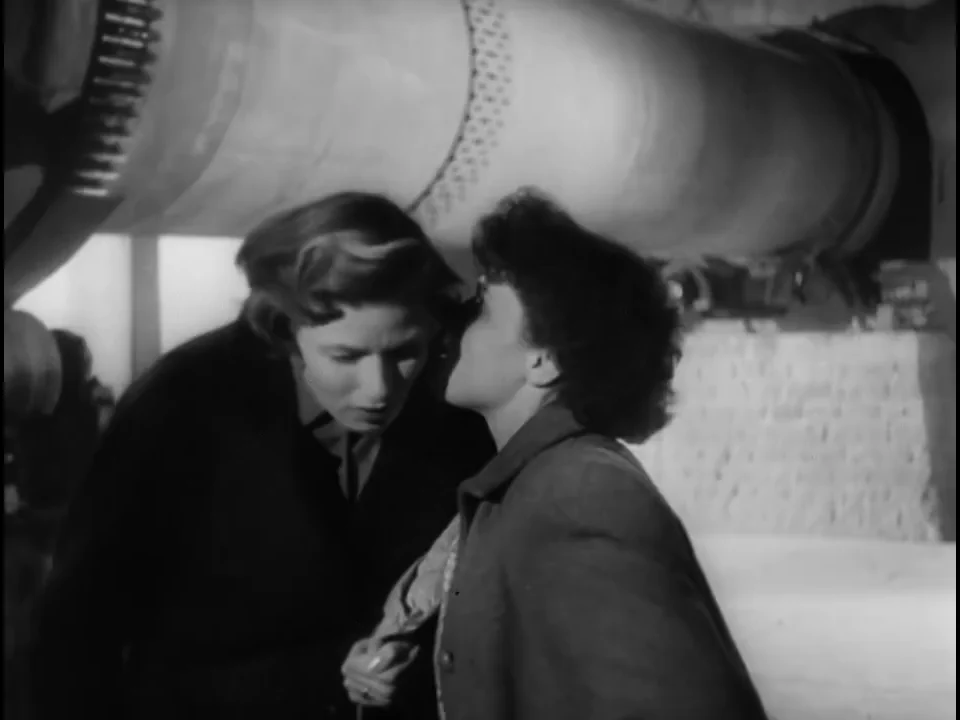
Europa ’51 · Roberto Rossellini · 1952Site extension: beginning from the machines' occupation of the frame, close-range conversation in the narrow passage, and the coexistence of mechanical sound and dialogue, test whether the factory still exceeds its practical account as a ‘workplace’ even while local acts remain possible. Reading that gap as the genesis of a seer requires Deleuze, Marrati, and Rushton; it does not follow directly from a single still.
Tropical Malady
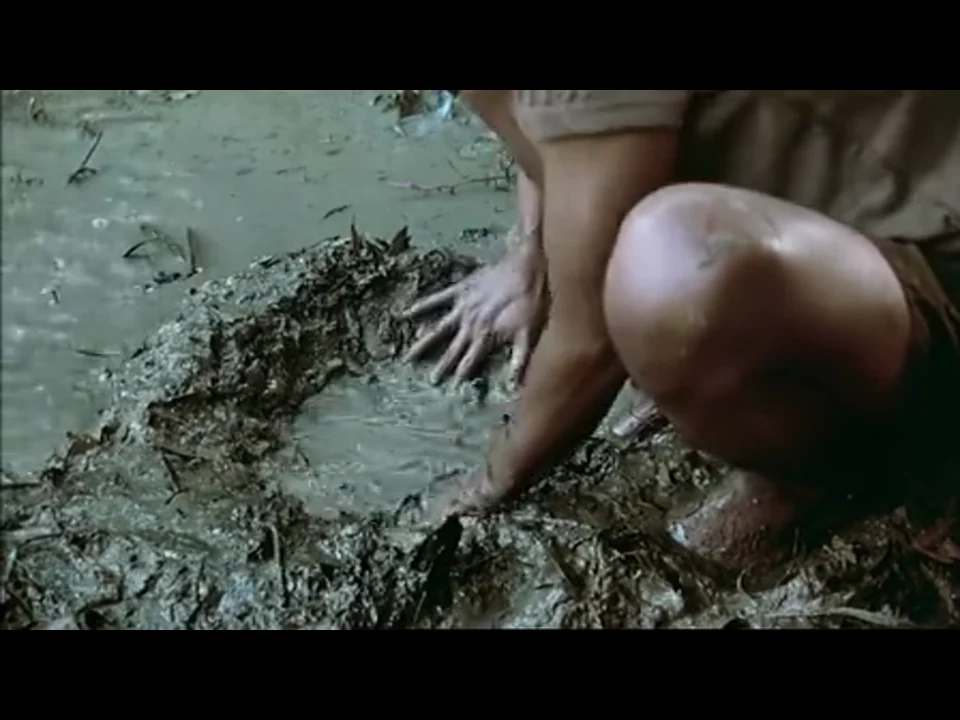
สัตว์ประหลาด · Apichatpong Weerasethakul · 2004Site extension: the soldier gives up upright walking and forms new contacts among hands, feet, knees, and mud, presenting becoming at the level of capacity rather than a tiger-transformation effect.
The Passion of Joan of Arc
La Passion de Jeanne d’Arc · Carl Theodor Dreyer · 1928Site extension: close-ups detach faces from action-space and turn them into intensive surfaces of tear, skin, gaze, and judicial force.
Pickpocket
Pickpocket · Robert Bresson · 1959Site extension: hands, pockets, objects, accomplices, and station montage form machinic connections through which thought occurs as bodily technique.
Jeanne Dielman
Jeanne Dielman, 23 quai du Commerce, 1080 Bruxelles · Chantal Akerman · 1975Site extension: minute deviations in domestic ritual make bodily time within repeated labour gradually undo the sensory-motor schema.
Beau Travail
Beau Travail · Claire Denis · 1999Site extension: drill, jealousy, discipline, and the final dance test how regulation folds into the body and how another capacity for movement emerges.
The Turin Horse
A torinói ló · Béla Tarr & Ágnes Hranitzky · 2011Site extension: exhausted cycles of fetching water, dressing, eating, and pausing turn diminished capacity directly into temporal experience.
Crash
Crash · David Cronenberg · 1996Site extension: connections among cars, scars, photography, and sexuality produce desirable objects rather than explaining everything through lack.
Videodrome
Videodrome · David Cronenberg · 1983Site extension: media signals grow into flesh and rewrite organ-functions, testing how technology folds into the body and produces subjects and commands.
Tetsuo: The Iron Man
鉄男 · Shinya Tsukamoto · 1989Site extension: metallic intrusion, speed, and fleshly mutation test whether body-machine proximity is becoming or destructive organization.
Titane
Titane · Julia Ducournau · 2021Site extension: car, gender presentation, pregnancy, and father-daughter relation recompose bodily functions and territories of kinship.
Under the Skin
Under the Skin · Jonathan Glazer · 2013Site extension: predatory vision, black space, and tactile encounters gradually alter a nonhuman body-milieu relation.
Holy Motors
Holy Motors · Leos Carax · 2012Site extension: one body repeatedly connects with roles, makeup, gestures, and limousine apparatuses, making the subject a provisional conjunctive effect.
Mad Max: Fury Road
Mad Max: Fury Road · George Miller · 2015Site extension: vehicle convoy, water, fuel, breast milk, and war machine make social flows, lines of flight, and a new collectivity visible together.
Koyaanisqatsi
Koyaanisqatsi · Godfrey Reggio · 1982Site extension: city, assembly line, traffic, and musical rhythm compose impersonal flows into a social machine and a block of sensation.
High Life
High Life · Claire Denis · 2018Site extension: spacecraft, reproductive regime, management of desire, and care relations test how bodily flows are coded and partially reconnected.
OUTWARD PERSPECTIVES
Further questions and research directions
Embodied cognition and action prediction
- QUESTION
- How do posture, sensation, and environmental constraint participate in concept formation rather than merely execute a prior thought?
- EXTENSION
- Compare body-field, perceptual field, and embodied thought with contemporary embodied and enactive cognition.
- TENSION
- A philosophical bodily relation is not a directly verified neural mechanism; the two evidential layers must remain separate.
- TEST
- Record task, bodily posture, environmental feedback, action-selection, and conceptual change together.
Feminist, queer, and disability studies
- QUESTION
- Whose body is treated as universal, and whose as metaphor, deficit, or experimental material?
- EXTENSION
- Connect capacity, BwO, and becoming to care, dependency, disability justice, gender technologies, and kinship.
- TENSION
- Bodily difference must not be romanticized as philosophical intensity; illness, self-harm, and disability are not conceptual decoration.
- TEST
- Check character agency, production labour, accessibility of viewing, and speech by affected communities separately.
Desiring-production and platform political economy
- QUESTION
- How are desirable objects jointly produced by family, advertising, platform, metrics, and payment interface?
- EXTENSION
- Extend social machine, coded flows, and reterritorialization into recommendation, creator labour, and data ownership.
- TENSION
- Desiring-production does not explain every market act through desire; price, ownership, and labour conditions require separate evidence.
- TEST
- Map flows and controllers across production, distribution, recommendation, transaction, and reuse.
Technical media, interfaces, and synthetic bodies
- QUESTION
- How do screens, sensors, algorithms, and generative models fold into bodies and rewrite organ-functions?
- EXTENSION
- Use Videodrome, Tetsuo, and Titane to extend tests for body-machine, BwO, and fold.
- TENSION
- Technical hybridity does not automatically constitute becoming; reciprocal changes of capacity and new relations are required.
- TEST
- Record interface input, bodily rewrite, feedback loop, control, and reversibility.
Creative education and collaborative toolboxes
- QUESTION
- How does open connection become observable collaboration rather than using rhizome as a brainstorming slogan?
- EXTENSION
- Turn rhizome, toolbox, and fold into multi-entry curricula, cross-material experiments, and iterative reflection.
- TENSION
- Open networks still produce centres, exclusions, and hidden labour; rupture can also remove support from participants.
- TEST
- Mark entrances, contribution paths, decision rights, post-rupture reconnection, and those left unconnected.
READING ROUTE
Chapter sequence and reading questions
- 01pp. 1–24
Begin with conceptual attribution
Label each claim as Han's synthesis, a concept supportable from Deleuze's primary texts, or a critical site extension.
- 02pp. 25–72
Build the bodily lineages
Record separately which relation comes from Bergson, Nietzsche, Merleau-Ponty, Barthes, Foucault, and the BwO.
- 03pp. 73–131
Move from sensation to desiring-machines
First state how material transmits force, then map flow, cut, three syntheses, social coding, and reterritorialization.
- 04pp. 132–160
Evaluate through force and return
Separate active/reactive from victory/defeat and list differences and selected-out relations in each recurrence.
- 05pp. 161–187
Complete the film experiment through rhizome and fold
For one sequence, map multi-entry connections and post-rupture paths, then identify outside force, folding-in, and unfolding within one material.
EDITIONS, SOURCES, AND RIGHTS
Return from the guide to editions, catalogues, and research
Copyright remains with Nanjing Normal University Press, Han Guiling, and relevant rightsholders.
Covers identify editions. Film images are low-resolution stills for commentary, with a source and timecode. Third-party images carry no open-licence designation.
Tongji University Library catalogue ↗
Han Guiling, A Study of Gilles Deleuze's Creatology of the Body, Nanjing Normal University Press, 2011, call number B017.9/H177. The copyright page states first edition and printing, August 2011, ISBN 978-7-5651-0211-0/B·61; CIP data state August 2010, and the guide preserves the discrepancy.
Holdings and publication-year verification; no authorized full-text open access or formal translation located.Shangqiu Normal University professor listing ↗
The official listing identifies Han Guiling as a professor in the School of Educational Sciences.
Verification of institutional affiliation and rank.Shangqiu Normal University doctoral-staff listing ↗
Official listing used to verify doctoral education at Nanjing Normal University and specialization in Western Marxism.
Author academic background.Nietzsche and Philosophy ↗
Related primary entry for body, active/reactive, will to power, affirmation, and eternal return.
Published-edition entry at Columbia University Press.A Thousand Plateaus ↗
Related primary text for the BwO, becoming, deterritorialization, rhizome, and assemblage.
Published-edition entry at the University of Minnesota Press.Francis Bacon: The Logic of Sensation ↗
Related primary entry for sensation, force, body, and artistic material.
Published-edition entry at the University of Minnesota Press.The Fold: Leibniz and the Baroque ↗
Related primary text for fold, inside/outside, material, and subjectivation.
Published-edition entry at the University of Minnesota Press.Cinema 1: The Movement-Image ↗
Cross-textual entry for the body as perception-action interval and for movement-image classification.
Published-edition entry at the University of Minnesota Press.Cinema 2: The Time-Image ↗
Cross-textual entry for the break in the sensory-motor schema, gesture, ritual, and give me a body.
Published-edition entry at the University of Minnesota Press.