
Roberto Rossellini / 罗伯托·罗西里尼 · 1952
Europe ’51
Europa ’51
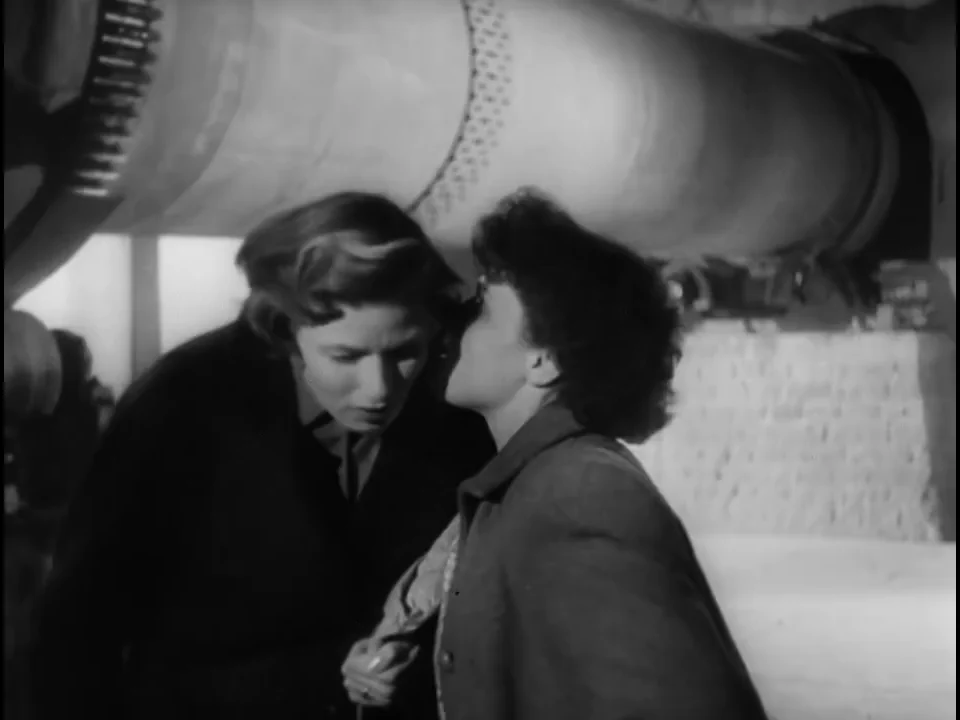
The factory passage does not leave Irene wholly unable to act: she can still approach, converse, and leave. Yet the machines' scale, the narrow passage, and the mechanical sound are no longer exhausted by the site's use as a ‘workplace’; the atlas reads this remainder as her shift from managing a situation toward enduring and seeing it anew as a seer.
Film details
- Original title
- Europa ’51
- Director
- Roberto Rossellini / 罗伯托·罗西里尼
- Year
- 1952
- Region
- Italy
Film analysis: how shots organize concepts
Cylindrical machinery occupies the upper frame; Irene and the worker converse at close range in the narrow passage below it while mechanical sound and dialogue coexist.
A huge cylindrical machine occupies the upper frame.
Irene and the worker stand close together in the narrow passage beneath the machine.
Continuous mechanical sound coexists with the women's dialogue.
SITE ANALYSISThis still and approximate verification interval support only the audio-visual facts of machine scale, bodily distance, and the coexistence of mechanical sound and dialogue. Read with Deleuze's discussion of the factory's audio-visual ‘abstraction’ and the seer, Marrati's account of the failure of practical recognition, and Rushton's interpretation of ‘pure seeing,’ the atlas understands the passage as follows: local communication can still succeed, yet the factory is no longer exhausted by its use as a ‘workplace.’ This is not a causal fact that a single still can establish directly.
Deleuze, Cinema 2, Minnesota 1989 English translation, ch. 1, p. 2 and ch. 3, pp. 45–46; Marrati, Gilles Deleuze: Cinema and Philosophy, 2008 English translation, pp. 58–60; Rushton, Cinema After Deleuze, 2012, pp. 63–65.Bilibili at 01:00:00 Open original still ↗The 01:00:00 still has been checked; 00:59:45–01:00:35 is an approximate verification interval on the single-part Bilibili timeline.Single-part Bilibili repost; the still at 01:00:00 has been checked, and the image and timestamp come from the same public upload. 00:59:45–01:00:35 is only an approximate verification interval, not a claim about the exact beginning and end of the complete factory passage.
Bilibili · Europa '51 complete film · verified 2026-08-14Close-reading questions
- 01Why is what the protagonist sees in the factory strong enough to break her existing ethics of action?
- 02How does seeing reorganize the relation between character and world?
Shots, relations, and concepts
- 1Record
An enormous cylindrical machine spans the upper frame; pipes, supports, and its body divide the background into dense industrial layers. Continuous mechanical noise and the women's dialogue occur together; their bodies remain close while they speak.
Open the scene currently used to ground this chain: Local adjustments still work, yet use no longer exhausts what is seen - 2Judge the relation
Within this viewing interval, turning and leaning complete an immediate adjustment for communication. Read with the film's wider narrative of Irene taking a shift, seeking help, and caring for others, local responses still work while neither those responses nor the established use ‘workplace’ exhausts what is seen. The latter claim is the atlas's cross-reading of facts from this interval and whole-film context. Persistent noise, repetitive machine forms, and the adjustment for communication coexist; after the adjustment succeeds, those audio-visual relations still solicit attention. This viewing interval is insufficient by itself to establish the production of direct time. It first records perception as unexhausted by the immediate response and supplies one testable condition for a pure optical-sound situation.
- 3Name the concept last
The seer、Sensory-motor schema. Only concepts whose scene relation resolves to “supports” under the current record are named here; candidates, adjacent terms, and countertests are not merged into the conclusion.
- 4Countertest
The criterion is not the mere presence of machines, a pause to look, or shock at the factory. Two evidentiary scales must be separated. Within the window, visual scale and mechanical noise persist after the communicative adjustment succeeds; across the film, local acts such as taking a shift, seeking help, and caring do not exhaust what Irene sees. Only when Marrati's account of practical recognition and Deleuze's audio-visual circuits explain this gap does the judgement of the seer hold.
Shots and scenes
The criterion is not the mere presence of machines, a pause to look, or shock at the factory. Two evidentiary scales must be separated. Within the window, visual scale and mechanical noise persist after the communicative adjustment succeeds; across the film, local acts such as taking a shift, seeking help, and caring do not exhaust what Irene sees. Only when Marrati's account of practical recognition and Deleuze's audio-visual circuits explain this gap does the judgement of the seer hold.
Open viewing position ↗Primary texts, scholarship, and locators
Theory coordinate: Cinema 2, Minnesota 1989, Preface p. xi; ch. 1, pp. 2, 21; ch. 3, pp. 45–46, 54; ch. 7, p. 171
- 01Cinema 2: The Time-Image
Authoritative source for the standard translation, translators, ISBN, and publication date.
Open the atlas source record →
Scholarship cited by the scene records: Each study is listed once, with its locators and supported scenes retained together.
- 01Gilles Deleuze: Cinema and Philosophy
Locator(s): Paola Marrati, Gilles Deleuze: Cinema and Philosophy, English translation (2008), pp. 58–60
Cited by scene(s): Local adjustments still work, yet use no longer exhausts what is seen
Marrati uses Irene's factory experience to distinguish practical recognition from seeing. The character does not first acquire knowledge about the factory and then act on it; rather, the failure of habitual recognition lets things appear with a force not exhausted by action. This interpretation supports the scene's conceptual boundary without replacing verification of the specific carrier.
Open the atlas source record → - 02Cinema After Deleuze
Locator(s): Richard Rushton, Cinema After Deleuze (2012), pp. 63–65
Cited by scene(s): Local adjustments still work, yet use no longer exhausts what is seen
Rushton interprets the factory vision as ‘pure seeing’ released from established habits of looking and places Irene's break with middle-class conventions within the narrative process that ends in social exclusion and psychiatric confinement. He does not claim that the institution directly diagnoses this one factory vision, nor does he provide the time coordinate of the atlas still.
Open the atlas source record →
This film in books and research
《吉尔·德勒兹身体创造学研究》 · Atlas extension
Europe ’51
Film relation: Site extension: beginning from the machines' occupation of the frame, close-range conversation in the narrow passage, and the coexistence of mechanical sound and dialogue, test whether the factory still exceeds its practical account as a ‘workplace’ even while local acts remain possible. Reading that gap as the genesis of a seer requires Deleuze, Marrati, and Rushton; it does not follow directly from a single still.
Shot question: First ask what Irene actually does, then which audio-visual relations those acts fail to exhaust. When does the gap between them become sufficient to support a shift from agent to seer?
Cinema After Deleuze · Book case
Europa ’51
pp. 64–65
Film relation: Irene's factory vision leaves habitual perception, and institutions close it again through diagnosis.
Shot question: How do machine, workers, and sound alter Irene, and why can society name the change only as abnormal?
Cinema After Deleuze · Further discussion
Ecological crisis and nonhuman world-belief
Question: When climate crisis, extinction, and infrastructural failure break the human-world link, who bears belief?
Extension: Connect belief in the world to geological time, multispecies relations, and irreversible material consequences.
Tension: An open future does not deny irreversible losses already incurred.
Film test: Identify nonhuman actors, temporal scale, bearers of damage, relations that can continue, and irrecoverable loss.
Gilles Deleuze : cinéma et philosophie · Scholarly reading
Europe ’51
PUF 2003, pp. 76–78
Film relation: Marrati uses Europe ’51 to argue that Irene no longer ‘recognizes’ the factory through everyday practical use; because she recognizes less, she sees more and learns to become a seer.
Shot question: The verified still and its approximate interval establish only machine scale, bodily proximity, and the coexistence of mechanical sound and dialogue. Which actions elsewhere in the film, and which textual coordinates, connect those facts to Marrati's account of failed practical recognition without making one frame bear a causal proof?
Conclusion: A single still is insufficient to establish that practical recognition has broken down. Read the approximate interval within the film-wide context of Irene taking a shift, seeking help, and caring, then cross-check it against Marrati's 2008 English translation, pp. 58–60, and Cinema 2, chapters 1 and 3. The present evidence then supports only a bounded judgment: local acts still work, yet use no longer exhausts the factory, and Irene moves toward the seer. This conclusion does not present 00:59:45–01:00:35 as the exact boundary of the complete factory passage.
Sensory-Motor Rupture: How a Character Becomes a Seer
The situation produces the seer
Claim: The seer is intensely receptive: the character sees more because inherited recognition and response no longer govern the visible.
Conclusion: Test whether seeing changes the character's perceptual regime: do inherited recognition, task, and response cease to distribute meaning?
Cinema 2: The Time-Image · ch. 1, pp. 2, 20–21; ch. 3, pp. 45–46Deleuze on Cinema · pp. 107–113Gilles Deleuze: Cinema and Philosophy · pp. 57–61
Sensory-Motor Rupture: How a Character Becomes a Seer
Audio-visual features open another circuit
Film comparison: Industrial space is no longer exhausted by the use ‘workplace’; a few audio-visual features open a mental vision.
Cinema 2: The Time-Image · ch. 1, pp. 2, 20–21; ch. 3, pp. 45–46
Time-image research chapters
When time stops hiding behind movement
Bearing Time Chinese DOCX, paragraphs 44–133.
Claim: The threshold of the time-image is not slowness but the failure of perception to lead automatically to action that can close the situation.
What to watch for: Record image, sound, body, space, and editing: where does action fail, and which duration cannot be reclaimed as narrative information?
Viewing gateways and editions
- Verified complete Bilibili carrier: 一九五一年的欧洲(1952)bilibili.comOpen film page ↗
- Page access
- Accessible when checked
- Version extent
- Recorded as a complete version
- Source type
- User-uploaded page
Edition note: Complete single-part film · 1:58:22.
Link checked: 2026-08-13