 01:00:00
Action rupture · SHOT EVIDENCE
Local adjustments still work, yet use no longer exhausts what is seen
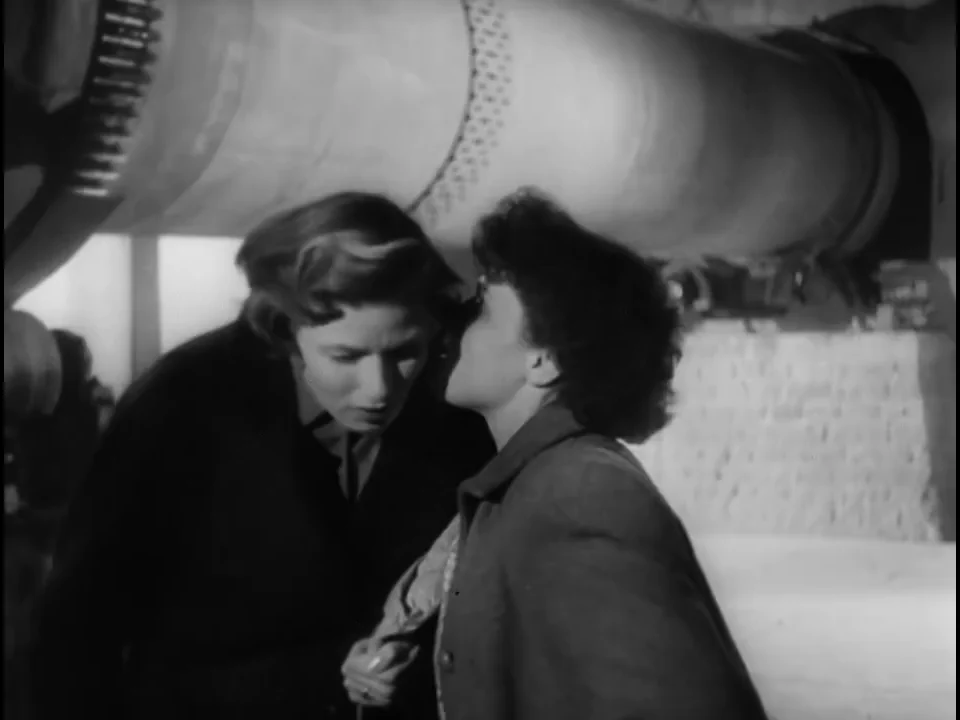
Irene can continue the conversation after leaning toward the worker. Why, once communication succeeds, do the scale and sound of the machinery remain unexhausted by that local response?
Film and viewing version
Europe ’51 · Europa ’51 · Roberto Rossellini / 罗伯托·罗西里尼 · 1952
The 01:00:00 still and its surrounding viewing interval were checked continuously on the single-part Bilibili repost BV15x4y1m7fS. This range provides reproducible coordinates for machinery, passage, bodily position, and sound; it does not claim the exact beginning and end of the complete factory passage. Every other release or cut requires fresh location.
Version boundary: The timecodes on this page apply only to the named viewing carrier. Restorations, differing leaders, or platform transcodes may shift them.
Passage and still timecodes
approx. 00:59:45–01:00:35 (still anchor 01:00:00)
The window locates the passage; its boundaries remain approximate
The passage window and still anchor are separate coordinates: the Bilibili still at 01:00:00 was checked on 2026-08-14; it does not turn an approximate passage on another carrier into exact bounds.
Visible facts
- 01
An enormous cylindrical machine spans the upper frame; pipes, supports, and its body divide the background into dense industrial layers.
- 02
Irene and the worker stand in a narrow passage beneath the machine; Irene turns sideways and leans toward the other woman, who faces her.
Audible facts
- 01
Continuous mechanical noise and the women's dialogue occur together; their bodies remain close while they speak.
Action relation
Within this viewing interval, turning and leaning complete an immediate adjustment for communication. Read with the film's wider narrative of Irene taking a shift, seeking help, and caring for others, local responses still work while neither those responses nor the established use ‘workplace’ exhausts what is seen. The latter claim is the atlas's cross-reading of facts from this interval and whole-film context.
Temporal relation
Persistent noise, repetitive machine forms, and the adjustment for communication coexist; after the adjustment succeeds, those audio-visual relations still solicit attention. This viewing interval is insufficient by itself to establish the production of direct time. It first records perception as unexhausted by the immediate response and supplies one testable condition for a pure optical-sound situation.
Conceptual reading
The criterion is not the mere presence of machines, a pause to look, or shock at the factory. Two evidentiary scales must be separated. Within the window, visual scale and mechanical noise persist after the communicative adjustment succeeds; across the film, local acts such as taking a shift, seeking help, and caring do not exhaust what Irene sees. Only when Marrati's account of practical recognition and Deleuze's audio-visual circuits explain this gap does the judgement of the seer hold.
Concepts used in the judgement
- Sensory-motor schemaschème sensori-moteur · SCENE SUPPORT
Local responses remain effective while perception is not exhausted by them, a more exact claim than saying simply that the character cannot act.
→ - Pure optical / sound situationopsigne / sonsigne · CANDIDATE
The visual scale of the machinery and its unrelenting roar acquire force in distinct registers; the atlas records each strand before reading them together as an emerging pure optical-sound situation.
→ - The seervoyant · SCENE SUPPORT
When practical recognition no longer exhausts the factory, Irene begins to undergo relations among machine, worker, and passage that action has not yet explained.
→
Primary and scholarly coordinates
- 01Cinema 2: The Time-Image
Minnesota 1989 translation: ch. 1, p. 2; ch. 3, pp. 45–46
Chapter 1 places Europa '51 in the postwar lineage of pure optical-sound situations and the seer. Chapter 3 analyses the factory as an audio-visual ‘abstraction’: a few features send the same object through different circuits and open Irene's mental vision of prisoners rather than reviving a recollection. The account of seeing more when practical recognition fails comes from Marrati. The primary text supplies neither a coordinate for this Bilibili carrier nor a shot-by-shot description of this still; the atlas separately verifies the scene window and audio-visual facts.
- 02Gilles Deleuze: Cinema and Philosophy
Paola Marrati, Gilles Deleuze: Cinema and Philosophy, English translation (2008), pp. 58–60
Marrati uses Irene's factory experience to distinguish practical recognition from seeing. The character does not first acquire knowledge about the factory and then act on it; rather, the failure of habitual recognition lets things appear with a force not exhausted by action. This interpretation supports the scene's conceptual boundary without replacing verification of the specific carrier.
- 03Cinema After Deleuze
Richard Rushton, Cinema After Deleuze (2012), pp. 63–65
Rushton interprets the factory vision as ‘pure seeing’ released from established habits of looking and places Irene's break with middle-class conventions within the narrative process that ends in social exclusion and psychiatric confinement. He does not claim that the institution directly diagnoses this one factory vision, nor does he provide the time coordinate of the atlas still.
Terminological coordinates
- sensory-motor schemaschème sensori-moteur
Uses the gap between a successful local bodily adjustment and still-unexhausted perception to test whether perception continues naturally into adequate action.
→ - pure optical and sound situationsituation optique et sonore pure
The machine, both an oversized visible object and a sound continuously covering space, begins to escape the status of a merely instrumental cue.
→ - opsign / optical signopsigne
The scale relations among cylinder, pipes, and narrow passage continue to organise what is seen after the communicative adjustment succeeds.
→ - sonsign / sound signsonsigne
Mechanical noise and dialogue persist together; bodily distance and sound can be recorded separately before judging whether they are related.
→ - seervoyant
Seeing ceases to be mere preparation for the next act and becomes a transformation of relations the character must undergo.
→
Chapter relations
- Cinema 2, Chapter 1
How Rossellini's postwar characters become seers and how pure optical-sound situations emerge where sensory-motor extension breaks.
→ - Cinema 2, Chapter 3
Deleuze treats the factory as an audio-visual abstraction: a few features send the same object through different circuits and open a mental vision that is not a recollection.
→
Viewing and still sources
Direct scene · Watch continuously from 00:59:45 to 01:00:35. Record separately the machine's scale in the frame, whether mechanical noise and dialogue coexist, and how the women alter bodily distance. After confirming that the communicative adjustment succeeds, compare the window with the film-wide context of taking a shift, seeking help, and caring to test whether use still fails to exhaust what is seen. The coordinate binds only BV15x4y1m7fS. Public availability and the uploader's authorization to redistribute the film are separate questions.