Argument
Deleuze joins Bergson's matter-image, formal analysis, and Peircean semiotics into a genetic taxonomy. Frame, shot, and montage organize changes in an open whole, while perception-, affection-, impulse-, action-, and reflection-images together with the single mental/relation problem field specify different functions of movement. Mental-image makes relations, symbolic acts, and intellectual feelings objects of thought; relation-image then gives the field its semiotic determination through Thirdness. Time appears mainly indirectly through movement and montage, and the final crisis of action already opens the passage to Cinema 2.
Core question
How does cinema present movement directly? How does the interval introduced by a living centre differentiate one universe of images into perception, affection, and action?
Argument structure
Chapters 1–3 develop movement, mobile sections, and the open whole. The middle chapters distinguish perception, affection, impulse, action, and reflection. The closing mental/relation problem field concerns relations, symbolic acts, intellectual feelings, Thirdness, marks, and demarks. Chapter 12 examines the crisis of the action-image, connecting it to the pure optical and sound situations of Cinema 2.
Chapters
01 · Theses on movement: First commentary on Bergson
pp. 3–19 · 2016 Chinese edition02 · Frame and shot, framing and cutting
pp. 20–46 · 2016 Chinese edition03 · Montage
pp. 47–89 · 2016 Chinese edition04 · The movement-image and its three varieties: Second commentary on Bergson
pp. 90–114 · 2016 Chinese edition05 · The perception-image
pp. 115–139 · 2016 Chinese edition06 · The affection-image: Face and close-up
pp. 140–163 · 2016 Chinese edition07 · The affection-image: Qualities, powers, any-space-whatevers
pp. 164–196 · 2016 Chinese edition08 · From affect to action: The impulse-image
pp. 197–224 · 2016 Chinese edition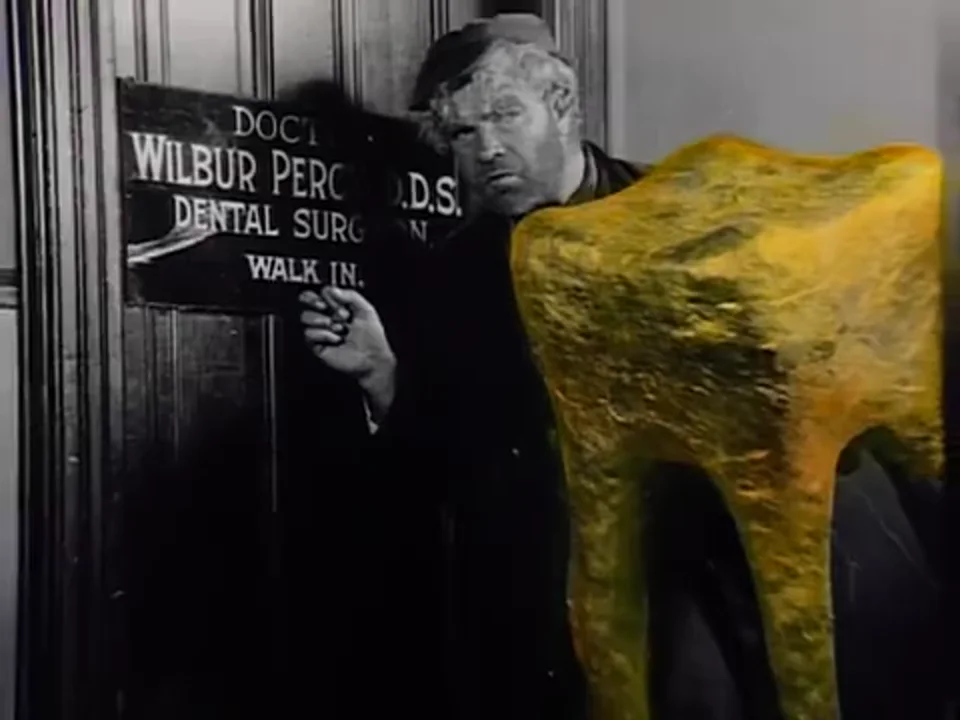 Watch this sequence · 02:51:55 ↗
Greed · The gold tooth is first something saleable, not a fetish on sight
These are first ordinary economic actions: if the tooth remains an exchangeable commodity, meat an actual use, and change a real budget, the fetish classification should be withdrawn. A fetish candidate arises only when the object is detached from exchange and use to become a partial object repeatedly seized by impulse.
Image: The large gold tooth changes from the dental parlour's professional sign into an object McTeague can move and sell; the subsequent meat purchase turns on budget, payment, and change. Trina demands saving, asks about change, and makes McTeague bear the expense; these acts first belong to economic behaviour under scarcity.
Sound: Narrative information in the silent film is supplied mainly by intertitles; the edition of the reconstruction score could not be independently established and is not used as impulse-image evidence.
 Watch this sequence · 03:02:30 ↗
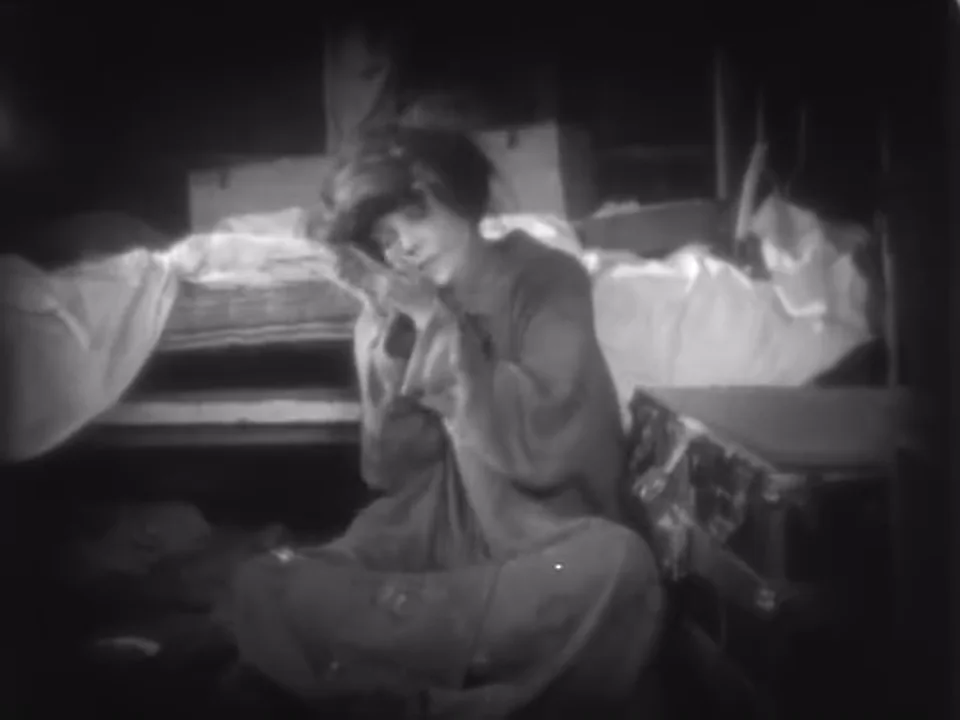
Greed · Counting, holding, addressing money: symptom and fetish separate here
Symptom is the appearance of impulse in counting, holding, and address; fetish is the appearance of seized money as partial object, and the two must not be conflated. If later evidence shows the savings still serving a concrete life plan, the fetish relation should be weakened or withdrawn while the gestural symptom candidate may remain.
Image: Trina counts, holds, and brings money near her face; the low-resolution carrier establishes the relation between money and gesture but not the denomination or material of each piece. Intertitles emphasize 'four hundred and fifty,' labouring and saving for the money, and 'no one shall ever get you'; Trina addresses the savings directly as second-person 'you'.
Sound: This is a silent passage; the reconstruction score supplies no dialogue evidence for distinguishing symptom from fetish, so the atlas limits itself to gesture, intertitles, and object-function.
 Watch this sequence · 03:54:15 ↗
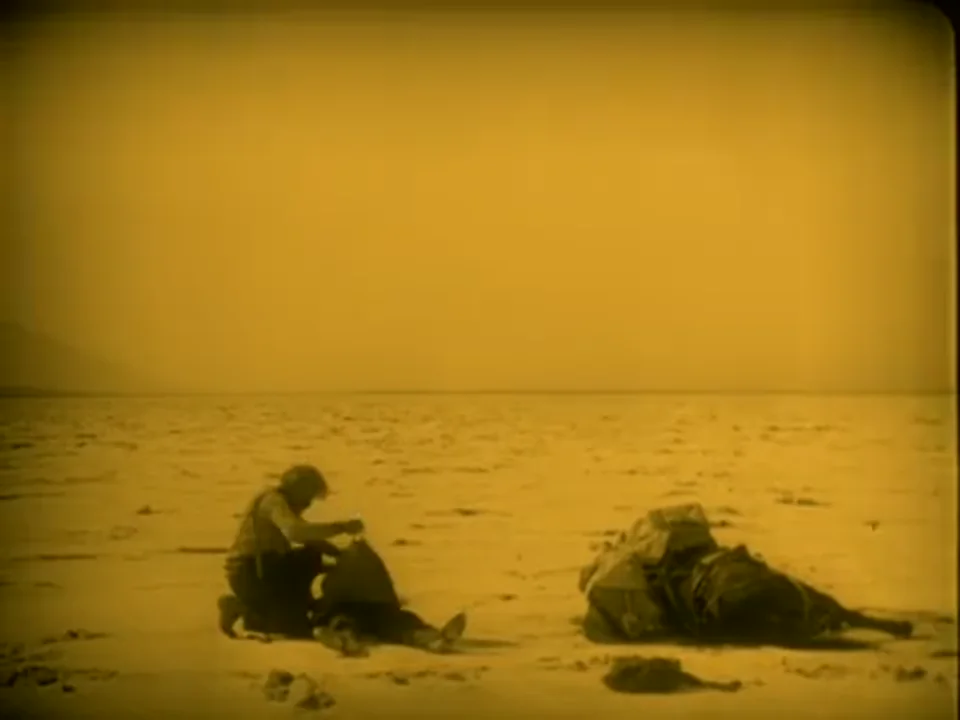
Greed · Death Valley exhausts use: is money the only fetish candidate?
The money bag and chromatically stressed money are fetish candidates as objects seized by impulse after losing survival use. Broken canteen, dead horse, handcuff, and bird first mark material exhaustion and relations of restraint; they must not all be called fetishes. If seizure as a partial object cannot be demonstrated, the fetish label for that object should be withdrawn.
Image: The passage contains struggle over a money bag, the dead horse, handcuffs around 03:52:48, the broken canteen around 03:53:21, money and blood stressed by tint around 03:53:51, and McTeague approaching the birdcage. Desert and salt flat offer no visible shelter; objects' prior uses fail one by one under thirst, death, and restraint, but failed objects do not thereby all become fetishes.
Sound: Causality in the silent film is organized by moving image and intertitles. The 'lust of gold' wording around 03:55:51–03:56:09 belongs to the reconstruction's end-card layer and cannot retroactively prove every earlier piece of money.
09 · The action-image: The large form
pp. 225–253 · 2016 Chinese edition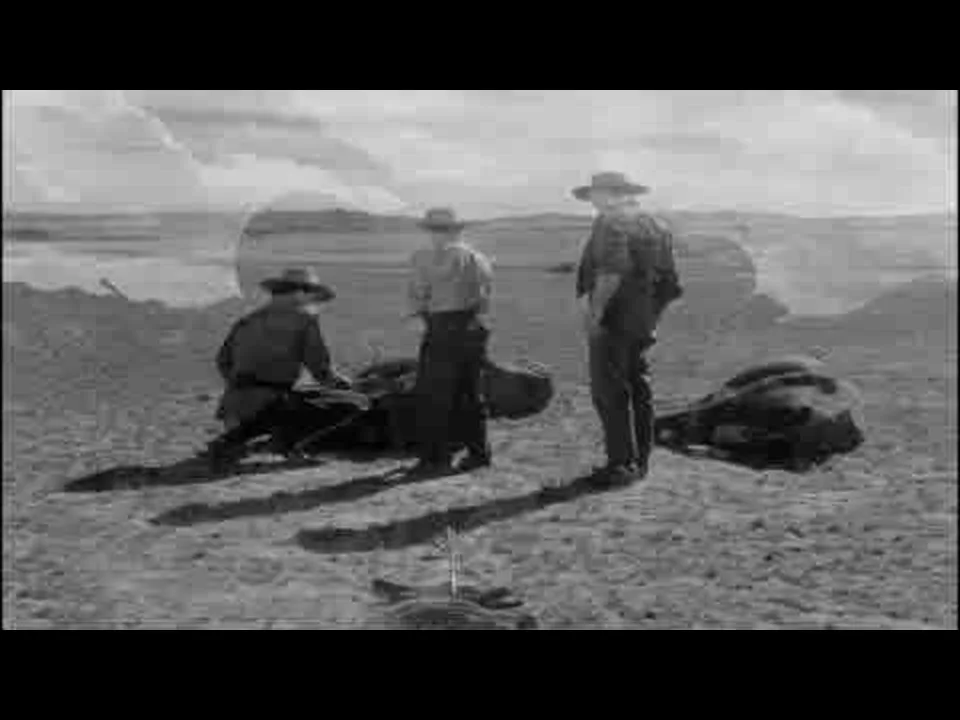 Watch this sequence · 00:15:38 ↗
Red River · Beside the grave, land begins to be written as property
This shot poses only the S hypothesis of the large form. S–A–S′ holds only if subsequent action emerges from this encompassing situation and transforms it into S′; expansive scenery alone proves nothing.
Image: Three men occupy an open landscape; one kneels beside a calf while two stand. Figures and animals remain low in the frame, leaving horizon and sky to set the dominant scale. Only scale and position visible in the still are treated here as checked facts; grave, claim, and branding must be followed across the passage.
Sound: The image anchor has been checked, while dialogue and sound still await itemized transcription; sound carries none of this entry's conceptual burden.
 Watch this sequence · 00:51:20 ↗
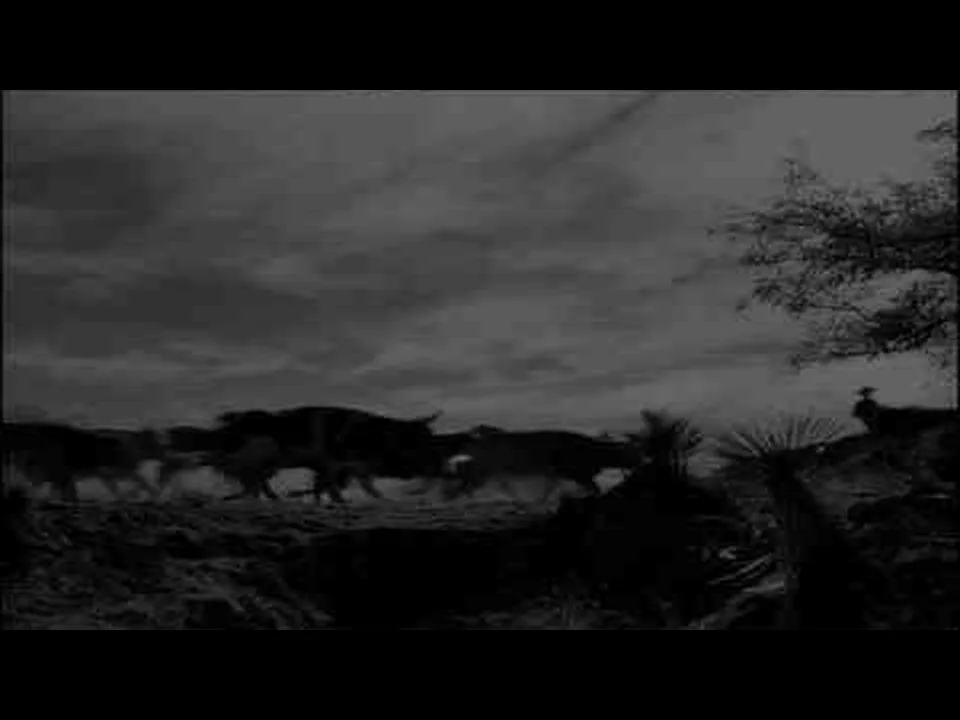
Red River · The herd amplifies one disturbance into an event beyond command
If shot-level review shows local acts progressively disclosing and reorganizing the situation, the passage approaches Hawksian functional relations. If an encompassing situation still stably generates and reabsorbs action, it supports the pure large form more strongly. Stampede alone does not prove a crisis of the action-image.
Image: The herd crosses the low-lit frame laterally; speed, occlusion, and density weaken individual outlines, while the rider at right occupies another vertical level. A single frame establishes density and direction of movement, not the cause of the stampede, the efficacy of commands, or the passage's full causality.
Sound: Disturbance, hoofbeats, cries, and music have not yet been transcribed by track; claims about sonic propagation remain questions for review.
 Watch this sequence · 01:21:08 ↗
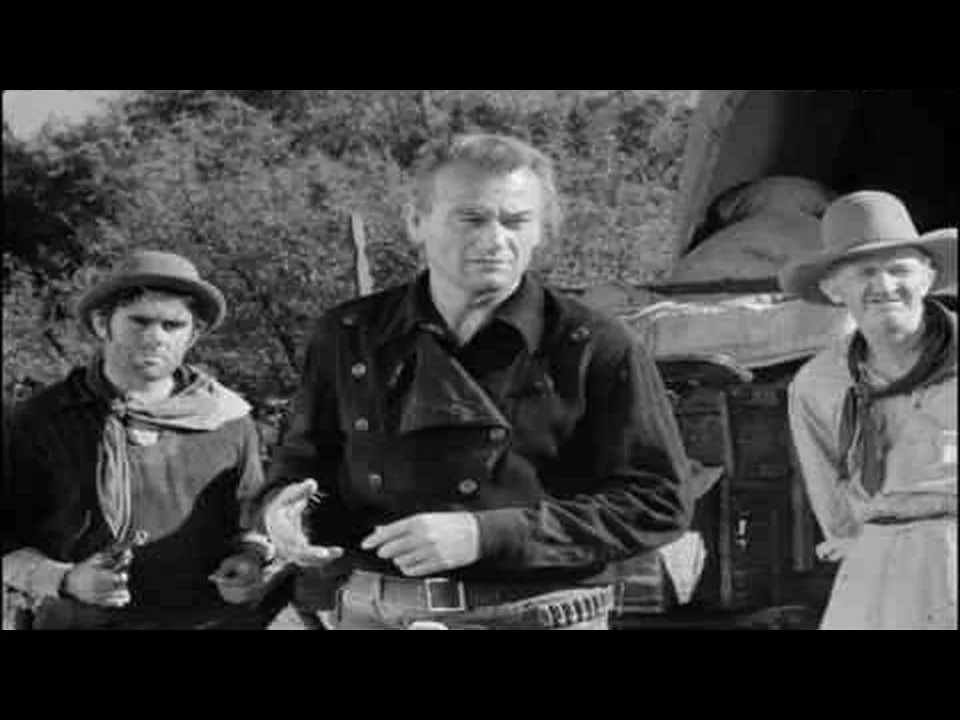
Red River · The route continues while the position of command changes hands
If the act of taking command progressively discloses and alters a situation not fully given in advance, it supports an A–S–A′ candidate. If it merely emerges from a fully presented global conflict and completes S′, the large-form reading remains viable.
Image: Matthew faces an off-screen addressee at centre, flanked by two cowboys with a covered wagon behind; their positions place an individual declaration inside the relations of the outfit. The still does not show the complete chain before and after the transfer; mutiny, changed destination, and Dunson's departure require continuous viewing.
Sound: Matthew's declaration, the group's responses, and ambient sound still await line-by-line transcription; this entry treats positions and ensuing changes in action as a chain for review.
 Watch this sequence · 00:35:10 ↗
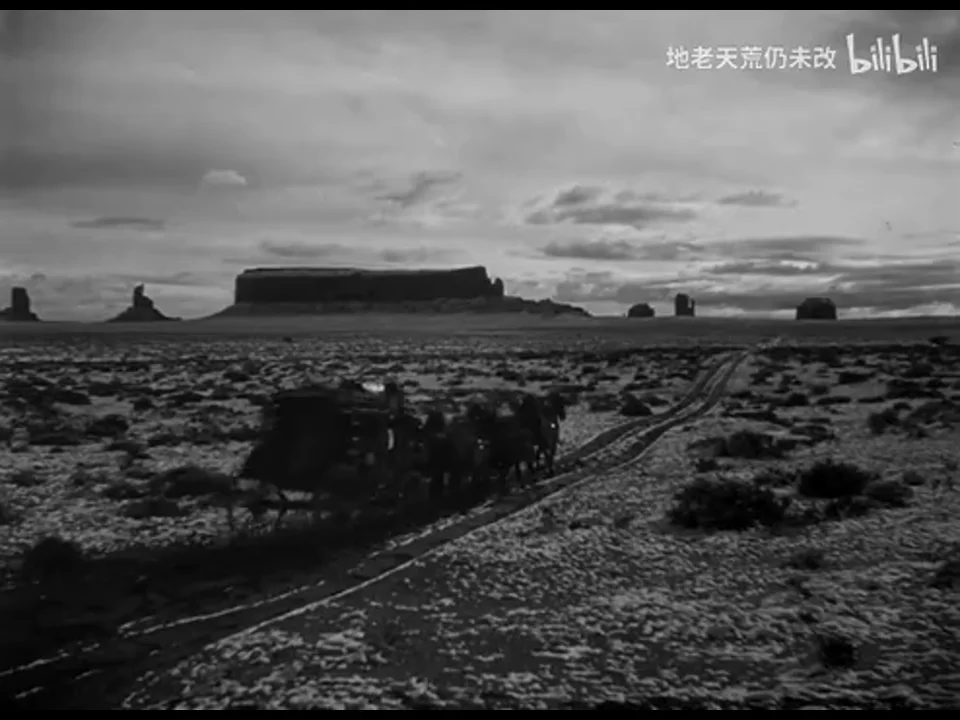
Stagecoach · The coach enters the landscape: condition or compositional effect?
S–A–S′ holds only if this encompassing situation generates action and is transformed by that action into a new situation. If the landscape is merely a spectacular backdrop to movement, the classification should be withdrawn.
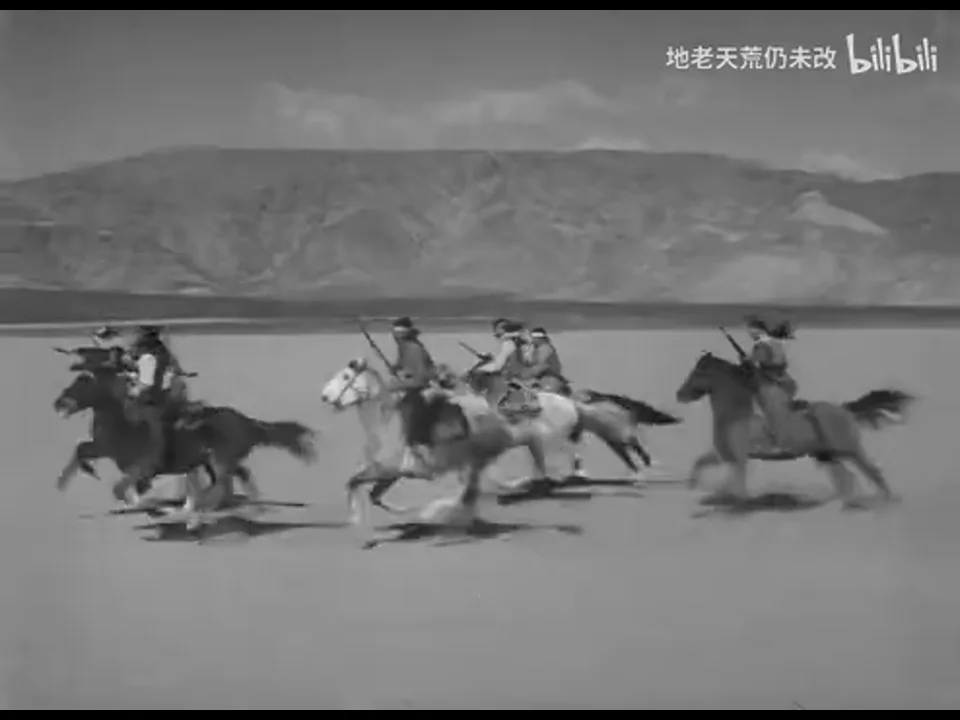
Image: The coach moves along the valley route into depth; coach and horses are markedly smaller than mesas, pale open ground, and sky, and faces are not legible at this anchor. The passage alternates between the coach interior and the exterior route; each exact cut still requires master-specific frame review.
Sound: The carrier contains dialogue, wheel or hoof sounds, and music, but no track-by-track transcription has been completed; sound carries none of this entry's large-form verdict.
 Watch this sequence · 01:14:00 ↗
Stagecoach · The chase is not one heroic act but a set of simultaneous responses
If these local tasks remain organized by a clearly given global danger and lead to restoration of the situation, the passage supports the large form. If shot review shows delays between perception and response depriving the whole of its organizing force, the relation should be weakened.
Image: The coach remains in rapid motion; driving, balancing, shooting, and approaching the target are carried by different figures and positions. Editing cuts among coach body, horses, pursuers, and passengers' local acts; one anchor does not contain the complete causal chain of attack and defence.
Sound: Gunfire, hoofbeats, wheels, cries, and music coexist, but their sequence and sources have not been itemized; the atlas does not substitute sonic intensity for analysis of mechanism.
 Watch this sequence · 01:34:30 ↗
Stagecoach · Leaving town after Ringo's release: new situation or self-preservation of the old order?
If S′ means that the whole redistributes members' positions after action, this is a large-form candidate. Yet the passage confirms only that Ringo is released and leaves town with Dallas, not a corresponding change in the town's distribution. Until such a visible difference is found, a triumphal S′ reading should be withheld.
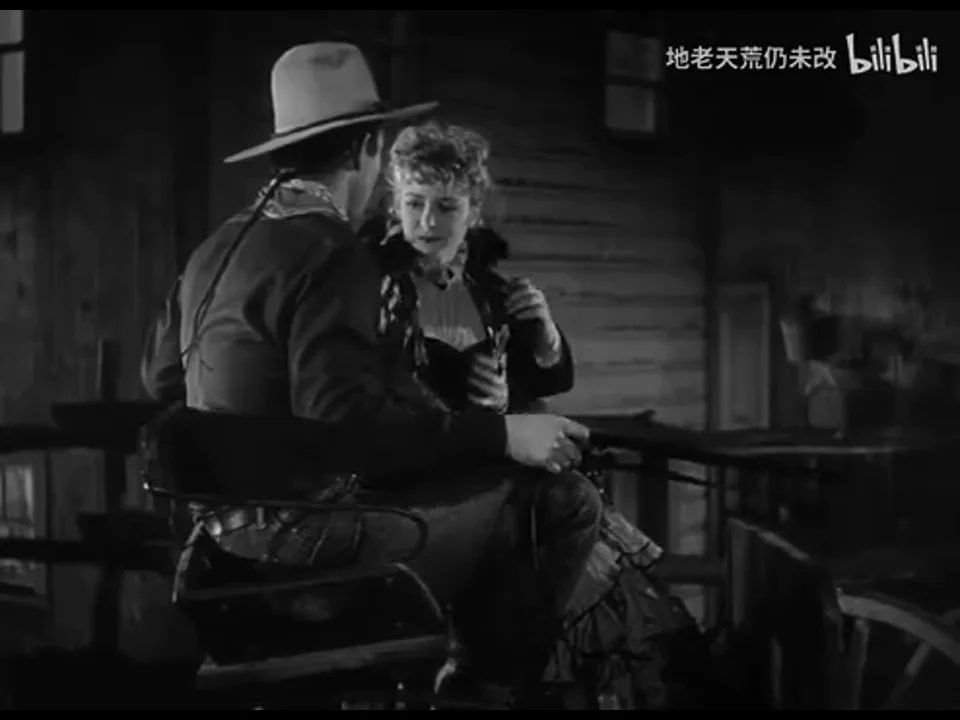
Image: Ringo and Dallas sit in the cart while Curley and the doctor remain in the street; the cart then leaves town and the relation shifts from proximity to a receding route. The anchor shows the pair seated together after Ringo's release; by itself it does not establish their social status or future life.
Sound: Dialogue and laughter participate in the decision to let Ringo go, but subtitle and soundtrack have not been checked line by line; only Ringo's release and the pair's departure are treated as located facts here.
10 · The action-image: The small form
pp. 254–280 · 2016 Chinese editionWatch this sequence · 00:15:38 ↗Red River · Beside the grave, land begins to be written as property
This shot poses only the S hypothesis of the large form. S–A–S′ holds only if subsequent action emerges from this encompassing situation and transforms it into S′; expansive scenery alone proves nothing.
Image: Three men occupy an open landscape; one kneels beside a calf while two stand. Figures and animals remain low in the frame, leaving horizon and sky to set the dominant scale. Only scale and position visible in the still are treated here as checked facts; grave, claim, and branding must be followed across the passage.
Sound: The image anchor has been checked, while dialogue and sound still await itemized transcription; sound carries none of this entry's conceptual burden.
Watch this sequence · 00:51:20 ↗Red River · The herd amplifies one disturbance into an event beyond command
If shot-level review shows local acts progressively disclosing and reorganizing the situation, the passage approaches Hawksian functional relations. If an encompassing situation still stably generates and reabsorbs action, it supports the pure large form more strongly. Stampede alone does not prove a crisis of the action-image.
Image: The herd crosses the low-lit frame laterally; speed, occlusion, and density weaken individual outlines, while the rider at right occupies another vertical level. A single frame establishes density and direction of movement, not the cause of the stampede, the efficacy of commands, or the passage's full causality.
Sound: Disturbance, hoofbeats, cries, and music have not yet been transcribed by track; claims about sonic propagation remain questions for review.
Watch this sequence · 01:21:08 ↗Red River · The route continues while the position of command changes hands
If the act of taking command progressively discloses and alters a situation not fully given in advance, it supports an A–S–A′ candidate. If it merely emerges from a fully presented global conflict and completes S′, the large-form reading remains viable.
Image: Matthew faces an off-screen addressee at centre, flanked by two cowboys with a covered wagon behind; their positions place an individual declaration inside the relations of the outfit. The still does not show the complete chain before and after the transfer; mutiny, changed destination, and Dunson's departure require continuous viewing.
Sound: Matthew's declaration, the group's responses, and ambient sound still await line-by-line transcription; this entry treats positions and ensuing changes in action as a chain for review.
 Watch this sequence · 00:09:25 ↗
City Lights · Why does she take the flower buyer for a wealthy motorist?
Car-door sound still requires sound-by-sound review. If review shows door sound and the Tramp's acts being joined as one subject in her perception, the passage supports the equivocal index and A–S–A′. If attribution or order does not support that chain, the specific sonic mechanism should be withdrawn, leaving only the visible identity mistake.
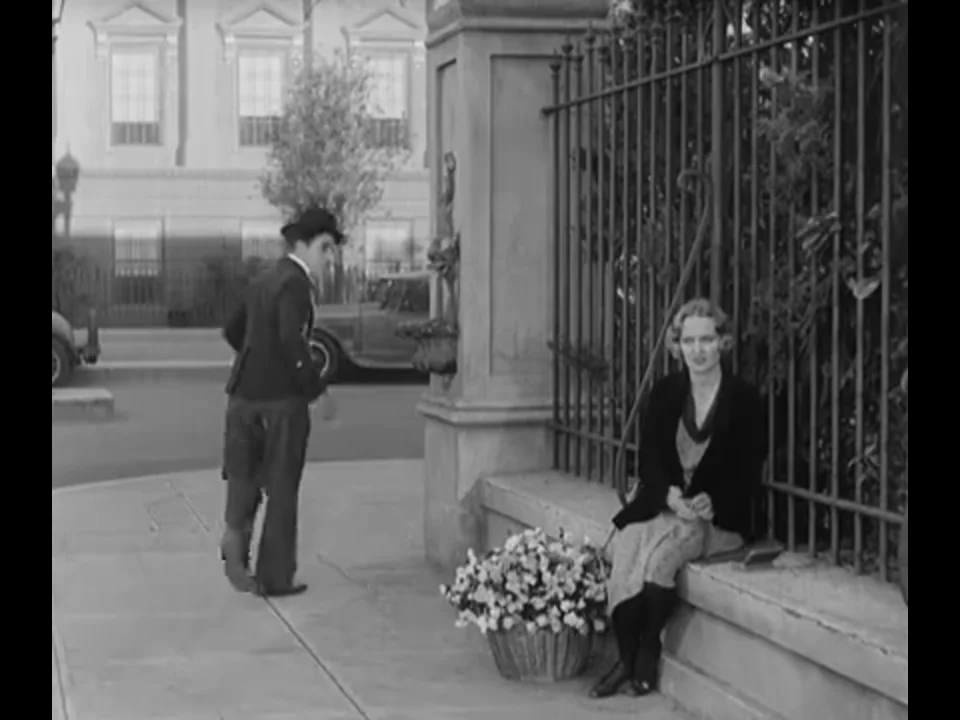
Image: The flower seller sits by the street selling flowers; after a flower falls, she searches with hand and cane, and the Tramp retrieves it and notices that she is blind. The Tramp then walks away and looks back; a car departs from near them while the flower seller retains the inference that her customer is wealthy.
Sound: The precise way car-door sounds participate in the mistake still requires sound-by-sound review on this master, including attribution of the first and second closures; no unverified sound source is treated as settled causality.
 Watch this sequence · 00:35:30 ↗
City Lights · When the millionaire wakes sober, why is last night's friend left outside?
Only the pairing of drunken recognition with sober rejection can test the atlas's concrete reading of the 'personality split of a pivotal character' on p. 169. If the two passages do not establish a stable reversal of rules and show only an accidental lapse, the small-form relation should be weakened.
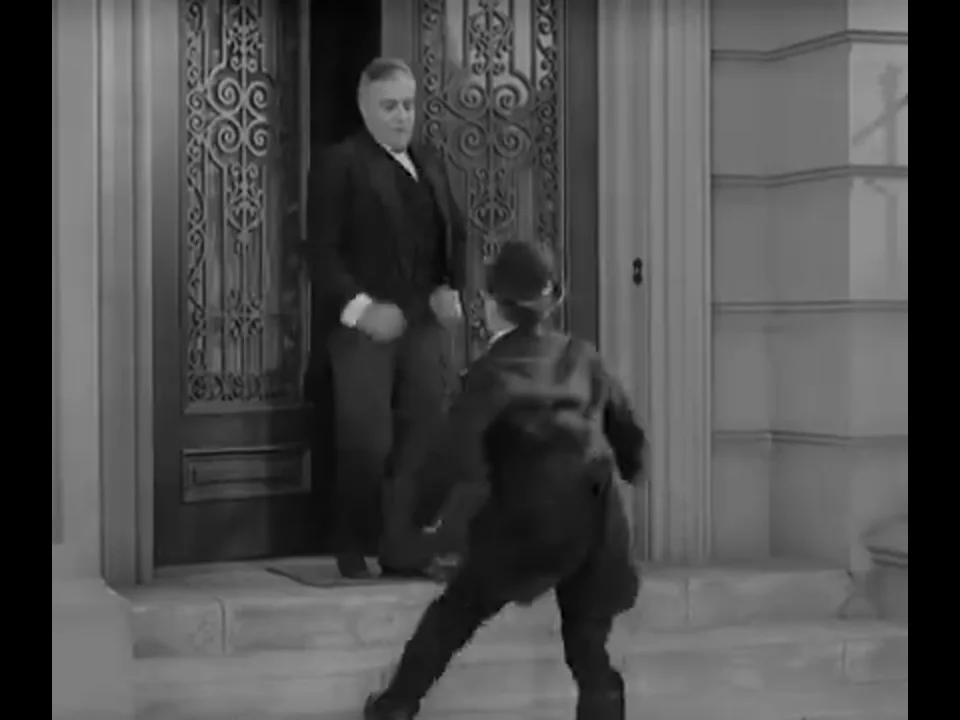
Image: The passage begins from morning and the millionaire's sobriety; when the Tramp reaches the mansion, he does not receive the previous night's treatment as friend, and the butler keeps him beyond the entrance. This passage must be read against the drunken encounter around 00:11:30–00:15:50; isolated, the doorway rejection shows only S→A and cannot compose a complete A–S–A′ by itself.
Sound: An intertitle marks the change of state with sober dawn awakening a different man; the atlas does not medicalize this difference into a clinical personality diagnosis.
 Watch this sequence · 01:25:25 ↗
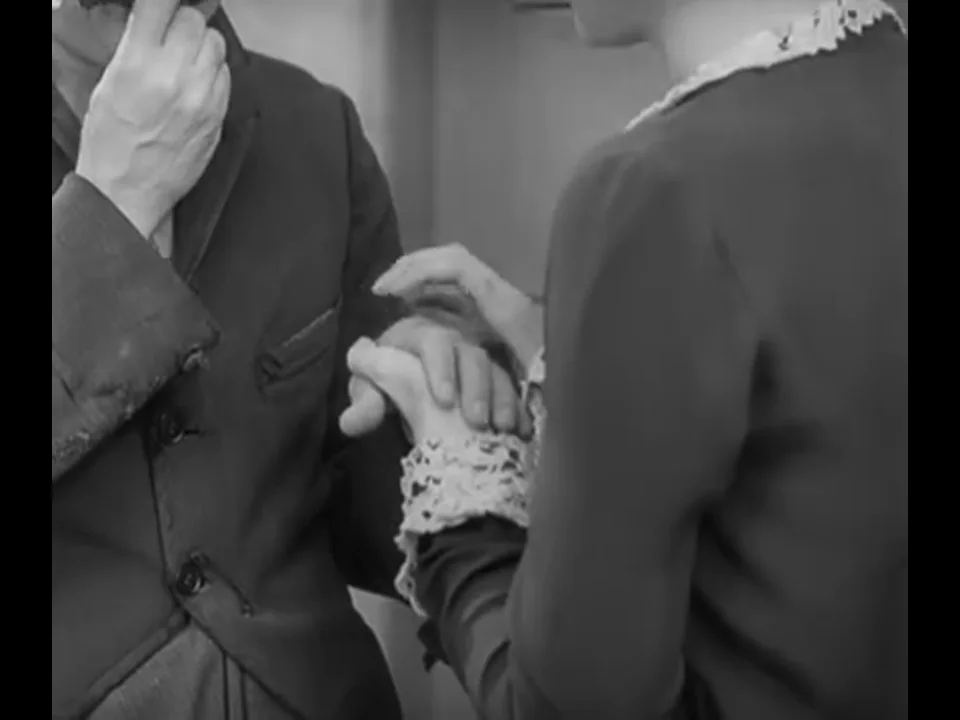
City Lights · She recognizes him by touch; why does the film stop on a smile?
The passage can test the small form's limit where it contracts into affect before A′; it is not sufficient evidence for a time-image. If analysis cannot show how touch changes recognition and leaves only a 'moving ending,' the conceptual relation should be withdrawn.
Image: After the flower seller holds the Tramp's hand, her expression changes; the intertitle 'You?' appears, followed by cuts between their faces. The Tramp asks whether she can see now; the passage ends within the close relation of faces and hands without showing their subsequent life together.
Sound: The score edition on this silent-film carrier could not be independently established; tactile recognition and visible intertitles suffice to locate the passage, and music carries no classificatory burden.
 Watch this sequence · 01:53:12 ↗
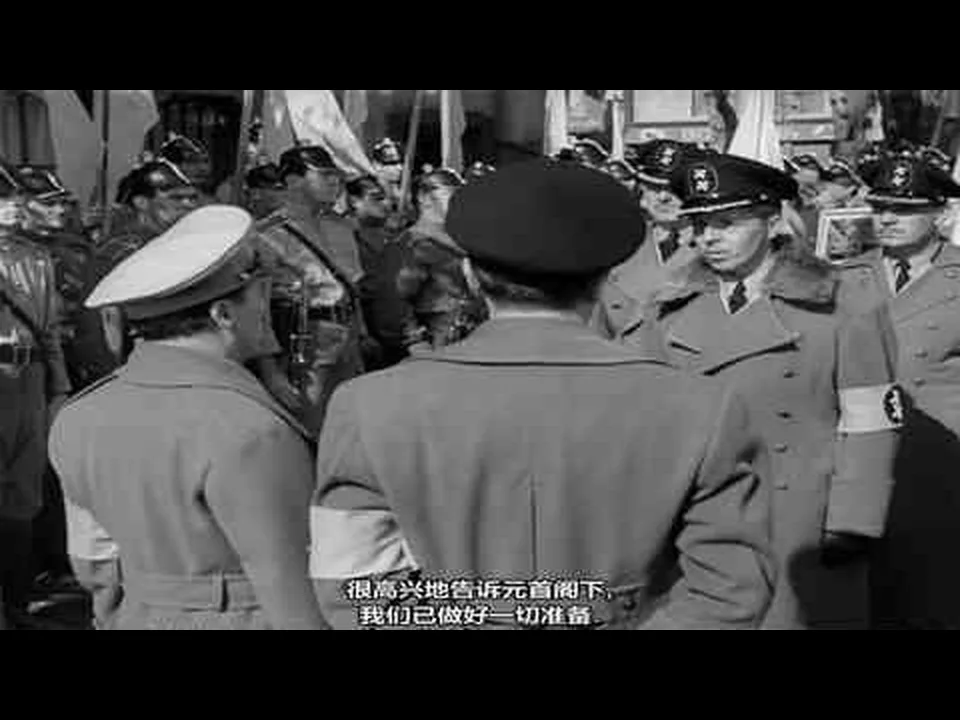
The Great Dictator · One face exchanges social positions: the fugitive is arrested and the barber welcomed
Chapter 10, pp. 171–172 directly discusses how one face joins two incommensurable situations, while chapter 11, pp. 183–187 supplies the general criterion of inversion. The primary text does not explicitly name the pursuit–welcome passage as inversion. If the exchange serves only plot misrecognition without transforming the functional relation of action and situation, withdraw the candidate.
Image: A drenched Hynkel, stripped of the visible apparatus of power, is arrested by soldiers as the fugitive or barber, while the film advances the escaping barber in uniform. The barber reaches the military assembly, is ceremonially welcomed as Hynkel, and enters the parade convoy. The 01:53:12 anchor shows only the welcoming chain. The complete reversal requires cross-checking it with the other chain in which Hynkel is arrested.
Sound: Commands, recognitions, ceremonial address, military music, and crowd sound distinguish the two social positions. The Chinese-subtitled carrier was checked passage by passage without a line-by-line soundtrack transcript.
 Watch this sequence · 01:59:21 ↗
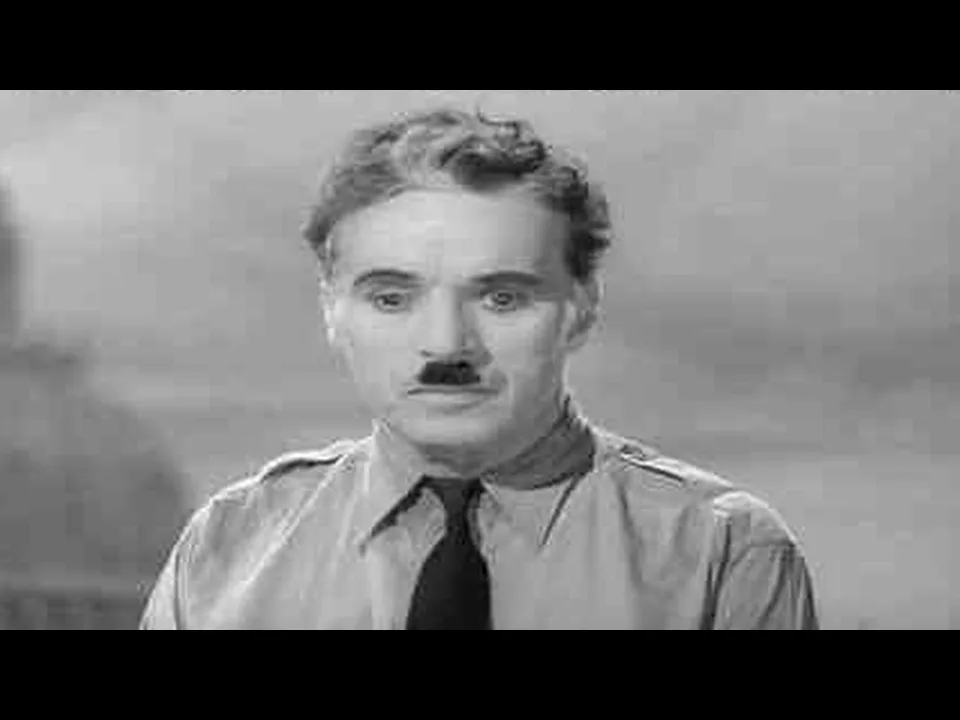
The Great Dictator · The final address: discourse becomes a problem rather than declaring action victorious
Cinema 1, chapter 10, pp. 172–173 directly opposes the final intelligible language to the tyrant's gibberish and terror and names a figure of discourse; Cinema 2, chapter 2, p. 33 retrospectively makes the discursive figure the reflection-image's genetic sign. This supports the figure of discourse without proving that the address completes democratic institutional transformation; any claim of accomplished political victory must be withdrawn.
Image: The barber stands before several microphones under Hynkel's identity; the camera moves from podium and military setting to a sustained frontal close-up. The close-up progressively reduces the ceremonial background so that face, gaze, and duration of address become the main image-event; after the speech the film cuts to Hannah. The 01:59:21 anchor comes from Bilibili's native preview. The atlas cropped a non-film banner at the top without removing face, uniform, or filmic background information.
Sound: The barber shifts to sustained intelligible English address, audibly contrasting with Hynkel's earlier pseudo-German, noise, and threatening delivery. The atlas does not reproduce the speech at length.
11 · Figures, or the transformation of forms
pp. 281–307 · 2016 Chinese edition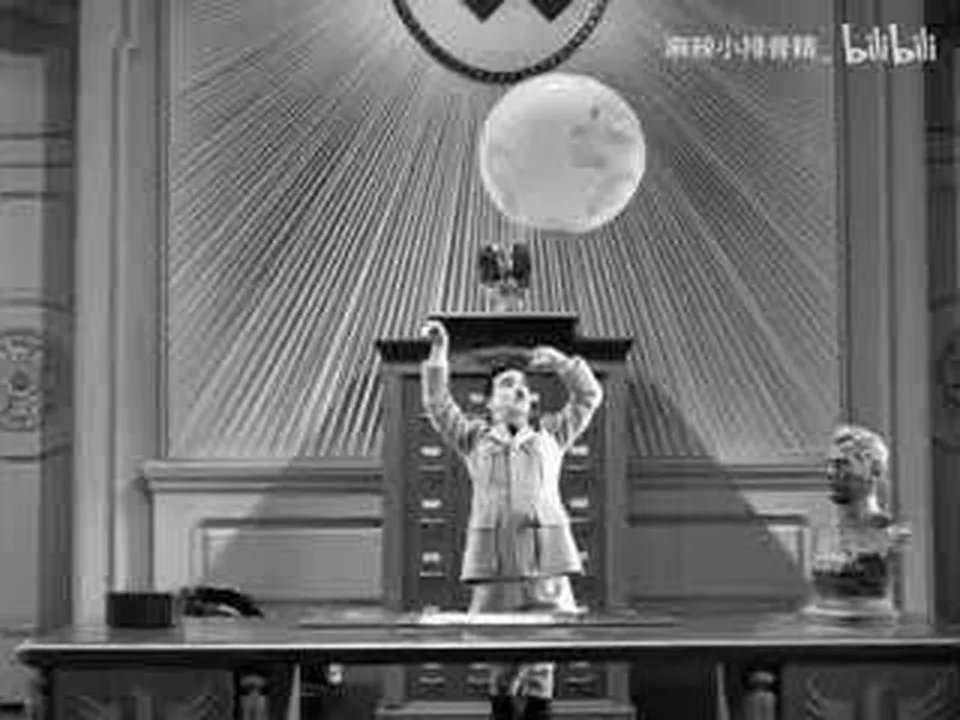 Watch this sequence · 00:55:40 ↗
The Great Dictator · The inflatable globe intervenes: how weightless dance refers indirectly to world rule
The attraction reading holds only if the third term lets a small act point toward an ellipsed political situation and changes the direct action–situation relation. If the globe remains a generic symbol of ambition or a visual gag, withdraw the reflection-image classification.
Image: Alone in his office, Hynkel takes down the inflatable globe and redirects its rises and falls with hands, head, hips, and feet. He presses the globe near face and chest before tossing it again; the sphere eventually bursts and the dance stops. The 00:55:40 anchor shows only the lifting pose. The political relation of world rule requires the office insignia, the complete dance, and the globe's rupture to be read together.
Sound: Continuous orchestral music organizes the movement, while no intelligible speech explains the globe during the dance proper. This audit did not identify the recording edition or transcribe the track beat by beat.
Watch this sequence · 01:53:12 ↗The Great Dictator · One face exchanges social positions: the fugitive is arrested and the barber welcomed
Chapter 10, pp. 171–172 directly discusses how one face joins two incommensurable situations, while chapter 11, pp. 183–187 supplies the general criterion of inversion. The primary text does not explicitly name the pursuit–welcome passage as inversion. If the exchange serves only plot misrecognition without transforming the functional relation of action and situation, withdraw the candidate.
Image: A drenched Hynkel, stripped of the visible apparatus of power, is arrested by soldiers as the fugitive or barber, while the film advances the escaping barber in uniform. The barber reaches the military assembly, is ceremonially welcomed as Hynkel, and enters the parade convoy. The 01:53:12 anchor shows only the welcoming chain. The complete reversal requires cross-checking it with the other chain in which Hynkel is arrested.
Sound: Commands, recognitions, ceremonial address, military music, and crowd sound distinguish the two social positions. The Chinese-subtitled carrier was checked passage by passage without a line-by-line soundtrack transcript.
12 · The crisis of the action-image
pp. 308–336 · 2016 Chinese edition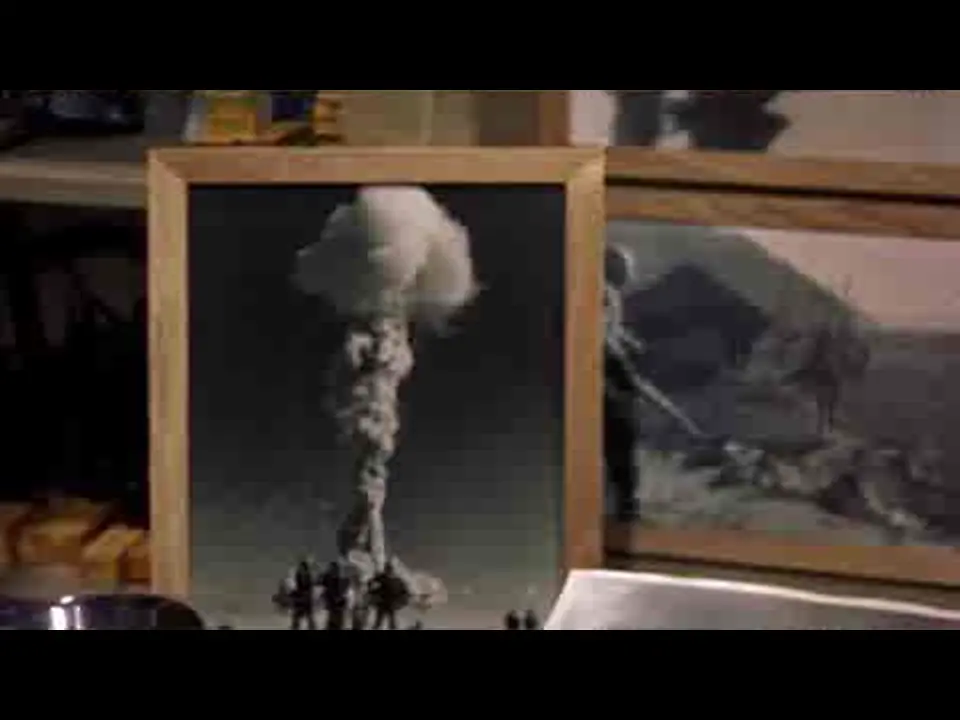 Watch this sequence · 00:02:15 ↗
Rear Window · Camera, racing photographs, and cast: how a viewing position is explained
If these objects merely provide rapid exposition and cease to govern how Jeff observes, infers, and delegates action, the relation-image claim should be downgraded. The passage becomes relational only because that fixed position continues to govern the film.
Image: The camera moves from the courtyard and sleeping Jeff to his leg cast, then across racing-crash photographs, a damaged camera, and magazine covers. The 00:02:15 anchor juxtaposes two racing-crash photographs; it does not by itself show the injury occurring.
Sound: The visual inventory has no explanatory voice-over; the following telephone exchange more explicitly supplies Jeff's profession and condition.
 Watch this sequence · 01:40:25 ↗
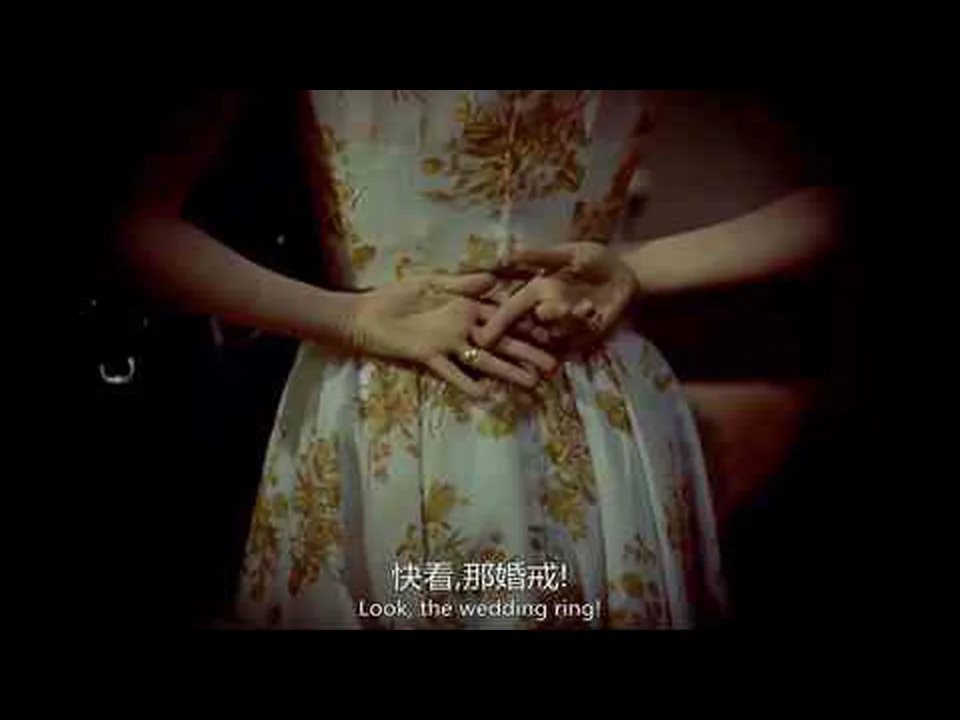
Rear Window · Lisa raises the wedding ring: how one object redirects several relations
If the ring merely transmits evidence in a detective plot, it remains a clue consumed by action. The symbol claim holds only when the concrete object bears and reorganizes abstract relations among marriage, crime, knowledge, and positions of looking.
Image: Lisa raises the ring at the opposite window and displays it toward Jeff; the film cuts back to Jeff and Stella watching and responding. Thorwald then notices Lisa's gesture and turns his look across the courtyard, threatening the previously one-way arrangement of vision.
Sound: Jeff and Stella's dialogue identifies the ring as an object Mrs. Thorwald would not willingly leave behind. Hard subtitles provide Chinese and English text but are not treated as an independent master check.
 Watch this sequence · 01:47:05 ↗
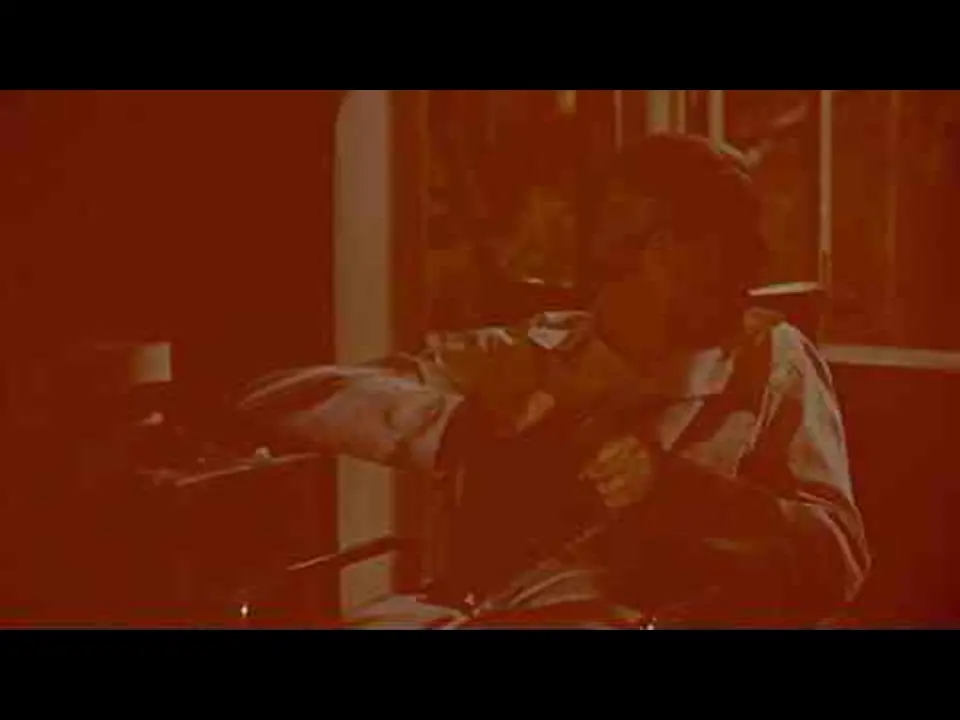
Rear Window · After the flashbulb: does relation return to action or make the observer an object?
Calling the red afterimage a relation-image in isolation would mistake an optical effect for Thirdness. A mental or relational reading remains only a candidate when the flash is returned to the reversal in which the observer has been identified and becomes an observed, attacked object. If analysis reduces to flash defence and causal struggle, the passage belongs to sensory-motor action.
Image: Thorwald enters the dark room and advances on Jeff; Jeff loads flashbulbs and fires them, after which the image shows a red or orange circular afterimage. Repeated flashes only delay the approach; Thorwald ultimately seizes Jeff and forces him toward the window.
Sound: Around 01:46:00, Thorwald asks Jeff what he wants from him; loading and firing of bulbs, footsteps, and struggle follow.
 Watch this sequence · 00:00:50 ↗
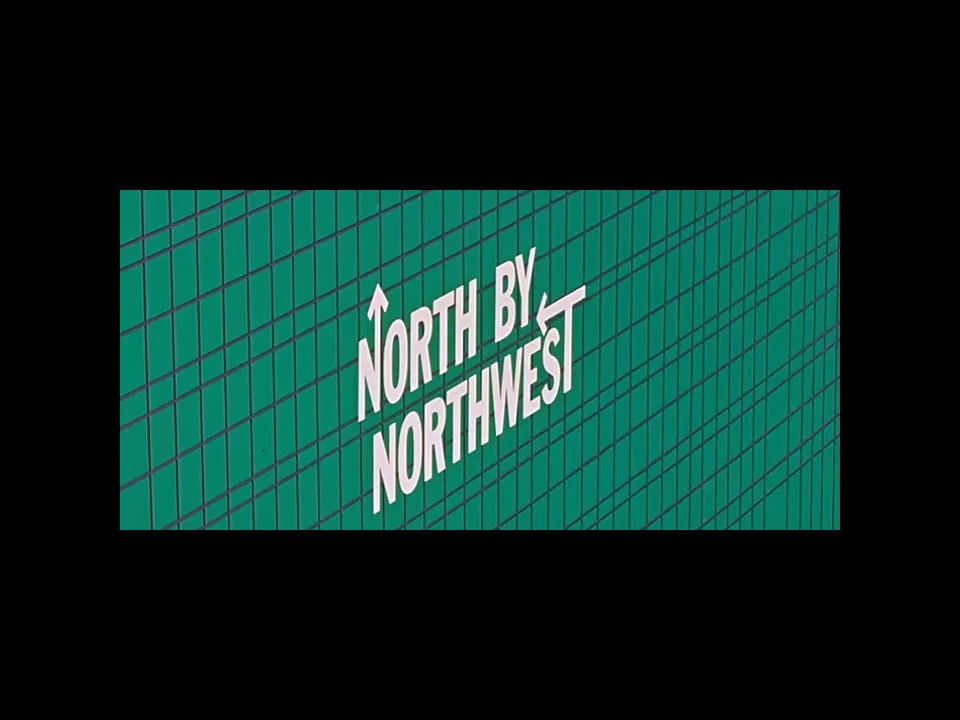
North by Northwest · The title grid enters the city: does relation appear before character?
Visual resemblance between grid and façade is not sufficient to prove a relation-image. The title passage remains a candidate prelude to relational form only if the later film repeatedly subjects the character's position to names, institutions, others' actions, and relations known by the spectator. If that link can be supplied only by thematic association, withdraw it.
Image: The credits first move diagonal lines, intersections, lettering, and directional arrows along coordinates on a green field; the 00:00:50 anchor has not yet entered live-action city space. The graphic grid then joins the mullions of a glass curtain wall, which reflects vehicles, before the image moves into streets, building entrances, and crossing crowds. Thornhill and his secretary enter the urban circulation near the end of the working passage, but the Kaplan misidentification has not yet occurred within it.
Sound: A continuous orchestral score governs the graphic titles and their transition into city images. Character dialogue enters only after the title passage; the atlas does not treat the score's structure by itself as evidence of a relation-image.
 Watch this sequence · 01:12:00 ↗
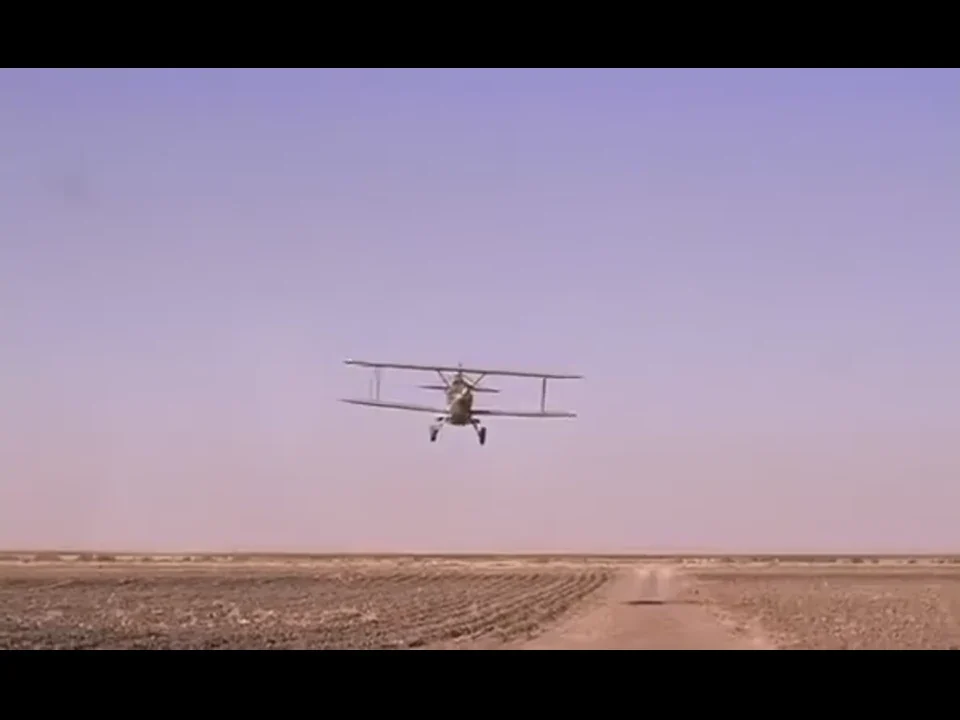
North by Northwest · Where there are no crops to spray: how the crop-duster becomes a demark
The strict criterion for the demark is the plane's appearance where there are no crops to spray, not its later emergence as an attacker. If carrier evidence cannot establish this place–use mismatch, or if attack, explosion, and a symbolic evil machine are required to make the anomaly legible, withdraw the claim of direct primary-text support and retain only the atlas's candidate analysis of the action passage. The ensuing attack remains a visible consequence and must not be passed off as the primary text's shot analysis.
Image: Thornhill waits alone beside an open highway. Cars and a bus follow the road, another passenger waits and boards in the ordinary way, and the distant plane remains a small term in the environment. After the bus takes the other passenger away, the plane changes its relation of distance and repeatedly dives toward Thornhill; he drops, runs, and takes cover in a field. The 01:12:00 anchor shows the plane bearing head-on toward barren ground and a dirt road; the pursuit then continues into a causal chain involving a truck, tanker, and explosion.
Sound: The other waiting passenger's dubbed dialogue first notes that the plane is dusting where there are no crops to spray. After the bus leaves, the engine grows louder with the approach.
 Watch this sequence · 02:15:59 ↗
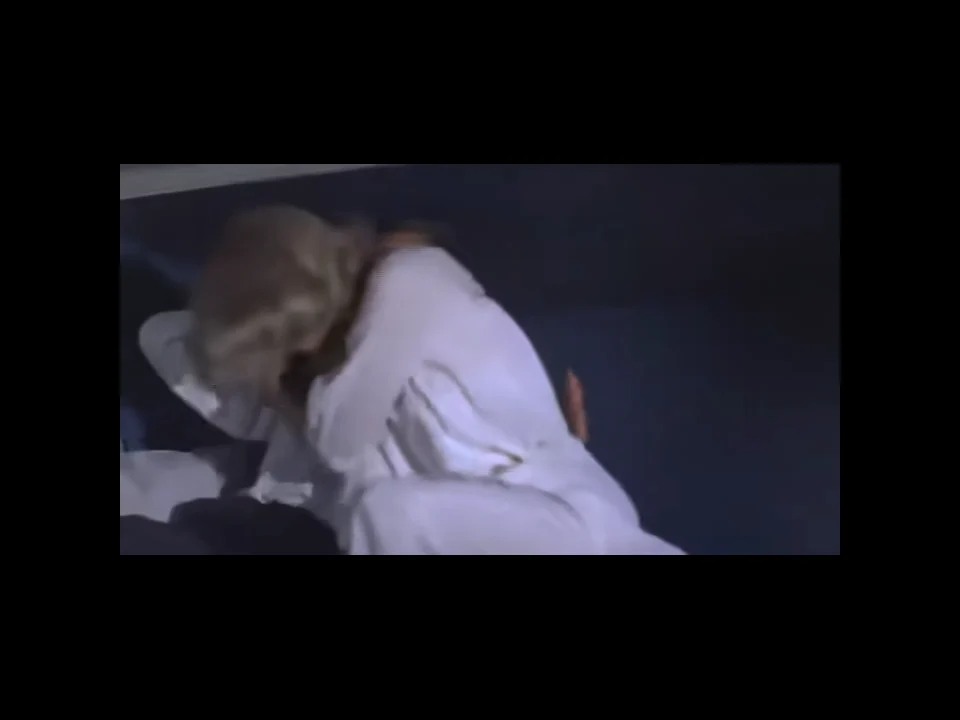
North by Northwest · From cliffside pull to train berth: how action and marriage reclose relation
If a relation-image requires relation itself to keep governing action as an unresolved problem, this passage supplies a countertest: cliffside action closes as successful rescue, while marriage is resolved through the final form of address and berth embrace. Relational support should return only if identity, spectatorial knowledge, or relational conflict retains autonomous force across the cut; if the cut primarily completes action and marriage, withdraw the supportive classification.
Image: On the Mount Rushmore cliff, Eve hangs at the rock edge while Thornhill holds her hand and pulls upward. Before the rescue is shown as a completed climb, the film matches the upward pull into a train berth: Thornhill draws Eve toward him and the couple embrace in the compartment. The 02:15:59 anchor shows the berth embrace, not the cliff; an exterior train view at the passage's end carries the journey forward.
Sound: After the match cut, the dubbed dialogue addresses Eve with a married form of address, presenting the relation as an accomplished marriage. This record does not invent the unshown wedding process from that line.
 Watch this sequence · 00:04:31 ↗
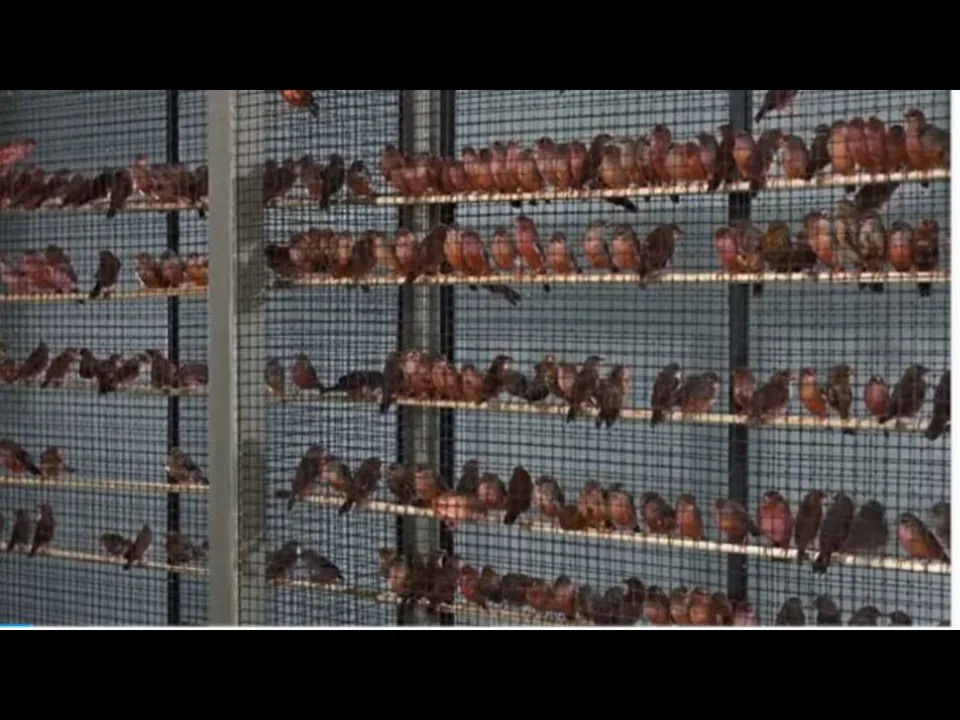
The Birds · Caged birds, the shop-assistant role, and lovebirds: how ordinary relations are established
The pet shop does not become a mark merely because it contains many birds. The atlas retains the candidate only if merchandise, gift, captivity, and environmental presence form a recognizable habitual series across later passages. If the analysis reduces to a romantic meeting or the birds do not recur within a series, the mark claim must be withdrawn.
Image: The passage cuts among Melanie, Mitch, cage racks, and individual cages as the two figures change position across the counter and caged birds. The 00:04:31 anchor shows neither Mitch nor Melanie: stacked cages fill the frame and small birds line the perches.
Sound: Bird calls continue through the conversation. Mitch repeatedly asks about species and care, and Melanie's answers gradually reveal her unfamiliarity with the shop. In the dialogue, lovebirds names both a species and the gift Mitch wants for his sister.
 Watch this sequence · 00:25:23 ↗
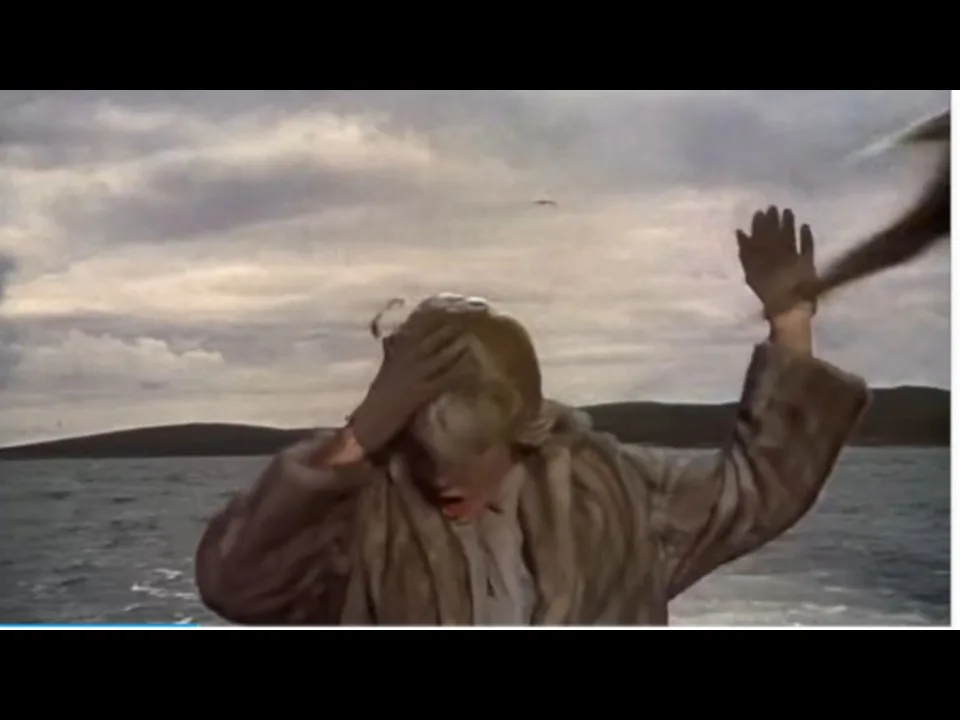
The Birds · The first strike over the bay: a demark is not another mark
Cinema 1, p. 204 makes the first gull attacking the heroine a demark. If a clip begins only after the wound or supplies no prior habitual series to be rerouted, the card cannot establish the claim by itself. Nor can the gull be called another mark: it departs from and reroutes an established habitual series.
Image: Melanie pilots the skiff alone toward the dock while Mitch watches her approach; the bay crossing still advances toward a clear goal. A single gull dives from above, strikes past her head, and leaves a wound; the film then cuts toward Mitch on shore and Melanie's injured reaction.
Sound: The skiff engine, water, and harbour ambience sustain the ordinary continuity of the crossing; a sharp bird cry cuts in with the impact. No explanatory dialogue supplies a cause for the attack; Mitch can respond only through calls and gestures after the anomaly has occurred.
 Watch this sequence · 01:11:22 ↗
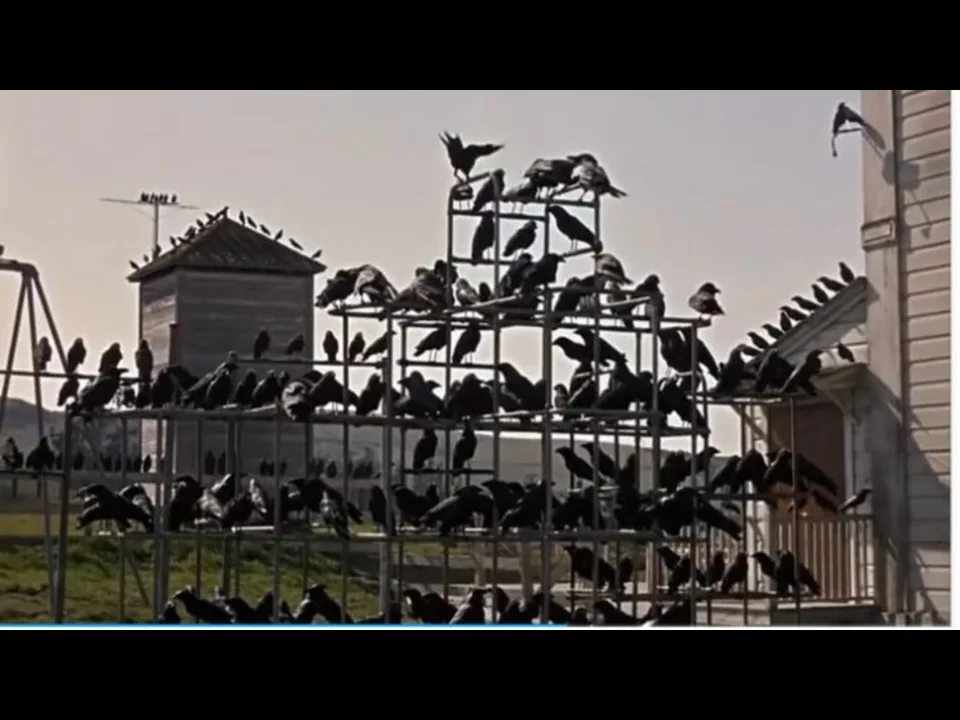
The Birds · The song continues as the flock takes form: when number begins to bear relations
Numerical increase and greater danger are insufficient to establish a symbol. The playground passage can serve as a shot-level candidate for p. 204's flock-as-a-whole only if the flock changes school/play, song/alarm, perching/encirclement, classroom order/urgent evacuation, and the human–nature relation together. If the account reduces to a numerical threshold, the symbol claim must be downgraded.
Image: Melanie smokes alone on a bench outside the school. The film repeatedly cuts from her to the climbing frame behind her; more crows have landed on each return while she does not turn around. A passing crow finally guides her look backward. The climbing frame, nearby roofs, and ground are now crowded with birds, after which she enters the classroom to organize the children's departure.
Sound: Children repeat the same song off screen; it continues across successive cuts between Melanie and the climbing frame. After the flock is discovered, the song gives way to scattered bird calls, shouts, and warnings to evacuate.
 Watch this sequence · 00:15:30 ↗
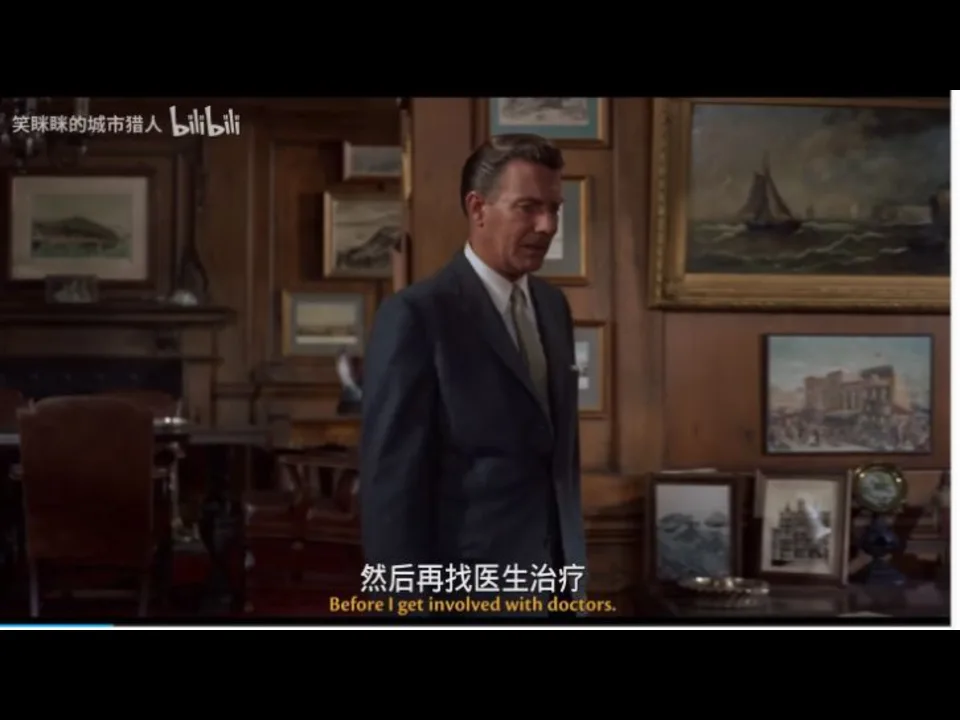
Vertigo · The absent Carlotta already governs the investigation
If the conversation is summarized merely as a detective receiving an assignment, it remains plot exposition. The relation-image claim holds only if the absent Carlotta continues as a third term governing how Madeleine, Elster, Scottie, and spectator interpret later images; if that third term ceases to operate, the classification must be downgraded.
Image: Elster brings Scottie into a wood-panelled office and the men alternate in medium views; images of ships, harbours, and buildings are visible on the walls and desk. Only Elster and Scottie appear in this interval; the image inserts no portrait or flashback of Madeleine or Carlotta.
Sound: Elster asks Scottie to follow his wife and explains her anomalous behaviour as the influence of the dead Carlotta. Scottie questions the possession story but ultimately accepts the task of observation. In dialogue, Elster identifies himself as husband, places Scottie as observer, designates Madeleine as the woman to be followed, and uses Carlotta's family history to explain her behaviour.
 Watch this sequence · 01:39:20 ↗
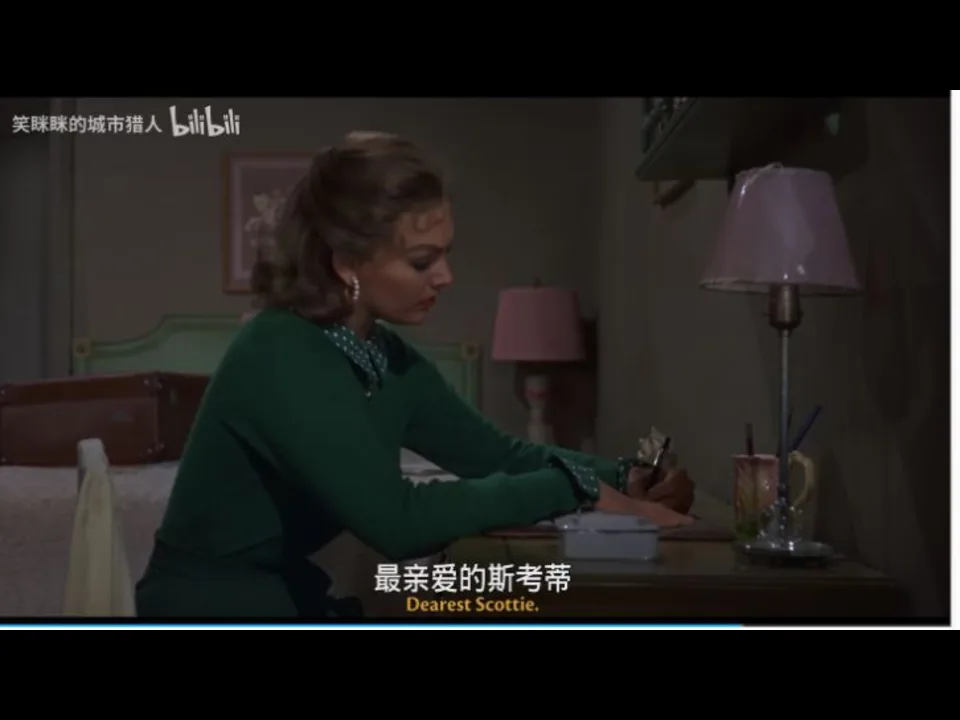
Vertigo · The unsent letter moves the spectator ahead of Scottie
The letter as prop is not itself the demark. Rushton's claim is that Judy disrupts the established Carlotta–Madeleine series and acquires a new function. Detached from the first half's doubling series and the spectator's knowledge gap, the writing becomes mere exposition and both demark and relation-image claims must be withdrawn.
Image: Alone in the hotel room, Judy begins packing, then sits to write. A recollection shows her dressed as Madeleine ascending the tower and another body falling. After finishing the letter, she tears it up; the letter is not given to Scottie.
Sound: Judy's voice-over reading gives the prior deception directly to the spectator, including Elster's arrangement and her position in playing Madeleine. Scottie is absent from the room and does not hear Judy's voice-over reading.
 Watch this sequence · 01:55:20 ↗
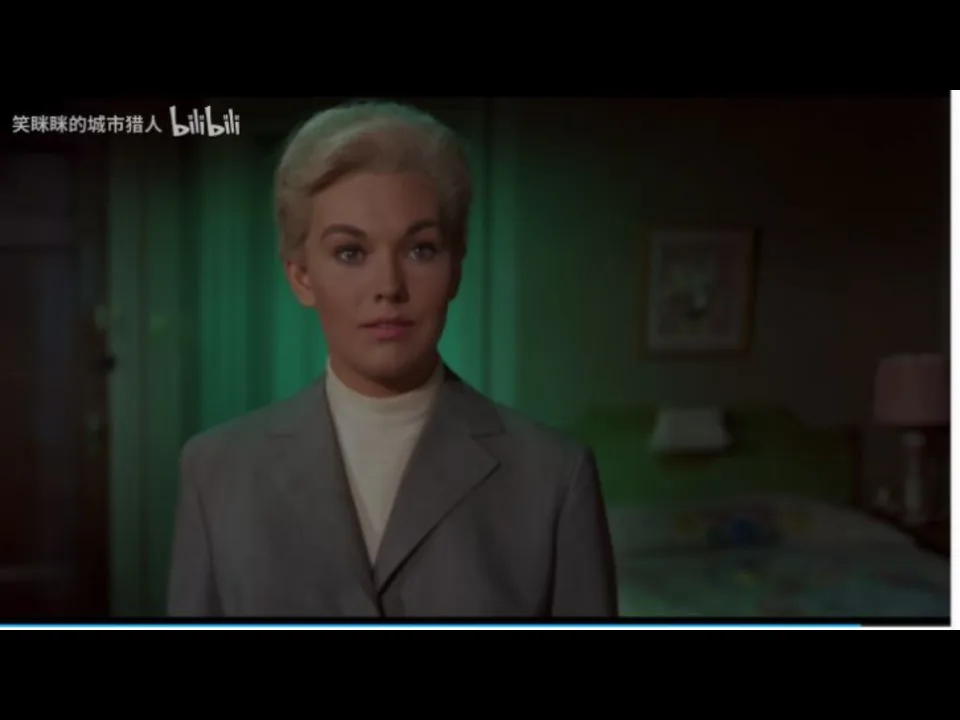
Vertigo · The return in green light: how desire manufactures its object
Rushton, pp. 56–57, supports Scottie's remaking of the desired object and shows that the spectator already knows Judy's identity, making the process of control visible. The atlas is responsible for treating green light and circular camera movement as relational mechanisms. If that knowledge gap is ignored, the scene reduces to remaking action and affective intensity; green colour, memory, or superimposition alone cannot establish an actual–virtual relation or crystal-image.
Image: Judy enters from the direction of the bathroom in a grey suit with her blonde hair pinned up; the curtains and wall are lit green. Scottie approaches and embraces her as the camera circles the couple. The hotel room briefly overlaps with the earlier stable space before returning to the green room.
Sound: Dialogue recedes; the score expands as Judy appears, Scottie approaches, and the couple embrace.
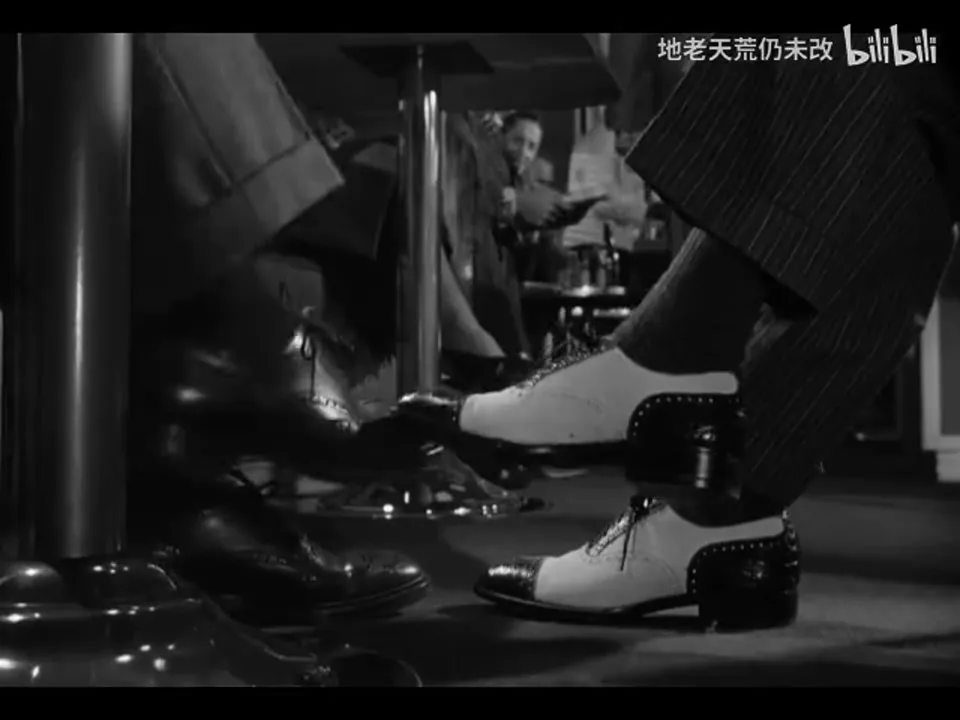 Watch this sequence · 00:02:05 ↗
Strangers on a Train · Foot contact starts the conversation: Bruno treats an offhand assent as agreement
Accidental meeting or foot contact is not sufficient for a relation-image. The initiating act enters a web governed by a third term—the relation of exchanged murder—only when Bruno organizes contact and Guy's words into that exchange; the relation then changes both men's actions, police judgement, and spectator foreknowledge.
Image: The opening separately follows two pairs of shoes into the station—two-tone brogues and plainer dark shoes—while withholding both faces. After crossing rails, the edit enters the compartment. Guy moves his foot into Bruno's, joining two previously parallel series.
Sound: Train and station sounds precede dialogue. After the contact, Guy apologizes first; Bruno takes the opening to recognize him as a tennis player and then introduces himself. The ensuing conversation moves from newspapers, marriage, and Bruno's father to each man killing for the other. Guy treats the proposal as absurd talk, while Bruno retains his response as an agreement.
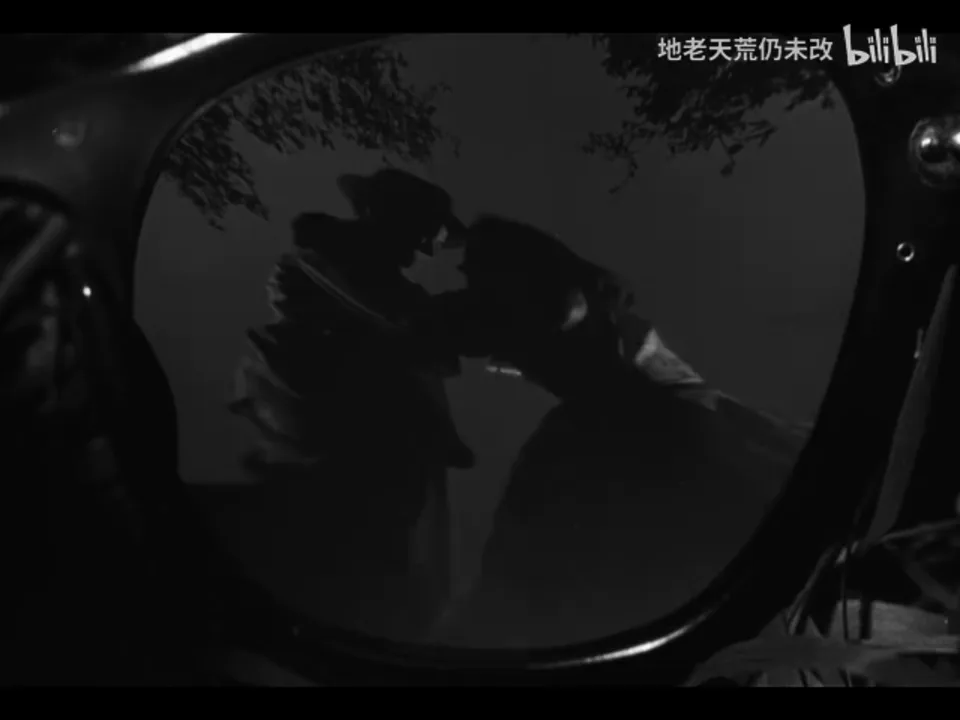 Watch this sequence · 00:26:30 ↗
Strangers on a Train · Strangulation reflected in a fallen lens: this is not Miriam's point of view
The still directly supports one claim: Bruno's strangulation appears as a reflection on the fallen lens, not as Miriam's point of view. Relating the passage to the relation-image requires cross-scene links to Bruno taking the glasses, his two trances before Barbara's similar pair, and the spectator's knowledge of the exchanged murder. That second layer comes from Rushton's analysis of the series and the atlas's cross-scene verification; the reflection alone does not prove it.
Image: Bruno follows Miriam and two companions into the fairground, rings the bell on the strength tester, and trails their boat through the Tunnel of Love. Miriam's glasses fall on the grass. The strangulation is shown principally in one reflected lens, bending and compressing the two bodies while the frame remains visible.
Sound: Distant fairground music, machinery, and cries continue over the lens image without supplying an on-scene witness capable of intervention. A scream first sounds inside the Tunnel of Love; as the boat emerges, Miriam's protests and laughter temporarily frame it as horseplay. Breathing and ambient sound dominate the later strangulation on the island.
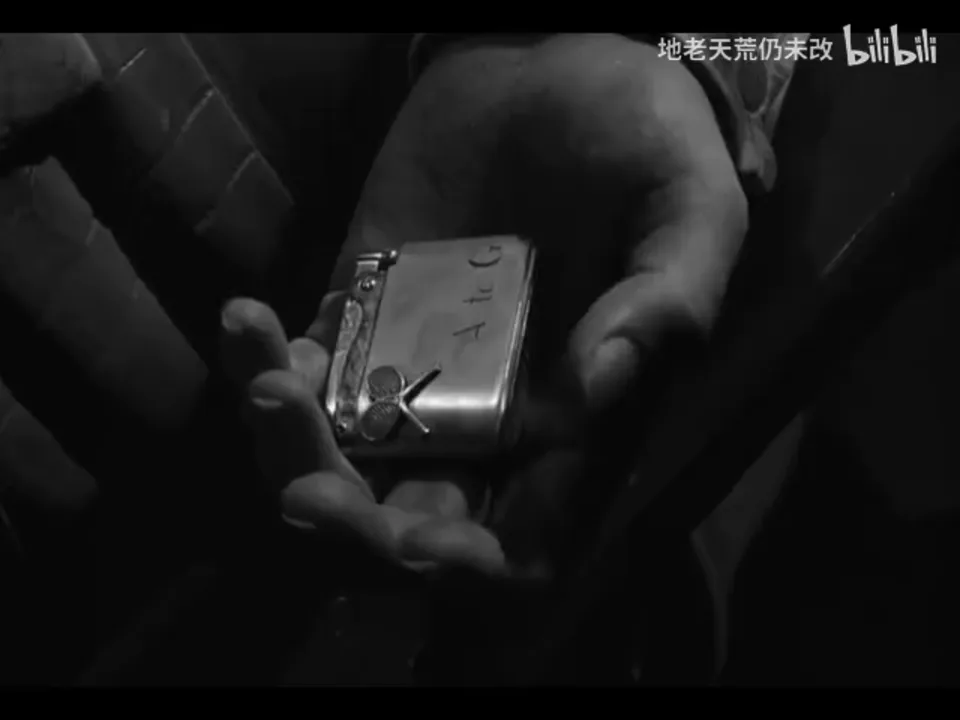 Watch this sequence · 01:38:45 ↗
Strangers on a Train · Exposed in Bruno's palm: how A to G reverses evidence
The lighter moves from keepsake to relational mark, then to Bruno's attempted means of demarking himself from the series, and finally reverses into evidence that he possessed the object and lied about it. The boatman's identification supplies the identity claim; together they change the police judgement. The relation-image lies in this changed function, not in the metal object or inscription's inherent meaning. The atlas follows Rushton's mark–demark reading and explicitly does not attribute this prop-level naming to Deleuze shot by shot.
Image: After the carousel runs out of control and collapses, Bruno lies beside the wreckage while Guy, police, and fairground workers gather nearby. As Bruno is dying, his clenched hand slowly opens. The film cuts to the open palm, where the lighter engraved A to G with crossed tennis rackets lies exposed.
Sound: After the boatman identifies Bruno, Guy tells Turley that Bruno has the lighter and meant to plant it on the island. Bruno denies this and insists that the lighter is still on the island. Guy asks to go through Bruno's pockets while Bruno is still alive. Turley refuses permission, noting that Bruno says he does not have the lighter. After Bruno is pronounced dead, Turley picks up the lighter from the already opened palm, asks Guy to identify it, and then confirms that Guy was right. Ambient noise, rescue instructions, and brief dialogue replace the fairground's earlier cyclical music.
Related concepts, chapters, and films
Original editions, translations, and access
L’Image-mouvement. Cinéma 1
French · Les Éditions de Minuit · 1983
ISBN 9782707306593Original edition details- Cinema 1: The Movement-ImageUniversity of Minnesota Press · 1986 · Trans. Hugh Tomlinson; Barbara Habberjam
- 《运动—影像/电影1》湖南美术出版社 · 2016 · Trans. 谢强
- 《電影 I:運動-影像》遠流出版 · 2003 · Trans. 黃建宏