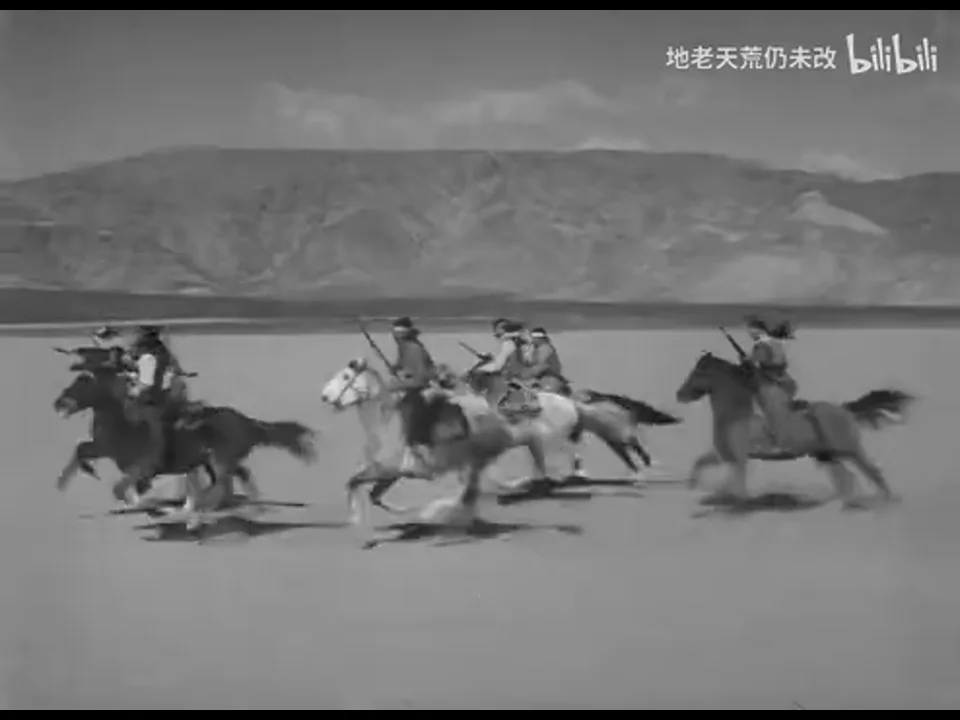
 01:14:00
Forms of action · SHOT EVIDENCE
The chase is not one heroic act but a set of simultaneous responses
Does the chase's unity come from a shared diegetic danger or from editing that joins distributed acts into one circuit?
Film and viewing version
Stagecoach · Stagecoach · John Ford / 约翰·福特 · 1939
Reviewed passage by passage on the single-part Bilibili carrier with a decoded-stream duration of 01:35:33. 01:14:00 is the still anchor and 约 01:13:30—01:15:20 is the atlas's working boundary for analysis; cut points may shift slightly across masters.
Version boundary: The timecodes on this page apply only to the named viewing carrier. Restorations, differing leaders, or platform transcodes may shift them.
Passage and still timecodes
约 01:13:30—01:15:20 (stagecoach chase and coordinated-defence passage containing the 01:14:00 still)
The window locates the passage; its boundaries remain approximate
The passage window and still anchor are separate coordinates: the Bilibili still at 01:14:00 was checked on 2026-09-01; it does not turn an approximate passage on another carrier into exact bounds.
Visible facts
- 01
The coach remains in rapid motion; driving, balancing, shooting, and approaching the target are carried by different figures and positions.
- 02
Editing cuts among coach body, horses, pursuers, and passengers' local acts; one anchor does not contain the complete causal chain of attack and defence.
Audible facts
- 01
Gunfire, hoofbeats, wheels, cries, and music coexist, but their sequence and sources have not been itemized; the atlas does not substitute sonic intensity for analysis of mechanism.
Action relation
The chase distributes capacity to act across driving, equine speed, shooters' positions, passenger responses, and editorial linkage; the hero occupies only one position in the circuit.
Temporal relation
Each response must arrive quickly after a changing threat, and the montage compresses several local timings of 'in time' or 'too late' into one forward process.
Conceptual reading
If these local tasks remain organized by a clearly given global danger and lead to restoration of the situation, the passage supports the large form. If shot review shows delays between perception and response depriving the whole of its organizing force, the relation should be weakened.
Concepts used in the judgement
- Action-image: large formgrande forme de l'image-action · CANDIDATE
Global danger generates coordinated action tending toward restoration, making this a strong candidate A; the ending must still be tested for a genuine S′.
→ - Sensory-motor schemaschème sensori-moteur · CANDIDATE
The montage can trace how threat is perceived and local acts are linked; because audio-visual order has not been itemized, the relation remains a candidate.
→
Primary and scholarly coordinates
- 01Cinema 1: The Movement-Image
Minnesota 1986 translation, chapter 9, pp. 141–152, especially p. 146
Pages 141–142 formulate S–A–S′. Page 146 directly uses Stagecoach's alternation of interiors and exteriors to describe the Encompasser and presents S–A–S, the restoration of a circular order, as a first approximation. Page 147 then distinguishes Ford's spiral: the situation reached differs from the one left, producing S–A–S′. Page 150 criticizes the reduction of social causes to individual confrontation, while pp. 151–152 discuss how global mission, local acts, and decisive action redistribute forces. Deleuze does not assign the atlas's three passages one by one; shot boundaries, visible facts, and candidate or countertest relations remain the atlas's responsibility.
Terminological coordinates
Chapter relations
Viewing and still sources
Direct scene · Still anchor 01:14:00; watch 01:13:30–01:15:20 and record who sees, who responds, and where the result lands at each cut.