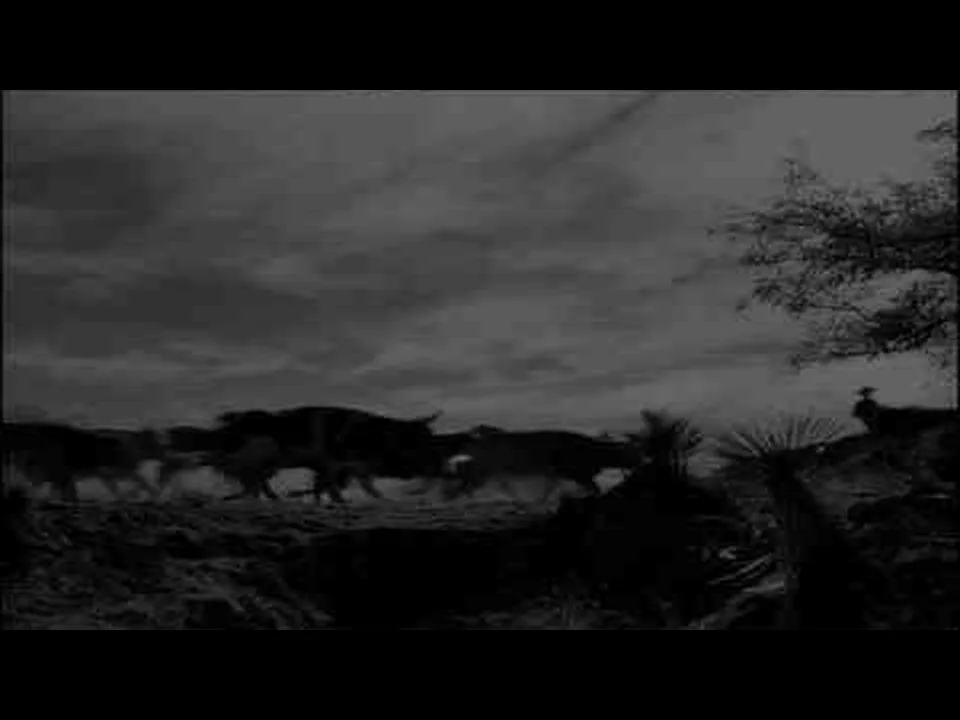
 00:51:20
Forms of action · SHOT EVIDENCE
The herd amplifies one disturbance into an event beyond command
When the milieu feeds back through speed and density, who can still be called the centre of action?
Film and viewing version
Red River · Red River · Howard Hawks / 霍华德·霍克斯 · 1948
The 00:51:20 still anchor is verified on the 02:13:26 single-part Bilibili edition. The passage is located by that anchor; its endpoints still require shot-level delimitation.
Version boundary: The timecodes on this page apply only to the named viewing carrier. Restorations, differing leaders, or platform transcodes may shift them.
Passage and still timecodes
night stampede passage containing the 00:51:20 still
The window locates the passage; its boundaries remain approximate
The passage window and still anchor are separate coordinates: the Bilibili still at 00:51:20 was checked on 2026-08-25; it does not turn an approximate passage on another carrier into exact bounds.
Visible facts
- 01
The herd crosses the low-lit frame laterally; speed, occlusion, and density weaken individual outlines, while the rider at right occupies another vertical level.
- 02
A single frame establishes density and direction of movement, not the cause of the stampede, the efficacy of commands, or the passage's full causality.
Audible facts
- 01
Disturbance, hoofbeats, cries, and music have not yet been transcribed by track; claims about sonic propagation remain questions for review.
Action relation
Herd density, darkness, rider position, and propagation speed jointly determine opportunities for response, so the action circuit is no longer possessed by heroic will alone.
Temporal relation
A difference of speed opens between command and event: responses continue, but arrive only after propagation has begun.
Conceptual reading
If shot-level review shows local acts progressively disclosing and reorganizing the situation, the passage approaches Hawksian functional relations. If an encompassing situation still stably generates and reabsorbs action, it supports the pure large form more strongly. Stampede alone does not prove a crisis of the action-image.
Concepts used in the judgement
- Sensory-motor schemaschème sensori-moteur · CANDIDATE
The passage can test how perception, delay, and response are distributed across humans, horses, cattle, and night milieu; audio-visual causality still requires itemized review.
→ - Action-image: large formgrande forme de l'image-action · COUNTERTEST
The stampede countertests whether one encompassing situation can be represented by a central hero's action. It weakens that reading without automatically reclassifying the whole film as small form.
→
Primary and scholarly coordinates
- 01Cinema 1: The Movement-Image
Minnesota 1986 translation, chapter 10, p. 165
Deleuze names Red River in the chapter on the small form and Hawksian functionalism. The three-shot segmentation and conceptual relations below are the atlas's responsibility, not a shot-by-shot paraphrase of p. 165.
Terminological coordinates
- sensory-motor schemaschème sensori-moteur
Trace how stimulus, delay, local response, and feedback are distributed.
→ - large form of the action-image / S–A–S′grande forme de l’image-action / S–A–S′
Use the event beyond command to test whether encompassing situation and central action still correspond stably.
→
Chapter relations
Viewing and still sources
Direct scene · The direct still anchor is 00:51:20; begin before the disturbance to review the order of propagation and response.