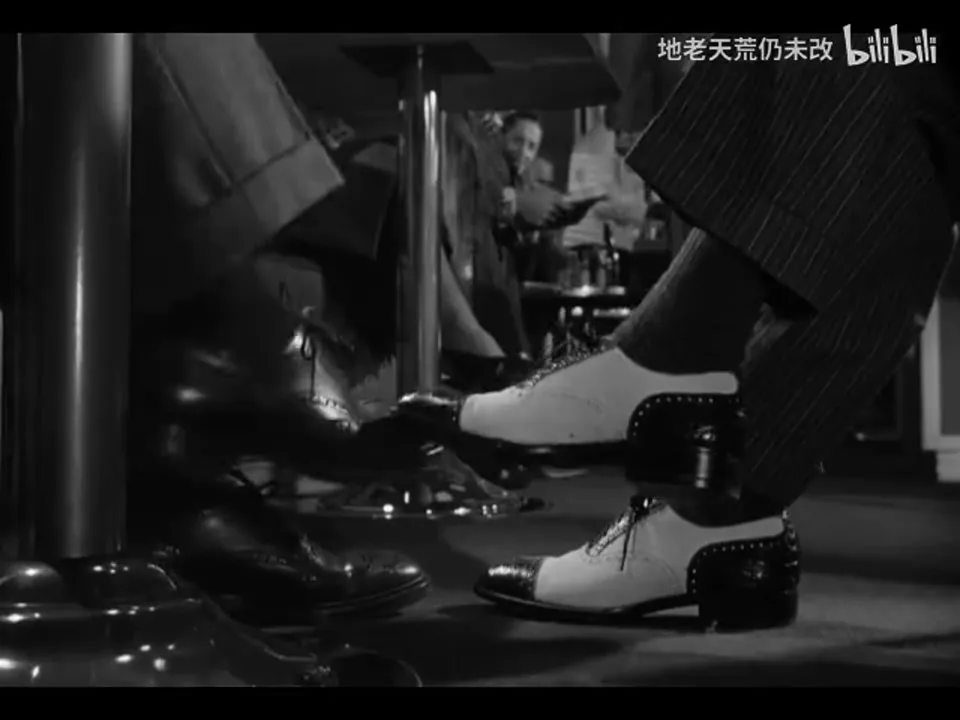
 00:02:05
Mental and relational image · SHOT EVIDENCE
Foot contact starts the conversation: Bruno treats an offhand assent as agreement
If the later exchange of murders were removed, what would remain of this foot contact, and which subsequent act rewrites the accident as the film's governing constraint?
Film and viewing version
Strangers on a Train · Strangers on a Train · Alfred Hitchcock / 阿尔弗雷德·希区柯克 · 1951
Reviewed passage by passage on the 01:40:27 single-part hard-subtitled Bilibili repost BV1SY6fYdEnV. 00:02:05 is the still anchor and 00:00:52—00:09:30 is the atlas's working boundary for the argument. These coordinates bind only this carrier; every other release or cut requires fresh location.
Version boundary: The timecodes on this page apply only to the named viewing carrier. Restorations, differing leaders, or platform transcodes may shift them.
Passage and still timecodes
approx. 00:00:52—00:09:30 (00:02:05 still shows Guy's dark shoe touching Bruno's two-tone brogue; the relational interpretation is completed in the ensuing conversation)
The window locates the passage; its boundaries remain approximate
The passage window and still anchor are separate coordinates: the Bilibili still at 00:02:05 was checked on 2026-09-01; it does not turn an approximate passage on another carrier into exact bounds.
Visible facts
- 01
The opening separately follows two pairs of shoes into the station—two-tone brogues and plainer dark shoes—while withholding both faces.
- 02
After crossing rails, the edit enters the compartment. Guy moves his foot into Bruno's, joining two previously parallel series.
Audible facts
- 01
Train and station sounds precede dialogue. After the contact, Guy apologizes first; Bruno takes the opening to recognize him as a tennis player and then introduces himself.
- 02
The ensuing conversation moves from newspapers, marriage, and Bruno's father to each man killing for the other. Guy treats the proposal as absurd talk, while Bruno retains his response as an agreement.
Action relation
Guy's foot contact is involuntary, but Bruno's interpretation prolongs it into acquaintance, proposal, and an imposed exchange. Miriam's death gives Guy's casually voiced wish a consequence he did not enact. Bruno remains the killer; what changes is the act's relational meaning, the direction of suspicion toward Guy, and the movement of evidence between the two men.
Temporal relation
The opening edit first arranges two pairs of shoes, crossing rails, and foot contact into a chain of encounter. Only in the ensuing conversation does Bruno treat Guy's offhand assent as agreement to exchange murders. A contact with no contractual force of its own then constrains later action through that interpretation.
Conceptual reading
Accidental meeting or foot contact is not sufficient for a relation-image. The initiating act enters a web governed by a third term—the relation of exchanged murder—only when Bruno organizes contact and Guy's words into that exchange; the relation then changes both men's actions, police judgement, and spectator foreknowledge.
Concepts used in the judgement
- Relation-imageimage-relation · SCENE SUPPORT
An accidental action is taken over by a third relation that continues to reorganize both agents and the spectator; Rushton, pp. 49–50, explicitly uses the opening to explain initiation of the web.
→ - Mental-imageimage mentale · SCENE SUPPORT
The image asks us to track not personality but how contact becomes an imposed agreement and a relational act through interpretation.
→ - Sensory-motor schemaschème sensori-moteur · ADJACENT
Contact, conversation, and murder retain a clear action-chain; the scene shows relation governing action, not the collapse of the action schema.
→
Primary and scholarly coordinates
- 01Cinema 1: The Movement-Image
Minnesota 1986 translation, chapter 12, pp. 197–205, especially p. 201
Page 201 defines the Hitchcockian third as relation and uses exchanged crimes to show relation entering action; pp. 203–204 distinguish mark, demark, and symbol in general. The primary text supplies neither the atlas's carrier coordinates nor a shot-by-shot assignment of eyeglasses and lighter to sign types; Rushton and carrier review bear that object-level chain.
- 02Deleuze’s Cinema Books: Three Introductions to the Taxonomy of Images
David Deamer, Deleuze’s Cinema Books (2016), pp. 132–137
Deamer reconstructs the general taxonomy of relation-image, mark, demark, symbol, and spectator implication. It helps police the inference boundary but does not analyze Strangers on a Train shot by shot.
- 03Cinema After Deleuze
Richard Rushton, Cinema After Deleuze (2012), pp. 48–50
Rushton develops five traits through Strangers on a Train: relational third, initiating action, exchange of crimes, series of marks and demarks, and film–spectator relation. Pages 49–50 treat the opening encounter, pp. 50–52 the exchanged crimes, lighter, and glasses, and pp. 52–53 the final proof and spectator trap.
Terminological coordinates
Chapter relations
Viewing and still sources
Direct scene · Watch 00:00:52–00:09:30 continuously: first record only shoes, rails, contact, lighter, and seating, then record how Bruno turns Guy's replies step by step into an exchange of murders. The timecode applies only to the 01:40:27 repost BV1SY6fYdEnV; Blu-ray, theatrical, and preview cuts require fresh location. A publicly reachable page and authorization to redistribute the feature are separate questions.