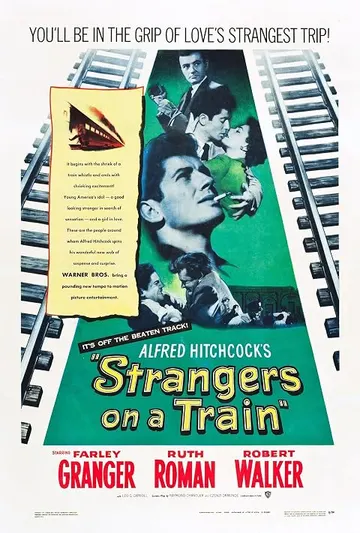
Alfred Hitchcock / 阿尔弗雷德·希区柯克 · 1951
Strangers on a Train
Strangers on a Train
Cinema 1, p. 201 directly invokes an exchange of crimes and murders to explain how Hitchcock surrounds and penetrates action with a fabric of relations; it does not classify the lighter, touching shoes, or spectacles shot by shot. Rushton, pp. 48–53, supplies the more specific chain: accidental foot contact on the train initiates a relation between strangers; Bruno construes Guy's words as an exchange of crimes. The lighter begins as Anne's gift to Guy. When Guy lends it to Bruno for a cigarette, Bruno reads its 'A to G' inscription—Anne to Guy—and draws the Anne–Guy gift relation into the Guy–Bruno criminal relation, making the lighter a mark of that relation; he later tries to turn it into a demark that would place Guy at the murder site. Barbara's spectacles abruptly reconnect a dinner-party strangling game to Miriam's murder. On p. 53 Rushton follows Robin Wood's account of the “spectator trap” to show that implication is not merely informational: the film first encourages the audience to treat Miriam's death as the removal of Guy's obstacle, then turns that desire back on the audience through the dinner-party strangling game. That the audience witnesses Bruno's act before Guy does is the atlas's carrier-based record of a knowledge gap; it is not folded into the same claim about Thirdness. Deamer, pp. 132–137, is used only to calibrate the general taxonomy of mark, demark, symbol, and spectator relation. The atlas remains responsible for its three Bilibili timecodes and shot-level applications; these are not presented as Deleuze's own shot analysis.
Film details
- Original title
- Strangers on a Train
- Director
- Alfred Hitchcock / 阿尔弗雷德·希区柯克
- Year
- 1951
- Region
- United States
Film analysis: how shots organize concepts
Close-reading questions
From the foot contact at 00:02:05 and the reflected strangulation at 00:26:30 to the lighter exposed in Bruno's palm at 01:38:45, how does one exchange relation successively change the interpretation of an encounter, what the spectator knows, and the object's evidentiary function for the police?
Shots, relations, and concepts
- 1Record
The opening separately follows two pairs of shoes into the station—two-tone brogues and plainer dark shoes—while withholding both faces. Train and station sounds precede dialogue. After the contact, Guy apologizes first; Bruno takes the opening to recognize him as a tennis player and then introduces himself.
Open the scene currently used to ground this chain: Foot contact starts the conversation: Bruno treats an offhand assent as agreement - 2Judge the relation
Guy's foot contact is involuntary, but Bruno's interpretation prolongs it into acquaintance, proposal, and an imposed exchange. Miriam's death gives Guy's casually voiced wish a consequence he did not enact. Bruno remains the killer; what changes is the act's relational meaning, the direction of suspicion toward Guy, and the movement of evidence between the two men. The opening edit first arranges two pairs of shoes, crossing rails, and foot contact into a chain of encounter. Only in the ensuing conversation does Bruno treat Guy's offhand assent as agreement to exchange murders. A contact with no contractual force of its own then constrains later action through that interpretation.
- 3Name the concept last
Relation-image、Mental-image. Only concepts whose scene relation resolves to “supports” under the current record are named here; candidates, adjacent terms, and countertests are not merged into the conclusion.
- 4Countertest
Accidental meeting or foot contact is not sufficient for a relation-image. The initiating act enters a web governed by a third term—the relation of exchanged murder—only when Bruno organizes contact and Guy's words into that exchange; the relation then changes both men's actions, police judgement, and spectator foreknowledge.
Shots and scenes
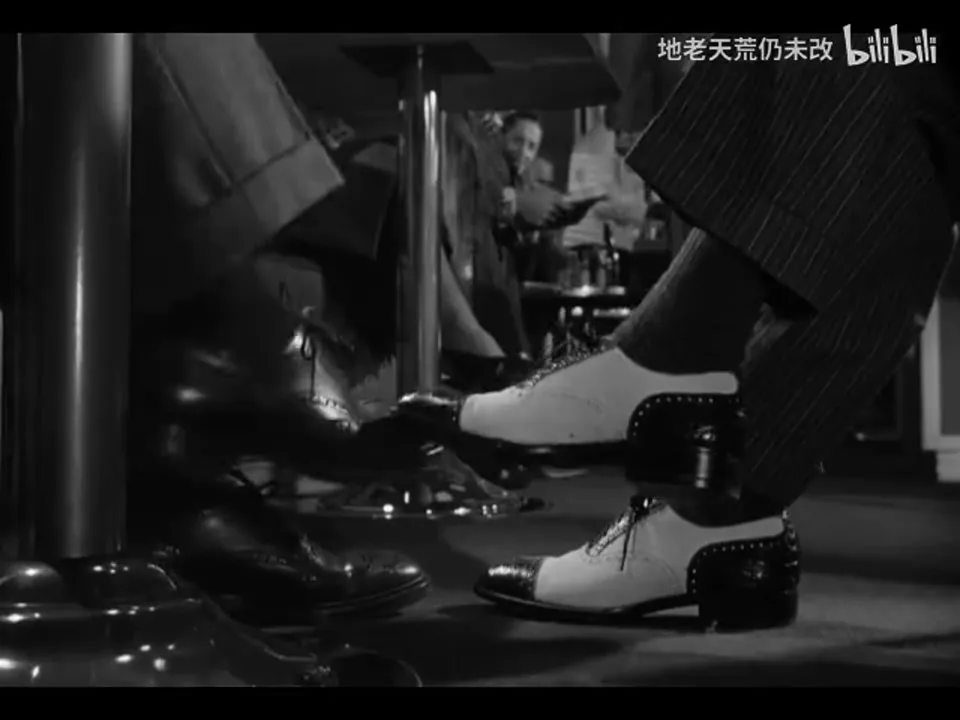
Accidental meeting or foot contact is not sufficient for a relation-image. The initiating act enters a web governed by a third term—the relation of exchanged murder—only when Bruno organizes contact and Guy's words into that exchange; the relation then changes both men's actions, police judgement, and spectator foreknowledge.
Open viewing position ↗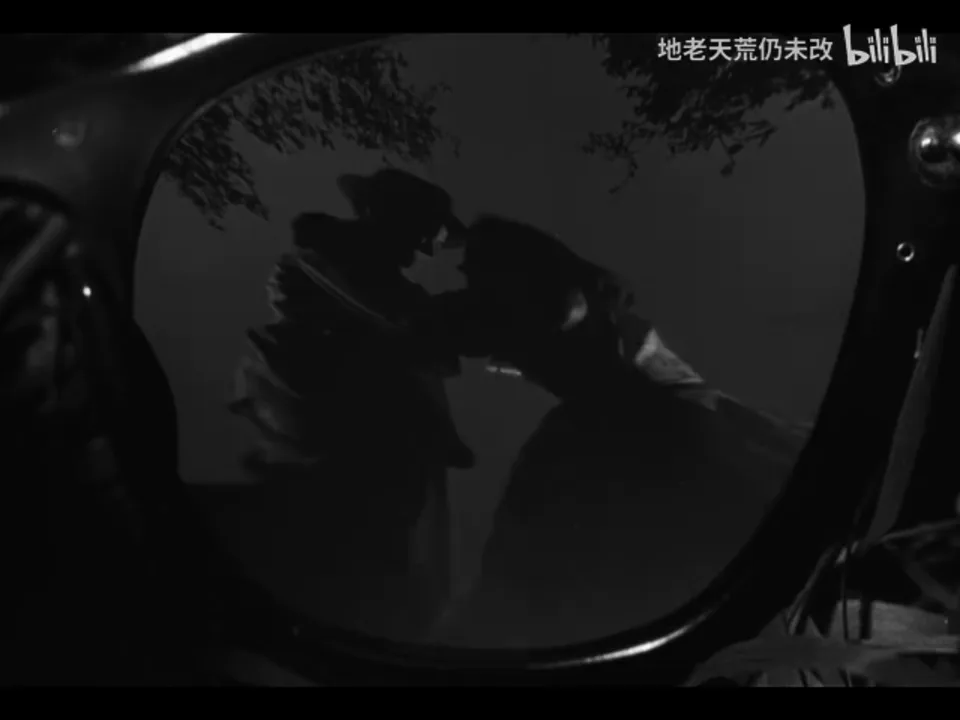
The still directly supports one claim: Bruno's strangulation appears as a reflection on the fallen lens, not as Miriam's point of view. Relating the passage to the relation-image requires cross-scene links to Bruno taking the glasses, his two trances before Barbara's similar pair, and the spectator's knowledge of the exchanged murder. That second layer comes from Rushton's analysis of the series and the atlas's cross-scene verification; the reflection alone does not prove it.
Open viewing position ↗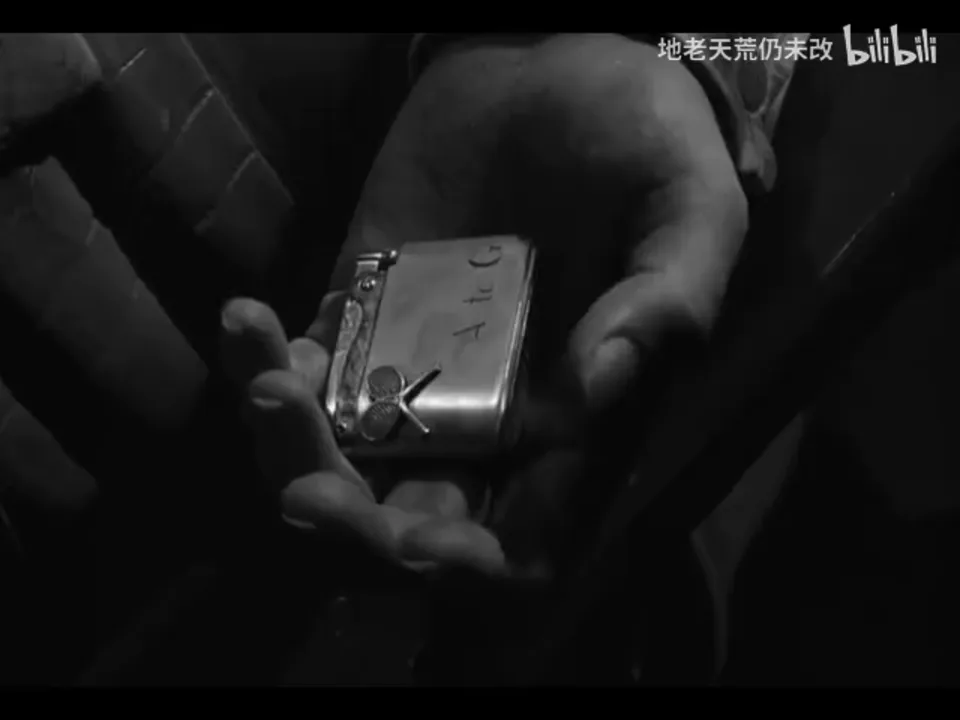
The lighter moves from keepsake to relational mark, then to Bruno's attempted means of demarking himself from the series, and finally reverses into evidence that he possessed the object and lied about it. The boatman's identification supplies the identity claim; together they change the police judgement. The relation-image lies in this changed function, not in the metal object or inscription's inherent meaning. The atlas follows Rushton's mark–demark reading and explicitly does not attribute this prop-level naming to Deleuze shot by shot.
Open viewing position ↗Primary texts, scholarship, and locators
Theory coordinate: Cinema 1, Minnesota 1986, ch. 12, p. 201; Richard Rushton, Cinema After Deleuze (2012), pp. 48–53; David Deamer, Deleuze's Cinema Books (2016), pp. 132–137 (general taxonomy only); atlas scene-level application
- 01Cinema After Deleuze
Treats Hitchcock as a central case of the relation-image; pp. 48–53 distinguish relation, spectator knowledge, and the demark and include the crop-duster in North by Northwest.
Open the atlas source record → - 02Deleuze’s Cinema Books: Three Introductions to the Taxonomy of Images
Detailed reconstruction with a film index; the nine-cell grid and eleven film cases carry the evidence status of Deamer’s later interpretation.
Open the atlas source record → - 03Cinema 1: The Movement-Image
Standard Minnesota English translation and a principal citation edition in Anglophone scholarship.
Open the atlas source record →
Scholarship cited by the scene records: Each study is listed once, with its locators and supported scenes retained together.
- 01Deleuze’s Cinema Books: Three Introductions to the Taxonomy of Images
Locator(s): David Deamer, Deleuze’s Cinema Books (2016), pp. 132–137
Cited by scene(s): Foot contact starts the conversation: Bruno treats an offhand assent as agreement · Strangulation reflected in a fallen lens: this is not Miriam's point of view · Exposed in Bruno's palm: how A to G reverses evidence
Deamer reconstructs the general taxonomy of relation-image, mark, demark, symbol, and spectator implication. It helps police the inference boundary but does not analyze Strangers on a Train shot by shot.
Open the atlas source record → - 02Cinema After Deleuze
Locator(s): Richard Rushton, Cinema After Deleuze (2012), pp. 48–50 · Richard Rushton, Cinema After Deleuze (2012), pp. 51, 53 · Richard Rushton, Cinema After Deleuze (2012), pp. 51–52
Cited by scene(s): Foot contact starts the conversation: Bruno treats an offhand assent as agreement · Strangulation reflected in a fallen lens: this is not Miriam's point of view · Exposed in Bruno's palm: how A to G reverses evidence
Rushton develops five traits through Strangers on a Train: relational third, initiating action, exchange of crimes, series of marks and demarks, and film–spectator relation. Pages 49–50 treat the opening encounter, pp. 50–52 the exchanged crimes, lighter, and glasses, and pp. 52–53 the final proof and spectator trap.
Open the atlas source record → - 03Figures of Style in Strangers on a Train
Locator(s): Peter J. Dellolio, “Figures of Style in Strangers on a Train,” open PDF pp. 5–6 · Peter J. Dellolio, “Figures of Style in Strangers on a Train,” open PDF p. 2 and pp. 5–6
Cited by scene(s): Strangulation reflected in a fallen lens: this is not Miriam's point of view · Exposed in Bruno's palm: how A to G reverses evidence
Dellolio analyzes how canted framing, gate bars, the eyeglass reflection, and carousel write the Guy–Bruno parallel into space, and identifies the dying gesture that exposes the lighter on p. 2. The paper uses an Expressionist and psychological framework; the atlas borrows its verifiable shot observations without equating that psychology with Deleuze's relation-image.
Open the atlas source record →
This film in books and research
Cinema After Deleuze · Book case
Strangers on a Train
pp. 49–53
Film relation: Lighter and spectacles weave encounter, exchanged murder, and spectator desire into a relational network.
Shot question: At which transfer or trigger of resemblance does an object change its sign-function, and when does the spectator learn before Guy that the exchange has been carried out?
Viewing gateways and editions
- Verified complete Bilibili carrier: 火车怪客【1951】bilibili.comOpen film page ↗
- Page access
- Accessible when checked
- Version extent
- Recorded as a complete version
- Source type
- User-uploaded page
Edition note: Complete single-part film; actual runtime 6,027.297 seconds (about 1:40:27), displayed as 6,028 seconds on the page. Scene timecodes follow the film's actual timeline.
Link checked: 2026-09-01