 00:26:30
Mental and relational image · SHOT EVIDENCE
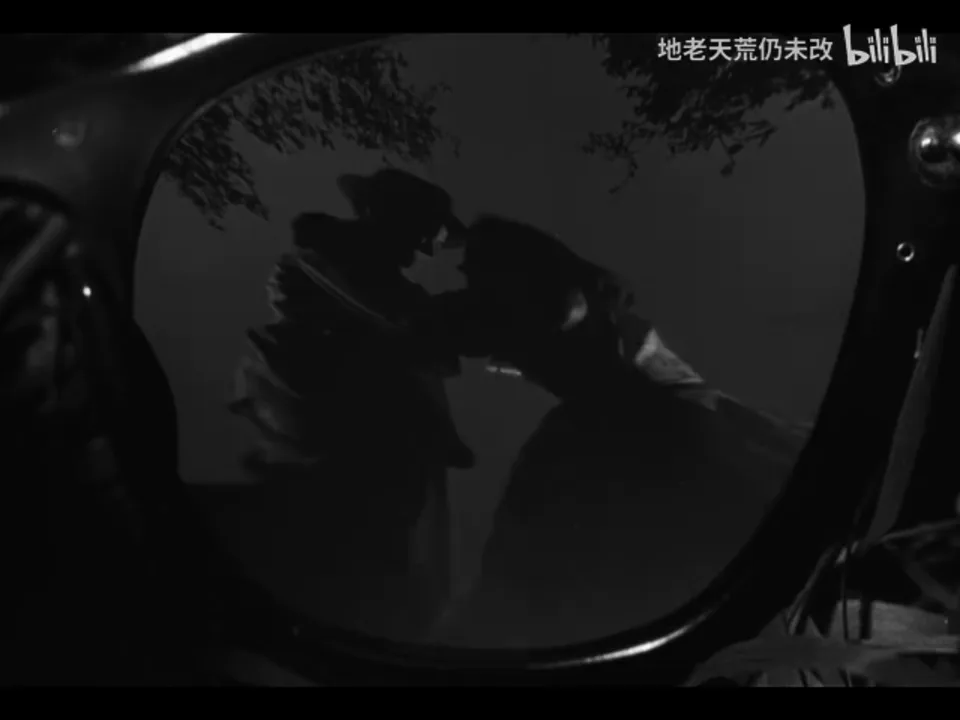
Strangulation reflected in a fallen lens: this is not Miriam's point of view
Why does the film give the murder to lenses already fallen from the victim's face; what knowledge does that position grant the spectator, and whose capacities to see and act does it remove?
Film and viewing version
Strangers on a Train · Strangers on a Train · Alfred Hitchcock / 阿尔弗雷德·希区柯克 · 1951
Reviewed passage by passage on the 01:40:27 single-part hard-subtitled Bilibili repost BV1SY6fYdEnV. 00:26:30 is the still anchor and 00:24:20—00:27:05 is the atlas's working boundary for the argument. These coordinates bind only this carrier; every other release or cut requires fresh location.
Version boundary: The timecodes on this page apply only to the named viewing carrier. Restorations, differing leaders, or platform transcodes may shift them.
Passage and still timecodes
approx. 00:24:20—00:27:05 (00:26:30 still shows Bruno strangling Miriam in one lens of her fallen eyeglasses)
The window locates the passage; its boundaries remain approximate
The passage window and still anchor are separate coordinates: the Bilibili still at 00:26:30 was checked on 2026-09-01; it does not turn an approximate passage on another carrier into exact bounds.
Visible facts
- 01
Bruno follows Miriam and two companions into the fairground, rings the bell on the strength tester, and trails their boat through the Tunnel of Love.
- 02
Miriam's glasses fall on the grass. The strangulation is shown principally in one reflected lens, bending and compressing the two bodies while the frame remains visible.
Audible facts
- 01
Distant fairground music, machinery, and cries continue over the lens image without supplying an on-scene witness capable of intervention.
- 02
A scream first sounds inside the Tunnel of Love; as the boat emerges, Miriam's protests and laughter temporarily frame it as horseplay. Breathing and ambient sound dominate the later strangulation on the island.
Action relation
Bruno carries out the wish Guy voiced but did not enact, and Bruno remains unequivocally the killer. The fallen lens presents the strangulation as a reflection visible to the spectator without becoming Miriam's point of view; Guy's wish, absence, and later burden of suspicion and evidence enter through surrounding scenes. The spectator therefore knows before Guy that Bruno has unilaterally carried out the exchange.
Temporal relation
The fallen lens reflects the strangulation as it occurs; it does not record the event. Bruno later brings Miriam's glasses to Guy as proof that he has killed her. Barbara's separate but similar pair later triggers Bruno's trance twice, bringing the visual relation back into the present.
Conceptual reading
The still directly supports one claim: Bruno's strangulation appears as a reflection on the fallen lens, not as Miriam's point of view. Relating the passage to the relation-image requires cross-scene links to Bruno taking the glasses, his two trances before Barbara's similar pair, and the spectator's knowledge of the exchanged murder. That second layer comes from Rushton's analysis of the series and the atlas's cross-scene verification; the reflection alone does not prove it.
Concepts used in the judgement
- Relation-imageimage-relation · SCENE SUPPORT
Rushton p. 51 identifies the resemblance between Barbara's and Miriam's glasses, and Bruno's resulting trances, as a demark; p. 53 discusses spectator implication. Dellolio, pp. 5–6, analyzes the lens reflection. Connecting this reflected murder to Guy's wish, Barbara, and spectator knowledge is the atlas's cross-scene synthesis.
→ - Mental-imageimage mentale · SCENE SUPPORT
The shot forces three distinctions: Guy voices the wish, Bruno commits the murder, and the film gives the result to the spectator first. This is not reducible to Bruno's projection.
→
Primary and scholarly coordinates
- 01Cinema 1: The Movement-Image
Minnesota 1986 translation, chapter 12, pp. 197–205, especially p. 201
Page 201 defines the Hitchcockian third as relation and uses exchanged crimes to show relation entering action; pp. 203–204 distinguish mark, demark, and symbol in general. The primary text supplies neither the atlas's carrier coordinates nor a shot-by-shot assignment of eyeglasses and lighter to sign types; Rushton and carrier review bear that object-level chain.
- 02Deleuze’s Cinema Books: Three Introductions to the Taxonomy of Images
David Deamer, Deleuze’s Cinema Books (2016), pp. 132–137
Deamer reconstructs the general taxonomy of relation-image, mark, demark, symbol, and spectator implication. It helps police the inference boundary but does not analyze Strangers on a Train shot by shot.
- 03Cinema After Deleuze
Richard Rushton, Cinema After Deleuze (2012), pp. 51, 53
Rushton develops five traits through Strangers on a Train: relational third, initiating action, exchange of crimes, series of marks and demarks, and film–spectator relation. Pages 49–50 treat the opening encounter, pp. 50–52 the exchanged crimes, lighter, and glasses, and pp. 52–53 the final proof and spectator trap.
- 04Figures of Style in Strangers on a Train
Peter J. Dellolio, “Figures of Style in Strangers on a Train,” open PDF pp. 5–6
Dellolio analyzes how canted framing, gate bars, the eyeglass reflection, and carousel write the Guy–Bruno parallel into space, and identifies the dying gesture that exposes the lighter on p. 2. The paper uses an Expressionist and psychological framework; the atlas borrows its verifiable shot observations without equating that psychology with Deleuze's relation-image.
Terminological coordinates
Chapter relations
Viewing and still sources
Direct scene · Watch 00:24:20–00:27:05, separately recording Bruno's pursuit, how the tunnel scream is temporarily reframed as horseplay at the exit, the fallen glasses, lens reflection, sound continuity, and subsequent removal of the glasses; do not treat reflection alone as conceptual proof. The timecode applies only to the 01:40:27 repost BV1SY6fYdEnV; Blu-ray, theatrical, and preview cuts require fresh location. A publicly reachable page and authorization to redistribute the feature are separate questions.