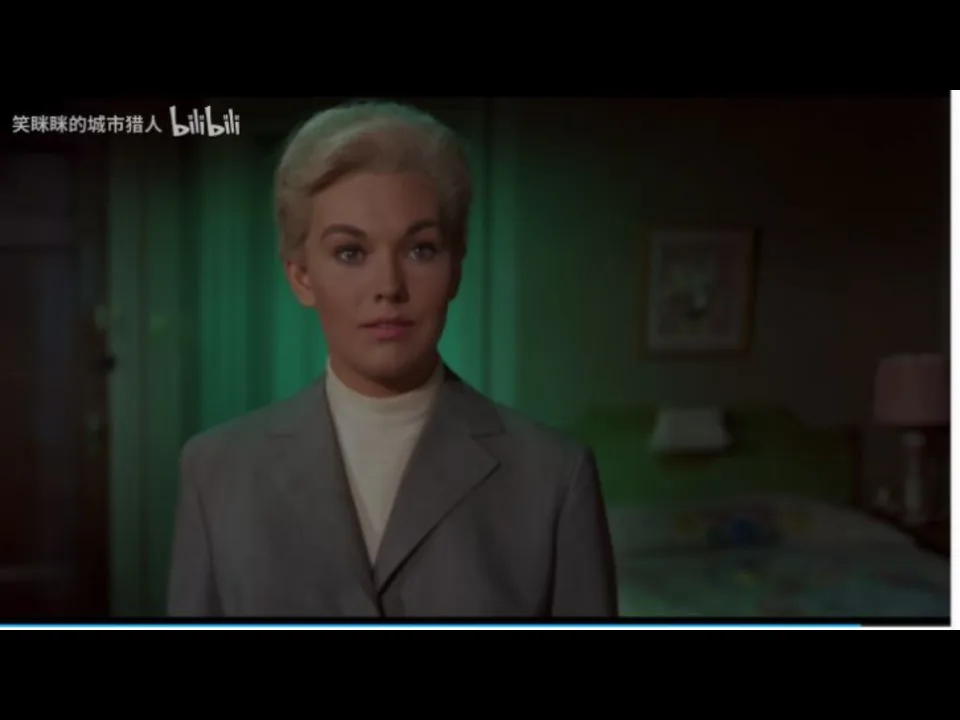
 01:55:20
Mental and relational image · SHOT EVIDENCE
The return in green light: how desire manufactures its object
Which elements make Scottie see Judy as Madeleine, and how does the spectator's prior knowledge prevent resemblance from being mistaken for identity?
Film and viewing version
Vertigo · Vertigo · Alfred Hitchcock / 阿尔弗雷德·希区柯克 · 1958
Reviewed passage by passage on the 02:07:27 single-part Bilibili repost with hard Chinese and English subtitles. 01:55:20 is the still anchor and 01:53:45—01:56:50 is the atlas's working boundary. Bilibili's official feature page ep291561 runs 02:07:49, and the repost may trim opening or closing material, so their timelines are not interchangeable.
Version boundary: The timecodes on this page apply only to the named viewing carrier. Restorations, differing leaders, or platform transcodes may shift them.
Passage and still timecodes
approx. 01:53:45—01:56:50 (01:55:20 still shows Judy after the hair-and-suit makeover against green-lit curtains and wall)
The window locates the passage; its boundaries remain approximate
The passage window and still anchor are separate coordinates: the Bilibili still at 01:55:20 was checked on 2026-09-01; it does not turn an approximate passage on another carrier into exact bounds.
Visible facts
- 01
Judy enters from the direction of the bathroom in a grey suit with her blonde hair pinned up; the curtains and wall are lit green.
- 02
Scottie approaches and embraces her as the camera circles the couple. The hotel room briefly overlaps with the earlier stable space before returning to the green room.
Audible facts
- 01
Dialogue recedes; the score expands as Judy appears, Scottie approaches, and the couple embrace.
Action relation
Scottie is not recovering Madeleine; he is forcing Judy to reproduce a remembered appearance through demands about clothes, hair colour, hairstyle, and posture. Judy endures, resists, and at times complies with those demands.
Temporal relation
The past enters the present body through costume, hair, light, music, and circular movement, while the earlier stable is briefly superimposed on the hotel room. Whether past and present form a reciprocal, indiscernible crystal circuit still requires more than this overlap.
Conceptual reading
Rushton, pp. 56–57, supports Scottie's remaking of the desired object and shows that the spectator already knows Judy's identity, making the process of control visible. The atlas is responsible for treating green light and circular camera movement as relational mechanisms. If that knowledge gap is ignored, the scene reduces to remaking action and affective intensity; green colour, memory, or superimposition alone cannot establish an actual–virtual relation or crystal-image.
Concepts used in the judgement
- Relation-imageimage-relation · SCENE SUPPORT
Spectator foreknowledge, Scottie's desire, and Judy's controlled performance jointly determine the present image; relation is not an added theme but a condition of the image's formation.
→ - Mental-imageimage mentale · SCENE SUPPORT
The object of viewing includes the present woman, absent image, remaking procedure, and knowledge gap and cannot be reduced to Scottie's private fantasy.
→ - Actual / virtualactuel / virtuel · CANDIDATE
The remembered Madeleine concretely governs Judy's clothing, hairstyle, and posture; this proposes an actual–virtual candidate but does not yet establish a crystal.
→ - Sensory-motor schemaschème sensori-moteur · COUNTERTEST
Scottie's remaking action obtains visible results in clothing and body, countertesting any automatic account of the green light as a sensory-motor rupture.
→
Primary and scholarly coordinates
- 01Cinema 1: The Movement-Image
Minnesota 1986 translation, chapter 12, pp. 197, 204–205
These pages define the mental image's objects, Hitchcock's relational web, and the spectator's position, and directly explain Vertigo through variations in the relations of the Same. They do not analyze the atlas's chosen commission, letter, or green-light passages shot by shot; Rushton and the atlas's scene review bear those specific classifications.
- 02Cinema After Deleuze
Richard Rushton, Cinema After Deleuze (2012), pp. 56–57
Rushton explains Scottie's remaking of Judy as regaining the object of desire and keeps spectator foreknowledge within the relational web; he does not directly analyze the green lighting or the 360-degree camera movement.
- 03Cinema 2: The Time-Image
Minnesota 1989 translation, chapter 4, pp. 68–70, 78–81
These pages supply general criteria for actual–virtual relations and the crystal without naming Vertigo. The atlas therefore retains only a candidate and requires additional evidence of reciprocal circuit and indiscernibility.
Terminological coordinates
Chapter relations
Viewing and still sources
Direct scene · Watch 01:53:45–01:56:50 and record costume, hair colour, hairstyle, green light, Scottie's reaction, embrace, circular camera movement, and stable overlap separately before judging which term actually changes the relation. The timecode applies only to the 02:07:27 repost BV1ECSHYoEwW; this carrier may trim opening or closing material, so the official feature page, Blu-ray, and other restorations require fresh location.