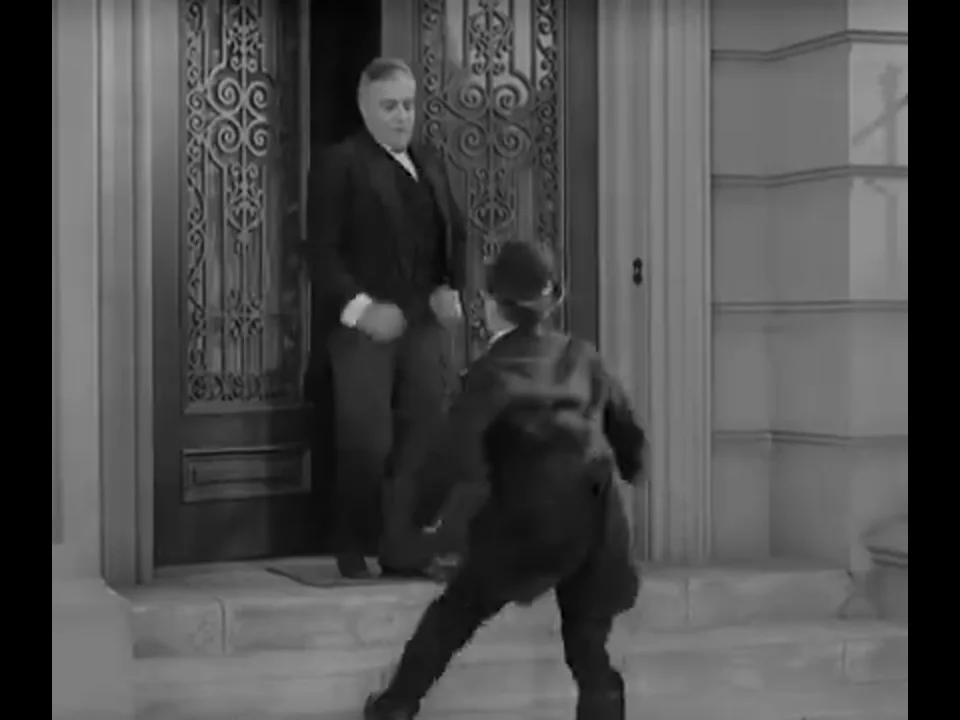
 00:35:30
Forms of action · SHOT EVIDENCE
When the millionaire wakes sober, why is last night's friend left outside?
Why can the situation disclosed by one action not survive the next sobriety, but must instead be replayed from zero?
Film and viewing version
City Lights · City Lights · Charles Chaplin / 查理·卓别林 · 1931
Reviewed passage by passage on the single-part Bilibili carrier with a decoded-stream duration of 01:26:47. 00:35:30 is the still anchor and 约 00:34:14—00:35:48 is the atlas's working boundary. Approximately 25.8 seconds of black at the end are excluded from narrative analysis.
Version boundary: The timecodes on this page apply only to the named viewing carrier. Restorations, differing leaders, or platform transcodes may shift them.
Passage and still timecodes
约 00:34:14—00:35:48 (millionaire's sober rejection of the Tramp containing the 00:35:30 still)
The window locates the passage; its boundaries remain approximate
The passage window and still anchor are separate coordinates: the Bilibili still at 00:35:30 was checked on 2026-09-01; it does not turn an approximate passage on another carrier into exact bounds.
Visible facts
- 01
The passage begins from morning and the millionaire's sobriety; when the Tramp reaches the mansion, he does not receive the previous night's treatment as friend, and the butler keeps him beyond the entrance.
- 02
This passage must be read against the drunken encounter around 00:11:30–00:15:50; isolated, the doorway rejection shows only S→A and cannot compose a complete A–S–A′ by itself.
Audible facts
- 01
An intertitle marks the change of state with sober dawn awakening a different man; the atlas does not medicalize this difference into a clinical personality diagnosis.
Action relation
The millionaire treats the Tramp as a friend when drunk and fails to recognize him when sober; the same relation changes with his state, and local behaviour discloses the situation.
Temporal relation
The previous night's friendship does not accumulate into a social fact available next morning; each return to sobriety resets the relation, making repetition structural to the situation.
Conceptual reading
Only the pairing of drunken recognition with sober rejection can test the atlas's concrete reading of the 'personality split of a pivotal character' on p. 169. If the two passages do not establish a stable reversal of rules and show only an accidental lapse, the small-form relation should be weakened.
Concepts used in the judgement
Primary and scholarly coordinates
- 01Cinema 1: The Movement-Image
Minnesota 1986 translation, chapter 10, pp. 160–171, especially pp. 169–171
From p. 160 Deleuze defines A–S–A′ and its indices. Page 169 directly names City Lights as an example of a 'personality split of a pivotal character,' but does not assign the drunk or sober passages or a rule of recognition shot by shot. The atlas tests the paired drunken welcome and sober rejection as its concrete filmic realization. The scene directly named on p. 171 is the thread-unravelling passage around 00:52:32–00:53:54, not the final tactile recognition. Boundaries and theoretical relations for the opening mistake, sober rejection, and final recognition remain the atlas's responsibility.
Terminological coordinates
Chapter relations
Viewing and still sources
Direct scene · Still anchor 00:35:30; watch 00:34:14–00:35:48, then revisit the drunken encounter around 00:11:30–00:15:50 and compare address, access, and permission to act.