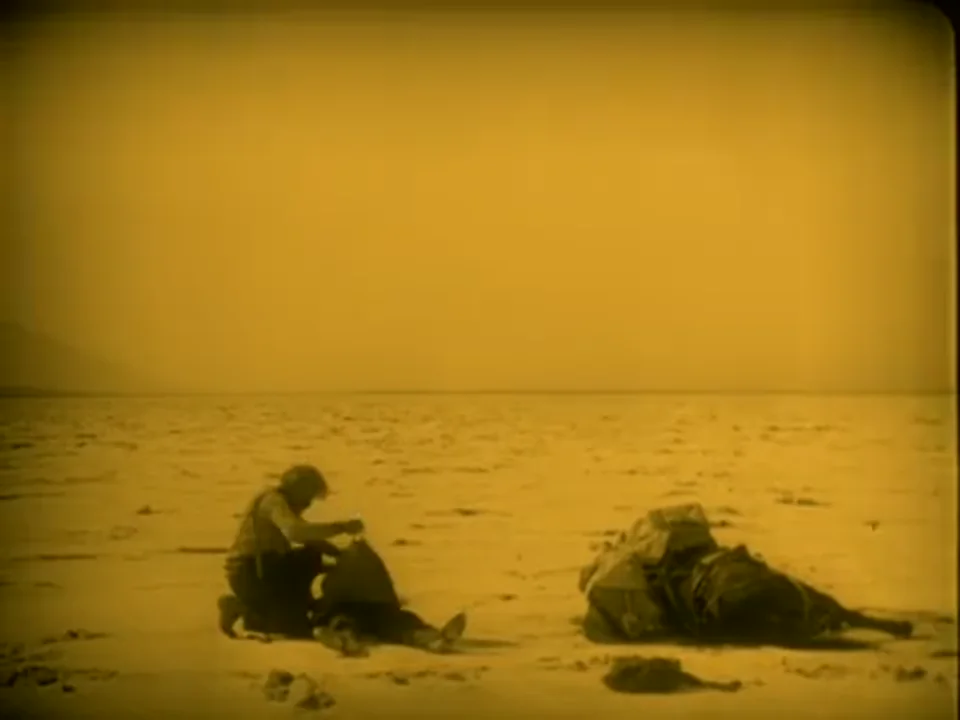
 03:54:15
Impulse and originary world · SHOT EVIDENCE
Death Valley exhausts use: is money the only fetish candidate?
When the milieu makes every use fail, how do we decide whether a remnant is merely a broken tool or a partial object seized by impulse?
Film and viewing version
Greed · Greed · Erich von Stroheim / 埃里克·冯·施特罗海姆 · 1924
Reviewed passage by passage on the long-reconstruction Bilibili carrier with a decoded-stream duration of 03:56:21. 03:54:15 is the still anchor and 约 03:50:45—03:55:39;重构尾卡约 03:55:51—03:56:09 is the atlas's working boundary. Still photographs, reconstruction cards, and moving footage must be read as distinct layers.
Version boundary: The timecodes on this page apply only to the named viewing carrier. Restorations, differing leaders, or platform transcodes may shift them.
Passage and still timecodes
约 03:50:45—03:55:39;重构尾卡约 03:55:51—03:56:09 (Death Valley fight, handcuff, broken canteen, and birdcage passage containing the 03:54:15 still)
The window locates the passage; its boundaries remain approximate
The passage window and still anchor are separate coordinates: the Bilibili still at 03:54:15 was checked on 2026-09-01; it does not turn an approximate passage on another carrier into exact bounds.
Visible facts
- 01
The passage contains struggle over a money bag, the dead horse, handcuffs around 03:52:48, the broken canteen around 03:53:21, money and blood stressed by tint around 03:53:51, and McTeague approaching the birdcage.
- 02
Desert and salt flat offer no visible shelter; objects' prior uses fail one by one under thirst, death, and restraint, but failed objects do not thereby all become fetishes.
Audible facts
- 01
Causality in the silent film is organized by moving image and intertitles. The 'lust of gold' wording around 03:55:51–03:56:09 belongs to the reconstruction's end-card layer and cannot retroactively prove every earlier piece of money.
Action relation
Death Valley contracts survival behaviour to water, movement, and release from restraint. The money bag continues to provoke struggle, while the failure of canteen, horse, and bodily capacity shows a derived milieu no longer able to support survival. Elementary impulse thereby exposes an originary world without fixed coordinates within exhaustion.
Temporal relation
Relations accumulated through profession, marriage, savings, and flight become remnants on the salt flat. The ending does not reset time but leaves money, corpse, handcuff, and cage from the descent co-present.
Conceptual reading
The money bag and chromatically stressed money are fetish candidates as objects seized by impulse after losing survival use. Broken canteen, dead horse, handcuff, and bird first mark material exhaustion and relations of restraint; they must not all be called fetishes. If seizure as a partial object cannot be demonstrated, the fetish label for that object should be withdrawn.
Concepts used in the judgement
Primary and scholarly coordinates
- 01Cinema 1: The Movement-Image
Minnesota 1986 translation, chapter 8, pp. 125–130, especially pp. 125 and 128
Page 125 generally defines originary world or derived milieu, elementary impulse or real behaviour, and symptom or fetish, while directly listing Greed's desert ending as a localized originary world. Pages 126–127 discuss Stroheimian descent, entropy, and degradation. Page 128 directly names the film's impulse for gold, then defines partial object and fetish in general; pp. 129–130 address exhaustion of milieu, fragments, and remnants. The primary text does not classify the atlas's three anchors one by one as symptom or fetish; specific gestures, objects, and withdrawal criteria remain the atlas's responsibility.
Terminological coordinates
Chapter relations
Viewing and still sources
Direct scene · Still anchor 03:54:15; watch 03:50:45–03:55:39 and log money bag, horse, handcuff, canteen, money, and birdcage separately. 03:55:51–03:56:09 belongs to the reconstruction's end-card layer; the carrier has a decoded-stream duration of 03:56:21 and is not the lost original full cut.