Concept definition
Following Cinema 2, pp. 32–33, which retrospectively revisits the first semiotics, the atlas gathers the figures developed in Cinema 1, chapters 10–11—attraction, inversion, and discourse—under reflection-image. All three still transform the situation–action relation from within the action forms: attraction uses a substitute or rehearsal to miniaturize, prefigure, or stage another situation or act; inversion exchanges large and small powers; discourse makes an implicit problem into an audible and visible object of thought. Reflection-image must not be prematurely equated with chapter 12's relation-image.
What the concept explains
The reflection-image makes forms of action think their limits through three figures only: attraction, inversion, and discourse. Attraction inserts a plastic substitute or theatrical rehearsal into the present form as a miniature, rehearsal, or prefiguration of another situation or act, allowing large form to contract into a local index or small form to sketch an encompassing situation not yet unfolded. Inversion exchanges large and small powers; discourse makes an implicit problem directly into an object.
Intellectual lineage: Cinema 1, chapter 11, pp. 178–196 develops transformations of the action forms: pp. 182–187 supply the general mechanisms of attraction and inversion, while pp. 189–195 move into problems and limits of form, so the whole range cannot be reduced to the first two figures. The discursive figure of The Great Dictator already appears directly in chapter 10, pp. 171–173. Only when Cinema 2, chapter 2, pp. 32–33 retrospectively revisits the first semiotics are attraction and inversion classified as compositional signs, discourse as the genetic sign, and the three gathered under reflection-image. The record therefore preserves a genealogy in which the collective name arrives after the figures are developed.
Sensory-Motor Rupture: How a Character Becomes a SeerDiagrams and film passages
The Great Dictator
The Great Dictator (1940)
Supported by the scene
The final address: discourse becomes a problem rather than declaring action victorious
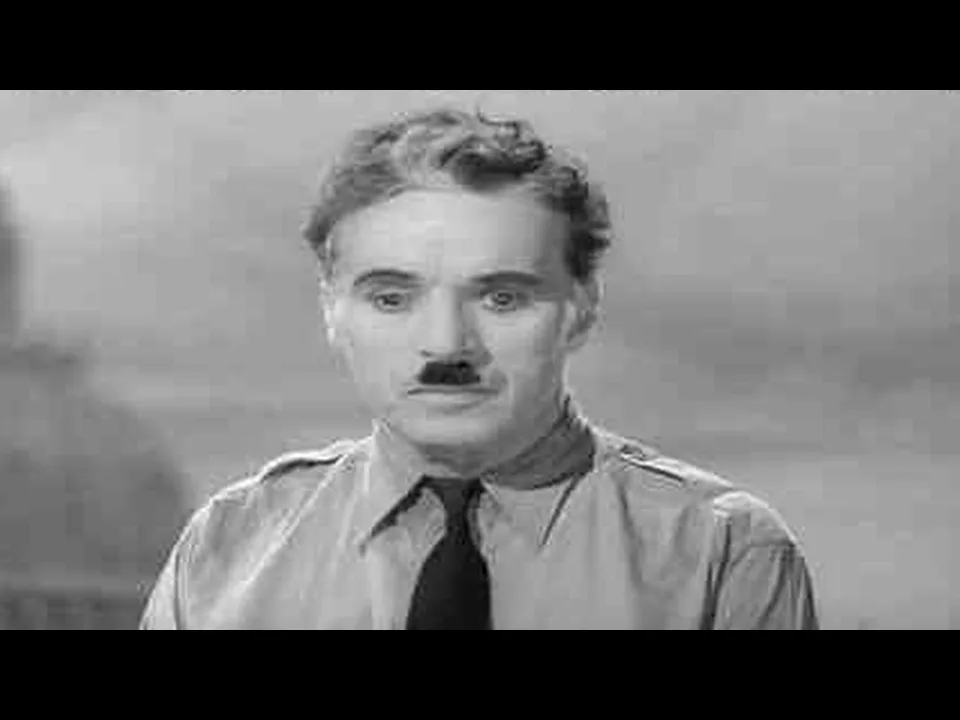
The uniform still belongs to the dictator's position while the mode of address changes. The frontal close-up gives the spectator the problem of who can speak, to whom, and whether discourse can become action.
Open full-size still- Displayed still
- 01:59:21
- Discussion passage
- approx. 01:59:09—02:03:08 (the sustained frontal close-up of the barber's final address in Hynkel's uniform containing the 01:59:21 still)
Reviewed passage by passage on the single-part BV1XikCYxEUQ carrier. The API runtime is 7,535,155 ms, the container is 02:05:35.155, and Bilibili's integer metadata displays 02:05:36. 01:59:21 is the still anchor and 01:59:09—02:03:08 the atlas's working passage, not a claim to final cut-by-cut boundaries.
Still anchor 01:59:21; watch 01:59:09–02:03:08, comparing podium totality, frontal close-up, duration of address, and the cut to Hannah rather than substituting one famous line for image analysis. The timecode applies only to the 02:05:35.155 BV1XikCYxEUQ container (02:05:36 in Bilibili's integer metadata). The specific restoration or master was not independently established; other editions require fresh location.
Still checked: 2026-09-01 · Carrier access checked: 2026-09-01
Image
The barber stands before several microphones under Hynkel's identity; the camera moves from podium and military setting to a sustained frontal close-up.
The close-up progressively reduces the ceremonial background so that face, gaze, and duration of address become the main image-event; after the speech the film cuts to Hannah.
The 01:59:21 anchor comes from Bilibili's native preview. The atlas cropped a non-film banner at the top without removing face, uniform, or filmic background information.
Sound
The barber shifts to sustained intelligible English address, audibly contrasting with Hynkel's earlier pseudo-German, noise, and threatening delivery. The atlas does not reproduce the speech at length.
Relation to the concept
Chapter 10, pp. 172–173 directly uses the final address for the figure of discourse; Cinema 2, p. 33 retrospectively specifies discourse as the reflection-image's genetic sign.
Sources and further reading
- Cinema 1: The Movement-Image
Minnesota 1986 translation, chapter 10, pp. 171–173 · Pages 172–173 directly use The Great Dictator's final address and intelligible language for the figure of discourse; the atlas is responsible for the 01:59:09–02:03:08 boundary, still, and itemized facts.
- Cinema 2: The Time-Image
Minnesota 1989 translation, chapter 2, p. 33 · Page 33 retrospectively specifies discourse as the reflection-image's genetic sign; it is not a shot-by-shot transcription of the final address.
- Deleuze’s Cinema Books: Three Introductions to the Taxonomy of Images
David Deamer, Deleuze’s Cinema Books (2016), pp. 104–119 · Deamer reconstructs the reflection-image as three transformations through which the two action forms criticize one another: attraction, inversion, and discourse, treated respectively on pp. 105–109, 110–114, and 115–119. This taxonomic reconstruction does not classify The Great Dictator's globe ballet or mistaken-identity passage for the atlas.
- Bilibili · BV1XikCYxEUQ · reviewed 02:05:35.155 single-part carrier with Chinese subtitles; the first still comes from the decoded stream, the second and third from native previews, with a non-film banner cropped from the third before proportional letterboxing
01:59:21 · The uniform still belongs to the dictator's position while the mode of address changes. The frontal close-up gives the spectator the problem of who can speak, to whom, and whether discourse can become action.
- Open the single-part Chinese-subtitled Great Dictator carrier on Bilibili
Still anchor 01:59:21; watch 01:59:09–02:03:08, comparing podium totality, frontal close-up, duration of address, and the cut to Hannah rather than substituting one famous line for image analysis. The timecode applies only to the 02:05:35.155 BV1XikCYxEUQ container (02:05:36 in Bilibili's integer metadata). The specific restoration or master was not independently established; other editions require fresh location.
The Great Dictator
The Great Dictator (1940)
Candidate reading
The inflatable globe intervenes: how weightless dance refers indirectly to world rule
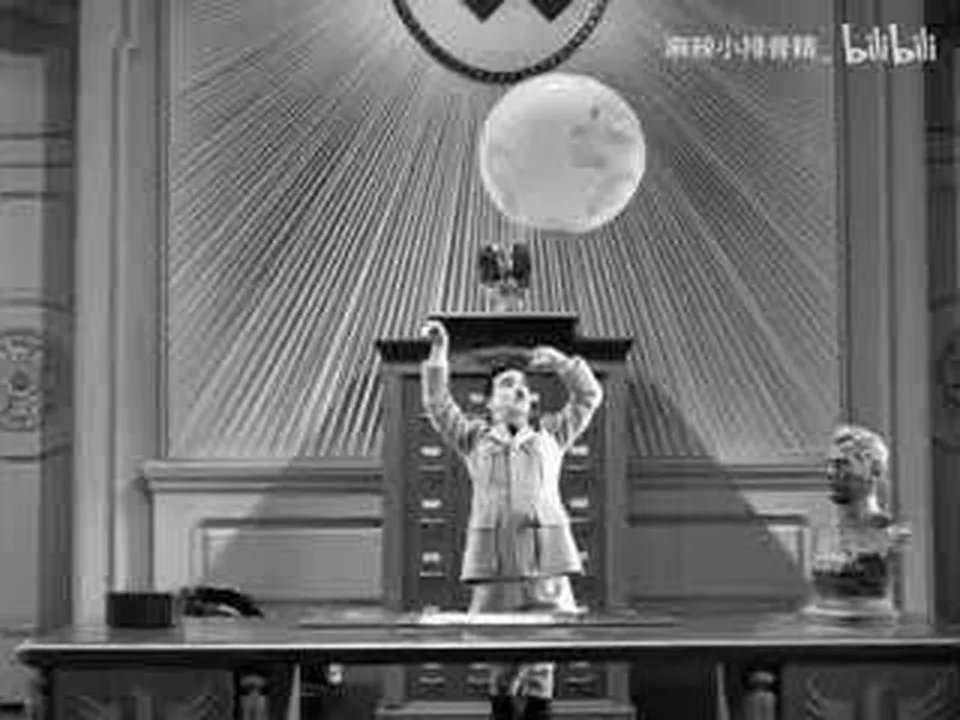
The globe joins a local, weightless bodily game to the political situation of world rule through a third term. It poses an attraction figure without letting one still complete the classification.
Open full-size still- Displayed still
- 00:55:40
- Discussion passage
- approx. 00:54:08—00:56:16 (Hynkel's office dance while he holds the inflatable globe containing the 00:55:40 still)
Reviewed passage by passage on the single-part BV1XikCYxEUQ carrier. The API runtime is 7,535,155 ms, the container is 02:05:35.155, and Bilibili's integer metadata displays 02:05:36. 00:55:40 is the still anchor and 00:54:08—00:56:16 the atlas's working passage, not a claim to final cut-by-cut boundaries.
Still anchor 00:55:40; watch 00:54:08–00:56:16 continuously, record how the globe changes the scale of action, and include the burst in the countertest. The timecode applies only to the 02:05:35.155 BV1XikCYxEUQ container (02:05:36 in Bilibili's integer metadata). The specific restoration or master was not independently established; other editions require fresh location.
Still checked: 2026-09-01 · Carrier access checked: 2026-09-01
Image
Alone in his office, Hynkel takes down the inflatable globe and redirects its rises and falls with hands, head, hips, and feet.
He presses the globe near face and chest before tossing it again; the sphere eventually bursts and the dance stops.
The 00:55:40 anchor shows only the lifting pose. The political relation of world rule requires the office insignia, the complete dance, and the globe's rupture to be read together.
Sound
Continuous orchestral music organizes the movement, while no intelligible speech explains the globe during the dance proper. This audit did not identify the recording edition or transcribe the track beat by beat.
Relation to the concept
Chapter 11, pp. 182–183 gives the general criterion of attraction and plastic representation. Deleuze does not classify the globe ballet scene by scene, so the atlas retains candidate status and a withdrawal test.
Sources and further reading
- Cinema 1: The Movement-Image
Minnesota 1986 translation, chapter 11, pp. 182–183 · The primary text provides the general mechanism of attraction but does not classify The Great Dictator's globe ballet scene by scene. The time window, decomposition of facts, and candidate classification are the atlas's responsibility.
- Deleuze’s Cinema Books: Three Introductions to the Taxonomy of Images
David Deamer, Deleuze’s Cinema Books (2016), pp. 104–119 · Deamer reconstructs the reflection-image as three transformations through which the two action forms criticize one another: attraction, inversion, and discourse, treated respectively on pp. 105–109, 110–114, and 115–119. This taxonomic reconstruction does not classify The Great Dictator's globe ballet or mistaken-identity passage for the atlas.
- Bilibili · BV1XikCYxEUQ · reviewed 02:05:35.155 single-part carrier with Chinese subtitles; the first still comes from the decoded stream, the second and third from native previews, with a non-film banner cropped from the third before proportional letterboxing
00:55:40 · The globe joins a local, weightless bodily game to the political situation of world rule through a third term. It poses an attraction figure without letting one still complete the classification.
- Open the single-part Chinese-subtitled Great Dictator carrier on Bilibili
Still anchor 00:55:40; watch 00:54:08–00:56:16 continuously, record how the globe changes the scale of action, and include the burst in the countertest. The timecode applies only to the 02:05:35.155 BV1XikCYxEUQ container (02:05:36 in Bilibili's integer metadata). The specific restoration or master was not independently established; other editions require fresh location.
The Great Dictator
The Great Dictator (1940)
Candidate reading
One face exchanges social positions: the fugitive is arrested and the barber welcomed
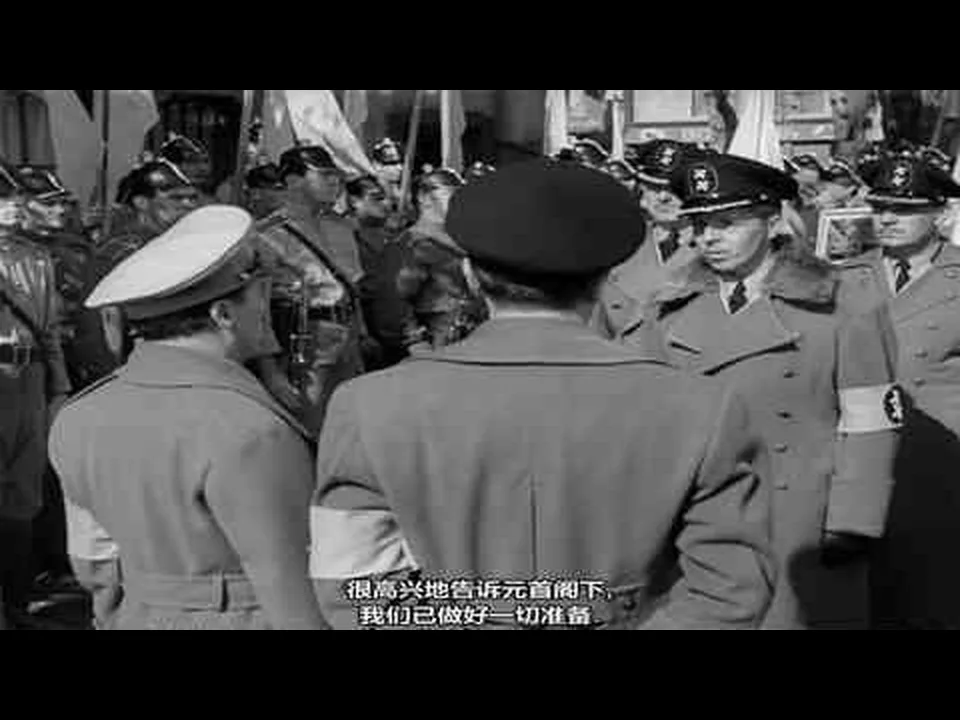
This welcoming image must be read with the preceding arrest of a drenched Hynkel as the fugitive. Inversion arises from crossing two chains of misrecognition, not from one uniform still.
Open full-size still- Displayed still
- 01:53:12
- Discussion passage
- approx. 01:50:07—01:54:27 (the mistaken-identity chain in which officers welcome the barber as Hynkel containing the 01:53:12 still)
Reviewed passage by passage on the single-part BV1XikCYxEUQ carrier. The API runtime is 7,535,155 ms, the container is 02:05:35.155, and Bilibili's integer metadata displays 02:05:36. 01:53:12 is the still anchor and 01:50:07—01:54:27 the atlas's working passage, not a claim to final cut-by-cut boundaries.
Still anchor 01:53:12; watch 01:50:07–01:54:27 and separately record which visible cues cause one body to be arrested and the other welcomed. The timecode applies only to the 02:05:35.155 BV1XikCYxEUQ container (02:05:36 in Bilibili's integer metadata). The specific restoration or master was not independently established; other editions require fresh location.
Still checked: 2026-09-01 · Carrier access checked: 2026-09-01
Image
A drenched Hynkel, stripped of the visible apparatus of power, is arrested by soldiers as the fugitive or barber, while the film advances the escaping barber in uniform.
The barber reaches the military assembly, is ceremonially welcomed as Hynkel, and enters the parade convoy.
The 01:53:12 anchor shows only the welcoming chain. The complete reversal requires cross-checking it with the other chain in which Hynkel is arrested.
Sound
Commands, recognitions, ceremonial address, military music, and crowd sound distinguish the two social positions. The Chinese-subtitled carrier was checked passage by passage without a line-by-line soundtrack transcript.
Relation to the concept
One face and two misrecognition chains pose an inversion candidate. Neither the general criterion nor the direct naming of the film completes this shot-level classification for the atlas.
Sources and further reading
- Cinema 1: The Movement-Image
Minnesota 1986 translation, chapter 10, pp. 171–172; chapter 11, pp. 183–187 · Pages 171–172 directly name the film's one-face/two-situations mechanism; pp. 183–187 define inversion. Neither explicitly classifies the 01:50:07–01:54:27 arrest and welcome as an inversion.
- Deleuze’s Cinema Books: Three Introductions to the Taxonomy of Images
David Deamer, Deleuze’s Cinema Books (2016), pp. 104–119 · Deamer reconstructs the reflection-image as three transformations through which the two action forms criticize one another: attraction, inversion, and discourse, treated respectively on pp. 105–109, 110–114, and 115–119. This taxonomic reconstruction does not classify The Great Dictator's globe ballet or mistaken-identity passage for the atlas.
- Bilibili · BV1XikCYxEUQ · reviewed 02:05:35.155 single-part carrier with Chinese subtitles; the first still comes from the decoded stream, the second and third from native previews, with a non-film banner cropped from the third before proportional letterboxing
01:53:12 · This welcoming image must be read with the preceding arrest of a drenched Hynkel as the fugitive. Inversion arises from crossing two chains of misrecognition, not from one uniform still.
- Open the single-part Chinese-subtitled Great Dictator carrier on Bilibili
Still anchor 01:53:12; watch 01:50:07–01:54:27 and separately record which visible cues cause one body to be arrested and the other welcomed. The timecode applies only to the 02:05:35.155 BV1XikCYxEUQ container (02:05:36 in Bilibili's integer metadata). The specific restoration or master was not independently established; other editions require fresh location.
Films and scenes
The Great Dictator distributes one face and moustache between the barber and Hynkel, opening an immense social distance through minute formal difference. The atlas treats the 00:54:08–00:56:16 globe ballet as a candidate attraction and the 01:50:07–01:54:27 misrecognition as a candidate inversion; Deleuze does not name either passage shot by shot. What the primary text directly supports is the final address at 01:59:09–02:03:08: misrecognition places the barber at the dictator's podium, where discourse makes the social problem implicit in the doubled role into an image-object.
IMDb identification poster ↗Related film readings · 1 films
The Great Dictator · 1940 · Meets the test — The Great Dictator distributes one face and moustache between the barber and Hynkel, opening an immense social distance through minute formal difference. The atlas treats the 00:54:08–00:56:16 globe ballet as a candidate attraction and the 01:50:07–01:54:27 misrecognition as a candidate inversion; Deleuze does not name either passage shot by shot. What the primary text directly supports is the final address at 01:59:09–02:03:08: misrecognition places the barber at the dictator's podium, where discourse makes the social problem implicit in the doubled role into an image-object.
Criteria
Identify the third term introduced between situation and action, then demonstrate shot by shot whether it transforms the prior S–A or A–S direction through substitution and prefiguration, inversion of large and small powers, or discourse that makes an implicit problematic relation into the image's object.
Distinctions and counterexamples
Mirror reflection, hesitation, or genre parody can leave S–A and A–S entirely unchanged. Without a third term placing action and situation into an indirect relation, no reflection-image has formed.
Common confusion: A mirror, reflection, symmetrical composition, a character's self-reflection, or a line of commentary is insufficient. The reflection-image remains bound to the action-image and must show a third term transforming the direct correspondence between situation and action.
Texts and sources
Cinema 1, ch. 10, pp. 171–173 (discursive figure), ch. 11, pp. 182–187 (attraction and inversion) (Minnesota 1986); Cinema 2, ch. 2, pp. 32–33 (retrospective sign classification) (Minnesota 1989)
- 01Cinema 1: The Movement-Image
Standard Minnesota English translation and a principal citation edition in Anglophone scholarship.
View source and edition → - 02Cinema 2: The Time-Image
Authoritative source for the standard translation, translators, ISBN, and publication date.
View source and edition →
Research disagreements
Replacement or coexistence?
The time-image reverses the subordination of time to movement; both regimes persist and can shift locally within one film.
Taxonomy or generator?
Fixed labels invite mere example-hunting; an open taxonomy requires new concepts to transform existing relations and explain across cases.
How do we use Deleuze precisely?
Test four layers: sensory-motor relation, actual/virtual circuit, audio-visual connection, and regime of truth.
Concepts to distinguish
Compare them
- Movement-imageimage-mouvement
The movement-image is a regime in which movement differentiates into perception, affection, impulse, action, reflection, and mental relation to organize the image directly, while time appears indirectly through movement and montage. The relation-image is a decisive realization within the mental-image's problem-field, not an additional source-level rank parallel to it, and films need not pass through one fixed action-chain.
→ - Impulse-imageimage-pulsion
The impulse-image stands between affection and action. Deleuze divides its naturalist structure into four terms arranged in two pairs: originary world/derived milieu and elementary impulse/real behaviour. A historically, geographically, and socially determinate derived milieu remains present while elementary impulse penetrates real behaviour from within; impulse seizes object-fragments from that milieu and thereby exposes an uncoordinated originary world. Symptom and fetish are not additional structural terms but two classes of signs: a symptom is the appearance of impulse in the derived milieu, while a fetish is the appearance of the seized object-fragment itself. Stroheim realizes this structure through decay, descent, and entropy; Buñuel through repetition, cycles, and restart. These are distinct realizations, not cumulative thresholds that every example must satisfy.
→ - Action-image: large formgrande forme de l'image-action
The large form of the action-image follows S–A–S′. A milieu, collective, historical pressure, or danger first composes an encompassing situation S; that pressure leaves an internal imprint upon the character and concentrates itself in action A as effort, duel, or collective coordination; action then carries the milieu into a situation S′ different from the initial one. Its decisive question is how a situation demands action and whether action actually reorganizes that situation.
→ - Action-image: small formpetite forme de l'image-action
The small form of the action-image follows A–S–A′. It begins from an action A already underway whose meaning remains equivocal; indices of lack or ambiguity progressively disclose the situation S in which that act is embedded, forcing a revised action A′. The situation is not given in advance as a known whole but inferred through local gestures, misrecognitions, clues, gags, and the consequences of action.
→ - Mental-imageimage mentale
In Cinema 1's strict usage, the mental-image first names a problem-field: images take relations, symbolic acts, and intellectual feelings as their objects rather than representing states inside a character's head. Relations are external to their terms and irreducible to the attributes of any one term; symbolic acts and intellectual feelings must likewise become operations of image, sound, and editing rather than plot content. The atlas gives mental-image and relation-image separate pages only as reading interfaces for this problem-field and its Hitchcockian realization through Thirdness. The source does not rank them as parallel levels or make the former a superclass of recollection- and dream-images.
→ - Relation-imageimage-relation
The relation-image is the decisive Hitchcockian realization within the mental-image's problem-field: it makes relation itself the image's object and specifies its signs through Peircean Thirdness. A mark sustains a natural or habitual series, a demark redirects that series through an anomalous term, and a symbol makes a concrete term bear an abstract relation; Hitchcock further composes director, film, and the spectator who must enter the inference as a triadic apparatus. The separate atlas page is an explanatory interface, not evidence that the source ranks mental-image and relation-image as parallel levels.
→ - Crisis of the action-imagecrise de l'image-action
The crisis of the action-image is not the disappearance of movement but the loss of a credible bond among situation, perception, and action capable of changing the world. Cinema 1 lists a constellation of five surface symptoms: dispersive situations that replace a totality with gaps; deliberately weak links among events; wandering that displaces goal-directed travel; consciousness of clichés, as figures and spectators begin to recognize how ready-made schemata obscure real relations; and the exposure or denunciation of conspiracy—the network of control behind the plot. These are external negative conditions for a new image-regime, not a checklist that every film and every sequence must complete.
→