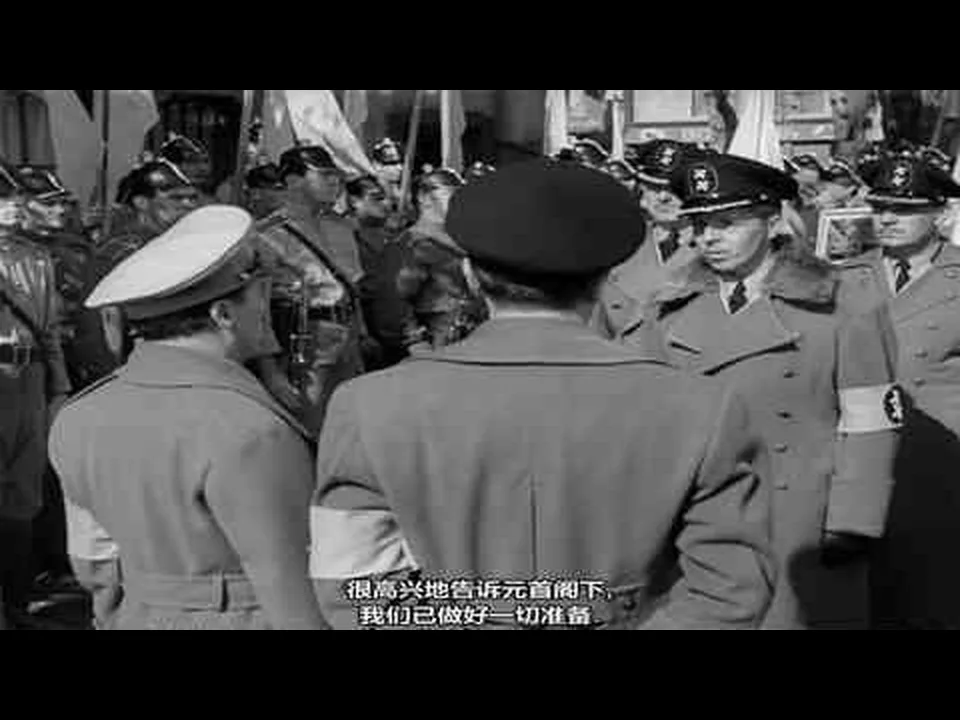
 01:53:12
Reflection and transformation of forms · SHOT EVIDENCE
One face exchanges social positions: the fugitive is arrested and the barber welcomed
When does the identity gag become an inversion of how uniform, ceremony, and crowd sustain the action positions of victim and ruler?
Film and viewing version
The Great Dictator · The Great Dictator · Charles Chaplin / 查理·卓别林 · 1940
Reviewed passage by passage on the single-part BV1XikCYxEUQ carrier. The API runtime is 7,535,155 ms, the container is 02:05:35.155, and Bilibili's integer metadata displays 02:05:36. 01:53:12 is the still anchor and 01:50:07—01:54:27 the atlas's working passage, not a claim to final cut-by-cut boundaries.
Version boundary: The timecodes on this page apply only to the named viewing carrier. Restorations, differing leaders, or platform transcodes may shift them.
Passage and still timecodes
approx. 01:50:07—01:54:27 (the mistaken-identity chain in which officers welcome the barber as Hynkel containing the 01:53:12 still)
The window locates the passage; its boundaries remain approximate
The passage window and still anchor are separate coordinates: the Bilibili still at 01:53:12 was checked on 2026-09-01; it does not turn an approximate passage on another carrier into exact bounds.
Visible facts
- 01
A drenched Hynkel, stripped of the visible apparatus of power, is arrested by soldiers as the fugitive or barber, while the film advances the escaping barber in uniform.
- 02
The barber reaches the military assembly, is ceremonially welcomed as Hynkel, and enters the parade convoy.
- 03
The 01:53:12 anchor shows only the welcoming chain. The complete reversal requires cross-checking it with the other chain in which Hynkel is arrested.
Audible facts
- 01
Commands, recognitions, ceremonial address, military music, and crowd sound distinguish the two social positions. The Chinese-subtitled carrier was checked passage by passage without a line-by-line soundtrack transcript.
Action relation
Arrest and welcome are effective acts, but face, uniform, and positional cues direct them toward the wrong bodies. The functional position of action exchanges between two situations.
Temporal relation
The two chains of misrecognition advance in parallel, while the spectator knows the exchange before the officers do. Inversion is formed through comparison and a knowledge gap, not one revelation at the end.
Conceptual reading
Chapter 10, pp. 171–172 directly discusses how one face joins two incommensurable situations, while chapter 11, pp. 183–187 supplies the general criterion of inversion. The primary text does not explicitly name the pursuit–welcome passage as inversion. If the exchange serves only plot misrecognition without transforming the functional relation of action and situation, withdraw the candidate.
Concepts used in the judgement
- Reflection-imageimage-réflexion · CANDIDATE
One face and two misrecognition chains pose an inversion candidate. Neither the general criterion nor the direct naming of the film completes this shot-level classification for the atlas.
→ - Action-image: small formpetite forme de l'image-action · SCENE SUPPORT
Minute visible indices—uniform, gait, and how a body is treated—let local acts disclose radically different social situations; chapter 10, pp. 171–172 directly coordinates the film.
→
Primary and scholarly coordinates
- 01Cinema 1: The Movement-Image
Minnesota 1986 translation, chapter 10, pp. 171–172; chapter 11, pp. 183–187
Pages 171–172 directly name the film's one-face/two-situations mechanism; pp. 183–187 define inversion. Neither explicitly classifies the 01:50:07–01:54:27 arrest and welcome as an inversion.
- 02Deleuze’s Cinema Books: Three Introductions to the Taxonomy of Images
David Deamer, Deleuze’s Cinema Books (2016), pp. 104–119
Deamer reconstructs the reflection-image as three transformations through which the two action forms criticize one another: attraction, inversion, and discourse, treated respectively on pp. 105–109, 110–114, and 115–119. This taxonomic reconstruction does not classify The Great Dictator's globe ballet or mistaken-identity passage for the atlas.
Terminological coordinates
- reflection-imageimage-réflexion
Inversion requires an exchange in the functional positions of action and situation, not merely plot misidentification.
→ - small form of the action-image / A–S–A′petite forme de l’image-action / A–S–A′
Reconstructs social situation from indices such as face, uniform, and ceremony.
→
Chapter relations
Viewing and still sources
Direct scene · Still anchor 01:53:12; watch 01:50:07–01:54:27 and separately record which visible cues cause one body to be arrested and the other welcomed. The timecode applies only to the 02:05:35.155 BV1XikCYxEUQ container (02:05:36 in Bilibili's integer metadata). The specific restoration or master was not independently established; other editions require fresh location.