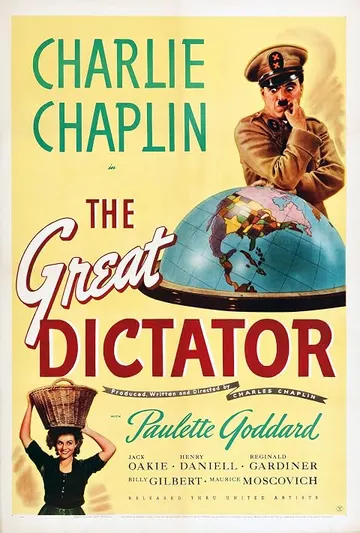
Charles Chaplin / 查理·卓别林 · 1940
The Great Dictator
The Great Dictator
The same face and moustache need only a change of uniform, posture, and vocal regime to occupy the incommensurable situations of victim and executioner. At 00:54:08–00:56:16, the globe ballet contracts world conquest into balloon, dance, and rupture; the atlas treats it as a candidate attraction under chapter 11, pp. 182–183. At 01:50:07–01:54:27, misrecognition exchanges prisoner and ruler, making it a candidate inversion under pp. 183–187. Both are shot-level atlas inferences. The final address at 01:59:09–02:03:08 has direct support in chapter 10, pp. 171–173: an ordinary voice replaces Hynkel's pseudo-German terror and makes the political problem implicit in the doubled role into Deleuze's discursive figure. This establishes discourse as image-object, not the completed transformation of democratic institutions within the film.
Film details
- Original title
- The Great Dictator
- Director
- Charles Chaplin / 查理·卓别林
- Year
- 1940
- Region
- United States
Film analysis: how shots organize concepts
Close-reading questions
- 01At 01:50:07–01:54:27, barber and Hynkel share face, moustache, and actor's body. How do uniform, camera position, gait, and voice use minimal difference to produce the maximal distance between victim and dictator? Under chapter 11, pp. 183–187 this remains a candidate inversion because the primary text does not name the passage shot by shot.
- 02At 01:59:09–02:03:08, how does the barber's final address reclaim speech from Hynkel's plosives, roars, and violence against the microphone, changing the relation between voice and crowd? Chapter 10, pp. 171–173 directly supports the discursive figure, but shot evidence must still identify which cuts and looks carry the turn.
- 03At 00:54:08–00:56:16, the globe ballet reduces world conquest to a weightless game. How does the balloon's rupture make the plastic substitute expose the fragility of political ambition? Chapter 11, pp. 182–183 supplies only the criterion for attraction, so this passage must remain a withdrawable candidate.
Shots, relations, and concepts
- 1Record
A drenched Hynkel, stripped of the visible apparatus of power, is arrested by soldiers as the fugitive or barber, while the film advances the escaping barber in uniform. Commands, recognitions, ceremonial address, military music, and crowd sound distinguish the two social positions. The Chinese-subtitled carrier was checked passage by passage without a line-by-line soundtrack transcript.
Open the scene currently used to ground this chain: One face exchanges social positions: the fugitive is arrested and the barber welcomed - 2Judge the relation
Arrest and welcome are effective acts, but face, uniform, and positional cues direct them toward the wrong bodies. The functional position of action exchanges between two situations. The two chains of misrecognition advance in parallel, while the spectator knows the exchange before the officers do. Inversion is formed through comparison and a knowledge gap, not one revelation at the end.
- 3Name the concept last
Action-image: small form. Only concepts whose scene relation resolves to “supports” under the current record are named here; candidates, adjacent terms, and countertests are not merged into the conclusion.
- 4Countertest
Chapter 10, pp. 171–172 directly discusses how one face joins two incommensurable situations, while chapter 11, pp. 183–187 supplies the general criterion of inversion. The primary text does not explicitly name the pursuit–welcome passage as inversion. If the exchange serves only plot misrecognition without transforming the functional relation of action and situation, withdraw the candidate.
Shots and scenes
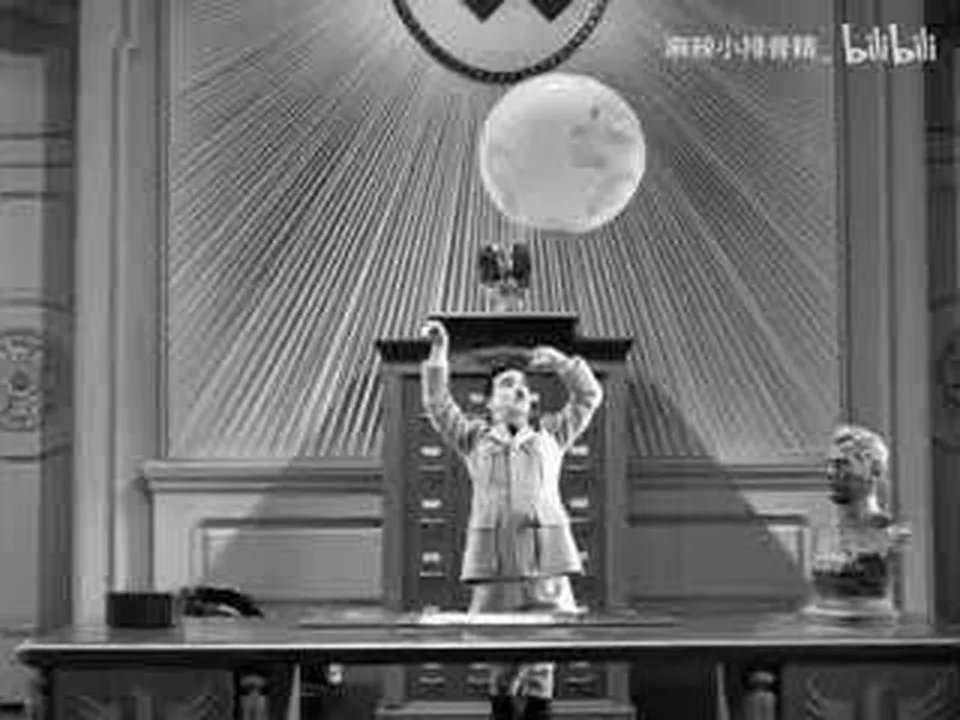
The attraction reading holds only if the third term lets a small act point toward an ellipsed political situation and changes the direct action–situation relation. If the globe remains a generic symbol of ambition or a visual gag, withdraw the reflection-image classification.
Open viewing position ↗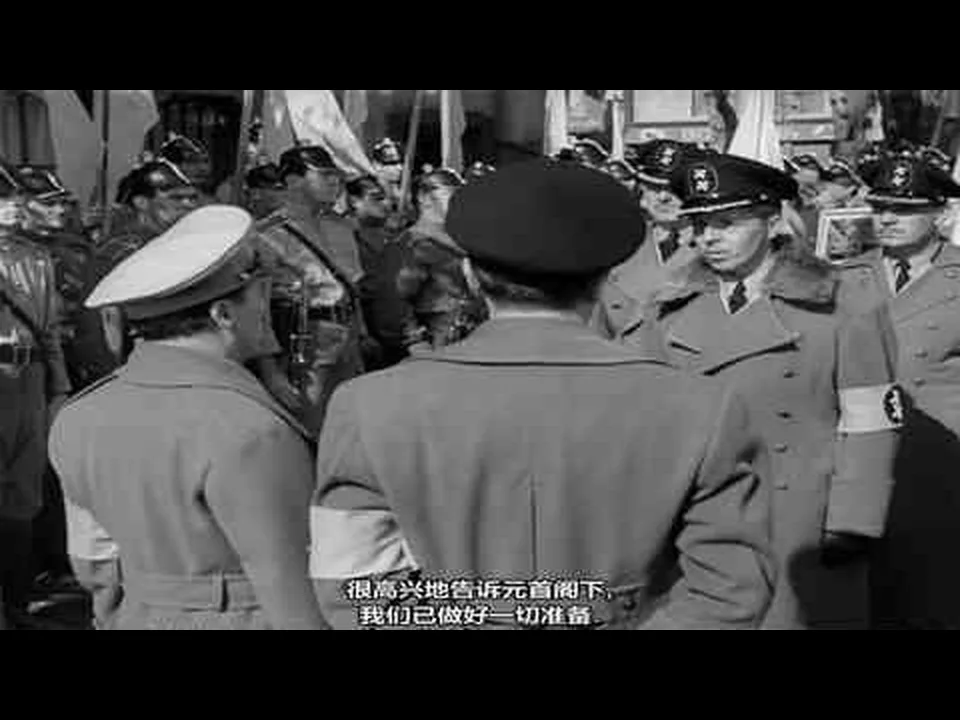
Chapter 10, pp. 171–172 directly discusses how one face joins two incommensurable situations, while chapter 11, pp. 183–187 supplies the general criterion of inversion. The primary text does not explicitly name the pursuit–welcome passage as inversion. If the exchange serves only plot misrecognition without transforming the functional relation of action and situation, withdraw the candidate.
Open viewing position ↗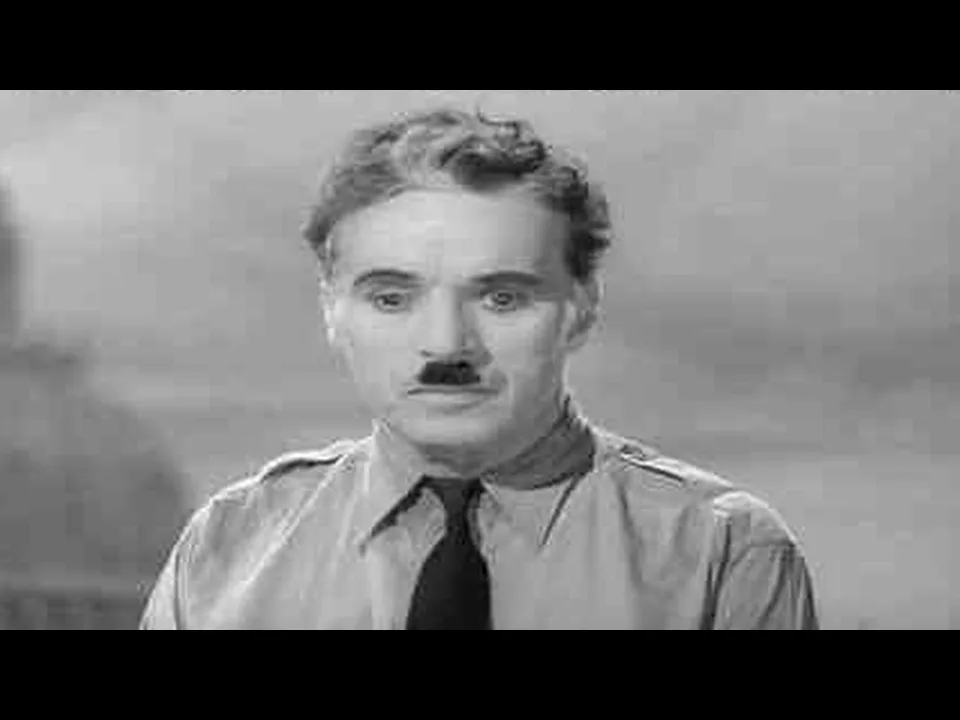
Cinema 1, chapter 10, pp. 172–173 directly opposes the final intelligible language to the tyrant's gibberish and terror and names a figure of discourse; Cinema 2, chapter 2, p. 33 retrospectively makes the discursive figure the reflection-image's genetic sign. This supports the figure of discourse without proving that the address completes democratic institutional transformation; any claim of accomplished political victory must be withdrawn.
Open viewing position ↗Primary texts, scholarship, and locators
Theory coordinate: Direct primary coordinate: Cinema 1, Minnesota 1986, ch. 10, pp. 171–173 (final discourse). Atlas comparison criteria: ch. 11, pp. 182–187 (attraction / inversion); Cinema 2, ch. 2, p. 33.
- 01Cinema 1: The Movement-Image
Standard Minnesota English translation and a principal citation edition in Anglophone scholarship.
Open the atlas source record → - 02Cinema 2: The Time-Image
Authoritative source for the standard translation, translators, ISBN, and publication date.
Open the atlas source record →
Scholarship cited by the scene records: Each study is listed once, with its locators and supported scenes retained together.
- 01Deleuze’s Cinema Books: Three Introductions to the Taxonomy of Images
Locator(s): David Deamer, Deleuze’s Cinema Books (2016), pp. 104–119
Cited by scene(s): The inflatable globe intervenes: how weightless dance refers indirectly to world rule · One face exchanges social positions: the fugitive is arrested and the barber welcomed · The final address: discourse becomes a problem rather than declaring action victorious
Deamer reconstructs the reflection-image as three transformations through which the two action forms criticize one another: attraction, inversion, and discourse, treated respectively on pp. 105–109, 110–114, and 115–119. This taxonomic reconstruction does not classify The Great Dictator's globe ballet or mistaken-identity passage for the atlas.
Open the atlas source record →
Viewing gateways and editions
- Verified complete Bilibili carrier: 大独裁者 The Great Dictator (1940).中字bilibili.comOpen film page ↗
- Page access
- Accessible when checked
- Version extent
- Recorded as a complete version
- Source type
- User-uploaded page
Edition note: Chinese-subtitled single-part film · 2:05:36.
Link checked: 2026-08-25