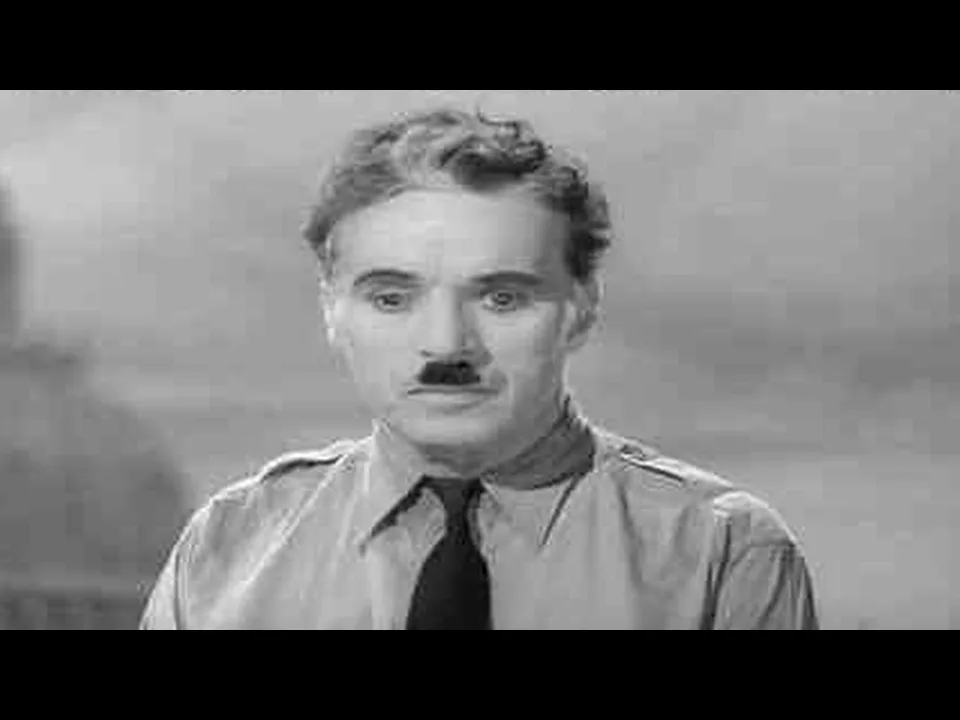
 01:59:21
Reflection and transformation of forms · SHOT EVIDENCE
The final address: discourse becomes a problem rather than declaring action victorious
How does discourse separate from the power machine's commands and noise while preserving the unresolved question of whether speech can actually alter the situation?
Film and viewing version
The Great Dictator · The Great Dictator · Charles Chaplin / 查理·卓别林 · 1940
Reviewed passage by passage on the single-part BV1XikCYxEUQ carrier. The API runtime is 7,535,155 ms, the container is 02:05:35.155, and Bilibili's integer metadata displays 02:05:36. 01:59:21 is the still anchor and 01:59:09—02:03:08 the atlas's working passage, not a claim to final cut-by-cut boundaries.
Version boundary: The timecodes on this page apply only to the named viewing carrier. Restorations, differing leaders, or platform transcodes may shift them.
Passage and still timecodes
approx. 01:59:09—02:03:08 (the sustained frontal close-up of the barber's final address in Hynkel's uniform containing the 01:59:21 still)
The window locates the passage; its boundaries remain approximate
The passage window and still anchor are separate coordinates: the Bilibili still at 01:59:21 was checked on 2026-09-01; it does not turn an approximate passage on another carrier into exact bounds.
Visible facts
- 01
The barber stands before several microphones under Hynkel's identity; the camera moves from podium and military setting to a sustained frontal close-up.
- 02
The close-up progressively reduces the ceremonial background so that face, gaze, and duration of address become the main image-event; after the speech the film cuts to Hannah.
- 03
The 01:59:21 anchor comes from Bilibili's native preview. The atlas cropped a non-film banner at the top without removing face, uniform, or filmic background information.
Audible facts
- 01
The barber shifts to sustained intelligible English address, audibly contrasting with Hynkel's earlier pseudo-German, noise, and threatening delivery. The atlas does not reproduce the speech at length.
Action relation
Misrecognition places the barber in power, but the address is not a victorious act that has already changed institutions. It changes the question from how to perform Hynkel to what common world can be spoken from that position.
Temporal relation
The sustained close-up lengthens address beyond a brief plot command. It directs present listeners, distant Hannah, and an unrealized political future within one act of speech.
Conceptual reading
Cinema 1, chapter 10, pp. 172–173 directly opposes the final intelligible language to the tyrant's gibberish and terror and names a figure of discourse; Cinema 2, chapter 2, p. 33 retrospectively makes the discursive figure the reflection-image's genetic sign. This supports the figure of discourse without proving that the address completes democratic institutional transformation; any claim of accomplished political victory must be withdrawn.
Concepts used in the judgement
- Reflection-imageimage-réflexion · SCENE SUPPORT
Chapter 10, pp. 172–173 directly uses the final address for the figure of discourse; Cinema 2, p. 33 retrospectively specifies discourse as the reflection-image's genetic sign.
→ - Action-image: small formpetite forme de l'image-action · SCENE SUPPORT
Minute differences of face, uniform, and address are lengthened into a direct problem of social situation; discourse pushes the small form to its limit.
→ - Mental-imageimage mentale · ADJACENT
Discourse brings the problematic relation into thought while remaining a reflection within the action-image here; it must not be prematurely equated with chapter 12's relation-image.
→
Primary and scholarly coordinates
- 01Cinema 1: The Movement-Image
Minnesota 1986 translation, chapter 10, pp. 171–173
Pages 172–173 directly use The Great Dictator's final address and intelligible language for the figure of discourse; the atlas is responsible for the 01:59:09–02:03:08 boundary, still, and itemized facts.
- 02Cinema 2: The Time-Image
Minnesota 1989 translation, chapter 2, p. 33
Page 33 retrospectively specifies discourse as the reflection-image's genetic sign; it is not a shot-by-shot transcription of the final address.
- 03Deleuze’s Cinema Books: Three Introductions to the Taxonomy of Images
David Deamer, Deleuze’s Cinema Books (2016), pp. 104–119
Deamer reconstructs the reflection-image as three transformations through which the two action forms criticize one another: attraction, inversion, and discourse, treated respectively on pp. 105–109, 110–114, and 115–119. This taxonomic reconstruction does not classify The Great Dictator's globe ballet or mistaken-identity passage for the atlas.
Terminological coordinates
- reflection-imageimage-réflexion
Discourse is not dialogue explaining plot but a figure directly reflecting a problematic relation.
→ - small form of the action-image / A–S–A′petite forme de l’image-action / A–S–A′
Tests the limit of the small form through the lengthening of slight difference into a problem.
→ - mental imageimage mentale
Marks how the figure adjoins an object of thought without collapsing into the relation-image.
→
Chapter relations
Viewing and still sources
Direct scene · Still anchor 01:59:21; watch 01:59:09–02:03:08, comparing podium totality, frontal close-up, duration of address, and the cut to Hannah rather than substituting one famous line for image analysis. The timecode applies only to the 02:05:35.155 BV1XikCYxEUQ container (02:05:36 in Bilibili's integer metadata). The specific restoration or master was not independently established; other editions require fresh location.