 00:15:30
Mental and relational image · SHOT EVIDENCE
The absent Carlotta already governs the investigation
Before Madeleine first appears, which relations has the film already led you to accept—and do they arise from seeing, or has Elster's story already framed Scottie's way of looking?
Film and viewing version
Vertigo · Vertigo · Alfred Hitchcock / 阿尔弗雷德·希区柯克 · 1958
Reviewed passage by passage on the 02:07:27 single-part Bilibili repost with hard Chinese and English subtitles. 00:15:30 is the still anchor and 00:12:00—00:15:50 is the atlas's working boundary. Bilibili's official feature page ep291561 runs 02:07:49, and the repost may trim opening or closing material, so their timelines are not interchangeable.
Version boundary: The timecodes on this page apply only to the named viewing carrier. Restorations, differing leaders, or platform transcodes may shift them.
Passage and still timecodes
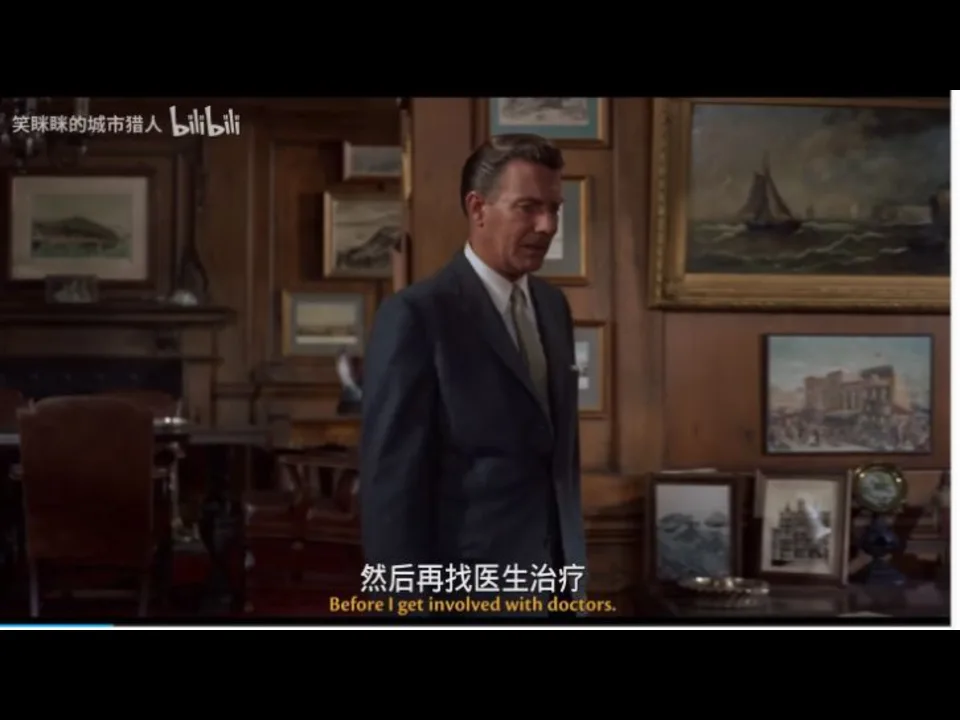
approx. 00:12:00—00:15:50 (00:15:30 still shows Elster standing in an office crowded with maritime images)
The window locates the passage; its boundaries remain approximate
The passage window and still anchor are separate coordinates: the Bilibili still at 00:15:30 was checked on 2026-09-01; it does not turn an approximate passage on another carrier into exact bounds.
Visible facts
- 01
Elster brings Scottie into a wood-panelled office and the men alternate in medium views; images of ships, harbours, and buildings are visible on the walls and desk.
- 02
Only Elster and Scottie appear in this interval; the image inserts no portrait or flashback of Madeleine or Carlotta.
Audible facts
- 01
Elster asks Scottie to follow his wife and explains her anomalous behaviour as the influence of the dead Carlotta. Scottie questions the possession story but ultimately accepts the task of observation.
- 02
In dialogue, Elster identifies himself as husband, places Scottie as observer, designates Madeleine as the woman to be followed, and uses Carlotta's family history to explain her behaviour.
Action relation
Follow her is a clear assignment, yet its object is not one woman alone: Scottie must judge whether Carlotta's past is affecting Madeleine. From the start, the assignment ties Scottie and Madeleine to the absent Carlotta.
Temporal relation
The past associated with the dead Carlotta enters the present not through flashback but through her name, a family history, and the terms of the assignment; it directs Scottie's looking before he sees any evidence.
Conceptual reading
If the conversation is summarized merely as a detective receiving an assignment, it remains plot exposition. The relation-image claim holds only if the absent Carlotta continues as a third term governing how Madeleine, Elster, Scottie, and spectator interpret later images; if that third term ceases to operate, the classification must be downgraded.
Concepts used in the judgement
- Relation-imageimage-relation · SCENE SUPPORT
Elster's commission lets an absent third term govern investigator, object, and spectator positions, with scholarly support from Rushton, pp. 53–54.
→ - Mental-imageimage mentale · SCENE SUPPORT
What the image asks us to think is not Scottie's private doubt but how Madeleine, Carlotta, Elster, and observer determine one another.
→ - Sensory-motor schemaschème sensori-moteur · ADJACENT
Following remains goal-directed action. The passage shows relation governing action, not a completed rupture of the sensory-motor schema.
→
Primary and scholarly coordinates
- 01Cinema 1: The Movement-Image
Minnesota 1986 translation, chapter 12, pp. 197, 204–205
These pages define the mental image's objects, Hitchcock's relational web, and the spectator's position, and directly explain Vertigo through variations in the relations of the Same. They do not analyze the atlas's chosen commission, letter, or green-light passages shot by shot; Rushton and the atlas's scene review bear those specific classifications.
- 02Deleuze’s Cinema Books: Three Introductions to the Taxonomy of Images
David Deamer, Deleuze’s Cinema Books (2016), pp. 132–137
Deamer supplies general criteria for mark, demark, symbol, and relation-image; he does not establish that a particular letter, colour, or camera movement has already acquired any of those statuses.
- 03Cinema After Deleuze
Richard Rushton, Cinema After Deleuze (2012), pp. 53–54
Rushton develops Vertigo's relational structure through Elster's commission, Judy's disruption of the existing series, spectator foreknowledge, and Scottie's remaking of the desired object. The substantive film argument ends on p. 57; p. 58 adds no film evidence.
Terminological coordinates
Chapter relations
Viewing and still sources
Direct scene · Watch 00:12:00–00:15:50 continuously and record every name, kinship position, source of knowledge, and condition under which Scottie accepts the assignment. The timecode applies only to the 02:07:27 repost BV1ECSHYoEwW; this carrier may trim opening or closing material, so the official feature page, Blu-ray, and other restorations require fresh location.