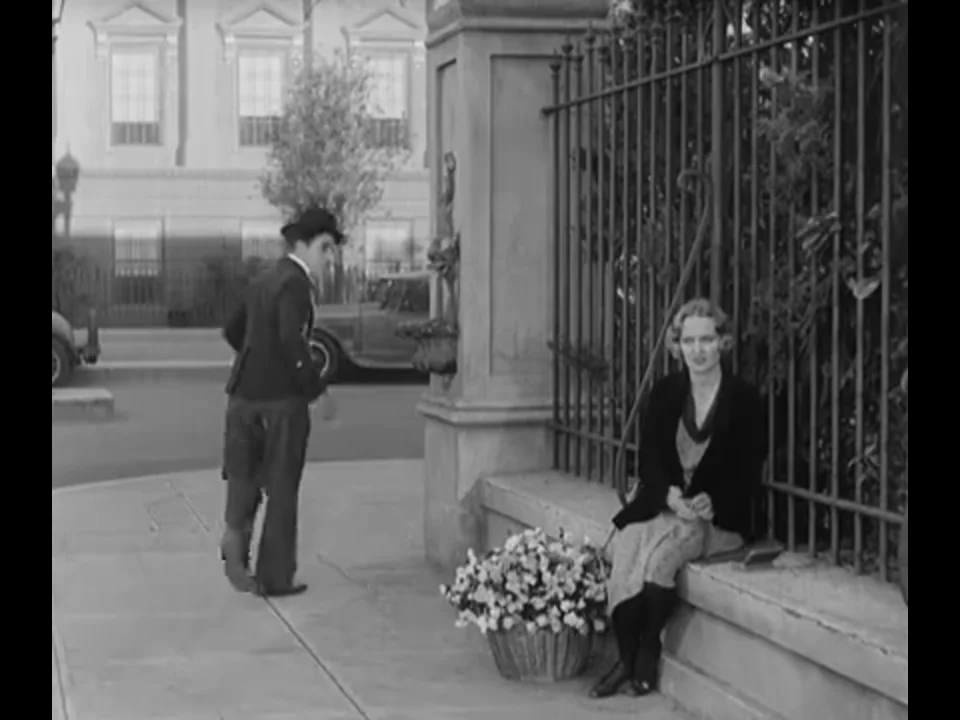
 00:09:25
Forms of action · SHOT EVIDENCE
Why does she take the flower buyer for a wealthy motorist?
Does small form occur here because the viewer sees exchange, approach, and a departing car while the flower seller can infer a 'wealthy man' only through touch, transaction, and sound? Which door sounds must track-level review establish as part of her perceptual chain?
Film and viewing version
City Lights · City Lights · Charles Chaplin / 查理·卓别林 · 1931
Reviewed passage by passage on the single-part Bilibili carrier with a decoded-stream duration of 01:26:47. 00:09:25 is the still anchor and 约 00:07:20—00:09:38 is the atlas's working boundary. Approximately 25.8 seconds of black at the end are excluded from narrative analysis.
Version boundary: The timecodes on this page apply only to the named viewing carrier. Restorations, differing leaders, or platform transcodes may shift them.
Passage and still timecodes
约 00:07:20—00:09:38 (flower seller's misrecognition of the customer's identity containing the 00:09:25 still)
The window locates the passage; its boundaries remain approximate
The passage window and still anchor are separate coordinates: the Bilibili still at 00:09:25 was checked on 2026-09-01; it does not turn an approximate passage on another carrier into exact bounds.
Visible facts
- 01
The flower seller sits by the street selling flowers; after a flower falls, she searches with hand and cane, and the Tramp retrieves it and notices that she is blind.
- 02
The Tramp then walks away and looks back; a car departs from near them while the flower seller retains the inference that her customer is wealthy.
Audible facts
- 01
The precise way car-door sounds participate in the mistake still requires sound-by-sound review on this master, including attribution of the first and second closures; no unverified sound source is treated as settled causality.
Action relation
The film juxtaposes the dropped and retrieved flower, coin, approaching figure, and departing car for the viewer; the flower seller can draw on touch, exchange, and sound. Because the sources and order of the door sounds remain unverified, the car's departure cannot be written as something she directly perceives.
Temporal relation
The mistake is not pre-explained background; it forms as several acts arrive in succession and persists after the car actually departs. How the visible departure joins the sounds available to her into one causal chain remains to be verified.
Conceptual reading
Car-door sound still requires sound-by-sound review. If review shows door sound and the Tramp's acts being joined as one subject in her perception, the passage supports the equivocal index and A–S–A′. If attribution or order does not support that chain, the specific sonic mechanism should be withdrawn, leaving only the visible identity mistake.
Concepts used in the judgement
- Action-image: small formpetite forme de l'image-action · CANDIDATE
A local purchase produces an identity situation through an equivocal index, making an A–S–A′ candidate; the door-sound sequence is not yet exhaustively verified, so the relation is not conclusive.
→ - Sensory-motor schemaschème sensori-moteur · CANDIDATE
The scene tests how partial perception leads to a mistaken yet effective response; sound sources and act order must first be clarified.
→
Primary and scholarly coordinates
- 01Cinema 1: The Movement-Image
Minnesota 1986 translation, chapter 10, pp. 160–171, especially pp. 169–171
From p. 160 Deleuze defines A–S–A′ and its indices. Page 169 directly names City Lights as an example of a 'personality split of a pivotal character,' but does not assign the drunk or sober passages or a rule of recognition shot by shot. The atlas tests the paired drunken welcome and sober rejection as its concrete filmic realization. The scene directly named on p. 171 is the thread-unravelling passage around 00:52:32–00:53:54, not the final tactile recognition. Boundaries and theoretical relations for the opening mistake, sober rejection, and final recognition remain the atlas's responsibility.
Terminological coordinates
Chapter relations
Viewing and still sources
Direct scene · Still anchor 00:09:25; watch 00:07:20–00:09:38 and separately record the order of flower, money, footsteps, door, and departing car.