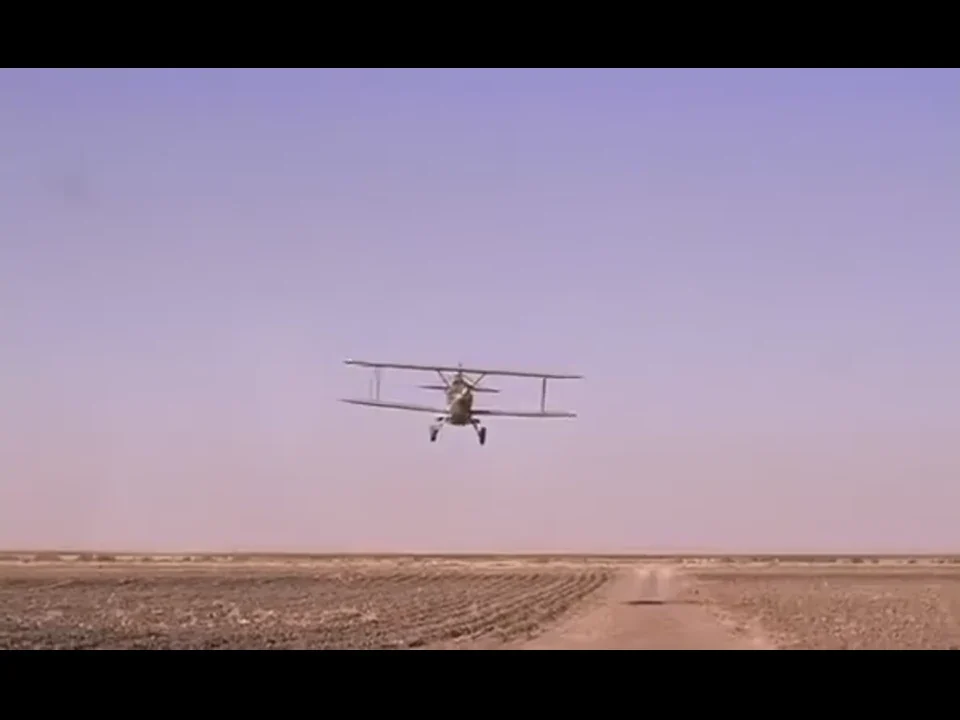
 01:12:00
Mental and relational image · SHOT EVIDENCE
Where there are no crops to spray: how the crop-duster becomes a demark
When does the crop-duster become anomalous: after it attacks, or when its mismatch with the place has already been spoken while no attack has yet occurred?
Film and viewing version
North by Northwest · North by Northwest · Alfred Hitchcock / 阿尔弗雷德·希区柯克 · 1959
Reviewed passage by passage on the 02:16:25 single-part dubbed BV1m2XTYuERk carrier. 01:12:00 is the still anchor and 01:07:45—01:14:40 the atlas's working passage, not a claim to final cut-by-cut boundaries. Credits, transitions, and end titles may introduce seconds of drift across masters.
Version boundary: The timecodes on this page apply only to the named viewing carrier. Restorations, differing leaders, or platform transcodes may shift them.
Passage and still timecodes
approx. 01:07:45—01:14:40 (the attack passage in which the crop-duster flies head-on and closes on the barren roadside horizon containing the 01:12:00 still)
The window locates the passage; its boundaries remain approximate
The passage window and still anchor are separate coordinates: the Bilibili still at 01:12:00 was checked on 2026-09-01; it does not turn an approximate passage on another carrier into exact bounds.
Visible facts
- 01
Thornhill waits alone beside an open highway. Cars and a bus follow the road, another passenger waits and boards in the ordinary way, and the distant plane remains a small term in the environment.
- 02
After the bus takes the other passenger away, the plane changes its relation of distance and repeatedly dives toward Thornhill; he drops, runs, and takes cover in a field.
- 03
The 01:12:00 anchor shows the plane bearing head-on toward barren ground and a dirt road; the pursuit then continues into a causal chain involving a truck, tanker, and explosion.
Audible facts
- 01
The other waiting passenger's dubbed dialogue first notes that the plane is dusting where there are no crops to spray. After the bus leaves, the engine grows louder with the approach.
Action relation
The plane initially belongs to a distant, negligible everyday series. Its presence where there are no crops to spray first breaks the customary relation to its setting; only its subsequent turn toward Thornhill inserts that anomaly into a chain of dodging, running, and collision.
Temporal relation
The extended wait delays classification of the plane: the spectator first sees a distant moving term and later reinterprets it through dialogue and low flight. This delay organizes recognition but still leads into a clear chase and does not automatically constitute a time-image.
Conceptual reading
The strict criterion for the demark is the plane's appearance where there are no crops to spray, not its later emergence as an attacker. If carrier evidence cannot establish this place–use mismatch, or if attack, explosion, and a symbolic evil machine are required to make the anomaly legible, withdraw the claim of direct primary-text support and retain only the atlas's candidate analysis of the action passage. The ensuing attack remains a visible consequence and must not be passed off as the primary text's shot analysis.
Concepts used in the judgement
- Relation-imageimage-relation · SCENE SUPPORT
Cinema 1, p. 203 directly makes this plane a demark: one term departs from its customary series so that natural relation enters the image. Support extends only this far and does not turn the primary text into a shot commentary on the attack.
→ - Mental-imageimage mentale · SCENE SUPPORT
Character and spectator must judge the relation among plane, place, and use. The object is not the plane's shape but why it is here.
→ - Sensory-motor schemaschème sensori-moteur · ADJACENT
Once anomaly becomes attack, the scene rapidly resumes the sensory-motor causality of stimulus, dodge, flight, and collision; this sets the boundary of the demark reading.
→
Primary and scholarly coordinates
- 01Cinema 1: The Movement-Image
Minnesota 1986 translation, chapter 12, p. 203
Page 203 directly identifies as a demark the plane's appearance where there are no crops to spray. It neither specifies the atlas's 01:12:00 carrier anchor nor describes the ensuing attack shot by shot; the atlas is responsible for the window, still, and attack facts.
- 02Cinema After Deleuze
Richard Rushton, Cinema After Deleuze (2012), pp. 48–53
Across these pages Rushton develops five general features of Hitchcock's relation-image through Strangers on a Train and Vertigo. North by Northwest enters only as a listed example of wrong identity, the exchange-of-crime tradition, and the crop-duster demark. The book does not supply the atlas's shot-level analysis of the title grid, the attack, or the final match cut.
Terminological coordinates
- relation-imageimage-relation
Identifies the demark through an anomalous place–use relation rather than defining it backward from the later attack.
→ - mental imageimage mentale
Makes why it is here, rather than what it is, the object of judgement.
→ - sensory-motor schemaschème sensori-moteur
Tracks when relational anomaly re-enters a direct chain of action.
→
Chapter relations
Viewing and still sources
Direct scene · Still anchor 01:12:00; watch 01:07:45–01:14:40, first recording the ordinary road and aircraft series, then separately the no-crops dialogue, low turn, evasions, and explosion so that the later attack does not replace the criterion for the demark. The timecode applies only to the 02:16:25 single-part dubbed BV1m2XTYuERk carrier. The specific master or restoration was not independently established; other editions require fresh location.