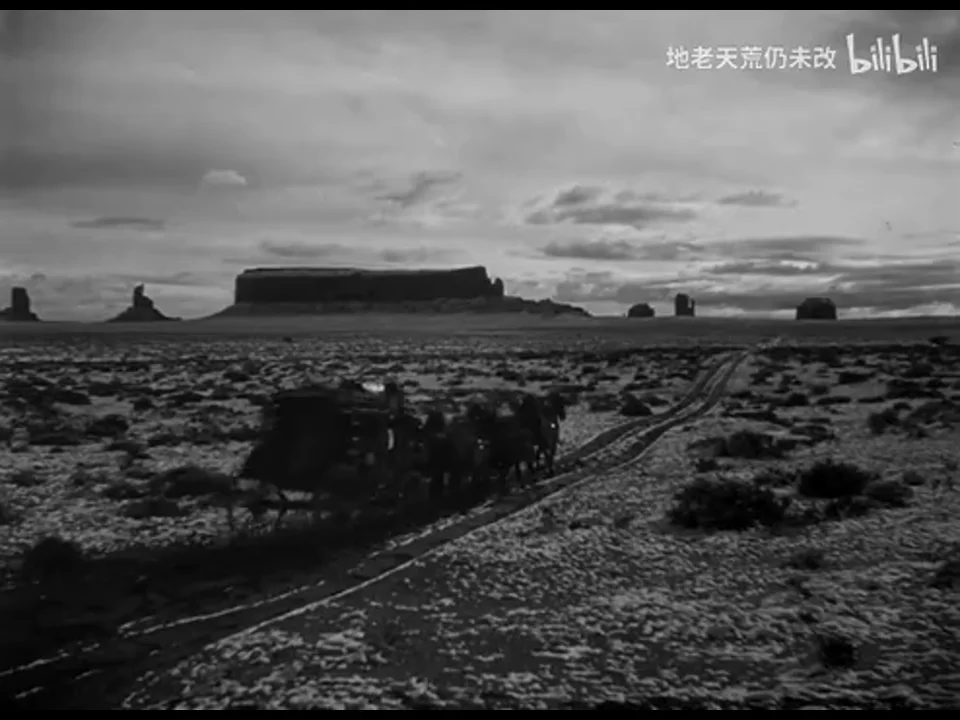
 00:35:10
Forms of action · SHOT EVIDENCE
The coach enters the landscape: condition or compositional effect?
Does Ford's long shot give action a whole, or first manufacture the viewing illusion that a whole already exists?
Film and viewing version
Stagecoach · Stagecoach · John Ford / 约翰·福特 · 1939
Reviewed passage by passage on the single-part Bilibili carrier with a decoded-stream duration of 01:35:33. 00:35:10 is the still anchor and 约 00:34:50—00:36:20 is the atlas's working boundary for analysis; cut points may shift slightly across masters.
Version boundary: The timecodes on this page apply only to the named viewing carrier. Restorations, differing leaders, or platform transcodes may shift them.
Passage and still timecodes
约 00:34:50—00:36:20 (pale open ground and Monument Valley route passage containing the 00:35:10 still)
The window locates the passage; its boundaries remain approximate
The passage window and still anchor are separate coordinates: the Bilibili still at 00:35:10 was checked on 2026-09-01; it does not turn an approximate passage on another carrier into exact bounds.
Visible facts
- 01
The coach moves along the valley route into depth; coach and horses are markedly smaller than mesas, pale open ground, and sky, and faces are not legible at this anchor.
- 02
The passage alternates between the coach interior and the exterior route; each exact cut still requires master-specific frame review.
Audible facts
- 01
The carrier contains dialogue, wheel or hoof sounds, and music, but no track-by-track transcription has been completed; sound carries none of this entry's large-form verdict.
Action relation
The exterior route temporarily binds unlike passengers into one transport mission; conflict inside the coach tests whether that whole truly determines their later local acts.
Temporal relation
The route presses a not-yet-reached destination into the present as a shared future, without dissolving class and moral divisions inside the coach.
Conceptual reading
S–A–S′ holds only if this encompassing situation generates action and is transformed by that action into a new situation. If the landscape is merely a spectacular backdrop to movement, the classification should be withdrawn.
Concepts used in the judgement
Primary and scholarly coordinates
- 01Cinema 1: The Movement-Image
Minnesota 1986 translation, chapter 9, pp. 141–152, especially p. 146
Pages 141–142 formulate S–A–S′. Page 146 directly uses Stagecoach's alternation of interiors and exteriors to describe the Encompasser and presents S–A–S, the restoration of a circular order, as a first approximation. Page 147 then distinguishes Ford's spiral: the situation reached differs from the one left, producing S–A–S′. Page 150 criticizes the reduction of social causes to individual confrontation, while pp. 151–152 discuss how global mission, local acts, and decisive action redistribute forces. Deleuze does not assign the atlas's three passages one by one; shot boundaries, visible facts, and candidate or countertest relations remain the atlas's responsibility.
Terminological coordinates
Chapter relations
Viewing and still sources
Direct scene · Still anchor 00:35:10; watch continuously from 00:34:50 to 00:36:20 and compare interior with exterior rather than isolating one landscape.