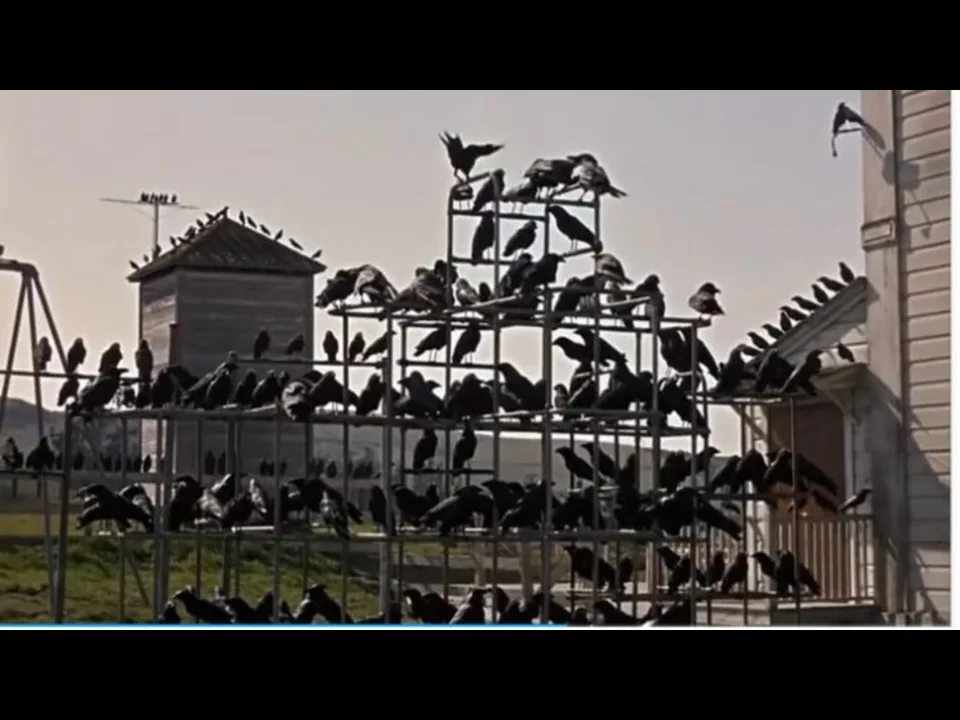
 01:11:22
Mental and relational image · SHOT EVIDENCE
The song continues as the flock takes form: when number begins to bear relations
At which cutback does the flock cease to be merely a countable threat and begin changing relations among school, song, play equipment, and escape—and can you name at least three such changes?
Film and viewing version
The Birds · The Birds · Alfred Hitchcock / 阿尔弗雷德·希区柯克 · 1963
Reviewed passage by passage on the 01:59:24 single-part Bilibili repost. 01:11:22 is the still anchor and 01:09:45—01:12:15 is the atlas's working boundary. Bilibili's official feature page ep291861 runs 01:59:30, so the two carriers cannot share second-level coordinates.
Version boundary: The timecodes on this page apply only to the named viewing carrier. Restorations, differing leaders, or platform transcodes may shift them.
Passage and still timecodes
approx. 01:09:45—01:12:15 (01:11:22 still shows the flock covering the climbing frame and nearby rooflines)
The window locates the passage; its boundaries remain approximate
The passage window and still anchor are separate coordinates: the Bilibili still at 01:11:22 was checked on 2026-09-01; it does not turn an approximate passage on another carrier into exact bounds.
Visible facts
- 01
Melanie smokes alone on a bench outside the school. The film repeatedly cuts from her to the climbing frame behind her; more crows have landed on each return while she does not turn around.
- 02
A passing crow finally guides her look backward. The climbing frame, nearby roofs, and ground are now crowded with birds, after which she enters the classroom to organize the children's departure.
Audible facts
- 01
Children repeat the same song off screen; it continues across successive cuts between Melanie and the climbing frame.
- 02
After the flock is discovered, the song gives way to scattered bird calls, shouts, and warnings to evacuate.
Action relation
Melanie's waiting yields no new information for her, while the spectator watches the flock form behind her. When she finally turns, the school shifts at once from play and study to evacuation.
Temporal relation
The same song and near-identical framing make difference appear cumulatively. Each cutback does not repeat the same present; it preserves the previous birds and adds new ones while the character remains unaware.
Conceptual reading
Numerical increase and greater danger are insufficient to establish a symbol. The playground passage can serve as a shot-level candidate for p. 204's flock-as-a-whole only if the flock changes school/play, song/alarm, perching/encirclement, classroom order/urgent evacuation, and the human–nature relation together. If the account reduces to a numerical threshold, the symbol claim must be downgraded.
Concepts used in the judgement
- Relation-imageimage-relation · CANDIDATE
Page 204 supports the flock as a whole as symbol; treating this particular playground passage as its concrete bearer is a site-level candidate tested against that criterion.
→ - Mental-imageimage mentale · SCENE SUPPORT
Ahead of the character, the spectator compares differences across cutbacks and organizes number, soundscape, architectural use, and escape relation as an object of thought.
→ - Sensory-motor schemaschème sensori-moteur · ADJACENT
Delayed perception produces relational pressure, after which the children still run under instruction. The scene pushes action toward its limit without wholly cancelling the chain of response.
→
Primary and scholarly coordinates
- 01Cinema 1: The Movement-Image
Minnesota 1986 translation, chapter 12, p. 204
Page 204 states that “the thousands of birds … are a symbol.” It names neither the playground nor 01:11:22. The atlas uses that film-level judgement to constrain its playground analysis rather than passing off shot description as the primary text.
- 02Deleuze’s Cinema Books: Three Introductions to the Taxonomy of Images
David Deamer, Deleuze’s Cinema Books (2016), pp. 132–137
Deamer reconstructs the operative difference among mark, demark, and symbol: a habitual series, an anomalous term departing from that series, and a concrete term bearing abstract relations. The pages provide criteria rather than classifying these three passages for the atlas.
Terminological coordinates
Chapter relations
Viewing and still sources
Direct scene · Watch 01:09:45–01:12:15 continuously, recording the birds' positions at every cutback, whether the children's song continues, when Melanie turns, and how the classroom changes from learning space to point of evacuation. The timecode applies only to the 01:59:24 single-part repost BV1jJ411g7Yj; the official feature page, Blu-ray, and other streaming editions require fresh location.